
pep人教版英语六年级下册Unit3复习资料
played cleaned /d/ /d/ /d/, climbed learned /d/ /d/ /d/. watched washed /t/ /t/ /t/, cooked danced /t/ /t/ /t/. visited studied /id/ /id/ /
clean
weekend your you yesterday I my grandparents visited
last did you what do
room
did
泰山
March 15th , 2011 Sunny Last weekend, I visited my grandparents by plane. They lived in Tai`an. Saturday morning I climbed the mountain with my grandpa. There were many beautiful flowers and tall trees. The bird flew in the sky. The fish swam in the river. When I got(到达) to the top(顶) of the mountain, I was tired out. Sunday morning, we got up early to see the sunrise(日出). How beautiful it was! I was so excited. 1> Tick or cross (对的打“√”,错的打“× ”) a. Zhang Peng visited my grandparents by car. ( × ) b. The bird flew in the forest. ( × ) c. Zhang Peng climbed the mountain with his grandpa on Sunday. ( × ) 2> Answer the questions.(回答问题) a. How was Zhang Peng feeling when he got to the top of the mountain. b. How was Zhang Peng feeling when he saw the sunrise?
Last weekend I played football, What did you do? What did you do? Last weekend I went hiking, What did you do? What did you do? Last weekend I watched TV, What did you do? What did you do? Last weekend I cleaned the room, What did you do? What did you do? Last weekend I read a book, What did you do? What did you do? Last weekend I went to a park, What did you do? What did you do?
He was tired.
He was excited.
1> 找出不同类的单词 a. ( A ) A. together B. weekend C. yesterday D. today b. ( C ) A. saw B. swam C. jump D. took c. ( B ) A. sunny B. bike C. windy D. rainy d. ( D ) A. went B. read C. washed D. study 2> 用下列动词的正确形式,填写短文。 ( read go visit play watch ) Mike went to a park by bus last Monday. He read a book with his friends last Tuesday. He played football last Wednesday. He visited his grandparents last Thursday. He watched TV last Friday. He was happy. 3> 写一写妇女节一天的生活。
play computer games have English class do homework do the dishes draw pictures do housework clean the room
do morning exercises
sweep the floor watch TV
read
fly
read flew went swam did
flewwwwwwwwwww. visited,visited,visited,visited, read,read,read,read, read,read,read,read, swim,swam,swim,swam, swim,swam,swim,swam, get,got, get, got, get,got, get, got, take,took,take,took, take,took,take,took, went,went,went,went, went,went,went,went, saaaaaaaaaaaaaaaaaaaaaw.
What did you do last weekend? What did you do last …?
连词成句:
What did you do last weekend? Did you clean your room?
I visited my grandparents yesterday.
go shopping go swimming play chess
go fishing go hiking play football
go to the cinema play sports play ping-pong
play the piano
play the violin
fly kites read a book wash the windows
play played clean watch watched cook dance danced study studied stop stopped
动词加ed方法: 1、直接加ed。
cleaned cooked
2、e接尾的单词,直接加d。
3、辅音接尾,把y改成i加ed。 4、辅音+原音+辅音,末尾双写加ed。
visit grandparents
cook the meals
climb mountains listen to music
Tree-planting Day
Women’s Day
What did you do last Women’s Day?
played football watched TV climbed mountain read a book went hiking went swimming flew kites cleaned the room visited grandparents washed the clothes went to a park went fishing went shopping did homework
Last Women’s Day, I got up at 7 o’clock. I ate breakfast with my parents. I …
人教版(PEP)英语六年级下册 Unit 3 A Let’s talk(教案)
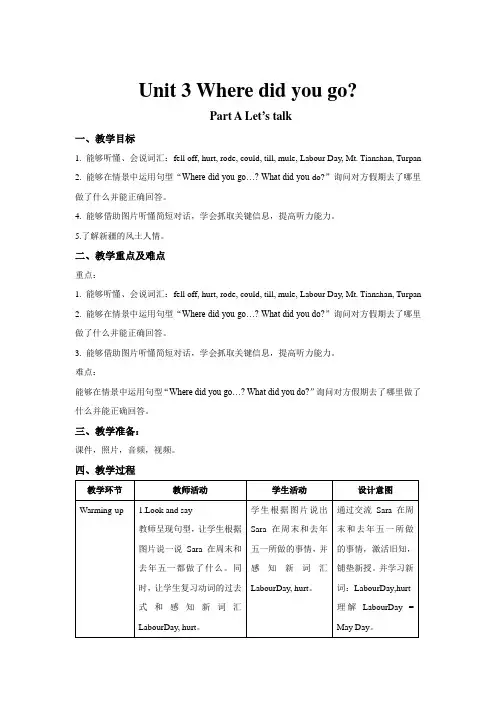
Unit 3 Where did you go?Part A Let’s talk一、教学目标1. 能够听懂、会说词汇:fell off, hurt, rode, could, till, mule, Labour Day, Mt. Tianshan, Turpan2. 能够在情景中运用句型“Where did you go…? What did you do?”询问对方假期去了哪里做了什么并能正确回答。
4. 能够借助图片听懂简短对话,学会抓取关键信息,提高听力能力。
5.了解新疆的风土人情。
二、教学重点及难点重点:1. 能够听懂、会说词汇:fell off, hurt, rode, could, till, mule, Labour Day, Mt. Tianshan, Turpan2. 能够在情景中运用句型“Where did you go…? What did you do?”询问对方假期去了哪里做了什么并能正确回答。
3. 能够借助图片听懂简短对话,学会抓取关键信息,提高听力能力。
难点:能够在情景中运用句型“Where did you go…? What did you do?”询问对方假期去了哪里做了什么并能正确回答。
三、教学准备:课件,照片,音频,视频。
四、教学过程五、板书设计Unit 3 Where did you go?Part A Let’s talkKey words:fell off, hurt, rode, could, till, mule, Labour Day, Mt. Tianshan, TurpanKey sentences:What happened?Where did you go…?What did you do?。
人教版小学英语六年级下册第三单元复习资料
第三单元复习资料一:重点单词和词组。
Shop buy plant plants busy时间类的: next week this morning this afternoon this evening tomorrow tonight on the weekend this weekendat 3 o’clock in 20 years’s time one day on Saturday其他:take a nap read a magazine go to the cinema theme park the Great Wall comic book post card shoe storefruit stand pet shop visit my parents clean my room watch TV buy a book go to the zoo learn kung fuaunt and uncle have a new computer an English book plant trees a science teacher plant shop in the futureon the moon Come on this way二:重点句型。
1.What are you going to do this weekend ? I’m going to +事情(clean my room)……………..2.Where are you ging +时间(next week)? I’m going to+地点(the shoe store)…………….3.When are you going ? This afternoon..(用时间回答)4.What are you going to buy? I’m going to buy a comic book.5.What does she want to be in the future? She want to be a science teacher.6.What are you going to do in 20 years’ time ?7.I’m going to visit my grandparents this weekend .8.I’m going to buy an English book in the bookstore.9.I’m going to buy a new CD and some story-books.10.I’m going to buy a magazine about plants.11.I think it’s fun to walk on the moon.12.I’m going to learn how to swim?13.How can you learn to swim without practicing it in the pool.14.Practice and you will learn .15.Let’s go to the swimming pool.16.Learn by doing .17.I’m going to have a good day .三:反义词。
人教版PEP六年级英语下册第三单元知识点要点复习 附知识点测试卷及答案
人教版PEP六年级英语下册第三单元知识点要点复习附知识点测试卷及答案Unit 3《Where did you go》要点知识【重点词汇】go fishing--- went fishing 去钓鱼go camping --- went camping 去野营go swimming--- went swimming 去游泳ride a bike--- rode a bike 骑自行车ride a horse--- rode a horse 骑马hurt my foot--- hurt my foot 我的脚受伤take pictures--- took pictures 照相buy gifts--- bought gifts 买礼物eat fresh food--- ate fresh food 吃新鲜的食物fall off---fell off 从…摔倒licked (lick的过去式)舔 could (can的过去式)能及其过去式laughed(laugh的过去式)笑【重点语法】▶一般疑问句,把did提前— Did you help your parents clean the room ? ( 当句子变为一般疑问句,动词应还原)—Yes , I did ./No, I didn’t .▶特殊疑问句 : 疑问词+did+主语+V原形+其它?1. —Where did you go on your holiday? 假期你去了哪里?—I went to Xinjiang. 我去了新疆.2. —What did you do on your holiday?你假期干了什么?—I sang and danced. 我即唱了歌又跳了舞.3. —How did you go there? 你怎样去的?—I went by train. 我坐火车去的.4.—When did you go? 你什么时候去的? —I went last Monday. 我上周一去的.第三单元练习及答案一、Read and choose.选出不同类的一项。
PEP人教版小学英语六年级下册Unit3听写单词表
[kud]
v.能(can的过去式)
19
[til]
conj.直到…为止prep.直到
20
[bi:tʃ]
n.海滩;海滨
21
['bɑ:skit]
n.篮子
22
[pɑ:t]
n.部分;成分;角色v.分离;分开;分割
23
[likt]
v.舔( lick的过去式和过去分词);<口>打败;(波浪)轻拍;(火焰)吞卷
24
['lɑ:ft]
v.笑( laugh的过去式和过去分词);发笑;嘲笑;(特别表示因成功而)处于有利地位
PEP人教版小学英语六年级下册
Unit3听写单词
1
[went]
vi.去(go的过去式)
2
[kæmp]
n. (夏令)营,营地vi.野营;宿营
3
[wentˈkæmpɪŋ]
(went是go的过去式)去野营、去露营
4
[fɪʃ]
n.鱼;鱼肉vi.钓鱼;捕鱼
5
[wentˈfɪʃɪŋ]
(went是go的过去式)去钓鱼
6
[rəud]
v.骑(ride的过去式)
7
[hɜ:t]
vt.&vi.伤害,受伤;伤人感情hurt的过去式hurt的过去分词
8
[et]
v.吃(eat的过去式)
9
[tuk]
v.拿;拿走(take的过去式)
10
[tʊkˈpiktʃəz]
(took是take的过去式)照相
11
[bɔ:t]
v.买(buy的过去式及过去分词)
12
[gɪft]
n.赠品;礼物;天赋;才能
PEP人教版小学英语六年级下册期末复习课件(全册)

更小的 __s_m_a_l_l_er__ 12岁_1_2__y_e_a_r_s_o_ld__ 多重__h_o_w__h_e_a_v_y__
更强壮的__st_r_o_n_g_e_r 多高__h_o_w__t_a_l_l __ 多少号__w_h_a_t__si_z_e_
任务二:翻译重点句型 (两人一组,正确读出句子并翻译成汉语可得2分)
游戏规则: 按要求每完成一项任务即可获得相应的 分数,满10分即可获得一张王牌。
任务一:在习题本上写出下列单词或词组的过去 式并翻译成汉语,全部正确可得2分。
go_____w_e_n_t__去_______ ride__ro_d_e__骑__(__马__;__自__行__车__)_ hurt_h_u_r_t__(__使__)__受__伤__ eat_____a_te__吃_________ take ___t_o_o_k___拍__照_____ buy___b_o_u_g_h_t___买______ fall____fe_l_l__摔__倒_______ laugh____la_u_g_h_e_d___笑____
beautiful—more beautiful—most beautiful
任务四:看例子,说语法,学解题 (听老师讲例句,然后做下一页习题,全对可得2分)
You are__o_ld_e_r__ than me. 你比我年龄大。
解析: 这是用于比较两个人或事物的常见句型,句型 结构是:主语+be动词(am\is\are)+比较级+than+宾语。 年龄大用old,其比较级是older.
任务一:在习题本上写出下列单词的过去式并且
翻译成汉语,全部正确可得2分。
clean __c_le_a_n_e_d_打__扫___
六年级下册英语试题-Unit3 Where did you go_复习练习题(无答案)人教PEP版
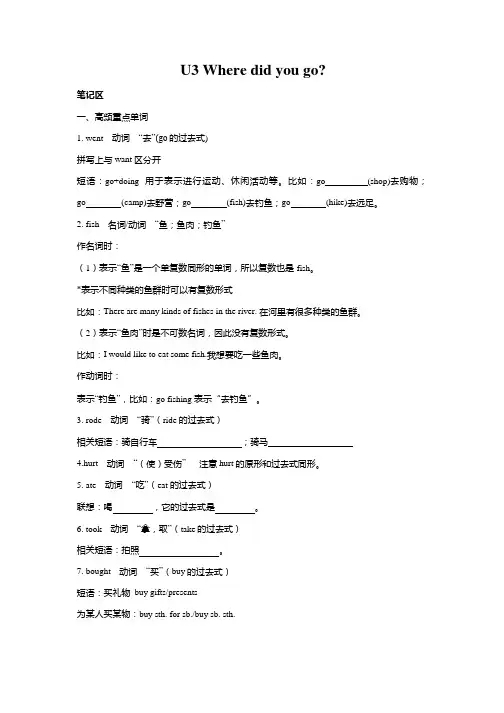
U3 Where did you go?笔记区一、高频重点单词1.went 动词“去”(go的过去式)拼写上与want 区分开短语:go+doing 用于表示进行运动、休闲活动等。
比如:go (shop)去购物;go (camp)去野营;go (fish)去钓鱼;go (hike)去远足。
2.fish 名词/动词“鱼;鱼肉;钓鱼”作名词时:(1)表示“鱼”是一个单复数同形的单词,所以复数也是fish。
*表示不同种类的鱼群时可以有复数形式比如:There are many kinds of fishes in the river. 在河里有很多种类的鱼群。
(2)表示“鱼肉”时是不可数名词,因此没有复数形式。
比如:I would like to eat some fish.我想要吃一些鱼肉。
作动词时:表示“钓鱼”,比如:go fishing 表示“去钓鱼”。
3.rode 动词“骑”(ride 的过去式)相关短语:骑自行车;骑马4.h urt 动词“(使)受伤”注意hurt 的原形和过去式同形。
5.ate 动词“吃”(eat 的过去式)联想:喝,它的过去式是。
6.took 动词“拿,取”(take 的过去式)相关短语:拍照。
7.bought 动词“买”(buy 的过去式)短语:买礼物buy gifts/presents为某人买某物:buy sth. for sb./buy sb. sth.8.gift 名词“礼物”gift 是一个可数名词,因此它的复数是:。
同表示“礼物”的还有present。
二、次频单词1.fell 动词摔倒(fall 的过去式)2.off 介词从(某处)落下3.mule 名词骡子4.beach 名词海滩在海滩:on the beach5.could 情态动词能够(can 的过去式)6.till 连词直到7.licked 舔(lick 的动词过去式)8.basket 名词篮子9.part 名词短语:一部分a part ofughed 动词过去式笑(原型laugh)三、重点句型1.What happened? 怎么了?2.Are you right?你还好吧?3.I’m OK now. 我现在沒事了。
人教版pep小学六年级下册英语课件 Unit 3 Where did you go (6)
三、Read and choose. 请选择恰当的句子补全对话,并 将其字母编号写在横线上。
A. Are there any people there? B. Did you have a good time? C. What about you? D. Where did you go? E. What did you do last holiday? F. Did you visit the Great Wall? G. There were so many people on the beach.
四、Read and judge. 阅读下面的短文,判断正误,正确的 写“T”,错误的写“F”。
Zhang Peng didn’t come to school yesterday morning. He went to see a doctor. He told the doctor he had a headache and a sore throat. He had a fever, too. The doctor said he got the flu and gave him some medicine. The doctor told him he must drink more hot water and stay in bed for a few days. ( T )1. Zhang Peng felt sick yesterday morning. ( F )2. Zhang Peng hurt his leg yesterday morning. ( T )3. Zhang Peng should take some medicine and drink more hot water. ( F )4. The doctor said Zhang Peng could go swimming tomorrow. ( F )5. If someone gets the flu, he or she usually has a fever and a toothache.
新人教版(PEP)小学英语六年级下册各单元知识点总结
人教PEP版英语六年级下册各单元知识点Unit 1 How tall are you ?一.必背单词(形容词的比较级)①一般形容词→词尾+ertall —— taller 高的----更高的 short —— shorter 矮的/短的----更矮的/更短的long —— longer 长的----更长的 strong—— stronger 强壮的----更强壮的old —— older 老的/旧的----更老的/更旧的 young—— younger 年轻的----更年轻的 small —— small 小的----更小的 low—— lower 低地----更低地smart——smarter 聪明的 ----更聪明的②以e结尾的形容词→词尾+rlarge —— larger 大的----更大的 late —— later 晚的----更晚的simple —— simpler 简单的----更简单的 safe —— safer 舒服的----更舒服的③以重读闭音节结尾,辅+元+辅→双写最后一个辅音字母+erbig——bigger 大的——更大的 thin——thinner 瘦的——更瘦的fat——fatter 胖的——更胖的 sad ——sadder难过的——更难过的hot——hotter 热的——更热的 wet——wetter 潮湿的——更潮湿的④辅音字母+y 结尾→改 y 为 i +erhappy——happier 开心的——更开心的 heavy——heavier 重的——更重的funny——funnier 滑稽的——更滑稽的 angry——angrier 生气的----更生气的sunny——sunnier 生气的----更生气的 windy——windier 有风的的----更有风的busy——busier 忙的----更忙的 early——earlier 提早的----更早的dinosaur 恐龙 hall 大厅 than 比 both 两个都 meter 米kilogram 千克;公斤size 号码 feet 脚 wear 穿 countryside 乡村 shadow 影子;阴影become 变成;开始变得二.重点句型⑴ 问年龄,身高,体重等How old are you? How tall are you? How heavyare you?--- I’m _______ (years old). --- I’m ______metres tall. ---- I’m ______ kilograms .⑵ 问物品的情况:① How large is your room? 你的房间有多大?It’s ______ m (square meters.) 有___平方米。
新版人教版(PEP)六年级英语下册unit3-where-did-you-go
yesterday
Catch the plane 找飞机,看谁快
last Monday
the day before yesterday last week
一般过去时态
含义
表示过去某个时间里发生的动作或状态。
动词过去式
规则变化
不规则变化
动词过去式
1. 直接加ed eg. watched; washed; cleaned; played; cooked; wanted 2. 以不发音的e结尾,在词尾加d eg. liked, used, lived 3.以辅音加y结尾,去y变i加ed eg. stuied, worried 4. 以元音加辅音结尾的重读闭音节, 双写加ed eg. stopped 5.不规则变化 rg. saw, drank, read, did, was...
delicious food.今天是晴朗的一天。在早上,我们骑了三人自 行车。马克斯坐在自行车前面的(车)筐里。那很有趣! 我们拍了美丽乡村的照片。我们买了一些礼物,并且吃了 一些美味的食物。
In the afternoon, Mum ate some bad fruit and didn't feel well. So we stayed in the hotel. Dad and I wanted to make her happy. We dressed up and made a funny play. Robin played the part of a dog. He was so cute. Max liked him so much. He jumped on him and licked him.Of course,
PEP人教版新版六年级英语Unit_3_My_weekend_plan试题
Unit 3 My weekend planPart A直击考点重点单词和短语visit, film, see a film, trip, take a trip, supermarket, evening, tonight, tomorrow, next week重点句型分析1. ---What are you going to do tomorrow?---I’m going to have an art lesson.此句是个一般将来时态的特殊疑问句。
用了be going to 结构。
“b e going to +动词原形”构成一般将来时态, 表示计划、安排将要做的事或根据目前推测将要发生的动作, 意为“打算, 将要”。
2. We are going to draw some pictures in Renmin Park.此句是be going to 结构的肯定句式。
基本结构为: 主语+ be going to +动词原形+表示将来的时间。
Some 一些,用于肯定句中, 后接可数名词的复数形式或不可数名词, 而在疑问句或否定中表示一些要用any 。
基础起跑线一、 选出不同类的单词,将代号填在上面。
1.4.二、单选我最棒。
( ) 1. I am going to __________ my grandparents next week.A. visitB. visitsC. visiting ( ) 2. ---What are you going __________ on Sunday morning?---I am going to run in the park.A. toB. to doC. doing ( ) 3. I _______ visit the Great Wall next week.A. going toB. be going toC. am going to ( ) 4.----What are you going to do this evening?----_______________________ A. I'm going to see a film. B. I'm going to do see a film. C. I see a film.( ) 5.---How is Amy going tomorrow?---__________________A. BeijingB. By planeC. On the weekend 培优新乐园三、 读对话,根据首字母提示补全单词。