
【牛津版】八年级英语下册 Unit 4 A good read Reading II教案
Unit 4 A good readReading (II)I. Teaching aims and learning objectivesBy the end of the lesson, students should be able to:1. have a better understanding of the story;2. learn to use the language points correctly and retell the story in their own words;3. learn to think while reading and form the interest in reading.II. Teaching contents1. New words and phrases: against, tie, over, stomach, until, finger, tiny, continue,either, manage, lift, army, must, unable, shoulder, by thetime, be tired out, be tied to, look down, the same size as,fall over, continue doing sth, manage to do sth, a huge armyof, run away, get away2. New structures: After our ship crashed against the rocks, I swam as far as I could. It moved up over my stomach and neck until it was standing near my face.However, they soon got up again and continued moving across my body.I didn’t know what to say either.I tried to pull one hand free and finally managed to break the ropes. Gulliver found himself unable to move.III. Focus of the lesson and predicted area of difficulty1. Retell the story in students’ words.2. Use the new language points correctly.IV. Teaching proceduresStep 1 Lead-in1. Revision(1) What story did we read last period?(2) Do you still remember what happened in the story?2. Five main points of a storyT: When we read a story or want to know an event, what should we focus on?S: The time, the place, the characters, the details and the feeling.T: Great! That’s to say, we should pay attention to these aspects, like who, when, where, what and how.Step 2 Reading1. Reading for general idea of the story(1) The five points of this passage.T: Let’s watch the video and enjoy the story again. Try to find out the five points from the passage and then fill in the form.When did Gulliver wake up?Where was Gulliver then?Who did Gulliver see on the beach?What did the tiny men do to Gulliver?How did Gulliver feel at the end of the story?(2) Main idea of the passage.Put the answers together and let the students form the main idea of this story.As the sun was rising, Gulliver found himself on the beach. Some tiny men tied him to the ground, moved up over his stomach and neck, stood on his face and even climbed all over him. Gulliver didn’t know where he was and he didn’t know how to get away.【设计意图:让学生了解事件的五要素,使其对文章有整体的把握,帮助他们梳理故事情节.】2. Reading for understanding and thinkingPara 1T: Why did Gulliver come to the beach? What happened to Gulliver’s ship at first? S: His ship crashed against the rocks.T: Can you think of one word to replace “crash against”?S: Hit.T: Yeah, the ship hit the rocks and what happened then?S: The ship couldn’t move.T: The ship couldn’t continue moving. Have we learnt any phrase similar to the word “continue”?S: Yes, the phrase “go on”.T: So Gulliver met with many difficulties. Did he do something to save himself? S: Yes, he swam as far as he could.T: What is the meaning of the phrase “as far as he could”?S: It means “游得尽可能远”.T: We can use the structure like this: as + adj./adv. + as sb can/could = as + adj./adv. + as possible. Can you rewrite this sentence?S: He swan as far as possible.T: Well done! Did Gulliver finally feel the land under his feet?S: Of course.T: How did Gulliver feel when he felt the land?S: He was very tired. The story says: He was tired out. He fell down on the beach and went to sleep.Para 2(1) T: Great. However, something strange happened when he woke up. What’s that,do you know? Let’s move on to Para TwoS: He couldn’t move because he was tied to the ground.T: OK. The word “tie”means “hold things together with ropes”. Look at the picture. The master tied the dog to the tree. Can you use another way to say so?S: The dog was tied to the tree.(2) Further thinking.T: Gulliver was tied to the ground when he woke up. When was Gulliver tied tothe ground?S: Before he woke up.T: That’s to say, while he was sleeping. Right? How did Gulliver feel now? Can you imagine?Para 3(1) T: OK, from the first two paragraphs, we have known Gulliver saved himself afterthe ship crashed and he was found tied to ground after waking up. Do you think that was strange? Do you want to find out the truth? Please continue reading Para Three and tell me who tied Gulliver to the ground.S: The tiny men.T: What did they do to Gulliver?S: They moved from the leg, then moved up over Gulliver’s stomach and neck and even stood near his face.T: They were moving on his body. How small were the tiny men?S: They were the same size as Gulliver’s finger.T: Here, what does the phrase “the same … as” mean?S: 和…一样.T: For example. I like reading. My sister likes reading too. Can you join the two sentences together with the new phrase?S: I have the same hobby as my sister.T: Great! So we can use the phrase like this: the same + n. + as .…(2) Further thinking.T: There are so many tiny men on Gulliver’s body. Who was the tiny person standing on his face? Why did they want to tie Gulliver to the ground? Para 4(1) T: Suddenly, the tiny men fell over. Do you know why? Let’s come to Para Four. S: Because Gulliver shouted at them.(2) Further thinkingT: What do the tiny men think of the sound from Gulliver? How did they feel? What do you think of these tiny men?Para 5(1) T: One of the tiny men began talking to Gulliver. What was Gulliver’s reaction?Please find out the answers from Para Five.S: He couldn’t understand and didn’t know what to say, either.T: Can we use “too” here?S: No, because it is a negative sentence.T: Then what did Gulliver do then?S: He tried to pull one hand free and managed to break the ropes.T: Did he succeed breaking the ropes?S: Yes, he could lift his left hand.T: manage to do sth = succeeded in doing sth 成功做到某事try to do sth “试图或尽力做某事”,多表示一种企图或决心,而不表示一定成功.T: What about the tiny men?S: They began to shout.T: Pay attention to “began talking”and “began to talk”. What can you find out?S: We can use “begin + doing sth/ + to do sth”.T: What did Gulliver see when he looked down?S: He saw a huge arm of tiny men coming straight towards him.(2) Further thinking.T: Let’s go over Para 5 again. The tiny men began talking to Gulliver. What did one of the small men say to Gulliver?Gulliver couldn’t understand the tiny men. What was his feeling?As Gulliver lifted his left hand in the air, why did the tiny men begin to shout?How did Gulliver feel when he saw a huge group of tiny people coming towards him?(3) Imagination.T: Gulliver wanted to run away from the tiny men, but he didn’t know what to do. Do you think he could get away at last?T: Some of you say yes and some say no. If he could, how did he manage to do so? If he failed to do so, how could he manage to live in Lilliput? Now, let’s have a discussion and tell me your reasonable ideas.【设计意图:通过further thinking的问题引导,鼓励学生大胆思考,走进故事情节,体会人物感受.在培养学生深层次理解文本能力的同时, 在语篇情境中教授、学习语言点,在与学生的交流中,增加这些语言点的输入频率,为下面的运用做好铺垫.】3. Reading for developmentRetell the story in the perspective of a small man.T: Please retell the story in the perspective of a small man. Let’s name the storyA huge man in Lilliput. You may begin like this: After the rainstorm, I ... onthe beach. Suddenly, I found something strange. ... These useful phrases may help you.【设计意图:以小人国人物的角度来复述故事,提升了学生运用语言的能力,避免了背诵课文的单调与乏味.所提供的关键词,为学生复述搭建了脚手架,也是多角度阅读输入后水到渠成的输出.】Step 3 ConclusionT: This time, when Gulliver woke up, he found himself in another country—Brobdingnag. The people there were the same size as the tall buildings. Gulliver was the same size as their little finger. What will happen to Gulliver later on? It is time for you to read and find out!T: Boys and girls, there are many amazing places in books. Spare some time to do some reading, and I am sure you will have a wonderful travel in time and space! 【设计意图:让学生用本课所学知识点来讲故事,训练了学生的现象力、创造力.简要呈现小说中的其他精彩情节,引发学生的阅读兴趣.】V. Homework1. After class, continue reading Gulliver in Lilliput and try to tell the story toyour partner in yourown words.2. Read the simplified English version of Gulliver’s Travel if you want to know what would happen to Gulliver later on.。
牛津译林版英语八下Unit4《Agoodread》(welcome)说课稿
牛津译林版英语八下Unit 4《A good read》(welcome)说课稿一. 教材分析《牛津译林版英语八下Unit 4 A good read》是一篇关于阅读和文学欣赏的课文。
本节课的主要内容是让学生通过阅读一篇关于名著《动物农场》的介绍文章,了解这本书的内容、特点以及作者的观点,并能够就自己的阅读体验进行交流和分享。
教材通过丰富的语言材料,引导学生关注英语阅读,培养他们的阅读兴趣和阅读能力。
二. 学情分析根据对学生的了解,他们在七、八年级时已经学习过一些关于文学作品的课文,对名著有一定的了解。
但是,对于《动物农场》这本书,可能了解不多。
因此,在教学过程中,我需要帮助学生更好地理解课文内容,引导他们欣赏文学作品,并能够就自己的阅读体验进行表达。
三. 说教学目标1.知识目标:学生能够掌握课文中的关键词汇和短语,理解课文的主要内容。
2.能力目标:学生能够阅读并理解英文文学作品,提高他们的阅读能力。
3.情感目标:学生能够欣赏文学作品,培养他们的阅读兴趣。
四. 说教学重难点1.重点:学生能够理解课文内容,掌握关键词汇和短语。
2.难点:学生能够欣赏文学作品,并能够就自己的阅读体验进行表达。
五. 说教学方法与手段在教学过程中,我将采用任务型教学法和交际法。
通过设计各种任务,引导学生积极参与课堂活动,提高他们的阅读和表达能力。
同时,我将使用多媒体教学手段,如PPT和视频,以丰富教学内容,激发学生的学习兴趣。
六. 说教学过程1.Pre-reading:我将以一段关于《动物农场》的视频导入新课,激发学生的学习兴趣,并引导学生思考:他们是否读过这本书?对这本书有什么了解?2.While-reading:学生将阅读课文,回答相关问题。
在这个过程中,我将引导学生关注课文中的关键词汇和短语,并帮助他们理解课文内容。
3.Post-reading:学生将就自己的阅读体验进行交流和分享。
在这个过程中,我将引导学生表达自己的观点,提高他们的表达能力。
牛津译林版八年级英语下册 Unit4 a good read 课文要点解析
牛津译林版八年级英语下册Unit4 a good read 课文要点解析Comic strip1.Have you decided what to do with these books, Hobo?霍波,你已决定怎样处理这些书了吗? (教材第48页)I)decide此处用作及物动词,意为“决定”,后跟名词、代词、动词不定式或从句等。
She decided to book two tickets to Hainan online.她决定在网上预订两张去海南的票。
Let's first decide where we should go.咱们先决定应该去什么地方。
[拓展]decide的名词形式是decision,意为“决定”。
make a decision (to do sth. )意为“做决定(做某事)”。
You need to make a decision today.你今天需要做个决定。
中考.链接(2017.江苏苏州).Jack, why have you decided_________Chinese folk music as a course?一To learn more about Chinese culture.A. takeB. takenC. takingD. to take解析:我们可用“固定搭配法”解答此题。
decide to do sth.为固定搭配,意为“决定做某事”,故选D。
句意:“杰克,你为什么决定选择中国民间音乐这门课”“为了更多地了解中国文化。
” 答案:D(2)do with意为“处理;处置;对待”,常与疑问词what连用。
What did you do with those old keyboards?你怎么处理那些旧键盘了?The new teacher didn't know what to do with students.那位新老师不知道如何对待学生。
牛津译林版八年级英语下册 Unit4 a good read 课文要点解析

牛津译林版八年级英语下册Unit4 a good read 课文要点解析Comic strip1.Have you decided what to do with these books, Hobo?霍波,你已决定怎样处理这些书了吗? (教材第48页)I)decide此处用作及物动词,意为“决定”,后跟名词、代词、动词不定式或从句等。
She decided to book two tickets to Hainan online.她决定在网上预订两张去海南的票。
Let's first decide where we should go.咱们先决定应该去什么地方。
[拓展]decide的名词形式是decision,意为“决定”。
make a decision (to do sth. )意为“做决定(做某事)”。
You need to make a decision today.你今天需要做个决定。
中考.链接(2017.江苏苏州).Jack, why have you decided_________Chinese folk music as a course?一To learn more about Chinese culture.A.takeB. takenC. takingD. to take解析:我们可用“固定搭配法”解答此题。
decide to do sth.为固定搭配,意为“决定做某事”,故选D。
句意:“杰克,你为什么决定选择中国民间音乐这门课”“为了更多地了解中国文化。
” 答案:D(2)do with意为“处理;处置;对待”,常与疑问词what连用。
What did you do with those old keyboards?你怎么处理那些旧键盘了?The new teacher didn't know what to do with students.那位新老师不知道如何对待学生。
牛津译林版八年级下册Unit 4《A good read》(reading)课件1
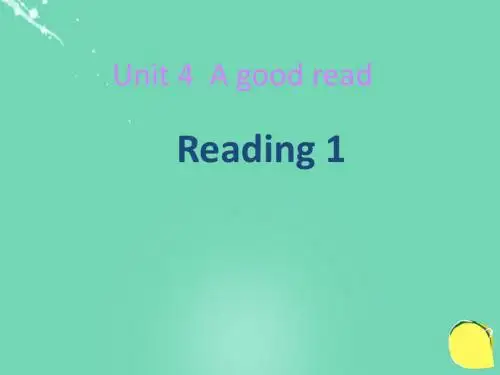
1. Gulliver’s ship crashed against the rocks. ___ T 2. When Gulliver woke up, it was almost early morning evening. ____ F 3. A tiny man climbed onto Gulliver’s body and near face _____ stood on hishis shoulder. F 4. Gulliver shouted at the tiny men, but they did not care. _____ T 5. Gulliver couldn’t talked talk with those small men. __ F 6. Gulliver finally pulled his right left hand free. ___ F
Today a good reader, tomorrow a great leader.
– Margaret Fuller
Homework
1. Read the text several times and try to retell it. 2. Finish the exercises .
Para.2
woke up – could not move — be tied
Para.5
Para.3-4
felt-looked down-saw-move up-started climbing-shoutedfall over -continue moving
began talking-couldn’t understand-managed tolifted-looked down- a huge army of
牛津译林版英语八下Unit 4《A good read》(Grammar)教学设计

牛津译林版英语八下Unit 4《A good read》(Grammar)教学设计一. 教材分析《A good read》是人教版牛津译林英语八年级下的一个单元,主题是关于书籍和阅读。
本课的主要内容是通过介绍两本书的评价,让学生学会如何使用过去时态和现在时态描述事件的顺序。
教材中包含了丰富的阅读材料,有助于提高学生的阅读兴趣和阅读能力。
二. 学情分析学生在学习这个单元前,已经掌握了动词的过去式和现在式的变化规则,同时也具备了一定的阅读理解能力。
但学生在阅读长篇文章时,可能会遇到生词和难句,影响阅读理解。
因此,在教学过程中,需要帮助学生克服这些困难,提高他们的阅读能力。
三. 教学目标1.知识目标:学生能够正确使用过去时态和现在时态描述事件的顺序。
2.能力目标:学生能够读懂文章,提高阅读理解能力。
3.情感目标:激发学生对阅读的兴趣,培养良好的阅读习惯。
四. 教学重难点1.重点:学生能够正确使用过去时态和现在时态描述事件的顺序。
2.难点:学生能够读懂文章,提高阅读理解能力。
五. 教学方法1.任务型教学法:通过完成各种任务,激发学生的学习兴趣,提高学生的参与度。
2.互动式教学法:教师与学生,学生与学生之间的互动,促进知识的传递和能力的培养。
3.情境教学法:创设情境,让学生在真实的环境中学习,提高学生的应用能力。
六. 教学准备1.教师准备:准备好教材、多媒体教具、教学卡片等教学资源。
2.学生准备:学生提前预习课文,了解文章大意。
七. 教学过程1.导入(5分钟)教师通过提问方式引导学生谈论他们喜欢的书籍和阅读体验,激发学生的学习兴趣。
2.呈现(10分钟)教师通过多媒体展示两本书的评价,让学生听懂并理解文章的内容。
3.操练(15分钟)学生分角色朗读文章,模仿文章中的评价语言。
教师引导学生运用过去时态和现在时态描述事件的顺序。
4.巩固(10分钟)学生分组讨论,总结文章的主旨大意,并用自己的话进行表达。
教师巡回指导,纠正学生的错误。
牛津译林版英语八下Unit 4《A good read》(integrated skills)说课稿
牛津译林版英语八下Unit 4《A good read》(integrated skills)说课稿一. 教材分析《牛津译林版英语八下Unit 4 A good read》是一篇关于阅读理解和文学鉴赏的课文。
本节课的主要内容是让学生通过阅读一篇关于小说《动物农场》的评论文章,提高学生的阅读理解能力,同时培养学生的文学鉴赏素养。
教材中包含了丰富的语言知识,如词汇、语法和阅读策略,为学生提供了全面的语言学习材料。
二. 学情分析在八年级下学期的学生已经具备了一定的英语基础,能够理解和运用基本的英语语法和词汇。
然而,他们在阅读理解方面还存在一定的困难,特别是对于长篇复杂的文章。
此外,由于学生对文学作品的接触较少,他们在文学鉴赏方面的素养还有待提高。
因此,在教学过程中,教师需要关注学生的阅读理解能力和文学鉴赏素养的提升。
三. 说教学目标1.知识目标:学生能够掌握课文中的关键词汇和语法知识,如现在完成时、被动语态等。
2.能力目标:学生能够提高阅读理解能力,能够运用阅读策略理解长篇复杂的文章。
3.情感目标:通过阅读和讨论,学生能够培养对文学作品的鉴赏能力,激发对阅读的兴趣。
四. 说教学重难点1.重点:学生能够理解课文内容,掌握关键词汇和语法知识。
2.难点:学生能够运用阅读策略理解长篇复杂的文章,提高阅读理解能力。
五. 说教学方法与手段1.教学方法:采用任务型教学法,让学生在完成任务的过程中提高语言运用能力。
2.教学手段:利用多媒体课件、纸质教材和网络资源等,为学生提供丰富的学习资源。
六. 说教学过程1.导入:通过提问学生喜欢的书籍和作家,激发学生对文学作品的兴趣,引入本节课的主题。
2.阅读理解:学生自主阅读课文,回答相关问题,教师引导学生运用阅读策略理解文章。
3.词汇语法:学生通过课文学习新词汇和语法知识,教师进行讲解和练习。
4.小组讨论:学生分组讨论课文中的观点和表达方式,培养学生的批判性思维能力。
5.文学鉴赏:教师引导学生分析课文中的文学手法和特点,提高学生的文学鉴赏素养。
牛津译林版英语八年级下(初二)Unit 4 A good read Reading课件
用所给单词的适当形式填空。
• 1. Jack is deciding what ________ (read) now. • 2. —________ you ________ (read) that book? • —Not yet. • 3. I don’t like swimming. I think it is ________ (bore). • 4. We all know that J. K. Rowling is the ______ (write) of Harry Potter. • 5. I didn’t know you ________ (come) from Beijing. • 6. Jim is a good cook. He is good at ________ (cook).
Unit 4 A good read
Reading
Words & phrases review
against be tired out tie over stomach until finger tiny fall over prep. 紧靠,碰,撞 筋疲力尽 vt. 捆,绑 prep. 从一边到另一边 n. 腹部;胃 conj. 直到……为止 n. 手指 adj. 极小的 摔倒
finish what you have tried to do
Gulliver managed to break the ropes.
put up something
he lifted his left hand into the air a huge army of tiny people
a large number of
To compare or contrast
牛津译林版八年级下册 Unit4 A good read 分课时单词短语句型语法知识梳理
Comic strip & welcome to the unit1.read n. 读物reader n. 读者read v. (read-read-read)a good read 一本好的读物an interesting read 一本有趣的读物some good reads 一些好的读物do some reading 阅读2.Have you decided what to do with these books,Hobo?what to do with these books怎么处理这些书“疑问词十不定式”构成的不定式短语, 在句中作宾语。
3..Give them to me then.那就把它们给我吧. give sb sth.=give sth to sb含give动词构成的词组和短语有: give a talk 做报告; give up放弃; give in 屈服; 让步; “use sth to do sth”是固定搭配,意为“使用.....做......”. 如:give sb some advice 给某人提建议; give back 归还; give out 分发4.have to不得不;只好.如:I have to clean the room before my mother comes home. 我不得不在妈妈回来之前打扫房间。
[辨异]have to和must(1)must多表示主观需要或责任感的驱使,有必要或有义务去做某事,多译为“必须”,而haveto多表客观存在的环境所限,即客观要求(无奈)而为之,多译为“不得不干某事.”如:We must be there on time. (责任感的驱使)我们一定准时到达。
I have to do my homework now.(不得不做)我现在不得不做作业。
(2)must没有时态的变化,而have to有时态的变化。
牛津译林版八年级英语下册Unit4Agoodreadreading1精品PPT课件
Unit 4 Reading Ⅰ
Gulliver’s Travels
by
Jonathan Swift
(1667-1745)
His ship crashehditagainst the rocks.
[ə’genst] The ship can’t continue moving.
[kən'tinju:]
After Gulliver’s ship…
Para.1
Para.2
swam – tired out
woke up – could not move
– fell down – went to sleep — be tied
Para.3-4
Para.5
felt-lookedmove up-started down-saw climbing-fall over
– Margaret Fuller
1. Write a short passage about your idea.
(If Gulliver could run away, how could he do it?
If Gulliver couldn’t run away, What would happen next?)
go on
Gulliver in Lilliput
What happened?
Para.1
Read and answer
①What did Gulliver do after their ship crashed against the rocks?
He swam as far as he could. ② Why did Gulliver fall down on the beach? Because he was tired out after swimming for a long time.
牛津译林版八年级下册Unit 4 A good read Reading 教案
牛津译林版八年级下册Unit 4 A good readReading 教案Unit 4 A good readReading (I)I. Teaching aims and learning objectivesBy the end of the lesson, the students should be able to:1. understand the extract from Gulliver’s Travels with the teacher’s help;2. learn how to read a novel from the transitions between ideas and analyze the spirits of the characters.II. Teaching contents1. New words and phrases:against, until, finger, tiny, continue, either, manage, lift, army, must, unable, shoulder, by the time, be tired out, be tied to, look down, the same size as, fall over, continue doing sth., manage to do sth.2. New sentence structures:After our ship crashed against the rocks, I swam as fast as I could.I woke up as the sun was rising.However, they soon got up again and continued moving across my body.I tried to pull one hand free and finally managed to break the ropes.III. Focus of the lesson and predicted area of difficulty1. To get a full understanding of the extract.2. To analyze the structure of the story with transitions.IV. Teaching proceduresStep 1. Lead-in1. An introduction to Gulliver’s Travels(1) The teacher asks the students some questions about reading.What type of book do you like best and whyThe teacher introduces the novel Gulliver’s Travels and its author to the students with the help of pictures.Step 2. Pre-reading1. Show some background information of the bookJonathan Swift was the writer of the story. He wrote the story in England. The novel tells us Gulliver’s amazing adventures in some countries, including Lilliput(小人国), Brobdingnag(大人国), Laputa(飞岛国)and Houyhnhnms(智马国).Present new expressionsHis ship crashed against the rocks.The ship couldn’t continue moving.He was tired out and fell down.Tiny people managed to use ropes to tie him to the ground.Step3. While-reading1.Skimming: read for gistRead the passage and fill in the formFive elements(五要素):When did Gulliver wake upWhere was Gulliver thenWho did Gulliver see on the beachWhat did the tiny men do to GulliverHow did Gulliver feel at the end of the story2.Scanning: read for detailsTask1:Read Para.1 and answer the following two questions:(1)What did Gulliver do after their ship crashed against the rocks(2)Why did Gulliver fall down on the beachTask2:Read Para.2 carefully.What did Gulliver do after their ship crashed against the rocks .Why did Gulliver fall down on the beach and go to sleepWhy couldn't he moveTip 1: When we meet the new words, try to guess the word's meaning according to the context(语境).Tip 2: Don't miss any given information, even the picture.Task3:1. Read Para.3 and answer the following questions:(1)What did the small man do(2)How big was the small man2. Can you choose the functions of the two questions (多选)(A) Make readers want to read the story.(B) Make readers feel Gulliver’s feeling.(C) Make the story vivid(生动的) and interesting.Task4:Read Para.4 and answer the following questions:(1)Why did the tiny men all fall over(2)What did they do after thatTask: Read Para.5 and answer1. Did the small men try to communicate with Gulliver What about Gulliver2. Did Gulliver do anything to help himself out What did he doStep4. Post-reading1.Discussion in groups:How do you understand the word “army” itselfWhy did “I” think the “tiny” people were a huge armyShould we look down on(轻视)the tiny people(小人物)in our life 2. Further thinking: Which character(角色) has interested you most WhyGulliver:brave,calm,lucky,friendly,kind...I think Gulliver was kind because he didn’t eat the tiny men.②…., so I dislike Gulliver.Tiny men: cooperative(合作的),clever,brave...①I like the tiny men were ... because they...② I can learn … from the tiny men because …教学反思1. 对于文本内涵的挖掘还有待提高,如在探讨“huge army”时,可以给予学生更多的时间和空间,激发学生思考文中内涵的力量对比、情感变化,将问题导向化的教学更加深度地落实在每节课中;2. 阅读是学生的个性化行为,不应以教师的分析来代替学生的阅读实践。