
仁爱英语七年级下册U5T1导学案
(2)Do / Does +主语+频度副词+日常活动?意思是_______________________
1.了解_______________2.学校生活________________3.坐黄色校车______________
4.开始上课_____________5.在空闲时间____________6.没有更多时间____________
3.Do you usually come here by bus?(同义句转换)
Do you usually come ____a _______here?
乌加河中学七年级英语学案主备教师:班级:_学生姓名:___备课时间:2014年2月23日
学习内容
仁爱七下Unit5Topic 1 Section C
9做作业__________10看电视________ 11去睡觉_______12去游泳_____________
13一会儿____________14听音乐__________ 15读(看)书______________
16一周一次_____________17一周两次____________ 18一周三次__________________
II.按要求完成句子。
1.Mr. Zhang goes toBeijingby planethree times a year.(对划线部分提问)
______ ______ ______Mr. Zhang_______toBeijingby plane?
2.he, once a week,go swimming(连词成句) _____________________________________
【课堂检测】:
I.根据句子的意思,选出恰当的单词填空。by get have at take
Kangkang usually1up at a quarter past six in the morning. At half past six, he has breakfast. Then he goes to school2bus at ten to seven. He has lunch at school3twelve o’clock. He4the subway home at ten past five in the afternoon. At half past six in the evening, he5dinner with his parents.
2.了解一般现在时和频度副词,掌握有关表达交通方式的句型。
学习目标
1.掌握有关掌握表达交通工具方式的两种句型。
2.掌握几个常见的频度副词。
重、难点
1.学习如何询问对方乘坐哪种交通工具。2.掌握表达交通方式的句型。
重、难点
1.掌握本课重点单词、短语,会运用频度副词能背诵或熟读1a。
【自主学习】:I.用5分钟自读P125的单词,然后读音标写出单词及词意。
II.我会朗读和翻译下列句子:
1.他在早上七点骑自行车去上学。________________________________________
2.王丽经常在晚饭后听一会儿音乐。___________________________________
3.你多久去钓一次鱼?一周两次。_________________________________________
乌加河中学七年级英语学案主备教师:班级:_学生姓名:___备课时间:2014年2月23日
学习内容
仁爱七下Unit5Topic 1 I usually come to school by subway.Section A
学习内容
仁爱七下Unit5Topic 1 Section B
学习目标
1.能根据音标写本课单词,能正确朗读本课对话。
2.Mrs black, go shopping, on foot ________________________________________
【自主学习】:I.用5分钟自读P125的单词,然后读音标写出单词及词意。
II.自读P3,4中的内容,写出下列短语或句子。
1.什么时候__________________2.起床_________3.在工作日_______________
重、难点
复习巩固有关日常活动的词组和一般现在时的用法。
【自主学习】:I.我会读和写出下列单词和词组。
1起床__________ 2吃早饭____________ 3上学____________4吃午饭____________
5踢足球__________ 6搭地铁回家______________7到家__________8吃晚饭_________
学习内容
仁爱七下Unit5Topic 1 Section D
学习目标
1.复习巩固交通方式的表达法;2.学习频度副词,学会日常活动频率的表达法。掌握How often的用法。
学习目标
复习巩固交通方式的表达法;2、复习巩固频度副词的用法及日常活动频率的表达法。复习巩固How often的用法。
重、难点
复习巩固有关日常活动的词组和一般现在时的用法。
II.句型转换1.He usually goes to the park by bus . (划线提问)
______ ______ usually ____to the park by bus .
2.She often drives a car to work.(同义句转换) She often goes to work______car.
II.自读P1页的课文1a,写出下列短语或句子。
1.新年快乐______________________2.你也一样_________________3.步行_________
4.看起来很漂亮_________________5.来学校_______________6.骑自行车____________
3. Does your father go to work ______ _________ (坐地铁)?
4. _______ _____(快点) . We don’t have much time.
III.用所给提示词造句子。
1. Tom ,go, by bike __________________________________________________
4.步行去学校_______________5.乘坐公共汽车________________
6.早起的鸟儿有虫吃_______________________________________
7.做作业__________________8.踢足球________________9.看电影____________
2.My father a________goes to work by car.
3. Do you o________ come to school by bus?
II.根据句意补全句子。
1.Have a good weekend!__________________(你也一样).
2.Ren Hao usually comes to school _____ _______ (步行).
7.乘地铁__________________8.该上课了__________________ 9.坐火车____________
【课内合作交流】:了解一般现在时
构成:一般现在时主要用动词原形表示,如果主语是第三人称单数,则动词用单三形式(动词后加-s-或es)
用法:(1)表示经常性或习惯性动作。E.g.I usually come to school by subway.
4.你经常在放学后踢足球吗?是的。____________________________________
【课内合作交流】:我归纳我明白:
1.询问活动的频率要用__________ + do / does +主语+日常活动?的句型。
回答时可以直接用often, sometimes, never等__________副词或者表示活动频率的副词词组,比如_____________ቤተ መጻሕፍቲ ባይዱ_______________等。
3.often,play soccer,you ,do ,after school(连词成句) ___________________________
【自主学习】:头脑风暴:在最短的时间内按要求写出尽量多的单词.
1.频度副词或词组: ________________________________________________
_______________________________________________________________________
2.交通工具类的名词:_________________________________________________
_______________________________________________________________________
【课内合作交流】:乘坐某种交通工具的两种表达方式
第一种: take a/an /the +交通工具第二种: by +交通工具(on foot特殊)
come…by bike = _____ a bikego…by subway = take the subway
go…on foot =___________…by bus = take a bus
英语仁爱英语七年级下册UNIT5导学案

仁爱英语七年级下册Unit5导学案Unit5 Topic1 Section A一、学习目标:1、知识与技能:A:频度副词:如usually(通常),你在P1 还能够找到两个,试一试:____________(经常);______________(总是)B:学习交通方式的表达法:骑自行车:by bike ;你来试一试:乘火车_______________乘飞机_______________乘地铁_______________乘轮船_______________乘小船_______________乘公交_______________乘小轿车_______________特别注意!:步行_______________ (可以参考课本P2)C:能够用一般现在时谈论交通方式,尝试翻译:How do you usually come to school ?____________________________?I usually come to school by bus . _______________________________康康总是怎样回家的?______________________________________?2、过程与方法课前做好预习,预习中做好预测,标出不会的内容,寻求同桌、小组帮忙,聆听别人的见解,专注于老师的总结。
二、重点难点:1、写出下列动词的单三形式A. come _______ look_______ work_______ live _______B. teach_______ watch______ catch_______C. try _______study _______carry_______ fly _______D. go _______do _______have_______3、补全对话:A: Nice to see you again ! B: ________________________!A: Your new bike looks very new !B:___________________!A: Happy birthday !B:_________________!A: Happy New Year ! B:___________________!三、学习过程:Step1 : Read 1a . 理解并翻译下列词组或句子1. Happy New Year ! The same to you !2. look very nice .3. How about ….? = _______________?4. It’s time for class !=___________________!5. at the gate6. It’s time _____ sth = It’s time ____ _____ sth .7. by bike by subway by bus四、精讲点拨1、Happy New Year! The same to you.新年快乐!你也一样(你也是)。
仁爱版七年英语下册U5T1SC导学案

Section CI. Material analysis本节课是第五单元话题一的第三课时,主要活动是1a和2。
通过介绍Jane 的一天,进一步学习用一般现在时的第三人称单数表达日常活动,巩固有关交通方式和频率的表达。
还将通过用方框中的单词和短语编对话的方式练习一般现在时的一般疑问句及其肯定和否定回答,复习日常活动和频度副词seldom和never 等。
同时学习对频率提问的句型“How often...?”和表示具体频率的副词,如once a week, twice a week, three times a week等。
语音部分主要是复习本话题所学字母及字母组合发音规律以及句子的升降调。
但是,在本课中,由于学生词汇、语法积累的不同,在将阅读输入信息转化为口头的输出时可能会出现语言组织或语法运用的障碍。
因此教师可结合图片展示、借助关键词、优生示范等活动,帮助培养学生说和复述课文的能力。
II. Teaching aims1.Knowledge aims能根据已学语音、音标及发音规则,正确朗读和拼写下列词汇:begin, at school, after, bed, basketball, swim, listen, music, library, week, once, twice在Section A和Section B的语法基础上,能熟练运用usually, often, always 等频度副词和两种交通方式的表达,能用一般现在时第三人称单数表达日常活动,能对频率进行提问与回答;在Section A已学的语音基础上,能结合图片和音标拼写单词,并能尝试结合语音发音规律拼读新单词,并了解句子的重音和升降调;能结合话题,运用“谈论日常生活、询问和回答某项活动的频度”等交际功能的用法,进行口头和笔头的信息输出,如:(1)I usually get up at ... in the morning.(2)At ... o’clock I have breakfast...(3)—How often do you come to the library?—Three times a week.2.Skill aims能听懂有关表达日常生活的叙述;能听懂简单的课堂用语,并作出反应;能根据图文就交通方式和日常活动的频度等进行交流;能在阅读训练中进行读前猜测、读中验证的活动;能根据图文理解相关话题,抓住大意和具体信息并根据要求进行学习活动;能准确写出黑体单词和词组;能写出表达交通方式和频度的简单句子。
仁爱版七年级英语下册第五单元Topic1SectionC导学案
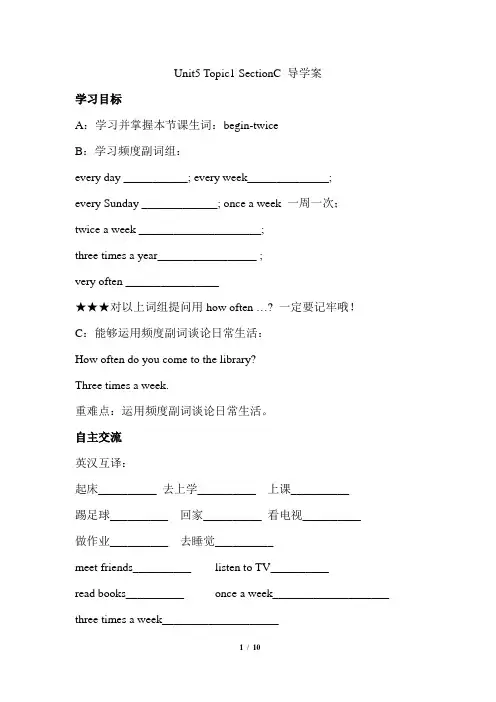
Unit5 Topic1 SectionC 导学案学习目标A:学习并掌握本节课生词:begin-twiceB:学习频度副词组:every day ___________; every week______________;every Sunday _____________; once a week 一周一次;twice a week _____________________;three times a year_________________ ;very often ________________★★★对以上词组提问用how often …? 一定要记牢哦!C:能够运用频度副词谈论日常生活:How often do you come to the library?Three times a week.重难点:运用频度副词谈论日常生活。
自主交流英汉互译:起床__________ 去上学__________ 上课__________踢足球__________ 回家__________ 看电视__________做作业__________ 去睡觉__________meet friends__________ listen to TV__________read books__________ once a week____________________ three times a week____________________after school____________________合作探究一、Read 1a. 理解并掌握下列短语,然后在文中标出。
1. get home意为“到家”。
home是副词,get后接副词时不带to。
而“get to+地点名词”意为“到达某地”。
例:到校____________ 到图书馆_____________2. begin开始、着手begin to do sth.或begin doing sth.开始做某事。
仁爱英语七年级下Unit5Topic1学案.docx
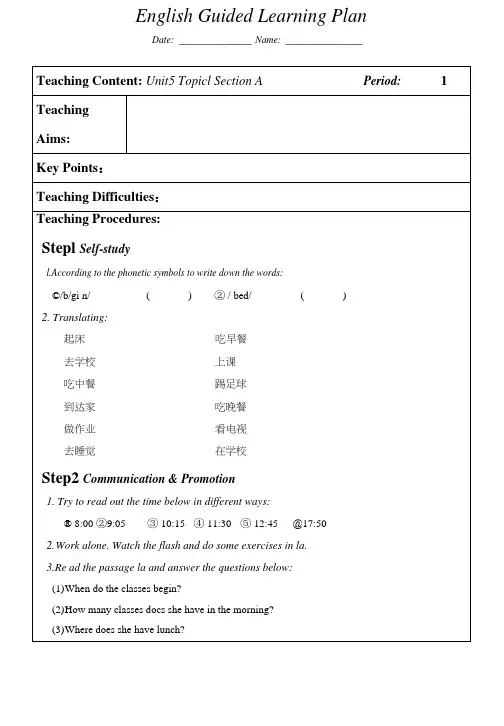
English Guided Learning PlanDate: _______________ Name: ________________Teaching Content: Unit5 Topicl Section A Period:1 TeachingAims:Key Points:Teaching Difficulties:Teaching Procedures:Stepl Self-studyl.According to the phonetic symbols to write down the words:©/b/gi n/ ( ) ② / bed/ ( )2. Translating:起床吃早餐去学校上课吃中餐踢足球到达家吃晚餐做作业看电视去睡觉在学校Step2 Communication & Promotion1.Try to read out the time below in different ways:® 8:00 ②9:05 ③ 10:15 ④ 11:30 ⑤ 12:45 @17:502.W ork alone. Watch the flash and do some exercises in la.3.Re ad the passage la and answer the questions below:(1)W hen do the classes begin?(2)H ow many classes docs she have in the morning?(3)W here does she have lunch?(4)When does she play soccer with her classmates?(5)How does she go home?4.Watch the flash of la and follow it.5.Work in groups of three. Discuss the pictures in lb and retell the passage in la.Example:A: Jane gets up at 6:20.She has breakfast at ........ Then she ••••The class begins at....B: She has lunch at school at ••…She has two classes ....... A fter school, she ....Then she...by subwayC: She has dinner with...After dinner,she••…and…She goes to bed....Step3 Consolidation & DevelopmentStep4 Self-checkStep5 ReflectionEnglish Guided Learning PlanDate:_____________ Name: _____________________TeachingProcedures: Sfeplself.smdy L According io ?e phoneticsymbolsfowrifedownthewords- ㊀/brg-n/( )©'bed*( )2・Transklnng-色弟囹相嚴^5k 箔窈夕«淫: 更瀑厳 專吞W迷尹阜m sSfep2communication氐promotionLmioreadouiiheiimebelowindsieFeniways*• ㊀800 @905 ©§5 ®l r r 3001Z45©s o 2・W7P"ahme.WhfcAfheflashanddosomeexercisesinla.3・Read fhe passage 7a and awsweu fhe questionsbelow-Teaching Confenf:Unii5Topic1 section B I P lb-1c &. 3Period-Teaching Aims: Key Poinfs :TeachingDifECUttes"(1) w hcn do ihcclassesbegirf? (2) H 0w many classes docs shehaveinihe mornings(3) w heredoes shehave lunch"? (4) w hen does she playsoccer wiihherCnassma<?s7(5) How does she go home"?4.Watch the flash of la and follow it.5.Work in groups of three. Discuss the pictures in lb and retell the passage in la.Example:A: Jane gets up at 6:20.She has breakfast at ...... Then she •…The class begins at....B: She has lunch at school at ••…She has two classes ...... After school, she ....Then she…by subwayC: She has dinner with...After dinncr.shc••…and... She goes to bed....Step3 Consolidation & DevelopmentStep4 Self-checkStCp5 ReflectionEnglish Guided Learning PlanDate: _______________ Name: _____________________Teaching Content:Unit5 Topicl SectionB 2a & 2b Period:3Teaching Aims : 1 .Master different ways to express the means of transportation;2. Develop the students communicative skills;Key Points : Master different ways to express the means of transportation Teaching Difficulties: Different ways to express the means of transportation Teaching Procedures:Stepl Self-studyAccording to the tips to understand the two ways of expressing the same meaning. Then fill in the blanks.(1) come/go...by +交通工具名词—> take a(an)/ the +交通工具名词 (2) come/go...by bike — ride a bike (3) come/go..on foot -> walke.g. come...by bus= _________________ take the subway= ______________________ride a bike = ________________ go....on foot- ________________________Step2 Communication & Promotion1. Read the following examples to finish the sentences:②She sometimes comes to school by subway. =She sometimes takes the subway to school. ③I usually go to the park on foot. =I usually walk to the park. [Test]: 1.1 always come to school by bike =_2.She often comes to the zoo on foot.=3. ________________________________ = They never take the subway to school.4. _____________________________________ =You seldom take a bus to the park. 2. Work alone. Try to finish 2a f Page 3 by self.3. Work together. Try to read the sentences in 2a together loudly.4. Brain-storm. Pay attention to following sentences to find out the differences: (D Li Xiang often rides a bike to school. ② We usually walk to the park.③ Maria sometimes takes the subway home. ④ They always take a bus here.[Conclusion]: ________________________________________________________________________4. G roup work. Ask and answer questions about the pictures in 2a with your partner. Example:A: How do (you/ they/...) go to school?B: I/they... often go to school by bike./ 1/ They •…often ride a bike to school. A: How does (she/he/Li Xiang/...) go to school?B: Shc/Hc often goes to school by bike./ Shc/Hc often rides a bike to school.®He often comes to school bv bike. =He often rides a bike to school. @Wc always go to the zoo by bus. =We always take a bus to the zoo.Step3 Consolidation & Developmentcome/go …by subway —> take the subwaycome/go---by bike —> _______________ —>come/go---on one^s bikecome/go …on foot —> ____________come/go …by bus —> ___________ —>come/go …on a buscome/go …by car —►___________ —>come/go …in one^s car—> drive a carcome/go--e by plane _______________ —fly类似的介词短语:in/ on +a(an)/the/this/one,s/...+表示交通工具的单数名词[Translation]:①他骑自行车去学校。
仁爱版七下 U5T1SA.导学案 第一课时 doc
( )5. It’s five o’clock . It’s _____ go home .
A.time to B. time for C. time D. time to go to
( )6. Kangkang’s new shoes look _________.
3. \根据句意和首字母提示完成句子
1. My mothers .
2.They a_______ play games after school .
3. They are brothers , they look the s________.
4. It’s a long way , you must go there by t____________.
(5)你经常骑自行车来上学吗?是的。
2.短语互译
(1)乘飞机_________(2)乘小船_________(3)步行_________
(4)by subway_________ (5) by train_________(6) by car _________
4.重点解析:
(1).How do you usually come to school?是由How引导的特殊疑问句,对交通方式进行提问,通常用by bike ,by train,by bus, by car, by plane/air,by ship/sea等来回答。
学
习
过
程
1.自主学习
1.自读1a,能够理解对话内容。
2.根据汉语意思填写单词或短语(别忘了用红笔纠错哦!)
1)大门______ 2)总是,一直______ 3)飞机______ 4)火车______
仁爱版英语七年级下册 Unit5 Topic1 SectionD 精品导学案

Unit5 Topic1 SectionD 导学案学习目标1、总结频度副词的用法。
2、复习表达新年问候,交通方式的表达。
自主预习:英汉互译:美国学生的校园生活________________了解________________参观长城________________坐地铁去办公室________________校车________________放学________________in their free time ________________I’m sorry we have no more time ________________Nice talking to you. ________________after school ________________合作探究:1、I’m sorry we have no more time.I’m sorry + that从句,表示很抱歉……2、Nice talking to you.Nice to see you.Nice + doing指____________________Nice + to do指____________________当堂反应:一、单项选择:( )1. Her mother goes to work _______ bus every morning.A、byB、atC、onD、in ( )2. I like going to school _______ my bike.A、inB、onC、byD、at ( )3. —What about _______ a rest?—OK! Let’s go fo r a walk.A、to haveB、hadC、haveD、having二、按照要求转换以下各句:1、Sue goes home twice a week.(对划线局部提问)__________ __________ does Sue go home?2、Linda seldom walks to school on weekdays.(改为一般疑问句)__________ Linda seldom __________ to school on weekdays?3、Tom rides a bike to school every day.(改为同义句)Tom __________ to school __________ bike every day.4、Lily goes to bed at eleven in the evening.(改为否认句)Lucy __________ __________ to bed at eleven in the evening.5、David sometimes goes home by subway.(改为同义句)David sometimes __________ __________ subway home.拓展提升:Survey your classmates about their school lifeWrite a passage.You may begin like this:The school like of American students is different from ours…自我评价_____________________________________________________________________ _____________________________________________________________________。
仁爱版英语七年级下册 Unit5 Topic1 SectionC 精品导学案
Unit5 Topic1 SectionC 导学案学习目标A:学习并掌握本节课生词:begin-twiceB:学习频度副词组:every day ___________; every week______________;every Sunday _____________; once a week 一周一次;twice a week _____________________;three times a year_________________ ;very often ________________★★★对以上词组提问用how often …? 一定要记牢哦!C:能够运用频度副词谈论日常生活:How often do you come to the library?Three times a week.重难点:运用频度副词谈论日常生活。
自主交流英汉互译:起床__________ 去上学__________ 上课__________踢足球__________ 回家__________ 看电视__________做作业__________ 去睡觉__________meet friends__________ listen to TV__________read books__________ once a week____________________ three times a week____________________after school____________________合作探究一、Read 1a. 理解并掌握以下短语,然后在文中标出。
1. get home意为“到家〞。
home是副词,get后接副词时不带to。
而“get to+地点名词〞意为“到达某地〞。
例:到校____________ 到图书馆_____________2. begin开场、着手begin doing sth.开场做某事。
(完整word版)仁爱英语七年级下册U5T1导学案
3. Do you o________ come to school by bus?
II.根据句意补全句子。
1.Have a good weekend!__________________(你也一样).
2.Ren Hao usually comes to school _____ _______ (步行).
go…by car = _____ a cargo…______________ = fly
翻译:Mary每天乘公共汽车去学校。
1. ______________________________2. ______________________________
我们经常步行去购物。
1. ______________________________2. ______________________________
3.Does your father go to work_______________ (坐地铁)?
4. _______ _____(快点) . We don’t have much time.
III.用所给提示词造句子。
1.Tom ,go, by bike __________________________________________________
2.Mrs black, go shopping, on foot________________________________________
【自主学习】:I.用5分钟自读P125的单词,然后读音标写出单词及词意。
II.自读P3,4中的内容,写出下列短语或句子。
1.什么时候__________________2.起床_________3.在工作日_______________
仁爱版七年级英语U5T1SA导学案
英语 星期:
学科课堂设计活页 备课组长签字:
第
周 第 课时 学科主任签字:
导学案编号:1
班级:_______________
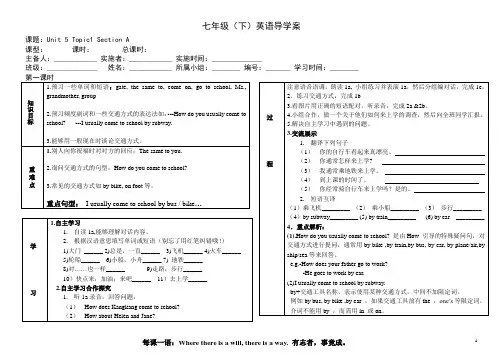
课题: Unit 5 Topic 1 How do you usually come to school? Section A 设计人: 洪晓珏 1. 学习各种交通工具表述。 2. 学习对交通工具使用的提问。 课前检测内容:组长任选 3 Step1 课前检测,默写出下列单词。 2、Jane usually (come)to school by bike. 个抽查单双号默写单词。 自行车_______ 火车_______飞机_______ 脚_______ 3、Does Michael often (come)to school on foot? 轮船________ 小船_______ 地铁_______ 小汽车_______ 4、Helen always (come)to school by subway. 5、Kangkang and Jane (go)to school on foot. 6、How does Jane usually (come)to school? Step 2 自主背诵 P1 1a 重点知识,并进行预习成果分享。 教师板书内容: 简单写 Step 2 【知识点一、 知识点一: by + 交通工具名称,表示“乘坐”某种交通 二、根据汉语意思提示,补全句子。 三、四、五】 (go)home (步行). 工具,中间不加限定词 the 和 a。 例:by bus 乘公共汽车 1、Helen 2、They (go)shopping (骑自行车). 1. ______________ 乘飞机 2. ______________ 乘地铁 3、I (go)for a picnic (坐船) 知识点二: How do you usually come to school? 你通常怎 Step 5 文本改编展示。 【改编方法指导:对话中必须含有询 样来学校?(用于询问交通方式) 板书安排: 问交通方式的问答句,学会用 by 和 on foot】 走路” 相当于 walk to 例如: 主板:Step 3 和 Step 4 的一 知识点三: on foot “步行、 I go to school _____ ____. == I ______ _______ school. Step 6 达标检测 一、听课本 P2 的 2b 听力,并完成书上的练习。 知识点四: It’s time for class. 意思是:_______________ 前两组侧板:Step 2 二、填空,只填一个词。 知识点五: Come on. 有两种意思: “快点儿”和“加油” 后两组侧板:Step 4 的一 1、A: do you often go to school? B: By bus. 2、She (go)home by bike. Step 3 学习新单词,并进行单词抢读、领读。P125 subway = underground always 后黑板:合作板完 Step 4 gate by 三、选择题 come on on foot plane train ship boat 的二以及达标检测二、三 ( )1、They go to the park_____ . Step 4 重点句型练习与巩固 一、用所给动词的适当形式填空 1、I usually (come)to school by bus. ( A. on feet B. on a foot C. by foot D. on foot )2、It’s time to . A. breakfast B. have breakfast C. has breakfast D. for breakfast
仁爱英语七年级下册unit5 Topic1导学案
导学案一、词汇与词组在学校门口你也一样来学校骑自行车坐地铁坐公交车步行坐飞机坐火车二、重要句子1.The same to you.你也一样(用于对问候语的回答)Eg: ——Merry Christmas!圣诞快乐!——2.Oh, your new bike looks very nice!啊,你的新自行车看起来很好看!Look意为“看起来,好像”,在此用作系动词,后面常跟形容词或介词短语。
Eg: 她看起来很高兴3.Do you often come to school by bike?你经常骑自行车来学校吗?By在此意为“乘坐(某种交通工具)”,后面直接加交通工具。
Eg: 我经常乘坐公交车去学校三、我来闯关1.I usually go to school subway.2.He often (come)to school by bike.3.Mrs. Wang goes to Beijing (坐飞机)4.They go to school foot.5.你通常怎样去学校?(翻译句子)导学案一、词汇与词组在平日总是从不看电视踢足球有时很少看电影骑自行车二、重要句子1.What time do you usually ge up on weekdays?你平日通常几点起床?Weekday指一周除了周六和周日的五天,即周一到周五。
On weekdays在平日on weekends在周末2.I usually come to school on foot, but sometimes by bike.我通常步行上学,但有时骑自行车。
Sometimes 是频度副词,意为“有时”。
频度副词还有never, seldom, often,usually, always等,常置于行为动词前,be动词、情态动词和助动词后。
Eg: I go to school by plane (从不)She goes to school by bike.(经常)He goes to school on foot.(总是)We go to Shanghai by plane.(很少)3.The early bird catches the worm.早起的鸟儿有虫吃。