
英语人教版八年级下册unit1 Period 1
Look at the picture. Write the correct letter [a-m] for each part of the body.
a j l c ___hand ___head ___leg ___mouth m k ___neck ___nose ___stomach d f ___tooth
Have a+疾病名(表示患什么病)
have a cold have a fever have a headache have a stomachache have a toothache have a sore throat have a sore back/(a backache) ……
I
单项选择
What’s the matter with him?
He has a fever.
What’s the matter with him?
He has a headache.
He has a toothache.
He has a stomachache.
What’s the matter with them?
arm
shoulder
back
stomach knee
leg
foot (feet)
Games: Pair work
When you hear your partner say the part,
touch the parts of your body
触摸身体部位
1a
e g b h ___arm ___back ___ear ___eye ___foot i
Conversation 3 A: What’s the matter, Ben? Can you move?
soccer the other day and I ______ B: Not really. I was playing ________ hurt myself. It seemed OK at first, but now I have a really sore _____. back
A: What’s the matter, David? Are you OK?
junk food at my friend’s birthday party. B: I ate too much _____________ So last night, I got a ________________. I almost couldn’t get out stomachache of bed this morning.
1
2
3
4
A: What’s the matter with ----in picture---? Pair work B: --has a… A: Oh, that’s too bad. I’m sorry to hear that. 5 6 7 8
1b
Listen and look at the picture. Then number the names [1-5].
Where are they? They are in the hospital.
What’s the matter with the baby? He is ill.
What’s the matter with her? She has a cold. 感冒 What’s the matter with them? They have colds.
Sarah David Ben Nancy Judy
has a cold. has a stomachache. has a sore back. has a toothache. has a sore throat.
What’s the matter with ---? -----------------------------
No, I am not feeling well.
have a stomachache.
backstomach胃来自armthroat
neck
leg
foot feet
hair eye nose face mouth tooth(teeth) throat
ear
finger
neck
head
hand
Conversation 4
tired What’s the matter, Nancy? A: You look really _______.
B: I didn’t sleep very well last night. I have a toothache _________. hurtsa It’s terrible. I can’t really eat anything either. It _____ lot. Conversation 5
I have a sore back.
同义句
=I have a backache.
=I have a sore back.
=My back hurts.
• 1.抄写单词 matter--hurt • 2. 《作业本1》第1课时 • 3.背诵 单词 matter--hurt, 1c, Grammar FocusP4
1. --- __________________? A --- I have a sore back. A. What’s the matter? B. What do you like? C. Do you have a sore back? 2. -What’s the matter ? - I have a__________ . C A. sore cold B. tooth C. toothache
Do you have any trouble?
What's the matter with you?
What’s the matter? 怎么了?
同义句 = What’s wrong? = What’s the trouble?
What’s the matter with you?
What’s the matter with you?
A: What’s the matter, Judy?
B: I’m sorry, but it’s difficult for me to talk.
A: Oh, dear. What’s the matter?
B: I talked too much yesterday and didn’t drink _________________. I have a very sore throat now. enough water
Period1(1a—1c)
----Are you happy today? ----Were you happy during the winter holiday ? You holiday where ? What ? When ? ….
----Are you OK today?
----Yes, I am very well, thanks.
He has a sore back. 背痛 She has a sore throat.
喉咙痛
He has a sore leg.
腿痛
toothache stomachache headache
health problems
sore neck
sore throat
sore back
have a fever have a cold
1.---have a cold / fever / cough---. 2. --have a headache / toothache / stomachache-----3. ----have a sore back/throat/neck/leg-4. ----head / leg / back ------ hurts.
3 Sarah__ 1 David__ 2 Ben__ 5 Judy__ 4 •Nancy__
Conversation 1
well What’s the matter, Sarah? A: You don’t look ______.
B: I was playing with my friend at the park yesterday. Then it got windy but I didn’t _________ _______, put on my jacket. Now I have a cold. Conversation 2
人教版八年级下册英语导学案

Unit1 Will people have robots?Section A period 1 (1a-1c)主备人:曾丝秀审核人:初二英语备课组学习目标:1、学会拼写单词will,robot,everything,paper和won’t2、学会运用will 表示一般将来时和能用will和won’t写出表将来的句型3、创设情景,让学生简单预测自己的未来学习方法:Reading,Listening and writing学习流程及措施:一、预习自学(一)通过预习,完成下列单词和词组的拼写1、将、会;要________2、机器人_________3、每件事情______4、纸,纸张_______5、在人们的家里_____________6、有个机器人__________7、在家通过电脑学习__________8、活到100岁__________9、在五年后__________10、在纸上________(二)根据首字母及句意完成单词1)R______ can do many things for people.2) There are some pieces of p______ on the desk,and you can write on them.3) E_____ is ready .Let’s begin.4) He u____ a pen to write.5)There will be more and more tall b______ in our city.二、研讨一)通过预习完成下列句子1、人们家中将有机器人。
People _____- ______ ______ in their homes.2、人们将不再用钱,每样东西都是免费的People ____ _____ ______. Everything____ ______ _____.3、将来书只在电脑上出现,而不会在纸上.Books _____ ____ ______ on computer, not _____ ______.4、孩子们将不去上学,他们将在家中通过电脑学习。
山东省枣庄市薛城区奚仲中学人教版(旧)八年级英语下册教案Unit1Willpeoplehaverobots

Period 1: Checking, Listening and Speaking (Page 2)(Do you think there will be robots in people’s homes?)Objectives●To learn to make predictions●To learn to use future with willProcedures■Warming up by learning about grammarGood morning. Welcome back to school. Now turn to page 3, and look at the grammar focus.Now give attention to the blackened words. Will is used here to express future event. More examples: I will have English classes this afternoon. He won’t go to school tomorrow.The form of the usage is: will+ verb.Now let’s have a game to make sentences with will to see who will say the most sentences with will.1a Reading and checkingNow let’s go to page 2. There are 6 statements here. Read them and check A if you agree with the prediction. If you disagree with the prediction, check D.1b Listening and circlingListen and circle the predictions you hear in activity 1a.Now go to page 87 to read this conversation. While reading try to find all the sentences with will. And also cut/ the sentence into thought groups, study all theall the linking words and underline all the expressions. That’s grammar study, indeed.Now read the conversation again to turn it into a text.1c Pairing and speakingDo you predict? Now in pairs ask and answer predicting about the future using will.Period 2: Listening and Speaking (Page 3)(There will be more people.)Objectives●To learn to use Yes/No questions with short answers●To learn to use questions with more, less, fewerProcedures■Warming up by talking about robot warsHello, everyone! Nice to see you back at school after the winter holidays. How did you spend your Spring Festival?Now I am going to show you a film called The Story of Robot Wars. What is a robot? Yes, it is 机器人. The story goes like this:All the robots at the governmental institute of robots were shut down for the night, Suddenly in a flash of light they all got beamed to another planet! And then they all automatically turned on they saw that they were in a giant arena. Suddenly a monitor appeared, and on it a giant robot it said "let me explain, I am the champion robot, and I need entertainment, my newest entertainment is the "Robot Wars". It’s where you robots fight each other with missiles, lasers etc. Now eventually you will get to the point where there will other robots from other institutes for you to fight, and eventually one of you will fight me, now when you score a point by hitting your opponent you get a weapon" and with that they all got beamed to separate arenas and so the fight for freedom began.2a Listening and circlingNow we are going to listen and circle the words we hear.2b Listening and checkingYou are to listen again. Check the predictions you hear on page 3.Turn to page 87. Read the conversation. While reading remember to cut/ the sentenceinto thought groups, studyunderline all the expressions.Now read the conversation again to turn it into a text.2c GROUPWORKWe hear predictions about the future just now. Now you are going to work in groups of four. Make predictions about the future, will you?Period 3: Filling, Speaking and Writing (Page 4)(What do you think Sally will be in five years?)Objectives●To learn to make predictions●To learn to use questions with more, less, fewerProcedures■Warming up by learning about grammarGood morning. Look at this. What’s this in English? It is a robot. What color is it? It’s white and black. What is his name? His name is Gina. Where is your robot? Do you have a robot? Do you like robots? How much are these robots? When is your robot’s birthday? Do you want to go to a robot shop? Can you start a robot? What time does your robot start to work? My favorite subject is Science of Robot. What is your favorite subject? Whe re’s your robot from? Why do you like robots? I want to be a robot scientist. What do you want to be? I’m watching my robot working at home. What are you doing? What does my robot look like? Is he handsome? I’d like some more robots made in China. How was your robot doing yesterday? Where did he go? What do you think of robots made in China? How often do you you’re your robots?What’s the matter? My robot won’t start. How do you get your robot started?Can you help me with my robot? Could you please start my robot for me? What’s the best robot in the world? Will students and teachers have robots in their classroom?3a Looking and fillingNow turn to page 4. Look at the three pictures and complete the sentences.3b Pairing and speakingNext you are to make predictions about Sally.3c Thinking and writingYou will look back, look ahead and write about yourselves.4 GROUPWORKYou will draw a picture of a tomorrow city. And you will describe it to your class.Period 4: Writing, Speaking and Listening (Page 5)(I live in an apartment.)Objectives● To learn to use future with will● To learn to use Yes/No questions with short answersProcedures■ Warming up by making sentences with willTo begin with, we will try to make sentences with will.1a Looking and writingLook at the words on page 5. Read after me these words.You will go on to write each of the words into the correct column below.1b Pairing and writingThink of other words. And write them into the chart above on page 5.2a Listening and numberingYou will listen to Alexis and Joe talking about living somewhere. Number the pictures [1-3] on page 5.2b Listening and fillingYou will listen again to the conversation. Fill in the blanks with the correct verbs from the box.Turn to page 87. Read the conversation on your own.While reading remember to cut/ the sentence into thought groups, study all thepredicates, circle all the linking words and underline all the expressions.Now read the conversation again to turn it into a text.2c Pairing and speakingYou will role play the conversation between Alexis and Joe, talking about Joe’s life now, ten years ago, and ten years from now.Period 5: Reading, Writing and Speaking (Page 6)(In ten years, I think I’ll be a reporter.)Objectives●To learn to use Yes/No questions with short answers●To learn to use questions with more, less, fewerProcedures■Warming up by reading the text to the recordingReading aloud to the recording helps you develop and improve English skills —reading, writing, speaking, and listening. Listening to yourself makes you better understand vocabulary and grammar.Now open your book to page 7 and read the text aloud to the tape.3a Reading and fillingI will ask you to read on page 6 Ming’s answer to the question “What will your life be like in ten years?” Then you will fill in the chart below on page 6, too. While reading the text, try to cut/ the sentences into thought groups, study the predicates, circle the connectives and underline the expressions.Now you are going to read the text again, and underline all the useful expressions. You will have to copy them into your notebook after school.What will your life be like in ten years? Now think and write about it.Read after me the four questions on page 6. Now answer the questions in pairs and complete the table on page 6.SELF CHECK1 Filling in blanks with a word givenTo check your studies, you will first fill in the blanks with the words given on page 7. Then make your own sentences with the same words.Turn to page 7, and read the passage, circling the inventions on the right. While reading, try to cut/ the sentences into thought groups, study the predicates, circle the connectives and underline the expressionsNow you will read the passage once again and copy the expressions into your notebook.You will go over the unit again to find these in the box on page 7.Reading: Do you think you will have your own robot?Before you read— go over the vocabulary list for this unit at the back of your textbook.While you read—cut/ the sentences into thought groups, study thethe connectives and underline the expressionsAfter you read—copy all the useful expressions into your notebook.Now read the text again to turn it into a conversation.。
英语人教版八年级下册unit1 Section A 1a-1c教案设计

Unit1 What’s the matterPeriod One (Section A:1a-1c)Teaching aims:1.Knowledge aims:1)Ss can use the following words and phrases: head , ear, eye, mouth, nose,throat , neck, back, hand, arm, leg, tooth-teeth, foot-feet , matter, have a cold, stomachache, , backache, headache, toothache2)Ss can use the following sentence patterns:What’s the matter? I have a stomach./I have a sore back./I have a cold.He/She has a sore throat.What should I do? You should …2.Ability aims: Learn how to talk about health problems and give some advice3.Emotion aims: Let the Ss know keeping healthy is importantImportant & difficult points:Learn how to talk about health and give some advice.Teaching aids: computerTeaching design:Step 1 Warming-upSing an English song: If you’re happy.Step 2 Word study1. T: Are you happy?S: Yes, we are.T: When we’re happy, we can clap our hands and stamp our feet. Hands and feet are parts of our body, look at the boy, can you say other parts of our body in English?S: Yes ,I can.2.Present a picture of a baby. let the Ss say the parts of the body.3.Work on Section A 1a4. Play a game: Touch the parts of your body1)Let the whole class touch the parts of their body when teacher say: Touchyour…2)Ask six Ss to come to the front and do as the teacher tells them: Touchyour…if one does wrong, let him or her go back, the last one who in the front is the winner.(clap hands)Step 3 Presentation and practice1. T: Are you happy? Ss: Yes, we are.T: Look at the picture, is he happy?Ss: No, he isn’t.T: Why?(Help the Ss to answer: He has a stomachache.)2.Present other pictures, talk about health problems of the persons in the pictures. What’s the matter? He/She has a headache/ toothache /a sore back/ a sore throat/a cold and a cough.3. Let the Ss practice in pairs4. T: Suppose there is something wrong with your body .You may say: I have a headache. I have a sore throat.Step 4 ChantHead, head, I have a headache. I have a headache,Stomach, stomach, I have a stomachache. I have a stomachache,Ear, ear, I have an earache. I have an earache,Tooth, tooth, I have a toothache. I have a toothache.Back, back, I have a sore back. I have a sore back,Throat, throat, I have a sore throat. I have a sore throat.Oh, dear! Do more exercise, please and keep healthy!Step 5 listen and say1.Work on Section A 1b, listen and number the names 1-5.2.Listen again and talk about the health problems of the persons in the picture.Eg: Nancy has a toothache, Sarah has a cold,…Step6. PresentationGuessing gameThe teacher shows some part of the pictures to the Ss and let them guess .T: What’s the matter with him/her?S: Does he/she have a …?T: Yes, he/she has a cold. Can you give him/ her some advice? Whatshould he /she do?S: He /She should drink hot tea with honey/ shouldn’t speak more/ go to see a doctor… (Ss can give different advice as they like)T: What’s the matter with him/her?S: Does he/she have a …?T: Yes, he / she has a / an toothache /fever / headache / earache…Whatshould he /she do?S: He /She should go to see a dentist / shouldn’t eat ice cream/shouldn’tdrink cold water /lie down and rest / shouldn’t play basketball/ shoulddrink a lot of water./should see a doctor…Step7. PracticeGroup-work. Role play the conversations in 2b. Let the Ss read the conversations first. Then work in a group, make a new conversation .A: What’s the matter?B: My head feels very hot.A: Maybe you have a fever.B: What should I do?A: You should drink hot water and take some medicineStep 8 Summary。
新人教版初中英语八年级下册精品课件Unit 2 I will help to clean u Period 1 Section A (1a-2d) (1)

12.凯特好像咽喉痛。 It seems that Kate ______h_a_s _______a_ ______so_r_e _____th_r_o_a. t 13.医生刚才量过你的体温了吗? Did the doctor _____ta_k_e____y_ou_r___t_e_m_p__er_a_t_uare moment ago?
【2019•铜仁】
【A.】ol句d e意n为ou“gh—; h—er我se们lf 不应该B担. b心ig玛en丽ou。gh—; —he你rse说lf得对! C她. e已no经u足gh够ol大d;了he,r 能照顾自己D.了en”ou。gh形b容ig词; h需er要放在
enough的前面,即形容词+enough,故排除C、D。这 里的足够大,指的是年龄大,应该用old,故排除B。 herself是反身代词,指她自己。故选A。
6.Michael's grandfather is too old to drive a car. (改为同义句)
Michael's grandfather isn't ___y_o_u_n_g___e_n_o_u_g_hto drive a car.
7.—Would you like something to drink, Mum?
2.—You don't look well. What's the matter with you?
—_____B___.
【2019•岳阳】
A.I won the game
B. Maybe I have a fever
C. That's too bad
【 】句意为“—看起来不太好。你怎么啦?— —或许我发烧了”—你。 I won the game我赢 得了比赛;Maybe I have a fever或许我发烧了; That's too bad那太糟糕了。故选B。
八年级英语下册 - 第一单元
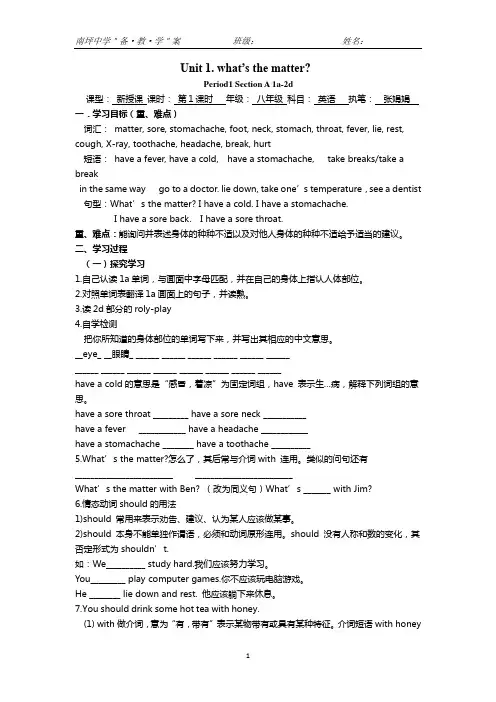
Unit 1. what’s the matter?Period1 Section A 1a-2d课型:新授课课时:第1课时年级:八年级科目:英语执笔:张娟娟一.学习目标(重、难点)词汇:matter, sore, stomachache, foot, neck, stomach, throat, fever, lie, rest, cough, X-ray, toothache, headache, break, hurt短语:have a fever, have a cold, have a stomachache, take breaks/take a break in the same way go to a doctor. lie down, take one’s temperature,see a dentist句型:What’s the matter? I have a cold. I have a stomachache.I have a sore back. I have a sore throat.重、难点:能询问并表述身体的种种不适以及对他人身体的种种不适给予适当的建议。
二、学习过程(一)探究学习1.自己认读1a单词,与画面中字母匹配,并在自己的身体上指认人体部位。
2.对照单词表翻译1a画面上的句子,并读熟。
3.读2d部分的roly-play4.自学检测把你所知道的身体部位的单词写下来,并写出其相应的中文意思。
__eye_ __眼睛_ ______ ______ ______ ______ ______ ____________ ______ ______ ______ ______ ______ ______ ______have a cold的意思是“感冒,着凉”为固定词组,have 表示生…病,解释下列词组的意思。
have a sore throat _________ have a sore neck ___________have a fever ____________ have a headache ____________have a stomachache ________ have a toothache __________5.What’s the matter?怎么了,其后常与介词with 连用。
人教版八年级下册英语教案unit1
人教版八年级下册英语教案unit1就英语教学过程而言,英语教案要充分体现开放性和动态生成性,从而赋予课堂教学以灵活性和多元性品格;下面是小编为大家精心整理的人教版八年级下册英语教案unit1,仅供参考。
人教版八年级下册英语教案unit1范文课题:Unit One What’s the matter? Period 1 Section A (1a-2d)一、Teaching date:二:学情及教学内容分析:主要讨论的话题是询问某人的健康状况以及遇到麻烦的表达方法。
本单元涉及到大量的表示人体部分的单词以及关于身体某部位不舒服的短语。
此外,本单元还涉及到党当人身体不适时,医生、朋友或亲人提出的意见的表达法。
本单元共有阅读类文章两篇,文章的主体时态都为一般过去时。
主要句型为.What’s the matter with…?”“What should I/ you/ he/ she/they… do?” “I/ you/ he/ she/they should do…?” “I have a headache/stomachache/toothache.” “Does she/he/ have a fever/cold/toothache…?”总的来说,本单元的相关语法知识并不难。
教学目标:三:教学目标:1. 语言知识目标:1) 能掌握以下单词以及短语:matter, sore, have a cold, foot, neck, stomach, throat, fever, lie, lie down, rest, cough, toothache, headache, break, hurt, enough water, take breaks away from, all weekend, take one’s temperature, in the same way, go to a doctor, see a dentist,2) 能熟悉以下句型:What’s the matter with…?”“What should I/ you/ he/ she/they… do?”“I/ you/ he/ she/they should do…”2. 情感态度价值观目标:教会学生关心他人,培养同学间团结、友善的精神。
人教版英语八年级下册一单元教案解析SectionA+sectionB
Unit 1 What’s the matter?Section A一.教材分析学生将会学会如何谈论他们的健康问题以及如何给予他人建议。
本单元的话题是健康问题,健康是一切活动的保障,关乎我们每天的日常生活,所以有必要让学生了解相关的知识。
本节课的话题出自Unit1 What’s the matter?(section A),主要让学生认知表示身体部位的单词以及部分疾病的表达方法,学会谈论自己及他人的健康状况,能针对健康问题提出合理化建议。
在具体教学中我对教材内容进行了整合,删除了材料中的听力部分,将其用图片的形式展示出来以保持课堂的完整性。
我还对教材做了适当的修改和扩充,使内容更贴近生活,让学生有更多的发挥空间。
二、学情分析八年级的学生具有过渡性和动荡性的心理特点,处于两极分化的突出时候,学生差异较大,因此在任务设计上我注重分层,面向全体,充分调动每个学生的积极性。
但由于这个阶段的学生活泼好动,好奇心较强,再加上本节课又是他们从未接触过的有关健康的话题,所以在课堂设计上我十分注意生动活泼但不幼稚,发扬传统但不古板。
三.教学目标1、Knowledge Objectives(知识目标)(1)掌握身体每个部分生词的发音,含义以及描述健康问题的词汇,Be able to master the pronunciation,meaning and spelling of the names of body parts and diseases.(2)如何根据别人的健康问题提建议。
Be able to learn the expressions of giving advice.(3)能够运用“What’s the matter? I have a……”谈论健康问题,能运用“You should ……You shouldn’t……”句型给出建议。
Be able to talk about health problems b y using “What’s the matter? I have a……” and give advice by using “You should ……You shouldn’t……”2.Ability Objectives(技能目标):(1)能听懂谈论健康问题的对话材料;Be able to understand the dialogue materials about health problems (2)能够流利的讨论据别人的健康问题提建议;Be able to talk about one’s health problems and give advice fluently (3)能写出重点单词和重点句型,并能描述怎样对待健康问题Be able to write key words and sentence patterns, and describe how to deal with health problems.3.Moral Objectives(情感态度目标)(1)通过本课的阅读,通过开展扮演病人等活动,培养学生关心他人身体健康的品质。
人教版英语八年级下册Unit1第一单元测试题含答案
Unit1What’s the matter?一.单项选择。
(每小题 1 分,共15 分)()1.As people’s life is getting better and better, so how to is becoming more and more important.A. play sportsB. keep healthyC. have a coldD. drink coffee ()2.You are tired, so you go to the party.A.shallaren’tB.needC. shouldn’tD.()3.The little girl has a fever. The doctor is .A. taking her temperature C. getting an X-rayB. putting some medicine on it D. putting a bandage on it()4.—I’d like a cup of tea nothing in it.—OK. What else?A. haveB. hasC. withD. and ()5.—I have a toothache.—I think you should .A. lie down and restB. drink hot tea with honeyC. listen to soft musicD. go to see a dentist()6.—What was the matter with you?—.A.I passed my math exam C.I broke my bikeB.I found my library book D.He lost his dictionary()7.You shouldn’t eat food, or you’ll be fat.A. too much; much too C. much too; too m uchB.too much; too much D. much too; much too()8.Tony is thinking about a new bike.A. buy B .to buy C. buys D.buying()9.Alice is interested in the Internet.A. useB. using C .to use es()10. her surprise, she felt better after having a rest.A .In B. On C. To D .At()11.Linda has trouble Chinese history.A. learningB. learnC. to learnD. learned ()12.Ben is used to to school. He used to the bus to school last year.A. walking;takingB. walk; takeC. walking;takeD. walk;taking()13.Where will you ?A. get outB. get off C .get out of D. get of ()14.His money . He asked his mother for some.A. ran out ofB. is run outC. was run outD. ran out ()15.If you keep on , you’ll succeed.A. tryB. to tryC. tryingD. tries二.单元重难点过关。
人教版高中英语同步练习:选修8 unit 1 period 1(含答案)(精修版)
人教版英语精品资料(精修版)Unit 1 A land of diversity Period 1 Warming Up,Pre-reading & Reading 同步精练(人教版选修8,课标通用)Ⅰ.介、副词填空1.Some of the president's advisers feared Hitler might declare war________the United States.2.We kept________our friendship for over twenty years.3.The old people died but the young ones lived________.4.He succeeded________means________perseverance.5.________the time he was ten, Tom had built a chemistry lab himself.6.She has two cars, and________addition, a motorboat.7.We hope the garden to keep________the weeds.8.Millions of people die________the illnesses caused by smoking.答案 1.on 2.up 3.on 4.by of 5.By 6.in7.down 8.fromⅡ.单词拼写1. He drew a quite artificial________(差别) between men and women readers. 2.Whisky contains a large________(百分比) of alcohol.3.Gradually she learned to make a joke of all these________(困难).4.The ________(部) of Transport made a searching enquiry to discover the cause of the plane crash.5.The oil market is enjoying a ________(繁荣).6.The ________(种族的) discrimination issue is a political hot potato. 7.Leonardo da Vinci is a famous artist in the ________(意大利) Renaissance.8.In the USA foreign policy is decided by the ________(联邦的) government. 9.The ________(大多数)of people seem to prefer TV to radio.10.He was ________(选举) chairman of the education committee.答案 1.distinction 2.percentage 3.hardships 4.Ministry 5.boom 6.racial7.Italian8.federal9.majority 10.electedⅢ.翻译与仿写1. However, it is likely that Native Americans were living in California at least fifteenthousand years ago.翻译:_____________________________________________________________ 仿写:这次会议有可能会由于天气原因而被推迟。
人教版八年级英语下册Unit 1(1)教案
新人教版八年级英语下册Unit 1(1)教案Teaching goals:1. Words&phrases: robot, paper, less, fewer, simple, unpleasant, factory, seem, etc .2. will 构成的一般将来时态的陈述句、否定句、疑问句及回答.3. There be 句型的一般将来时.4. more , less , fewer 的用法.5. 学习一般将来时态的相关知识,学会对未来进行预测.6. 对five years ago ,today ,in five years 简洁回顾与展望的方式,贴近实际符合学生心理,激发学习兴趣.7. 通过时间对比复习一般过去时态、一般现在时态,巩固一般将来时.Important and difficult points :1. will构成一般将来时态的句式。
2. There be 句型的一般将来时态。
3. more , fewer , less 的用法。
4. How to make predictions .Period 1Teaching procedures:Step 1 Leading in1. Greetings: Welcome to sc hool .What’s the date today ? Who’s on duty today ?Do you enjoy your winter holiday ?Do you finish your homework ?Do you want to live on the moon ?Can you guess what will happen in ten years ?Collect the Ss’ answers and say something about their predictions .Step 2 Pre-taskPage 2 ,1a .1. Look at the picture :How will the world be different in the future ,100 years from now ?We’re going to talk about sth in 100 years .2. Read each predictions to the class .Explain the new vocabulary .3. Read the instructions .Make sure Ss know what they should do .4. Do it by themselves .5. Talk about the answers with the class .Explain :一般将来时态构成: will / be going to +动词原形Step 3 While-taskPage 2 ,1b .1. Practise reading the six predictions .2. Read the instructions to Ss .Circle the things you hear on the recording .3. Play the tape twice .4. Play the tape a third time .At the same time ,check the answers .Page 2 , 1c .1. Pay attention to the dialogues .2. Read the dialogues fluently .3. Pairwork .Work in pairs to make predictions according to the sample .4. Ask several pairs to share their conversations to the class .Page 3 , 2a & 2b .1. Read the predictions .2. Read the instructions and point out the sample answer .3. Play the tape twice .Ss circle the word they hear in each sentences: more , less , fewer .4. Check the answers .学生探究: less , fewer 的区别。