
安徽省合肥市2018届高三第三次教学质量检测英语试题 扫描版
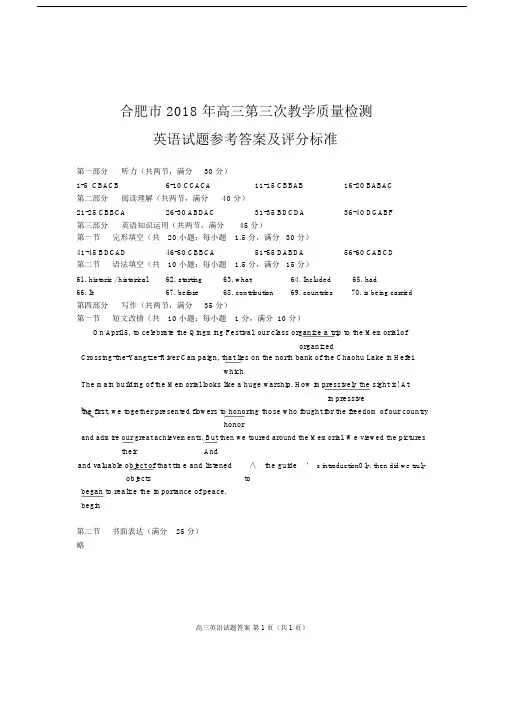
合肥市2018年高三第三次教学质量检测
英语试题参考答案及评分标准
第一部分听力(共两节,满分30分)
1-5 CBACB 6-10 CCACA 11-15 CBBAB 16-20 BABAC
第二部分阅读理解(共两节,满分40分)
21-25 CBBCA 26-30 ABDAC 31-35 BDCDA 36-40DGABF
第三部分英语知识运用(共两节,满分45分)
第一节完形填空(共20小题;每小题1.5分,满分30分)
41-45 BDCAD 46-50 CBBCA 51-55 DABDA 56-60 CABCD
第二节语法填空(共10小题;每小题1.5分,满分15分)
61. historic / historical 62. starting 63. what 64. Included 65. had
66. It 67. before 68. contribution 69. countries 70. is being carried
第四部分写作(共两节,满分35分)
第一节短文改错(共10小题;每小题1分,满分10分)
On April 5, to celebrate the Qingming Festival, our class organize a trip to the Memorial of
organized
Crossing-the-Yangtze-River Campaign, that lies on the north bank of the Chaohu Lake in Hefei.
which
The main building of the Memorial looks like a huge warship. How impressively the sight is! At
impressive
the first, we together presented flowers to honoring those who fought for the freedom of our country
honor
and admire our great achievements. But then we toured around the Memorial. We viewed the pictures their And
and valuable object of that time and listened ∧the guide’s introduction. Only then did we truly objects to
began to realize the importance of peace.
begin
第二节书面表达(满分25分)
略
高三英语试题答案第1 页(共1页)。
安徽省合肥市高三第三次教学质量检测英语试题 word版

合肥市2012年高三第三次教学质量检测英语试题(考试时间:120分钟满分:150分}注意事项:1.选择题用答题卡的考生,答第I卷前,务必将自己的姓名、准考证号、试题科目用2B 铅笔涂写在答题卡上。
2.选择题用答题卡的考生,在答第I卷时,每小题选出答案后,用2B铅笔把答题卡上对应题目的答案标号涂黑。
如需改动,用橡皮擦干净后,再选涂其它答案,不能答在试题卷和答题卷的选择题栏中。
不用答题卡的考生,在答第I卷时,每小题选出答案后,填在答题卷相应的选择题栏上。
3.答第II卷时,考生务必将自已的学校、姓名、考点、准考证号填在答题卷相应的位置;答题时,请用0.5毫米的黑色签字笔直接答在答题卷上,不要在试题卷上答题。
4.考试结束,监考人将答题卷和答题卡一并收回,第I、II卷不收回。
第I卷(三部分,共115分)第一部分:听力(共两节,满分30分)第一节(共5小题;每小题1. 5分,满分7. 5分)听下面5段对话。
每段对话后有一个小题,从题中所给的A、B、C三个选项中选出最佳选项,并标在答题卷的相应位置。
用答题卡的考生,先把选出的最佳选项标在试卷的相应位置,苒转涂到答题卡上。
听完每段对话后,你都有10秒钟的时间来回答有关小题和阅读下一小题。
每段对话仅读一遍。
1.When did the alarm ring?A. At 7 : 00.B. At 7 : 30.C. At 8: 00.2.What does the woman think of the man?A. He is careful.B. He is forgetful.C. He is childish.3.What does the man think is helpful to our health?A. Swimming in the sea.B. Swimming in winter.C. Swimming every day.4.Why do most people dance in the street?A. To kill time.B. To draw comfort.C. To show paces.5.What are the two speakers talking about?A. Goldfish.B. Snakes.C. Pets.第二节(共15小题,每小题1. 5分,满分22. 5分)听下面5段对话或独白。
安徽省合肥市2018届高三英语质量检测英语试题
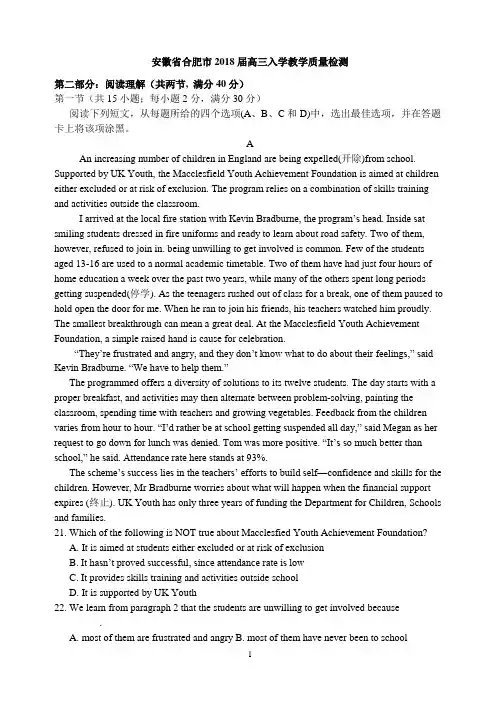
安徽省合肥市2018届高三入学教学质量检测第二部分:阅读理解(共两节, 满分40分)第一节(共15小题;每小题2分,满分30分)阅读下列短文,从每题所给的四个选项(A、B、C和D)中,选出最佳选项,并在答题卡上将该项涂黑。
AAn increasing number of children in England are being expelled(开除)from school. Supported by UK Youth, the Macclesfield Youth Achievement Foundation is aimed at children either excluded or at risk of exclusion. The program relies on a combination of skills training and activities outside the classroom.I arrived at the local fire station with Kevin Bradburne, the program’s head. Inside sat smiling students dressed in fire uniforms and ready to learn about road safety. Two of them, however, refused to join in. being unwilling to get involved is common. Few of the students aged 13-16 are used to a normal academic timetable. Two of them have had just four hours of home education a week over the past two years, while many of the others spent long periods getting suspended(停学). As the teenagers rushed out of class for a break, one of them paused to hold open the door for me. When he ran to join his friends, his teachers watched him proudly. The smallest breakthrough can mean a great deal. At the Macclesfield Youth Achievement Foundation, a simple raised hand is cause for celebration.“They’re frustrated and angry, and they don’t know what to do about their feelings,” said Kevin Bradburne. “We have to help them.”The programmed offers a diversity of solutions to its twelve students. The day starts with a proper breakfast, and activities may then alternate between problem-solving, painting the classroom, spending time with teachers and growing vegetables. Feedback from the children varies from hour to hour. “I’d rather be at school getting suspended all day,” said Megan as her request to go down for lunch was denied. Tom was more positive. “It’s so m uch better than school,” he said. Attendance rate here stands at 93%.The scheme’s success lies in the teachers’ efforts to build self—confidence and skills for the children. However, Mr Bradburne worries about what will happen when the financial support expires (终止). UK Youth has only three years of funding the Department for Children, Schools and families.21. Which of the following is NOT true about Macclesfied Youth Achievement Foundation?A. It is aimed at students either excluded or at risk of exclusionB. It hasn’t proved successful, since attendance rate is lowC. It provides skills training and activities outside schoolD. It is supported by UK Youth22. We learn from paragraph 2 that the students are unwilling to get involved because_________.A. most of them are frustrated and angryB. most of them have never been to schoolC. few of them have learned about road safetyD. few of them are used to a normal academic timetable23. What do the students think of the scheme?A. They have mixed opinionsB. They think it’s better than schoolC. They think it’s boring and meaninglessD. They think it’s interesting but not helpful24. What will the author most probably discuss in the next part?A. Courses the scheme offersB. Difficulties the scheme facesC. Solutions the scheme providesD. Achievements the scheme has madeBMany teens in high school want to try out for sports. A lot of them try out because they think it will make them popular or get them more dates. While this may seem like a silly reason, there are lots of other benefits to sports that your children may fail to notice.With TV, movies, computers and video games becoming more and more popular, it has become so much easier for teens to be by themselves rather than going out with friends. Kids used to go hang out at the mall or drive around town; now they just sit at home. Getting your teens into a sport gives them a chance to go out and spend time with other people socially. While they may not find a new best friend, they will learn how to communicate with one another and work as a team and they’ll find something useful later in life.More and more kids are becoming overweight. Joining a team sport will help teens get out and get some exercise without feeling pressured to lose weight or get in shape. What’s more, if your teens see that their physical condition is causing them to under-perform, they may be encouraged to do other activities to get healthy. By the time your children reach their teenager year, part of good parenting will be providing them with direction and encouragement and continuing to help them develop a healthy style of living.These days, it’s becoming harder to show your teenagers that you love and support them. A great way to do this is by showing up to their game, helping them practice, and helping with team fundraisers. These are also great ways to spend time with your kids and talk to them.You may think “but my teen isn’t good enough to make their school team”. There are ple nty of other places besides school to play team sports. You can always check out “for-fun” teams. You could look into more unknown sports that you may not have thought of, did you know that bowling is a NCAA team sports If you do a little research, you’re sure to find something your teen will enjoy.Team sports are a great way for teens to get out of the house, get moving, make friends, and even get a scholarship to college. So why not talk to them about getting into sports today25. After joining a sport, children may .A. lose weight without any pressure.B. find little pressure in learning.C. be forced to do some exercise.D. be provided with good parenting.26. What does the under lined word “this” refer to?A. To help teens develop a healthy lifestyle.B. To show love to your teens.C. To enable teens to know more about new places.D. To motivate teens to get healthy.27. Why did the author write this passage?A. To explain some non-competitive sports.B. To encourage parents to join their children in sports.C. To introduce the advantages of sports for teens.D. To stress the importance of teamwork in sports.CMany years ago, when we were a young couple with two small children, aged 2 and 4, we were practically impecunious. My in-laws lived from hand to mouth, so we didn't expect any help from them. My parents lived a great distance away, and I was too ashamed to let them know about our situation.My husband was trying to earn a living with an old pick-up truck, carrying groceries for local shopkeepers, but it was constantly breaking down. It took almost all the money we had to have it fixed. The truck was also the only means of transportation for us.We lived in the countryside, and we always used the back door because the driveway led to it. One winter evening, I stepped outside to take a bag of trash to the barrel and almost tripped over something. It was nearly dark, and I had to bend down to see what it was. I could hardly believe my eyes. There sat a large basket loaded with food.It was heavy, so I called to my husband to carry into the house. Once inside, we discovered two loaves of bread, some butter, several cans of vegetables, a can of orange sauce, and a large turkey. There was so much that I can't remember it all, but it was everything we needed to fix a wonderful dinner—everything except potatoes.A little while later I remembered that I hadn't taken the trash to the barrel. By now it was dark, so I had to turn on the yard light —and that's when I spotted a small bag of potatoes sitting on the porch.That dinner was the best I can remember.We weren't able to thank our donators, though, because we never found out who had been so generous in helping a struggling young family. Whoever it was, we are forever grateful.28. Which of the following can replace the underlined word "impecunious" in Paragraph 1?A. Generous.B. Harmonious.C. Penniless.D. Stubborn.29. How did the author's husband support the family?A. By starting a garage.B. By selling food door to door.C. By delivering goods.D. By working as a shop assistant.30. How did the author feel when she saw the basket?A. She was annoyed.B. She was astonished.C. She was terrified.D. She felt a sense of relief.31. What may be the best title for the text?A. A helping hand in timeB. A struggling young coupleC. A tale of potatoesD. A reward from a strangerDAs Artificial Intelligence (A) becomes increasingly sophisticated,there are growing concerns that robots could become a threat.This danger can be avoided,according to computer science professor Stuart Russell,if we figure out how to turn human values into a programmable code.Russell argues that as robots take on more complicated tasks,it’s necessary to translate our morals into AI language.For example,if a robot does chores around the house,you wouldn't want it to put the pet cat in the oven to make dinner for the hungry children. "You would want that robot preloaded with a good set of values," said Russell.Some robots are already programmed with basic human values.For example,mobile robots have been programmed to keep a comfortable distance from humans.Obviously there are cultural differences,but if you were talking to another person and they came up close in your personal space,you wouldn't think that's the kind of thing a properly brought-up person would do.It will be possible to create more sophisticated moral machines,if only we can find a way to set out human values as clear rules.Robots could also learn values from drawing patterns from large sets of data on human behavior.They are dangerous only if programmers are careless.The biggest concern with robots going against human values is that human beings fail to do sufficient testing and they've produced a system that will break some kind of taboo(禁忌).One simple check would be to program a robot to check the correct course of action with a human when presented with an unusual situation.If the robot is unsure whether an animal is suitable for the microwave,it has the opportunity to stop,send out beeps,and ask for directions from a human.If we humans aren't quite sure about a decision,we go and ask somebody else.The most difficult step in programming values will be deciding exactly what we believe in moral,and how to create a set of ethical rules.But if we come up with an answer,robots could be good for humanity.32.What does the author say about the threat of robots?A.It may be a challenge to computer programmers.B.It accompanies all machinery involving high technology.C.It can be avoided if human values are translated into their language.D.It has become an inevitable danger as technology gets more sophisticated.33.How do robots learn human values?A.By interacting with humans in everyday life situations.B.By following the daily routines of civilized human beings.C.By picking up patterns from massive data on human behavior.D.By imitating the behavior of properly brought-up human beings.34.What will a well-programmed robot do when facing an unusual situation?A.Keep a distance from possible dangers.B.Do sufficient testing before taking action.C.Set off its built-in alarm system at once.D.Stop to seek advice from a human being.35.What is most difficult to do when we turn human values into a programmable code?A.Determine what is moral and ethical.B.Design some large-scale experiments.C.Set rules for man-machine interaction.D.Develop a more sophisticated program.第二节(共5小题;每小题2分, 满分10分)根据短文内容,从短文后的选项中选出能填入空白处的最佳选项。
安徽省合肥市高三英语第三次教学质量检测英语试卷

英语试题本试卷分第一卷(选择题)和第二卷(非选择题)两部分。
第一卷 1至 8页。
第二卷9至 10页。
考试结束,将本试卷和答题卡一并交回。
第I卷(选择题,共115分)注意事项:1.答题前,考生在答题卡上务必用直径0.5毫米黑色墨水签字笔将自己的姓名、准考证号填写清楚。
请认真核准准考证号、姓名和科目。
高考资源网2.每小题选出答案后,用2B铅笔把答题卡上对应题目的答案标号涂黑,如需改动,用橡皮擦干净后,再选涂其他答案,在试题卷上作答无效。
第一部分:听力(共两节,满分30分)做题时先将答案标在试卷上,录音内容结束后,你将有两分钟的时间将试卷上的答案转涂到答题卡上。
第一节(共5小题;每小题1.5分,满分7.5分)听下面5段对话。
每段对话后有一个小题,从题中所给的A、B、C三个选项中选出最佳选项,并标在试卷的相应位置。
听完每段对话后,你都有10秒钟的时间来回答有关小题和阅读下一小题。
每段对话仅读一遍。
1. What does the woman mean?A. She is not well prepared.B. She is ready for the test.C. She will quit the test.2. What does the woman like to do in her spare time?A. Sit quietly.B. Do nothing.C. Surf the Internet.3. How is the traffic at this time every day?A. Light.B. Unusual.C. Heavy.4. What do the speakers say about the restaurant?A. It serves the best food in town.B. They are disappointed at it.C. They like the new chef in it.5. Where is the son?A. In the washroom.B. In the kitchen.C. In the basement.第第二节(共15小题;每小题1.5分,满分22.5分)听下面5段对话或独白。
安徽省皖南八校2018届高三第三次联考英语试题

安徽省皖南八校2018届高三第三次联考英语试题第一部分听力(共两节,满分30分)第一节(共5小题;每小题1.5分,满分7.5分)听下面5段对话。
每段对话后有一个小题,从题中所给的A、B、C三个选项中选出最佳选项,并标在试卷的相应位置。
听完每段对话后,你都有10秒钟的时间来回答有关小题和阅读下一小题。
每段对话仅读一遍。
1. Where did the man spend his childhood?A. In China.B. In Canada.C. In the USA2. What will the woman probably do next?A. Change her address.B. Mail some letters.C. Call the post office.3. What does the man order?A. Cold coffee.B. Corn bread.C. Grape juice.4. How is it now on the beach?A. It’s cloudy.B. It’s raining.C. It’s fine.5. What is the woman planning to do?A. Play tennis.B. Go swimming.C. Clean the house.第二节(共15小题;每小题1.5分,满分22.5分)听下面5段对话或独白。
每段对话或独白后有几个小题,从题中所给的A、B、C三个选项中选出最佳选项,并标在试卷的相应位置。
听每段对话或独白前,你将有时间阅读各个小题,每小题5秒钟;听完后,各小题将给出5秒钟的作答时间。
每段对话或独白读两遍。
听第6段材料,回答第6、7题。
6. What’s the probable relationship between the speakers?A. Workmates.B. Friends.C. Strangers.7. What is the woman going to do next?A. Write a report.B. Look for Alan.C. Have lunch.听第7段材料,回答第8、9题。
2018年高考英语全国卷3(附答案)完整版.doc
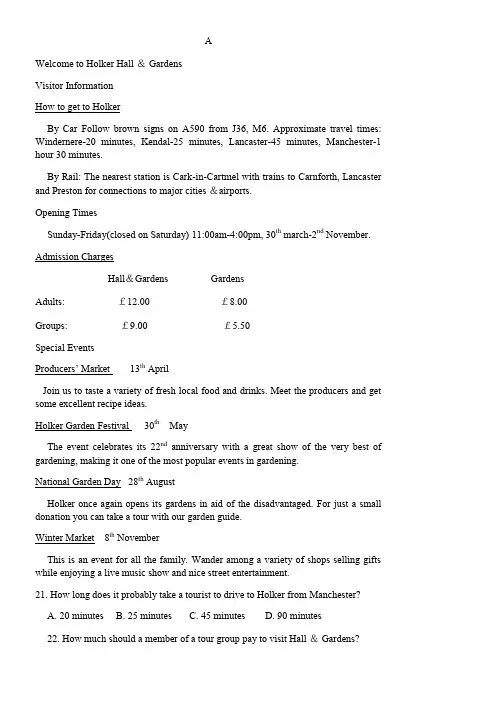
AWelcome to Holker Hall & GardensVisitor InformationHow to get to HolkerBy Car Follow brown signs on A590 from J36, M6. Approximate travel times: Windernere-20 minutes, Kendal-25 minutes, Lancaster-45 minutes, Manchester-1 hour 30 minutes.By Rail: The nearest station is Cark-in-Cartmel with trains to Carnforth, Lancaster and Preston for connections to major cities &airports.Opening TimesSunday-Friday(closed on Saturday) 11:00am-4:00pm, 30th march-2nd November.Admission ChargesHall&Gardens GardensAdults: £12.00 £8.00Groups: £9.00 £5.50Special EventsProducers’ Market 13th AprilJoin us to taste a variety of fresh local food and drinks. Meet the producers and get some excellent recipe ideas.Holker Garden Festival 30th MayThe event celebrates its 22nd anniversary with a great show of the very best of gardening, making it one of the most popular events in gardening.National Garden Day 28th AugustHolker once again opens its gardens in aid of the disadvantaged. For just a small donation you can take a tour with our garden guide.Winter Market 8th NovemberThis is an event for all the family. Wander among a variety of shops selling gifts while enjoying a live music show and nice street entertainment.21. How long does it probably take a tourist to drive to Holker from Manchester?A. 20 minutesB. 25 minutesC. 45 minutesD. 90 minutes22. How much should a member of a tour group pay to visit Hall & Gardens?A. £12.00B. £9.00C. £8.00D. £5.5023. Which event will you go to if you want to see a live music show?A. Producers’ MarketB. Holker Garden FestivalC. National Garden DayD. Winter MarketBCities usually have a good reason for being where they are, like a nearby port or river. People settle in these places because they are easy to get to and naturally suited to communications and trade. New York City, for example, is near a large harbour at the mouth of the Hudson River. Over 300 years its population grew gradually from 800 people to 8 million. But not all cities develop slowly over a long period of time. Boom towns grow from nothing almost overnight. In 1896, Dawson, Canada, was unmapped wilderness(荒野). But gold was discovered there in 1897, and two years later, it was one of the largest cities in the West, with a population of 30000.Dawson did not have any of the natural conveniences of cities like London or Paris. People went there for gold. They travelled over snow-covered mountains and sailed hundreds of miles up icy rivers. The path to Dawson was covered with thirty feet of wet snow that could fall without warning. An avalanche(雪崩) once closed the path, killing 63 people. For many who made it to Dawson, however, the rewards were worth the difficult trip. Of the first 20000 people who dug for gold, 4000 got rich. About 100 of these stayed rich men for the rest of their lives.But no matter how rich they were, Dawson was never comfortable. Necessities like food and wood were very expensive. But soon, the gold that Dawson depended on had all been found. The city was crowded with disappointed people with no interest in settling down, and when they heard there were new gold discoveries in Alaska, they left Dawson City as quickly as they had come. Today, people still come and go-to see where the Canadian gold rush happened. Tourism is now the chief industry of Dawson City-its present population is 762.24. What attracted the early settlers to New York City?A. its business cultureB. its small populationC. its geographical positionD. its favourable climate25. What do we know about those who first dug for gold in Dawson?A. two-thirds of them stayed thereB. one out of five people got richC. almost everyone gave upD. half of them died26. What was the main reason for many people to leave Dawson?A. they found the city too crowdedB. they wanted to try their luck elsewhereC. they were unable to stand the winterD. they were short of food27. What is the text mainly about?A. the rise and fall of a cityB. the gold rush in CanadaC. journeys into the wildernessD. tourism in DawsonCWhile famous foreign architects are invited to lead the designs of landmark buildings in China such the new CCTV tower and the National Center for the Performing Arts, many excellent Chinese architects are making great efforts to take the center stage.Their efforts have been proven fruitful. Wang Shu, a 49-year-old Chinese architect, won the 2012 Pritzker Architecture Prize-which is often referred to as the Nobel Prize in architecture-on February 28. He is the first Chinese citizen to win this award.Wang serves as head of the Architecture Department at the China Academy of Art(CAA). His office is located at the Xiangshan campus(校园) of the university in Hangzhou, Zhejiang Province. Many buildings on the campus are his original creations.The style of the campus is quite different from that of most Chinese universities. Many visitors were amazed by the complex architectural space and abundant building types. The curves(曲线) of the buildings perfectly match the rise and fall of hills, forming a unique view.Wang collected more than 7 million abandoned bricks of different ages. He asked the workers to use traditional techniques to make the bricks into walls, roofs and corridors. This creation attracted a lot of attention thanks to its mixture of modern and traditional Chinese elements(元素).Wang's works show a deep understanding of modern architecture and a good knowledge of traditons. through such a balance, he had created a new type of Chinese architecture, said Tadao Ando, the winner of the 1995 Pritzker Prize.Wang believes traditons should not be sealed in glass boxes at museums. "That is only evidence that traditions once existed," he said."Many Chinese people have a misunderstanding of traditions. They think tradition means old things from the past. In fact, tradition also refers to the things that have been developing and that are still being created," he said."Today, many Chinese people are learning Western styles and theories rather than focusing on Chinese traditions. many people tend to talk about traditions without knowing what they really are," said Wang.The study of traditions should be combined with practice. otherwise, the recreation of traditions would be artificial and empty, he said.28. Wang's winning of the prize means that Chinese architects areA. following the lastest world trendB. getting international recognitionC. working harder than ever beforeD. relying on foreign architects29. What impressed visitors to the CAA Xiangshan campus most?A. Its hilly environmentB. its large sizeC. Its unique styleD. its diverse functions30. What made Wang’s architectural design a success?A. The mixture of different shapesB. the balance of east and westC. The use of popular techniquesD. the harmony if old and new31. What should we do about Chinese traditions according to Wang?A. Spread them to the worldB. preserve them at museumsC. Teach them in universitiesD. recreate them in practiceDAdults understand what it feels like to be flooded with objects. Why do we often assume that more is more when it comes to kids and their belongings? The good news is that I can help my own kids learn earlier than I did how to live more with less.I found the pre-holidays a good time to encourage young children to donate less-used things, and it worked. Because of our efforts, our daughter Georgia did decide to donate a large bag of toys to a little girl whose mother was unable to pay for her holiday due to illness. She chose to sell a few larger objects that were less often used when we promised to put the money into her school fund(基金) (our kindergarten daughter is serious about becoming a doctor).For weeks, I’ve been thinking of bigger, deeper questions: How do we make it a habit for them? And how do we train ourselves to help them live with, need, and use less? Yesterday, I sat with my son, Shepherd, determined to test my own theory on this. I decided to play with him with only one toy for as long as it would keep his interest. I expected that one toy would keep his attention for about five minutes, ten minutes, max. I chose a red rubber ball-simple, universally available. We passed it, he tried to put it in his mouth, he tried bouncing it, rolling it, sitting on it, throwing it. It was totally, completely enough for him. Before I knew it an hour had passed and it was time to move on to lunch.We both became absorbed in the simplicity of playing together. He had my full attention and I had his. My little experiment to find joy in a single object worked for both of us.32.What do the words “more is more” in paragraph 1 probably mean?A.The more, the betterB. Enough is enoughC. More money, more worriesD. Earn more and spend more33.What made Georgia agree to sell some of her objects?A.Saving up for her holiday.B.Raising money for a poor girlC. Adding the money to her fundD. Giving the money to a sick mother34. Why did the author play the ball with Shepherd?A.To try out an ideaB. To show a parent’s loveC. To train his attentionD. To help him start a hobby35.What can be a suitable title for the text?A.Take it or leave itB. A lesson from kidsC.Live more with lessD. The pleasure of giving七选五Before there was the written word, there was the language of dance. Dance expresses love and hate, joy and sorrow, life and death, and everything else in between.36 We dance from Florida to Alaska, from north to south and sea to sea. We dance ant weddings, birthdays, office parties and just to fill the time.“I adore dancing,” says Lester Bridges, the owner of a dance studio in Iowa. “I can’t imagine doing anything else with my life,” Bridges runs dance classes for all ages. “Teaching dance is wonderful. 37 It’s great to watch them. For many of them, it’s a way of meeting people and having a social life.”38 “I can tell you about one young couple,”says Bridges. “They’re learning to do traditional dances. They arrive at the class in low spirits and they leave with a smile. 39 ”So, do we dance in order to make ourselves feel better, calmer, healthier? Andrea Hillier says, “Dance, like the pattern of a beating heart, is life. Even after all these years, I want to get better and better. 40 I find it hard to stop! Dancing reminds me I’m alive.”A.So why do we dance?B.Dance in the U.S. is everywhere.C.If you like dancing outdoors, come to America.D.My older students say it makes them feel young.E.I keep practicing even when I’m extremely tired.F.Dancing seems to change their feeling completely.G.They stayed up all night long singing and dancing.完形填空When most of us get a text messages on our cell phone from an unknown person, we usually say “sorry, 41 number!” and move on. But when Dennis Williams 42 a text that clearly wasn’t intended for him, he did something 43 .On March 19, Dennis got a group text 44 him that a couple he didn’t know were at the hospital, waiting for the 45 of a baby.“Congratulations! But I think someone was mistaken,” Dennis 46 . The baby was born and update texts were 47 quickly from the overjoyed grandmother, Teresa. In her 48 , she didn’t seem to realize that she was 49 the baby’s photos with a complete stranger. “Well, I don’t 50 you all but I will get there to take pictures with the baby,” replied Dennis before asking which room the new 51 were in.Much to the family’s surprise, Dennis stuck to his 52 ! He turned up at the hospital 53 gifts for the new mother Lindsey and her baby boy. Lindsey’s husband was totally 54 by the unexpected visit. “I don’t think we would have randomly invited him over but we 55 it and the gifts.”Teresa 56 a photo of the chance meeting on a social networking website 57 by the touching words: “What a 58 this young man was to our family! He was so 59 and kind to do this.” The post has since gained the 60 of social media users all over the world, receiving more than 184000 shares and 61500 likes in just three days.41.A.unlucky B.secret C.new D.wrong42.A.received B.translated C.copied D.printed43.A.reasonable B. special C. necessary D. practical44.A. convincing B. reminding C. informing D. warning45.A. wake-up B. recovery C. growth D. arrival46.A. responded B. interrupted C. predicted D. repeated47.A. coming in B. setting out C. passing down D. moving around48.A. opinion B. anxiety C. excitement D. effort49.A. comparing B. exchanging C. discussing D. sharing50.A. accept B. know C. believe D. bother51.A. parents B. doctors C. patients D. visitiors52.A. dream B. promise C. agenda D. principle53.A. bearing B. collecting C. opening D.making54.A. discouraged B. relaxed C. astonished D. defeated55.A. admit B. need C. appreciate D. expect56.A. found B. selected C. developed D. posted57.A. confirmed B. simplified C. clarified D. accompanied58.A. pity B. blessing C. relief D. problem59.A. smart B. calm C. sweet D. fair60.A. sympathy B. attention C. control D. trust语法填空I’m not sure 61 is more frightened, me or the female gorilla(大猩猩)that suddenly appears out of nowhere. I’m walking on a path in the forest in theCentral African Republic. Unexpectedly, I’m face- to-face with the gorilla, whobegins screaming at 62 top of her lungs. That makes her baby scream, andthen a 400-pound male appear. He screams the 63 (loud) of all. The noiseshakes the trees as the male beats his chest and charges toward me. I quickly lower myself, ducking my head to avoid 64 (look) directly into his eyes so he doesn’t feel 65 (challenge).My name is Mireya Mayor. I’m a 66 (science) who studies animalssuch apes and monkeys. I was searching 67 these three western lowlandgorillas I’d been observing. No one had seen them for hours, and my colleagues and Iwere worried.When the gorillas and I frightened each other, I was just glad to find 68 (they) alive. True to a gorilla’s unaggressive nature, the huge animal 69 (mean) me no real harm. He was just saying: “I’m king of this forest, and here is your reminder!” Once his message was delivered, he allowed me 70 (stay) and watch.短文改错It was Monday morning, and the writing class had just begin. Everyone wassilent, wait to see who would be called upon to read his and her paragraph aloud.Some of us were confident and eager take part in the class activity; others were nervous and anxious. I had done myself homework, but I was shy. I was afraid that tospeak in front of a larger group of people. At that moment, I remembered that myfather once said “The classroom is a place for learning and that include learning from textbooks, and mistake as well.” Immediate, I raised my hand.作文假定你是李华,你的英国朋友Peter来信询问你校学生体育运动情况,请给他回信,内容包括:1.学校的体育场馆2.主要的运动项目3.你喜欢的项目注意:1.词数100左右; 2. 可以适当增加细节,以使行文连贯参考答案:21-25 DBDCB 26-30 BABCD 31-35 DACAC 36-40 BDAFE41-45 DABCD 46-50 AACDB 51-55 ABACC 56-60 DDBCB61. who 62. the 63.loudest 64.looking 65.challenged66.scientist 67.for 68.them 69.meant 70.to stay71.begin→begun72.wait →waiting73.and→or74.eager ∧to75. myself→my/the76.去掉thatrger→large78.include→including79.mistake→mistakes80.immediate→immediately高考赠送以下资料考试知识点技巧大全一、考试中途应饮葡萄糖水大脑是记忆的场所,脑中有数亿个神经细胞在不停地进行着繁重的活动,大脑细胞活动需要大量能量。
合肥市高中高三第三次教学质量检测英语包括答案.doc
合肥市 2018 年高三第三次教学质量检测英语试题参考答案及评分标准第一部分听力(共两节,满分30 分)1-5 CBACB 6-10 CCACA 11-15 CBBAB 16-20 BABAC第二部分阅读理解(共两节,满分40 分)21-25 CBBCA 26-30 ABDAC 31-35 BDCDA 36-40 DGABF第三部分英语知识运用(共两节,满分45 分)第一节完形填空(共20 小题;每小题 1.5 分,满分30 分)41-45 BDCAD 46-50 CBBCA 51-55 DABDA 56-60 CABCD第二节语法填空(共10 小题;每小题 1.5 分,满分15 分)61. historic / historical 62. starting 63. what 64. Included 65. had66. It 67. before 68. contribution 69. countries 70. is being carried第四部分写作(共两节,满分35 分)第一节短文改错(共10 小题;每小题 1 分,满分 10 分)On April 5, to celebrate the Qingming Festival, our class organize a trip to the Memorial oforganizedCrossing-the-Yangtze-River Campaign, that lies on the north bank of the Chaohu Lake in Hefei.whichThe main building of the Memorial looks like a huge warship. How impressively the sight is! Atimpressivethe first, we together presented flowers to honoring those who fought for the freedom of our countryhonorand admire our great achievements. But then we toured around the Memorial. We viewed the pictures their Andand valuable object of that time and listened∧ the guide’ s introductionOly. then did we truly objects tobegan to realize the importance of peace.begin第二节书面表达(满分25 分)略高三英语试题答案第 1 页(共 1 页)。
安徽省合肥市高三第三次教学质量检测英语试题(三模)(word版)
合肥市2013年高三第三次教学质量检测英语试题(考试时间:120分钟满分:150分) 注意事项:1. 选择题用答题卡的考生,答第I卷前,务必将自己的姓名、准考证号、试题科目用2B 铅笔涂写在答题卡上。
2. 选择题用答题卡的考生,在答第I卷时,每小题选出答案后,用2B铅笔把答题卡上对应题目的答案标号涂黑,如需改动,用橡皮擦干净后,再选涂其它答案,不能答在试題卷和答题卷的选择题栏中;不用答题卡的考生,在答第I卷时,每小题选出答案后.填在答题卷相应的选择题栏上。
3. 答第II卷时,考生务必将自己的学校、姓名、考点、准考证号填在答题卷相应的位置;答题时,请用0.5毫米的黑色签字笔直接答在答题卷上,不要在试题卷上答题。
4. 考试结束,监考人将答题卷和答题卡一并收回,第I、II卷不收回。
第I卷(三部分,共115分)第一部分:听力(共两节,满分30分)回答听力部分时,请先将答案标在试卷上。
听力部分结束前,你将有两分钟的时间将你的答案转涂到客观答题卡上第一节(共5小题;每小题1.5分,满分7.5分)听下面5段对话。
每段对话后有一个小题,从题中所给的A、B、C三个选项中选出最佳选项,并标在答题卷的相应位置:用答题卡的考生,先把选出的最佳选项标在试卷的相应位置,再转涂到答题卡上。
听完每段对话后,你都有10秒钟的时间来回答有关小题和阅读下一小题。
每段对话仅读一遍。
1. Where was Sally’s backpack?A. On the square.B. On the 2nd Avenue.C. In the government building.2. What is the man going lo do for his birthday?A, Have a party. B. Dine out with his friends. C. Have dinner with his sister.3. When is Doctor Wang available?A. This afternoon.B. Any time this week.C. The following afternoon,4. What time probably was it when the conversation happened?A. 9:05pm, B, 9:25pm. C. 9:30pm.5. What does the man mean?A. He wants to drive to the bank.B. He can go to the bank on foot.C. He will wait at the school gate.第二节(共15小题,每小题1.5分,满分22. 5分)听下面5段对话或独白。
2018年全国卷Ⅲ英语高考试题(含答案)
2018年普通高等学校招生全国统一考试(新课标III卷)英语第一部分阅读理解(共两节,满分40分)第一节(共15小题;每小题2分,满分30分)阅读下列短文,从每题所给的A、B、C和D四个选项中,选出最佳选项。
AWelcome to Holker Ha ll & GardensVisitor InformationHow to Get to HolkerBy Car:Follow brown signs an A590 from JB6, M6.Approximale travel times: Windermere-20 minutes, Kendal-25 minutes, Lancaster-45 minutes, Manchester-I hour 30 minutes.z.x.xkBy Rail: The nearest stati on is Cark-in-Cartmel with trains to Carnforth, Lancaster Preston for connections to major cities & airports.Opening TimesSunday-Friday (closed on Saturday) 11:00 am-4:00pm, 30 March-2nd November.Admission ChargesHall & Gardens GardensAdults: £12.00 £8.00Groups £9 £5.5Producers: Market 13th AprilJoin us to taste a variety of fresh local food and drinks. Meet the producers and get some excellent recipe ideas.Holker Garden Festival 30th MayThe event celebrate its 22nd anniversary with a great show of the very best of gardening, making it one of the most popular events in gardening.National Garden Day 28th AugustHolker once again opens is gardens in aid of the disadvantaged. For just a small donation you can take a tour with our garden guide.Winter Market 8th NovemberThis is an event for all the family. Wander among a variety of shops selling gifs while enjoying a live music1show and nice street entertainment.1. How long does it probably take a tourist to drive to Holker from Manchester?A. 20minutes.B.25 minutes.C.45 minutes.D.90 minutes.2. How much should a member of a tour group pay to visit to Hall & Cardens?A.£l2.00.B. B.19.00.C.A8.0D.45.503. Which event will you go to if you want to see a live music show?A. Producers' Market.B. Holker Garden Festival.C. National Garden Day.D. Winter Market.BCities usually have a good reason for being where they are, like a nearby port or river. People settle in these places because they are easy to get to and naturally suited to communications and trade. New York City, for example, is near a large harbour at the mouth of the Hudson River. Over 300 years its population grew gradually from 800 people to 8 million. But not all cities develop slowly over a long period of time. Boom towns grow from nothing almost overnight. In 1896, Dawson, Canada, was unmapped wilderness(荒野). But gold was discovered there in 1897, and two years later, it was one of the largest cities in the West, with a population of 30,000.Dawson did not have any of the natural conveniences of cities like London or Paris. People went there for gold. They travelled over snow-covered mountains and sailed hundreds of miles up icy rivers. The path to Dawson was covered with thirty feet of wet snow that could fall without warming. An avalanche(雪崩) once closed the path, killing 63 people. For many who made it to Dawson, however, the rewards were worth the difficult trip. Of the first 20,000 people who dug for gold, 4,000 got rich. About 100 of these stayed rich men for the rest of their lives.But no matter how rich they were, Dawson was never comfortable. Necessities like food and wood were very expensive. But soon, the gold that Dawson depended on had all been found. The city was crowded with disappointed people with no interest in settling down, and when they heard there were new gold discoveries in Alaska, they left Dawson City as quickly as they had come. Today, people still come and go — to see where the Canadian gold rush happened. Tourism is now the chief industry of Dawson City — its present population is 762.4. What attracted the early settlers to New York City?A. Its business culture.B. Its small population.C. Its geographical position.D. Its favourable climate.25. What do we know about those who first dug for gold in Dawson?A. Two-thirds of them stayed there.B. One out of five people got rich.C. Almost everyone gave up.D. Half of them died.6. What was the main reason for many people to leave Dawson?A. They found the city too crowded.B. They wanted to try their luck elsewhere.C. They were unable to stand the winter.D. They were short of food.7. What is the text mainly about?A. The rise and fall of a city.B. The gold rush in Canada.C. Journeys into the wilderness.D. Tourism in Dawson.CWhile famous foreign architects are invited to lead the designs of landmark buildings in China such as the new CCTV tower and the National Center for the Performing Arts, many excellent Chinese architects are making great efforts to take the center stage.Their efforts have been proven fruitful. Wang Shu, a 49-year-old Chinese architect, won the 2012 Pritzker Architecture Prize — which is often referred to as the Nobel Prize in architecture — on February 28. He is the first Chinese citizen to win this award.Wang serves as head of the Architecture Department at the China Academy of Art (CAA). His office is located at the Xiangshan campus(校园) of the university in Hangzhou, Zhejiang Province. Many buildings on the campus are his original creations.The style of the campus is quite different from that of most Chinese universities. Many visitors were amazed by the complex architectural space and abundant building types. The curves(曲线) of the buildings perfectly match the rise and fall of hills, forming a unique view.Wang collected more than 7 million abandoned bricks of different ages. He asked the workers to usetraditional techniques to make the bricks into walls, roofs and corridors. This creation attracted a lot of attention3thanks to its mixture of modern and traditional Chinese elements(元素).Wang’s works show a deep understanding of modern architecture and a good knowledge of traditions. Through such a balance, he had created a new type of Chinese architecture, said Tadao Ando, the winner of the 1995 Pritzker Prize.Wang believes traditions should not be sealed in glass boxes at museums. "That is only evidence that traditions once existed," he said."Many Chinese people have a misunderstanding of traditions. They think tradition means old things from the past. In fact, tradition also refers to the things that have been developing and that are still being created, " he said."Today, many Chinese people are learning Western styles and theories rather than focusing on Chinese traditions. Many people tend to talk about traditions without knowing what they really are, " said Wang.The study of traditions should be combined with practice. Otherwise, the recreation of traditions would be artificial and empty, he said.8. Wang’s wi nning of the prize means that Chinese architects are ___________.A. following the latest world trendB. getting international recognitionC. working harder than ever beforeD. relying on foreign architects9. What impressed visitors to the CAA Xiangshan campus most?A. Its hilly environment.B. Its large size.C. Its unique style.D. Its diverse functions.10. What made Wang’s architectural design a success?A. The mixture of different shapes.B. The balance of East and West.C. The use of popular techniques.D. The harmony of old and new.11. What should we do about Chinese traditions according to Wang?A. Spread them to the world.B. Preserve them at museums.C. Teach them in universities.D. Recreate them in practice.DAdults understand what it feels like to be flooded with objects. Why do we often assume that more is more4when it comes to kids and their belongings? The good news is that I can help my own kids learn earlier than I did how to live more with less.z.x.xkI found the pre-holidays a good time to encourage young children to donate less-used things, and it worked. Because of our efforts, our daughter Georgia did decide to donate a large bag of toys to a little girl whose mother was unable to pay for her holiday due to illness. She chose to sell a few larger objects that were less often used when we promised to put the money into her school fund(基金)(our kindergarten daughter is serious about becoming a doctor)For weeks, I've been thinking of bigger, deeper questions: How do we make it a habit for them? And how do we train ourselves to help them live with, need, and use less? Yesterday, I sat with my son, Shepherd, determined to test my own theory on this. I decided to play with him with only one toy for as long as it would keep his interest. I expected that one toy would keep his attention for about five minutes, ten minutes, max. I chose a red rubber ball-simple, universally available. We passed it, he tried to put it in his mouth, he tried bouncing it, rolling it, sitting on it, throwing it. It was totally, completely enough for him. Before I knew it an hour had passed and it was time to move on to lunch.We both became absorbed in the simplicity of playing together. He had my full attention and I had his. My little experiment to find joy in a single object worked for both of us.12. What do the words “more is more” in paragraph 1 probably mean?A. The more, the better.B. Enough is enough.C. More money, more worries.D. Earn more and spend more.13.What made Georgia agree to sell some of her objects?A. Saving up for her holidayB. Raising money for a poor girlB. Adding the money to her fund D. Giving the money to a sick mother14. Why did the author play the ball with Shepherd?A. To try out an ideaB. To show a parent's loveC. To train his attentionD. To help him start a hobby15. What can be a suitable title for the text?A. Take It or Leave ItB. A Lesson from KidsC. Live More with LessD. The Pleasure of Giving5第二节(共5小题;每小题2分,满分10分)根据短文内容,从短文后的选项中选出能填入空白处的最佳选项。
2018年安徽省合肥市高考英语三模试卷
Opening Hours: Daily 8: 00 pm, Varies Seasonally
●Thundering Water Cultural Show
Niagara, like many impressive wonders of nature, is a sacred(神圣的)place for the local Native American people. This show uses dance as a storytelling medium through which to showcase the impact that the falls have had on native culture.
(1)Why did Laura Wolf take the photo and post it online?
A.She was really into recording some small gestures.
B.She wanted to draw attention to the restaurant.
A.Get to the top of the fells.
B.Spray water onto each other.
C.Have an experience of getting wet.
D.Go sightseeing along the Niagara River.
(2)Which of the following can help you appreciate the beauty of the falls at night?
安徽省合肥市高三英语第三次教学质量检测试题(含解析)
安徽省合肥市2014届高三第三次教学质量检测英语试题(考试时间:120分钟满分:150分)第I卷(三部分,共115分)第一部分:听力 (共两节, 满分30分)第一节 (共5小题; 每小题1. 5分, 满分7. 5分)听下面5段对话。
每段对话后有一个小题,从题中所给的A、B、C三个选项中选出最佳选项, 并标在答题卷的相应位置。
用答题卡的考生, 先把选出的最佳选项标在试卷的相应位置, 再转涂到答题卡上。
听完每段对话后, 你都有10秒钟的时间来回答有关小题和阅读下一小题。
每段对话仅读一遍。
1. How is the man going to Chicago?A. By bus.B. By train.C. By air.2. What do we know about the woman?A. She is excited.B. She is crazy.C. She feels stressed3. What's the woman worried about?A. The man's study.B. The man's efforts.C. The man's job.4. What is the boy's attitude towards taking a piano class?A. He is eager to take itB. He is unwilling to take it.C. He is hesitant to take it.5. Where does the conservation most probably take place?A. In a hotel.B. In a store.C. In a bank.第二节 (共15小题,每小题1. 5分,满分22. 5分)听下面5段对话或独白。
每段对话或独白后有几个小题,从题中所给的A、B、C三个选项中选出最佳选项,并标在答题卷的相应位置。