
Unit 6 语法知识:被动语态 课件-2022-2023学年人教英语九年级全册
人教新目标英语九年级全册 Unit 6 When was it invented 语法精讲
对比一般过去时和一般将来时的被动语态
一、构成对比
1. 一般过去时的被动语态:was / were + 动词的过去分词
如: The teaching building was built six years ago.
这座教学楼建于六年前。
2. 一般将来时的被动语态:“will be + 动词的过去分词”或“am / is / are going to be
+ 动词的过去分词”
如: This museum will / is going to be finished next month.
这座博物馆将于下个月竣工。
二、否定形式和疑问形式对比
1. 否定形式:
★一般过去时的被动语态:was / were + not + 动词的过去分词
如: The window was not broken by him.
窗玻璃不是他打碎的。
★一般将来时的被动语态:“will not be + 动词的过去分词”或“am / is / are not
going to be + 动词的过去分词”
如:The new film will not / isn’t going to be shown in our city next week.
那部新电影下周不在我们城市放映。
2. 疑问形式:
★一般过去时的被动语态:通常把was / were置于主语前。如:
Were the textbooks written in 2000?
这些课本是2000年写的吗?
Where were those buses made?
那些公共汽车是哪里制造的?
★一般将来时的被动语态:将will, (be going to中的) am / is / are置于主语之前。如:
When will the road be opened to traffic?
这条路什么时候通车?
Are we going to be asked to attend the meeting? 我们会被邀请参加会议吗?
人教新目标英语九年级全册 Unit 6 When was it invented?单元语法精讲与精
人教新目标英语九年级全册 Unit 6 When was it invented?单元语法精讲与精练 含答案
1 / 4 Unit 6 When was it invented? 单元语法精讲与精练
单元语法精讲
被动语态(二):一般过去时的被动语态
1.一般过去时的被动语态的结构
肯定句:主语+ was/were+Vp.p + (by…)
eg:The car was invented in 1895.汽车是在1895年发明的。
否定句:主语+ was/were+not+Vp.p +(by…)
eg:He wasnt told to go to Beijing.没人叫他去北京。
一般疑问句:Was/Were+主语+Vp.p +(by…)?
eg:Was the light bulb invented by Edison?电灯是爱迪生发明的吗?
回答为:Yes,主语+ was/ were;No,主语+ was/were+not.
特殊疑问句:
(1)疑问词不作主语:疑问词+ was/were +主语十Vp.p+ (by…)?
eg:How was tea invented?茶是怎样被发明的?
(2)疑问词作主语:疑问词+ was/were +Vp.p+ (by…)?eg:When was computer
invented?电脑是什么时候发明的?
2.被动语态的用法
(1)当我们不知道谁是动作的执行者,或者没有必要指出谁是动作的执行者时,常用被动语态。
eg:The yellow cup was broken.黄色的杯子被打破了。
(2)当我们主要关心动作的承受者,但也关心动作的执行者时,通常会在动作的执行者前面加by。 人教新目标英语九年级全册 Unit 6 When was it invented?单元语法精讲与精练 含答案
2 / 4 eg:The nice picture was drawn by a ten-year-old boy.
Unit6知识点人教版英语九年级全册
九年级unit6重点短语
语法:
1.一般过去时的被动语态:
①构成:was/were+及物动词的过去分词。
The desk was made by my father.这张书桌是由我父亲做的。
②句式变化:
肯定句:主语+was/were+及物动词的过去分词+其他.
否定句:主语+wasn`t/weren`t+及物动词的过去分词+其他.
一般疑问句:Was/Were+主语+及物动词的过去分词+其他?
回答:Yes,主语+was/were.
No,主语+wasn`t/weren't.
2.、被动语态的注意事项
①”主语+连系动词+表语”的句子没有被动语态。
②there be结构没有被动语态。
③主动句中宾语是反身代词的没有被动语态。
④主动句的谓语动词为不及物动词的,没有被动语态。
⑤有些带有介词的短语动词,如果变被动语态,不能把动词后的介词丢掉。
He looks after his younger sister.→His younger sister is looked after by him.
⑥在主动语态中,在make,hear, 等词后跟不带to的动词不定式作宾补,但在被动语态中,要带to。
We saw a stranger enter the hall.→A stranger was seen to enter the hall by us.
重点短语1.the style of ...的样式
in style 流行的
out of style 过时的
2.have a point 有道理
3.by accident=by chance偶然;意外地
4. with pleasure 乐意效劳=My pleasure=
It's my pleasure.
be pleased to do sth 乐于做...
be pleased with dui.. 感到满意
Unit6重点知识2022-2023学年人教版九年级英语全册
九年级Unit6重点知识
一 词形词块拓展
① please v.使高兴,使满意;→pleasure n.高兴,愉快→pleased adj. 开心的,满足的;→
pleasing adj. 令人高兴的,令人满意的
② day n.一天,一日,白天→ daily adj. 每日的,日常的
③ accident n. 事故→accidental adj. 意外的,偶然的
④ rule v. 统治,支配;n. 规则 → ruler n.统治者;支配者
⑤ smell v.发出....气味;闻到 → smelled/ smelt(过去式)→smelled/smelt (过去分词) n.气味
⑥ popular adj. 受欢迎的→popularity n. 受欢迎,普及
⑦ translate v.翻译 → translation n. 翻译,译本 →translator n.翻译员,翻译家
translate...into....把....翻译成......
⑧ sudden adj. 突然的 n.突然发生的事→ adv.突然,忽然 suddenly
⑨ music n.音乐,乐曲 →musical adj.音乐的,有音乐天赋的 → musician n.音乐家
live music 现场音乐 play wonderful music 播放美妙的音乐 musical notes 音符
⑩ ring v.(使) 发出钟声或铃声;打 →rang (过去式)→rung(过去分词)
⑪ doubt n.疑惑,疑问v.怀疑 →doubtful adj.不确定的,怀疑的
without doubt 毫无疑问 in doubt 怀疑
⑫plete adj. 彻底地,完全地 v.完成 → pletely adv. 彻底地,完全地
Unit5重点短语人教版九年级英语全册
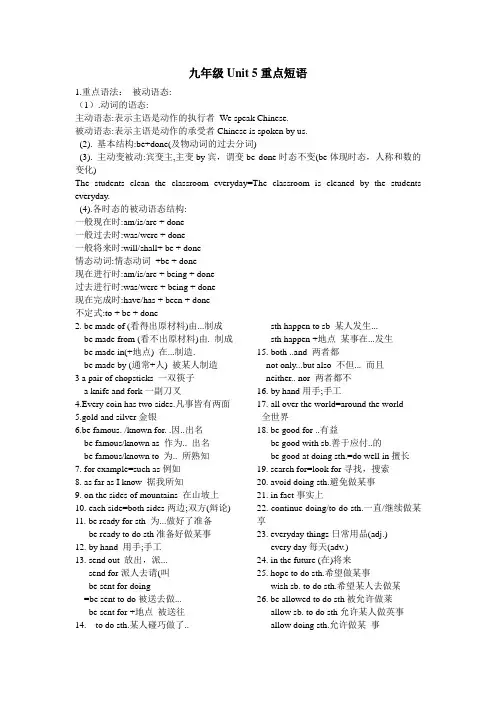
九年级Unit 5重点短语
1.重点语法: 被动语态:
(1).动词的语态:
主动语态:表示主语是动作的执行者 We speak Chinese.
被动语态:表示主语是动作的承受者Chinese is spoken by us.
(2). 基本结构:be+done(及物动词的过去分词)
(3). 主动变被动:宾变主,主变by宾,谓变be done时态不变(be体现时态,人称和数的变化)
The students clean the classroom everyday=The classroom is cleaned by the students
everyday.
(4).各时态的被动语态结构:
一般现在时:am/is/are + done
一般过去时:was/were + done
一般将来时:will/shall+ be + done
情态动词:情态动词 +be + done
现在进行时:am/is/are + being + done
过去进行时:was/were + being + done
现在完成时:have/has + been + done
不定式:to + be + done2. be made of (看得出原材料)由...制成
be made from (看不出原材料)由. 制成
be made in(+地点) 在...制造.
be made by (通常+人) 被某人制造
3 a pair of chopsticks 一双筷子
a knife and fork一副刀叉
4.Every coin has two sides.凡事皆有两面
5.gold and silver金银
6.be famous. /known for. .因..出名
be famous/known as 作为.. 出名
be famous/known to 为.. 所熟知
2024年人教版九年级英语全册知识点归纳
2024年人教版九年级英语全册知识点归纳
九年级是初中英语学习的重要阶段,知识的深度和广度都有了较大的提升。以下将对人教版九年级英语全册的知识点进行详细归纳。
一、词汇
1、 重点单词
adventure 冒险
intelligent 聪明的
valuable 有价值的
effort 努力
overcome 克服
responsibility 责任
wisdom 智慧
courage 勇气
achieve 实现
influence 影响
2、 拓展单词
adventure adventurous (形容词) intelligent intelligence (名词)
valuable value (名词、动词)
effort effortless (形容词)
overcome overcome (过去分词)
responsibility responsible (形容词)
wisdom wise (形容词)
courage courageous (形容词)
achieve achievement (名词)
influence influential (形容词)
3、 短语
be used to 习惯于
be afraid of 害怕
be proud of 为感到骄傲
deal with 处理
give up 放弃
look forward to 期待
make a difference 有影响 pay attention to 注意
put off 推迟
take up 开始从事
二、语法
1、 宾语从句
宾语从句在句中作宾语,通常跟在动词、介词或形容词后。
引导宾语从句的关联词有 that(在口语或非正式文体中常省略)、if / whether(是否)、特殊疑问词等。
宾语从句要用陈述句语序。
例如:I believe that he is a good student (that 可省略)
英语人教版九年级全册Unit 5 Grammar Focus
教学设计
一、教学目标:通过本次课程(Grammar Focus)的学习使学生掌握被动语态的基本构成及其用法,并经过大量练习达到灵活运用的目的。
二、教学重难点:(1)重点:被动语态的构成
(2)难点:被动语态当中需要注意的内容,包括时态,主谓一致等等
三、导学案
(一)、语态概述
我吃了一个苹果, 那现在苹果怎样了?苹果被我吃了。正如汉语中的被字句,英语中的“被字句”我们称之为被动语态。英语中有两种语态:主动语态和被动语态。英语的语态是通过动词形式的变化表现出来的。
主动语态表示主语是动作的执行者。巧记为:主动、主动、主去动。 例如:Many people speak
English.
谓语:speak的动作是由主语many people来执行的。
被动语态表示主语是动作的承受者,即行为动作的对象。巧记为:被动、被动、主被动。例如:English is spoken by many people.主语English是动词speak的承受者。
例如:He opened the door.他开了门。(主动句) The door was opened.门被开了。(被动句)
(二)、被动语态的构成
被动语态由“be+及物动词的过去分词”构成。不及物动词本身没有被动语态。
及物动词---本身意义不完整,后必须带宾语,有些还可以带双宾。
不及物动词---本身意义完整,不需要带宾语,如带宾语必须通过介词。
人称、数和时态的变化是通过be的变化表现出来的。现以eat为例说明被动语态在各种时态中的构成。
一般现在时:am/is/are+eaten 一般过去时:was/were+eaten
一般将来时:will/shall/be going to be+eaten 过去将来时:would/should/be going
人教版初中英语九年级全一册语法知识点汇总
1 人教版初中英语九年级全一册语法知识点汇总
动词
1. 被动语态(passive voice)
(1)主动语态和被动语态
英语动词有两种语态,即主动语态(active voice)和被动语态(passive voice)。当主语为动作的执行者时,谓语的形式为主动语态;当主语为动作的承受者时,谓语要用被动语态。
【练习】:判断下列句子为主动句还是被动句,并找出该动作的执行者和承受者。
Many people speak English.
Bell invented the telephone in 1876.
English is spoken by many people.
The telephone was invented by Bell in 1876.
(2)被动语态的构成
被动语态由“助动词be+及物动词的过去分词”构成。助动词be有人称、数和时态的变化,其变化规则与be作为连系动词时完全一样。现以动词ask为例,将一般现在时和一般过去时被动语态的肯定式、否定式及疑问式列表如下:
肯定式 否定式 疑问式
一般现在时 I am asked ....
He /She is asked...
We / You /They are asked... I am not asked...
He /She is not asked...
We / You /They are not
asked... Am I asked...?
Is he/she asked...?
Are we/you / they asked...?
一般过去时 I was asked...
He/She was asked...
We / You /They were I was not asked...
He/She was not asked...
We / You /They were not Was I asked...?
人教版九年级英语全一册重点整理
人教版九年级英语全一册重点整理
一、语法重点
1. 时态时态
- 一般现在时:用于描述经常发生的事情或客观事实。
- 现在进行时:用于表示目前正在进行的动作。
- 一般过去时:用于过去发生的动作或存在的状态。
- 过去进行时:用于过去某一时间段内正在进行的动作。
- 将来时态:用于表示将要发生的动作或情况。
2. 被动语态被动语态
- 被动语态用法:主语是动作的承受者,动作的执行者常常省略或放在介词by后。
- 被动语态结构:be + 过去分词。(例如:is done, was seen)
3. 情态动词情态动词
- can/could:表示能力、许可。
- may/might:表示可能性、请求、允许、祝愿。
- will/would:表示意愿、惯、推测。 - must:表示肯定、推测。
- should:表示建议、推测。
4. 定语从句定语从句
- 用来修饰名词或代词的从句称为定语从句。
- 引导定语从句的关系词通常有which、who、whom、whose、that等。
二、词汇与短语积累
- 必备词汇
- 数字:one, two, three, four, five, six, seven, eight, nine, ten,
eleven, twelve, twenty, thirty, forty, fifty, sixty, seventy, eighty, ninety,
hundred, thousand.
- 季节:spring, summer, autumn, winter.
- 颜色:red, yellow, blue, green, black, white.
- 学科:Chinese, English, math, history, geography, physics,
chemistry, biology.
- 常用短语 - in the morning/afternoon/evening:在早晨/下午/晚上。
Unit6知识点归纳(短语+句型+语法) 人教版九年级英语全册
人教版九年级U6知识点归纳(短语+句型+语法)
Unit 6 When was it invented?
【重点短语】
1. by accident 偶然地;意外地
2. without doubt 毫无疑问的;的确
3. by mistake 错误地;无意中
4. look up to 钦佩;仰慕
5. take place 发生;出现
6. all of a sudden 突然;猛地
7. divide…into… 把……分开
8. the Olympics 奥林匹克运动会
9. the style of ……的样式
10. be used for 被用于……
11. give sth. to sb./ give sb. sth. 给某人某样东西
12. be used for doing ,用来做…...
14. all day 整天
15. by mistake 错误地
16. make mistake犯错
17. by accident 意外,偶然
19. not…until… 直到……才……
20. fall into 落入,掉进
21. fall down 摔倒 22. in the way 这样
23. travel around 周游
24. knock into 撞上. 某人)
25. divide sth. into … ,将…划分成,
【重点句型】
1.Who was it invented by? It was invented by Bell.
2. What is the hot ice-cream scoopused for? It s used for serving
really cold ice-cream.
3. English is spoken by many people.
4. I gave a pen to him.= I gave him a pen. 我给了他一支笔。