
人教版高中英语必修一教案
人教版高中英语必修一教案
Unit 1 Friendship
Period 1 Reading and Vocabulary
Teaching aims:
1. Enable students to understand the main idea and some specific
details of the reading passage.
2. Enable students to enlarge their vocabulary on the topic of
friendship.
Teaching procedures:
Step 1: Lead-in
1. Greet the students and introduce the topic of today's class:
friendship.
2. Show some pictures about friendship on the screen and ask the
students to talk about what they see in pairs.
3. Ask some pairs to share their ideas with the whole class.
Step 2: Pre-reading
1. Ask the students to read the title of the reading passage and
predict what it will be about.
2. Write down their predictions on the blackboard.
Step 3: Reading
1. Ask the students to read the passage quickly and silently to get
the general idea.
2. Play an audio recording of the passage for the students to listen
and read along.
3. Ask the students to read the passage again and answer the
following questions: a) What is the main idea of the passage?
b) What reasons are given for having friends?
c) What are the three stages of friendship mentioned in the
passage?
4. Ask some students to share their answers with the whole class.
Step 4: Vocabulary
1. Explain and give examples of the following vocabulary:
a) conquer: to successfully overcome or deal with a problem or
difficulty
b) goodness: the quality of being good
c) reliable: able to be trusted or depended on
d) challenging: difficult and needing a lot of effort
e) unintentionally: not on purpose; not intended
f) overcome: to succeed in controlling or dealing with a problem
or difficulty
2. Ask the students to work in pairs and match the vocabulary with
their definitions.
3. Check their answers together as a class.
Step 5: Further understanding
1. Ask the students to discuss the following questions in pairs:
a) Do you agree that friendship is a necessary part of life? Why
or why not?
b) What characteristics do you think a good friend should have?
2. Ask some pairs to share their ideas with the whole class.
Step 6: Summary and homework
1. Summarize what has been learned in this class.
2. Assign homework: ask the students to write a short composition about the importance of friendship in their lives.
Teaching reflection:
In this class, the students will be able to understand the main idea
and some specific details of the reading passage about friendship.
They will also enlarge their vocabulary on the topic of friendship.
The class is designed to be interactive and engaging, with
opportunities for pair and whole class discussions. The homework
assignment allows the students to reflect on the importance of
friendship in their own lives.
人教版高中英语必修一 Unit1 Friendship 教案
教 案
人教版高一英语《英语1》第一单元Friendship
第1课时:Warming up and Pre-reading
一.教学目标
① 知识目标:
⑴让学生掌握以下生词和短语: survey add point upset ignore calm concern loose cheat add up calm down
have got to be concerned about walk the dog
⑵让学生学会使用以下结构来表达态度,同意和不同意和确定语气: Are you afraid that. . . ? I (don’t)think. . . In my
opinion, . . . I (don’t)think so, I (don’t)agree, I believe. . . , I’m afraid not, Exactly, That’s correct, Of course not.
② 技能目标:
1.让学生学会用英语描述自己的朋友。
2.列出朋友间通常存在的问题,并找的不同方法来解决这些问题。
3.鼓励学生用本课学到的一些短语和结构来思考和谈论朋友和友谊。
③ 情感目标
1.让学生学会如何解决朋友间可能出现的问题。
2.培养学生在高中阶段形成学习英语的好习惯。
二.教学重点
1.用给定的形容词和句子结构来描述他们的一个朋友。
2.学习评价朋友和友谊。
三.教学难点
1.与搭档合作并描述他们的一个好朋友。
2.与搭档讨论并找出解决问题的方法。
四.教学方法
1.任务型教学法
2.合作学习法
3.讨论法
五.教学准备
多媒体和其他常规教学工具
六.教学过程
1.导入新课:
第一步:导入Lead-in
上课前,老师可以通过展示一个友谊天长地久的视频来激发学生的学习兴趣,。这是新学期的第一节课。所以在一开始,请学生用他们喜欢的方式来谈谈关于新学校和朋友的话题。
人教版高中英语必修1单词表
Unit 1
1.words
________ n. 调查;测验
________ 合计
________ adj.心烦意乱的;不安的;不适的vt. 使不安;使心烦
_________ vt.不理睬;忽视
________ vt.& vi. (使)平静;(使)镇定
adj.平静的;镇静的;沉着的
__________ vt.(使)担忧;涉及;关系到
n.担心;关注;(利害)关系
___________adj.松的;松开的 vt.
_______n. 兽医
________ n.连续;系列 _______________一连串的;一系列;一套
_____________ adv.在户外;在野外
_________ vt.(spellbound,spellbound)迷住;迷惑
___________ n.黄昏;傍晚
______________vi.打雷;雷鸣
n.雷;雷声
___________adj.整个的;完全的;全部的
__________adv.完全地;全然地;整个地
__________n.能力;力量;权力
______________n.窗帘;门帘;幕布
________ adj.积满灰尘的
___________n. 伙伴;合作者;合伙人
____________vi.安家;定居;停留
vt.使定居;安排;解决
____________vt.& vi 遭受;忍受;经历
___________ n..孤单;寂寞
____________n.公路;大路
___________vi.& vt.痊愈;恢复;重新获得
____________vi.& vt.捆扎;包装;打行李 n.小包;包裹
_____________n..手提箱;衣箱
___________n.大衣;外套
___________n.十几岁的青少年
__________vi.& n.闲话;闲谈 adv.确实如此;____________正是;确切地
人教版高中英语必修1精品教案Friendship
Unit 1 Friendship
Warming Up, Pre-reading and Reading
Reading “Anne’s Best Friend”
1. Teaching objectives:
1) To develop the students’ reading ability, learn to use some reading strategies such
as guessing, key sentences, skimming and so on;
2). To get the students to realize the importance of friends and friendship, and to tell
true friends from false friends;
3). To grasp some useful words and expressions in this passage, such as on purpose,
be crazy about etc.;
4). To learn the writing style of this passage.
2. Teaching method: Task-based teaching
3. Teaching procedures:
Step 1.Pre-reading
1. Please enjoy three pieces of music and find out what they are about.
2. Does a friend always have to be a person? What else can be your friend?
3. What do you know about the World War II?
4. Background introduction
人教版高中英语必修一

---------------------------------------------------------------最新资料推荐------------------------------------------------------
1 / 4
人教版高中英语必修一
人教版高中英语必修一 Unit 4 Earthquakes教学案例 一、 教学设计 Teaching aims(教学目标):
1 .learning aims (学习目标) (1 ).Know about basic
knowledge about earthquakes(了解地震的基本知识) (2).Know
about how to protect oneself and help others in disasters(了解如何自救与他救) 2. emotional aims(情感目标) make the
students be aware of the terrible disasters, meantime have
them face it ,treat it in a proper way, and never get discouraged.(使学生对灾难有正确的认识, 要用积极的态度来对待它。
) 3. Ability aims(能力目标) a. let the students
collect the information from the internet by themselves.(独立搜集信息的能力) b. Let the students pack up the information
by themselves.(独立整理信息的能力) c. Get the students to
design it for the purpose of showing in class.(设计制作课件的能力) d. feed them back to students in class ,using what they
人教版高中英语必修1教案Unit 4 Earthquakes
人教版高中英语必修1教案Unit 4
Earthquakes
Unit4教学设计课题:Earthquakes教材分析与学生分析:本单元的主题是“地震”。warmingUp部分Pre-Reading部分要求学生描述、讨论与地震有关的话题。Reading部分是一篇新闻报道,介绍了唐山大地震前的预兆、地震造成的城市建筑和人畜损失以及地震后的救援情况。LearningaboutLanguage部分涉及了本单元的词汇和语法。该部分主要通过阅读和句型练习帮助学生学习单词、数字的表达法以及有that,which,who,whose引导的定语从句,培养学生的自主学习能力。UsingLanguage部分的“读写说(Reading,writingandspeaking)”训练提供了一封信,要求学生阅读后写一篇大地震纪念公园落成仪式上的演讲稿,接着说一说唐山大地震纪念邮票。随后的听力(Listening)是一位美国人以第一人称叙述他在1906年旧金山大地震中的可怕经历。写作(writing)部分训练学生如何写新闻报道,学会拟地定写作提纲。课时安排:Thefirstperiod:
Reading
Thesecondperiod:
ReadingThethirdperiod:ListeningTheforthPeriod:GrammarThefifthperiod:ExtensivereadingThesixthperiod:Summary教学目标:①
知识与技能:了解地震的成因、预兆,地震造成的损失,地震时的应急措施以及震后的救援;掌握和运用本单元出现的新词汇和短语以及数字的表达法;熟练运用that,which,who,whose引导的定语从句;学会写英文新闻报道,拟订写作提纲。②
过程与方法:在学习阅读部分时,可以根据教学的需要和教学班级的实际,从不同的角度设计目的明确的任务。阅读材料提及了很多孩子失去双亲成为孤儿,矿工在地震中的遭遇。救护人员和解放军官兵不顾自身安危,奋力抢险的事迹,地震无情人有情,感人至深。因此可以将他们作为素材,设计多种任务,展开课堂教学活动。如:1.组织学生讨论震后孤儿的安置2.模拟采访被抢救的矿工。3.写一篇新闻故事,描述救护人员和军队救灾的感人故事。③
人教版高中英语必修一Unit1教案
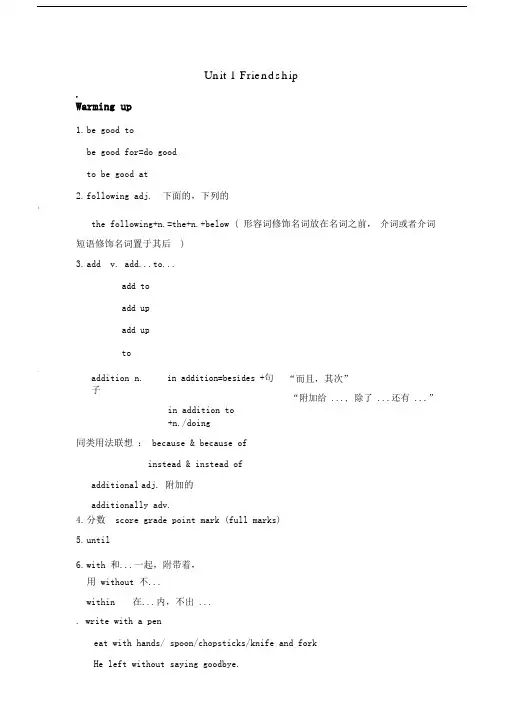
Unit 1 Friendship
?
Warming up
1. be good to
be good for=do good
to be good at
2. following adj. 下面的,下列的
)
the following+n.=the+n.+below ( 形容词修饰名词放在名词之前, 介词或者介词
短语修饰名词置于其后 )
3. add v. add...to...
add to
add up
add up
to
: addition n. in addition=besides +句子
in addition to
+n./doing
同类用法联想 : because & because of
instead & instead of
additional adj. 附加的
additionally adv.
“而且,其次”
“附加给 ..., 除了 ...还有 ...”
4. 分数 score grade point mark (full marks)
5. until
6. with 和...一起,附带着,用 without 不...
within 在...内,不出 ...
. write with a pen
eat with hands/ spoon/chopsticks/knife and fork
He left without saying goodbye.
He left with the water running.
分析: saying 前无名词,则是主语发出 saying 的动作; running 前有 water,因此是 water 发出 running 的动作,而不是句子的主语 he。
翻译练习:
(1) 他今天去上班没带领带。
Today, he went to work without (wearing) his tie.
人教版高中英语必修一Module1
Module 1 Wonders of the world
笔 试 部 分
一、选择填空 (本题共15分,每小题1分)
在各题所给的三个选项中,选出一个最佳选项。
( ) 1. She ______________ the Grand Canyon twice.
A. has been to B. has gone to C. went to
( ) 2. They will have a trip to the Great Wall if it tomorrow.
A. won’t rain B. doesn’t rain C. not rain
( )3.- Is Susan going to her hometown by train?
- I guess she ________ . I know she likes driving her new car.
A. mustn’t B. can’t C. may not
( ) 4. We had a party last month, and it was so fun. Why don’t we have _______
one this month?
A. more B. another C. the other
( ) 5. “Please don’t be angry with me,” said Amy laughingly. This made me even
_________.
A. angry B. angrier C. angriest
( ) 6. Don’t make any noise, Grandma (sleep).
A. sleeps B. slept C. is sleeping
人教版高中英语必修一unit4教案
Unit 3 补充
1. 。。。dressed in。。。
dress的宾语通常是人,意思是“给……穿衣服”。dress oneself/ sbd表示给自己或别人穿衣服。如果人作主语一般是be/ get dressed (in) ,in 表示穿的状态,例如
She is dressed in a fur coat.
这里dressed in 引导的过去分词短语做的是后置定语。
其它表示穿的动词或短语:
dress up的意思是“盛装打扮、乔装打扮”。
I’d like you to dress up for my birthday party tonight.今晚我希望你为我的生日派对打扮打扮。
Young kids often dress up and have fun at Halloween.万圣节前夜,小孩子通常都乔装打扮,玩得很开心。
put on “穿上、戴上”,强调“穿”“戴”的动作,后接衣服、鞋帽等。表示“穿(衣)戴(帽)”,后面的宾语是表示衣服、鞋、帽、手套、袜子、眼镜等的名词。
例如:
I want you to put on this coat and this hat. 我要你穿这件外套,戴这顶帽子。
Put on your heavy winter coat if you are going out.如果你要出去,穿上你的厚冬衣。
wear是状态动词,表示“穿戴、佩戴(手表、首饰、花等),留(发型、胡须等)”;还可表示“面露、面带(某种表情、样子等)”,意义广泛。
She was wearing a diamond necklace. 她戴着钻石项链。
have on 是状态动词短语,除了表示“穿着,戴着”之外,还可表示树木等“披着,挂着”,不用进行时态。
It's autumn.But the trees still have leaves on. 现在是秋天,但树叶还挂在树上。
人教版高中语文必修一教案
人教版高中语文必修一教案
第一单元
1、沁园春·长沙·教案
【背景资料】
一、写作背景
这首词作于1925年,当时革命运动的正蓬勃发展。五卅运动和省港大罢工相继爆发,湖南、广东等地农民运动日益高涨。毛泽东直接领导了湖南的农民运动。同时,国共两党的统一战线已经确立,国民革命政府已在广州正式成立。这年深秋,毛泽东去广州主持农民运动讲习所,在长沙停留,重游橘子洲,写下这首词。据《湖南全省第一次工农代表大会日刊》载:“毛先生泽东……去岁回湘养疴,曾于湘潭衡山一带,从事农民运动……后为赵恒惕所知,谋置先生于死地。先生闻讯,间道人粤。”
二、补充注释
《沁园春》:词牌名。沁园:东汉明帝女沁水公主的园林,后为外戚窦宪所夺(见《后汉书》)。《沁园春》词牌,相传由此得名。据《词谱》载,《沁园春》双调,114字。上片13句,四平韵;下片12句,五平韵。
【示范教案】
沁园春·长沙
毛泽东
【教学目标】
一、知识教育目标
1.了解《沁园春 长沙》的写作背景。
2.了解词的发展简史。
3.抓住关键词语,体会词中描绘的意象,理解景中寓情、情中显志的特点。
二、能力培养目标
1.训练学生诵读能力。
2.着重训练学生抓准词中意象的能力。
三、德育渗透目标
1.培养对祖国大好河山的真情的热爱。
2.感受革命前辈的博大情怀和革命壮志,珍惜今天的一切,激发学生奋发向上的热情。
【重点、难点及解决办法】
1.以乐景写哀,景中寓情,情中显志。从词中可以感受到词人的心情是惆怅的,写的又是寒秋景物,却毫无过去一般旧诗词里的那种肃杀、感伤的“悲秋”情调,词人笔下的秋景是活泼、美好的。原因在于越写山河的壮丽,就越使人感到人民不能主宰大地的可悲,越感到革命的必要。词人正是在这不一致中突出了强烈的革命精神。当然,这里面也含有热爱祖国壮丽河山的感情。
人教版高中英语必修1
人教版高中英语必修1 第一单元测试卷1
(完卷时间:120分钟,满分100分)
第I卷(选择题)
第一部分:听力(共两节,共20分)
【略】
第二部分: 英语知识运用 (共两节)
第一节:单项填空(共20题,每题1分,共20分)
从A、B、C、D四个选项中,选出可以填入空白处的最佳选项,并在答题卡上将该项涂黑。
21. It's seven thirty. I_________ go to school.
A. have got B. have got to
C. got to D. had got to
22. He came into the classroom_________.
A. very upset B. being upset
C. to upset D. to be upset
23. This is the first time that I_________ at the meeting.
A. had spoken B. have spoken
C. am D. was
24. His whole school education ________ only 2 years because of his illness.
A. added up B. added up in
C. added up to D. was added up