
2018-2019学年高中英语(人教版)选修八Unit 2 Cloning reading课时作业 (5)
Unit 2 Cloning reading课时作业阅读理解(共15小题;每小题2分,满分30分)请阅读下列短文,从短文后各题所给的A、B、C、D 四个选项中,选出最佳选项。
AWhy not come in and use our indoor heated pool, gym, squash (壁球) courts, group exercise, steam/sauna (桑拿浴), book a personal trainer, join a squash competition or swim with the Dubbo Ducks?The kids are even taken care of in our FREE supervised (有监督的) juniors room at the following time:Monday-Friday 9:00 am-1:30 pm. And NOW evenings Monday-Thursday 5:00 pm-8:00 pm!Did you know that kids join free with all family memberships?Get your children water safe for summer and let them in our Multi AUSTSWIM Award Winning swim school. There are group lessons, beginners to advanced, baby & me, stroke correction, mini group, adults and disability. We want to make you “Feel Good”,so take advantage of our 7 Day Free Membership Trial. If you have the desire for healthy fun and relaxation while in Dubbo, see the team at Dubbo RSL Aquatic & Health Club. Membership is now available.语篇解读:这是一则广告。
健身俱乐部通过介绍自己俱乐部的项目和服务吸引顾客加入。
1.What's the purpose of the text?A.To teach a swimming lesson.B.To make an advertisement.C.To present a website design.D.To introduce a new business.解析:选B写作意图题。
通读全文可知,这是健身俱乐部招募会员的简章,目的是为俱乐部做广告,吸引顾客加入。
故选B。
2.The passage is probably written by ______.A.a fitness club B.a swimming clubC.a squash club D.a children's club解析:选A推理判断题。
由文章中频繁出现的体育运动名词和healthy fun and relaxation等词汇,再结合生活常识可推断,文章应该是由健身俱乐部写的。
游泳和壁球只是其中的活动。
3.Which of the following is free of charge?A.Using the indoor heated pool.B.Playing squash.C.Kids' being taken care of.D.Swimming with the Dubbo Ducks.解析:选C细节理解题。
free of charge 意为“免费的”。
而“The kids are even taken care of in our FREE supervised (有监督的) juniors room at the following time.”表示孩子甚至可以在青少年的房间受到免费的监督照顾。
故C项正确。
BIn England, we look forward to our birthdays for 364 days a year!We invite special people to celebrate it with us.The PresentsPresents are opened as soon as the children are awake. They can't wait for the birthday cake later in the day!The CardsFriends and family send birthday cards. Sending birthday cards is a custom (风俗) that began in England about 100 years ago.The PartyThe birthday child will have a party to which friends andfamily are invited. Visitors to the party bring presents for thebirthday child. The children play games such as Musical Chairs andPass the Parcel.The CakeThe birthday cake is decorated on a theme (主题). A candle for each year is lit and placed on top and the child blows out the candles making a wish. We don't put objects inside the cake as stated on many websites.The Bumps (生日举放仪式)It used to be traditional for the birthday child to have the bumps. Friends would hold the child by the legs and under the arms and lift the child up and down bumping them gently on the ground. The number of bumps given is the age of the child plus one for extra good luck. As this can be dangerous, clapping (拍手) is often done instead.The SweetsSome children do take sweets to school to share with their classmates on their birthdays.语篇解读:每个国家的每个孩子都有自己的生日。
每当孩子过生日时,父母都要张罗一下为自己的孩子庆祝生日。
你知道英格兰的孩子是如何过生日的吗?本文进行了介绍。
4.In England, the birthday present is opened ______.A.before the child wakes upB.immediately after the child wakes upC.as soon as the child gets upD.during the birthday party解析:选B细节理解题。
由文章The Presents部分中的“Presents are opened as soon as the children are awake.”可知,孩子们一醒来就把礼物打开,故B 项正确。
5.If Alice is celebrating her 7th birthday, how many bumps will she be given?A.Six. B.Seven.C.Eight. D.Nine.解析:选C细节理解题。
由文章The Bumps部分中的“The number of bumps given is the age of the child plus one for extra good luck.”可知,孩子的生日“举放仪式”的次数是孩子的年龄加一,表示更多的好运。
故C项正确。
6.Which of the following facts about birthdays in England is NOT true?A.All the children will receive birthday cards on their birthdays.B.Clapping is often done for the birthday child.C.Objects are usually placed inside the birthday cake.D.Nowadays children may share sweets with their classmates on their birthdays.解析:选C细节理解题。
由文章The Cake部分中的“We don't put objects inside the cake as stated on many websites.”可知C项错误;而其他三项均符合文章内容,故排除。
7.What would be the best title for this passage?A.How birthdays are celebrated in the world?B.Where to hold an English birthday party?C.What to send when invited to a child's birthday party?D.How English children celebrate their birthdays?解析:选D标题归纳题。
文章第一句指出:在英格兰,一年当中我们有364天都在盼望过生日。
接下来分六个部分介绍了英格兰孩子庆祝生日的风俗,故选D。
CSvetlana Alexandrovna Alexievich, born on 31 May 1948, is a Belarusian investigative journalist and non-fiction prose writer, writing in Russian. She was awarded the 2015 Nobel Prize in Literature “for her polyphonic writings, a monument to suffering and courage in our time”. She is the first writer from Belarus to receive the award.Alexievich grew up in Belarus. After finishing school she worked as a reporter in several local newspapers before graduating from Belarusian State University and becoming a journalist for the literary magazine Neman in Minsk.She went on to a career in journalism and writing narratives from interviews with witnesses to the most dramatic events in the country, such as World War Ⅱ,the Soviet-Afghan War, the fall of the Soviet Union, and the Chernobyl disaster. After political persecution (迫害) by the Lukashenko administration, she left Belarus in 2000. The International Cities of Refuge Network offered her shelter and during the following decade she lived in Paris, Gothenburg and Berlin. In 2011, Alexievich moved back to Minsk.According to Russian writer and critic Dmitry Bykov, her books owe much to the ideas of Belarusian writer Ales Adamovich, who felt that the best way to describe the horrors of the 20th century was not by creating fiction but through recording the evidence of witnesses. Belarusian poet Uladzimir Nyaklyayew called Adamovich “her literary godfather”.He also named the documentary novel I'm from the Burned Village by Ales Adamovich, Janka Bryl and Uladzimir Kalesnik, about the villages burned by the Nazi troops during the occupation of Belarus, as the main single book that has influenced Alexievich's attitude to literature. Alexievich admitted the influence of Adamovich and added, among others, Belarusian writer Vasil Bykaǔas another source of impact on her. Her most notable works in English translation include a collection of first-hand accounts from the war in Afghanistan (Zinky Boys: So v iet Voices from a Forgotten War) and a highly praised oral history of the Chernobyl disaster (Voices from Chernobyl).Alexievich describes the theme of her works this way: If you look back at the whole of our history, both Soviet and post-Soviet, it is a huge common grave and a blood bath. An eternal dialogue of the executioners and the victims. The accursed Russian questions: what is to be done and who is to blame. The revolution, the gulags, the Second World War, the Soviet-Afghan war hidden from the people, the downfall of the great empire, the downfall of the giant socialist land, the land-utopia, and now a challenge of cosmic dimensions — Chernobyl. This is a challenge for all the living things on earth. Such is our history. And this is the theme of my books, this is my path, my circles of hell, from man to man.Her first book, War's Un w omanly Face, came out in 1985. It was repeatedly reprinted and sold more than two million copies. The book was finished in 1983 and published (in short edition) in Oktyabr, a Soviet monthly literary magazine, in February 1984. In 1985, the book was published by several publishers, and the number of printed copies reached 2,000,000 in the next five years. This novel is made up of monologues (独白) of women in the war speaking about the aspects of World War Ⅱ that had never been related before. Another book, The Last Witnesses: theBook of Unchildlike Stories, describes personal memories of children during war time. The war seen through women's and children's eyes revealed a new world of feelings. In 1993, she published Enchanted w ith Death, a book about attempted and completed suicides due to the downfall of the Soviet Union. Many people felt inseparable from the Communist ideology and unable to accept the new order surely and the newly interpreted history.Her books were not published by Belarusian state-owned publishing houses after 1993, while private publishers in Belarus have only published two of her books: V oices from Chernobyl in 1999 and Second-hand Time in 2013, both translated into Belarusian. As a result, Alexievich has been better known in the rest of world than in Belarus.语篇解读:本文是人物传记,主要介绍2015年诺贝尔文学奖得主白俄罗斯女作家斯维特兰娜·阿列克谢耶维奇的人生经历和她的主要作品。
选修 8 unit 2 cloning
The new plants that grow from the runners (蔓藤植物)are exact copies of the original plant.
Twins
They are born naturally and identical in sex and appearance.
Cloning can help save
endangered animals Cloning can provide a copy of a child for a couple whose child has died
Quiz
In pairs, look at these pictures and discuss which ones are natural clones and which ones are man-made. Think about how they differ.
A strawberry plant
The writer’s attitude towards cloning
A. Objective (be fair) B. Negative (be against it) C. Positive (be in favour of it)
the author does not state any personal Because______________________________ opinion about cloning.
3. What problems may arise when humans are cloned? • People may want to clone themselves so they can live forever. • People may want to clone dead children. • People may want to clone their favourite pets.
高中英语人教版选修8 Unit2 Cloning Reading Cloning:Where is
English learning Plan of Senior 2(导学案)The wish words of teacher's(教师寄语):Relax! Be patient and enjoy yourself. Learning foreign languages should be fun. (放松点!要有耐性,并让自己快乐!学习外语应该是乐趣无穷的。
)㈠Teaching aims(学习目标)1.Knowledge aims(知识目标)⑴To learn about cloning by reading.⑵.To master and understand some structures and complex sentences.2.Ability aims(技能目标)⑴. Read passages by using different reading skills (skimming﹑scanning﹑careful reading) .⑵. Express own opinions about cloning in form of debate..3.Emotion aims(情感目标)⑴Be interested in science technology (cloning).⑵. Learn to team up with others.㈡Special and difficult Points(学习重难点)1. Learn different reading skills(Skimming, scanning﹠careful reading).2 Learn more about cloning.3. Describe cloning in your own words.㈢The procedure of learning (学习过程)Before class (课前预习胸有成竹)【自主预习】㈠学法指导⑴通读本篇文章,查字典,猜生词,记短语,勾出文中复合句以及难句。
选修八Unit_2 Cloning原文翻译

Unit 2 克隆:他将把我们引向何方?
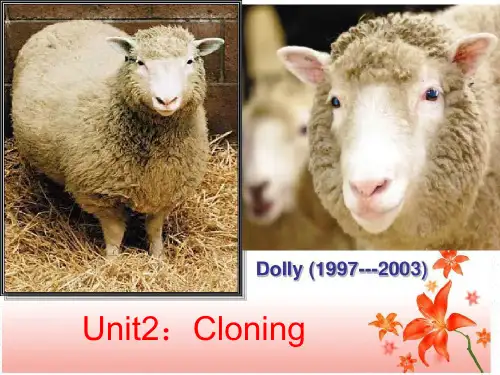
克隆一直与我们同在,而如今它还要坚持下去。这是一种用来生产与原型完全相同的动植物的方法。当园艺师从生长的植物上剪下枝条来培植新植物时,就会产生这种现象。这种现象也发生在动物身上,从同一个原生卵子产生性别和相貌相同的双胞胎也是克隆。实际上,这些都是自然克隆现象。
On the one hand, the whole scientific world followed the progress of the first successful clone, Dolly the sheep. The fact that she seemed to develop normally was very encouraging. Then came the disturbing news that Dolly had become seriously ill. Cloning scientists were cast down to find that Dolly's illnesses were more appropriate to a much older animal. Altogether Dolly lived six and a half years, half the length of the life of the original sheep. Sadly the same arbitrary fate affected other species, such as cloned mice. The questions that concerned all scientists were: "Would this be a major difficulty for all cloned animals? Would it happen forever? Could it be solved if corrections were made in their research procedure?"
人教版高中英语选修八Unit Two Cloning
Unit Two Cloning课程标准中的内容标准:本单元的中心话题是“克隆”。
本单元内容具体涉及“什么是克隆”、“克隆羊多莉是如何诞生的”、“克隆的利弊”等。
语言技能和语言知识都是围绕“克隆”这一中心话题设计的。
教学细目:1、(情感目标)通过阅读,了解什么是克隆、克隆的利弊及对克隆技术的反思。
2、(交际)通过听说学习进一步熟悉和运用有关接受与拒绝、表扬与鼓励的表达方式。
3、(词汇)通过阅读、师生互动掌握本单元的教学目的和要求中的词汇和短语。
4、(写作)通过听说,让学生展开讨论发表自己的看法,利用表格提供的信息,写成一份报告。
5、(语法)通过书面训练,熟练掌握同位语的用法。
学习领域与主题内容及要求目标层次人教版选修八UnitTwoCloning理解掌握运用1.1.1. 话题:Natural clones and man-madeclones; the history of cloning; controversyabout cloning√1.1.2功能(通过听和说,能在生活中运用下列英语进行交际):1. 接受与拒绝(Acceptance and refusal)I’m happy to accept…but…I can/cannot accept your argumentbecause…I support…because…No, I can’t agree with…because…I agree with/ could never agreeto…because…How can you believe that?√Your argument has convinced me because…I would like to agree with you but…Do you think it is wise to…?No, that is not reasonable because…Is it fair to…?I don’t care for your ideas because…2. 表扬与鼓励(Praise and encouragement)Your ideas sound very encouraging tome.That’s a good idea/ great idea.Well done to you for…√1.1.3 Understanding vocabulary(理解词汇)(通过听、看、阅读,能理解下列词汇含义。
人教版高二英语选修8 Unit 2 Cloning
Do you know about the procedure of cloning Dolly the sheep?
Procedure of Cloning Dolly
An egg cell The carrier The nucleus A somatic cell
genes
The nucleus is taken out of the somatic cell
Words preview exact adj. 精确的;准确的 twin n. 双胞胎之一 adj. 成对的; 成双的 commercial adj. 商业的;贸易的 straightforward adj. 简单的;坦率的 undertake vt. 着手;从事;承担 breakthrough n. 突破 procedure n. 程序;步骤;手续 carrier n. 携带者;搬运工; 运输工具
Animal clones may die younger than the donor (捐献 的) animals. Evil leaders may want to clone themselves. Cloning plants can produce plants of similar quality to make more money Cloning plants can be useful for research on new plant species. There are moral objections to Cloning can help save cloning human beings. endangered animals.
Match the main idea of each paragraph
最新人教版选修八unit 2《cloning》教案.doc
U n i t2C l o n i n gⅠ. 单元教学目标Skill Goals技能目标▲To talk about cloning▲To practice expressing and supporting an opinion ▲To use the appositive clause▲To write a composition about cloningⅡ. 目标语言功能句式Expressing and supporting an opinionI’m happy to accept... but...I would never accept...I’m not bothered about...I don’t mind but...I hope you’ll carry on...Are you sure you want to...?I agree with you that...Is it fair to...?Do you think it is wise to...?I think you should...Well done to you for...I don’t understand why you don’t...I can’t help thinking...I could never agree to...四会词汇Differ exact twin commercial straightforward undertake breakthrough procedure carrier cast altogether词汇arbitrary correction object objection medium obtain attain moral conservative forbid accumulate constitution compulsory opera chorus loaf flour owe shortly retire bother assumption regulation strike initial vain resist drawback merely decoration unable feather turkey claw adore hatch reasonable词组cast down, object to, the media, in favour of,(be)bound to (do)..., from time to time, bring back to life, pay off, in vain语法Appositive clause —同位语从句重点句子It is a way of... P11The fact is that... P11The question that occurred ... P12 The advantage is that... P15Ⅲ. 教材分析和教材重组1. 教材分析本单元以Cloning为话题,旨在通过单元教学,使学生了解克隆技术的优缺点,学会表达和支持个人观点,能用所学的有关Cloning的词汇去表述自己对这一新技术的观点和看法。
人教版高中英语选修8《Unit2Cloning》教案
人教版高中英语选修8《Unit 2 Cloning》教案人教版高中英语选修8《Unit 2 Cloning》教案【一】教学准备教学目标一、语言知识目标初步理解、掌握课文中关于克隆的词汇,学习分析课文中的长难句子。
二、阅读技能目标1. 能获取和处理文章中的主要信息。
2. 能够掌握文中出现的重要的语言知识三、学习策略目标掌握速读、略读、猜测词义等阅读策略。
四、情感态度目标让学生认识到克隆的利和弊。
五、文化意识目标了解克隆,正确地利用克隆技术来为人类服务。
教学重难点初步理解、掌握课文中关于克隆的词汇,学习分析课文中的长难句子。
教学过程Step 1 Daily reportOne student comes to the front and gives a report about advantages and disadvantages of science and technology.Step 2 leading-inThe teacher shows some pictures and starts a discussion about cloning.Step 3 SkimmingTask 1: Whats the main idea of the passage? Task 2: Match the main idea with each paragraph Para 1: A. Peoples attitude towards cloning. Para 2: B. The problems of Dolly.Para 3: C. The impact of Dolly.Para 4: D. Two major uses and the procedure of cloning.Para 5: E. The definition(定义)of cloning.Step 4 ScanningTask 1. Look through Para 2 and answer the following questions.(1) What are the two major uses of cloning?(2) Which one is easier, to make plant clones or animal clones?Task 2. Look through Para 3 and fill in the chart. Task 3. Do the following translation and word guessing.(1). Translation:On the other hand, Dollys appearance raised a storm of objections and had a great impact on the media and public imagination.(2). The word controversial in paragraph 4 probably means_________.A. complicatedB. arguableC. importantD. valuableTask4. Do the following Tor F questions based on Paragraph 5.1. People feared some evil leaders might use cloning to reach their goal.2. All the research into cloning will be forbidden.3. Religious leaders are in favor of human cloning.Step 5 Enjoy beautiful sentences1. Cloning plants is straightforward while cloning animals is very complicated.2. At last the determination and patience of the scientists paid off.3. The fact that she seemed to develop normally was very encouraging.Step 6 Question and answerThis part is for students to find if they still have questions. If there is any, they can ask their classmates to help them.Step 7 QuizNote: This part is very challenging. In the picture there are five numbers. Students can choose their lucky number and answer questions. Most of the questions are based on what they have learned in class.Step 8. Test yourselfFill in the blank with proper words.Cloning is a way of _______ (make) an exact copy of another animal or plant. It has two major uses. One is _______ gardeners use it to produce plants. The ______ is that it is valuable for medical research on animals. ________, the process of cloning is difficult ___________ (undertake).The first successful clone, Dolly the sheep, made the whole _________ (science) world follow its progress, though it had ________ problems than the normal sheep. On the other hand, Dollys appearance _______ (raise) a storm of objections and had a great impact ______ the media and public imagination. Different people have different opinions on it. However, scientists still wonder ______ cloning will help or harm us and where it is leading us.Step 9 DebateTopic: Are you for or against cloning?课后小结HomeworkWrite a passage entitled My view on cloning.课后习题评测练习主要有两个。
人教版高二英语选修8_Unit_2_Cloning_全单元教案
Unit 2 CloningThe First Period warming upAims1. Talk about cloning2. Practice expressing and supporting an opinionContentsTask one: Looking and speakingIn pairs, look at the pictures and discuss which ones are natural clones and which ones are man-made. Explain how they differ.A.Dolly the sheepB. A strawberry plantC.TwinsD. Identical dogsTask two: Questions about cloningWhat is a clone?How is a clone produced?What benefits can humans gain from cloning?What problems may arise when humans are cloned?Task three: Free talkIn pairs, discuss what you understand about cloning, then list the questions you want to find out. Share your lists with one another.1. Should we clone human?2. Could cloning replace sex as the means of creating new human life?3. Could a parent clone a child who is dying of a terminal illness?The Second Period ReadingAims:1. Help the Ss to know how to describe cloning and how to catch the details of the text.2. Activate the Ss to show their opinions about the cloning and enable the Ss to write and article on this debate.Contents:Leading in by revision.Task one: Fast readingWhat is a clone?Show the following.1. Cloning means making a copy of an animal or a plant. (F. e xact… another)2. Gardeners can make a lot of money by cloning plants.(T.)3. Cloning animals is as complicated as cloning plants.(F. more than)4. Dolly the sheep was the first successful clone of a mammal. (T.)5. Natural clones happen in animals as well as in plants.(T)Task two: Careful readingRead the text again, try to answer the following questions and find out the main idea of each paragraph .Questions:1. What’s the main idea of the text?2. How many years did the sheep that donated the somatic cell most probably live?3. Why did the Cloning of Dolly the sheep succeed?4. What does the word ‘straightforward’ mean in the second paragraph?5. What is the writer’s attitude toward cloning in this passage?The main idea of each paragraph:Para. 1 Cloning is a way of making an copy of another animal and plant.Para. 2 Cloning has two major uses.Para. 3 The problems of Dolly.Para. 4 The effect of Dolly.Para. 5 It is forbidden to clone human being.Task three: Notes for debating: Should we use cloning?Argument for cloning:Cloning will be beneficial to humansWe could use cloning to cure illnesses.Arguments against cloning:healthy risks form mutation of genesemotional risksagainst naturerisk of abuse of the technologyCloned animals get ill and die quite young;The Third Period Language PointsAims:1. Enable the Ss to grasp the words of cloning.Get the Ss to master some useful expressions.Contents:1. differ v.1) “To be dissimilar or unlike in nature, quality, amount, or form”eg:Ambition differs from greed.2) “To be of a different opinion; disagree”eg:The critic differed with the author on several facts.2. exact adj. “Strictly and completely in accord with fact; not deviating from truth or reality”eg:an exact account; an exact replica; your exact words.3. commercial adj. 1) “Of or relating to commerce” 2) “Engaged in commerce’eg:a commercial loan; a commercial attaché; a commercial trucker.4. straightforward adj. 1) “honest’ 2) “easy to understand”eg: a ~ explanation; written in ~ language; a ~ problem in algebra5. procedure n.1) ‘A manner of proceeding; a way of performing or effecting something’eg:complained to the manager, and by this procedure got the money back.2) “A series of steps taken to accomplish an end”6. undertake v.1) “To take upon oneself; decide or agree to do”eg:undertake a task.2) “To pledge or commit (oneself) to’eg:undertake oneself to care for an elderly relative.7. breakthrough n.1) “An act of overcoming or penetrating an obstacle or restriction.”2) ‘A military offensive that penetrates an enemy's lines of defense’eg: a ~ in cancer research8. disturb v. “break the quiet, calm and peace’eg: She opened the door quietly so as not to disturb the sleeping boy.Don’t ~ the papers on my desk.9. arbitrary adj.1) “Determined by chance, whim, or impulse, and not by necessity, reason”eg:stopped at the first motel we passed, an arbitrary choice; arbitrary division of the group into halves.2) “Based on or subject to individual judgment or preference”eg:The diet imposes overall calorie limits, but daily menus are arbitrary.10. altogether adv.1) “Entirely; completely; utterly”eg:lost the TV picture altogether; an altogether new approach.2) “With all included or counted; all told”eg:There were altogether 20 people at the dinner.11. objection n. “The act of objecting”eg: He has a strong ~ to getting up early.~s to the plan will be listened to sympathetically.12. media n. 媒体eg: The running for president drew the ~’s attention.Now the press is an useful media.13. moral adj.1)“Of or concerned with the judgment of the goodness or badness”eg:moral scrutiny; a moral quandary.2) “Teaching or exhibiting goodness or correctness of character”eg:a moral lesson.14. accumulate v. “To gather or pile up”eg: By buying ten books every month, he soon ~d a library.Dust soon ~s if the room is not swept.15. forbid v.1) “To command (someone) not to do something”eg:I forbid you to go.2) “To command against the doing or use of (something); prohibit”eg:forbid smoking on trains.The Forth period Learning about language and Using languageAims:Let the Ss know more about the cloning.Improve the students’ listening, reading and writing ability.Contents:Task one: gap fillingplete the sentences using suitable words or phrases from the prevision sections.2.Rewrite the sentences using words of similar meaning to replace the underlined words.e the words and phrases below to fill in the passage.Task two: reading and discussing1.Read the passage and answer the questions.2.In pairs, discuss which extinct animals described below (which died out less than 10,000 yearsago) are worth restoring by means of cloning.a. Auroch (1627)b. Dodo bird (1755)c. Great auk (1844)d. Quagga (1883)Task three: listening and writing1.Read the statements before listening. Tick those that you hear.2.Listen to the tape again and then work with a partner to fill in the chart on page 17.3.Whose idea do you agree with according to the listening materials? Get ready to write acomposition. Think about the reasons for your point of view. Use your own ideas as well as those in the text.。
人教版高二英语选修八 Unit2 Cloning 知识点讲解
Unit 2 Working the land(耕作土地,在田间耕作) 一.单词考点Section A Warming-up,Reading&Comprehending1.struggle的用法⑴作vi.时,“斗争;拼搏;努力”搭配:for...为……而斗争struggle against...与……作斗争with...与……并肩作战to do sth....努力做某事eg:Millions of people are struggling for survival.⑵作n.时,[C]“斗争;奋斗;努力”搭配:with sb.for sth.与某人一起支持某事的斗争a struggle with sb.against sth.与某人一起反对某事的斗争with sb.to do sth.与某人一起努力做某事between A and B A与B之间的斗争eg:It is a struggle between good and evil.2.hunger的用法⑴作n时,[U]“饥饿”[C]“渴望,欲望”搭配:with hunger因为/由于饥饿die of hunger死于饥饿have a (strong) hunger for sth.(强烈)渴望某物eg:She has a strong hunger for knowledge.⑵作vi时,“渴求;渴望得到”搭配:hunger for/after...渴望得到hunger to do sth.渴望做某事eg:We all hunger for others’ understanding.3.disturbingadj 引起烦恼的;令人不安的—disturbedadj(感到)心烦意乱的;烦恼的—disturbvt使不安eg:What he said was disturbing.4.expand v “使变大;伸展”的用法搭配:expand...into...把……扩展/发展成……expand into...扩展/膨胀成……expand (up)on阐述,详谈eg:①Tom is expanding his story into a novel.②Expand this sentence into a paragraph.区别:expand,extend,enlarge,stretch⑴expand指范围、体积的扩大,尤指向四面八方扩大、扩张。
2019学年度人教版选修八Unit 2 CloningPeriod1Reading教案设计(8页)
2019学年度人教版选修八Unit 2 CloningPeriod1Reading教案设计Teaching goals教学目标1. Target language目标语言a. 重点词汇和短语clone,commercial,producer,undertake,arbitrary,object,forbid,accumulate,cast down,object to,the media,in favour ofb. 重点句子It is a way of….The fact is that….The question that occurred is….2. Ability goals能力目标Enable the students to describe cloning: What is the advantages of cloning?What is the problems or dangers of cloning?What is your opinion of cloning?3. Learning ability goals 学能目标Help the students learn how to describe cloning.Teaching important points 教学重点How to describe cloning.Teaching difficult point 教学难点Help the students analyze the writing techniques of the article.Teaching methods 教学方法Skimming, task-based method and debate method.Teaching aids 教具准备A recorder, a projector and some slides.Teaching procedures & ways教学过程与方式Step I Lead-inThis topic is difficult for students. So teacher should help the students learn more about it. Do this in the way of asking and answering questions.T: You can imagine how rapidly the modern science and technology develop. I think most of you must know something about space traveling, submarine exploration, robot, maglev train, gene engineering etc. But in recent years, a hot topic, cloning is often mentioned, especially when the cloning Dolly the sheep appeared. You may have first heard of cloning when Dolly the Sheep showed up on the scene in 1997. Cloning technologies have been around for much longer than Dolly, though. First things first, what is cloning and a clone? The dictionary says cloning is the technique of producing a genetically identical duplicate of an organism. A clone is said to be all descendants derived asexually from a single individual, as by cuttings, bulbs, by fission, by mitosis, or by parthenogenesis reproduction. It sounds very different and complicated to us. In fact, I mean, in our daily life, this happens often. For example, gardeners take cuttings from growing plants to make new ones. You often see that your mother picks a small branch from a growing plant to make a new one. If she likes this kind of flowers, she can do cloning. Cloning also happens in animals or human beings when twins identical in sex and appearance are produced from the same original egg. The fact is that cloning plants is straightforward but the cloning of animals is more complicated. The possibility of human cloning, raised when Scottish scientists at Roslin Institute created the much-celebrated sheep "Dolly", aroused worldwide interest and concern because of its scientific and ethical implications. You can give your questions if you are interested in this topic. I am here today one of the scientists who work in this field. I am ready to answer any of your questions.S: Now we know what is cloning. Are there different types of cloning?T: When the media report on cloning in the news, they are usually talking about only one type called reproductive cloning. There are different types of cloning however, and cloning technologies can be used for other purposes besides producing the genetic twin of another organism. A basic understanding of the different types of cloning is key to taking an informed stance on current public policy issues and making the best possible personal decisions. The following three types of cloning technologies will be discussed: (1) recombinant DNA technology or DNA cloning, (2) reproductive cloning, and (3) therapeutic cloning.S: Was Dolly created by what cloning? And why was Dolly so important?T: Reproductive cloning is a technology used to generate an animal that has the same nuclear DNA as another currently or previously existing animal. Dolly was created by reproductive cloning technology. She was the first mammal to be cloned from adult DNA taken from an adult cell. Previously, animals had only been cloned using embryo cells which already have the potential to become a complete embryo in its own right. The big breakthrough with Dolly was to make a clone from an ordinary, adult cell − in this case from a female goat’s udder.S: Have you seen Jurassic Park? In this feature film, scientists use DNA preserved for tens of millions of years to clone dinosaurs. They find trouble, however, when they realize that the cloned creatures are smarter and fiercer than expected. Could we really clone dinosaurs?T: In theory? Yes. What would you need to do this? A well-preserved source of DNA from the extinct dinosaur could serve as a surrogate mother. In reality? Probably not. It’s not likely that dinosaur DNA could survive undamaged for such a long time. However, scientists have tried to clone species that became extinct more recently, using DNA from well-preserved tissue samples. More questions about cloning are given in the appendix. The information above is for reference only. Or you can choose several students and ask them to act out a short play whose main topic is as follows:An old man who was dying left all his fortune to his own son. But he did not know that his son was cloned. So two same young men both claimed that they were the old man’s son. They quarreled and fought with each other; at last they went to the judge. The judge let them check DNA. The result was that their DNA was the same. Now even the judge did not know what to do.In this part the teacher can give the students some advice to act out. According to this play teacher ask the students several questions:1. Do you want to be cloned or not? Why?2. If you are the judge what will you do?3. Can you tell me the advantages of cloning?4. And what is the disadvantage?DiscussionIn this part the students will discuss the relationship between the development of technology andsocial customs.T: As the technology develops day by day, it has a more and more important influence on the whole society. Technology affects social customs and ethics, sometimes technology may go against the conventional thinking, then comes the problem that whether we should stop the development of research or change the ethics.S1: As technology develops in almost every field, a lot of our original customs and ethics changed, either because they are out of time or not so scientific. For example millions of years ago human ate meat of animals without heating them. Later people used fire and no longer ate raw meat and they also used fire to scare dangerous animals.S2: I think we could not stop the development of technology, for it may develop in the way which is acceptable by social customs.…Look at picturesT: Look at the pictures and discuss which ones are natural clones and which ones are man – made. Then explain how they differ.S: I think the twins are natural clones and the Dolly sheep is man-made.T: You are right! Can you explain how they differ?S: The twins were born at the same time, but the Dolly sheep is man-made.T: Anything else? Who want have a try?S: I think the identical dog is man-made.T: Good JobStep II Pre-readingBefore class, ask the students to search for some information about this topic. Now show your questions on the screen, and then let them discuss with each other.T: Now please work in pairs and discuss about cloning. Then list the questions you want to find out. Share your list with your partner.Ss: Yes, sir / madam.Questions about cloning:1. What is a clone?2. How is a clone produced?3. What benefits can humans gain from cloning?4. What problems may arise when humans are cloned?5. Should we clone human?6. Could cloning replace sex as the means of creating new human life?7. Could a parent clone a child who is dying of a terminal illness?After a few minutes.T: Do you have other questions? Volunteer!S: I have! What is the writer’s opinion?T: Good job! I think many of you have questions, now let us read the article with the questions.Suggest answers:1. It is a way of making an exact copy of another animal and plant.2. This happens in plants when gardeners take cuttings from growing plants to make new ones, and when small parts of a plant are taken and gown in a laboratory. It also happens in animals when twins identical in sex and appearance are produced from the same original egg.3. It can help cure disease and can help couples who have no baby to bear a new baby.4. There may be more bad people like Hitler.5. In my opinion, I do not agree, for it may cause many moral problems.6. No. Because cloned human has the same quality as the real human, natural born baby’s quality is higher than his parents.7. No. The cloned baby also has the disease.Step III While- readingGet the students to comprehend the passage quickly and accurately and meanwhile help the students form a good habit of reading.T: Have you not the answers of your questions? Now please skim the passage fast to obtain ageneral understanding of the whole passage into several parts and find out the main idea of each part.Show the following.Para. 1 Cloning is a way of making an exact copy of another animal and plant.Para. 2 Cloning has two major uses.Para. 3 The problems of Dolly.Para. 4 The effect of Dolly.Para. 5 It is forbidden to clone human being.Step IV Post-readingAsk the students to read the passage again to finish three tasks.T: Now let’s listen to the. While listening, pay more attention to the correct pronunciation and tone. Then read the text by yourselves to get the answers to the three tasks. You can work in groups.T: First, What are the problems or dangers of cloning?S: Let me have a try! First, the cloned animals have the same illness of old animals and the same goes with the other species. Second, the cloned animals have short life and can cause moral questions.T: You are right! And what are the advantages of cloning?S: I know! Firstly, gardeners use it all the time to produce commercial quantities of plants. Secondly, it is valuable for research on new plant species and for medical research on animals. Thirdly, it suddenly opens everyone’s eyes to the possibility of using cloning to cure serious illnesses, and even producing human beings.T: What is the writer’s opinion? What do you think is the writer’s point of view in this reading passage? Is it in favour of cloning or against is?S1: I think the writer is in favour of it, because there are many advantages of cloning. It can help people solve many problems in our daily life.S2: I think the writer doesn’t agree with it, because if the cloning technology can be used in an evil way, it can cause much trouble to our society.T: The next question: What is your opinion of cloning? Give the reasons.S1: As a coin has two sides, everything has two aspects. First, if the cloning is used in a correct way it can bring many conveniences to us. Such as: curing serious illnesses and being used to produce commercial qualities of plants. On the other hand, if the cloning is used in an evil way it can cause much troubles: such as moral questions.S2: My view on cloning and nuclear transfer is that it is ethical. So actually I find no reason to clone presently. I have this opinion currently, because scientists are unable to successfully clone using nuclear transfer as of today.S3: I also have a problem with the possible effects of using nuclear transfer on a large scale. Thisis because I fear that cloning could greatly reduce genetic diversity. I believe if we were to interfere with the genetic diversity of an entire population we would undoubtedly fail.S4: As you can see I believe cloning using nuclear transfer should not be used on humans for any reason. I think if we were to use cloning it should be closely monitored as to what dangers are involved in having copies of people. I also think this technology should not be used until success. S5: I agree that we should develop cloning. I’m not afraid of cloning Hitler or excited to clone Einstein’s. I would say the time and the environment produced Hitler, not his DNA. So you do not need DNA from Hitler to produce a Hitler. In fact, there are Nazis already present. We should make use of cloning to benefit future generations. You can imagine that how happy the people are if they can recover from the serious illness or get back the son who has just lost his life in an accident by cloning.T: Good job! Yes, if we our human beings use the scientific technology properly it can bring many advantages to us!S: Why did Dolly’s appearance raise a storm of objections and have a great impact on the media and public imagination?T: Because nothing really prepared the world for the 1997 announcement that a group of Scottish scientists had created a cloned sheep named Dolly. Many folks believe that within the next decade, we will hear a more shocking announcement of the first cloned human. Scientists in South Korea have already created human embryonic stem cells through cloning. Until now, the idea of human cloning has only been possible through movie magic, but the natural progression of science is making human cloning a true possibility. We’ve cloned sheep, mice and cows, so why not humans?Some countries have set up laws banning cloning, but it is still legal in many countries. Imagine using a piece of your great-grandmother. This opens the door to many ethical problems, but it’s a door that could soon be opened.S: So what happens next?T: Whatever the reasons, the new cloning technologies have sparked many ethical debates among scientists, politicians and the general public. Several governments have considered or enacted legislation to slow down, limit or ban cloning experiments outright. It is clear that cloning will be a part of our lives in the future, but the course of this technology has yet to be determined. Cloning could cause birth defects, but it’s not going to change society. In the absence of any legislation or regulation, cloning attempts will quietly continue. Eventually, cloning will succeed (if it hasn’t happened already), and humankind will have taken another step down the road of biological engineering. You should study hard today, and you will be able to face this difficult problem and know how to deal with it.ExplanationT: Now let’s deal with some language points. Turn to page 11. Let’s look at the sentence: It is a way of making an exact copy of another animal and plant. 全句汉语意思:它是一种精确复制另一个动物或植物的方式。