
一般现在时,一般过去时,一般将来时,现在完成时练习
一般现在时,一般过去时,现在进行时,一般将来时练习
一、用动词的正确形式填空
1. I ________ (do) my homework every evening.
2. My mother _____________ (clean) our room on Sundays.
3. Tom ____________(play) the piano every Saturday. Now he____________ (play).
4. She ___________(like) swimming. She _____________ (swim) last weekend.
5. Usually my mother ________(wash) the dishes after lunch. But she _________(not wash) today.
6. Look at the man! He ____________ (read) a magazine.
7. Listen! My aunt ____________ (sing) in the room.She is a singer. She __________ (like) singing . She _____________(have) a music show. She is excited.
8. Tom and Mike always ______________ (swim) in the river. They ___________ (swim) in the swimming pool three days ago. Look! They ________________ (swim).
9. What ____ you usually ______ (do) in the evening? I ______ (play) computer games.
10. What _______ you _______ (do) now? I __________ (make) a paper plane.
11. What _______ she ______ (do) yesterday? She ______ (visit) her grandparents.
12. _____ you ____ (like) fishing? No, I ______ . I like ______ (swim), but my brother ____ (like).
13. When______ you______ the car ? In 1998 . ( buy )
14.Light ______(travel )much faster than sound.
15.The teacher said that the earth ________(move) round the sun.
16.Look!Someone ________ (lie) on the floor.
17.It __________(rain) harder now. It ________ (rain) quite often in summer..
18. What time _________We _________ (leave) tomorrow?
19. My mother ____________(not do) housework yesterday.
20. ________ your father __________ (go) to work every day last year? No, he _________.
21.Jim with his parents __________(visit) the Great Wall the day after tomorrow.
22. Jenny (do) an experiment the day after tomorrow.
二、选择题
1. What colour _____ you _____ this bookcase? I _____ it pink.
A. are; going to paint; am going to paint
B. do; paint; paint
C. did; paint; painted
2. Tim always _____ a picture at home. He _____ a car now.
A. draws; is drawing
B. draw; draw
C. draws; draw
3. She usually _____ her friends. They often _____ tea.
A. see; drink
B. sees; drinks
C. sees; drink
4. _____ your pen-pal _____ diving? No, he _____ .He ______ writing stories.
A. Does; like; doesn’t; likes
B. Does; likes; doesn’t; like
C. Do; like; don’t; likes
5. _____ you _____ fishing yesterday? No, we _____ .
A. Does; go; doesn’t
B. Did; go; didn’t
C. Do; go; don’t
三、按要求变换句型。
1. Frank read an interesting book about history.一般疑问句
_______ Frank _______ an interesting book about history?
2. He’s cleaning his rooms.(划线提问)________ he _______?
3. I had some friends. (一般疑问句)________ _______ have _______ friends?
4. Sally often does some reading in the morning.(否定句 )
Sally _______ often ______ some reading in the morning.
5.Mary doesn’t often watch football matches(肯定句)。
一般现在时-一般过去时-一般将来时-现在完成时综合练习
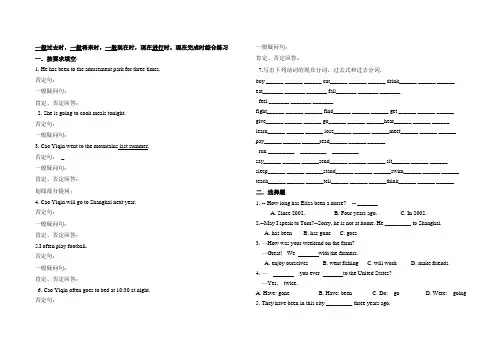
一般过去时,一般将来时,一般现在时,现在进行时,现在完成时综合练习一.按要求填空.1. He has been to the amusement park for three times.否定句:一般疑问句:肯定、否定回答:2. She is going to cook meals tonight.否定句:一般疑问句:3. Cao Yiqin went to the mountains last summer.否定句:_一般疑问句:肯定、否定回答:划线部分提问:4. Cao Yiqin will go to Shanghai next year.否定句:一般疑问句:肯定、否定回答:5.I often play football.否定句:一般疑问句:肯定、否定回答:6. Cao Yiqin often goes to bed at 10:30 at night.否定句:一般疑问句:肯定、否定回答:7.写出下列动词的现在分词、过去式和过去分词.buy ______ ______ ______ cut______ ______ ______ drink______ ______ ______eat_______ _______ _______ fall_______ _______ _______feel _______ _______ _______fight______ ______ ______ find______ ______ ______ get ______ ______ ______ give______ ______ ______ go______ ______ ______hear______ ______ ______learn______ ______ ______ lose______ ______ ______meet______ ______ ______ pay______ ______ ______read______ ______ ______run _________ _________ _________say______ ______ ______send______ ______ ______ sit______ ______ ______sleep______ ______ ______stand______ ______ ______swim______ ______ ______ teach______ ______ ______tell______ ______ ______think______ ______ ______ 二.选择题.1. -- How long has Eliza been a nurse? -- _______A. Since 2002.B. Four years ago.C. In 2002.2.--May I speak to Tom?--Sorry, he is not at home. He _________ to Shanghai.A. has beenB. has goneC. goes3. —How was your weekend on the farm?—Great! We with the farmers.A. enjoy ourselvesB. went fishingC. will workD. make friends4. —you ever to the United States?—Yes, twice.A. Have: goneB. Have: beenC. Do: goD. Were: going5. They have been in this city _________ three years ago.A. forB. aboutC. since6. ―have you been learning English?―I have been learning English for six years.A. How longB. How oftenC. How far7.--Where is Zhang Ming?-- Oh, he _____ to Beijng and he will be back tomorrow.A. has beenB. has goneC. goes8. The Greens____supper now. A:is having B:are;having C:is haveing9.____you usually _____to school with classmates?A. Do, comesB. does, comeC. Do, come10.Mr Green usually______newspapers after supper every day.A. readB. readingC. reads11.______Helen____________(wash )clothes? Yes ,she is .A. Is, washingB. Does , washC. Is, washes12. There ________ a dolphin show in the zoo tomorrow evening.A. wasB. is going to haveC. will haveD. is going to be13. He ________ her a beautiful hat on her next birthday.A. givesB. gaveC. will givingD. is going to giving14. There __________ a meeting tomorrow afternoon.A. will be going toB. will going to beC. is going to beD. will go to be 三.填空题.1.我母亲通常在星期日打扫卫生、洗衣服。
英语16种时态及练习题附答案
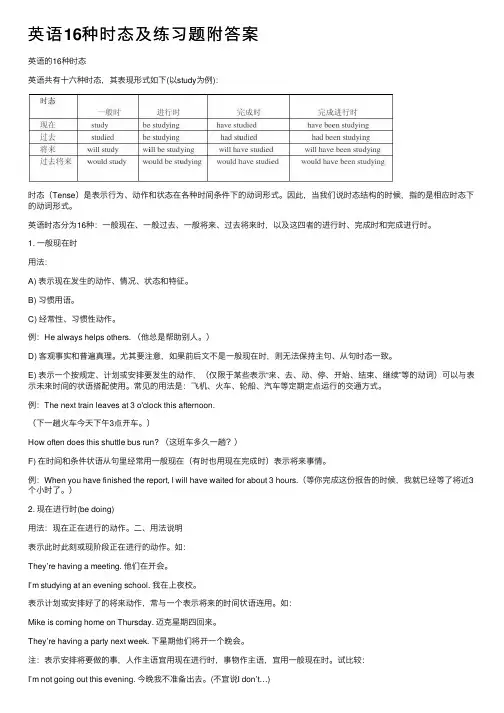
英语16种时态及练习题附答案英语的16种时态英语共有⼗六种时态,其表现形式如下(以study为例):时态(Tense)是表⽰⾏为、动作和状态在各种时间条件下的动词形式。
因此,当我们说时态结构的时候,指的是相应时态下的动词形式。
英语时态分为16种:⼀般现在、⼀般过去、⼀般将来、过去将来时,以及这四者的进⾏时、完成时和完成进⾏时。
1. ⼀般现在时⽤法:A) 表⽰现在发⽣的动作、情况、状态和特征。
B) 习惯⽤语。
C) 经常性、习惯性动作。
例:He always helps others. (他总是帮助别⼈。
)D) 客观事实和普遍真理。
尤其要注意,如果前后⽂不是⼀般现在时,则⽆法保持主句、从句时态⼀致。
E) 表⽰⼀个按规定、计划或安排要发⽣的动作,(仅限于某些表⽰“来、去、动、停、开始、结束、继续”等的动词)可以与表⽰未来时间的状语搭配使⽤。
常见的⽤法是:飞机、⽕车、轮船、汽车等定期定点运⾏的交通⽅式。
例:The next train leaves at 3 o'clock this afternoon.(下⼀趟⽕车今天下午3点开车。
)How often does this shuttle bus run? (这班车多久⼀趟?)F) 在时间和条件状语从句⾥经常⽤⼀般现在(有时也⽤现在完成时)表⽰将来事情。
例:When you have finished the report, I will have waited for about 3 hours.(等你完成这份报告的时候,我就已经等了将近3个⼩时了。
)2. 现在进⾏时(be doing)⽤法:现在正在进⾏的动作。
⼆、⽤法说明表⽰此时此刻或现阶段正在进⾏的动作。
如:They’re having a meeting. 他们在开会。
I’m studying at an evening school. 我在上夜校。
表⽰计划或安排好了的将来动作,常与⼀个表⽰将来的时间状语连⽤。
外研新版 八下 一般现在时、现在进行时、一般过去时、一般将来时、现在完成时。讲解及练习
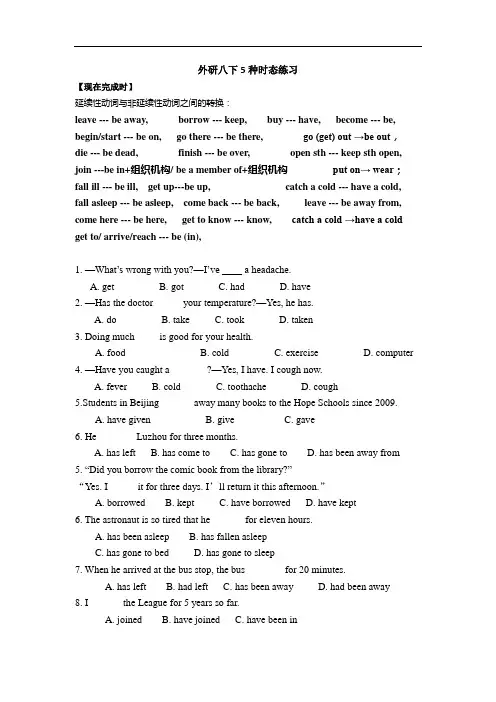
外研八下5种时态练习【现在完成时】延续性动词与非延续性动词之间的转换:leave --- be away, borrow --- keep, buy --- have, become --- be, begin/start --- be on, go there --- be there, go (get) out →be out,die --- be dead, finish --- be over, open sth --- keep sth open, join ---be in+组织机构/ be a member of+组织机构put on→ wear;fall ill --- be ill, get up---be up, catch a cold --- have a cold, fall asleep --- be asleep, come back --- be back, leave --- be away from, come here --- be here, get to know --- know, catch a cold →have a cold get to/ arrive/reach --- be (in),1. —What‘s wrong with you?—I‘ve ____ a headache.A. getB. gotC. hadD. have2. —Has the doctor _____ your temperature?—Yes, he has.A. doB. takeC. tookD. taken3. Doing much ____ is good for your health.A. foodB. coldC. exerciseD. computer4. —Have you caught a _______?—Yes, I have. I cough now.A. feverB. coldC. toothacheD. cough5.Students in Beijing ______ away many books to the Hope Schools since 2009.A. have givenB. giveC. gave6. He _______ Luzhou for three months.A. has leftB. has come toC. has gone toD. has been away from5. ―Did you borrow the comic book from the library?‖“Yes. I _____ it for three days. I’ll return it this afternoon.”A. borrowedB. keptC. have borrowedD. have kept6. The astronaut is so tired that he ______ for eleven hours.A. has been asleepB. has fallen asleepC. has gone to bedD. has gone to sleep7. When he arrived at the bus stop, the bus _______ for 20 minutes.A. has leftB. had leftC. has been awayD. had been away8. I ______ the League for 5 years so far.A. joinedB. have joinedC. have been in9. The factory ________ since the February of 1988.A . has been open B. has opened C. was open D. opened10. Mary and Rose _______friends since they met in 2000.A. have madeB. have beenC. madeD. have become11.You mustn't ________ until he comes back.A. be awayB. leaveC. be left12.The meeting _______ for a week now.A. has finishedB. has endedC. has been over13.Miss Gao ______ this school for nearly 5 years.A. has been inB. has come toC. has taught14.Ben ______ a teacher for 4 years .A. has beenB. has becomeC. wasD. became15. I ______ home for a week.A. have returnedB. have been backC. returned16. How long _______ he ________ ?A. diedB. has, diedC. has, been dead17. He ______ at eight yesterday afternoon.A. sleptB. was sleepingC. has sleepD. had slept18.He ________ the car for a week.A. boughtB. has boughtC. has had【一般现在时】一般现在时:表示经常性的事情,经常性的动作或一般性事实。
一般现在时_一般过去式及现在进行时知识点及练习题

一般现在时用法及练习题一、用法:1.表示事物或人物的特征、状态。
如:The sky is blue.天空是蓝色的。
2.表示经常性或习惯性的动作。
如:I get up at six every day.我每天六点起床。
3.表示客观现实。
如:The earth goes around the sun.地球绕着太阳转。
二、构成:1. be动词:主语+be(am ,is ,are)+其它。
如:I am a boy.我是一个男孩。
2.行为动词:主语+行为动词(+其它)。
如:We study English.我们学习英语。
当主语为第三人称单数(he, she ,it)时,三单变化:多数在动词后加s ,play—plays like—likes 以s,x,sh,ch,o结尾的动词加es go—goes wash—washes,以辅音字母加y结尾,把y改i再加es,fly—flies 。
第三,我的变化--否定句、一般疑问句、特殊疑问句:1. be动词的变化。
否定句:主语+ be + not +其它。
如:He is not a worker.他不是工人。
一般疑问句:Be +主语+其它。
如:-Are you a student -Yes. I am. / No, I'm not.特殊疑问句:疑问词+一般疑问句。
如:Where is my bike2.行为动词的变化。
否定句:主语+ don't( doesn't ) +动词原形(+其它)。
如:I don't like bread.当主语为第三人称单数时,要用doesn't构成否定句。
如:He doesn't often play.一般疑问句:Do( Does ) +主语+动词原形+其它。
如:- Do you often play football- Yes, I do. / No, I don't.当主语为第三人称单数时,要用does构成一般疑问句。
初中英语时态讲解及练习(全)

时间状语:Tomorrow, next day(week, month, year…),soon, in a few minutes, by…,the day after tomorrow, etc.
否定形式:主语+am/is/are not going to do ; 主语+will/shall not do+其他 一般疑问句:be放于句首;will/shall提到句首。
1.I ____(write, am writing, is writing, are writing) a letter now. 2.Look, it _____(begin, is beginning, am beginning, are beginning) to rain. 3.They ____(study, is studying, am studying, are studying) medicine at the Medical Institute of Chengde these days. 4.He _____(teach, am teaching, is teaching, are teaching) an English lesson at this time.
谓语动词使用过去式形式, 加ed,分为规则和不规则变 化。表示过去经常发生的动 作,也可用“used to do ” 和“would +动词原形”。
1. He____(be, was, were, been) here a moment ago. 2. They ____(be, was, were, been) here just now. 3. The scientists _____(leave, leaves, leaved, left) for America yesterday. 4. Last week we ______(visit, visited ) the Science Museum. 5. When I was a child, I often ____(play, played) football. 6. The students ran out of the classroom as soon as the bell ____(ring, rang, rung).
高中英语最实用语法一般过去时、现在完成时、将来完成时讲解和经典习题

I. 一般过去时一般过去时:在过去发生的动作,现在已经结束。
基本用法:1.过去某个特定时间发生的动作或存在的状态。
表示过去时间的时间状语:last+时间、时间+ago、yesterday、just now、the other day、once upon a time、at that time、then2. 表示过去经常发生的动作或存在的状态,可与频度副词always、usually、often等连用。
表示过去的习惯性动作,除了用动词过去式外,还可以用used to do sth、would do sth3.表示说话人始料未及的事情I didn’t know it was you.I never thought you would bring me a gift.4.宾语从句时态:主现从、主过从5.表示已去世者的情况或过去的历史。
II. 现在完成时一.基本结构:助动词have/has+过去分词(done)二.句型:否认句:主语+have/has+not+过去分词+其他.一般疑问句:Have/Has+主语+过去分词+其他.简略答语: Yes, 主语+ have/has.(肯定) No, 主语+ haven't/hasn't.(否认)三.用法〔1〕现在完成时表示过去发生或已经完成的动作对现在造成的影响或结果I have spent all of my money (so far).(含义是:现在我没有钱花了.)Guo zijun has (just/already) come. (含义:郭子君现在在这儿)My father has gone to work.(含义是:我爸爸现在不在这儿)〔2〕现在完成时可以用来表示发生在过去某一时刻的,持续到现在的动作〔用行为动词表示〕或状态〔be动词表示〕常与for〔+时间段〕,since〔+时间点或过去时的句子〕连用.①for+时段②since+过去一个时间点〔译为:自从……以来〕③since+时段+ago④主句〔现在完成时〕since+从句〔一般过去时〕→主完从过●⑤It is/ has been +时段+since+从句〔过去时〕Mary has been ill for three days.I have lived here since 1998.⑥It is + 第几次〔the first time〕that + 句子〔现在完成时〕四. has gone (to),has been (to), has been (in) 的区别Have/Has gone(to) :去了(现在不在说话现场)Where is your father?He has gone to Shanghai.Have/Has been (to) :去过〔已不在去过的地方〕My father has been to Shanghai.Have/has been in:呆了多久〔还在所呆的地方〕My father has been in Shanghai for two months. /since two months ago. 五.现在完成时的标志1. 现在完成时的含义之一是过去完成的动作对现在仍有影响,用以下四大标志词可以表达这种含义:* 以already, just和yet为标志He has already got her help. 他已得到她的帮助。
完成时和反义疑问句专项练习题
动词时态专练(一般现在时、现在进行时、一般将来时、一般过去时、现在完成时、过去将来时、过去进行时)一、用所给词的正确形式填空:1. Tom often ______(go) to school at 9 o’clock in the morning. But today is Sunday, It’s 9o’clock, he _______(swim) in the river, he ______(watch) movie tonight.2. Lucy ______ (never, be) to London before, She ______(go) there in July this year ____(watch)Olympic Games. She _____(watch) Beijing Olympic Games in 2008, she ______ (already, watch) it for three times.3. “Where is your father?” “He ______(go) to work.”“Where is your mother?” “ She_____(cook) in the kitchen, she ______(cook) for us in the morning.”4. “What _____you _____(do) at that moment?” I _____(do) my homework while mymother _____(clean) our room.5. The children ______(study) English since they _____(be) 9 years old, they ________(begin)5 years old, but they have problem_______(listen) to English, so they_____(practice )_______(listen) to English every day.6. Look! My friends _______(play) basketball over there, they _______(play)basketball for 2hours so far.7. Tom________(go) home just now, he _______ (do)his homework right now, he________(goto bed) right away, he _______(do) his homework in the past 20 minutes.8. Jack ______(read) books when his friend ______(call) me last night, he always _____(read)books before _______(go)to bed.9. The boy _____(fall) into river , he said to me that he ______(not, walk)along the river fromthen on. He _____(ever, walk) along the river since he _____(move) here .10. He _____(collection) stamps if he _____ (has) money. I want to know if you _____(come)here tomorrow.11. What _____you _____ in the future? My father_____(prediction) that I _____(be) an_____(art) when I grow up.12. Tom told us that he ______(come) here in ten days, he also told us that the earth _____(go)around the sun.13. “ We _______(have) my dinner already.” “ when _____you______(have) it ?"二、按要求改写下列句子。
所有时态综合练习题
所有时态综合练习题在语言学习中,时态一直是一个重要的概念。
正确理解和使用时态是准确表达时间、条件、可能性等意思的关键。
为了帮助大家更好地理解和使用各种时态,我们提供了一份综合练习题。
一、现在简单时(Simple Present Tense)1、I ______ (watch) TV every night.2、They ______ (go) to school every morning.3、He ______ (write) a letter to his friend last week.二、现在进行时(Present Continuous Tense)1、I ______ (cook) dinner right now.2、They ______ (play) football at the moment.3、She ______ (call) you when she arrives.三、现在完成时(Present Perfect Tense)1、I ______ (finish) my homework already.2、They ______ (visit) the museum last weekend.3、He ______ (hear) from his brother in the last few days.四、过去简单时(Simple Past Tense)1、We ______ (watch) a movie last night.2、They ______ (go) to the park yesterday.3、She ______ (write) a poem yesterday.五、过去进行时(Past Continuous Tense)1、I ______ (be) in the library at that time yesterday.2、They ______ (play) in the park when it started to rain.3、She ______ (read) a book while we were talking.六、过去完成时(Past Perfect Tense)1、I ______ (read) the book before I went to bed.2、They ______ (finish) their homework when the teacher came in.3、She ______ (talk) to her friend before she came to the party. 以上是各种时态的练习题,希望可以帮助大家更好地理解和使用这些时态。
中考英语单项选择专题练习《动词的时态》附答案
中考英语单项选择专题练习《动词的时态》了解动词的七种基本时态:一般现在时,一般过去时,一般将来时,现在进行时,过去进行时,现在完成时及过去将来时。
( )1.(2015·重庆B)—When shall we begin our meeting?—We'll begin it when Helen .A.comes B.came C.will come D.come( )2.(2015·盐城)Sherlock Holmes asked the suspect what he when the murder took place.A.was doing B.has doneC.is doing D.would do( )3.(2015·泰州)—Look at the blue sky! The rain .—Let's go out for a walk.A.stops B.will stopC.has stopped D.had stopped( )4.(2015·苏州)—Where is Joan?—She a novel in her study.A.has read B.readsC.will read D.is reading( )5.(2015·扬州)—You look worried.What's wrong?—I went for a job interview yesterday and I the result.A.waited for B.was waiting forC.am waiting for D.will wait for( )6.(2015·衡阳)—you to Nanhu Park a week ago?—Yes.We had a good time there.A.Do;go B.Did;go C.Did;went( )7.(2015·河南)I heard a new song on the radio,I high and low in the music store,but I can'tfind the song.A.search B.have searchedC.am searching D.will search( )8.(2015·淮安)Her son the army for two months.She misses him very much.A.has joined B.has been inC.joined D.was in( )9.(2015·北京)—Mum,where is Dad?—He flowers in the garden now.A.planted B.plantsC.will plant D.is planting( )10.(2015·上海)Now Jerry the exchange programme with his classmates in the meetingroom.A.discussed B.is discussingC.was discussing D.has discussed( )11.(2015·武汉)—Where are the flowers?—You see,someone them to the windows.A.moves B.had movedC.has moved D.would move( )12.(2015·常州)Mike used to be a top student,but he behind since he lost himself incomputer games.A.fell B.has fallen C.was D.has been( )13.(2015·济南)The Chinese dream true if everyone works hard enough.A.come A.comes C.will come D.came( )14.(2015·永州)—What were you doing at this time yesterday?—I my homework.A.did B.am doing C.was doing( )15.(2015·宿迁)Since 2009,Modern Family us the funny,sad and moving stories of threeAmerican families.A.has given B.will giveC.gave D.gives( )16.(2015·镇江)—Will you watch the programme Running Man in Zhejiang Star-TV tonight?—Yes,of course.It one of the most popular shows since last October.A.was B.becameC.has been D.has become( )17.(2015·南通)—Helen,when did you move here?—I here since two years ago.A.moved B.livedC.have moved D.have lived( )18.(2015·福州)—Miss Lin my deskmate with her lessons when I left school.—She is really a nice teacher.A.helps B.is helping C.was helping( )19.(2015·南京)—Why didn't Peter his homework?—He said he had lost his workbook.I think it's an excuse.A.does B.doing C.do D.did( )20.(2015·宜宾)Over fifty countries the AIIB (亚投行) so far.A.joined B.was joiningC.had joined D.have joined( )21.(2015·凉山)—I went to visit you yesterday evening,but you weren't in.Where were you then?—Oh,I my pet dog in the park.I this dog for three days and it’svery cute.A.was walking;have hadB.walked;boughtC.was walking;have boughtD.walked;have had( )22.(2015·杭州)I scared of dogs ever since a dog hurt me when I was five years old.A.will be B.was C.have been D.would be( )23.(2015·广州)Miss Brown,we cleaning our classroom.Can we go home now?A.finish B.finishingC.are finished D.have finished( )24.(2015·泰安)—Our classmates went to a concert yesterday afternoon.—What a pity! I my homework.A.had done B.was doingC.am doing D.would do( )25.(2015·潍坊)Next month w e’re going somewhere interesting as soon as the holiday .A.will begin B.has begunC.begins D.is beginning( )26.(2015·连云港)In the past few years,great changes in Lianyungang.A.take place B.took placeC.have taken place D.have been taken place( )27.(2015·威海)—How fast when the police stopped you?—I don't know exactly,but not too fast.A.were you drivingB.did you driveC.are you driving( )28.(2015·江西)—Ben and Sue aren't home,are they?—No.They to London on business.A.have gone B.goC.have been D.will go( )29.(2015·内江)I missed his call because at that time I a shower.A.had B.have hadC.have D.was having( )30.(2015·资阳)Bob took a photo of his girlfriend while she at the party.A.dances B.was dancingC.has danced D.is dancing( )31.(2015·天津)—Why did the car hit the boy?—Because the driver on the phone at that time.A.talk B.is talkingC.was talking D.have talked( )32.(2015·日照)—Have you watched the movie The Left Ear ?—Yes,I it last night with my sister.A.have watched B.watchedC.will watch D.was watching( )33.(2015·邵阳)—Where is your father,Bruce?—He Shanghai.He'll be back in 3 days.A.has been to B.has gone to C.went to( )34.(2015·绵阳)Mum,someone .Please pick up the phone.A.has called B.is callingC.will call D.was calling( )35.(2015·绵阳)—What's your father?—He is a doctor.He in a local hospital.A.worked B.has workedC.works D.will work( )36.(2015·眉山)—Do you know when Jay here tomorrow?—Sorry,I don't know.But when he here tomorrow,I'll tell you at once.A.gets;gets B.gets;will getC.will get;will get D.will get;gets( )37.(2015·武威)—Hey,Jenny.Let's go home together.—Just a moment.I an email.A.send B.sentC.am seding D have sent( )38.(2015·泰州)—Hi,Jack.Nice to meet you here in Taizhou!—Me too.But I you were in Shanghai.A.think B.thoughtC.am thinking D.will think( )39.(2015·宜昌)—Internet business traditional business in the past few years?—Not really.B.Does;beat B.Will;beatC.Has;beaten D.Is;beating( )40.(2015·黄冈)—Amy,can we give away these soft toys? We them for many years.—Mum.but I want to keep the bear.A.bought B.hadC.have bought D.have had( )41.(2015·汕尾)—The TV programme Voice of Youth is really great.—I think so.It the hearts of lots of fans since it started.A.lose and touchB.won and touchedC.has won and touchedD.has lost and hit( )42.(2015·雅安)The film has for an hour.A.started B.begun C.been on D.finished( )43.(2015·乐山)—The radio says there will be a heavy storm in Mount Emei tomorrow.—Bad luck.I to go there with my classmates.A.plan B.will plan C.planned( )44.(2015·山西)—Have you finished the poster for the party?—Not yet.I it in two days.A.finish B.finished C.will finish( )45.(2015·十堰)My grandfather likes the small village very much.So far he there for 50years.A.had lived B.livedC.lives D.has lived( )46.(2015·广东)Don't disturb Allen now.He for the Spelling Bee competition.A.prepares B.preparedC.is preparing D.will prepare( )47.(2015·铜仁)—Did you see Tom yesterday?—No.I him for a long time.A.didn't see B.hasn't seenC.saw D.haven't seen( )48.(2015·莱芜)—Mr Huang,it's late.Why are you still here?—My daughter hasn't come back from school yet.I for her.A.waited B.am waitingC.was waiting D.have waited( )49.(2015·郴州)I will send you an email as soon as I in London.A.arrived B.arrive C.will arrive( )50.(2015·娄底)—I to the cinema yesterday.—It's a pity.You didn't invite me.A.go B.went C.have gone( )51.(2015·孝感)We will go to Tian’anmen Square to watch the raising of the national flag if ittomorrow.A.will rain B.rainsC.doesn't rain D.won't rain( )52.(2015·漳州)—Ben.why are you watching TV at this time? How about your homework?—I all of it,Mum I want to have a rest.A.finishB.am finishingC.have finished( )53.(2015·绥化)The boys in Class 3 a maths class at nine o'clock yesterday morning.A.is having B.was having C.were having( )54.(2015·河北)I the shops.Can I get you anything?A.go to B.went toC.have gone to D.am going to( )55.(2015·海南)—My aunt me to Europe for vacation next month.—Have a good time!A.take B.took C.will take( )56.(2015·陕西)Many city people their bikes to work every day.A.ride B.will rideC.rode D.have ridden( )57.(2015·龙东五市)—I don't know if Sam tomorrow.—Don't worry.I will tell you as soon as he .A.comes:will comeB.will come;comesC.will come;will come( )58.(2015·上海)Tim told us that his company robots to do some of the work.A.uses B.will useC.has used D.would use( )59.(2015·济南)—How long have you ?—For almost ten years.A.owned this gardenB.bought this carC.arrived in ShanghaiD.come to this town( )60.(2015·随州)—May I speak to Mr Black?—Sorry,he Hong Kong.But he back in a few days.A.has been to;will come.B.has gone to:will comeC.has been to;cameD.has gone to;came( )61.(2015·黔西南)Michael his hometown for a long time.He really misses it!A.1eft B.has leftC.was away from D.has been away fom( )62.(2015·镇江)—Hi,I didn't see you at the party in the company yesterday evening.—Oh,all my family my son's birthday at home.A.celebrated B.have celebratedC.was celebrating D.were celebrating( )63.(2015·鄂州)—What Candy just now?—Sorry,I didn't hear it.I up the phone.A.was;saying;was pickingB.did;say;was pickingC.does;say;am pickingD.did;say;pick( )64.(2015·鄂州)—I'm sorry to have kept you waiting long.—Never mind.I here for only a few minutes.A.came B.have beenC.haw come D.had come( )65.(2015·绵阳)—It's getting late,Betty.—Nearly .I'm doing a composition.A.finished B.finishingC.finish D.finishes( )66.(2015·眉山)—How happy the grandparents are!—Yes,they for fifty years.A.have been married B.have marriedC.have got married D.married( )67.(2015·滨州)—Look at the sign! It says“No Smoking”.—Oh,sorry.I it.A.don't see B.haven't seenC.wasn't seen D.didn't see( )68.(2015·武威)Mother often tells me.“I hope you what I you to do at school!”A.won't forget;have toldB.don't forget;will tellC.didn't forget;tellD.haven't forgotten;am telling( )69.(2015·临沂)Tim Cook called his mother every week even while he around the world.A.was travelling B.is travellingC.travelled D.travels( )70.(2015·威海)—Dad,where is Mum?—She the supermarket.A.has gone toB.has been toC.is going to( )71.(2015·武汉)—Is your mother a teacher?—Yes,she is.She at a junior high school.A.taught B.teachesC.will teach D.is teaching( )72.(2015·长沙)—I called you last night but you didn't answer.—Sorry,Grace.I I Am A Singer when the phone rang.A.am watchingB.was watchingC.have watched( )73.(2015·乌鲁木齐)—Shall we hang out in Great Bazaar (大巴扎) tomorrow?—I'm afraid not.the final game of the World Cup on TV.A.ThereB.There will beC.There will haveD.There is going to have( )74.(2015·青岛)My parents are always worried about what will happen if I .A.succeededB.won't succeedC.will failD.fail参考答案1.A2.A3.C4.D5.C6.B7.B8.B9.D10.B11.C12.D13.C 14.C15.A16.C17.D18.C19.C20.D21.A22.C23.D24.B 25.C26.C27.A28.A29.D30.B31.C32.B33.B34.B35.C 36.D37.C38.B39.C40.D41.C42.C43.C44.C45.D46.C 47.D48.B49.B50.B51.C52.C53.C54.D55.C56.A57.B 58.D59.A60.B61.D62.D63.B64.B65.A66.A67.D68.A 69.A70.A71.B72.B73.B74.D。
初中英语一般过去时讲解+练习(含答案)
1. 动词在语言中是必不可少的一部分。
它的语法现象也较多,但在初中范围主要有以下几方面问题。
① 时态:初中范围主要有一般现在时,一般过去时,一般将来时,现在进行时,过去进行时和现在完成时,六种时态。
② 语态:主动语态与被动语态。
③ 助动词和情态动词。
④ 非谓语动词,也就是不定式,动名词及现在分词的用法。
2. 人教版初中英语教学大纲中除了以上 6 种时态,还会涉及到过去将来时和过去完成时,考生要熟练掌握这些时态的构成形式及基本用法。
3. 动词时态一般出现在单项选择题和完形填空题中,前者一般 2 道题,后者一般 1 道题,共占 5 分左右;此外在写作部分,时态是一个重点考察的项目,时态如果把握好,能给作文大大提分。
动词各时态在每个年级的分布:第 5 讲 一般过去时1.yesterday 或与其构成的短语:yesterday morning(afternoon, evening)等;2.由 last+时间名词构成的短语:last night, last year (winter, month, week)等;3.由―时间段+ago 构成的短语:a moment ago, a short time ago, an hour ago 等;4.其它 just now ,过去的时间:in 2000 等;一般过去时在七年级下册 Unit 11 中第一次出现,在这个单元的学习中,学生需要掌握以下知识点:一般过去时的定义及特征一般过去时的两种结构及其变化一般过去时的规则动词变形和不规则变形一般过去时的定义及特征定义:表示过去某个时间里发生的非持续性动作或存在的状态,也表示过去经常或反复发生的动作。
She opened the door this morning. (过去的非持续性动作) They were expensive twenty years ago. (过去存在的状态) I went swimming every Saturday last year. (过去经常发生的事)特征: a.谓语动词用过去式She was a doctor.I watered the flowers in the back yard. b.有表示过去的时间词She saw some paintings yesterday . Mary went fishing last weekend .注意:常与过去时搭配使用的标志性时间词1. 否定: 主语+was/were + not +其它 I was not (wasn’t) here yesterday.My parents were not (weren’t) at home last 2. 一般疑问句: Was/ Were +主语+其他?肯定回答用―Yes, 主语+was/were. 否定回答用―No, 主语+wasn’t/weren’t. ―Were you at home yesterday? ―Yes, I was. (No, I wasn’t.)—Were Wei Hua and Han Mei here just3. 特殊疑问句:特殊疑问词 + was/ were + 主语+其他?【即学即练】1. He usually gets up early in the morning. But he late today.2. She usually works from 8 a.m. to 5 p.m. But she from 8 a.m. to 6 p.m. yesterday.3. They often go to the park on Sundays. But they to the park last Monday.4. He reads the newspaper at breakfast. But he the newspaper yesterday morning.一般过去时的两种结构及其变化结构一:表示过去的状态: 主语+was/were +其它如:She was here yesterday.Three years ago I was a pupil. My parents were at home last night. 变化形式:否定:主语+did not +实义动词原形+其它 He didn’t watch TV yesterdayMike did not go to the farm last Sunday.一般疑问句: Did+ 主语+实义动词原形+其它? Did he watch TV yesterday?Did Mike go to the farm last Sunday?3.特殊疑问句:特殊疑问词 + did+ 主语 +实义动词原形+其它?What did he do yesterday?Where did Mike go last Sunday?结构二:表示过去发生的动作: 主语+实义动词过去式+其它注意:实义动词过去式分为规则和不规则变化(知识点三、四将会做详细讲解)如:He watched TV yesterday.Mike went to the farm last Sunday. Tom came to China last month. 变化形式:【即学即练】 1. My father ill yesterday. ( 2017 长沙七年级期末) A. isn’t B. aren’t C. wasn’tD. weren’t 2. your parents at home last week? ( 2017 江西七年级月考)A. isB. wasC. areD. were3. The twins in Dalian last year. They here now. ( 2016 大连七年级期末) A. are; wereB. were; areC. was; areD. were; was4. I my homework at 7:00 yesterday evening. ( 2017 兰州七年级期末)A. finishedB. would finishC. was finishingD. finish5. —?— He did some reading at home. ( 2017 安徽中考) A. What does your father do yesterday evening? B. What does your brother do in the school? C. What did your brother do over the weekend? D. Where did your brother go last Sunday?一般过去时的规则动词规则变形及不规则变形规则变形:情况加法原形例词一般情况加-ed look looked 以e 收尾的词加-d use used末尾只有一个辅音字母的重读闭音节词先双写这个辅音字母,再加-edstopplanstoppedplanned以“辅音字母+y”结尾的动词先变y 为i,再加-ed worrystudyworriedstudied不规则变形:1.中间去e 末尾加t,如:keep →kept,feel →felt,sleep →slept,sweep →swept2.结尾d 变t,如:build →built,lend →lent,send →sent,spend →spent3.遇见i 改为a,如:ring →rang,sit →sat,drink →drank,sing →sang,swim→ swam,4.“骑(马)”“开(车)”“写(字)”把i 变o 如:ride →rode,drive →drove,write →wrote 5.“想”“买”“带来”“打仗”ought 换上,如:think →thought,buy →bought,bring →brought,fight →fought6.“教书”“抓住”——aught 切莫忘,如:teach →taught,carry →caught7.ow/aw 改为ew 是新时尚,如:know →knew,grow →grew,throw →threw,draw →drew 8.“放”“让”“读”过去式与原形一个样,如:put → put,let → let,read → read /red/【即学即练】Dear Jim,My school trip 1. (is) great! We 2. (have) so much fun! We 3.(go) to Green Park. We 4. (climb) the mountains there and 5.(see) a lot of flowers. We 6. (eat) lunch under some trees and 7.(play) some games after that. But at about two o’clock, it 8. (get) very cloudy and we 9. _ (worry) it would rain. Luckily, it 10. (do not),and the sun 11. (come) out again!Bill易错点一:难以判别是否用过去式,如:I went to the supermarket and bought (buy) some fruit.由于没有找到时间状语,因而不知道应该填什么。