
外研版高中一 Module 3 my first ride on a train writing
Translate the following expressions.
• 1. a tourist spot 景点 • 2. places of interest 名胜 • 3. 骑自行车(摩托车)ride a bicycle/motorcar
• 4. 开车(开车回家) drive a car/drive home
• I first travelled a long distance by car in 2014.
• I went with some friends from Xinjin to Qinghai.
• The scenery was very colourful. The sun shone,
• As a student, we should cherish our life
2. I travelled a long distance for the first time when I was about ____ years old. I went to ______with_______.
3. The first time I travelled a long distance was when I was_______.
1.Where did you go? 2.When did you go? 3.How did you travel there? 4.Who did you go with? 5.What did you do there ? 6.What did you see there ? 7.What did you eat there? 8.Did you enjoy the trip?
2.Do you know the writer’s attitude and emotion? 3.Are there any good connecting words or phrases?(连接 词或短语)
4.Are there any good phrases or sentences?
5.Are there any spelling mistakes?
• and there were some clouds in the sky. Qinghai Lake was very clear and blue, and the field was yellow.
I rode a horse near the lake, and I felt a little nervous but enjoyable.
2.During the day, I sat and looked out of the window, and sometimes talked to other passengers.
3.I read books and listened to my Chinese cassettes.
4.One night, at about midnight, I watched the night sky for about an hour.
3. Recall the following adjectives(形容词).
• 美味的
delicious
• fantastic 极好的
• 令人惊异的 amazing
• well-known 著名的
• unforgettable难忘 的
• attractive 吸引人的
Do you want to share my long distance trip ?
SHOWTIME
• Who do you think did the best in your group?
Travel broadens the mind. Travel also makes us feel peaceful, completely relaxed and happy. 旅游开阔眼界,旅游可以释放心情
• Read the description on Page84.
• Write your description of a trip.
回答下列问题,将答案组成一段文字。
1.注意使用一般过去时态和恰当的时间状语。 2.注意恰当使用连接词,使上下文联接自然。 1.Where did you go? 2.When did you go? 3.How did you travel there? 4.Who did you go with? 5.What did you do there ? 6.What did you see there ? 7.What did you eat there? 8.Did you enjoy the trip?
5.We ate great food cooked by experts!
6.We saw abandoned farms which were built more than 100 years ago.
7.What a trip!
Think of the first time you went on a trip without/with your parents. Answer these questions.
Use them to make your own sentences
1.I first did sth by _____ when I was _____. I went with _____ from _____ to______.
2. I did sth for the first time when I was about ____ years old. I went to ______with_______.
• Please watch the video. • Think about why so many people join in
watching flag raising on Tian’anmen • Square on National Day.
• With our country reviving(复兴), Chinese people have a chance to travel about, living a better life.
•Exchange your descriptions, •when reading others’ descriptions pay attention to these questions:
1.Are you clear what happen (What, where, when, who, How, and Result)
13. pay a visit to
去参观,游览
14. enjoy the beautiful scenery欣赏美景
• 2. Write down the past tense of the verbs. • eat ate • drink drank • drive drove • take took • see saw • buy bought • bring brought • hear heard
8. 长途旅行 travel a long distance 9. 在十月一日的早晨
on the morning of October 1st. 10.在旅行期间 during the journey
11. go sightseeing
游览,观光
12. broaden one’s mind 开阔眼界
3. The first time I did sth was when I was_______.
PAIR WORK
Try to describe the first time you traveled a long distance.
• Sample: Now it’s your turn to share
Work in pairs. Ask and answer the questions. • 1.Where did you go? • 2.When did you go? • 3.How did you travel there? • 4.Who did you go with? • 5.What did you do there ? • 6.What did you see there ? • 7.What did you eat there? • 8.Did you enjoy the trip?
• Tips:When talking about experience, you should pay attention to these:
• Who , when, where, what, why, how
1.We spent two days and nights on the train.
无径之林,常有情趣, 无人之岸,几多惊喜, 世外桃源,何处寻觅, 聆听涛乐,须在海里; 爱我爱你,更爱自然。
——拜伦
Module Three
My First Ride on a Train
Learning Goals
• 1.Talking about a trip you made. • 2.Writing a passage about it. • 3.Try to use the expressions you
There is a pleasure in the pathless woods, There is a rapture on the lonely shore, There is a society where none intrudes, By the deep sea, and music in its roar; I love not Man the less, but Nature more.
高中英语Module 3 My First Ride on a Train读写教案

Book 1 Module 3 Reading:My First Ride on a TrainTeaching Design授课题材:外研版高一Book 1 Module 3教学内容:Reading:My First Ride on a Train授课课型:Speaing and writing教学时间:40 minutesI. Analysis of the teaching materialThis is the firet period of this module, which focus on reading, talking about a trip you made to a tourist spot. The topic is familiar to students, which will definitely raise the students’ interests and attentions. Through the introduction , students can talk about their own travelling experience, get to know the means of transportation. guide the students to write a short passage to invite sb to chegnduII . Analysis of the studentsThe students I will teach are these of Senior Grade 1 their English is not as excellent as other classes. Although they are familiar with the topic, it is the first time for them invite sb to chengdu Maybe they have some trouble in writingIII. Teaching Goals1. Knowledge Objects: (The knowle dge objects of learning this text are to…)❖Learn about the means of transportation❖Learn to describe an event, e.g. a trip, a bus ride, a train ride, an air flight, etc..❖Learn say when where how to describe their short journey.2. Ability Objects: (Th e ability objects of learning this text are to…)❖Practise the students’ speaking and writing ability.❖Learn how to speak and write based on the topic of travelling.3. Moral Objects: (The moral objects of learning this text are to…)❖Show interest in the relationship of friends❖Develop the sense of pride in ourcityIV. Teaching Important Points1.Enhance students’ abilities to describe an event, e.g. a trip, a bus ride, a train ride, an air flight, etc..2.Improve students’ abilities to speaking and writingV. Teaching Difficult Points1.Guide students how to speak and write based on the topic of travelling2.Enable students to enjoy the essay3.Guide students to express their wayVI. Teaching Methods and Teaching AidsTeaching Methods:Task-based Methods, Individual and Cooperative Methods Teaching Aids: Multimedia computer;blackboard; Multimedia power point;hand-out VII. Teaching ProceduresThe general processes are as follows:。
高中英语 Module3 My First Ride on a Train 1 period 外研版
Module 3 My First Ride on a TrainⅠ.The General Idea of This ModuleThe topic of this module is My First Ride on a Train.This module will describe the scene characteristics by traveling to Australia.We will learn some words about vehicles and natural phenomena in this module.On the other hand,we will learn grammar on the usage of the –edform.Also,we will get the students to describe their traveling and natural scenery with these words.The words with the -ed form can be used as adjectives and give some ex amples.We will train the student’s abilities of listening,speaking,reading and writing.What’s more,I will lead the students to go over the usage of the past time expressions.INTRODUCTIONIn this module,we’ll learn some new words on vehicles.Recall the students’ happy childhood on the first ride.READING AND VOCABULARY(1)To train reading skill by skimming and scanning the passage.(2)Enable the students to improve abilities of imagination,analysis and thinking in English.GRAMMARThe -ed form can be used as adjectives and attributive adjectives.FUNCTIONLearn to use everyday English to express good manners.VOCABULARYLearn some words on places,using these words to connect the related knowledge. READING AND SPEAKING(1)Read the passage on recalling childhood.(2)To get the general idea by reading the past experience.(3)To get the key points.(4)Make a similar dialogue.LISTENINGTo train the students’ ability to catch the key.WRITINGLearn to make notes by reading the passage.PRONUNCIATIONHow to read the correct stress of the sentencesEVERYDAY ENGLISHGive response to the dialogue.CULTURAL CORNERTo know the advantages about Maglev—the fastest train.TASKDescribe the travel looking at photots,postcards...MODULE FILETo help the students to conclude the content.To test what they have learned.Ⅱ.Three-Dimensional Goals1.Knowledge and Skills(1)To write down the sentences and passage including the new words,phrases and -ed words.(2)To read the passage to train the students’ ability of skimming.(3)To recall the past experience using the past time;making a dialogue using polite ways.2.Process and Methods(1)Teacher’s guidance and teaching lead the Ss to know the new achievements including Maglev.(2)Activity and InquiryTo know the travel culture in many places in the world.To know how to do in good manners,learn to be polite.3.Emotion and ValuesArouse the students’ love for their motherland.Get them to feel proud of social achievement.Ⅲ.Teaching Impo rtant PointLearn the passage and sentence structure.Ⅳ.Teaching Difficult PointGrammar:the -ed form and language points.Ⅴ.Teaching Aidsmultimedia,a little blackboardⅥ.Teaching Timeseven periodsThe first period:Introduction(Vocabulary and Speaking)The second period:Reading and VocabularyThe third period:Reading and VocabularyThe fourth period:Grammar 1,Function and VocabularyThe fifth period:Grammar,Reading and SpeakingThe sixth period:Listening,Writing,Pronunciation and Everyday EnglishThe seventh period:Cultural Corner,Task and Module FileThe First PeriodThe General Idea of This PeriodIn this period we’ll finish the four activities on Page 21.Then practise speaking after the model.At last I’ll give four situations to discuss.Teaching Aims1.To learn and master the following:Words: helicopter,motorbike,tram,ferryPhrases: get on,get off,get into,get out (of) ride,take off,land drive2.To develop the students’ speaking ability by talking and discussing.Teaching Important Points1.How to improve the students’ speaking ability2.Learn some vocabularies.Teaching Difficult PointHow to improve the students’ speaking ability by making some dialogues correctly. Teaching Methods1.Answering activity to help the students go through vocabulary2.Matching the words to arouse the students’ interest in the names of vehicles.3.Individual,pair or group work to make every student work in class.Teaching Aids1.a puter2.some picturesTeaching ProceduresStep 1 GreetingsGreet the whole class as usual.T: Good morning.Ss: Good morning,Miss Liu.Step 2 Lead-inT: With the development of society,we are changing our life.More and more people like to travel.Do you like traveling?S: Yes.T: Where have you been?S: The Great Wall,the Palace Museum,Mount Tai,...S: The West Lake,the Great Wall,...S:...T: How did you make your first journey?S:By train.S: By bus.S: By bike.T: Now,we’ll review the means of transportation.“Means of transportation” is a means of carrying people or goods from one place to another.(By means of transportation) Who can give us the names of the transportation?S: By bike/by train/by car/by boat/by plane or on foot.(on Page136) Step 3 PresentationT: Open your books at Page 21.Let’s e to Introduction.First look at the pictures.Let’s learn some wordsaboutvehicles.(Show them on the screen.)Ferry,tram,helicopter,motorbikeT: Read aloud and explain the Chinese meanings.Then ask the students how they travel around most frequently elicit basic expressions.S: I usually travel on foot/by bike/by bus.T: Who has traveled by train/taxi/plane/boat?Explain where,when and why.S:I have travelled by train to Beijing.Before we decide the means of transportation,we must consider the time and money we have to spend,and whether we’ll feel fortable and safe during our travels.T: OK.What you said is reasonable.(Teacher uses the multimedia to show the pictures at Page21.)Ask the students to match the words in the box with the pictures on the screen,then check with a partner.Check the answers with the students together.Picture 1.motorbike 2.ferry 3.tram 4.train 5.plane 6.bus7.helicopter 8.bicycle9.taxiStep 4 AnsweringGet the students to answer the Activity 2.Then check with them together.T: Read through the questions as the students follow.Make sure the students understand the questions.T: Ask students to do the activity in pairs.Asking and answering.Then get them to check with a partner.S: Which of the vehicles travel on road?S: Taxi,bicycles,motorbikes and buses travel on roads.S: Which of them travel on rails?S: Trams and trains-travel on rails.S: Which of them travels on water?S: Ferries travel on water.S: Which of them travel in the air?S: Helicopters and planes travel in the air.S: Which of them can you use to travel a long distance?S: You can use a plane or a train to travel a long distance.Step 5 PracticeMatch the verbs with the means of transport.Get the students to do Activity 3.1.Read through the verbs and have the class repeat them after you.get on get off get into get out (of) ride drive take off land2.Ask students to do the activity individually.They can check with a partner.3.Call back the answers from the class.Suggested answers:get on:bus/train/tram/bicycle/motorbike/ferry/planeget off:bus/train/tram/bicycle/motorbike/ferry/planeget into:taxi/helicopterride:bicycle/motorbikedrive:train/taxi/bustake off:plane/helicopterland:plane/helicopterStep 6 Speaking1.Get the students to describe the first time you travelled a long distance.2.Put the students into groups of four to ask and answer about their journeys.S: I first traveled a long distance by train when I was seven years old.I went with my parents from Nanjing to Beijing.S: I first traveled a long distance by train when I was twelve years old.I went with my classmates and my teacher from my hometown to Beijing.Then tell the students the following:I first traveled a long distance by train last year.I went to Harbin with my husband and my st Spring Festival,I went there to see the icy city—Harbin.There are a lot of wonderful statues,carved out of snow.I hope you will go there in the future.Step 7 DiscussionT: We can make a trip in many ways.But what do you have to consider before you decide the means of transportation?I think we must consider time and money we have to spend,and whether we’ll feel fortable and safe during travels.Thus is very reasonable.Do you understand?(Show a map of the world,a map of China and some situations on the screen.)T: Now look at the screen and discuss how you’d like to go to the places,by train,by bus or by air.Besides,give the reason why you make the decision.Situation1.from Shanghai to London2.from Beijing to Guangzhou3.from Dalian to Qingdao4.from Chongqing to Chengdu(The teacher gives the students a few minutes to discuss in groups of four and asks some of them to give their ideas.)Suggested ideas:1.Situation 1By air.It’s a long way from Shanghai to London.It’s the better and faster way to get there by air than by ship.2.Situation 2By train.Beijing is far from Guangzhou.We can get there by train or by plane.It’s faster by plane,but it’s better to go there by train.On the train we can b e fortable and enjoy the beautiful scenes on the way there.By boat/ship.It’s shorter by ship than by bus or train.Meanwhile,we can enjoy the beautiful scene on the sea.3.Situation 3By boat/ship.It’s shorter by ship than by bus or train.Meanwhile,we c an enjoy the beautiful scene on the season.4.Situation 4By bus.Chongqing is not far from Chengdu.It takes us only several hours to get there by bus.It’s faster by bus than by train.Step 8 Summary and HomeworkToday we’ve learned some vocabulary on the vehicles and done some speaking and known how to choose means of transportation.Also we’ve learned to discribe the first time you traveled a long distance.Besides,we’ve learnt some words(pointing to the blackboard).A.ferry,helicopter,tram,plane,motorbike,distanceB.get on/off/into/out(of),ride/dive,take off,land.Step 8 The Design of Writing on the BlackboardModule 3 My First Ride on a TrainThe First Periods: s:helicopter n. motorbike n.get on get offtram n.distance n.get into get out (of)a long distance n. ride/dive/landtake off3._________travel on roads_________on rails_________on water_________in the airStep 9 Activity and InquirySteps Students!Acting Teacher’s Organizing1 Look at the pictures give the words. Show the pictures on the screen.2 Answer the following. Write on the blackboard.3 Write down the description. Give description.。
外研版高中英语必修1《Module 3 My First Ride on a Train》word教案
Teaching PlanⅠ.Teaching content: Reading and V ocabular y—My First Ride on aTrain of Module3,Book1Ⅱ.Teaching objectives:1.Knowledge and Skills1)Train the student’s speaking skills.2)Develop the students’ reading ability.2.Process and Strategies1)Discussion to help the students prepare for reading.2)Scanning and careful reading to help the studentsunderstand the passage better.3.Emotion and ValuesTry to arouse the student’s cooperation awareness in their study by group work.Ⅲ.Teaching important points1.Help the students to organize group discussion.2.Help the students make sense of the whole passage.3.Help the students to improve their reading ability.Ⅳ.Teaching difficult points1.Lead students to talking in class actively.2.How to apply the teaching method effectively.Ⅴ.Teaching aidsthe multimediaⅥ.Teaching stepsStep1 Lead-inShow the students some pictures and introduce AustraliaStep2 Pre-reading1.Background knowledge of AustraliaFirst ask the students to talk about the questions below by working in groups. Then choose several students to describe Australia according to their discussion results.1) Do you know how many people live there?2) Do you know the name of the capital city?3) Where do you think most of the people live, in the central partor on the coast?4) What do you think the central part of the country is like?5) What Australia animals do you know about?Suggested answers:1) About 20 million2) Canberra3) On the coast4) Desert5) Koala bear; kangaroo2. V ocabulary1) First let the students read the new words. Teachers may helpclear the difficulties they meet in their pronunciation.Cassette diamonds camels desert abandoned clouds distance colourful experts law farm field food meal sand soil midnight shine shoot famous supply products recently government scenery weather passengers2) Then the students are required to finish the followingspelling exercise.Suggested answers:Step3 While-reading1. ScanningAsk the students read the passage quickly and try to find out appropriate information to fill in the two forms below:2.Careful readingAsk the students to read the passage carefully and answer the questions.Suggested answers:Step4 Home work1. Do more reading about the reading passage to get clearer and further understanding .2. Retell the passage in your own words.3. Find the new words and expressions which you are not familiar with after class.。
2014版英语复习方略课件(外研版通用):必修1 Module 3 My First Ride on a Train
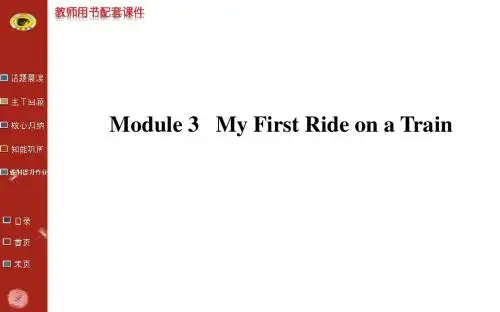
products but they were and returned with wool and other 8. ________,
more when government built a railway line. not used any 9. _____ which allowed people Then the government passed a law 10. ______
4. 定语从句 which were built more than a We saw abandoned farms __________________________ hundred years ago ________________(100 多年前建造的). 5. Would you mind if. . .
也
作为„„被接受
期望,盼望
一句多译 他学习写作已经十年了。 He has been learning writing for ten years. ①_____________________________________ It is ten years since he began to learn writing. ②_______________________________________
abandoned adj.)被遗弃的→________( abandon v.)遗弃;抛弃 9. __________( product n.)产品→________( produce v.)生产→__________( production n.)生产 10. _______( frighten vt.)使吃惊;惊吓→_________( frightened adj.)受惊的,害 11. _______(
外研版高中英语必修1Module3 My First Ride on a train
Module 3 My First Ride on a trainTeaching Aims:Knowledge and SkillTo write down the sentences and passage including the new words, phrases and –ed words.To recall he past experience using the past time; making a dialogue using polite waysEnable the students to improve their reading skills by skimming and scanning.Get the students to know details about Alice’s trip and the origin of the name of the train.Enable the students to improve the abilities of imagination, analysis and thinking in English.2.Emotion and ValuesTo help them describe a trip and arouse their love of their own motherland Make them to feel proud of social achievement3. Cross-cultural awareness:To help them learn about beautiful scenery of Australia.4. Character-building:To help them know the fastest train and encourage them to work hard in order to make great contribution to the societyTo let them know the importance of cooperating with others in a group Difficulties and Importance:Enable the students to understand the passage clearly and learn to describe their own trip.Enable the students to grasp the usage of the –ed form.The usage of past tense time expressions.Teaching Method:Task-based methodologyCommunicative ApproachTeaching Procedures:Period 1Teaching Content: Vocabulary and speakingEveryday English and functionStep 1. List the name of transportation vehicles.on roads: taxis, bicycles, motorbikes, buses, cars, tractors, trucks…on rails: trams, trains…on water: ferries, ships, boats, rafts(筏子), canoes(独木舟)…in the air: helicopters, planes, aeroplanes, spaceships, rockets…Long distance: planes, train, shipsferry, planeget into/get out of: taxi, helicopter,ride: bicycle, motorbike,drive: taxi, train, bus,take off/land: plane, helicopterStep 4. Describe the first time you traveled a long distance, including the following information such as your age, where you went and who accompanied and so on.Step 5. Everyday EnglishComplete each sentence with one of the expressions.Goodness Definitely!Interviewer: ________, did you enjoy making films?Mary Lennon:_________! It was good fun! Sometimes we made three films in a week.Interviewer:_________! Weren’t you bored?Mary Lennon:___________! It was good fun.Interviewer: ________? But weren’t you tired?Mary Lennon:______________! We were exhausted. We had to get up at 4 a.m. and we didn’t go to bed until midnight.Interviewer:___________. That’s a long time.Mary Lennon:___________! It takes a long time to make a film. Homework:Preview the text “My First trip On a train”.Period 2Teaching content: Reading and VocabularyStep 1 Warming up(brainstorming)Answer the following questions:Situation : If you go to Beijing in 2008, how will you get there? Why do you choose to go by …?(The Ss’ answers are free. After a while, go on asking the following questions:Do you think it is wonderful if we go by train?What do you want to do on a train?)Suggested answers:Play cardsTalk to other passengersEnjoy the food on the trainEnjoy the scenery along the tripRead booksListen to music…Step 2 pre-readingLook at the pictures on page 22, and answer the following questions. 1.Where do you think they were taken?Australia.2. Do you know how many people live there?About 20 million.3. Do you know the name of the capital city?Canberra.4. Where do you think most of the people live, in the central part of the country or on the coast?On the east/ southeast coast.5. What do you think the central part of the country is like?Desert.6. What Australian animals do you know about?Koala bear, duck-billed platypus, kangaroo, dingo…Step3 Detail Readinga. Skimming and scanning: read the text fast, try to find the answers to these questions.1. How old is the writer?2. When was a law which allowed people to shoot the animals if they werea problem passed?3. What’s the passage about?Suggested answers:1. 18 2. In 1925 3. Traveling to the central part of Australia.( ) ate meals cooked by experts( ) made friends with other passengers( ) talked to other passengers( )sang songs( )read books( )watched the night skyd. Answer the following questions:What’s Alice’s destination?Was the scenery the same during the whole journey?What did she do while she was on the train?What did the Australians use to travel to the central part of the country? They don’t use camels to deliver goods now, do they?Suggested answers:Her destination was the central part of Australia.No, it wasn’t.She read books and listened to her Chinese cassettes while she was on the train.The Australia used camels to travel to the central part of the country. No, they don’tStep 4 Post readingPara 1:Information about the writer and her train ride.Para 2: What the writer saw on the train.Para 3: What the writer did on the trainPara 4: Why is the train called the Ghan?Para 5: The use of camels.Para 6: What happened to the camels.b. Reading Comprehension1.What means of transportation were used in the Middle part of Australia? _____A. horsesB. camelsC. trainD. all of the above2. Australians used camels instead of horses, because______.A. horses didn’t like the hot weather and sandB. they bought some camels from Afghanistan.C. Camels were much better than horses for traveling a long distanceD. Both A and C3. Australians used to travel on camels for ________.A. businessB. tourC. farmingD. animal training4. The writer talked a lot about camels, because________.A. camels are of great use in traveling and quite helpful for manB. she was planning to travel on a camel with her friend soonC. readers are often interested in stories about animalsD. the writer wanted to explain why the train was called Ghan.5. Which of the following is true?_____A. The police shot the trained camels with the permission of the government.B. The Afghanistan government passed a law to shoot trained animals.C. The writer used to travel long distances on a train alone. Suggested answers: D D A D AStep 5 Key points1. in the distance / at a distanceTrees should not be planted close together but at a distance.He had disappeared in the distance before I could greet him.2. abandonedHe abandoned his house to the new comers.Don’t just abandon yourself to a life of pleasure.Because of the crowd trouble, the match was abandoned3. desert n & vdesert a house/ a village/ one’s wife and children4. exhausted adj.He was totally exhausted after the long ride through the desert.5. supply v & nsupply sth. to / for sb.supply sb. with sth.The company supplies us with electricity and gas.Helicopters dropped supplies (of food and clothing) to the villagers. 6. allow vt. & vi.permit sb to do or let sth happen sth .allow sb. to do sth.They are not allowed to smoke in the office.They don’t allow smoking in the hospital.The doctor allowed him up for two hours only, for he is still in poor health.7. refer toThe expert referred to at the meeting is Dr. Li.The discipline refers only to soldiers.The new law only refers to the camels used for delivering food.8. more than oneMore than one visitor likes the scenery here.9. on the coast ~ off the coast.Soon the ships appeared off the coast.There are some hills on the coast and you can see some islands off the coast.10. be short for.WTO is short for the World Trade Organization.be short of = lackThough they are short of money, his parents managed to send him to college.11. in the 1920s / in the 1920’sin the 20’s / 20sin one’s 20s12. at a speed over 400 kilometers per hourat a / the speed of 1000 meters a second.at full / top / high speedat the top of one’s speedwith speed / with great speed.Homework:Retell Alice first ride on a train.Period 3Teaching Content: Grammar 1 The –ed formFunctionListeningStep 1 PresentationRead the sentences from the passage then answer the questions.Trained camels carried food and other supplies.We saw abandoned fans which were more than a hundred years ago.We ate great meals cooked by experts.Questions: 1. Trained, abandoned and cooked are adjectives, but they are also past participles of verbs. What are the infinitives of the verbs? What is the word order of the underlined parts of the other two sentences? Why is it meals cooked by experts and not cooked meals by experts? Suggested answers:The infinitives of the verbs are : to train, to abandon, to cook.1&2: adjective +noun; 3:noun.+adjectiveThe word “cooked”can’t go in front of the noun “meals” because it refers directly to the phrase which follows it(by experts) –the people who cooked the meals- and we are interested in the information.Step 2 PracticeLook at the sentences, pay attention to the function of “-ed form”. Marry seems worried at the news.The door remained lockedThe teacher felt pleased with the student’s answer.The bottles are broken.Everything is settled now.Step 3 Watch and Compare1. There are many fallen leaves on the ground.This is a book written by a peasant.2. The book is well written.The book was written by a woman.3. The ground is covered with snow.This point has not been covered yet.4. This point has not been covered yet.The enemy was soon surrounded by us.Step 4 Watch and Compare(-ed form and –ing form)They all felt excited when they heard the exciting news.We all felt tired after the work, because the work is tiring.Nobody was interested in the story.The story he told was very interesting.Step 5 Practicepuzzled puzzlingThe problem seems quite _________.The teacher seems _________ about what to do next.interested interestingWhat seemed to me most __________ was that no one thought of his own safety. The students were __________ to hear the news.Step 6 Functiona. Read the conversation between a ticket inspector and a passenger on the train. Then answer the following questions.What does the ticket inspector want?What is happening?b. Discuss the questions.What do you think of the ticket inspector’s attitude?What expressions could you use to change it?c. Pair work.Work in groups to practise the conversation with the polite expressions. Excuse me…Could I (see your ticket)?Could I possibly (see your ticket)?Would you mind (if I say your ticket)?I’m sorry but (This is an old ticket.)The fact is that (it’s out of date.)Add more lines to the conversation. The following sentences may help you. What time does the train arrive at…?Where do I change to get to …?Is it possible to open the window?Is there a dining car on this train?Step 7 Listeninga. Pre-listening: Look at the picture, do you know this great woman?b. While-listening: Play the tape for the first time. Show the questions on the screen.Q1: when did she first go to America?Q2: How old was she?Q3: How did she get there?Q4: What did she do in New York?Q5: How did she get from New York to California?Q6: Where did she stop on the way?Q7: What did she think of Los Angeles?C. Post-listeningMatch the questions and answers.Where were you born?When did you go to America?Were you sick?How did you get to California?Were you and your friends bored?Did your friends go to California with you?a. When I was 19.b. on, I wasn’tc. By train.d. In Londone. No, they didn’t.f. Yes, we were.Homework:Finish the exercises 1,2,3 of page 79.Period 4Teaching Content: VocabularyReading and SpeakingGrammar 2Step 1 VocabularyRead the places and activities. Can you remember the first experience of them?Places: cinema circus kindergarten park playgroundseaside sports stadium swimming pool theatre zooActivities: learning to ride a bicycle, seeing a wild animal, seeing a film, learning to draw, reading comic books, swimming, playing sports for the first time, meeting your best friendStep 2 Reading and speakinga. Lead-inDo you remember your first visit to the zoo?Did you see wild animals?What wild animals did you see?Brainstorming: ask Ss to say something about their childhood.b. Read the passage individually and then decide which are happy and which are unhappy.c. PracticeTell the others about the first time they did one of the activities. Put the Ss into groups to talk about their first experiences.Step 3 Past tense time expressionsa. Find the following time expressions that appea r in “My First Ride on a Train.”Recently… A ling time ago…During the day… A hundred and fifty years agoOne night… Until the 1920sAt (about) midnight In 1925Which of them can refer to past or present actions?b. Recently: Alice went on her first long-distance train ride.During the day: She sat and looked out of the window.One night at about midnight: She watched the night sky for an hour.A long time ago: Australians needed a way to travel to the middle of thecountry.A hundred and fifty years ago: They bought some camels from Afghanistan. Until the 1920s: The camels carried food and other supplies across the street.In 1925: The government passed a law allowing people to shoot camels if they became a problem.c. Ask students to write down two sentences for during the day and at midnight.During the day:_______________________________At midnight:_________________________________d. Practice1. I first met Tom ten years ago. He _______in a radio factory at that time.A. had workedB. has workedC. was workingD. has been working2. His father gave up smoking for only 3days, but then ______ to his old ways.A. returnedB. returnsC. had returnedD. has returned3. I used to drink a lot of tea but thesedays I _______ coffee.A. preferB. preferredC. had preferredD. am preferringSuggested answers: C A AHomework:Write your description of a trip. Use the past tense and include some expressions, such as “On the first day…”, “After lunch…”, etc. Period 5Teaching Content Cultural CornerWritingStep 1. RevisionAsk some student to say something about Alice Thompson’s ride on a train. Ask them to say as much as possible.Step 2 Lead-inAlice Thompson traveled on a train. Do you know the speed of an ordinary train?(Less than 200 kilometers an hour.)Do you want to know a train about two times faster?Step 3 Skimming and ScanningQ1. How long does it take the Maglev to complete the 30-minute journey? Q2. Where does it run between?Suggested answers: 1. In 8 minutes.2. Between Shanghai’s Pudong Airport and Longyang Station in downtown Shanghai.Step 4 Detail readingQ1. What are the main differences between a magnetically levitated train and an ordinary train?Q2. What are the advantages of traveling on a Maglev train?Suggested answers:It is faster, less noisy and uses less energy.You travel very quickly and quietly. The train uses less energy.Step 5. key points of the textat full speedat a speed of 50 milesat the top of one’s voiceper hour; per minute ;per day ;per year…attended the opening ceremony of the train service.attendDid you attend the meeting yesterday?She was sick, so she didn’t attend her class.Step 6 WritingWrite a paragraph about one of these topicsA My first family holiday B. The most unusual journey I’ve madeC. My first train rideD. The best journey of my lifeHomework:Talking about a trip you made to a tourist spot。
外研版高中英语必修1 Module 3 My First Ride on a Train教学设计

My First Ride on a Train教学设计环节一:任务导入及准备(预设时间2分钟)【教师活动1】向学生寻求帮助,写一篇游记向China Daily投稿。
让学生观赏荣成旅游宣传片片段,引出本节课的游记目的地—成山头,提高学生兴趣,做好上课准备。
Have you seen the notice inviting travel notes to China Daily? Now I need your help.I want to post a travel note to China Daily, but I don’t know how to write it. Do you know anything about it? Today we’ll learn a travel note written by Alice. After learning it, we’ll try to write a travel note, then we’ll post it to China Daily, Perhaps we’ll get the rich contribution fee. Would you like to help me?【学生活动1】了解游记要求,明确自己的游记写作目的地。
【设计意图】通过观赏荣成旅游宣传片,吸引学生兴趣。
通过创设应用语境,用学生熟悉的地点做游记目的地,使学生降低了心理防卫,主动承担起学习的责任。
通过预设的话题,教师也能更好得“监控”课堂,做好学生学习的向导和促进者的角色。
以小组为单位学习,让他们在竞争的氛围下活动,更能激发他们的好胜心及求知欲。
环节二:课文理解及操练(预设时间35分钟)【教师活动2】向学生出示澳大利亚的地图,让学生了解悉尼和爱丽斯斯普林斯的地理位置,引导他们思考作者会在游记中写些什么内容。
From the map, we know Sydney is by the seaside, and Alice Springs is in the center of Australia. This is a long distance. In her journey, she would meet a lot of people and do a lot of things. What do you think she will write about in her travel note?【学生活动2】通过地图了解悉尼和爱丽斯斯普林斯两个地方的地理位置,考虑作者游记内容。