
英语人教版八年级下册Writing. 教案
Unit 2 I’ll help to clean up the city park s.Section A 1 (1a-2d)一、教学目标:1. 语言知识目标:1) 能掌握以下单词:clean up, city, cheer, cheer up, give out, volunteer, notice, used to, lonely,能掌握以下句型:① You could help to clean up the city parks.② We should listen to them and care for them.2) 能了解以下语法:情态动词could, should的用法;用should或could提出建议并对别人的建议作出评价。
如何表达主动提供帮助。
2. 情感态度价值观目标:在授课过程中渗透助人就是助己,助人收获快乐的情感目标,使学生在谈论如何为别人提供帮助的对话中能意识到尽己所能,帮助他人,乐于奉献是一种良好的品德,培养学生为他人着想,热爱公益事业,乐于助人的优良品质。
二、教学重难点教学重点:1) 掌握这些短语动词的构成和用法:clean up, city, cheer, cheer up, give out,volunteer, notice, used to, lonely2) 学会提供帮助的基本句型:I’d like to work outside.I’ll help clean the city park.You could give out food at a food bank.教学难点:学会提供帮助的基本句型三、教学过程Step 1 Warming up播放学生志愿者进行义务帮助别人的活动视频,通过询问他们问题来引导学生了解社会上一些志愿者们进行的活动。
T: Who are they?S:They’re volunteers. They usually volunteer to help others.T: How could we help people?S1: We could clean up the parksS2: We could help sick people in the hospital.S3: We could help plant trees.…Step 2 New words1. city n.城市e.g. The library is in the north of the city. 图书馆在城市的北部。
2. notice n. 公告牌;通告;布告e.g. Please read the list on the notice board. 请读公告板上的名单。
3. sign n.标志;信号e.g. Look around, we could see no sign of life.环顾四围,我们看不出一点生命的迹象。
4. volunteer v. 义务劳动,自愿做volunteer to do sth. 义务自愿做某事e.g. Many people volunteer to work on the farm. 很多人志愿到农场去工作。
5. clean up 打扫;清除e.g. The students take turns to clean up their campus. 学生们轮流打扫校园。
6. give out 分发;散发e.g. Please help me give out food. 请帮我将吃的发下去。
7. cheer v.欢呼; 喝彩e.g. Cheer up. The news isn’t too bad. 振作起来,消息还不算太坏。
8. lonely adj.孤独的;寂寞的e.g. I don’t feel lonely because I made new friends here.我不觉得孤独因为我交了新朋友。
9. used to 曾经,过去e.g. Jack used to be short, but now he’s tall. 杰克过去很矮,但现在高了。
Step 3 Discussion1. 1a. Look at the ways you could help others. Then list other ways.2. Ss discuss with their partners and write the ways one could help others:① Help to plant trees by the river.② Help to clean up the city park.③ Visit the old people in the old people’s home.④ Help young kids to learn English.Step 4 Listening1. T: Tell Ss to read the sentences in the chart. Make sure they know the meaningof the sentences.2. 1b. Play the recording for the Ss to listen and number the ways the boy and girlcould help others.(Key: 3, 2, 4, 1)Step 5 Pair work1. Let Ss read the conversation in the picture.2. 1c. Use the information in the chart of 1b to make other conversations.A: I hope to work outside.B: You could help to clean up the city parks.……3. Let some pairs act out their conversations.Step 6 Listening1. 2a:T: A group of students are planning a City Park Clean-up Day. Listen and check (√) the things they are go ing to do to tell people about it.1. Look at the pictures in 2a. Discuss the things they are going to do.2. Play the recording for the Ss to listen and check the pictures.3. Play the recording again to check the answers.Answers: b, c, e2. 2b:1. Let Ss read the sentences below. Explain some main sentences for the Ss.Make sure they know what to do.2. Play the recording for the Ss to write the correct words in the blanks.1. We need to _____ ___ ____ a plan to tell people about the city park clean-up.2. Clean-up Day is only two weeks from now. We can’t ___ ___ making aplan.3. We could ___ ___ signs.4. Let’s make some notices, too. Then I’ll ____ them ____ after school.5. We could each ____ ___ 10 students and ask them to come.3. Play the recording again to check the answers.Answers: 1. come up with 2. put off 3. put up 4. hand, out 5. call upStep 7 Pair work1. 2c. Tell Ss to make a conversation using the information in 2a and 2b.2. Let one pair to read out their conversation first.e.g.A: We need to come up with a plan for the City Park Clean-Up Day.B: Let’s have lunch first.A: No, we need to start now. Clean-Up Day is only two weeks from now.B: You’re right. We can’t put off making a plan. As we talk, I’ll write down all our ideas. Then we can decide which ideas are best.A: Let’s make some notices, too. Then I’ll hand them out after school.B: And we could each call up ten students and ask them to come.3. Ss act the conversation in pairs. Ask some pairs to act out their conversations. Step 8 Reading and Role-play1. Read the conversations and answer the two questions:①Where’s Helen going to work this summer?__________________________________② What did Tom do to help the old people?____________________________________Answers:She’s going to work in an old people’s home.Reading the newspaper or just talking to the old people.2. Read the conversation after the teacher.3. Practice the conversation with their partner. Then let some pairs to act out theconversation.Step 9 Language points1. Visit sick children in the hospital.1) sick和ill两个形容词都有“生病的”意思,在用法上有一些相同的地方,有时可以互换,但仍有许多不同之处。
Unit6 writing 教案2020-2021学年人教八年级人教版下册英语
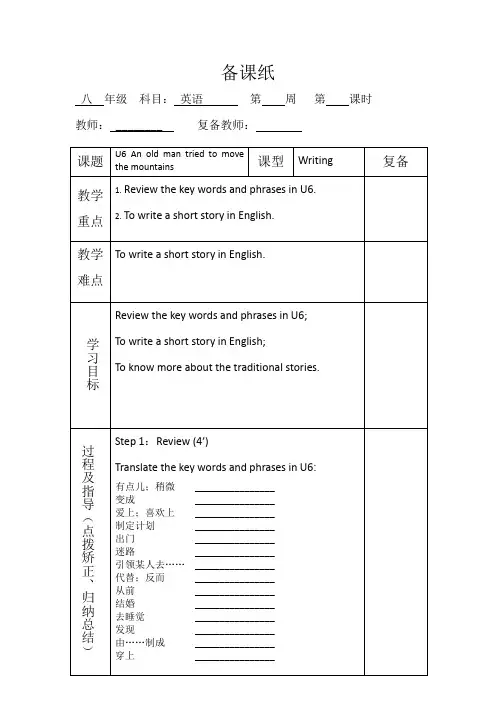
1.Finish 3a. (Write some key words from each scene. Then discuss the answers with their partner)
2.Finy of the play.)
They ______(tell) the emperor that they could make beautiful clothes for him, but he must ______ (give) them silk and gold. The brothers_____(be) bad people. They______ (keep) all the silk and gold for themselves. They told the emperor the clothes they made______ (be) special because only clever people could____ (see) them. When the emperor____ (put) on the clothes, all he could see was his underwear. But he didn’t want people to ______ (think) he was stupid, so he______ (say) the clothes were beautiful. Then he________ (walk) around the city in his new clothes until one boy______(shout),“The emperor isn’t wearing any clothes!”
人教版英语八年级下册Unit3写作课教学设计
3.能够运用本单元所学的句型,如:“He is famous for...”, “She achieved her goal by...”, “I dream of...”等进行人物描写。
4.掌握写作的基本结构,包括引言、正文和结尾,并能运用这些结构完成一篇关于人物的作文。
5.个体差异:学生的英语水平、兴趣爱好、性格特点等方面存在差异。教师应充分了解学生的个体差异,因材施教,提高教学质量。
三、教学重难点和教学设想
(一)教学重难点
1.重点:本章节的教学重点是让学生掌握描述人物成就和经历的词汇、句型和写作结构。通过学习,使学生能够熟练运用一般现在时、一般过去时和一般将来时进行人物描写,提高写作能力。
(3)课堂展示:每组推荐一名代表,展示作文并进行讲解,其他学生给予评价和建议。
4.写作技巧指导:
(1)教师针对文章结构、过渡句、修辞手法等方面进行讲解和示范,帮助学生掌握写作技巧。
(2)引导学生运用头脑风暴、思维导图等方法进行写作构思,提高写作效率。
5.作业布置:
(1)课后让学生完成一篇关于人物的作文,要求运用本节课所学的词汇、句型和写作技巧。
3.情感态度:学生对英语写作的态度存在差异,部分学生对写作抱有恐惧心理,担心犯错;另一部分学生对写作感兴趣,但缺乏自信。教师应关注学生的情感需求,鼓励他们积极参与写作活动,提高自信心。
4.学习策略:八年级学生在学习过程中,已经掌握了一定的学习策略,如合作学习、自主学习等。但在写作方面,他们需要进一步学习如何构思、组织文章、运用修辞手法等。
(五)总结归纳(500字)
1.教师引导学生回顾本节课所学的内容,总结描述人物成就和经历的词汇、句型和写作结构。
人教版英语八年级下册Unit9writing教学设计

1.教师布置课堂写作任务,要求学生结合本节课所学的知识,编写一篇关于自己经历的有趣故事。
2.学生在规定时间内完成写作任务,教师提醒注意文章结构、语言表达等方面。
3.学生完成写作后,进行同伴评价和修改,发现并改正错误。
(欣赏和学习。
-通过小组讨论,让学生互相启发,拓展写作思路。
3.丰富语言输入,提高句子多样性:
-教师选取与本单元主题相关的文章,引导学生学习并模仿其中的句型和表达方式。
-鼓励学生在写作中尝试运用不同的句型和词汇,增加文章的丰富性和生动性。
4.小组合作,互评互改:
-学生在小组内分享自己的文章,进行同伴评价和修改,发现并改正错误,提高写作质量。
-教师引导学生学会客观评价他人作品,善于发现优点,正视不足。
四、教学内容与过程
(一)导入新课(500字)
1.教师通过多媒体展示与本单元主题相关的图片,如:有趣的经历、探险故事等,引导学生进行观察和思考。
2.教师提问:“Can you describe an interesting story that you have experienced?”让学生尝试用英语描述自己的有趣经历,激发学生的表达欲望。
(二)教学设想
1.创设情境,激发兴趣:结合Unit 9的主题,设计富有生活气息的写作任务,让学生在真实语境中进行写作练习,激发其写作兴趣。
-例如,让学生编写一篇关于自己经历的有趣故事,要求运用本单元所学的词汇和句型。
2.引导学生进行写作构思:
-教师提供写作框架,指导学生进行文章构思,明确开头、中间和结尾部分的内容。
1.采用任务型教学法,设计丰富的写作任务,让学生在实践中提高写作能力。
2.引导学生进行小组合作,培养学生的团队协作能力和沟通能力。
人教版八年级下册英语Unit3SectionB3a3cwriting教学设计

针对人教版八年级下册英语Unit 3 Section B 3a-3c的教学内容,我们对学生的学情进行分析。八年级的学生已经具备了一定的英语基础,但在写作方面,尤其是运用时态方面仍存在一定的困难。以下是对学生学情的具体分析:
1.知识储备:学生在之前的学习中已经接触过一般现在时、一般将来时等时态,但对于一般过去时的掌握程度不够熟练。此外,部分学生对动词过去式的变化规则仍不够熟悉。
1.作业1:通过练习册的题目,让学生巩固语法知识,加强对一般过去时的理解和运用。
2.作业2:通过写作实践,让学生将所学知识应用到实际情境中,提高写作能力。
3.作业3:通过同伴评价,学生可以学习到他人的优点,发现自己的不足,促进相互学习和提高。
4.作业4:预习能够帮助学生提前了解新知识,减少课堂上的学习压力,提高学习效率。
3.与同学互相交换日记,进行同伴评价,给出建议和修改意见,然后在课堂上进行反馈分享。
4.预习下一课的内容,提前了解即将学习的一般将来时,为课堂学习做好准备。
5.选择一篇英语短文进行阅读,注意观察作者如何运用时态来描述事件,并尝试总结规律。
作业布置的目的是让学生在课后能够自主复习和巩固所学知识,同时培养他们的写作兴趣和习惯。以下是对作业的具体要求:
6.巩固拓展:
-通过课后作业,巩固一般过去时的用法;
-鼓励学生多阅读英语文章,提高语感,积累写作素材。
四、教学内容与过程
(一)导入新课(500字)
1.教师以一张有趣的照片或一则小故事引入课堂,如:“This photo was taken last weekend. Can you guess what I did?”或“Let me tell you a story about my last vacation. Listen carefully and try to catch the tense I use.”通过这种方式,自然引入一般过去时的话题。
人教版八年级英语下册Unit2写作课优秀教学案例

3.问题解决:学生通过小组合作、讨论等方式,共同解决问题,提高解决问题的能力和团队合作精神。
2.学生总结:学生根据自己的学习体验,总结本节课的收获和体会,如“I can describe my way to school in English now.”、“I understand the importance of learning English.”等。
(五)作业小结
1.作业布置:教师布置作业,要求学生写一篇关于自己上下学的交通方式的短文,如“Write a short passage about your way to school.”、“Include the words and sentences we learned today.”等。
2.媒体辅助:利用图片、视频等媒体资源,展示不同的交通方式,激发学生的学习兴趣,帮助学生更好地理解和记忆相关词汇和句型。
3.角色扮演:学生分组扮演不同角色,如司机、乘客、交警等,进行交通方式的模拟对话,增强学生的实际交流能力。
(二)问题导向
1.学生自主探究:引导学生提出问题,如“How do you go to school?”、“What is the fastest way to school?”等,激发学生的思考和探究欲望。
(四)反思与评价
1.学生自我评价:学生对自己的学习过程进行反思和评价,如“我今天学到了什么?”、“我还需要改进什么?”等,提高学生的自我认知和自我提升能力。
人教英语八年级下册Unit1Writing优秀教学案例
(三)小组合作
1.小组讨论:将学生分成小组,让他们就求职信的某个方面进行讨论。例如,讨论求职信的格式、写作技巧等。通过小组讨论,培养学生的团队合作意识和沟通能力。
2.小组互助:在写作过程中,学生可以相互审阅对方的作品,提供意见和建议。通过这种互助的方式,提高学生的写作能力,同时培养学生的团队合作精神。
3.小组展示:每个小组选出一篇优秀的求职信作品,进行课堂展示。其他小组成员和教师对展示的作品进行评价和讨论。通过这种方式,激发学生的学习兴趣,提高学生的表达能力。
(四)反思与评价
1.自我反思:在求职信写作过程中,引导学生对自己的写作进行反思,发现自己的优点和不足。让学生思考如何改进自己的写作策略,提高写作效果。
2.情境模拟:设计一个模拟求职的场景,让学生分组进行角色扮演,一组扮演招聘经理,另一组扮演求职者。通过这种情境模拟的方式,让学生更好地理解求职信的写作目的和写作技巧。
3.情境展示:通过展示不同类型的求职信样本,让学生了解求职信的基本格式和写作要点。同时,引导学生分析这些求职信的优点和不足,从而培养学生批判性思维能力。
3.小组合作:将学生分成小组,进行合作学习和讨论。通过小组合作,培养学生的团队合作意识和沟通能力,同时加深学生对求职信写作技巧的理解和应用。此外,小组合作还能够提高学生的表达能力和批判性思维能力。
4.反思与评价:引导学生进行自我反思和同伴评价,发现自己的优点和不足,并思考如何改进。通过反思与评价,培养学生的批判性思维能力和自我评估能力,同时激发学生的学习动力,提高学生的写作能力。
五、案例亮点
1.生活情境导入:通过一个真实的求职场景导入新课,使学生能够更好地联系实际,激发学习兴趣,并引出本节课的主题——如何写一封求职信。这种生活情境的导入方式,不仅能够激发学生的学习兴趣,还能够提高学生对求职信重要性的认识。
人教版八下Unit2 Writing 教学设计
Step2: Brainstorming: who needs help.
(5’)
The teacher plays a short video and asks the students to watch it carefully. Then try to tell us who needs help.
★当堂写作当堂检测。
Stage3.Post-writing:Evaluate the composition and summary.(5’)
1.The teacher gives the score standard.
2. Evaluate the composition in class.
★写后当堂反馈,巩固提升。
Step4:
Read the sample and find useful sentences.(5’)
1.Students work in groups and underline the good sentences which is used to express “what/who/how/why/where/when”.
★句子接龙是强化学生对范文中好句的记忆,以便于在接下来的写作中能使用这几个较复杂的句型。并且这些好句分别是描述6个“W”,和板书的思维导图紧密结合。
Step6:
To be Wordsmith
(Perfect the article)
(2’)
1. Try to use conjunctions.
The teacher gives two sentences and students choose the better one.
Unit2写作课教学设计人教版八年级英语下册
2.教师巡视,指导学生讨论方向,提示文章开头、内容、结尾结构。
3.教师辅助总结对学生写作有指导意义的文章结构,及每段都有哪些内容,如何收集素材。
3.独立创作,能运用本单元目标语言写出一篇70词左右的文章。
1.根据要求,学生审题,15分钟内独立创作一篇70词左右的文章。
2.根据标准自评是否分为三段,每段内容是否丰富,是否正确使用目标语言;
We had a party with the students there. We also helped them clean up their classrooms. The head teacher told us some stories about some hardworking students who are from very poor families. And in order to raise money for them, we held a big sale in our school playground the next day. We raised a lot of money.
课题
Grade8 unit2 i will help to clean up the city parks .
课时
1
课型
写作课
学习目标的表述:
1. 展示图片,师生交流,能说出一些help类短语如:give out food. visit the sick kids等并能运用这些词组进行句子表达;
2. 范文赏析,能归纳文章结构;
I think being a volunteer is really great and I would like to help more people.
英语人教版八年级下册Unit 3 sectionB writing 教学设计
八年级下Unit 3 writing写作指导——做家务一. Analysis of teaching material教材分析:本课以“做家务”为中心话题,中学生该不该做家务;做家务的体验。
中学生该不该做家务主要涉及的内容:关于做家务的观点及支持观点的理由;做家务的体验主要涉及的内容:做了什么家务及做家务后的感想。
二.Analysis of the students学情分析:现在的孩子生活幸福,无忧无虑,在家里很多孩子都是独生子女,父母在家里基本承担了所有的家务,孩子只是负责学习。
作为一名学生,帮助父母做家务是一件有趣而有意义的事。
它可以丰富我们的生活,让我们学会劳动、学会理解……三.Teaching goal教学目标1. Knowledge Goals知识目标:掌握做家务的动词词组2.. Ability Goals能力目标能够用英语表述家里表家务的表达方式,并就自己喜欢的家务事发表看法。
阐述孩子要在家里帮父母作家务的理由和原因。
3. Moral Goals情感目标:作为新时代的中学生,我们要的不仅仅是学习成绩,还有自理、自立的能力。
一味地追求学习成绩,只会让许多孩子变成“高分低能”的人。
在英语课上,老师组织全班同学开展有关“做家务”的讨论。
假如以下是你的小组所做的讨论记录,请你根据这个记录用英语向全班做一个汇报。
四.Teaching key and difficulty教学重难点1. Teaching Key Points教学重点:能运用所学的语言知识来简单地表达主动承担做家务的必要性。
2. Teaching Difficult Points教学难点:运用所学的语言知识来写一封简短的信,表达自己对于在家里要帮父母承担家务事的必要性五.Teaching Aids 教学工具an English book, guided learning plan , PPT and CAI六.Teaching steps教学过程Step 1 Warming-upPlay the song Proud of you, let students not nervous.Step 2GamePlay the game with students.The finger familyThis is the father ,kind and true.This is the mother who cares for you.This is the brother,so big and tall.This is the sister who plays with her ball.This is the baby,pet of them all.See the whole family ,big and small.Step 3 Presentation1. Watch the photos and ta lk about them “W hat does he do every day?’ and learn thesephrases: do chores, do the dishes, make the bed, take out the rubbish, fold the clothes. Step 4DiscussionDo you think children should do some chores at home?Why or why not?Discuss this with aWrite the students’ answers on the blackboard.Step 5 Writing(设计学生使用语言的情景,培养学生综合语言运用能力。
英语人教版八年级下册Unit 3 Writing 教案
Unit 3 Could you please clean your room?Section B (3a-3b)Teaching Aims: 1. Knowledge aim:Students will be able to express their opinions about “chores & housework”2. Ability aim:To improve students’ writing skills3. Emotional aim:Students will be able to understand that they should share the housework and get on well with their parentsAnalysis of students:students have learned some phrases and sentences about“chores & housework”and they are familiar with this topic, so they can express their opinions about housework easily. But they need to learn some writing and modifying skills to help them write good articles.Important and difficult points:1.Students will be able to express their opinions about “chores & housework”2. To improve students’ writing skillsTeaching process:Step 1 Leading:1.Greet students2. Look at these pictures I often do housework such as doing the dishes...What about you? Do you often do chores at home? What kind of housework do you often do?3.look at a video about doing chores, ask students :After watching this video, What’s your opinions about housework? Do you think children should do chores?Why?Step 2 Debating: ask students to discuss whether children should do house work or not, and then have a debate.2. After discussion, ask students to debate ( ask them to say the reasons quickly, one student can only say one sentence once)3. show teacher’s opinions, ask students to say the same idea in different ways, then read the opinionsStep 3 How to write an article about your opinions? teach some writing skills.Step 4 WritingDo you think children should do chores ? Why or why not? please write your opinions to the Sunday MailDear Sir or Madam:______________________________________________________________________________________________________________________________________________________________________________________________________________________________________________________________________________________________________________________________________________________________________________________________________________________________________________Yours truly,__________Step 5 watch some pictures about parents and then ask students their feelings after watching it.Let students understand that they should do housework and get on well with their parents.Step 6 HomeworkAsk students to modify(修改) their articles again, and then write in their exercise books.。