
Unit 4 知识梳理+考点精练-六年级英语上册(译林版三起)
Unit 4 Then and now
单元知识整合+考点精练(含答案)
一、语音
er /ə/ teacher, farmer, sister, brother, summer, driver, worker, waiter, father
二、必会词汇
四会单词
ago······以前 office 办公室 newspaper 报纸 news 新闻
watch 观看 e-book 电子书 with用 yesterday 昨天
三会单词
use 使用,利用 telephone 电话 anywhere 随处,到处 radio 收音机
TV 电视 still 仍然 spell 拼读,拼写
短语
then and now 过去和现在 six years ago六年前
do many things做很多事情 write letters (to sb)(给某人)写信
a mobile phone 一部手机 call people anywhere 在任何地方给人们打电话
listen to the radio 听收音机 read newspapers for news 看报纸获取新闻
on the Internet 在网上 read e-books 看电子书
make friends 交朋友 do shopping 购物
all over the world 全世界 work hard努力工作
on holiday 在度假 invent the compass 发明指南针
go on 继续 look out of the window 朝窗外看
spell the word 拼写这个单词 get angry变得生气
make a sentence with...用······造句 wait for the answer等待回答
三、核心句型
1. Six years ago, I couldn't write.六年前,我不会写字。
2. Twenty years ago, she bought things from shops.二十年前,她从商店买东西。
3. Now he can read and watch news on the Internet. 现在他能在网上看新闻。
4. What day is it today?今天星期几? 四、重点语法
1. 本单元进一步运用一般过去时,并且将过去和现在作比较。
一般过去时的记忆口诀:
一般过去时并不难,过去动作、状态记心间。
动词要用过去式,时间状语句末(首)站。
否定句很简单,didn’t站在动原前,其他部分不要变。
一般疑问句也好变,did 放在句子前,主语、动原、其他部分依次站。
特殊疑问句也简单,疑问词加一般疑问句记心间。
最后一条请注意,动词过去式要牢记!
2. ago的用法:
ago表示“……以前”,通常与具体时间连用,构成表示过去的时间短语。例如:
five years ago五年前, three weeks ago三周前, two days ago两天前。
3. 情态动词 can 及其过去式:
can为情态动词,表示“能够”,不能独立作谓语,后面接动词原形。
否定形式是 cannot(缩写为 can't),后面也接动词原形。情态动词没有人称和数的变化。例如:
Now he can do many things. 现在他会做很多事情。
could 是 can的过去式,表示过去的能力,否定形式是 could not(缩写为 couldn't)。例如:
Six years ago, Mike could read and draw, but he could not write. 六年前,迈克能阅读和画画,但他不能书写。
4. write 的用法:
write 的过去式是不规则变化,为 wrote。write to sb意为“给某人写信”。 例如:
I wrote to my friend yesterday. 昨天我给我朋友写信。
He often writes emails to his e-friends. 他经常给网友写电子邮件。
write... for sb 意为“为某人写……”。例如:
My uncle writes stories for children. 我叔叔为孩子们写故事。
5. use 的用法:
use 意为“使用”,“use A to do B”是动词短语,意为“使用 A(工具等)达到B(目 的)”。例如:
He used the telephone to call people. 他用电话给人们打电话。
同义句是“He called people with the telephone.”。 “with sth” ”是介词短语,在句中可以作状 语,表示“用……”。
6. look, see, watch 和 read:
这四个单词都表示“看”,但有所区别:
look强调“看”的动作,不能直接加对象,要用at连接对象。例如:
Look at the blackboard. 看黑板。
see强调“看”的结果,意思是“看见,看到”。例如:
I see a bird in the sky. 我看见天空中有一只鸟。
watch 强调“专注地看”,常用来表示看电视、看电影、看比赛等。例如:
watch TV 看电视。
read通常指“阅读”。例如:
read books 看书, read newspapers 看报纸。
五、文化常识
从20世纪80年代末90年代初开始,互联网技术迅猛发展并逐渐渗透进普通人的生活。 而如今,移动网络已融入社会生活的方方面面,深刻改变了人们的沟通、交流乃至整个生活 方式。第五代移动通信技术(5th Generation Mobile Communication Technology)(简称5G) 越来越普及。
Unit 4 Then and now考题精练
一、按要求写词。
1.can(过去式) 2.went(原形)
3.take(过去式) 4.fly(过去式)
5.read(过去式) 6.saw(原形)
7.couldn’t(完整形式) 8.shop(现在分词)
9.e-mail(复数) 10.buy(过去式)
二、根据所给首字母或中文提示,完成下列句子。
1.I called h an hour ago,but she didn't answer.
2.Look!Mr Brown is in the o .He is working hard now.
3.George got an e from his e John this morning.
4.The t is ringing.Please answer it,Helen. 5.Liu Tao c read six years ago,because he was too young then.
6.My father (观看新闻) on his (手机) every day.
7.Nancy likes (交朋友) at school.
8.Now we can buy things (来自全世界) on the Internet.
9.People (从报纸上获取新闻) thirty years ago.
10.Mr Smith usually (给他的朋友们写信) when he was young.
三、单项选择。
( )1.Grace lots of things the local shops.
A.bought;on B.bought;from C.buy;in
( )2.Paul wants friends his classmates.
A.to make;to B.to make;with C.made;for
( )3.Peter often science books.But five years ago,he only picture books.
A.read;read B.reads;reads C.reads;read
( )4.-Was there any traffic in the street last night? -Yes, .
A.there is B.there was C.there were
( )5. you English stories ten years ago,Gary?
A. Could;write B.Can;write C.Could;wrote
四、用所给词的适当形式填空。
1.My grandmother is (read) e-books on the Internet now.
2.My parents (use) the telephone (call) people before.
3.Liu Tao (write) a letter to his e-friend yesterday morning.
4.Twenty years ago,she usually (make) friends at school.
5.Mike (watch) TV after dinner last night?
(完整版)译林英语6BU3考点精练

考点精练
译林英语6年级下册 Unit 3
A卷: 课堂点拨题
1.a healthy diet【health 和healthy的相互转化 】
(1)【易错】He shouldn’t drink so cola , or he’ll be
A. much;unhealthy B. a lot of ;healthy C. many;unhealthy
(2)【易错】Everyone should keep . A.healthy B. healthily C.health
(3)【易错】Our (health) is the most important.(最重要)
2. like后用动名词 likes eating sweets
(1)【易错】Do you want a glass of water? A. eat B. drink C. have D./
(2)Mike doesn’t like (drink) water.
3. 三餐类前 for的用法【for翻译成“当做”】
(1)I eat a few noodles _______. A. in dinner B. of dinner C. for dinner
(2)我爷爷每天早餐吃一些面包和土豆。My grandpa some bread and breakfast day.
★4.数量形容词的用法,以及后面加可数还是不可数
(1)【易错】I will have a _______ vegetables and a _______ rice for dinner tonight.
译林版英语六年级上册 Unit 2考点精练(C)及答案
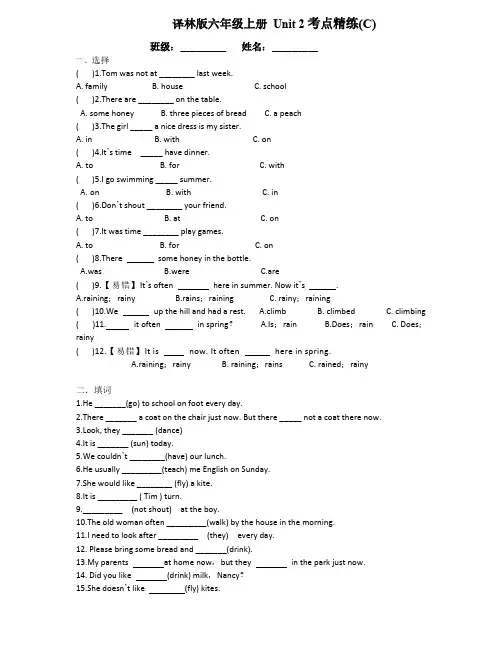
译林版六年级上册 Unit 2考点精练(C)
班级:_________ 姓名:_________
一. 选择 ( )1.Tom was not at ________ last week.
A. family B. house C. school
( )2.There are ________ on the table.
A. some honey B. three pieces of bread C. a peach
( )3.The girl _____ a nice dress is my sister.
A. in B. with C. on
( )4.It’s time _____ have dinner.
A. to B. for C. with
( )5.I go swimming _____ summer.
A. on B. with C. in
( )6.Don’t shout ________ your friend.
A. to B. at C. on
( )7.It was time ________ play games.
A. to B. for C. on
( )8.There some honey in the bottle.
A.was B.were C.are
( )9.【易错】It’s often here in summer. Now it’s .
A.raining;rainy B.rains;raining C. rainy;raining
( )10.We up the hill and had a rest. A.climb B. climbed C. climbing
( )11. it often in spring? A.Is;rain B.Does;rain C. Does;
rainy
( )12.【易错】It is now. It often here in spring.
新译林9A英语1-4单元知识点归纳总结

新译林9A英语1-4单元知识点归纳总结(总30页)
--本页仅作为文档封面,使用时请直接删除即可--
--内页可以根据需求调整合适字体及大小-- 新译林9A英语1-4单元知识点归纳总结
9A Unit1
一、词汇大集合
单词
1.influence vt.
[考点点拨] influence意为“影响”,往往指对行为、性格和观点等产生间接的、较长时间的或潜移默化的影响。如:
What you read influences your thinking.
你读的东西对你的思想有影响。
influence还可以用作名词.泛指影响时是不可数名词;特指某种影响时是可数名词。如:
Will you use your influence to get me a job?
你愿意运用你的影响力替我找一份工作吗?
Television has a strong influence on people.
电视对人有很强的影响。
2.require vt.
[考点点拨] require意为“需要,要求”,常用于以下结构:
(1) require+名词或代词。如:
They required immediate payment.
他们要求立即付款。
(2) require sth from/of sb.向某人要求某物。如:
We required an apology from/of him.
我们要求他赔礼道歉。
(3) require sb. to do sth.要求某人做某事。如:
We required him to keep it a secret.
我们要求他对这件事保密。
3.difficulty n.
[考点点拨] difficulty意为“困难;费力”时,是不可数名词,既不能与不定冠词连用,也不能以复数形式出现。其形容词为difficult,意为“困难的”。have difficulty (in)doing sth.做某事有困难;have difficulty with sth.做某事困难。如:
译林版六年级上册 Unit 5考点精练(A)

译林版六年级上册 Unit 5 考点精练(A)
班级:
姓名:
1. 句型 What does it mean? It means you can’t litter here.
(1) Does the sign ‘No ’?——Yes, it does. A.say, writing B. says,write C.
says,writing D.say, write
(2) This sign “No smoking” you can’t smoke. A.mean B.means
C.meaning
(3)【易错】What the words mean? A.does B.do C.is
(4)【易错】These signs different things. A.means B.mean C.meant
(5)【易错】Liu Tao knows a lot holidays. A.of with B.about C.with
(6)The near the window are funny. A.signs B.sign C. sign’s
(7)--Can you that sign ? It means you can’t shout here. –I’m sorry. A.look at
B.watch C.see
2.各种标志的表达 No eating or drinking
(1) “ Keep off the grass” means we walk on the grass. A. can B. shouldn’t C.
must D. should
(2) You can’t speak loudly run in the classroom. A. and B. to
C.or
3. 情态动词 can/should 的肯定句,疑问句和否定句
新版译林小学六年级英语6Aunit6知识点与练习
- 1 - 个性化辅导教案
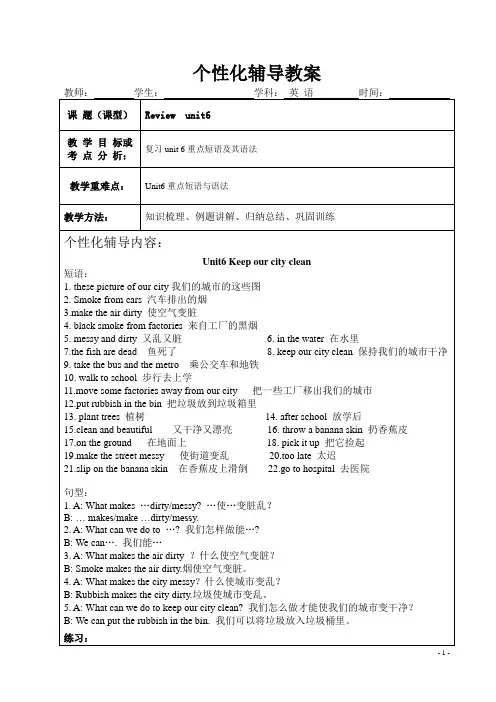
教师: 学生: 学科: 英 语 时间:
课 题(课型) Review unit6
教 学 目 标或考 点 分 析: 复习unit 6重点短语及其语法
教学重难点: Unit6重点短语与语法
教学方法: 知识梳理、例题讲解、归纳总结、巩固训练
个性化辅导内容:
Unit6 Keep our city clean
短语:
1. these picture of our city我们的城市的这些图
2. Smoke from cars 汽车排出的烟
3.make the air dirty 使空气变脏
4. black smoke from factories 来自工厂的黑烟
5. messy and dirty 又乱又脏 6. in the water 在水里
7.the fish are dead 鱼死了 8. keep our city clean 保持我们的城市干净
9. take the bus and the metro 乘公交车和地铁
10. walk to school 步行去上学
11.move some factories away from our city 把一些工厂移出我们的城市
12.put rubbish in the bin 把垃圾放到垃圾箱里
13. plant trees 植树 14. after school 放学后
15.clean and beautiful 又干净又漂亮 16. throw a banana skin 扔香蕉皮
17.on the ground 在地面上 18. pick it up 把它捡起
译林英语六年级上册第三单元考点精练
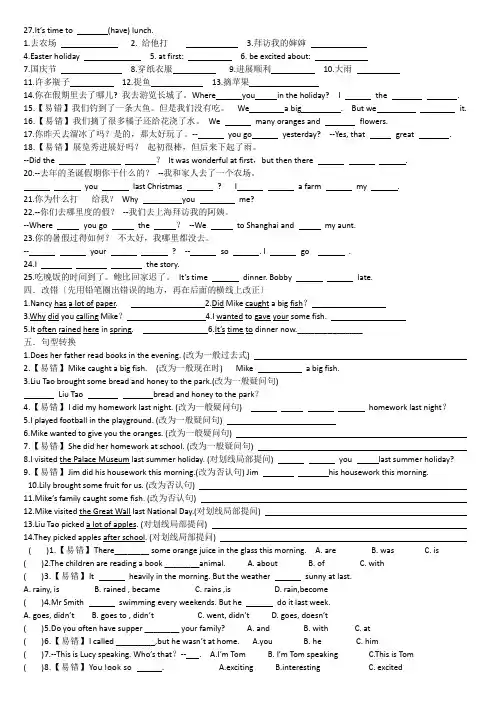
27.It’s time to (have) lunch.
1.去农场 2. 给他打 3.拜访我的婶婶
4.Easter holiday 5. at first: 6. be excited about:
7.国庆节 8.穿纸衣服 9.进展顺利 10.大雨
11.许多瓶子 12.捉鱼 13.摘苹果
14.你在假期里去了哪儿? 我去游览长城了。Where you in the holiday? I the .
15.【易错】我们钓到了一条大鱼。但是我们没有吃。 We a big . But we it.
16.【易错】我们摘了很多橘子还给花浇了水。 We many oranges and flowers.
17.你昨天去溜冰了吗?是的,那太好玩了。-- you go yesterday? --Yes, that great .
18.【易错】展览秀进展好吗? 起初很棒,但后来下起了雨。
--Did the ? It was wonderful at first,but then there .
20.--去年的圣诞假期你干什么的? --我和家人去了一个农场。
最新译林英语4A-U6考点精练(1)
精品文档
精品文档 4年级上册 Unit 6
A卷: 课堂点拨题
Story time
1.(1) -- ? --Some noodles,please. A.What do you like B. What would you like C.Do you like noodles
(2)I’d like some . ks B.rices C.noodles
(3)-- would you like? -- like some hamburgers. A.What’s;I B. What;I’d C.How;I’d
(4)--Can I help you? -- . A.Yes,please B. Yes,I’d like some bread C.No,thanks you
(5)【易错】--What you like? --I like noodles. A.do B.would C.are
(6)I’d like apple juice. A.some B.an C.a cup
2. (1)I’d like six ,please. A.sandwich B. sandwichs C. sandwiches
(2)Would you like an ? A.hamburger B.juice C.egg
(3)I’d like some bread. you? A.What are B.How are C. How about
(4)I’d like three of coffee. A.cup B.cups C.a cup
译林版英语六年级上册 Unit 1考点精练(C)及答案
译林版六年级上册 Unit 1考点精练(C)
班级:_________ 姓名:_________
一. 选择 ( )1.Look at the ______ cowboy. A. american B. American C. America ( )2.I go to school ______ half past seven. A. on B. in C. at
( )3.Tom visited the farm _______ his family yesterday.
A. with B. for C. in D. and ( )4.I want to play _______ football but he wants to play _______ volleyball.
A. /; the B. /; / C. the; / D. the; the
( )5. like to wear a kilt.
A. The Chinese B. The Scottish C. The American
( )6.Yesterday Nancy was sick, her mother her carefully.
A. looked after B. looked at C. looked for D. looked out
( )7.The witch(女巫) the prince the lion. A. turned …on B. talked…with… C. told…about D. turned…into
( )8.【易错】Liu Tao is . You should run .
A.quick;quickly B. quick;quick C. quickly;quick
( )9.The trousers are nice. Please . A.try it on B.try on them C. try them on
小学英语六年级上册知识讲解考点精练 Unit 4 Then and now(译林版三起含答案)
Unit 4 Then and now
知识点讲解与考题精练(有答案)
【语音】字母组合“er”的发音
字母组合er在非重点音节中,尤其是作为后缀时,常发短元音/ə/,如:teacher,worker
拓展:字母组合er在重读闭音节中,常发长元音/ə:/,如:term, her
[试一试]
从下列每组单词中选出画线部分读音不同的一项。
( )1.A.paper B.summer C.term D.worker
【知识点1】can--could表达某人过去会做某事
解析:·could是can的过去式,意为“能够,会,可以”,表示某人具有做某事的能力;
其否定形式为couldn’t =could not;
·两者没有人称和数的变化,其后都要接动词原形。即
can/could + 动词原形
·肯定句型结构:主语 + could + 动词原形(+其他).
否定句型结构:主语 + couldn’t + 动词原形(+其他).
一般疑问句结构:Could + 主语 + 动词原形(+其他)?
肯定回答:Yes, 主语+could./否定回答:No, 主语+couldn’t.
拓展:could也可以表示委婉、客气地提出问题或陈述看法,此时可以与can互换使用,但could的语气较can委婉,两者没有时态上的区别。
例如: When I was five years old, I could sing, but I couldn’t dance. Six years ago, Mike could read and draw, but he could not write.
六年前,迈克会读书和画画,但是他不会写字。 My mother is a teacher. 我的妈妈是个老师
2023-2024年小学英语三年级上册知识梳理考点精练 Unit 1 Hello! (译林版三起)
Unit 1 Hello!知识点讲解与考题精练(有答案)
巧记字母
猜一猜,写出图示字母的大写和小写形式。 1.
2. 3. 4.
【拓展】字母书写口诀★★
字母书写有规律,大写一律上两格,上要顶线是原则。小写字母怎么办? 请你耐心往下看:头上有“辫”上两格(b,d,f,h,k,l),有“尾”下面两格拖(g,p,q,y),无“辫”无“尾”中间格(a,c,e,m,n,o,r,s,u,v,w,x,z)。
【知识点1】认识人物
大A箭头指上方, 小a系辫好模样。大B耳朵右边长,小b食指指向上。
大C吃饭把嘴张,小c大C一个样。大D肚子圆又胖,小d四线格里藏。
【知识点2】打招呼用语
1. 与朋友见面打招呼时,可以用“Hi./Hello.”,朋友仍可以用“Hi./Hello.”回应。
例如:--Hi/Hello, Li Ming. 你好,李明。
--Hi/Hello, Amy. 你好,埃米。
2. 早晨或上午某个时间问候他人用:“Good morning.” 对方同样会应答“ Good morning."。下午某个时间问候朋友用:“Good afternoon.”,对方同样可以用“ Good afternoon.”回应。
在英语口语中,表达“早上好”或“上午好”时,可以把 good 省略,直接说" Morning!”。
晚上和睡觉前的问候语
(1)晚上见面时的问候语是“ Good evening.”
(2)睡觉前的问候语是“ Good night.”
【考题精练2】
一、单项选择。
( )1. --Good morning.
--____________.
A. Hi B. Good afternoon C. Good morning