
外研版七年级英语上册期末知识点复习ppt
6. have breakfast start work
have a break
in the playground do one’s homework
go to bed= go to sleep
finish school = after school
7.
I
my
me you her him
myself yourself herself himself
12. (不加介词) every Friday night 13. search for information (不可数名 词) 14. give/ send sth to sb
sb sth
buy/ cook/ get/ draw/ make sth for sb
15. check emails
sb sth
Module 9 知识点总结
1. 进行时 be +doing 2. stand in line
wait for
be on a school trip, a trip to+地点 take photos
be on sale
lie in the sun by email
3. enjoy + doing oneself
=have a good / great time 4. a lot = very much walk a lot (very much X ) 5. get on / off leave work
drive home
have afternoon tea have a drink
go to the theatre
语言/人 Chinese American Japanese
国家
England
France
Germany
语言/人 English
French
German
6. It’s + adj. +to do
It’s nice to meet you. It’s + n. +to do It’s time to have lunch.
write a name in the box
print----printer(打印机) 7. share with 8. go on the Internet 9. make travel plans 10. listen to music
11. watch movies = go to the cinema = see a film
11. get fat 12. 祈使句 v.原
P22
Module 5 知识点总结
1. have + 学科 “上…课” 2. talk with / to sb about sth 3. What lessons do you have today? When is your Chinese? 4. be difficult for sb to do sth 5. 一般现在时: every 频度副词 I get up at 7:00 Do you get up at 7:00? I don’t get up at 7:00.
动词单三形式变化规则
do----does
6. be bad / good for 7. too much too many 8. a lot of + 可数名词复数 不可数名词 9. health n. be good for your health
healthy adj. stay healthy 10. It’s important to do sth
5. work hard sweep the floor
cook the meal
clean the house hurry up
join sb
make lanterns
6. at Spring Festival 7. on the same day 8. sweep away bad luck 9. watch a programme 10. on Christmas Day 11. 连词 and, but, or, because, so
Module 8 知识点总结
1. would like to do Would you like to do sth? Yes, I’d like to. Sorry… Would you like some? Yes, please. No, thank you
2. 频度副词用how often提问 3. get some presents 4. go shopping, go swimming 5. 人 + spend (in) doing on sth 6. as a present 7. go to the concert 8. watch matches on television
see friends call home
greetings from
write to 6. thank you for doing
sth
Module 10 知识点总结
1.get ready for sth to do 2. help sb with sth
do sth 3. be at work 4. put away
5. everyone + v.单 6. some 肯定句 any 否定/疑问句 以下句型some不变any
What/ How about some…?
Would you like some…? Can/ Could you …?
7. on the wall in front of
in the front of
have 助动词
have got
实义动词 “吃” “上课” I have English every day Do you have English every day? Yes, I do. No, I don’t I don’t have English every day. have----has go----goes
on
at
Friday (星期) Friday morning (某日上下午) October 7th (具体日期) “上演” weekdays night 7:00 (具体时间) +小地点 bus stop, police station,
weekends 8. 职业+工作地点 P10
Module 3 知识点总结
you(你)
she he
your
her his
it
they we
its
their our
it
them us
itself
themselves ourselves
you(你们) your
you
yourselves
Module 6 知识点总结
1. welcome to 2. many kinds of +可数名词复数 3. such as 4. different +可数名词复数 5. called 被称作 6. in Asia 7. a little a few little few 8. all over the world
1. What’s … like? like prep. 像 v. 喜欢 + doing 2. furniture 家具的总称(不可数)+v.单 3. 数字的书写 P14 forty 4. there be 句型 就近原则 Yes, there is / are
No, there isn’t / aren’t
同义句转换
1.would like to do sth=want to do sth 想要做某事 2.have a good time=enjoy oneself =have fun 玩的很开心 3.a lot=very much 非常 4.a lot of =lots of =many 许多 5.give sb sth=give sth to sb 给某人某物
7. first name= given name (名) P7
last name= family name(姓)
Module 2 these / those are… 3. a university / Europe an actor / uncle / English book 4. What’s sb?
Module 1 知识点总结
1. be动词
I she/ he/ it
am is
they/ you/ we are 2. Class Four Grade Seven 3. What / How about + doing? 4. come from =be from
5. 国家 China America Japan
Module 7 知识点总结
1. connect… to 2. turn on
off 3. use sth to do would like to do = want to do 4. What do I do next? 5. paper 不可数
newspaper 可数
6. open a document save a document
What’s sb’s job?
What does sb do?
5. hotel managers, factory worker, science lab, school office, computer room 6. a photo of Miss Li = Miss Li’s photo 7. 介词总结 1998 / January (年份,月份) spring (四季) in the morning (早下晚) Dalian (+大地点)
外研版七年级英语上册期末系统复习习题课件

二、根据句意及首字母提示补全所缺单词
A
1. Miss Black ill love her.
2. My father's brother is my uncle .
3. —What is twenty and twenty?
—Forty .
4. Tom is in Class 1. Mike is in Class 1 too. They are in the same class.
13. —Do you like Chinese, Rose? —Yes, but it's difficult .
14. It's 8:00 now. It's time to start work . 15. It's cold today. Remember to close the windows. 16. —How many minutes are there in a day?
7. Her mother isn't in the _k__it_c_h_e_n_ (厨房)now. 8. The boy is good at __m__a_th_s__ (数学)and English. 9. I want to know some _i_n_fo_r_m__a_t_io_n_ (信息)about the
—He is a _m__a_n_a_g_e_r_ (经理)of a hotel.
26. Tony sits in the __m_i_d_d_l_e_ (中间)of the classroom. 27. —Is your sister a teacher?
—No, she is a __n_u_r_s_e__ (护士). 28. What are the __p_o_l_ic_e__ (警察)doing over there? 29. This weekend I want to ___s_ta_y___ (停留)at home. 30. Here is a train __t_ic_k_e_t__ (票)to Beijing.
最新外研版七年级上英语期末复习资料和练习

最新外研版七年级上英语期末复习资料与练习内容:1. Modules 6-10 各模块重点词汇用法;2. 各模块重点短语总结;3. 各模块重点句型总结;4. 各模块写作话题材料及例题;5. 各模块基础知识综合练习(含答案),紧密对应各模块重要考点。
Module 6 A trip to the zoo词汇:1. bear n. 熊v. 忍受eg. I can’t bear this animal.2. country n. 国家;乡下,农村countries country的复数形式country music 乡村音乐3. dangerous adj. 危险的danger n. 危险eg. The lions are dangerous because they eat meat.4. leaf n. 树叶leaves leaf的复数形式5. cute adj. 可爱的eg. Pandas are cute.6. guide n. 向导,指南v. 引导,带领eg. A trained dog can act as a guide to a blind person. 受过训练的狗可以做盲人的向导。
7. Asia 亚洲Europe 欧洲Africa 非洲North America 北美洲South America 南美洲Oceania 大洋洲8. about (1) 关于eg. I’m reading a book about animals.(2)大约There are about 300 students in our school.9. alone adj. 独自的lonely adj. 孤独的eg. He doesn’t live with his children. He lives alone.Although he lives alone, he never feels lonely.10. even 甚至eg. Monkeys eat meat, leaves, fruit and even eggs.重点短语及表达:1. welcome to + 地点欢迎到某地eg. Welcome to the zoo.2. a kind of 一种all kinds of 各种各样的eg. There are many kinds of animals in the zoo.3. such as 比如,列举eg. The zoo has many kinds of animals, such as bears, zebras, lions and pandas.4. come from = be from 来自eg. They come from different countries. = They are from different countries.Where does he come from ? = Where is he from?5. live in 生活在,居住在eg. This elephant lives in Africa.6. a little 一点儿,少量(表示肯定,修饰不可数名词)little 几乎没有(表示否定,修饰不可数名词)a few 一些(表示肯定,修饰可数名词)few 几乎没有(表示否定,修饰可数名词)eg. There’s little meat in the fridge. Can you go and get some ?There is still a little time left. I’m sure we can finish the work.He is new here and he has got few friends.7. as well as 也,还有eg. The panda eats 30 kilos of bamboo a day, as well as plants and leaves.She can play tennis as well as basketball.8. a kilo of 一千克重点句型:1. shall we +动词原形?我们一起做某事好吗?(表示提建议)eg. Shall we go and see the pandas?Let’s + 动词原形eg. Let’s go and see the pandas.2. 含有行为动词的一般现在时句式:Do lions eat meat?Yes, they do.Does the elephant eat meat?No, it doesn’t.The zebra doesn’t like meat.3. Is there an animal called Tony?叫做Tony 的,过去分词作后置定语eg. The boy called Bob comes from Canada.4. be good at sth. / doing sth 擅长做某事eg. It’s good at swimming.写作话题材料:My favorite animal(1)The zoo has many kinds of animals, such as zebras, bears, giraffes and pandas. They come from many different countries.My favorite animal is a panda.(2) Pandas live in China. There are only about 1800 pandas in China. The panda eats bamboos as well as plants and leavesevery day. They are cute. This black and white animal is the favorite of people all over the world.基础知识综合练习:一单项选择1. There are _______________ books in the school library.A. many kinds ofB. a kind ofC. kind ofD. much kind2. _________________ the kangaroo jump very far?A. IsB. DoC. DoesD. Are3. I have _______ water in my bottle. I’l l give you some.A. a fewB. fewC. a littleD. little4. Why ________ come and join us?A. don’tB. not youC. not toD. not5. Camel lives in the _____________________.A. forestB. jungleC. riverD. desert6. Is there ____________ European university in the list?A. anB. aC. theD. /7. — Where __________ from?--- He’s Beijing.A . is him B. are you C. is he D. does he8. The animals in the zoo are from different ______.A.a country B.country C.countries D.countrys9.Giraffes like to eat ______ and ______.A.grass;leaf B.grasses;leaf C.grass;leaves D.grass;leafs10. The monkeys ______ are very clever.A.come from Asia B.comes from Asia C.from Asia D.are from Asia 11.______ your father often ______ football matches?A.Do;watch B.Does;watch C.Do;watches D.Does;watches12. China is in__________.A. AfricaB. AsiaC. EuropeD. America13. He__________ his homework every day.A. doesn’t doB. don’t doC. doesn’t doesD. don’t does14. There are two __________ workers in this factory.A. thousandB. thousandsC. thousand ofD. thousands of15. —Where ________ zebras _______?—Africa.A. is; fromB. does; fromC. do, come fromD. do, from完成句子练习:1. ——袋鼠来自亚洲吗?——不,不是的。
外研版英语七年级上册Module 10 Spring Festival 复习课件

visit our family and friends
get lucky money
A: What can you watch at Spring Festival? B: We can ...
watch a dragon dance watch a lion dance
Read the passage as loudly as you can.
on the wall.
A. In
B. At
C. With
D. On
3. I didn’t get any cards yesterday, but today there are
________ beautiful ones.
A. little
B. a little
C. few
D. a few
4. Jimmy wants to be a pop star ________ Michael Jackson.
③My mother usually gets up early and gets ready ______
the meal.
A. for cook
B. cook
C. cooking
D. to cook
④We are getting ready forle_a_r_n_i_n_g (learn) a dragon dance.
I'm Li Shan from China. Spring Festival is very important in my country. Like Christmas, it happens every year, but not on the same day. It usually comes in February, but sometimes it comes in January. I've got some photos of it. Have a look at them!
2024外研版英语七年级上册复习知识点汇总
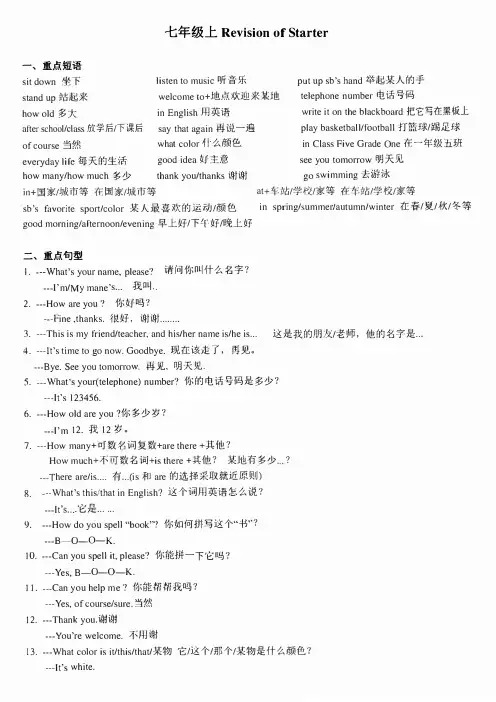
七年级上Revision of Starter 一、重点短语sit down坐下stand up站起来how old多大after school/class放学后/下课后listen to music听音乐welcome to+地点欢迎来某地in English用英语say that again再说一遍of course当然what color什么颜色eve,yday life每天的生活good idea好主意how many/how much多少thank you/thanks谢谢put up sb's hand举起某人的手telephone number电话号码write it on the blackboard把它写在黑板上play basketball/football打篮球/踢足球in Class Five Grade One在一年级五班see you tomorrow明天见go swimming去游泳m+国家/城市等在国家/城市等at+车站/学校/家等在车站/学校/家等sb's favorite sport/color某人最喜欢的运动/颜色good morning/afternoon/evening早上好/下午好/晚上好二、重点句型l---\邓at's your name, please? 请问你叫什么名字?---I'm/My mane's... 我叫.2.---How are you ? 你好吗?---F ine,thanks.很好,谢谢……..in spring/summer/autumn/winter在春/夏/秋/冬等3.---This is my friend/teacher, and his/her name is/he is...这是我的朋友/老师,他的名字是.4.---I t's time to go now. Goodbye.现在该走了,再见。
外研版七年级上册Module 10Spring Festival Unit 2 复习课件
根据汉语补充对话
口语练习,大声朗读
I'm Li Shan from China. Spring Festival is __v_er_y__im__p_o_r_t_a_n_t_i_n_o_u_r__c_o_u_n_tr_y__(在我们 国家非常重要). _L__ik_e__C_h_r_i_s_tm__a_s__(像圣诞节一样), it happens every year, but _n_o_t_o_n__th__e_s_a_m_e__d_a_y__(但不在同一天). It usually __c_o_m_e_s_i_n__F_e_b_r_u_a_r_y__(在二月来临), but sometimes it comes in January. I've got some photos of it. Have a look at them!
对完答案后大声朗 读句子,至少3遍!
大声朗读课文,熟读每个句子,完成后面的评价任务。
建议时间:3分钟
课文复习:填空
口语练习,大声朗读
I'm Li Shan from China. Spring Festival is very __im__p_o_r_t_a_n_t__ in my country. __L__ik_e____ Christmas, it __h_a_p_p_e_n_s__ every year, but not on the _s_a_m__e_ day. It usually comes in _F_e_b_r_u_a_r_y__, but _s_o_m__e_ti_m__e_s_ it comes in January. I've got some photos of it. Have a look at them!
新外研版七年级英语上册教学PPT课件(全册)汇总(共1064页)

拓展: 当你想很有礼貌地问别人的名字时: What’s your name, please? May I have your name, please?
4. I’m twelve years old. 我12岁。 …years old, 表示“……岁”。
有 时years old可省略, 只用数字来 表达年龄即可。
America Chinese England grade student
Betty, Tony, Daming and Lingling are (1) ____st_u_d_e_nitns Class 4 (2) ____G_r_a7d.eBetty is from (3) ______A_m_ earnidcaTony is from (4) ______E_n_g.lDanadming and Lingling are (5) ________. Chinese
1. I’m from Wuhan. 我来自武汉。(我是武汉人。) be from表“来自哪里”、“从哪里 来” 或“是哪里人”。 e.g. He’s from Beijing. 他来自北京。(他是北京人。)
2. Where are you from? 这是疑问词where引导的特殊疑问句, 用来询问“你是哪里人”,常用“I’m from ...”来回答。如:
My name is … I’m… I’m…years old. I’m from…
Work in pairs. Ask and answer. A: What’s your name? B: My name is ... A: Are you English? B: No, I’m … A: How old are you? B: I’m...years old. I’m in Class… A: Nice to meet you. B: Nice to meet you, too.
外研版七年级英语上册PPT课件
外研版七年级英语上册PPT课件外研版七年级英语上册《Language in use》Spring Festival PPT课件下载(第2课时),共17页。
Warming-up Who is he? What do you know about him? Practice Around the world Christmas and Father Christmas Christmas is the most important festival in mo...•外研版七年级英语上册《Language in use》SpringFestival PPT课件下载(第1课时),共21页。
Warming-up Fun fun festival Why do you think so? We eat a lot and sing aloud Its so traditional. Interesting interesting What do you do so? We visit our f...•外研版七年级英语上册《Language in use》SpringFestival PPT教学课件,共25页。
Learning ObjectivesBy the end of the class, we will be able to: 1. usethe interrogative sentences of present continuoustense correctly; 2. know the difference...•外研版七年级英语上册《My mother's cleaning our house and sweeping away bad luck》PPT精品课件,共19页。
Pre-reading Work in pairs. Look at the pictures andtalk about whats happening. Whats Li Shans mother doing? Shes cleaning the house. Wh...•外研版七年级英语上册《My mother's cleaning our house and sweeping away bad luck》PPT免费下载,共29页。
外研版英语七年级上册Module-1-10期末总复习课件
Language points
1. Between this building and the dining hall is the classroom building with twenty-four classrooms.
在b”教这e。t室幢we。楼en和是餐个厅介词之,间常是和教an学d连楼用, :里“面在有……24之间间
There are two dogs and a cat under the tree.
就近原则 be动词单复数形式要跟there be之后的主语保
持一致, 如果主语是单数或不可数名词用is,
如果主语是复数用are。
There is a bird in the tree.(改为否定句) There isn't a bird in the tree.
2.There is a dog sitting in the front of the car.
family 是集合名词。 指家庭, 谓语动词用单数形式; 指成员, 谓语动词用复数形式。
1.His family____is__ big .(is /are) 2.His family all __li_k_e__reading.(like/likes ) 3.___W__h_a_t_h__o_t_ weather it is today ! (What hot/How hot/What a hot/How a hot )
Module 1
My Classmates
Introduction
Work in pairs.
--Where is he from? --He is from China.
He is Chinese.
--Where is she from?
外研版(新)英语七年级上册重点短语与句子课件(PPT68张)
Starter Module 1 and Module 2 重点短语 1.good morning 早上好 2.good afternoon 下午好 3.work in pairs 两人一组练习 4.thank you 谢谢 5.see you 再见,回头见 6.stand up 起立,站起来 7.sit down 坐下,请坐
• • • • • • • • • •
Module 1 1.be from... =come from... 2....years old 3.what about... =how about... 4.in Class Three, Grade Seven 5.the capital of... 6.first name =given name st name=family name 8.English name 9.Chinese name
• Starter Module 1 and Module 2 重点句子
• • • • 10. Put up your hand. 举起你的手。 11. Are you a new student here? 你是一个新学 生吗? 12. What class are you in? 你在哪个班? 13. What’s your telephone number? 你的电话号 码是多少? 14. How old are you? 你多大(几岁)了?
•
• • • • • • • • • •
Starter Module 3 and Module 4 重点短语 1. in English 用英语,用英语说 2.write on 在...上写 3.of course 当然,当然可以 4.in spring 在春天 5.after school 放学后 6.good idea 好主意,好想法 7. let’s =let us 让我们 8.like swimming 喜欢游泳 9. go swimming 去游泳
外研版七年级英语上册复习课件:Module 1 Unit 1
Unit 1 Nice to meet you.
新课预习 一、英汉短语配对
( D)1.be from ( G)2.how old ( A)3....(years) old ( F)4.Class 4 Grade 7 ( B)5.what about... ( H)6.our friends ( C)7.welcome to... ( E)8.my classmates
如: I’m from China and I’m Chinese. 我来自中国,我是中国人。
(2)not作副词,意为“不;不是”。它不能单独使用,要 放在be动词、助动词或情态动词之后,构成否定句。 如:
◎I’m迁n移o训t in练C[见la“ss随4.堂我练不习在”4第班1。1、13、15题]
【答案】Are you, No, I’m not
14.What about going swimming?(改为同义句) ________ ________ going swimming?
【答案】How about 15.I am from England.(改为同义句)
I ________ ________ England./I ________ ________.
◎迁移训练[见“随堂练习”第2、10、14题]
3. —Hello, are you from America?你好,你来自 美国吗? —No, I’m not.不,我不是。(课本第2页)
(1)America意为“美国”,表示国名,而American意为 “美国人”,表示国籍,American还可作形容词,意 为“美国的;美国人的”。现将本单元出现的国名与 国籍归纳如下:
◎迁移训练[见“随堂练习”第3、4题]