
外研版(三起)三下英语:M4U2
Does she like oranges? Yes,she does.
Does she like apples? No,she doesn't.
Daming like_________, he doesn’t like__________. Lingling like_________, she doesn’t like_________.
basketball
table tennis
连线复习
1.bananas
2.orange
3.pears
4.apple
rice 鱼 meat 米饭 fish 肉 noodles 牛奶 milk 面条
tiger monkey elephant lion cat dog panda
noodles fish
rice milk meat
banana
bananas
pear pears
orange oranges
Does he/she/Daming …like…?
……喜欢……吗?
Yes, he /she does.
No, he /she doesn’t.
Does he / she/Daming …like…?
Thanks!
更多精彩内容,敬请关注微信公资源由“我是好教师”整理提供
Module 4
Unit 2 Does Lingling like oranges?
米饭rice喷喷香; 肉是meat最解谗; 鱼是fish营养多; milk牛奶真好喝; 面条noodles细又长; 不挑不捡身体棒 。
Game:嫦娥姐姐变单词
noodles fish
rice milk meat
Game:嫦娥姐姐变单词
……喜欢……吗?
√ √
×
Listen and answer the questions.
Does he like bananas?
Yes,he does.
Does he like pears? No,he doesn't.
更多精彩内容,敬请关注微信公众号:我是好教师
扫描二维码关注即可下载
本资源由“我是好教师”整理提供
Do you like …? Does she/he like…?
Does your father(mother) like…? Yes, he/she does. No, he/she doesn’t.
morning exercises
swimming skipping
morning exercises football
外研版一起三年级下册M4U2what-can-you-see优秀教案
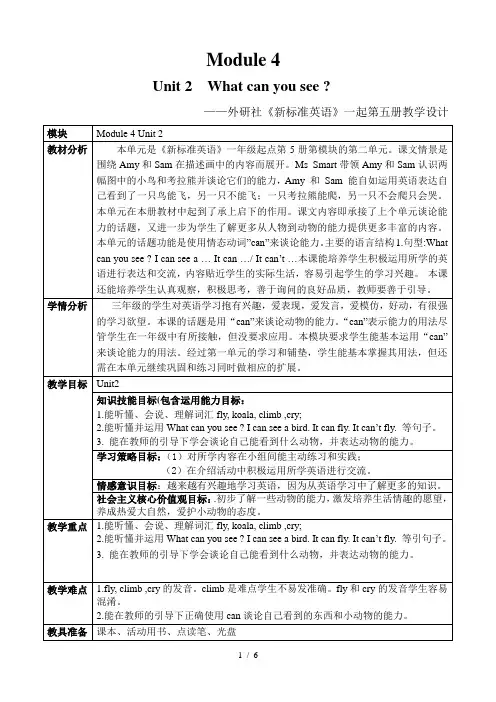
三年级的学生对英语学习抱有兴趣,爱表现,爱发言,爱模仿,好动,有很强的学习欲望。本课的话题是用“can”来谈论动物的能力。“can”表示能力的用法尽管学生在一年级中有所接触,但没要求应用。本模块要求学生能基本运用“can”来谈论能力的用法。经过第一单元的学习和铺垫,学生能基本掌握其用法,但还需在本单元继续巩固和练习同时做相应的扩展。
Ss: repeat twice.
T:Meanwhile, we will have competition between boys and girls, look here ,this red koala is to girl and this green koala is to boy, let’s see who can climb to the top first.
S: …
T: You are so smart ! Follow me , What can you see ?
Ss:..
T: So what can you see in this picture ? I can see a tree .
T:What can you see ?
S1: I can see a dog.
T: Help means:
Ss:..
T:You are so smart.
T: Boys and girls, we can see some animals in this picture. Do you like animals?
Ss: Yes.
T: I like animals, too. I took some pictures of animals and put them in our classroom .Look, I can see a bird. It’ white . So children, Do you want to see ? Now I will give you 20 seconds to go around in our classroom to see then tell me what can you see ? pls look careful and try your best to find more of them. Now ,let’s go .
初中英语外研版m4u2教案

初中英语外研版m4u2教案一、教学内容二、教学目标1. 学生能够掌握与职业、理想、未来相关的词汇,并能运用这些词汇进行简单的交流。
2. 学生能够正确使用“going to”结构来表达将来时态。
3. 学生能够理解Millie的未来规划,并能用英语表达自己的未来理想。
三、教学难点与重点1. 教学难点:词汇的掌握与运用;“going to”结构的正确使用。
2. 教学重点:阅读理解能力的培养;用英语表达自己的未来理想。
四、教具与学具准备1. 教具:多媒体课件、黑板、粉笔。
2. 学具:英语课本、词汇表、练习本、彩色笔。
五、教学过程1. 导入:通过展示不同职业的图片,引导学生谈论自己的未来理想,激发学习兴趣。
2. 新课内容呈现:a. 学习词汇:通过PPT展示,让学生跟读、拼写、运用新词汇。
b. 学习语法:讲解“going to”结构,并给出例句,让学生模仿练习。
c. 阅读理解:让学生阅读Millie's future部分,回答相关问题,提高阅读能力。
3. 例题讲解:针对词汇和语法点,给出典型例题,进行讲解和练习。
4. 随堂练习:让学生根据所学内容,进行词汇填空、句子翻译等练习,巩固知识。
5. 小组活动:分组讨论,让学生用英语分享自己的未来理想,并使用“going to”结构。
六、板书设计1. 词汇:jobs, ambitions, future等。
2. 语法:“going to”结构。
3. 阅读理解:Millie's future。
七、作业设计1. 作业题目:用英语写一篇关于自己未来理想的短文,至少80词。
2. 答案:略。
八、课后反思及拓展延伸1. 课后反思:关注学生在课堂上的参与度,及时调整教学方法和节奏。
2. 拓展延伸:鼓励学生在课后了解更多关于不同职业的信息,为未来的职业规划做好准备。
同时,建议学生观看与未来职业相关的英语视频,提高英语听说能力。
重点和难点解析1. 教学难点与重点的确定。
外研版(一起)英语三年级下册Module 4 Unit 2 Thirteen, fourteen,
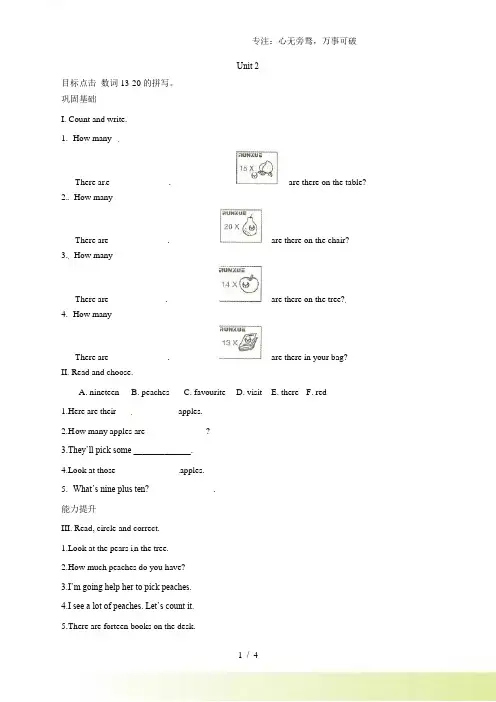
Unit 2目标点击数词13-20的拼写。
巩固基础I.Count and write.1.- How many _____________- There ar e _____________. are there on the table?2.- How many _____________- There are _____________. are there on the chair?3.- How many _____________- There are_____________. are there on the tree?4.- How many _____________- There are _____________. are there in your bag?II.Read and choose.A. nineteenB. peachesC. favouriteD. visitE. thereF. red1.Here are their _____________ apples.2.How many apples are _____________ ?3.They’ll pick some _____________.4.Look at those _____________ apples.5.- What’s nine plus ten? - _____________.能力提升III.Read, circle and correct.1.Look at the pears in the tree.2.How much peaches do you have?3.I’m going help her to pick peaches.4.I see a lot of peaches. Let’s count it.5.There are forteen books on the desk.IV.Look and match.1. A. six + ten = sixteen2. B. ten + ten = twenty3. C. five + nine = fourteenV.Look and write.例子:/ 16- How many bananas are there?- There are sixteen.1. / 18- _________________________________- _________________________________2. / 20- _________________________________- _________________________________趣味练习VI.Group the words.twenty fruit peach twelve four-teen apple tree book sixteen river eye参考答案Unit 2巩固基础I .1.peaches, fifteen2.pears, twenty3.apples, fourteen4.books, thirteenII.1.C 2.E 3.B 4.F 5.A能力提升III.1.in→on2.much→many3.going后加to4.it→them5.forteen→fourteenIV.1-C 2-A 3-BV. 1.- How many pears are there?- There are eighteen.2.- How many apples are there?- There are twenty.趣味练习VI.名词: fruit, peach, tree, book, apple, river,eye 数词: twenty, twelve, fourteen, sixteen。
三年级英语下册外研三起点_Module4_Unit2_知识详解

Module4 Unit2 知识详解知识点2 询问他人(第三人称单数)喜好的句型及对应答语①—Does Lingling like oranges? 玲玲喜欢橙子吗?—Yes, she does. 是的,她喜欢。
(教村第23页)②—Does Sam like pears? 萨姆喜欢梨吗?—No, he doesn’t. 不,他不喜欢。
(教村第23页)句式结构—Does+他人+like…?—Yes, he (she) does./No, he (she) doesn’t.用法详解“Does+他人+like…?”用于询问他人的喜好,更具体点儿说,就是询问他人是否喜欢某物或者某些事物。
“Yes, he (she) does./No, he (she) doesn’t.”是对应的简略答语。
具体说明:肯定答语Yes, he/she does.Does:助动词,无词义,用于构成一般疑问句他人:主语,第三人称单数,可以是名词或代词(he,she等) 问句like:实义动词,用原形…:宾语,可以是单数/复数名词、不可数名词、代词否定答语No, he/she doesn’t.拓展延伸情景示例多多和妈妈去超市买水果,妈妈问多多他姐姐是不是喜欢苹果。
典例2 ( ) —Does your father like noodles?—No, ________.A. he don’tB. he doesn’tC. he does解析由题干中的“No”可知,答语的谓语部分应该用否定形式,排除C;he 为第三人称单数形式,对应的助动词应是does,而不是do,故本题选B。
【答案】B。
外研版三年级起点四年级下册M4U2教学设计
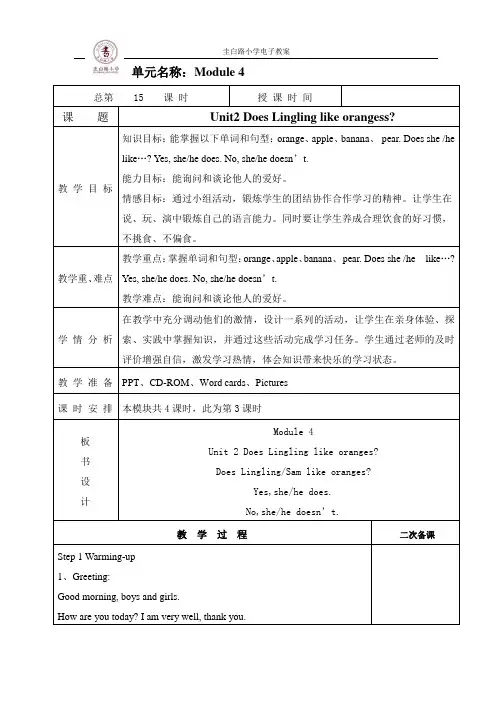
单元名称:Module 4总第 15 课时授课时间课题Unit2 Does Lingling like orangess?教学目标知识目标:能掌握以下单词和句型:orange、apple、banana、pear. Does she /he like…? Yes, she/he does. No, she/he doesn’t.能力目标:能询问和谈论他人的爱好。
情感目标:通过小组活动,锻炼学生的团结协作合作学习的精神。
让学生在说、玩、演中锻炼自己的语言能力。
同时要让学生养成合理饮食的好习惯,不挑食、不偏食。
教学重、难点教学重点:掌握单词和句型:orange、apple、banana、pear. Does she /he like…? Yes, she/he does. No, she/he doesn’t.教学难点:能询问和谈论他人的爱好。
学情分析在教学中充分调动他们的激情,设计一系列的活动,让学生在亲身体验、探索、实践中掌握知识,并通过这些活动完成学习任务。
学生通过老师的及时评价增强自信,激发学习热情,体会知识带来快乐的学习状态。
教学准备PPT、CD-ROM、Word cards、Pictures 课时安排本模块共4课时,此为第3课时板书设计Module 4Unit 2 Does Lingling like oranges?Does Lingling/Sam like oranges?Yes,she/he does.No,she/he doesn’t.教学过程二次备课Step 1 Warming-up1、Greeting:Good morning, boys and girls.How are you today? I am very well, thank you.2、师生齐读上节课的chant来复习上节课的内容。
rice, rice, I like rice.Meat, meat, I don’t like meat.Fish,fish, I like fish.Milk, milk, I don’t like milk.Step 2 lead –in1. T: Before our new class, let’s have a listening practice . I will play the tape, and I want you listen carefully and tell me what kind of food do you hear in the conversation.Now, look at these two faces, what does it mean? What about this?Ss:like and don’t like.Now, listen again, let’s find what does panpan like and dislike.Now open your books at page at page 23,let’s read the activity 1. Boys, read questions and girls read anwers.Step 3 Presentation1. T:In last unit, we knew that our friends’like and dislike about food. Today we’ll learn some names of fruit. First, let’s listen to a song,(放歌曲) 多媒体出示各种水果,学习词汇:bananas pears oranges apples Which fruit do you hear? 之后,师手拿一个苹果走到一名学生面前问“What’s this?”学生回答“I t’s an apple.”师出示苹果的卡片教读,以此方式学习pear,orange,banana单词。
小学英语外研新标准三年级下册(2022年新编)Module4Module4

Module 4Unit 2 Does Lingling like oranges ?Period 1Teaching Goals :1.To master the following key words :does, orange, apple, banana, pear, doesn’t=does not 2.To learn how to use the following structures to talk about likes.A.Do you like......?Yes, I do. No, I don’t.B.Does she/ he like......?Yes, she/ he does. No, she/ he doesn’t.3.To tell Ss they should eat more fruit to keep healthy. Teaching Important and Difficult Points:1.The key words.2.How to use the following structures to talk about likes.Does she/ he like......?Yes, she/ he does. No, she/ he doesn’t. Teaching Procedures:Step1. Warming up1.Sing English songs.2.Greeting.Step 2. Lead inT: Let’s watch a video. Then say: I like milk.(T show milk) Do you like milk?Ss:......T: Well, today we’ll learn M4 U2 Does Lingling like oranges? to learn how to ask for others’ likes .Step3. PresentationTask1. Learn the new words.1.T show a picture of fruit.(then T ask: What do you like?)2.Learn the new words.does, orange, apple, banana, pear, doesn’t=does not Task2. Reading1.Play the video, then ask Ss to listen carefully.2.Ask Ss to read by themselves.3.Answer the following questions:A.Does Lingling like oranges?B.Does Sam like bananas?4.Retell the conversations in activity 2.Step4. Practice(Groupwork)1. Use the following structure.Does she/ he like......?Yes, she/ he does. No, she/ he doesn’t.3.GroupworkMake your own conversations.A: I like milk. Do you like milk?B: Yes, I do.C: Does she/ he like milk?D:Yes, she / he does. No, she/ he doesn't. Step5.SummaryWhat have we learnt today?Does she/ he like......?Yes, she / he does.No, she / he doesn't.Step6. Homework.1.Copy the words.copy three times each one.2.Read activities1-2.。
2024年初中英语外研版m4u2教案
2024年初中英语外研版m4u2教案一、教学内容本节课选自2024年初中英语外研版教材M4 Unit 2,主要内容包括:Grammar focus: the use of “used to” and “be used to”; Vocabulary: words related to changes; Reading: a text about changes in a city; Listening: a conversation about changes in people's lives.二、教学目标1. Students can understand and use the structures “used to” and “be used to” correctly.2. Students can describe changes in their environment and daily lives using appropriate vocabulary.3. Students can improve their reading and listeningskills understanding and interpreting a text and a conversation about changes.三、教学难点与重点1. The correct use of “used to” and “be used to”.2. The description of changes using specific vocabulary.3. Developing reading and listening skills to understand and analyze a text and a conversation.四、教具与学具准备1. Textbook and workbook.3. Handouts with exercises and vocabulary lists.4. Answer keys for selfchecking.五、教学过程1. Introduction (5 minutes)Set a practical context showing pictures of a city before and after changes.Elicit students' ideas about the changes and encourage them to express their opinions.2. Vocabulary presentation (10 minutes)Introduce new vocabulary related to changes, using pictures and examples.Conduct activities to practice the new words, such as matching and group discussions.3. Grammar focus (15 minutes)Explain the use of “used to” and “be used to” with examples.Provide practice exercises for students to use the structures in sentences.4. Reading and listening (15 minutes)Play the listening conversation, and students answer related questions.5. Group work (10 minutes)Divide students into groups and assign tasks to describe changes using the learned vocabulary and grammar structures.6. Guided practice (5 minutes)Provide guided exercises for students to practice reading and listening skills.Offer feedback and corrections to ensure understanding.7. Production (10 minutes)Ask students to create a short dialogue or story about changes in their own lives using the learned vocabulary and grammar.Share and discuss the productions among classmates.六、板书设计1. Write the key vocabulary and grammar structures on the board.2. Use a mindmap to visually represent the changes in the city.3. Include example sentences and exercises for students to refer to during practice.七、作业设计八、课后反思及拓展延伸1. Reflect on the effectiveness of the practical context, vocabulary presentation, and group work activities.2. Consider adjustments for future lessons to enhance student engagement and understanding.3. Extend learning exploring additional resources, such as online videos or articles about changes in different cities or cultures.重点和难点解析1. 教学难点与重点的明确;2. “used to”和“be used to”的正确使用;3. 词汇的呈现与实践;4. 阅读和听力的教学过程;5. 课堂活动的组织与反馈;6. 作业设计与答案提供;7. 课后反思与拓展延伸。
外研版一起三年级下册M4U2what-can-you-see优秀教案
Unit2
知识技能目标(包含运用能力目标:
1.能听懂、会说、理解词汇fly, koala, climb ,cry。
2.能听懂并运用What can you see ? I can see a bird. It can fly. It can’t fly.等句子。
3.能在教师的引导下学会谈论自己能看到什么动物,并表达动物的能力。
T: Nice to meet you.
Ss: Nice to meet you, too.
2. Say a chant.
T: Firstly, let’s say a chant.
Swim, swim, can you swim ?
Yes, I can. Yes, I can.
Run, run, can you run ?
S1: Yes, I can.
T: Wow, You are so cool.
T: Hello, girl! Can you play basketball ?
S2: No, I can’t.
T: What can you do ?
S2: I can sing a song.
T: Now, boys and girls, pls work in pair to know about your partner’s abilities. Pay attention to trying your best to ask more questions to know your partner’s abilities. Go.
Ss:。。
T: Stop here. Who wants to try?
S1:..
S2:..
初中英语外研版m4u2教案
初中英语外研版m4u2教案一、教学内容二、教学目标1. 学生能够理解并掌握阅读文章的主旨和大意。
2. 学生能够学会并运用本节课所学的词汇和表达,讨论关于保护濒危动物的话题。
3. 学生能够提高听力技巧,准确理解对话内容,并能够进行相关的口语表达。
三、教学难点与重点1. 教学难点:词汇的掌握和运用,以及听力技巧的提升。
2. 教学重点:阅读理解,口语表达以及保护濒危动物话题的讨论。
四、教具与学具准备1. 教具:多媒体设备,PPT,黑板,教鞭等。
2. 学具:学生用书,练习册,文具等。
五、教学过程1. 引入:通过展示一张大熊猫的图片,引发学生对濒危动物的关注,进而导入本节课的话题。
2. 阅读环节:引导学生阅读文章,理解文章大意,并完成相应的练习题。
3. 词汇环节:学习并复习与本节课话题相关的词汇和表达。
4. 听力环节:播放对话,让学生听并完成相关任务,提高听力技巧。
5. 口语环节:分组讨论,让学生运用所学词汇和表达,讨论如何保护濒危动物。
六、板书设计1. M4 Unit 2 The story of Xi Wang2. 主要内容:文章大意,重点词汇,听力技巧,口语表达等。
七、作业设计1. 作业题目:Write a short passage about how to protect endangered animals.2. 答案示例:We should take action to protect endangered animals. Firstly, we need to create a good living environment for them. Secondly, it's important to establish laws to protect these animals. Lastly, we should raise public awareness about the importance of biodiversity.八、课后反思及拓展延伸1. 课后反思:本节课学生对词汇的掌握和运用较好,但在听力环节部分学生存在一定的困难,今后需加强对这部分学生的指导。
三年级下册英语教案-Module4Unit2B|外研社(三起)
三年级下册英语教案Module 4 Unit 2 B|外研社(三起)教学内容单词:dog, cat, fish, bird, mouse句型:I have a教学目标1. 让学生掌握本节课的单词和句型,并能用英语描述自己拥有的宠物。
2. 培养学生的听说能力和交际能力,提高他们的英语口语表达能力。
3. 培养学生的观察能力和思维能力,使他们能够通过观察和思考,用英语描述宠物的特征。
教学难点1. 单词的记忆和发音:特别是mouse这个单词的发音,容易和mouth混淆。
2. 句型的运用:学生需要理解并运用"I have a "这个句型,描述自己拥有的宠物。
教具学具准备1. 宠物的图片或实物:用于展示和教学单词。
2. 录音机或音响设备:播放教材中的录音,帮助学生学习和模仿发音。
3. 黑板和粉笔:用于板书设计,展示和解释句型。
教学过程1. 导入:向学生展示宠物的图片或实物,引起他们的兴趣,并引导他们用中文描述宠物的特征。
2. 新课导入:向学生介绍本节课的学习内容,展示单词卡片,教授单词的发音和拼写。
3. 句型教学:通过示例和练习,教授学生如何使用"I have a "这个句型,描述自己拥有的宠物。
4. 听力练习:播放教材中的录音,让学生听并跟读,提高他们的听说能力。
5. 互动活动:组织学生进行角色扮演或小组讨论,让他们用英语描述自己拥有的宠物,提高他们的交际能力。
板书设计1. 在黑板上写下本节课的Module 4 Unit 2 B。
2. 在下方,写下单词和句型,并附上相应的图片或实物。
3. 在板书的右侧,写下教学目标和学习难点,以便学生明确学习的重点和难点。
作业设计1. 写一篇关于自己宠物的英文短文,使用本节课学到的单词和句型。
2. 听教材中的录音,跟读并模仿发音。
课后反思通过本节课的教学,我发现学生在单词的记忆和发音方面还存在一些困难,特别是mouse这个单词的发音容易和mouth混淆。