
八年级英语下册 Unit 4 Why don’t you talk to your parents(
Unit 4 Why don’t you talk to your parents?Section A 2 (3a-3c)一、教学目标:1. 语言知识目标:1) 学习掌握下列词汇:get on with; relation, communication, argue, cloud, elder, instead, whatever, nervous, offer, proper, secondly, communication, explain, clear2)阅读短文,能按要求找到相应的信息。
3)通过阅读提高学生们的阅读能力。
4) 了解在如果生活中发生了一些不尽如人意的问题,应当如何面对理性地去解决。
2. 情感态度价值观目标:人的一生并不都是一帆风顺的,难免有一些挫折的困难,如果生活中发生了一些不尽如人意的问题,我们学会冷静对待,学会合理的办法去理性地去解决。
二、教学重难点1. 教学重点:1) 掌握本部分出现的生词和词组,达到熟练运用的目标。
2) 阅读短文,获得相关的信息。
通过阅读练习,来提高阅读能力。
2. 教学难点:1) 阅读短文,获得相关的信息的能力。
2) 理解并运用所学的词汇及表达方式。
三、教学过程Step 1 RevisionSome Ss give some problems. Other Ss give advice.Problems and advice:1. I have to study too much so I don’t get enough sleep.Why don’t you go to sleep earlier this evening?2. I have too much homework so I don’t have any free time to do things I like.Why don’t you go camping with your friends this weekend?3. My parents don’t allow me to hang out with my friends.Why not read some interesting books at home?4. I have too many after-school classes.Why don’t you talk about it with your parents?5. I got into a fight with my best friend.Why not call him up?Role-play the conversation of 2d.Step 2 Presentation the new words1. relation n.关系;联系;交往e.g. Their relation seemed quite close. 他们的关系看起来很亲密。
2. argue v. 争吵;争论e.g. The couple began to argue about the child’s education.那对夫妇开始就孩子的教育问题争吵。
3. proper adj.正确的;恰当的e.g. It’s not proper to visit a friend too late in the evening.太晚了,去看朋友不合适。
4. nervous adj. 焦虑的;担忧的e.g. Don’t be nervous. It is just a sm all test. 不要紧张。
就是个小测试而已。
5. clear adj.清楚易懂的;晴朗的e.g. The sun shone out of a clear sky. 天空晴朗,阳光灿烂。
Step 3 Lead-in一、通过问答一些有关家庭生活的问题来导入正题:1. Can you get on well with your family?2. Are the relations between your parents good?3. Do you have any brothers or sisters? Can you get on well with him/her?4. Who do you ask for help when you have problems?…Step 4 ReadingWork on 3a:1. Tell Ss to read the article in 3a quickly and try to find the answers to these questions: What’s Sad and Thirteen’s probl em?How does he feel at home?方法指导:带着问题,然后快速阅读短文,争取在较短的时间内,找到答案。
学生们,按老师指导的方法进行阅读,并快速回答这两个问题。
最后,教师让部分学生回答答案,并校对答案。
2. Ss read the article again and fill in the chart.学生们认真阅读短文,并在表格中填出男孩Sad and Thirteen面临的问题,并填写出罗波特先生所给出的建议。
和同学们一起校对答案。
3. Ss read the article again and fill in the blanks.Work on 3b:1. 让学生们讨论罗波特先生对问题的建议,并发表自己的看法。
2. 学生们分小组讨论,发表自己的意见,由小组长汇总。
3. 让小组长并汇总的意见和其他同学汇报。
S1: I agree with his advice. Because more communication can make family members understand each other better and know about the feeling they have.S2: I don’t agree with his advice. I think their parents should fight any more. They should care more about their children and spend more time with them.Work on 3c1. 告诉学生们本学习活动的要求:找出短文与下列词汇意思相同的句子。
2. 让学生们先读3c中的词汇,理解其意思,然后再在短文找出与其意思相同的词汇或词组。
3. 方法指导:根据上下文的意思,来确定词汇或词组的意思。
4. Check the answers。
5. 让学生们用这些词汇或词组造句子。
make sth. clear — explainCan you explain to me how to do this math problem?talk — _____________ __________________________________not allow — _______ ___________________________________worried — ________ __________________________________get along with — ______________ ___________________________________Step 5 Language points1. My problem is that I can’t get on with my family.get on with 和睦相处;关系良好相当于 get along withe.g. The child doesn’t get on well with others. 那个小孩不合群。
2. Instead he watches whatever he wants until late at night.1) instead adv.代替;反而;却e.g. Lee was ill so I went instead. 李病了,所以我去了。
辨析:instead 是副词,常置于句子末尾。
e.g. He didn’t answer. Instead, he asked me a question.I don’t want to watch TV. Let’s play games instead.I will send him a flower instead of a postcard.Tim will go to the party instead of me.I stayed in bed all day instead of going to work.2) whatever pron.任何;无论什么相当于 no matter whate.g. Whatever I suggest, he always disagrees.无论我提什么建议,他都不同意。
3. If your parents are having problems, you should offer to help.offer v. 主动提出;自愿给予offer侧重主动或愿意给予,主动提出做某事。
常用结构:offer sb. sth. 或offer to do sth.e.g. She offered me a cup of tea. 她给我端了杯茶。
He offered to go instead of me. 他主动提出代替我去。
4. Secondly, why don’t you sit down and communicate with your brother?secondly adv.第二;其次辨析: second和secondlysecond用作序数词或形容词,意为“第二”,常修饰名词。
secondly是副词,意为“其次,第二”,常用来修饰整个句子。
如:First, it’s very expensive. _________, it’s ugly. Secondly首先,它很贵。
其次,它很难看。
The ________ day of a week is Monday. second一周的第二天是星期一。
communicate v.交流;沟通communicate with sb. 与某人交流e.g. Li Mei can easily communicate with foreigners in English.李梅能用英语与外国人轻松交流。
人教八年级英语下册《Unit 4 Why don't you talk to your parent
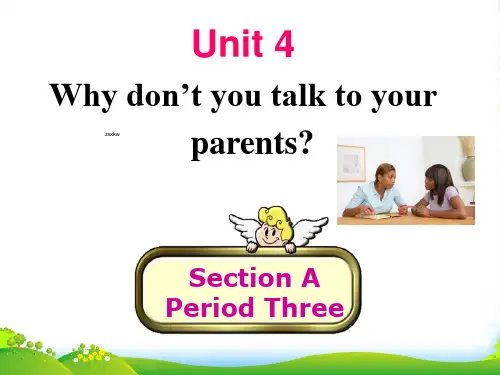
4. Kids shouldn’t play computer games until late at night. They should rest early.
◆You could do … : “你(可以) 做……” ◆ Let’s do … : “让我们做……吧!” ◆ “主语+had better (not)+动词原形” :
“……最好(不要)做某事” You’d better go to school on time. ◆ It’s best to do ... : “做……再好不过 了。”
• 3. You could save more money __s_o_t_h_a_t_ you can buy a gift for your friend’s birthday.
4. Kids shouldn’t play computer games ___u_n_t_i_l __ late at night. They should rest early.
Guess
1. H__o_w__a_b_o_u_t going out for a walk? 2. W__h__a_t _a_b_o_u_t_ another cake? 3. W__h__y_d_o_n_’_t_ you _t_u_r_n__to__ the
reference book? 4.Why _d_id_n_’_t you s_e_e_ the football match? 5.W__h_y__d_o_n_’_t _y_o_u_ go there with us? 6. W__h__y_n_o_t_ go fishing today?
八年级英语下册 口头表达专练 Unit 4 Why don’t you talk to your p
Why don’t you talk to your parents? BThis information comes from Yang Xuehui at Shili middle school in Xihe, Gansu.Section B 1a参加体育运动和朋友们一起闲逛和父母或其他家庭成员交谈独自消磨时光玩电脑游戏看书看电影1c父母给我许多学业压力。
我睡眠不足。
我没有足够的闲暇时间。
我和父母吵了一架。
在学校我不得不和同班同学竞争。
1d1. 尽管你可能和父母在一起不开心,但是你应当和他们谈谈。
问问他们为什么给你那么多压力。
2. 生活不应该只看重分数。
闲时活动诸如运动以及跟朋友闲逛也是挺重要的。
3. 你不应该为了取得较好成绩跟同学较劲。
你们都应该互相帮助共同提高。
2b或许你应该学会放松!如今,中国孩子有时周末比上学日还要忙,因为他们不得不上那么多的课外班。
他们中许多人在学习考试技巧以便他们能进入一所好的高中再后来可以上一所好大学。
另外一些人在参加体育训练以便他们能在比赛中获胜。
然而,这不仅仅发生在中国。
泰勒一家是一个典型的美国家庭。
对于凯茜•泰勒的三个孩子来说,生活是忙碌的。
“在大多数日子的放学后”,凯茜说:“我把两个儿子中的一个带去练篮球,女儿去训练足球。
然后我还得送另一个儿子去上钢琴课。
或许我可以减少一些他们的活动,但我相信这些活动对我孩子的将来是很重要的。
我真希望他们将来成功。
”然而,疲劳不堪的孩子们直到晚上7点才回到家。
他们匆匆忙忙吃完饭,接着就该做作业了。
琳达•米勒,一位有三个孩子的母亲,清楚这一切的压力。
“在有些家庭里,竞争从很小就开始了,一直持续到孩子长大成人。
妈妈们把自己的孩子送到各种各样的学习班。
她们老是拿自己的孩子和别人家的孩子对比。
这简直是疯了。
我觉得这不公平。
他们为什么不能让孩子做回孩子呢?人们不应该把孩子逼得那么紧。
“医生说太多的压力对孩子们的发展是有害无益。
爱丽丝· 格林医生说所有这些活动只能给孩子带来很多压力。
人教版英语八年级下册Unit 4 Why don’t you talk to your parent

2019-2020学年人教版英语八年级下册Unit 4 Why don’t you talk to your parents?课文知识点总结Section A1.Why don’t you talk to your parents? 你为什么不和你打父母谈谈呢?【解析】Why don't you do sth ?= Why not do sth? 为什么不......呢?【拓展】用于提建议的句型有:(1)What about doing sth ?=How about doing sth? ….怎么样?(2)Why don’t you do sth?= Why not do sth? 为什么不呢?(3)Let’s do sth.让我们一起做某事吧。
(4)Shall we/I do sth?我们做…好吗?(5)had better do/not do sth 最好做/不做某事(6) Will/Would you please do sth 请你做…好吗?(7) Would you like to do sth? 你想去做某事吗?(8)Would you mind doing sth?你介意做某事吗?【回答】(1). 同意对方的建议时,一般用:◆Good idea./ That’s good idea. 好主意◆OK/ All right./ Great 好/ 行/太好了◆Yes, please ./ I’d love to 是的/ 我愿意◆I agree with you 我同意你的看法◆No problem 没问题◆Sure/ Of course/ Certainly 当然可以◆Yes, I think so 对,我也这样想(2).对对方的帮助或要求表示委婉谢绝时,一般用:◆I don’t think so 我认为不是这样◆Sorry, I can’t 对不起,我不能◆I’d love to, but…◆I’m afraid…我愿意,但恐怕……2.I have to study too much so I don’t get enough sleep.我要学的太多,因此我睡眠不足。
人教版八年级英语下册《Unit4 Why don’t you talk to your parent
人教版八年级英语下册《Unit4 Why don’t you talk to your parents》教学设计(第5课时)一. 教材分析人教版八年级英语下册《Unit4 Why don’t you talk to your parents》是本单元的第五课时,主要围绕着如何向父母提出建议展开。
本课时包含两个部分:part A 和part B。
part A包含一个听力活动,一个读写任务和一个口语练习;part B包含一个读写任务和一个口语练习。
本课时旨在帮助学生掌握向父母提出建议的策略,提高他们的听说读写能力。
二. 学情分析学生在之前的学习中已经掌握了如何提出建议的基本句型“Why don’t you…?”和“You should….”,但还需要在实际情境中进行运用和提高。
此外,学生在听力、口语、阅读和写作方面需要进一步的加强和巩固。
三. 教学目标1.知识目标:(1)能够听懂、会说、会读、会写本课时所学的单词和短语。
(2)能够运用所学句型提出建议,并进行简单的交流。
2.能力目标:(1)提高学生的听力能力。
(2)提高学生的口语表达能力。
(3)提高学生的阅读和写作能力。
3.情感目标:(1)培养学生积极主动与父母沟通的习惯。
(2)培养学生珍惜友谊,关心他人的品质。
四. 教学重难点(1)掌握本课时所学的单词和短语。
(2)运用所学句型提出建议,并进行简单的交流。
(1)如何准确地运用听力技巧获取信息。
(2)如何准确地运用阅读技巧获取信息。
五. 教学方法1.任务型教学法:通过完成各种任务,激发学生的学习兴趣,提高学生的学习积极性。
2.情境教学法:通过设定真实的情境,让学生在实际情境中学习和运用英语。
3.交际型教学法:通过小组讨论、角色扮演等方式,培养学生的交际能力。
六. 教学准备1.教材:人教版八年级英语下册《Unit4 Why don’t you talk to your parents》。
2.课件:根据教学内容制作的课件。
人教目标版八年级下册Unit4 Why don’t you talk to your parents
If you’re Linda Miller. Tell us your opinion about after-school classes.
I don’t really agree that children should take after-school classes. I think(In my opinion, )it’s crazy/unfair for children to…. I believe it is better if parents …. People shouldn't....
Why don’t they let their kids be kids?
7. 医生们说太多的压力不利于孩子们的成长。
Doctors say too much pressure is not good for a child's development.
8. 所有这些活动会给孩子们导致很大的压力。
Unit 4 Why don’t you talk to
your parents? Period5
1. 家庭成员 2. 独自消磨时光 3. 给某人那么多的压力 4. 与某人竞争 5. 取得更好的成绩 6. 业余活动 7. 互相
family members spend time alone give sb. so much pressure compete with sb. get better grades free time activities each other
The most common activity I want to do is that …
八年级英语下册 Unit 4 Why don't you talk to your parents作

“我的妈妈……杂志……”可知look through符合句意。因此答案选
B。
11.We should learn how to ________ well with people around us. A.get along B.get down
C.get to D.get up
A 【解析】get along (well)with sb.为固定搭配,意为“和某人相
果”;even if意为“尽管”;if only意为“只要;但愿”。根据句意
“他说的很清楚……每个人都理解他说的意思”可知so that 符合句 意。因此答案选B。
13 . He speaks ________ English ________ French.Instead , he speaks German. A.either;or B.not only;but also C.both;and D.neither;nor D 【 解 析 】either...or... 意 为 “ 或 者 …… 或 者 ……” ; not
so 意为“因此”;if意为“如果”。根据句意“法兰克过着简朴的
生活……他有很多钱”可知although符合句意。因此答案选A。
9.—May I borrow this book?
—Of course,please ________ it in two weeks. A.turn B.return C.give D.delete
处(得好)”;get to意为“到达”;get up意为“起来;起床”;get
down意为“下来”,因此答案选A。
12.He spoke clearly ________ everybody understood him. A.so far B.so that C.even if D.if only B 【解析】so far意为“到目前为止”;so that意为“以便;结
人教新目标八年级英语下册Unit4Whydon'tyoutalktoyourparents说课稿
人教新目标八年级英语下册Unit 4 Why don’t you talk to your parents说课稿一. 教材分析人教新目标八年级英语下册Unit 4 Why don’t you talk to your parents是一篇关于日常交流和沟通的文章。
本篇文章主要讲述了在遇到问题时,如何与父母沟通,寻求解决方案。
通过本节课的学习,学生能够掌握情态动词why not的用法,以及如何运用交际策略进行日常交流。
教材内容贴近学生生活,有利于激发学生的学习兴趣和积极性。
二. 学情分析八年级的学生已经掌握了基本的英语语法和词汇,具备一定的听说读写能力。
但在实际交流中,学生往往因为害羞、紧张等原因不敢开口说英语,本题正好可以引导学生学会如何与父母沟通,提高他们的交际能力。
同时,学生在这个年龄段开始关注家庭和社交问题,对本节课的内容会产生浓厚兴趣。
三. 说教学目标1.知识目标:学生能够掌握情态动词why not的用法,了解日常交际中的沟通策略。
2.能力目标:学生能够运用所学知识进行日常交流,提高口语表达能力。
3.情感目标:学生学会与父母沟通,增进家庭关系,培养良好的交际习惯。
四. 说教学重难点1.重点:情态动词why not的用法和日常交际策略。
2.难点:如何运用所学知识进行实际交流,克服羞涩、紧张等心理障碍。
五. 说教学方法与手段1.情景教学法:通过设定情景,让学生在实际语境中学习英语,提高交际能力。
2.任务型教学法:学生分组完成任务,激发学习兴趣,培养合作精神。
3.互动式教学法:教师与学生互动,引导学生积极参与课堂讨论,提高口语表达能力。
六. 说教学过程1.导入:用一段关于家庭沟通的短片引出本节课的主题,激发学生的学习兴趣。
2.新课呈现:教师展示文章,引导学生关注文章标题和关键词,预测文章内容。
3.课堂讲解:教师讲解情态动词why not的用法和日常交际策略,让学生通过例句理解并掌握。
4.实践环节:学生分组进行角色扮演,运用所学知识进行实际交流,教师巡回指导。
八年级英语下册 Unit 4 Why don’t you talk to your parents
Unit 4 Why don’t you talk to your parents?【教材分析】:本课例选自新目标GO FOR IT八年级下 Unit 4 Section B3a-3b。
由于教材中的写作任务是杂志社采访家长有关于学生课外辅导班的看法,让学生以家长的身份运用阅读文章中的语言写信表达意见。
为了使写作活动更加具有实际意义,让学生有话可写,我把写作活动改编成学生根据自身的客观情况写信给父母或是朋友,针对课外辅导班表达自己的观点,使写作活动更具有语用功能。
【教学目标】:1.学生能运用不同的句型陈述自己的观点和理由。
2.学生能正确使用could, should 表达建议。
3.学生能正确使用连词来连接上下文。
【教学重难点】:1. 如何为学生搭建写作的支架,让学生有话可写,有目的地去写2. 如何让学生学会使用不同的句型陈述不同的理由。
【教学过程】Step 1: Warm upT:what do I often do after work?Show pictures of YouthPalace. A lot of parents are waiting for applying for all kinds of classes for their children.T: Guess what they are doing?How do you feel when you see the pictures?设计意图:从家长在少年宫为学生报名参加各种补习班的火爆图片,引发学生的思考,使学生产生共鸣。
为下一个活动有关学生自己的课外辅导班做好铺垫。
Step 2: Lead inTask: Have a quiz about after-school classesT: Do you have after-school classes? Do you like to take after-school classes? Hereis a quiz for you . Choose the answer as quickly as you can.A quiz about after-school classes1. Are you busier on weekends than on weekdays?A.Yes .B. No .C. Other answers2. How many after-school classes do you take every week?A. More than 2 classes.B. One to two classes.C. Other answers.3. Do you think these classes are important for your future?A.No .B. Yes .C. Other answers.3.Who makes you take after-school classes?A.Parents .B. Yourself.C. Other answers.5.How do you feel when you take after-school classes?A.Tired.B. Glad.C. Other answers.T: If most of your answers are A, it means you don’t like taking after-school classes. Why not talk to your parents?If most of your answers are B, it means you like to take after-school classes. You agree with your parents. Why don’t you share your opinions to help your classmates? If most of your answers are C, it means you have no idea about after-school classes. So perhaps in this class you’ll find your answer.设计意图:通过对学生的课外辅导班的情况调查,进一步了解了学生自身的真实情况,使学生明确本节课写作的目的。
英语人教版八年级下册Unit4_Why_don't_you_talk_to_yo
I have too much homework.
What’s wrong?
.
Why don’t you talk to your friends?
I got into a fight withnd circle the problems you hear in 1a.
Unit 4 Section A(1)
Why don’t you talk to your parents? --by Hexi School 文琳
Talk about problems or troubles讨论困难和麻烦 Give advice 提供建议
What’s the matter with the boy? =What’s wrong with the boy?
What’s wrong?
after-school classes. I have too many ____________________ 补习班
What’s wrong?
with my best friend. get into a fight with sb =have a fight with sb.
Pair work
Look at the problems in 1a.
Task One: 六个宝盒里有五个等待解决的问题,看看 哪一个小组提出的建议最多最合理?
1
2
3
4
5
I can’t get good grades.
I am not strong.
I am not good at math.
got into a fight I ___________
REVIEW
• • • • • • Study too much 学习任务重 enough sleep 充足睡眠 too much homework 太多家作 hang out with friends 和朋友出去玩 after-school classes 课后辅导 get into a fight 争吵
人教版八年级英语下册集体备课教案:Unit4 Why don’t you talk to your
课题课时Period 1教学目标语言技能听:能听懂他人他人陈述困难和麻烦的简单对话的内容,并获取主要信息。
说:1.能询问、陈述自己或他人的困难和麻烦,如What’s wrong?I’m really tired because I studied until midnight last night.2.能针对别人的困境提出解决的办法和建议,如What should Ido?Well,you should call him so that you can say you’re sorry.语言知识语音:熟练把握邀请句的升调语调,同时,在口语交流时能做到语音、语调准确、自然、流畅。
词汇:1.熟练运用:allow,wrong,midnight,guess,de al.2.掌握:What’s wrong, look through,work out.语法:1.能正确使用情态动词could,should表达或劝告,如:Youcould go to his house.2.能正确使用Why don’t you...?句型表达建议。
功能:学会询问、陈述自己或他人的困难和麻烦。
话题:了解人际交往的相关知识。
情感态度1.培养学生用英语交际能力,学会与人进行流畅的沟通和交流;2.使学生在活动中学会真诚、坦然地与人交谈。
学习策略认知策略:能在具体的情境中询问、陈述自己或他人的困难和麻烦,从而进一步主动练习和实践。
调控策略:.能针对别人的困境提出解决的办法和建议,并与人进行交流。
交际策略:培养学生合作能力,不断完善知识点,加强对话练习,学会与人闲聊,进行交流。
资源策略:通过多媒体、录音机等教学辅助工具。
文化意识了解中西方家长对待孩子参加课外活动和课外学习班的态度与做法。
教学重难点教学重点1.能正确使用情态动词could,should表达或劝告。
2.能正确使用Why don’t you...?句型表达建议。
教学难点1.Talk about problems.2.Give advice.教学方法听说法,交际法,教学辅助手段PPT, recorder.板书设计Unit4 Why don’t you talk to your parents?Sectio n A 1a-2dallow What’s wrong?wrong Why don’t you...?midnightguessdeal教后反思本节课学会了提建议的方式有:Why don’t you...? /Why not…?等Teaching ProcedureStages/TimingStep 1. warming-upStep 2 PresentationStep3 DiscussionStep 4Pre sentationStep 5 ListeningTeach ers’ a ctivitiesAfter greeting, ask students :What day is it today?What’s the date today?What’s the weather like today?1. Show the picture of a girl:T: Please look at this girl,what isshe doing?T: Look at her face,she isworried.because she has a lotof homework to do.Do yo uhave too much homework todo?Do you think it is serious?1a.Get them to read the followingsentences and discuss wheatherthey are serious or not. And thenwrite them in the approprite boxT:Do you have theseproblems?What kind of problemsdo you have?Students’ activitiesStudents answer the questions。