
(完整版)比较级和最高级变化规则
四.形容词和的比较级和最高级的变化规则类似。
规则变化如下
构成规则例词
一般情况,在单音节或
双音节词的词尾直接
加-er, -est
tall—taller—tallest
great—greater—greatest
near—nearer—nearest
soon—sooner—soonest
hard—harder—hardest
fast—faster—fastest
以不发音 e 结尾的单音节词,只加-r, -st large—larger—largest nice—nicer—nicest
late—later—latest
以重读闭音节结尾,并
且以一个元音字母加
一个辅音字母结尾的单词,先双写最后这个辅音字母,再加-er,-est
big—bigger—biggest
hot—hotter—hottest
fat—fatter—fattest wet—wetter—wettest
thin—thinner—thinnest
以“辅音字母+y”结尾的单词,把 y 改为 i, 再加-er, -est happy—happier—happiest
heavy—heavier—heaviest
easy—easier—easiest
early—earlier—earliest
大部分双音节词和多音节词,在原级前面加 more, most 来构成比较级和最高级
friendly—more friendly—most friendly
relaxed—more relaxed—most relaxed important—more important—most
carefully—more carefully—most carefully
构成规则例词
以形容词加-ly 构成的
副词,在原形前加more, most 构成比较级和最高级 quickly—more quickly—most quickly easily—more easily—most easily
clearly—more clearly—most clearly
形容词和副词的不规则变化。
原级比较级最高级变化
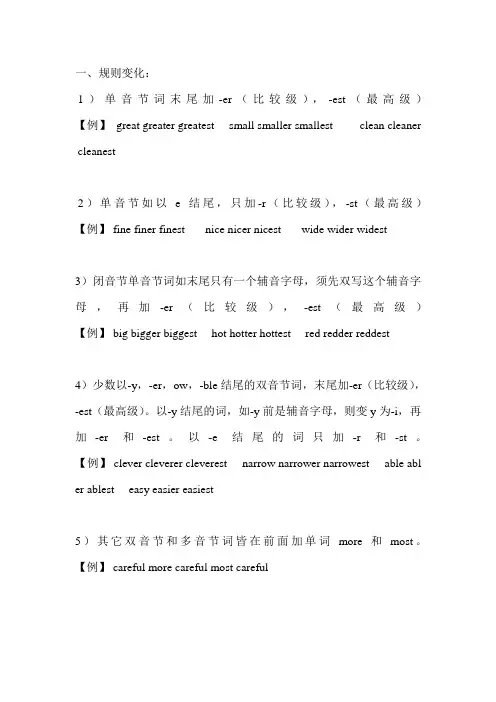
一、规则变化:
1)单音节词末尾加-er(比较级),-est(最高级)【例】 great greater greatest small smaller smallest clean cleaner cleanest
2)单音节如以e结尾,只加-r(比较级),-st(最高级)【例】 fine finer finest nice nicer nicest wide wider widest
3)闭音节单音节词如末尾只有一个辅音字母,须先双写这个辅音字母,再加-er(比较级),-est(最高级)【例】 big bigger biggest hot hotter hottest red redder reddest
4)少数以-y,-er,ow,-ble结尾的双音节词,末尾加-er(比较级),-est(最高级)。
以-y结尾的词,如-y前是辅音字母,则变y为-i,再加-er和-est。
以-e结尾的词只加-r和-st。
【例】 clever cleverer cleverest narrow narrower narrowest able abl er ablest easy easier easiest
5)其它双音节和多音节词皆在前面加单词more和most。
【例】 careful more careful most careful
二,不规格。
(word完整版)(总)形容词比较级和最高级规律和不规则变化
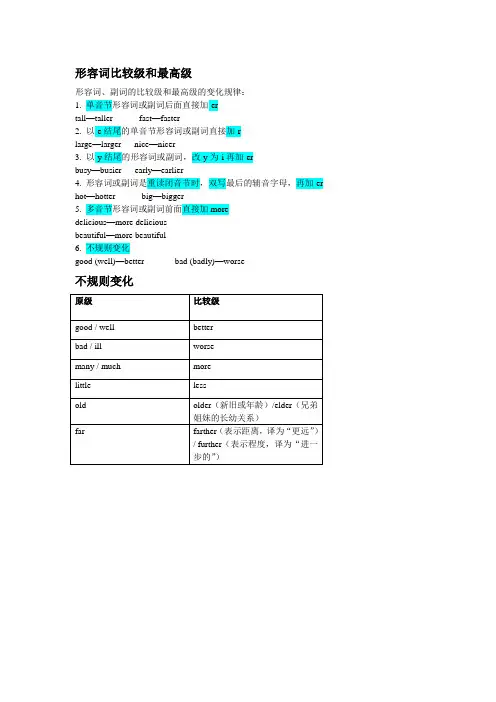
原级
比较级
good / well
better
bad / ill
worse
many / much
more
little
less
old
older(新旧或年龄)/elder(兄弟姐妹的长幼关系)
far
farther(ห้องสมุดไป่ตู้示距离,译为“更远”)/ further(表示程度,译为“进一步的”)
形容词比较级和最高级
形容词、副词的比较级和最高级的变化规律:
1.单音节形容词或副词后面直接加-er
tall—taller fast—faster
2.以-e结尾的单音节形容词或副词直接加-r
large—larger nice—nicer
3.以-y结尾的形容词或副词,改-y为-i再加-er
busy—busier early—earlier
4.形容词或副词是重读闭音节时,双写最后的辅音字母,再加-er
hot—hotter big—bigger
5.多音节形容词或副词前面直接加more
delicious—more delicious
beautiful—more beautiful
6.不规则变化
good (well)—better bad (badly)—worse
比较级和最高级变化规则

容易的 easy--easier --easiest
忙的 busy --busier-- busiest
5) 其他双音节或多音节词,在前 more 或者most
重要的important-more important-most important
简单地 easily-more easily -most easily
大的 large -- larger --largest
有能力的 able --abler --ablest
3) 以辅元辅,重读结尾的单词,双写尾字母加er/est
大的 big -- bigger-- biggest
热的 hot --hotter--- hottest
瘦的 thin --thinner --thinnest
11. 关于“ as + 形容词或副词原级 + as ”
1)在否定句或疑问句中可用so… as.
eg. He cannot run so/as fast as you.
2)当as… as 中间有名词时采用以下格式.
as +形容词+ a +单数名词
as + many/much +名词
eg. This is as good an example as the other is.
1. 二者相比较,说明“A比B更……一些”时要用一个连词than引导的从句.
句型:A+动词+形容词比较级+than + B.
than后面接代词时,一般要用主格.但在口语中也可使用宾格.
eg. 我比你老: I am older than you.
(完整版)形容词比较级和最高级变化规则
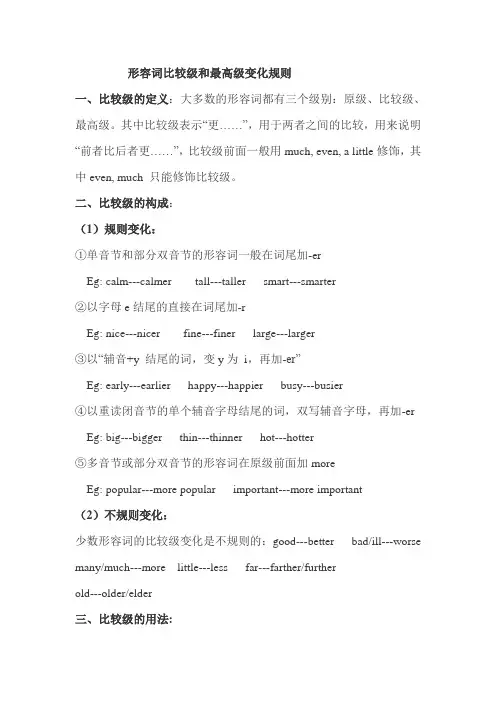
形容词比较级和最高级变化规则一、比较级的定义:大多数的形容词都有三个级别:原级、比较级、最高级。
其中比较级表示“更……”,用于两者之间的比较,用来说明“前者比后者更……”,比较级前面一般用much, even, a little修饰,其中even, much 只能修饰比较级。
二、比较级的构成:(1)规则变化:①单音节和部分双音节的形容词一般在词尾加-erEg: calm---calmer tall---taller smart---smarter②以字母e结尾的直接在词尾加-rEg: nice---nicer fine---finer large---larger③以“辅音+y 结尾的词,变y为i,再加-er”Eg: early---earlier happy---happier busy---busier④以重读闭音节的单个辅音字母结尾的词,双写辅音字母,再加-er Eg: big---bigger thin---thinner hot---hotter⑤多音节或部分双音节的形容词在原级前面加moreEg: popular---more popular important---more important(2)不规则变化:少数形容词的比较级变化是不规则的:good---better bad/ill---worse many/much---more little---less far---farther/furtherold---older/elder三、比较级的用法:(一)当两个人或事物(A和B)进行比较时,我们需要用到形容词(副词)的原级或者比较级1.表达“A和B一样”,用as…as的结构。
公式: A+be动词+as+形容词原级+as…+BA+实义动词+as+副词原级+as…+BEg I am as tall as you.我和你一样高。
He runs as fast as I. 他跑得和我一样快。
比较级最高级变化规则总结

比较级和最高级变化规则总则1比较级直接在词尾+ er;最高级直接在词尾+est.序号原级比较级最高级中文1.short shorter shortest最矮的;最短的2.long longer longest最长的3.small smaller smallest最小的4.fast faster fastest最快的;最快地5.hard harder hardest最努力地6.smart smarter smartest最聪明的7.tall taller tallest最高的8.young younger youngest最年轻的9.quiet quieter quietest最文静的10.old older oldest最旧的;最老的11.thick thicker thickest最厚的12.cheap cheaper cheapest最便宜的13.slow slower slowest最慢的14.strong stronger strongest最强壮的15.weak weaker weakest最弱的16.new newer newest最新的17.warm warmer warmest最温暖的18.cold colder coldest最冷的19.cool cooler coldest最凉爽的20.shy shyer shyest最害羞的21.tight tighter tightest最紧的22.clean cleaner cleanest最干净的23.clever cleverer cleverest最聪明的1.以不发音e结尾的单音节词,比较级直接加---r;最高级直接加---st.序号原级比较级最高级中文1.nice nicer nicest最友好的rge larger largest最大的3.fine finer finest最好的4.wide wider widest最宽的5.safe safer safest最安全的2.在重读闭音节(即:辅音+元音+辅音)中,要双写结尾的辅音字母,然后比较级加---er;最高级加---est。
比较级、最高级变化规律
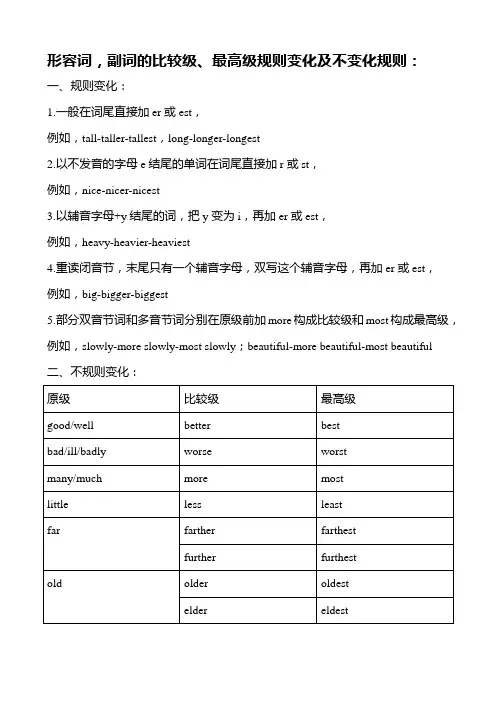
形容词,副词的比较级、最高级规则变化及不变化规则:一、规则变化:1.一般在词尾直接加er或est,例如,tall-taller-tallest,long-longer-longest2.以不发音的字母e结尾的单词在词尾直接加r或st,例如,nice-nicer-nicest3.以辅音字母+y结尾的词,把y变为i,再加er或est,例如,heavy-heavier-heaviest4.重读闭音节,末尾只有一个辅音字母,双写这个辅音字母,再加er或est,例如,big-bigger-biggest5.部分双音节词和多音节词分别在原级前加more构成比较级和most构成最高级,例如,slowly-more slowly-most slowly;beautiful-more beautiful-most beautiful 二、不规则变化:下列单、双音节词只能加more和most.扩展资料1.可以修饰比较级的词,much,a lot,far,…的多a little,a bit,…一点儿even 甚至,still仍然2.比较级常用的句型结构:(1)“甲+be+(倍数)+形容词比较级+than+乙”表示“甲比乙…”或“甲比乙…几倍”(2)“甲+be+形容词比较级+than+any other+单数名词(+介词短语)”表示“甲比同一范围的任何一个人/物都……”,含义是“甲最……”。
(3)“甲+be+the+形容词比较级+ofthetwo+……”表示“甲是两者中较……的”。
(4)“比较级+and+比较级”表示“越来越……”。
(5)“the+比较级,the+比较级”表示“越……,越……”。
(6)“特殊疑问词+be+形容词比较级,甲or乙?”。
比较级和最高级归纳总结
b) 不规则变化: good — better — best well — better — best bad — worse — worst many/much — more — most
far — farther —farthest far — further — furthest old — elder — eldest old — older — oldest
4. 使用形容词比较级时需注意以下几点:
1) than后面接代词时, 一般要用主格形式,
但在口语中也可使用宾格形式。 如:
My brother is taller than I / me.
2) 当需要表示一方超过另一方的程度时, 可以用much, a lot, a little, a bit, even, still 等来修饰形容词比较级。注意: 比较级不 能用very, so, too, quite等修饰。如: He is much more serious than Sam.
个时, 用最高级。最高级的前面一般要加定
冠词 the, 后面可带 of ( in )短语来说明比较
的范围。
如:She is the youngest in the class.
Jason is the tallest of the three.
Whose handwriting is the best of all?
2. 最高级可被序数词以及 much,by far, nearly,almost,by no means,not quite, not really,nothing like 等词语所修饰。例 如: This hat is by far/much/nearly/almost /not nearly/by no means/not quite/ nothing like the biggest. How much did the second most expensive hat coat?
比较级最高级变化规则总结
比较级最高级变化规则总结比较级和最高级是英语中用来表示两个或多个事物在其中一方面的比较的形式。
在比较级和最高级中,我们需要注意变化规则及注意的一些特殊情况,本文将对这些规则进行总结。
1.一般形容词的比较级和最高级变化规则一般形容词的比较级和最高级分别在词尾加上-er和-est。
对于以辅音字母+y结尾的词,将y改为i再加-er和-est。
例如:- tall(高)的比较级是 taller(更高),最高级是 tallest(最高)。
- small(小)的比较级是 smaller(更小),最高级是 smallest(最小)。
对于以辅音字母结尾的词,如果重读闭音节中只有一个元音字母,应双写该字母,再加-er和-est。
例如:- big(大)的比较级是 bigger(更大),最高级是 biggest(最大)。
2.以辅音字母+y结尾的双音节形容词的比较级和最高级变化规则对于以辅音字母+y结尾的双音节形容词,删除-y,并加-ier和-iest。
例如:- easy(容易的)的比较级是 easier(更容易),最高级是easiest(最容易)。
- happy(快乐的)的比较级是 happier(更快乐),最高级是happiest(最快乐)。
3.双音节和部分多音节形容词的比较级和最高级变化规则对于双音节和部分多音节形容词,使用 more和most来表示比较级和最高级。
例如:- famous(著名的)的比较级是 more famous(更著名),最高级是most famous(最著名)。
- intelligent(聪明的)的比较级是 more intelligent(更聪明),最高级是 most intelligent(最聪明)。
4.部分特殊形容词的比较级和最高级变化规则一些形容词比较级和最高级的变化规则与一般规则不同,例如:- good(好的)的比较级是 better(更好),最高级是 best(最好)。
- bad(坏的)的比较级是 worse(更坏),最高级是 worst(最坏)。
比较级和最高级变化规则
比较级和最高级变化规则比较级和最高级的变化规则:比较级就是将二者进行比较产生的词形,是由形容词或副词原级转化而来。
英语句子中,将比较两个主体的方法叫做”比较句型”。
最高级表示三者或三者以上的人或物进行比较时,用最高级。
在含有最高级的句子中,常有一个in/of/among短语来表示比较范围。
比较级的变化规则如下:单音节形容词和部分双音节词(大多是以y、ly、er、ow、ble结尾的双音节形容词) , 一般在词尾加-er。
例如:tall(taller)、great ( greater)、small ( smaller)、clean (cleaner)等等。
以字母e结尾的词,在词尾直接加-r。
例如:fine ( finer)、nice (nicer)、wide (wider)等等。
以一个元音加一个辅音结尾的词,且元音发短音时,双写尾字母,再加er。
例如:fat(fatter)、big (bigger)、hot (hotter)、red (redder)等等。
少数以y,er, ow,b1e结尾的双音节词,末尾加er;以y结尾的词如果y前是辅音字母,则变y为i,再加er;以e结尾的词只加r。
例如:clever ( cleverer)、narrow(narrower)、able (abler)、easy (easier)等等。
其它双音节和多音节词皆在前面加单词more。
例如:careful (more careful )、difficult (more difficult)、delicious ( more delicious)等等。
有些词的比较级变化不规则,则需要特殊记忆。
例如:good/well(better )、bad ( worse)、many/much (more)、little (less)、far( farther)等等。
最高级的变化规则如下:一般在词尾直接加er或est,例如,tall-taller-tallest,long-longer-longest。
(完整版)比较级和最高级
(完整版)比较级和最高级一、形容词的比较级和最高级变化规则;1、规则变化:(1) 单音节词和少数双音节词一般在词尾加er或est:如: small ---smaller --- the smallest(2) 以不发音的e字母结尾的加r,或st:如: late --- later --- the latest(3) 以辅音字母加y结尾的变y为I加er或est:如: easy --- easier --- the easiest(4)以一个辅音字母结尾的重读闭音节词双写最后一个辅音字母再加er或est:如: big --- bigger --- the biggest以er,ow结尾的双音节词加er 或est如: slow --- slower --- the slowest(5) 多音节词前加more或most, 副词最高级前省略the.如: important --- more important --- the most important2.不规则变化good / well --- better --- the best 好bad / badly / ill --- worse --- the worst 坏many / much --- more --- the most 多little --- less --- the least 少old --- older / elder --- the oldest / the oldest 老, 旧far --- farther / further --- the farthest / the furthest 远常见形容词比较级、最高级变化一览表1.在形容词词尾加上“er”“est”构成比较级、最高级:bright(明亮的)—brighter—brightest broad(广阔的)—broader—broadest cheap(便宜的)—cheaper—cheapest clean (干净的)—cleaner—cleanestclever(聪明的)—cleverer—cleverest cold(寒冷的)—colder—coldest cool(凉的)—cooler—coolest dark(黑暗的)—darker—darkest deep(深的)—deeper—deepest fast(迅速的)—faster—fastestfew(少的)—fewer—fewest great(伟大的)—greater—greatest hard(困难的,硬的)—harder—hardest high(高的)—higher—highest kind(善良的)—kinder—kindest light(轻的)—lighter—lightest long(长的)—longer—longest loud(响亮的)—louder—loudestlow(低的)—lower—lowest near(近的)—nearer—nearest new(新的)—newer—newest poor(穷的)—poorer—poorestquick(快的)—quicker—quickest quiet(安静的)—quieter—quietestrich(富裕的)—richer—richest short(短的)—shorter—shortestslow(慢的)—slower—slowest small(小的)—smaller—smallest smart(聪明的)—smarter—smartest soft(柔软的)—softer—softest strong(强壮的)—stronger—strongest sweet (甜的)—sweeter—sweetest tall(高的)-taller-tallest thick(厚的)—thicker—thickest warm(温暖的)—warmer—warmest weak(弱的)—weaker—weakest young(年轻的)—younger—youngest2.双写最后一个字母,再加上“er”“est”构成比较级、最高级:big(大的)—bigger—biggest fat(胖的)—fatter—fattesthot(热的)—hotter—hottest red(红的)—redder—reddestsad(伤心的)—sadder—saddest thin(瘦的)—thinner—thinnestwet(湿的)—wetter—wettest mad(疯的)—madder—maddest3.以不发音的字母e结尾的形容词,加上“r”“st”构成比较级、最高级:able(能干的)—abler—ablest brave(勇敢的)—braver—bravest close(接近的)—closer—closest fine(好的,完美的)—finer—finest large(巨大的)—larger—largest late(迟的)—later—latestnice(好的)—nicer—nicest ripe(成熟的)—riper—ripestrude(粗鲁的)—ruder—rudest safe(安全的)—safer—safest strange(奇怪的)—stranger—strangest wide(宽广的)—wider—widest wise(睿智的,聪明的)—wiser—wisest white(白的)—whiter—whitest4.以字母y结尾的形容词,把y改为i,再加上“er”“est”构成比较级、最高级:busy(忙碌的)—busier—busiest dirty(脏的)—dirtier—dirtiest dry(干燥的)—drier—driest early(早的)—earlier—earliest easy(容易的)—easier—easiest friendly(友好的)—friendlier—friendliest funny(好玩的)—funnier—funniest happy(开心的)—happier—happiest healthy(健康的)—healthier—healthiest heavy(重的)—heavier—heaviest hungry(饿的)—hungrier—hungriest lazy(懒惰的)—lazier—laziestlucky(幸运的)—luckier—luckiest naughty(调皮的)—naughtier—naughtiest noisy(嘈杂的)—noisier—noisiest pretty (美丽的)—prettier—prettiest silly(傻的)—sillier—silliest spicy(辣的)—spicier—spiciestthirsty(渴的)—thirstier—thirstiest ugly(丑的)—uglier—ugliest4.双音节、多音节形容词,在单词前面加上“more”“most”构成比较级、最高级:afraid(害怕的)—more afraid—most afraidbeautiful(美丽的)—more beautiful—most beautifulcareful(仔细的)—more careful—most carefulcheerful(开心的)—more cheerful—most cheerfulcrowded(拥挤的)—more crowded—most crowdeddangerous(危险的)—more dangerous—most dangerous delicious(美味的)—more delicious—most deliciousdifficult(困难的)—more difficult—most difficultexciting(令人兴奋的)—more exciting—most excitingexpensive(昂贵的)—more expensive—most expensivefamous(著名的)—more famous—most famousfrightened(受惊的)—more frightened—most frightened frightening(令人害怕的)—more frightening—most frighteninghard-working(勤奋的)—more hard-working—most hard-workinghelpful(有帮助的)—more helpful—most helpfulhonest(诚实的)—more honest—most honestimportant(重要的)—more important—most importantinteresting(有趣的)—more interesting—most interesting polite(有礼貌的)—more polite—most politeterrible(可怕的)—more terrible—most terribletired(累的)—more tired—most tired5.不规则变化的形容词:bad(坏的)—worse—worst good(好的)—better—bestfar(远的)—farther—farthest (far—further—furthest)ill(病的)—worse—worst little(少的)—less—leastmany(多的)—more—most much(多的)—more—most old(年老的)—older—oldest ( old—elder—eldest)well(好的,身体好的)—better—best一. 写出下列形容词或副词的比较级和最高级.bad ________________ ______________________________clean ________________ ______________________________ famous ______________ _______________________dirty _________________ ______________________________big __________________ _____________________________small _________________ ______________________________heavy _____________ ______________________little __________________ ______________________________hard __________________ ______________________________ happy _________________ ______________________________far ___________________ ______________________________ expensive _____________________ ________________________________ well _________________ ______________________________easy __________________ ______________________________ wide ___________________ _______________________________ young _________________ ________________________________ rude ___________________ ________________________________ cheap ___________________ _______________________________ ugly __________________ _________________________________ busy ___________________ ________________________________ old ____________________ _________________________________ noisy __________________ _________________________________ interesting _____________________ _______________________________ hot ____________________ _________________________________ cold ___________________ _________________________________ many __________________ ________________________________ bright __________________ _______________________________ boring __________________ _______________________________ difficult _______________________ ________________________________ beautiful _______________________ _____________________________thin _____________________ _______________________________ good ____________________ _______________________________ strong____________________ ______________________________ high _________________ _______________________warm ________________ _______________________late __________________ _______________________weak _________________ ______________________tall ___________________ ______________________short __________________ ______________________loud ___________________ ______________________lazy ___________________ ______________________quick __________________ ______________________angry __________________ ______________________clever __________________ ______________________smart __________________ ______________________low ____________________ __________________二、选择填空1. Which does Jimmy like _____ , Chinese or Art?A. wellB. bestC. betterD. much2. The Changjiang River is one of _____ in the world.A. the longest riverB. longest riversC. the longest riversD. longer rivers3. _____ of the two women is Mrs Brown.A. The beautifulB. The more beautifulC. More beautifulD. The most beautiful4. My mooncake is nicer _____ his.A. likeB. withC. forD. than5. You are fatter than _____ .A. heB. hisC. himD. he is tall6. He jumps _____ of the three.A. farB. furtherC. farthestD. furthest7. My hair is longer than _____ .A. my sisterB. KateC. my brother’sD. Lucys’8. There are _____ paper here .Please bring some.A. littleB. lessC. fewerD. a little9. The pen is _____ than that one.A. more cheapB. cheapC. much cheaperD. quite cheaper10.Tom speaks Chinese _____ better than Jimmy.A. moreB. veryC. a lot ofD. much11.There are _____ girls in Class Two than in Class Four.A. moreB. nicestC. mostD. best12.It’s too _____ for you to do that.A. easyB. more dangerousC. harderD. the easiest13.Who has _____ apples now, Jim, Lily or Lucy?A. muchB. biggestC. betterD. the most14.You have more rulers than me. But _____ are nicer than _____ .A. mine, yoursB. mine, yourC. my, yoursD. my, your15.Tingting is _____ than Meimei, but Meimei is _____ than Tingting.A. all, strongerB. taller, strongestC. tallest, strongD. taller, stronger16.Mother is _____ in my family.A. busyB. busierC. the busiestD. more busy17.There are _____ in the park on Sunday.A. more childrenB. a lot of peopleC. much men and womenD. many peoples18.-This blue sweater is too big for me .-Will you please show me a _____ one?A. smallB. smallerC. the smallestD. smallest19.No one is _____ Mary in the class.A. so tallest asB. as taller asC. so high asD. so tall as20. This bike is _____ than that one.A. twenty yuan dearB. twenty yuan dearerC. dear twenty yuanD. dearer twenty yuan[参考答案] CCDDA CDBCD AADAD CBBDB三、用所给词的适当形式填空1.Your classroom is _____ (wide) and _____ (bright) than ours.2.There are _____ (few) hours of sunlight a day in winter than in summer.3.Which do you like _____ (well) , maths or chemistry?4.This is the _____ (good) film I have ever seen.5.Africa is the second _____ (large) continent.6.What he said made his mother much _____ (angry) .7.I’m not as _____ (careful) as he.8.We’ve got as _____ (many) books as we need.9.Pratice as _____ (much) as you can.10.They have done _____ (much) work with _____ (little) money.11.You’re the _____ (kind) person I’ve ever met.12.He is _____ (young) than his two sisters.13.The _____ (old) I get, the _____ (strong) I seem to feel.14.The weather is getting _____ (warm) and _____ (warm) .15.Summer is _____ (hot) season of the year.[参考答案] 1. wider, brighter 2. fewer 3. better 4. best 5. largest 6. angry 7. careful 8. many 9. much 10. more, less 11. kindest 12. younger 13. older, stronger, 14. warmer, warmer 15. the hottest。