
英语人教版 必修二 unit 5 music warming up and reading
Forms Results
in 1996
new record
in the mid-1bout 1970
broke up
after a year or so
became serious
music & jokes
based on
began as
the Beatles
a TV show
rap
根据相应的英文描述给出音乐形式 traditional music from a particular country, region, or community
folk music
根据相应的英文描述给出音乐形式 many people get together to sing
choral
Para 2:
Para 3:
Para 4:
Why are the names of Song Zuying and Liu Huan mentioned in P1? D
A. Because they are very famous. B. Because they can sing very well. C. Because the text wants us to know them. D. Because the text is giving us some examples of the famous singers that we might want to be like.
Unit 5 music
根据相应的英文描述给出音乐形式 a type of music that people consider to be serious and that has a value that continues for a long time
classical music
根据相应的英文描述给出音乐形式 a large group of people playing many different kinds of musical instruments together, led by a conductor
2010年,香港电影《岁月神偷》使用门 基乐队的“I wanna be free”作为电影插 曲,很好地烘托了电影的气氛。
Discussion
How to form a band of your own?
Step 1 Step 2
choose a name for a band What kind of music to play?
Step 3
Step 4
How to make a band famous? Who will play the instruments and who will sing?
根据相应的英文描述给出音乐形式 belongs to any of a number of musical genres "having wide appeal" and is typically accepted by large audiences through the music industry
How most bands start?
Members Reasons Places
(The first step to fame)
High school students They like to write and play music. They practice their music in someone’s house. They may play to passers-by in the street or subway, and give performances in pubs or clubs. They can earn some extra money. They hope to make records in a studio and become millionaires.
orchestra
根据相应的英文描述给出音乐形式 a type of popular music in the style of the traditional music of the southern and western U.S.
country music
根据相应的英文描述给出音乐形式 a type of popular music in which the words of a song are not sung, but spoken in time to music with a steady beat
pop music
根据相应的英文描述给出音乐形式 a style of music which has a strong loud beat
rock ’n’ ro
NAME FAMOUS BANDS YOU KNOW
THE BAND THAT WASN'T
Main idea for each paragraph
Para 1:
The Monkees started in a different way. Many people want to be famous as singers or musicians. How the Monkees became popular and how they developed as a real band. How most bands start.
Summary
If we are _________ourselves, most of us have honest with _________being famous sometimes in our life. Most dreamed of musicians often meet and form _____a band. Sometimes they play in the street to ________ so that they can passers-by extra some _____money and this also gives earn them a chance _____ to realize their dreams. However, The Monkees played jokes on started in a different way. Their musicians ____________ each other as well as played music, basedof onwhich were loosely _______ “The Beatles”. most Their exciting performances were copied by other instruments groups. Later, “The Monkees” played their own broke _________ and up wrote their own music. Though it _______ in 1970, it reunited in the mid-1980s and it is still popular today.
人教版高中英语必修2Unit 5MusicWarming up and Reading教案10
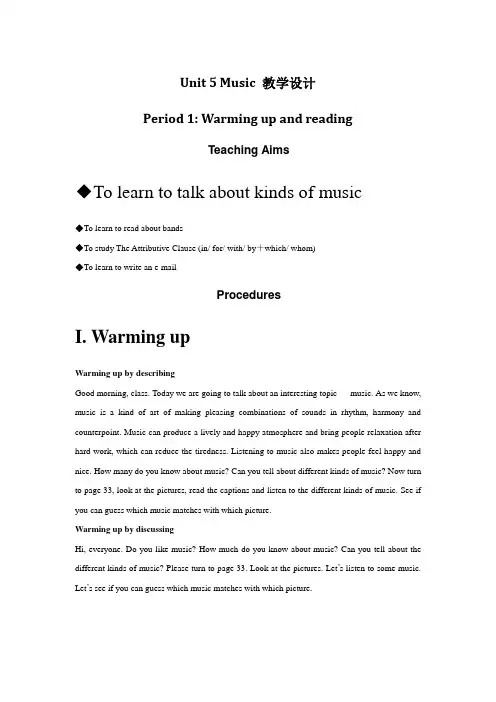
Unit 5 Music 教学设计Period 1: Warming up and readingTeaching Aims◆To learn to talk about kinds of music◆To learn to read about bands◆To study The Attributive Clause (in/ for/ with/ by+which/ whom)◆To learn to write an e-mailProceduresI. Warming upWarming up by describingGood morning, class. Today we are going to talk about an interesting topic --- music. As we know, music is a kind of art of making pleasing combinations of sounds in rhythm, harmony and counterpoint. Music can produce a lively and happy atmosphere and bring people relaxation after hard work, which can reduce the tiredness. Listening to music also makes people feel happy and nice. How many do you know about music? Can you tell about different kinds of music? Now turn to page 33, look at the pictures, read the captions and listen to the different kinds of music. See if you can guess which music matches with which picture.Warming up by discussingHi, everyone. Do you like music? How much do you know about music? Can you tell about the different kinds of music? Please turn to page 33. Look at the pictures. Let’s listen to some music. Let’s see if you can guess which music matches with which picture.Classical music Country music Rock ‘n’ RollRap Orchestra Folk musicYes, you are right. I’m sure you will really enjoy yourselves after listening to all these beautiful music. What kind of music do you like better, Chinese or Western, classical or modern? Why? How does music make you feel? Why do you like to listen to music? Let’s discuss these questions in small groups. Try to share your opinions with one another.II. Pre-reading1.Thinking and sayingHave you heard about any of the famous bands in the world? List some if you can.For reference: I’ve heard about “The Beatles”, “Back Street Boys”, “The Eagles”, “West life”and “Pink Floyd”.2.Listening, talking and sharingLet’s listen to some pieces of music from different bands. Work in groups of four. Tell your group mates which band you like best. Why? Then the group leader is to stand up and share the group idea with the class.For reference:I am from Group 1. Our group likes “The Beatles”best. We like their style of performances. Listening to their performances, we will feel relaxed, amused, and their performances make us think a lot about life.Do you know anything about “The Monkees”?III. Reading1.Reading aloud to the recordingNow please listen and read aloud to the recording of the text T HE BAND THAT WASN’T. Pay attention to the pronunciation of each word and the pauses within each sentence. I will play the tape twice and you shall read aloud twice, too.2.Reading and underliningNext you are to read and underline all the useful expressions or collocations in the passage. Copy them to your notebook after class as homework.3.Reading to identify the topic sentence of each paragraphSkim the text and identify the topic sentence of each paragraph. You may find it either at the beginning, the middle or the end of the paragraph.4th paragraph: How the Monkees became popular and how they developed as a real band.3.Reading and transferring informationRead the text again to complete the tables, which list how people formed a band and how The Monkees was formed by the TV organizers and became a real band.How do people get to form a band?Members High school studentsReasons They like to write and play music.Places They practice their music in someon e’s home.Forms They may play to passers-by in the street or subway.Results They can earn some extra money. They may also have a chance to dream of becoming famous.How was The Monkees formed and became a real band?The Monkees in 1968 (left to right): Micky Dolenz, PeterTork, Mike Nesmith & Davy Jonesbeginning of the band It began as a TV show.style of the performance They played jokes on each other as well as played music.first music and jokes Most of them were based loosely on the band called “The Beatles”. development of the band They became more serious about their work and started to playtheir own instruments and write their own songs like a real band.They produced their own records and started touring and playingtheir own music.changes of the band The band broke up in about 1970, but reunited in the mid-1980s.They produced a new record in 1996, which was a celebration oftheir time as a real band.4. Reading and understanding difficult sentencesAs you have read the text times, you can surely tell which sentences are difficult to understand.Now put your questions concerning the difficult points to me.IV. Closing downClosing down by doing exercisesTo end the lesson you are to do the comprehending exercises No. 1, 2, 3 and 4.Closing down by having a discussionDo you think the TV organizers were right to call “The Monkees” a band when they did not sing or write their own songs? Why?For reference: I don’t think the TV organizers were right to call “The Monkees” a band when they did not sing or write their own songs because singing and writing its own songs was the basis of a band.Do you agree that the jokes were more important than the music for this band? Give a reason.For reference: Yes. I think it is the jokes that really attract more fans.No. I think the purpose of forming a band is getting people to enjoy the spirit of music. It’s more important than playing jokes just to make people laugh.Closing down by retelling the form of the band TheMonkees.I shall write some key words and expressions on the board. You are to retell the form of the band according to these words.For reference: begin as a TV show, the TV organizers, look for, put an advertisement in a newspaper, use actors for the other members of the band, pretend to singPeriod 2: Learning about LanguageTeaching AimsTo help students learn about the Attributive Clause with a preposition in front.To help students discover and learn to use some useful words and expressions.To help students discover and learn to use some useful structures.ProceduresI. Warming upWarming up by discovering useful words and expressionsTurn to page 36 and do exercises 1, 2 and 3 first. Check your answers against your classmates’. II. Learning about grammar1.Reading and thinkingTurn to page 34 and read with me the text of THE BAND THAT W ASN’t. As you read on, pay attention to The Attributive Clause (in/ for/ with/ by+which/ whom), that is, the attributive clauses with a preposition ahead of the relative pronoun shown in the sentences.2.Doing exercise 2 on page 37Turn to page 34. Look at the sentence in the text:However, after a year or so in which they became more serious about their work, “The Monkees”started to play and sing their own songs like a real band.Pay attention to the structure: preposition + relative pronoun. Usually only two relative pronouns --- which and whom--- can be used in the Attributive Clause, with a preposition put before the clause. That can’t be used. Look at the screen. Here are more examples on this kind of structure.Now go on to do Exercise 3 on page 37, that is, to sort out the sentences.III. Ready used materials for The Attributive Clause (in/ for/ with/ by+which/ whom)In formal styles we often put a preposition before the relative pronouns which and whom:•The rate at which a material heats up depends on its chemical composition.•In the novel by Peters, on which the film is based, the main character is a teenager.•An actor with whom Gelson had previously worked contacted him about the role.•Her many friends, among whom I like to be considered, gave her encouragement.Notice that after a preposition you can’t use who in place of whom, and you can’t use that or zero relative pronoun either:•Is it right that politicians should make important decisions without consulting the public to whom they are accountable? (not --- the public to who they are accountable.)•The valley in which the town lies is heavily polluted. (not --- The valley in that the town...) •Arnold tried to gauge the speed at which they were traveling. (not --- the speed at they were traveling.)In informal English we usually put the preposition at the end in attributive clauses rather than at the beginning:•The office which Graham led the way to was filled with books.•Jim’s footballing ability, which he was noted for, had been encouraged by his parents.•The playground wasn’t used by those children who it was built for.In this case we prefer who rather than whom(although whom is used in formal contexts). In restrictive attributive clauses we can also use that or zero relative pronoun instead of who or which (e.g. ...the children (that) it was built for).If the verb in attributive clauses is a two-or-three-word verb (e.g. come across, fill in, go through, look after, look up to, put up with, take on) we don’t usually put the preposition at the beginning:•Your essay is one of those (which/that) I’ll go through tomorrow. (rather than...through which I’ll go tomorrow.)•She is one of the few people (who/that) I look up to. (not ... to whom I look up.)In formal written English, we often prefer to use of which rather than whose to talk about things: •A huge amount of oil was spilled, the effects of which are still being felt. (or...whose effects are still being felt.)•The end of the war, the anniversary of which is on the 16th of November, will be commemorated in cities throughout the country. (or...whose anniversary is on...)Note that we can’t use of which in place of whose in the patterns described in Unit 71B: •Dorothy was able to switch between German, Polish and Russian, all of which she spoke fluently. (not..,all whose she spoke...)We can sometimes use that...of in place of of which. This is less formal than of which and whose, and is mainly used in spoken English:•The school that she is head of is closing down. (or The school of which she is head...)Whose can come after a preposition in attributive clauses. However, it is more natural to put the preposition at the end in less formal contexts and in spoken English:•We were grateful to Mr. Marks, in whose car we had traveled home. (or...whose car we had traveled home in.)•I now turn to Freud, from whose work the following quotation is taken. (or...whose work the following quotation is taken from.)IV. Closing down by doing exercises:Join the sentence halves using which or whom after an appropriate preposition. (A)a.I would never have finished the work.b.It was primarily written.c.We know nothing.d.They got a good view.e.He learned how to play chess.f.Dennis scored three goals in the final.g.She was born.h.It was discovered.1.They climbed up to the top of a large rock.2. I would like to thank my tutor.3. She has now moved back to the house on Long Island.4. The star is to be named after Patrick Jenks.S. This is the ball.6. He is now able to beat his father.7. The book is enjoyed by adults as well as children.8. There are still many things in our solar system.Are these correct or appropriate? If they are, put a√. If they are not, give a reason, correct them and give alternatives if you can. (A)I. It's a piece of jewelry across which I came in an antique shop. --- which I came across in an antique shop. (‘came across’ is a two-word verb.)2. The extra work which she took on was starting to affect her health.3. My mother, after whom I looked for over 20 years, died last year.4. The people whom I work with are all very friendly.5. Some of the criticisms with which they had to put up were very unfair.6. He had many friends with whom he had a regular correspondence.7. The woman to who he is engaged comes from Poland.8. The forms which I had to fill in were very complicated.Rewrite these sentences so that they are more appropriate for formal written English. Use preposition + which or preposition + whose, as appropriate. (B)I. Tom Sims, whose car the weapons were found in, has been arrested. Torn Sims, in whose car the weapons were found, has been arrested.2. Tom Ham, whose novel the TV series is based on, will appear in the first episode.3. Dr Jackson owns the castle whose grounds the main road passes through.4. Tessa Parsons is now managing director of Simons, the company that she was once a secretary in.5. Allowing the weapons to be sold is an action that the Government should be ashamed of.6. The dragonfly is an insect that we know very little of.Period 3: Using LanguageTeaching AimsTo read the story about Freddy and then enjoy and understand Beatles’ songs.To use the language by reading, listening, speaking and writing.ProceduresI. Warming up by listening and writingTurn to page 38 and read these exercises before listening to the tape. Then listen to the tape and finish them.II. Guided reading1.Reading and translatingRead more about FREDDY THE FROY and translate it into Chinese paragraph by paragraph.2.Reading and underliningNext you are to read and underline all the useful expressions or collocations in the passage. Copy them to your notebook after class as homework.3.Doing exercisesNow you are going to do exercise 6 on page 39 following the article.Suggested answers to exercise 6:This is a story about a band that became famous and did not like it.III. Guided writing1.Writing a letter for advicePlease turn to page 39 writing. Let’s read the instructions.You’d better do some brainstorming in small groups before writing your letters. You should follow the procedure for brainstorming and outlining introduced in Module 1 Unit 2.2.Reading Freddy’s replyLet’s read Freddy’s reply and answer the questions:--- How was Freddy’s band formed?--- What advice does Freddy give?3.Writing a note and a paragraphPlease turn to page 74. Now in pairs you are going to decide on the best way to tell a foreign friend about one kind of Chinese folk music. What do you think they need to know before they can enjoy it? Why do you like it? Who are your favorite singers? Discuss it with your partner and write notes to remind you of your most important ideas. Then write a paragraph telling your foreign friend about the type of Chinese folk music you have chosen. Use a dictionary and other reference books to help you.IV. Further applyingFinding informationGo to the library to read or get online to search in order to find more information on music and musicians. Take notes of your findings and report them to your group mates next Monday morning.V. Closing down by filling a formMake use of the text and others to fill in the form below.Closing down by describing a bandTo end this period, I am going to have two of you to describe to the class a band whom you appreciates. Who’d like to speak first?附:同步备课资料I. Different types of music:Folk musicIt has been passed down from one generation to another. At first it was never written down. People learned the songs from their families, relatives, neighbors and friends in the same village. These songs were about the country life, the seasons, animals and plants, and about love and sadness in people’s lives.Pop musicIt is a kind of modern music with a strong beat and not of lasting interest, especially just favored for a short time by younger people•Rock ’n’ RollIt is also called rock and roll, a kind of modern music with strong beat, played loudly on electrical instruments, in which the singer repeats the same few simple words.JazzJazz was born in the USA around 1890. It came from work songs sung by black people and had its roots in Africa. Jazz started developing in the 1920s in the southern states. Soon it was played by white musicians, too, and reached other parts of the USA.African musicIt plays an important part in people’s lives, especially for work, and at festivals and weddings, when people dance all night long.Indian musicIt’s not written down. There is a basic pattern of notes which the musician follows. But a lot of modern music is also written. India also produces films with music, and millions of records are sold every year.Music in the CaribbeanThe slaves who were brought from Africa developed their own kind of music. West Indians make musical instruments out of large oil cans. They hit different parts of the drum with hammers to produce different notes. This type of music has become very famous in Britain and is very good music to dance to.II. Famous musicians:Joseph Haydn(1732-1809)was an Austrian composer and is known as “the father of the symphony”. Other composers had written symphonies before Haydn, but he changed the symphony into a long piece for a large orchestra.He was born in a village in Austria, the son of a peasant. He had a beautiful singing voice. After studying music in Vienna, Haydn went to work at the court of a prince in eastern Austria, where he became director of music. Having worked there for 30 years, Haydn moved to London, where he was very successful.Wolfgang Amadeus Mozart (1756-1791)was a composer, possibly the greatest musical genius of all time. He only lived 35 years and he composed more than 600 pieces of music.Mozart was born in Salzburg, Austria. His father Leopold was a musician and orchestra conductor. Wolfgang had musical talent from a very early age. He learned to play the harpsichord in a concert for the Empress of Austria.By the time he was 14, Mozart had composed many pieces for the harpsichord, piano and violin, as well as for orchestras. While he was still a teenager, Mozart was already a big star and toured Europe giving concerts. Haydn me t Mozart in 1781 and was very impressed with him. “He is the greatest composer the world has known,” he said. The two were friends until Mozart’s death in 1791.Ludwig van Beethoven (1770-1827)was born in Bonn, Germany. He showed musical talent when he was very young, and learned to play the violin and piano from his father, who was a singer. Mozart met Beethoven and was impressed by him. “He will give something wonderful to the world,” he said. Beethoven met Haydn in 1791, but was not impressed by the olde r man. After they had known each other for many years, Beethoven said, “He is a good composer, but he has taught me nothing.” However, it was Haydn who encouraged Beethoven to move to Vienna. Beethoven became very popular in the Austrian capital and stayed there for the rest of his life. As he grew older, he began to go deaf. He became completely deaf during the last years of his life, but he continued composing.III. Musical instrument 乐器saxophone electrical equipment pianoguitar fluteV. What are the functions of music?•Make things more lively and interesting•Make things better for people to understand and enjoy•Express people’s feeling•Make people feel good•Help people forget th eir pain•Attract people’s attention•help people to remember things wellVI. The introduction of the band The MonkeesThe Monkees were a four-person band who appeared in an American television series of the same name, which ran on NBC from 1966 to 1968. The Monkees were formed in 1965 in Los Angeles,California and disbanded in 1970. At their peak they were one of the most popular musical acts of their time.Several reunions of the original lineup have taken place. The first reunion lasted from 1986 to 1989, and a second regrouping took place between 1996-1997. The Monkees last worked together for a brief period in 2001.。
人教新课标必修二 Unit 5 Music-Warming up and Reading[课件]
![人教新课标必修二 Unit 5 Music-Warming up and Reading[课件]](https://360docs-1393072327.cos.ap-beijing.myqcloud.com/ee5120765acfa1c7aa00cc2c.webp)
Read and answer questions. (Para2)
• Why do musicians meet and form a band?
Because they like to write and play music.
• Who usually form bands?
Many times in America, bands are formed by high school students.
The passage is about the successful development ___________ of a famous the Monkees band____________ .
Read again and Match main ideas with paragraphs
Background背景介绍
门基乐队是一只美国本土乐队,由四人 组成,于二十世纪60年代兴起,最初, 乐队成员是应一则电视广告走到一起的。 电视制作人想寻找四位很活跃又很会演 奏的乐手。他们在报上登了广告,想招 摇滚乐手,但是只招到一位符合条件 的——也就是后来的乐队主唱弗雷迪。
The Band That Wasn’t 并非乐队的乐队
How were the Monkees formed and how did they develop? (Para. 3&4)
♫
♫
♫
♫
Can you draw a picture to show their development ?
♫
♫
The road to success
in the mid-1980s
funny bright
lively
最新高一英语必修二Unit-5-Music-Warming-up的教学设计

高一英语必修二U n i t-5-M u s i c-W a r m i n g-u p的教学设计高一英语必修二Unit 5 Music Warming up的教学设计中宁中学胡志存一.教材依据教学内容:人民教育出版社普通高中课程标准实验教科书高一英语必修二Unit 5 Music warming up的教学设计二.设计思想本单元的教学话题是“音乐”。
“热身”(Warming up)部分介绍了多种多样的音乐形式,“阅读”(Reading)部分介绍了美国著名的乐队“The Monkees”(门基组合)的诞生极其发展历程,在“语言应用”(Using Languange)部分又安排了一篇青蛙乐队的故事,目的是让学生进一步感受一只乐队的成功及成名的烦恼。
每当谈论音乐时,大部分学生都会狭义的理解为流行音乐,他们对流行歌手和组合及他们演唱的歌曲和音乐十分熟悉,且极为感兴趣。
新课标的理念是以人为本,教师在课堂上要激发学生的兴趣,充分调动学生的积极性,创设一个宽松的学习氛围,给他们一个充分展示个人才能的机会,使学生在和谐、民主的学习环境中学会合作学习。
基于上述原因,我利用多媒体课件容量大的特点对本单元的第一课时作了如下设计:一:上课伊始,我利用学生对流行音乐熟悉和痴迷的特点让他们听几位流行歌手演唱的歌曲,让他们说出歌手和歌曲的名字,激发他们的兴趣,调动他们参与的积极性,使课堂气氛立刻活跃起来。
二:接下来让他们以小组的形式来讨论古今中外的歌手、音乐家和他们演唱的作品,使学生更多地了解90年代以前中国的许多音乐家及知名的歌手。
三:为了使课堂气氛达到高潮,给学生一个充分展示个人才能的机会,我请一些有特长的学生演唱他们喜爱的歌曲和乐器,让学生对常见乐器和乐器的名称有个大概的了解。
四:接下来让他们观看中国知名乐队“零点乐队”的演奏,从而引出其他乐队和“The Beatles”(甲克虫乐队),为下节课学习了解“The Monkees”(门基组合乐队)的诞生极其发展历程打下基础。
人教版高中英语必修二Book2Unit5Musicwarmingup

▪ Hunting tools struck together may have been the first musical instruments. By about 10,000 B.C., people had discovered how to make flutes out of hollow bones. Many ancient peoples, including the Egyptians
Book 2 Unit 5 Music
Warming up
What is music?
▪ Music is sound arranged into pleasing or interesting patterns. It forms an important part of many cultural and social activities. People use music to express feelings and ideas. Music also serves to entertain and relax. Like drama and dance, music is a performing art.
classical music Light
rap
music
rock and roll
music style
country jazz
heavy music
metal
the blues
mc Latin music
Choral---A traditional Christmas song, which is often sung in the church on Christmas Day.
What is music produced?
高中英语必修2第5单元-unit5 music Warming up

Zero point
The flowers
BEYOND
BThe Beatles 披头士 (甲壳虫乐队)
A big hit!
Reading
Match main ideas with paragraphs
Para 1:
How the Monkees formed the band?
began as a TV
onem__u_s_ic_i_a_n__ and
show
three _a_c_t_o_rs___
The road to success
Have you ever dreamed of 1._______(be) famous as a musician? At first many singers may form a band to practise their music. And then they may get the chance to give_2____ (perform) in pubs or clubs. Later they may gradually become popular. _3____, the Monkees started in a different way. Only one of them was good enough and the other three members pretended _4__(sing). To be honest, it couldn't _5___(call) a real band at the beginning. Anyhow, their shows were _6___ (humour) and they became popular. After a year or so, they worked harder and produced _7__ (them) own records and started touring.
人教版高中英语 必修二 Unit5《Music ---Warming up》

Folk music—
Music in the traditional style of a country or community.
Symphony—A long complicated
piece of music for a large group of people playing various musical instruments.
Fast reading
Main idea of each paragraph
Paragraph 1:
A. Dreaming of being a famous musician or singer.
Paragraph 2:
B. How the Monkees became serious about their business.
Results
They can earn some extra money.
They hope to make records in a studio and become millionaires.
PaPraar.a3.3&&44 Information about The Mooknees.
in 1996
2.What kind of music do you like , why?
I prefer/hate ... because it make me feel...
I (don't) enjoy/appreciate/understand...because.
If I'm worried/frightened... I perfer to listen to... I find that if I listen to ... I feel ...
人教新课标必修二 Unit 5 Music-Warming up and Reading[课件]
2.Which band is “The Band That Wasn’t”?
“The Monkees”.
Careful-reading
1.They produced a new record in 1996 to 1970 celebrate their time as a band.
Information
1. It began as ______. a TV show 2. The musicians of the band ________ played jokes on each other as well played music. 3.The TV organizers had looked for four musicians who could ____ well as sing ____ act as rock but they only found one ___ musician who was good enough, but their humorous performances were ____.
Listening and try to find the main idea of each paragraph. How the Monkees got Para. 1.
their start
Para.2 Para.3 Para.4
Dreaming of being a famous musician or singer How Monkees become serious about the music business. How musicians form bands
人教版高中英语必修二Unit5《Music---Warmingup》
Beethoven
Schubert
MoCrhzoaprtin
Classical music—
A type of music that written in a Western musical tradition and considered to be serious and to have a lasting value.
Monkees
A different band
the Monkees
A big hit!
What do you think of
“the Monkees”?
popular attractive
funny crazy lively
the Monkees
Different: wasn’t a real band at first; played jokes on each other when
in the mid-1980s
a real band
in about 1970
?reunited
?broke up
after a year or so
became serious
music & jokes
began
based on ?The Beatles as ?a TV show
True or false
which is often sung in the church on Christmas Day.
Folk music—
Music in the traditional style of a country or community.
Symphony—A long complicated
新人教版必修二 unit 5 music-warming up and reading[教案]
Unit 5 MusicPeriod 1: Warming up and readingTeaching Aims◆To learn to talk about kinds of music◆To learn to read about bands◆To study The Attributive Clause (in/ for/ with/ by+which/ whom)◆To learn to write an e-mailProceduresI. Warming upWarming up by describingGood morning, class. Today we are going to talk about an interesting topic --- music. As we know, music is a kind of art of making pleasing combinations of sounds in rhythm, harmony and counterpoint. Music can produce a lively and happy atmosphere and bring people relaxation after hard work, which can reduce the tiredness. Listening to music also makes people feel happy and nice. How many do you know about music? Can you tell about different kinds of music? Now turn to page 33, look at the pictures, read the captions and listen to the different kinds of music. See if you can guess which music matches with which picture.Warming up by discussingHi, everyone. Do you like music? How much do you know about music? Can you tell about the different kinds of music? Please turn to page 33. Look at the pictures. Let’s listen to some music. Let’s see if you can guess which music matches with which picture.Classical music Country music Rock ‘n’ RollRap Orchestra Folk musicYes, you are right. I’m sure you will really enjoy yourselves after listening to all these beautiful music. What kind of music do you like better, Chinese or Western, classical or modern? Why? How does music make you feel? Why do you like to listen to music? Let’s discuss these questions in small groups. Try to share your opinions with one another.II. Pre-reading1.Thinking and sayingHave you heard about any of the famous bands in the world? List some if you can.2.Listening, talking and sharingLet’s listen to some pieces of music from different bands. Work in groups of four. Tell your group mates which band you like best. Why? Then the group leader is to stand up and share the group idea with the class.Do you know anything about “The Monkees”?III. Reading1.Reading aloud to the recordingNow please listen and read aloud to the recording of the text T HE BAND THAT WASN’T. Pay attention to the pronunciation of each word and the pauses within each sentence. I will play the tape twice and you shall read aloud twice, too.2.Reading and underliningNext you are to read and underline all the useful expressions or collocations in the passage. Copy them to your notebook after class as homework.3.Reading to identify the topic sentence of each paragraphSkim the text and identify the topic sentence of each paragraph. You may find it either at the beginning, the middle or the end of the paragraph.3.Reading and transferring informationRead the text again to complete the tables, which list how people formed a band and how The Monkees was formed by the TV organizers and became a real band.How do people get to form a band?How was The Monkees formed and became a real band?The Monkees in 1968 (left to right): Micky Dolenz, PeterTork, Mike Nesmith & Davy Jones4. Reading and understanding difficult sentencesAs you have read the text times, you can surely tell which sentences are difficult to understand. Now put your questions concerning the difficult points to me.IV. Closing downClosing down by doing exercisesTo end the lesson you are to do the comprehending exercises No. 1, 2, 3 and 4.Closing down by having a discussionDo you think the TV organizers were right to call “The Monkees” a band when they did not sing or write their own songs? Why?Do you agree that the jokes were more important than the music for this band? Give a reason.Closing down by retelling the form of the band The Monkees.I shall write some key words and expressions on the board. You are to retell the form of the band according to these words.Period 2: Learning about LanguageTeaching AimsTo help students learn about the Attributive Clause with a preposition in front.To help students discover and learn to use some useful words and expressions.To help students discover and learn to use some useful structures.ProceduresI. Warming upWarming up by discovering useful words and expressionsTurn to page 36 and do exercises 1, 2 and 3 first. Check your answers against your classmates’.II. Learning about grammar1.Reading and thinkingTurn to page 34 and read with me the text of THE BAND THAT W ASN’t. As you read on, pay attention to The Attributive Clause (in/ for/ with/ by+which/ whom), that is, the attributive clauses with a preposition ahead of the relative pronoun shown in the sentences.2.Doing exercise 2 on page 37Turn to page 34. Look at the sentence in the text:However, after a year or so in which they became more serious about their work, “The Monkees”started to play and sing their own songs like a real band.Pay attention to the structure: preposition + relative pronoun. Usually only two relative pronouns --- which and whom--- can be used in the Attributive Clause, with a preposition put before the clause. That can’t be used. Look at the screen. Here are more examples on this kind of structure.Now go on to do Exercise 3 on page 37, that is, to sort out the sentences.III. Ready used materials for The Attributive Clause (in/ for/ with/ by+which/ whom)In formal styles we often put a preposition before the relative pronouns which and whom:∙The rate at which a material heats up depends on its chemical composition.∙In the novel by Peters, on which the film is based, the main character is a teenager.∙An actor with whom Gelson had previously worked contacted him about the role.∙Her many friends, among whom I like to be considered, gave her encouragement.Notice that after a preposition you can’t use who in place of whom, and you can’t use that or zero relative pronoun either:∙Is it right that politicians should make important decisions without consulting the public to whom they are accountable? (not --- the public to who they are accountable.)∙The valley in which the town lies is heavily polluted. (not --- The valley in that the town...)∙Arnold tried to gauge the speed at which they were traveling. (not --- the speed at they were traveling.)In informal English we usually put the preposition at the end in attributive clauses rather than at the beginning:∙The office which Graham led the way to was filled with books.∙Jim’s footballing ability, which he was noted for, had been encouraged by his parents.∙The playground wasn’t used by those children who it was built for.In this case we prefer who rather than whom(although whom is used in formal contexts). In restrictive attributive clauses we can also use that or zero relative pronoun instead of who or which (e.g. ...the children (that) it was built for).If the verb in attributive clauses is a two-or-three-word verb (e.g. come across, fill in, go through, look after, look up to, put up with, take on) we don’t usually put the preposition at the begi nning: ∙Your essay is one of those (which/that) I’ll go through tomorrow. (rather than...through which I’ll go tomorrow.)∙She is one of the few people (who/that) I look up to. (not ... to whom I look up.)In formal written English, we often prefer to use of which rather than whose to talk about things: ∙A huge amount of oil was spilled, the effects of which are still being felt. (or...whose effects are still being felt.)∙The end of the war, the anniversary of which is on the 16th of November, will be commemorated in cities throughout the country. (or...whose anniversary is on...)Note that we can’t use of which in place of whose in the patterns described in Unit 71B:∙Dorothy was able to switch between German, Polish and Russian, all of which she spoke fluently. (not..,all whose she spoke...)We can sometimes use that...of in place of of which. This is less formal than of which and whose, and is mainly used in spoken English:∙The school that she is head of is closing down. (or The school of which she is head...)Whose can come after a preposition in attributive clauses. However, it is more natural to put the preposition at the end in less formal contexts and in spoken English:∙We were grateful to Mr. Marks, in whose car we had traveled home. (or...whose car we had traveled home in.)∙I now turn to Freud, from whose work the following quotation is taken. (or...whose work the following quotation is taken from.)IV. Closing down by doing exercises:Join the sentence halves using which or whom after an appropriate preposition. (A)a.I would never have finished the work.b.It was primarily written.c.We know nothing.d.They got a good view.e.He learned how to play chess.f.Dennis scored three goals in the final.g.She was born.h.It was discovered.1.They climbed up to the top of a large rock.2. I would like to thank my tutor.3. She has now moved back to the house on Long Island.4. The star is to be named after Patrick Jenks.S. This is the ball.6. He is now able to beat his father.7. The book is enjoyed by adults as well as children.8. There are still many things in our solar system.Are these correct or appropriate? If they are, put a√. If they are not, give a reason, correct them and give alternatives if you can. (A)I. It's a piece of jewelry across which I came in an antique shop. --- which I came across in an antique shop. (‘came across’ is a two-word verb.)2. The extra work which she took on was starting to affect her health.3. My mother, after whom I looked for over 20 years, died last year.4. The people whom I work with are all very friendly.5. Some of the criticisms with which they had to put up were very unfair.6. He had many friends with whom he had a regular correspondence.7. The woman to who he is engaged comes from Poland.8. The forms which I had to fill in were very complicated.Rewrite these sentences so that they are more appropriate for formal written English. Use preposition + which or preposition + whose, as appropriate. (B)I. Tom Sims, whose car the weapons were found in, has been arrested. Torn Sims, in whose car the weapons were found, has been arrested.2. Tom Ham, whose novel the TV series is based on, will appear in the first episode.3. Dr Jackson owns the castle whose grounds the main road passes through.4. Tessa Parsons is now managing director of Simons, the company that she was once a secretary in.5. Allowing the weapons to be sold is an action that the Government should be ashamed of.6. The dragonfly is an insect that we know very little of.Period 3: Using LanguageTeaching AimsTo read the story about Freddy and then enjoy and understand Beatles’ songs.To use the language by reading, listening, speaking and writing.ProceduresI. Warming up by listening and writingTurn to page 38 and read these exercises before listening to the tape. Then listen to the tape and finish them.II. Guided reading1.Reading and translatingRead more about FREDDY THE FROY and translate it into Chinese paragraph by paragraph.2.Reading and underliningNext you are to read and underline all the useful expressions or collocations in the passage. Copy them to your notebook after class as homework.3.Doing exercisesNow you are going to do exercise 6 on page 39 following the article.Suggested answers to exercise 6:This is a story about a band that became famous and did not like it.III. Guided writing1.Writing a letter for advicePlease turn to page 39 writing. Let’s read the instructions.You’d better do some brainstorming in small groups before writing your letters. You should follow the procedure for brainstorming and outlining introduced in Module 1 Unit 2.2.Reading Freddy’s replyLet’s read Freddy’s reply and answer the questions:--- How was Freddy’s band formed?--- What advice does Freddy give?3.Writing a note and a paragraphPlease turn to page 74. Now in pairs you are going to decide on the best way to tell a foreign friend about one kind of Chinese folk music. What do you think they need to know before they can enjoy it? Why do you like it? Who are your favorite singers? Discuss it with your partner and write notes to remind you of your most important ideas. Then write a paragraph telling your foreign friend about the type of Chinese folk music you have chosen. Use a dictionary and other reference books to help you.IV. Further applyingFinding informationGo to the library to read or get online to search in order to find more information on music and musicians. Take notes of your findings and report them to your group mates next Monday morning.V. Closing down by filling a formMake use of the text and others to fill in the form below.Closing down by describing a bandTo end this period, I am going to have two of you to describe to the class a band whom you appreciates. Who’d like to speak first?附:同步备课资料I. Different types of music:Folk musicIt has been passed down from one generation to another. At first it was never written down. People learned the songs from their families, relatives, neighbors and friends in the same village. These songs were about the country life, the seasons, animals and plants, and about love and sadness in people’s lives.Pop musicIt is a kind of modern music with a strong beat and not of lasting interest, especially just favored for a short time by younger people•Rock ’n’ RollIt is also called rock and roll, a kind of modern music with strong beat, played loudly on electrical instruments, in which the singer repeats the same few simple words.JazzJazz was born in the USA around 1890. It came from work songs sung by black people and had its roots in Africa. Jazz started developing in the 1920s in the southern states. Soon it was played by white musicians, too, and reached other parts of the USA.African musicIt plays an important part in peop le’s lives, especially for work, and at festivals and weddings, when people dance all night long.Indian musicIt’s not written down. There is a basic pattern of notes which the musician follows. But a lot of modern music is also written. India also produces films with music, and millions of records are sold every year.Music in the CaribbeanThe slaves who were brought from Africa developed their own kind of music. West Indians make musical instruments out of large oil cans. They hit different parts of the drum with hammers to produce different notes. This type of music has become very famous in Britain and is very good music to dance to.II. Famous musicians:Joseph Haydn(1732-1809)was an Austrian composer and is known as “the father of the symphony”. Oth er composers had written symphonies before Haydn, but he changed the symphony into a long piece for a large orchestra.He was born in a village in Austria, the son of a peasant. He had a beautiful singing voice. After studying music in Vienna, Haydn went to work at the court of a prince in eastern Austria, where he became director of music. Having worked there for 30 years, Haydn moved to London, where he was very successful.Wolfgang Amadeus Mozart (1756-1791)was a composer, possibly the greatest musical genius of all time. He only lived 35 years and he composed more than 600 pieces of music.Mozart was born in Salzburg, Austria. His father Leopold was a musician and orchestra conductor. Wolfgang had musical talent from a very early age. He learned to play the harpsichord in a concert for the Empress of Austria.By the time he was 14, Mozart had composed many pieces for the harpsichord, piano and violin, as well as for orchestras. While he was still a teenager, Mozart was already a big star and toured Euro pe giving concerts. Haydn met Mozart in 1781 and was very impressed with him. “He is the greatest composer the world has known,” he said. The two were friends until Mozart’s death in 1791.Ludwig van Beethoven (1770-1827)was born in Bonn, Germany. He showed musical talent when he was very young, and learned to play the violin and piano from his father, who was a singer. Mozart met Beethoven and was impressed by him. “He will give something wonderful to the world,” he said. Beethoven met Haydn in 1791, but was not impressed by the older man. After they had known each other for many years, Beethoven said, “He is a good composer, but he has taught me nothing.” However, it was Haydn who encouraged Beethoven to move to Vienna. Beethoven became very popular in the Austrian capital and stayed there for the rest of his life. As he grew older, he began to go deaf. He became completely deaf during the last years of his life, but he continued composing.III. Musical instrument 乐器saxophone electrical equipment pianoguitar fluteV. What are the functions of music?•Make things more lively and interesting•Make things better for people to understand and enjoy•Express people’s feeling•Mak e people feel good•Help people forget their pain•Attract people’s attention•help people to remember things wellVI. The introduction of the band The MonkeesThe Monkees were a four-person band who appeared in an American television series of the same name, which ran on NBC from 1966 to 1968. The Monkees were formed in 1965 in Los Angeles,California and disbanded in 1970. At their peak they were one of the most popular musical acts of their time.Several reunions of the original lineup have taken place. The first reunion lasted from 1986 to 1989, and a second regrouping took place between 1996-1997. The Monkees last worked together for a brief period in 2001.。
人教课标版+高中英语课件+ 必修2+Unit 5 Music+Warming up and reading
Choral
Jazz
1. Do you know any famous bands? List.
2. Which one do you like best? Why?
A band is a group of two or more musicians who perform instrumental or vocal music.
Homework
1. Review the new words and expressions.
2. Review the text and pick out the sentences that contain prep + whom / which attributive clauses.
Enjoy a song, My Music, by Ellis-T.
Unit 5
Music
Warming up and reading
Do you like music? How does music make you feel?
Listen to a piece of music and write down your feeling.
Can you name any music style? folk music rock Pop Jazz
of the famous singers that we might want to be like.
Why were the Monkees said to start in a
different way?
C
A. They played jokes on each other.
B. Only had three members at first.