
牛津译林版八年级下册Unit 4《A good read》(grammar)课件2
I only care about what to eat. I want to introduce foodie guider .
Foodie guider is a useful book. It’s all about what to eat. There is also a map at the end of the book. It tells you where to find nice food . It also shows you which bus to take.
He didn’t know where he could find other people. where to find other people He didn’t know how he could break the ropes. how to break the ropes He wondered who he could ask for help. who to ask for help At last, he found out what he could do with the tiny men. what to do with the tiny men And he decided when he should leave Lilliput. when to leave Lilliput
Unit To learn to use question words + toinfinitives To learn to use must and have to
Words and phrases review
hand hand in and so on review return on time renew vi. 交;递,给 上交,递交 ……等等 n. 评论 vt. 归还 准时 vt. 续借;更新;重新开始
V+ 宾语+ 疑问词+ to do
V + 宾语+ 疑问词+ to do
advise, find out, remember, think, ask, forget, say, decide, know, show, discuss learn teach wonder
Gulliver didn’t know what to say.
Gulliver didn’t know how to get away.
Use a question word with a to-infinitive after a verb.
Using question words + to-infinitives 1. Millie has decided what to read .(读什么) 2. Daniel didn’t say who to talk to .(与谁聊天) 3. Simon forgot when to meet friends .(何时与朋友见面) help 4. Sandy is wondering where to ask for .(去哪里寻求帮助 ) report ) 5. Amy doesn’t know how to write the .(如何写报告 All question words can be used with a to-infinitive, except why.
疑问词+to do 构成简单句,这个简 × I wonder when the meeting与主句的主语一 will end. 单句的主语 (subject) know what he can do next. √ He doesn’t 致 × Tom showed us how the police caught the thief. × Nobody can tell where the plane has gone. √ He is interested in how he can look after a pet.
5. Have you decided what to do with these books, Hobo? (P48) 6. I have to use them to reach the box on the fridge. (P48) 7. I did not know what to say either. (P51) 8. “I must run away from them,” I thought, but I did not know how to get away. (P51)
Look at the following sentences. 1. Some dogs just don’t know how to have fun. (七年级上册 U4) 2. I’m thinking about what to wear. (七年级上册 U8) 3. Eddie, I think we have to go up again. (七年级下册 U4) 4. We don’t have to feed her much. (七年级下册 U8)
√ She will explain why she recommends this book.
×
She will explain why to recommend this book.
Let’s pay attention to who takes action.
e.g. Millie has decided what to read. Daniel did not say who to talk to about this book. Simon forgot when to meet his friends. Kitty cannot decide which to choose first. Sandy is wondering where to ask for help. Amy does not know how to write the report.
牛津译林版英语八下Unit 4《A good read》(Grammar)ppt课件

Using question words + to-infinitives
what to read .(读什么) 1. Millie has decided who to talk to about this book 2. Daniel didn’t say .(与谁谈论这本书) 3. Simon forgot when to meet friends __ .(何时与朋友见面) for 4. Sandy is wonderingwhere to ask ___ __help .(去哪里寻求帮助)
2)“疑问词(组)+ 动词不定式” 作双宾语中的直接宾语,即: 谓语动词+sb.+“疑问词(组)+ 动 词不定式”。 此类谓语动词常有: advise、ask、shownd an object before a question word + to-infinitives
Gulliver didn’t know what to say.
Use a question word with a to-infinitive after a verb.
学海拾贝
Gulliver didn’t know how to get away.
疑问词(组)+ 动词不定式 (这种结构不适用于疑问词why) 1)“疑问词(组)+ 动词不定式”作宾语。 “疑问词(组)+ 动词不定式”前常有动词: know、learn、see、 hear、ask、tell、 advise,decide、explain、find out、 forget、remember、think、wonder 、 understand等。
18. 我得用它们去够冰箱上的盒子。 I have to use them to reach the box on the fridge. 19. 你不准在图书馆吸烟。 You must not smoke in the library. 20. 周末我们不必上学去。 We do not have to go to school at weekends.
最新牛津译林版八年级英语下册 Unit 4 A good read Grammar精品课件
我们可以在what,which,whose,how many和how much等疑问词后跟一个名词,再跟动词不定式。
我们可以在sure和clear这样的形容词后跟疑问词加 动词不定式。
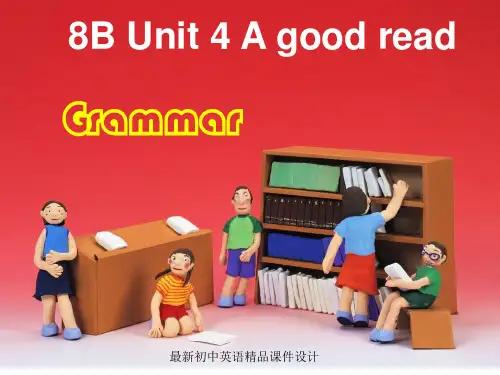
最新初中英语精品课件设计
选词填空:
how which what when where
1. When I go into the clothes shop, I
man.
Gulliver found out ___w_h_a_t_t_o_d_o____ with the tiny man.
(5) Gulliver decided when he should leave Lilliput.
Gulliver decided __w_h_e_n__to__le_a_v_e___should leave
Lilliput.
最新初中英语精品课件设计
which to read where to find
how to travel
最新初中英语精品课件设计
when to hand in
what to write about
who to ask for
最新初中英语精品课件设计
翻译句子
1.我不知道如何解决这个问题. I ___d_o_n_’_t_k_n_o_w__h_o_w__to__s_o_lv_e__th_i_s_p_r_o.blem 2.汤姆不知道该和谁玩. Tom__d_o_e_s_n_’t_k_n_o_w__w_h_o__t_o_p_l_a_y_w_i_th_____. 3.我忘了下一步该做什么. I forgot _w__h_a_t _to__d_o_n_e_x_t______________. 4.我们还没决定在哪儿见面. We haven’t __d_e_c_id_e_d__w_h_e_r_e_t_o_m__e_e_t____. 5.请告诉我何时开班会. Please tell me ____________________________.
牛津译林版初中英语八年级英语下Unit4 A good read grammar教案+课件
8B Unit 4 A good readGrammarTeaching aimsBy the end of this lesson, students are expected to1.activate their imagination on Gulliver’s voyage to Lilliput;e the model verbs must and have to correctly;3.grasp how to use the structure “question words + to-infinitives”;4.be more aware of the importance of reading.Teaching proceduresStep 1 Preparation1. Watch a video about Gulliver’s voyage to Lilliput.2. Have a free talk on the video.(The purpose is to arouse students’ interest and be familiar with the new teacher.) Step 2 Presentation and PracticePart A---the use of model verbs must and have to1. Present the background information.2. Learn the grammar point through the king’s words and Gulliver’s diary.3. Have a conclusion.4. Do exercises as a consolidation.Part B---the use of the structure “question words + to infinitives”5. Present the background information.6. Introduce the grammar point through Gulliver’s diary.7. Instruct students to learn the grammar point by themselves.8. Do exercises as a consolidation.(The purpose is to have students grasp the use of the two grammar points in situations, and reinforce the usage through different forms of activities.)Step 3 Production1. Present the background information.2. Discuss the thank-you letter in groups, using the grammar points learnt previously.(The purpose is to encourage students to practice using the grammar points learnt previously.)Step 4 Progress1. Discuss the importance of reading.(The purpose is to have students be more aware of the importance of reading.) Homework1. Find one more novel in English you are interested in and enjoy it.Thank you!。
牛津译林版英语八下Unit 4《A good read》(Grammar 2)课件
Grandma is ill. She has to see the doctor.
She doesn’t have to worry about herself.
Unit 4 A good read
Grammar 2
We use must when the speaker feels that something is necessary.
Gulliver was tied to the ground. So he must run away. He mustn’t lie on the ground.
return the books on time, if you want to
keep them longer, you have to renew them.
6. You don’t have to bring your student card every time you
go to the library, but remember to bring your library car.
2. You
keep quiet in the library. keep the books clean and tidy.
3. You mustn’t draw or write in the books.
4. You mustn’t eat or drink in the library.
5. You have to
Get the students to make up new sentences using “have to”.
牛津译林版英语八下Unit 4《A good read》(Grammar)教学设计

牛津译林版英语八下Unit 4《A good read》(Grammar)教学设计一. 教材分析《A good read》是人教版牛津译林英语八年级下的一个单元,主题是关于书籍和阅读。
本课的主要内容是通过介绍两本书的评价,让学生学会如何使用过去时态和现在时态描述事件的顺序。
教材中包含了丰富的阅读材料,有助于提高学生的阅读兴趣和阅读能力。
二. 学情分析学生在学习这个单元前,已经掌握了动词的过去式和现在式的变化规则,同时也具备了一定的阅读理解能力。
但学生在阅读长篇文章时,可能会遇到生词和难句,影响阅读理解。
因此,在教学过程中,需要帮助学生克服这些困难,提高他们的阅读能力。
三. 教学目标1.知识目标:学生能够正确使用过去时态和现在时态描述事件的顺序。
2.能力目标:学生能够读懂文章,提高阅读理解能力。
3.情感目标:激发学生对阅读的兴趣,培养良好的阅读习惯。
四. 教学重难点1.重点:学生能够正确使用过去时态和现在时态描述事件的顺序。
2.难点:学生能够读懂文章,提高阅读理解能力。
五. 教学方法1.任务型教学法:通过完成各种任务,激发学生的学习兴趣,提高学生的参与度。
2.互动式教学法:教师与学生,学生与学生之间的互动,促进知识的传递和能力的培养。
3.情境教学法:创设情境,让学生在真实的环境中学习,提高学生的应用能力。
六. 教学准备1.教师准备:准备好教材、多媒体教具、教学卡片等教学资源。
2.学生准备:学生提前预习课文,了解文章大意。
七. 教学过程1.导入(5分钟)教师通过提问方式引导学生谈论他们喜欢的书籍和阅读体验,激发学生的学习兴趣。
2.呈现(10分钟)教师通过多媒体展示两本书的评价,让学生听懂并理解文章的内容。
3.操练(15分钟)学生分角色朗读文章,模仿文章中的评价语言。
教师引导学生运用过去时态和现在时态描述事件的顺序。
4.巩固(10分钟)学生分组讨论,总结文章的主旨大意,并用自己的话进行表达。
教师巡回指导,纠正学生的错误。
牛津译林版八年级下册Unit 4《A good read》(grammar)课件1

1. I’m going on a field trip but I haven’t decided ______. (2007河南) A. what to do B. to do what C. where to go D. to go where 2. Excuse me. Would you please tell me ______ buy a digital camera? (2007安徽) A. what to B. where to C. what I can D. where can I
3. must 还可以表示肯定猜测,意思是 “一定” 。否定的猜测是can’t。 e.g. You must be hungry after all that walking. 走了那么远的路,你一定饿了吧。 That can’t be Lucy. She has gone to American. 那肯定不是Lucy,她已经去了美国。
Group discussion 3
They are discussing which color to paint the walls. You can ask your parents how much money to take with you.
结论3:
有些疑问词,如what, which, whose, how many, how much等,其后可以先接一个名词,再接动词不定式 。
列动词的宾语后,即双宾语。
Group discussion 2
× Suzy will explain why to recommend
this book. √ Suzy will explain why she recommend this book.
2021年牛津译林版八年级英语下册《Unit 4 A good read Grammar》精品课件
We must know how to operate the machine. 我们必须弄懂如何操作这机器。
We want to learn how to write plays. 我们想要学习如何写剧本。
To learn to use must and have to
语法讲解建议采用归纳法,如尽 可能多的呈现一些相关例句,或 可让学生从已学课文中找相应例 句,引导学生试着从所观察到的 语言现象中总结出语言规则和语 法规律。
Look at the following sentences.
1. Some dogs just don’t know how to have fun. (七年级上册 U4)
学科网
Words and phrases review
hand hand in and so on review return on time
renew
vi. 交;递,给 上交,递交 ……等等 n. 评论 vt. 归还 准时 vt. 续借;更新;重新开始
To learn to use question words + toinfinitives
5. He has a bad cold, Mr. Williams, so he
must stay in bed for a week. (新概念1 L61)
6. Eddie, I think we have to go up again. (七年级下册 U4)
7. We don’t have to feed her much. (七年级下册 U8)
Guess
Fill in the blanks.
牛津译林版八年级Unit 4 A good read(Grammar)课件(19张)
Did he have to do it? = Must he do it? 他得 做那件事吗? 而且在否定句中, have to 表不需要,
must 表不允许:
You don‘t have to go
there. 你不需要去那儿。
You mustn’t go there?
你不可去那儿。
have to 用法
1. Have you decided what to do with these books, Hobo? (P48)
2. I did not know what to say either. (P51)
3. “I must run away from them,” I thought, but I did not know how to get away. (P51)
Discussion
What rules must we obey when we’re in the library?
must must mustn’t mustn’t
must don’t have to
have to
Work in groups
Work out some class rules using must, must not, have to and do not have to.
light a fire?
—— No, we ___, because things here are easy to catch fire.
A. won’t D. needn’t
B. can’t C. mustn’t
5.-----Look, it__c_______ be Mr. Wang.
Words and phrases review
英语优秀课件牛津译林版八年级下册英语Unit4-A good read(Grammar)课件 (共31张PPT)
4.They should learn English well
English should be learned well by them.
New lesson
1.我已经被选为这次义演得主持人。
I have been chosen to be the host of a charity show.
2. 上个月,那些男孩被照顾得很好。 Those boys were looked after well last month.
Revision
一般过去时的被动语态: 主语+was/were + 过去分词
Exercise more
They
built the tall building last year.
1.Tom明天将打扫房子。 Tom will clean the house tomorrow.
The house will be cleaned by Tom tomorrow.
New lesson
2. 工作10 finished in ten days.
The tall building was built by them last year.
He
took good care of his little brother yesterday.
We
His little brother was taken good care of by him yesterday.
2. Mr. Dong has repaired 10 bicycles.
10 bicycles has been repaired. 3. We have seen that film a few times. That film has been seen by us a few times.
牛津译林版八年级英语下册Unit4 A good read Grammar课课件
GrammarⅠ
Read the following sentences
1. Some dogs just don’t know how to have fun. (七年级上册 )U4
2. Have you decided what to do with these books, Hobo? (八年级下册 ) P48
讨4论. :如结这论何些逃短语跑是由疑哪问两词部+分动构词成不的定?式
总体目标:学会正确使用“疑问词+动词不定式 ” (To learn to use question words + to-infinitives)
目标分解 1. 掌握 “疑问词+ 动词不定式 ” 的结构 2. 探究 “疑问词+ 动词不定式 ”在句子中使用的三种情况
1.Suzy was not sure who to ask for help.
2.Are you clear when to meet at the gate tomorrow?
助记:动词+宾语+疑问词+动词不定式 直接宾语
这样的动词还有:advice, decide,discuss,know, find out,wonder,think,learn,say…
问他们老师何时 交作业
1.The students asked their teacher _w_h_e_n__to__h_a_n_d__in__their homework.
1.带多少钱 how much money to take
2.买多少书 how many books to take
which book to choose