
人教新目标九年级全册Unit8SectionB2a-2e
What is one of the greatest mysteries of Stonehenge? Why?
2c Read the article again and complete the chart.
Mysteries about Stonehenge
Q: How many visitors does Stonehenge receive every year?
Why do people go to Stonehenge in June?
Task 2 Read Para. 2 and finish the form.
For many years, historians believed Stonehenge was a temple where ancient leaders tried to communicate with the gods. However, historian Paul Stoker thinks this can’t be true because Stonehenge was built so many centuries ago. “ The leaders arrived in England much later, ” he points out.
人教新目标九年级全册 Unit8SectionB2a-2e
2020/9/12
2a
Match each linking word or phrase with its purpose.
Linking word or phrase
Purpose of linking word or phrase
so
expressing a difference
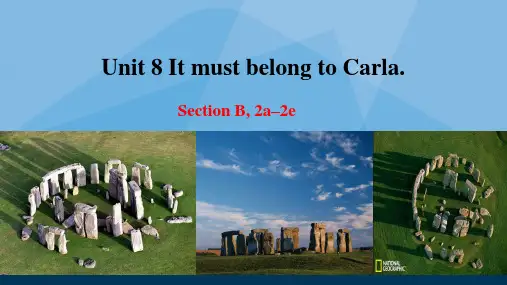
Do you know the name of this place? Where is Stonehenge? Who built Stonehenge?
2b Read the article below and underline the linking words or phrases. Do you think you have made correct matches in 2a?
What Stonehenge might have been used for…
Who built it?
as a temple where ancient leaders tried ed with the gods
for?/ Why was it built? a kind of calendar
Task 1 Read Para. 1 and answer the questions.
Stonehenge, a rock circle, is not only one of Britain’s most of famous historical places but also one of its greatest mysteries. Every year it receives more than 750,000 visitors. People like to go to this place especially in June as they want to see the sun rising on the longest day of the year.
as, because, since
givi勇n于g开a始c,h才o能i找ce到成
but, however, though exp功re的s路sing a result
not only ... but also
or when, while
expressing two things happening at the same time giving reasons adding information
1.Stonehenge might be _a__k_in_d__o_f_c_a_l_e_n_d_a_r.___.
2.Other people believe _t_h_e_s_t_o_n_e_s_h_a_v_e_a__m__ed__ic_a_l_p_u_r_p_o_s_e___.
3.The position of the stones must be for _a_s_p_e_c_ia_l_p__u_r_p_o_se___. Some think it might be _a_b_u_r_i_a_l_p_l_a_ce____ or a place to _h_o_n_o_r_a_n__ce_s_t_o_r_s. Others think it was built to _c_e_l_e_b_r_a_te__a_v_i_c_to_r_y__o_v_e_r_a_n__en__em__y___________
How was it built?
have a medical purpose
might be a burial place or a place to honor ancestors
celebrate a victory over an enemy
Complete the sentences using the 2d words from the chart in 2a on page
Task 4 Read Para. 4 and answer the questions.
Stonehenge was built slowly over a long period of time. Most historians believe it must be almost 5,000 years old. One of the greatest mysteries is how it was built because the stones are so big and heavy. In 2001, a group of English volunteers tried to build another Stonehenge, but they couldn’t. “ We don’t really know who built Stonehenge, ” says Paul Stoker. “ And perhaps we might never know, but we do know they must have been hardworking – and great planners! ”
Another popular idea is that Stonehenge might be a kind of calendar. The large stones were put together in a certain way. On midsummer’s morning, the sun shines directly into the center of the stones. Other people believe the stones have a medical purpose. They think the stones can prevent illness and keep people healthy. “ As you walk there, you can feel the energy from your feet move up your body, ” said one visitor. No one is sure what Stonehenge was used for, but most might be a burial place or a place to honor ancestors. Others think it was built to celebrate a victory over an enemy.
Historians
Historian Paul Stoker
opinions believed
thinks _th__is_c_a_n_’_t_b_e__t_r_ue
Stonehenge was because
_a__te_m__p_l_e_____ ____________________
Task 3 Read Para. 3 and finish the sentences.
62.
1.Midsummer’s morning is in June _s_o______ a lot of people go to Stonehenge during this month.
2. The sun shines straight into the center of Stonehenge __b_e_c_a_u_s_e____ the stones were put in a special position.
英语人教版九年级全册U8 Section B(2a-2e)

新目标九年级英语Unit 8 It must belong to Carla SectionB 2a-2e一、教学目标1. 了解巨石阵的相关知识。
2. 掌握一定的阅读技巧,提高阅读能力。
3. 掌握本节课的重点词汇和重要句型。
4. 拓展知识面,放眼看世界。
二、学情分析初三的学生虽然在英语语言方面已经有了一定的基础,但对于英国文化却知之甚少,很多同学对巨石阵都闻所未闻,所以需要教师补充文化背景。
巨石阵对学生来说既遥远又神秘,能勾起学生强烈的好奇心和探索欲,相信学生会有一番紧张而刺激的探索之旅。
三、重点难点1.情态动词表示推测。
2.连词的用法。
四、教学过程第一学时教学活动Ⅰ.ReviewFill in the blanks with must or can.1. The boy who is playing football on the playground _____ be Harry. He doesn’t come to school today.2. There ________ be someone in the classroom because the light is on.3. Many people go to Sanya to travel. It ____ be a beautiful place.4. You _____________ talk with each other during the exam, or you will be asked to leave.根据汉语意思和括号中的英文提示完成句子。
1. 她一定有二十多岁了。
(must be)She must be over / more than twenty years old.2.那双鞋不可能是我姐姐的,因为她不喜欢红色。
(can’t be)That pair of shoes can’t be my sister’s because she doesn’t like red.Ⅱ.Pre-readingLead- inPay attention to the use of linking words.1. It was snowing, and so I could not go out.2. As I am very tired, I am going to bed.3. I study because I want to learn.4. Since it is late, I shall go home now.5. The watch was cheap, but it goes quite well.6. We all tried our best. However, we lost the game.7. Though the task was difficult, they managed to finish it on time.8. We must not only finish our task but also do it well.9. You can go by air or by train.10. I was reading a magazine when he came in.11. While Mary was writing a letter, the children were playing outside.Do 2aPlay a video of the Stonehenge .Ask students some questions about it to see how much they know about it.Watch the video, and talk about the places in the video.Ⅲ.Fast- readingSkim the article and underline the sentences with linking words or phrases.not only … but also, as,however, because,As, but, or,because, but, And, but, andRead the article again and answer the questions.1. How many people visit Stonehenge every year?2. Who is Paul Stocker?3. Do people think it hard to build Stonehenge? Why?Read the passage quickly and answer these two questions.Ⅳ.After readingRead the article again and complete the chart.Do 2c.Complete the sentences using the words from the chart in 2a. Do 2d.Thinking and discussing.Play a video of the historical places in the world that have great mysteries. Watch the video and then discuss them..Ⅴ.SummaryPhrases and language points.Ⅵ.Homework.。
英语人教版九年级全册Unit8 SectionB 2a-2e
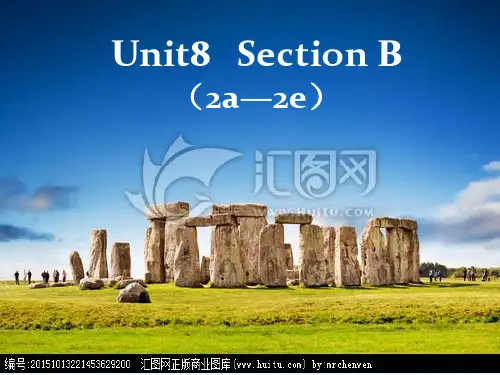
Stonehenge
• 在英国伦敦西南100多千米的索巨石阵又称索尔兹 伯里石环、环状列石、太阳神庙、史前石桌、斯 通亨治石栏、斯托肯立石圈等名,是欧洲著名的 史前时代文化神庙遗址,位于英格兰威尔特郡索 尔兹伯里平原,约建于公元前4000~2000年 (2008年3月至4月,英国考古学家研究发现,巨 石阵的比较准确的建造年代在公元前2300年左右) 尔兹伯里平原上,一些巍峨巨石呈环形屹立在绿 色的旷野间,这就是英伦三岛最著名、最神秘的 史前遗迹—巨石阵。
2b Read the article below and underline the
linking words and phrase.
Paragraph 1: • Stonehenge, a rock circle, is not only one of Britain’s
most famous historical places but also one of its greatest mysteries. • People like to go to this place especially in June as they want to see the sun rising on the longest day of the year.
• In 2001, a group of English volunteers tired to build another Stonehenge, but they couldn’t.
• “We don’t really know who built Stonehenge,” says Paul Stoker. “And perhaps we might never know, but we do know they must have been hard-working– and great planners!”
九年级英语全一册(人教版)Unit8第四课时SectionB2a2e教学设计
一、教学目标
(一)知识与技能
在本章节的学习中,学生将掌握以下知识与技能:
1.能够理解并熟练运用Section B 2a-2e中的重点词汇和短语,如“concentration”, “distraction”, “multitasking”, “prioritize”等,提高英语词汇运用能力。
(五)总结归纳
1.回顾课堂:对本节课的重点词汇、短语、语法进行回顾,让学生复述学习内容。
2.知识梳理:总结阅读技巧,引导学生认识到学习习惯对学习的重要性。
3.情感态度:强调学习态度和合作精神的重要性,鼓励学生在日常学习中积极改进学习习惯。
五、作业布置
为了巩固本节课的学习内容,培养学生的自主学习能力,特布置以下作业:
3.汇报成果:每组派一名代表汇报讨论成果,其他小组成员可进行补充。
(四)课堂练习
1.阅读理解:让学生完成Section B 2a-2e的阅读练习,检测学生对文章内容的理解程度。
2.口语练习:设置情景,让学生运用所学词汇和语法进行口语表达,如讨论学习习惯的优缺点。
3.课后作业:布置相关的书面作业,巩固所学知识。
2.语法讲解:通过例句和练习,让学生掌握一般现在时和一般过去时的用法,强调在学习习惯描述中的应用。
3.阅读技巧:引导学生关注文章结构,分析作者观点,教授如何通过阅读理解文章。
(三)学生小组讨论
1.分组活动:将学生分成若干小组,每组选择一个学习习惯进行讨论。
2.讨论话题:如“Multitasking: Good or Bad for Study?”,让学生发表自己的观点,并给出理由。
1.书面作业:
初中英语九年级 Unit 8 Section B (2a-2e)教学设计
初中英语九年级 Unit 8 Section B (2a-2e)教学设计一. 教材分析本课选取的是人教版初中英语九年级Unit 8 Section B (2a-2e)的内容。
这部分主要包括两部分:2a的阅读文本和2b-2e的听力内容。
本节课的主要话题是关于环境保护,通过阅读和听力材料的学习,让学生了解环境保护的重要性,提高他们的环保意识。
教材内容丰富,贴近学生生活实际,有利于激发学生的学习兴趣。
二. 学情分析九年级的学生已经具备了一定的英语基础,能够理解和运用简单的英语进行交流。
但是,对于一些较复杂的环保相关的词汇和表达,可能还需要进一步的学习和掌握。
此外,学生的阅读和听力能力参差不齐,因此在教学过程中需要针对不同层次的学生进行有针对性的指导。
三. 教学目标1.知识目标:学生能够掌握本课的生词和短语,理解文章的大意,能够正确运用一般现在时进行表达。
2.能力目标:通过阅读和听力活动,提高学生的阅读和听力能力,培养他们的环保意识。
3.情感目标:学生能够意识到环境保护的重要性,自觉地在日常生活中做到环保。
四. 教学重难点1.重点:学生能够掌握本课的生词和短语,理解文章的大意,能够正确运用一般现在时进行表达。
2.难点:对于一些较复杂的环保相关的词汇和表达的理解和运用,以及学生阅读和听力能力的提高。
五. 教学方法1.任务型教学法:通过设计各种任务,让学生在完成任务的过程中学习和运用英语。
2.情境教学法:通过设置环保相关的情境,让学生在实际情境中学习和运用英语。
3.小组合作学习:通过小组讨论和合作,提高学生的学习效果。
六. 教学准备1.教学课件:制作课件,包括文本、图片、音频等,以便于教学的顺利进行。
2.教学资源:准备相关的环保资料,以便于拓展教学内容。
3.教学设备:准备投影仪、电脑等教学设备,以便于教学的进行。
七. 教学过程1.导入(5分钟)通过向学生展示一些环保的图片,如污染的河流、砍伐的树木等,引导学生思考环境保护的重要性,激发他们的学习兴趣。
人教版九年级英语全册Unit8SectionB(2a~2e)教学设计
(一)导入新课
1.教学活动设计:
教师通过展示一组著名运动员的照片,如篮球运动员姚明、足球运动员梅西等,引发学生对成功人士的好奇心。随后,教师提问:“Do you know these famous athletes? Can you describe their achievements?”,让学生尝试用英语描述这些运动员的成就。
2.教学目的:
培养学生的合作学习能力,提高学生的口语表达能力。
3.教学步骤:
(1)教师给出讨论话题,明确讨论要求。
(2)学生分组讨论,运用所学时态和词汇描述成功人士的成就。
(3)各小组展示讨论成果,其他小组给予评价和反馈。
(四)课堂练习
1.教学活动设计:
教师设计一系列练习题,包括选择题、填空题、句型转换等,让学生巩固所学知识。
2.教学目的:
通过图片展示和问题引导,激发学生对本节课话题的兴趣,为新课的学习做好铺垫。
3.教学步骤:
(1)展示图片,提问并引导学生回答。
(2)鼓励学生分享自己了解的成功人士及其成就。
(3)导入新课,告知学生本节课将学习一篇关于成功人士的文章。
(二)讲授新知
1.教学活动设计:
教师引导学生阅读课文,通过讲解课文中的重点词汇、短语和句型,让学生掌握一般过去时和现在完成时的用法。
2.教学目的:
通过课堂练习,帮助学生巩固一般过去时和现在完成时的用法,提高学生的语言运用能力。
3.教学步骤:
(1)教师发放练习题,学生独立完成。
(2)教师选取部分题目进行讲解,分析解题思路。
(3)学生互相检查练习答案,讨论并解决问题。
(五)总结归纳
1.教学活动设计:
教师引导学生回顾本节课所学内容,总结一般过去时和现在完成时的用法,以及如何描述成功人士的成就。
人教版新目标九年级英语全册Unit 8 Section B 2a-2e 课件
not only … but also…
Para 2-3What was Stonehenge used for?
giving_r_ea_s_o_n_s__
ethxipnrgiedsseshiaanspgptewnoing supporting ideas
_a_t_e_tmh_ep__lsea_m__e__ti_m_e_ cgoivmimngunai_cc_aht_oe_iwc_ei_t_h the gods
Para.1givGinegneral introduction of Stonehenge
reasons
receive_m__or_e_th_a_n_7_50_,_00_0___ visitors
as ?
Visitor?
People like to go in _J_u_n_e___ see the sun __r_is_in__g_____
calendar
because it directly related to the sun
a medical purpose
prevent illness and keep people healthy
a burial place or a place to honor ancestors
was built to celebrate a victory over an enemy
1. What is Stonehenge? 2. When was it built? 3. Who built it ?
history n. 历史 historic adj. 具有历史意义的 historical adj. 有关历史的
historian n. ? 历史学家
人教版英语九年级全册Unit8SectionB(2a~2e)说课稿
(四)总结反馈
在总结反馈阶段,我将采取以下措施:
1.引导学生自我评价:让学生回顾本节课所学内容,分享自己的学习收获和不足;
2.同伴互评:组织学生相互评价,提出改进意见,促进共同进步;
3.教师评价:针对学生的表现,给予积极的评价和鼓励,指出需要改进的地方,并提供具体建议。
人教版英语九年级全册Unit8SectionB(2a~2e)说课稿
一、教材分析
(一)内容概述
本节课为人教版英语九年级全册Unit 8 Section B(2a~2e)的内容。在整个课程体系中,本单元主要围绕“过去的故事”这一主题展开,使学生通过学习英语故事,了解并掌握过去时态的用法。本节课作为单元的重点部分,旨在帮助学生深入理解故事内容,提高他们的英语阅读和表达能力。
1.部分学生对过去时态的运用不够熟练,可能在学习过程中产生混淆;
2.口语表达能力较弱的学生在角色扮演等活动中的参与度可能不高;
3.课堂时间有限,可能无法充分照顾到每个学生的学习需求。
为应对这些问题,我将:
1.对学生进行个别辅导,针对性地解答他们的疑问;
2.鼓励学生积极参与,提高口语表达能力;
3.合理安排课堂时间,确保教学活动的高效进行。
(五)作业布置
课后作业布置如下:
1.复习本节课所学词汇和句型,做好课后练习;
2.完成一篇以过去时态为主的短文写作,题目自拟;
3.预习下一节课的内容,提前了解相关背景知识。
作业的目的是巩固所学知识,提高学生的英语运用能力,培养他们的自主学习习惯,并为下一节课的学习做好准备。
五、板书设计与教学反思
(一)板书设计
(3)互评互改:学生相互评价、修改口语表达,提高合作能力和自我评价能力。
人教版英语九年级全册Unit8SectionB(2a~2e)教学设计
4.教学支持:
-针对学习困难的学生,提供额外的辅导和帮助,确保每个学生都能跟上教学进度。
-创设支持性的学习环境,鼓励学生积极参与,勇于尝试,不怕犯错误。
-定期与家长沟通,反馈学生的学习进展,争取家长的配合和支持。
四、教学内容与过程
(一)导入新课
1.教师以提问方式引导学生回顾上一课的内容,如:“Can you remember what we learned last class? What’s your favorite food?”通过这个问题,激发学生的兴趣,同时复习过去学过的知识。
2.教师展示一张制作食物的图片,并提出问题:“Do you know how to make this food?”让学生预测本节课的内容,激发学生的好奇心。
2.学生能够理解并运用一般现在时和现在进行时描述制作食物的过程。
3.学生能够通过阅读食谱,掌握食物制作的基本步骤,并能按照步骤进行实际操作。
4.学生能够在听力活动中,提高获取关键信息的能力,如听力材料中的数字、顺序、步骤等。
5.学生能够运用所学知识,编写一篇关于制作某种食物的简短文章。
(二)过程与方法
(二)教学设想
1.针对重点内容的教授:
-词汇学习:通过实物展示、角色扮演、词汇卡片游戏等多种形式,帮助学生记忆和运用新词汇。
-语法讲解:设计真实的语境,如模拟制作食物的场景,让学生在实际操作中学习并运用一般现在时和现在进行时。
-能力培养:通过听力练习,如听食谱步骤并排序,提高学生对关键信息的捕捉和处理能力。
2.难点的突破:
-口语表达:组织小组活动,让学生在小组内模拟制作食物的过程,并进行角色对话,以提高口语表达能力。
人教版英语九年级全册Unit8 SectionB(2a-2e)优质课教案
Unit8 SectionB(2a-2e)优质课教案教材分析:本单元的话题(topic)是神秘事件(Mysteries),要求学生能根据相关信息正确运用must, might, could, 和can’t进行推断。
SectionA部分主要围绕“推测物品的归属展开”,并进一步引入“神秘事件”这一话题。
SectionB部分内容通过对疑似外星人事件的讨论逐步过渡到对巨石阵的介绍,语言输入量较大。
这篇关于巨石阵的说明文涉及了英国文化以及一些含有连接词的复杂句子,需要引导学生在上下文语境中体会语言表达的确切含义。
学情分析:九年级学生已经有了一定的英语基础,听说读写的能力都比较强。
该班学生对SectionA部分的知识掌握情况较好,所以本节课将进一步巩固和拓展情态动词表推测的用法以及连词的正确应用。
但是学生对于长难文章的阅读能力一般,本堂课就此情况对学生加以技巧的指导,有针对性地提高学生英语阅读水平。
教学设计思路:本节课,一条主线,三个环节。
本节课贯穿的主线是“未解之谜”。
首先,通过观看视频,学生会了解这个介绍世界未解之谜的节目Discovery,接着设计了一个比赛活动,激起学生参与课堂活动的兴趣。
本节课的环节主要分为三个环节,每一个环节在设置了相应的学习活动。
Step one-Talk about the mysterious thing趣味猜测,引人入胜。
Step two- Walk into the mysterious place预测文章,泛读精读,环环相扣。
Step three-Know about the mysterious world 给学生充分展示自我的舞台,同时培养了学生的探索精神。
Teaching aims:During and after this class, the students should be able to1. Get relative information while reading, such as the detail of a passage.2. Make inferences by using must, might, could and can’t.3. Know the usage of some new words:mystery, historian, midsummer, burial, honor, ancestor.4. Know the usage of linking word or phrases.Teaching focus & difficulties:1. Get relative information while reading.2. Identify conjunctions or phrases that link ideas together while reading.Teaching strategies:Students will achieve the aims of1. Making prediction from the pictures and title.2. Using conjunctions or linking phrases correctly.Learning strategies:1. Working individually2. Cooperating in groupsTeaching procedures:Step One -- Talk about the mysterious thing★Activity1 Guess what it might be.★Activity2 Guess what might happen after that.Ask the students to guess the things by using must/ might/ could/ can’t [Explanation] 紧扣本单元话题“Mysteries”,及功能“Make inferences”复习情态动词must/ might/ could/ can’t的用法。
Unit 8 (Section B 2a-2e)九年级英语全一册(人教新目标Go For It!)
because the stones are so big and heavy. In 2001, a group of English volunteers
Tips: find something in common!
How many parts can we divide the passage into?
General introduction of Stonehenge
Different ideas about the purposes of Stonehenge
I think it was a temple.
It was built to celebrate
a victory over an enemy
Stones have a medical purpose. They can prevent illness
and keep healthy.
It might be a place
Historians have different ideas about Stonehenge.
More mysteries about Stonehenge
General introduction of Stonehenge
Skimming
Part 1 (para 1) Part 2 (para 2 & 3) Part 3 (para 4)
your feet climb up your body,” said one visitor. No one is sure what Stonehenge was used for, but most agree that the position of the stones must be for a special purpose. Some think it might be a burial place, or a place to honor ancestors. Others think it was built to celebrate a victory over an enemy.