
牛津译林版初中《英语》七年级下册Unit4 Grammar教学设计
牛津译林版初中《英语》七年级下册Unit4 Grammar教学设计
一、教学分析
1. 教学内容分析。
本节课教学内容选自译林版初中《英语》七年级下册Unit4中的Grammar板块。语法板块主要是针对本单元出现的语言现象进行归纳与总结,通过练习与活动帮助学生了解并掌握语法规则,有助于学生进行与本单元话题相关的语言的输出。
本单元的中心话题Finding your way,讨论的是在旅行过程中如何辨别方位、根据地图识路以及为别人指路。本课时的中心任务是结合本单元话题,创设真实语境,引导学生对冠词和方位介词的用法进行总结与运用。
2. 学生分析。
本节课授课对象为七年级学生。经过小学的英语学习,学生已具备一定的听、说、读、写能力。本节课的语法现象对学生而言并不陌生,但要在一节课内进行冠词和方位介词两个语法点的学习,内容偏多,想要完成并非易事。
3. 教学目标。
针对上述教学内容与学生学情的分析,设定如下教学目标:
(1)知识目标:学生能够掌握冠词以及方位介词的基本用法;
学生能够理解本课时的重点词汇与短语,如across、inside、outside等。
(2)能力目标:学生能够根据具体语境,使用正确的冠词来描述事物;运用方位介词来表达物体的位置。
(3)学习策略目标:学生能够通过同桌讨论、小组合作的方式,归纳冠词和方位介词的部分语法规则,提高主探究学习的能力。
(4)情感态度目标:学生能够在情景的辅助下,学会帮助他人,与他人分享快乐。
二、教学过程
Step1:Lead-in
教师向学生问好,询问学生今年去哪里春游的,通过向学生展示红山动物园
的照片来引出话题,A trip to the zoo。
[设计意图]
通过谈论学生熟悉的话题,轻松自然地导入与学生课外生活相关的话题,化解了学生的紧张情绪,调动了学生的学习积极性。同时,导出生詞与词组,引出含有冠词的句子,让学生进一步感悟定冠词和不定冠词在具体情景下的运用,为后面的语法学习做好铺垫。
Step2:Presentation
(1)教师创设情境Daniel与Millie参加了春游并拍摄了许多动物的照片,要求学生两人一组进行选择照片进行对话练习。
(2)在对话练习之后,教师提问:When do we use “a/an” or “the”? 让学生通过头脑风暴,归纳出定冠词与不定冠词的语法规则。
[设计意图]
本环节创设情境,让学生在真实的交际语境中进行练习。利用对话,使学生逐步加深对目标语法点的感知;利用头脑风暴,让学生进行观察、思考与分析,寻找规则,最终进行归纳与总结,加深了对语法规则的印象,培养了学生自主探究学习的能力。
Step2:Practice
教师继续围绕A trip to the zoo的话题,向学生布置课本练习进行操练,落实语法知识的掌握。
[设计意图]
在习得冠词的用法之后,创设情境,设置对话练习,使学生能够在对话和交际的过程中,针对定冠词和不定冠词的使用进行操练,检测学生对新的语法点的理解和运用能力。
Step3:Production
教师延续话题---春游后,Daniel还想约上朋友去市镇中心游玩,他正和朋友浏览地图,讨论游玩地点。教师通过一篇文章设置两项任务。任务1 T:Simon finds
a map of his town. Look at part of the map and complete what he says to Daniel with
a, an or the on your worksheet.任务2 :Retell the passage with the preposition
phrases.
[设计意图]
此环节采取任务驱动法,教师通过第一个任务---补全短文,让学生在情境中巩固语法所学,是对知识的运用与输出。而第二个任务则将本课的两个独立的语法点在设置的情境中过度,从而进入下一个语法点——地点介词的教学。
Step4:Presentation
教师设置Daniel在公园中寻找Eddie的情境,向学生提问---Where is Eddie?
学生使用“Is Eddie …?”的句型进行已学方位介词的操练。通过图片和情境来理解几组方位介词的区别,如:inside-outside、above-below、over-under等。
[设计意图]
本环节创设了Finding dogs的情境,引入了学生比较熟悉的实物,进行方位介词的学习。使抽象的语法形成了直观的表象,有助于学生更好地学习、理解和记忆。
Step5:Practice
教师设置游戏,要求学生使用方位介词向同学们描述自己好友的座位位置。其他学生通过该学生的描述,来推测出其好友是谁,猜对者给予奖励。
[设计意图]
教师设计游戏环节,在游戏中渗透语法知识的练习与使用,使学生在操练的过程中充分感知方位介词在实际生活中的运用,从而让学生掌握语法知识,同时也激发了学习英语的兴趣。
Step6:Production
教师紧扣A trip to the park的话题,给出Daniel与好友在公园玩耍的照片,要求学生帮助Daniel使用本节课学习的冠词和方位介词的语法知识,给他的笔友写一封信,描述照片内容。
[设计意图]
本环节是新授两个语法知识的语言输出阶段,也是检测教学效果的重要环节。教师为学生提供贴近真实生活的图片资料来创设情境,开展写作活动,检测学生对两个语法知识的综合运能力。
三、教学反思
本节课针对语法教学的特点和学生的认知规律,在教学设计上采取了“3P”教学法(Presentation-Practice-Production)进行教学。课堂活动由导入、呈现、
操练、成果等环节构成,结构完整,衔接自然,由浅入深,环环相扣。整节课设置了同一话题,一条主线贯穿语法教学。在教学的每一个环节都创设了贴近生活的情境,让学生能够自然地感悟语法意义。在设置练习时,教师利用语篇,展开多种形式的语法训练。在最后的成果展示环节,教师通过开展写作活动,强化了语法的实际运用。整个教学设计符合学生的认知规律,取得了较好的教学效果。
本节课也存在许多不足之处,如两个语法知识的教学使得课堂容量太大,最后的写作环节略显仓促,不能在课堂上进行及时地评价与成果展示。
2020-2021学年牛津译林版英语七年级下册随堂练习 Unit 4 grammar

I try, I insist, I succeed. 我努力,我坚持,我成功。 1 牛津译林版7年级下册随堂练习7BU4 grammar
一、单词默写。
(树、菜) 叶 n._____; (pl.) ______
东北方 ., _______________
桥 n. ________________ 穿过,横过 vt. ________________
笼子,岛笼 n. ________________
在…对面;穿过,横过 _______ 在…里面 prep._____________
在…外面 prep. _____________
在…上面
prep. _____________
leaf leaves cross inside northeast cage outside bridge across over
二、词组默写。
1.它正躺在草地上。
2.多么可爱!
3.一只小熊猫宝宝
4.看起来像它的母亲
5.在一片敞开的区域
6.在一个非常大的笼子里
7.半个小时以后
8.过桥(两种)
9.坐在长椅上聊天
10.在左边,一只鸟正在一棵树上唱歌。
在右边,两个男孩正坐在另一棵树下。
11.在商店的前面/后面
12.在教室的前部
13.在商店的里面/外面
14.在饮料的上面/在食物的下面
15.那指示牌在长椅的(垂直)上方。
I try, I insist, I succeed. 我努力,我坚持,我成功。 2 16.在长椅的下面
17.在你我之间
18.坐在桌子旁
19.跳过椅子
20.河上有一座桥。
It's lying on the grass.
How cute (it is)!
a baby panda
look like its mother
in an open area
in a very large cage
2020年牛津译林版七年级英语下册Unit4 Grammar 导学案
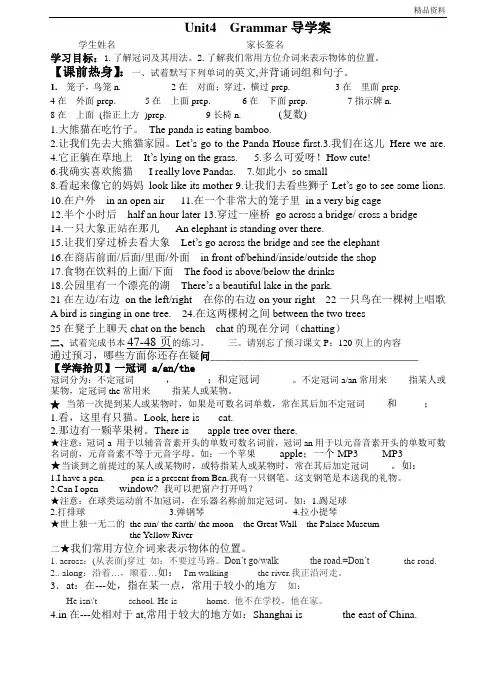
精品资料
Unit4 Grammar导学案
学生姓名____________________ 家长签名___________________
学习目标:1.了解冠词及其用法。2.了解我们常用方位介词来表示物体的位置。
【课前热身】:一、试着默写下列单词的英文,并背诵词组和句子。
1. 笼子,鸟笼n. _________2在---对面;穿过,横过prep. ________3在---里面prep. ________
4在---外面prep. _____5在---上面prep. _____ 6在---下面prep. _______7指示牌n. _________
8在---上面 (指正上方 )prep. _______9长椅n._______(复数)_________
1.大熊猫在吃竹子。 The panda is eating bamboo.
2.让我们先去大熊猫家园。Let’s go to the Panda House first.3.我们在这儿 Here we are.
4.它正躺在草地上 It’s lying on the grass. 5.多么可爱呀!How cute!
6.我确实喜欢熊猫 I really love Pandas. 7.如此小 so small
8.看起来像它的妈妈 look like its mother 9.让我们去看些狮子Let’s go to see some lions.
10.在户外 in an open air 11.在一个非常大的笼子里 in a very big cage
12.半个小时后 half an hour later 13.穿过一座桥 go across a bridge/ cross a bridge
14.一只大象正站在那儿 An elephant is standing over there.
译林版英语七年级下册教学教案Unit 4 Grammar

7B Unit 4 Finding your way
设计题目 7B Unit 4 grammar
教学内容 A. Using a, an and the B. Prepositions of place
教学对象 The seventh grade students
教学目标 教学目标:
1.能掌握冠词的用法。
2.能运用方位介词来表达物体的位置。
教学策略 1. Revise articles and prepositions of place.
2. Use them correctly.
教学过程(可续页)
教学步骤 所
用
时
间 教 师 活 动 学 生 活 动 设计说明
Step1: Lead in
Step2.
Presentation
Step3 practice.
Step 4 Summary
Step5
Presentation
Step6 practice
2 min
2 min
12min
2 min
2 min
12 min
3 min
10 min
T: Hi, boys and girls, today we are
going to talk about some things in
the classroom.
Look at the pictures, practice:
practice it orally, then do some
exercises.
Review the prepositions of place in
the classroom.
Get the students to use the
prepositions of place to practice,
then do some exercises.
Practice
What’s this?
It’s a book.
Whose book is it?
It’s …’s.
译林版七年级英语下册Unit 4 Grammar (2)教案

总 课 题 7B Unit 4 Finding your way 总课时 7 第4课时
课 题 Grammar 课型 New
教学目标 能掌握冠词的用法
能运用方位介词来表达物体的位置
教学重点 了解常用语言形式的基本结构和常用表意功能
教学难点 初步掌握描述时间,地点,方位的表达方式
教学准备 Tape recorder, Computer, Pictures Read the words and the text.
教学方法 Listening 、reading、acting& Discussing
教学过程
教学环节 教 师 活 动 学 生 活 动 备 注
Pre—task:
While—task:
A Using a, an and the
Step Ⅰ Free talk
1. What’s this?
It’s a book.
Whose book is it?
It’s…’s.
Write the sentences on the blackboard: It’s a
book. The book is…’s.
2. Make sentences
eg: This is an apple. The apple is big and red.
Step ⅡPresentation
We use a or an when we mention a person or
thing for the first time. We use the before a noun
when the person or thing is mentioned again, or
when we are talking about a specific person or
thing.
Show some pictures and ask students to say
something about the pictures:
牛津译林版英语七年级上Unit8 Grammar教学设计
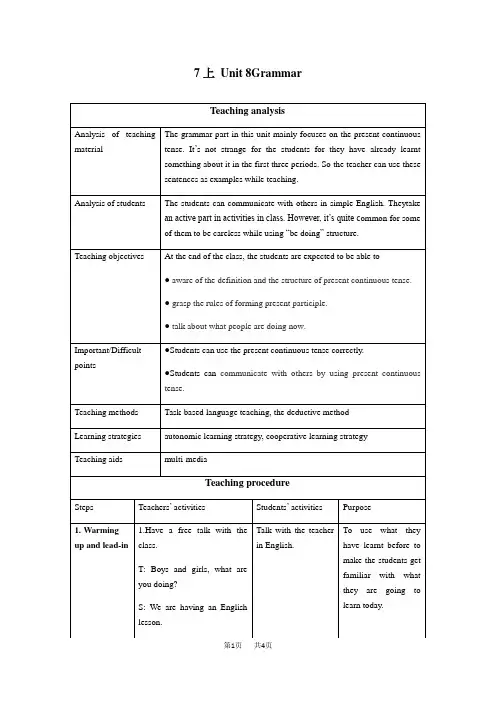
第1页 共4页 7上 Unit 8Grammar
Teaching analysis
Analysis of teaching
material The grammar part in this unit mainly focuses on the present continuous
tense. It’s not strange for the students for they have already learnt
something about it in the first three periods. So the teacher can use these
sentences as examples while teaching.
Analysis of students The students can communicate with others in simple English. Theytake
an active part in activities in class. However, it’s quite common for some
of them to be careless while using “be doing” structure.
Teaching objectives At the end of the class, the students are expected to be able to
● aware of the definition and the structure of present continuous tense.
● grasp the rules of forming present participle.
● talk about what people are doing now.
Important/Difficult
牛津译林版七年级英语下册7B Unit4 Grammar课时作业(含答案)
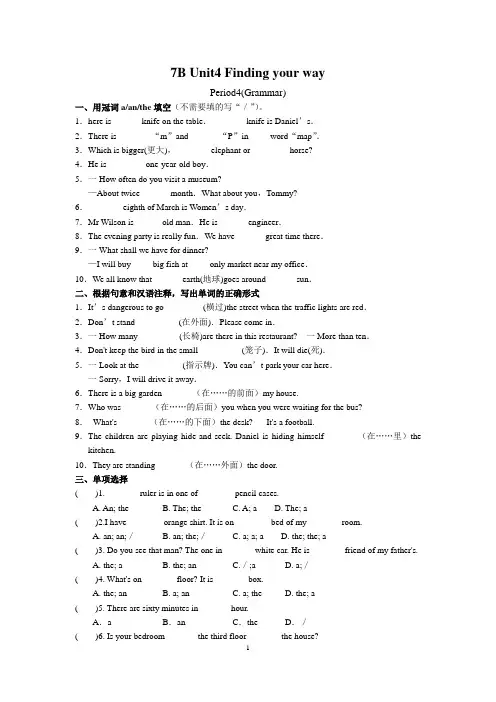
1
7B Unit4 Finding your way
Period4(Grammar)
一、用冠词a/an/the填空(不需要填的写“/”)。
1.here is_______knife on the table.________knife is Daniel’s.
2.There is________“m”and_______“P”in_____word“map”.
3.Which is bigger(更大),________elephant or_________horse?
4.He is_________one-year-old boy.
5.一How often do you visit a museum?
—About twice_______month.What about you,Tommy?
6.________eighth of March is Women’s day.
7.Mr Wilson is ______old man.He is_______engineer.
8.The evening party is really fun.We have_______great time there.
9.一What shall we have for dinner?
—I will buy_____big fish at_____only market near my office.
10.We all know that_______earth(地球)goes around_______sun.
二、根据句意和汉语注释,写出单词的正确形式
1.It’s dangerous to go_________(横过)the street when the traffic lights are red.
2.Don’t stand__________(在外面).Please come in.
牛津译林版英语七年级下册Unit2 Grammar练习
7B Unit2 Grammar
一、单词过关练习。
1. My computer is __________ (坏的). Can you help me fix it?
2. Kitty is good at drawing. She wants to be an ___________( 艺术家) in the
future.
3. He is the ___________(经理) of the company. Many people work for him.
4. She is __________( 幸运的 ) enough to win the singing match.
5. Mary lives six floors _____________ ( 下面 ) Wendy. She lives on the fourth
floor.
6. He can speak English ___________ ( 更好 ) than I .
7. We can get enough ______________( 信息 ) for our studies on the Internet.
8. Simon is looking at some ___________ ( 通告 ) at the community centre now.
9. My ___________ ( 年纪较长的 ) sister is a worker in the post office. But I am
still a student.
10. – Excuse me, how can I get to the train __________ ( 站 )?
– Walk along this street , and you will find it in front of you.
11. There are six floors in this building. My __________( 办公室 ) is on the third
Unit4 Grammar教案 牛津译林版初中英语七年级上册
Unit 4 My day
Grammar教案(一)
I. Teaching aims and learning objectives
By the end of the lesson, students should be able to:
1. use prepositions to talk about time correctly;
2. use the adverbs of frequency correctly;
3. grasp the usage of “how often”;
4. use these items of grammar to talk about their daily life. II. Teaching contents
1. New words and expressions: would, would like, life, all the best, roller skating
2. New structure: How often do they exercise?
III. Focus of the lesson and predicted area of difficulty
1. Know better about some usages of the prepositions of time;
2. Tell the difference between “how often” and “how many times”.
IV. Teaching procedures
A. Prepositions of time
Step 1 Presentation
1. Find out the expressions which should be put after “in/on/at” one by one.
2. Read the expressions together.
译林版英语七年级下册教学课件Unit 5 第4课时 Grammar
Unit 5 Amazing things
Grammar
学习目标:
了解掌握行为动词过去式的构成,了解一般过去时的结构和用法
根据情境正确使用一般过去时谈论过去的事件
学习重难点:
了解掌握行为动词过去式的构成,了解一般过去时的结构和用法
了解掌握行为动词过去式的构成,识记动词过去式
重点语法:一般过去时(I)
一. 一般过去时的结构
行为动词过去时的否定句和一般疑问句是如何构成的呢?
否定句:______+动词原形…, did not = ___________
一般疑问句:_______+ (主语)+动词原形…?
Yes,主语+_______ /No,主语+_______
二、一般过去时的用法:
a. 表示过去的动作或状态,常和明确的过去时间状语连用,如:yesterday, last week, three days ago, in 1998等,或与由when引导的从句。
e.g. I saw him yesterday.
She bought the bike two years ago.
He was there just now.
Where did you live when you were young?
b. 也可以表示过去某一段时间内经常或反复出现的动作。句子中常带有every day, often, usually, always,
sometimes 等时间状语。
如:When I studied in the university, I read aloud every morning.
In the past few years I usually went touring during my summer vocations. 在过去的几年里,每逢暑假我总是出去旅游。
c. 也可以用“used to +动词原形”表示过去经常或反复的动作。
牛津译林版英语七下Unit 2《Neighbours》(Grammar)教学设计
牛津译林版英语七下Unit 2《Neighbours》(Grammar)教学设计
一. 教材分析
牛津译林版英语七下Unit 2《Neighbours》主要讨论了与邻居相关的日常交流情景。通过本单元的学习,学生将掌握如何描述邻居的特点、交流邻居之间的互动以及表达自己对邻居的看法。本单元的核心语法是现在进行时态,用于描述正在进行的动作或状态。此外,学生还需熟悉和掌握一些与邻居相关的词汇和表达方式。
二. 学情分析
七年级的学生已经具备了一定的英语基础,能够听、说、读、写一些简单的英语句子。但他们在使用现在进行时态和描述邻居特点方面可能存在一定的困难。因此,在教学过程中,需要关注学生的个体差异,有针对性地进行教学。
三. 教学目标
1. 知识目标:
– 掌握现在进行时态的用法;
– 学会描述邻居的特点和交流邻居之间的互动;
– 学会表达自己对邻居的看法。
2. 能力目标:
– 能够熟练运用现在进行时态进行日常交流;
– 提高听力、口语、阅读和写作能力;
– 培养合作意识和团队精神。
3. 情感目标:
– 增强对英语学习的兴趣;
– 学会尊重和理解他人,培养良好的邻里关系。
四. 教学重难点
• 现在进行时态的用法;
• 描述邻居特点和交流邻居之间的互动;
• 表达自己对邻居的看法。
• 现在进行时态的运用; • 准确描述邻居特点和交流邻居之间的互动。
五. 教学方法
1. 情境教学法:通过设定真实的邻里场景,让学生在实际语境中学习和运用英语;
2. 交际教学法:鼓励学生进行角色扮演,模拟邻里之间的交流,提高口语表达能力;
3. 任务型教学法:通过完成小组任务,培养学生合作意识和团队精神;
4. 反馈与激励:及时给予学生反馈,鼓励学生积极参与课堂活动。
六. 教学准备
1. 教材:牛津译林版英语七下Unit 2《Neighbours》;
2. 多媒体课件:图片、视频、音频等教学资源;
3. 学习任务单:用于引导学生进行小组讨论和任务完成;