
初中英语九年级上册(牛津译林版)Unit2Grammar优秀教学案例
初中英语九年级上册(牛津译林版)Unit2Grammar优秀教学案例
一、案例背景
在初中英语九年级上册(牛津译林版)的教学过程中,Unit 2 Grammar部分的内容对于学生来说是一个重要的语言知识点。本章节主要围绕情态动词的用法,特别是“can”、“may”和“must”在表达能力、请求许可和推测时的运用。为了提高学生的学习兴趣,强化语法知识在实际语境中的应用,本教学案例将采用任务型教学法,结合生活情境,让学生在实际的语言实践中掌握语法规则。通过小组合作、角色扮演等多样化的教学活动,培养学生们的交际能力,提高他们用英语解决问题的综合素质。在此基础上,鼓励学生关注社会热点问题,学以致用,使语法学习变得生动有趣,提高英语学科的核心素养。
二、教学目标
(一)知识与技能
1. 知识层面:学生能理解和掌握情态动词“can”、“may”和“must”的用法,了解它们在不同语境下的词义和功能。通过本章节的学习,使学生在已有知识的基础上,进一步拓展和巩固语法知识。
2. 技能层面:培养学生运用所学情态动词进行表达能力、请求许可和表达推测的口语和书面表达能力。使学生在实际语境中,能够熟练运用这些语法知识进行有效沟通。
(二)过程与方法
1. 过程层面:采用任务型教学法,引导学生通过观察、分析、实践等环节,自主探究和合作交流,完成一系列与情态动词相关的学习任务。同时,关注学生的学习过程,关注个体差异,给予每个学生个性化的指导。
2. 方法层面:运用情景教学、角色扮演、小组讨论等多种教学方法,激发学生的学习兴趣,提高课堂参与度。此外,鼓励学生利用现代信息技术,如网络资源、在线学习平台等,拓宽学习渠道,提高学习效率。
(三)情感态度与价值观
1. 情感层面:通过本章节的学习,培养学生积极的学习态度,增强他们对英语学习的自信心。使学生在合作学习的过程中,学会尊重他人,培养团队精神。
2. 价值观层面:引导学生关注社会热点问题,学会用英语表达自己的观点和看法。通过讨论与情态动词相关的真实案例,帮助学生树立正确的价值观,培养他们的社会责任感和公民素养。
三、教学策略
(一)情景创设
为了让学生更好地理解和运用情态动词,我将创设丰富多样的情景,让学生在真实语境中感知、体验和运用目标语法。通过播放与情态动词相关的英语视频、讲述生活故事、展示漫画等形式,激发学生的兴趣和好奇心。同时,鼓励学生结合自身经历,创设个性化的情景,使语法学习更加贴近生活,提高学生的语言表达能力。
(二)问题导向
以问题为导向的教学策略,能够激发学生的思考,培养他们独立解决问题的能力。在本章节的教学中,我将设计一系列有关情态动词的问题,引导学生通过观察、分析、实践等途径寻找答案。问题设计要具有层次性和挑战性,让学生在解决问题的过程中,逐步掌握语法知识,提高英语思维品质。
(三)小组合作 小组合作学习有助于培养学生的团队精神和交际能力。在教学过程中,我将根据学生的性格、能力和兴趣,合理分组,确保每个学生都能在小组中发挥自己的优势。针对情态动词的学习,设计各种小组活动,如角色扮演、话题讨论、语法接龙等,让学生在互动交流中,共同提高语法水平。
(四)反思与评价
1. 反思:引导学生对学习过程进行自我反思,总结自己在情态动词学习中的优点和不足。通过反思,让学生认识到自己的学习方法和策略,以便在今后的学习中做出调整。
2. 评价:采用多元化评价方式,包括自评、互评、小组评价和教师评价。关注学生在学习过程中的表现,注重评价的激励性和指导性。在评价中,关注学生的个体差异,充分挖掘每个学生的潜能,提高他们的自信心。
四、教学内容与过程
(一)导入新课
在导入新课的环节,我将利用多媒体展示一组与学生生活密切相关的图片,如学生在图书馆看书、在教室讨论问题等,图片中包含情态动词“can”、“may”和“must”的使用场景。通过观察图片,引导学生思考并尝试用英语描述图片内容,从而自然引出本节课的主题——情态动词的用法。这样的导入方式既能激发学生的学习兴趣,又能让他们在轻松愉快的氛围中进入学习状态。
(二)讲授新知
在讲授新知环节,我会结合课本内容,详细讲解情态动词“can”、“may”和“must”的用法。通过例句、图表、互动问答等形式,让学生明确这三个情态动词在表达能力、请求许可和推测等方面的用法。同时,注重引导学生发现语法规则,提高他们的观察力和归纳能力。
1. 能力表达:以“can”为例,展示一些日常生活中的能力表达句子,如“I can swim.”,并邀请学生用“can”表达自己的能力,让学生在实际运用中掌握“can”的用法。
2. 请求许可:通过创设情境,教授“may”在请求许可时的用法,如“Can I go to the bathroom,
please?”,并组织学生进行角色扮演,练习使用“may”。
3. 推测:以“must”为例,讲解其在表达推测时的用法,如“He must be in the classroom now.”,引导学生学会用“must”进行合理推测。
(三)学生小组讨论
在学生小组讨论环节,我会根据学生的能力、兴趣和性格,合理分组。针对情态动词的用法,设计一系列小组讨论活动,如:
1. 小组内用情态动词创编小对话,展示生活中的实际场景。
2. 小组讨论:比较“can”、“may”和“must”在用法上的异同,总结规律。
3. 小组竞赛:设计一些关于情态动词的选择题、填空题,检验学生对语法知识的掌握程度。
(四)总结归纳
在总结归纳环节,我将邀请学生分享自己在讨论中的收获,对情态动词的用法进行梳理和总结。通过师生互动,共同归纳出情态动词“can”、“may”和“must”的用法规律,加深学生对语法知识的理解。
(五)作业小结
为了巩固本节课的学习成果,我设计了以下作业:
1. 结合课堂所学,用情态动词编写一段小对话,描述自己在学校的一天。
2. 完成课后练习册上关于情态动词的练习题,加强对语法知识的巩固。
3. 搜集生活中使用情态动词的例子,下节课与同学分享。
五、案例亮点
1. 任务型教学法的运用 本教学案例采用任务型教学法,将情态动词的学习与学生的实际生活相结合,设计了一系列富有挑战性和趣味性的学习任务。这种教学方法有助于激发学生的学习兴趣,提高他们的参与度和积极性,使学生在完成任务的过程中自然地掌握语法知识。
2. 真实语境的创设
案例中,通过创设丰富多样的真实语境,让学生在实际的语言环境中感知、体验和运用情态动词。这种方式有助于提高学生的语言表达能力,培养他们的英语思维品质,使语法学习更加生动有趣。
3. 小组合作与互动交流
本案例注重小组合作学习,通过小组讨论、角色扮演、小组竞赛等形式,促进学生之间的互动交流。这不仅有助于培养学生的团队精神和交际能力,还能让学生在合作中互相学习、共同提高。
4. 关注个体差异,实施个性化教学
在教学过程中,教师关注每个学生的个体差异,充分挖掘他们的潜能,给予个性化的指导。这种教学策略有助于提高学生的自信心,使他们在学习过程中获得成就感,从而更好地投入到英语学习中。
5. 多元化评价方式的运用
本案例采用多元化评价方式,包括自评、互评、小组评价和教师评价。这种评价方式不仅关注学生的学习成果,还注重学习过程,充分体现了评价的激励性和指导性。同时,多元化评价有助于学生从不同角度认识自己的优势和不足,促进他们的全面发展。
牛津译林版(新)英语九年级上册Unit 2 Colors Grammar 随堂练习

1
Unit 2 Colors Grammar 随堂练习
一、词组翻译
1. 去购物中心___________________
2. 在试衣室________________________
3. 似乎有个秘密_________________
4. 一个运动包______________________
5. 彩色的衣服___________________
6. 把它们涂成蓝色__________________
7. 不断做某事___________________
8. 奇怪的行为______________________
二、单词拼写
1. _________(慢跑) is good for our health.
2. I like to send__________(电子卡片) to my friends,on the Internet.
3. I don’t like eating__________(面条) very much.
4. Everyone was just not acting ________(通常) .
5. Maybe I should talk to someone about my friend’s strange________(举止) .
6. Our teacher asked us to keep a________ (日记) every day.
7. Has anybody told you that the color orange__________(代表) joy?
三、单项选择
( ) 1. 一Which color do you_______,red or black?
一Red,I think. Because it looks good _______me. 2
Unit 2 Grammar 牛津译林版英语九年级上册讲义 (含答案)
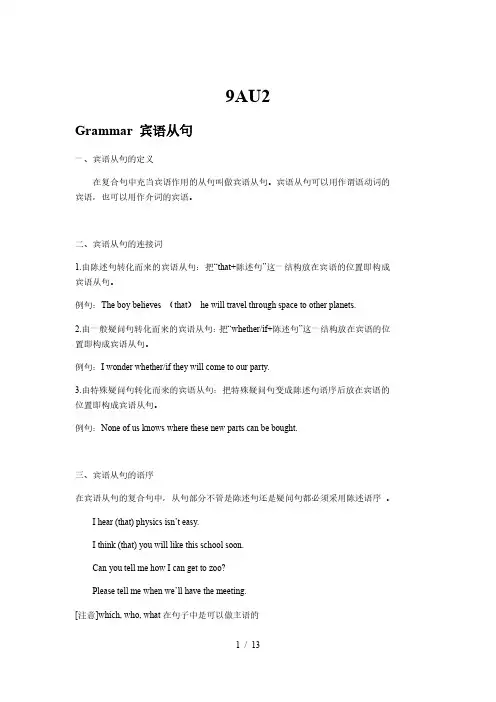
1 / 13 9AU2 Grammar 宾语从句 一、宾语从句的定义 在复合句中充当宾语作用的从句叫做宾语从句。宾语从句可以用作谓语动词的宾语,也可以用作介词的宾语。 二、宾语从句的连接词 1.由陈述句转化而来的宾语从句:把“that+陈述句”这一结构放在宾语的位置即构成宾语从句。 例句:The boy believes (that) he will travel through space to other planets. 2.由一般疑问句转化而来的宾语从句:把“whether/if+陈述句”这一结构放在宾语的位置即构成宾语从句。 例句:I wonder whether/if they will come to our party. 3.由特殊疑问句转化而来的宾语从句:把特殊疑问句变成陈述句语序后放在宾语的位置即构成宾语从句。 例句:None of us knows where these new parts can be bought. 三、宾语从句的语序 在宾语从句的复合句中,从句部分不管是陈述句还是疑问句都必须采用陈述语序 。 I hear (that) physics isn’t easy. I think (that) you will like this school soon. Can you tell me how I can get to zoo? Please tell me when we’ll have the meeting. [注意]which, who, what在句子中是可以做主语的 2 / 13 I wonder who is Tom’s English teacher. I don’t know what can be avoided. 四、宾语从句的时态 1. 如果主句的时态是一般现在时,宾语从句该用什么时态就用什么时态。 I don’t think (that) you are right. Please tell us where he is. Can you tell me how I can get to the railway station? 2. 如果主句的时态是一般过去时,宾语从句只能用相应的过去时态(一般过去时, 过去进行时, 过去将来时,过去完成时)。例如: He asked what time it was. He told me that he was preparing for the sports meet. He asked if you had written to Peter. He said that he would go back to the U.S. soon. 3. 如果宾语从句所陈述的是客观真理,其时态常用一般现在时。例如: Our teacher said that January is the first month of the year. Scientists have proved that the earth turns around the sun. 五、if和whether的区别 if/whether都可作宾语从句的引导词,意为“是否”,在一般情况下可以互换。if多用于口语和非正式文体中, whether则多用于比较正式的文体中。 只用whether的情况: 1)在带to的动词不定式前 I can't make up my mind whether to accept the job offer. 我还没下定决心是否要接受这份工作。 3 / 13 2) 在介词后 He was faced with the dilemma of whether or not to return to his country. 他面临着是否回国的艰难选择。 3) 直接与or not连用时 We're debating whether or not to go skiing this winter. 我们盘算着今年冬天是否去滑雪。 4) 在动词discuss后面的宾语从句中 Let's discuss whether we shall go by plane. 让我们讨论一下我们是否乘飞机去。 5) 宾语从句提前时只能用whether Whether this is true or not, I can’t say. 我不敢肯定这是不是真的。 6) 引导位于句首的主语从句或表语从句用whether Whether I believe you or not is irrelevant now. 我是否相信你,现在已无关紧要了。 六、if还是连词,意为“如果”,引导条件状语从句。 注意:if引导的条件状语从句,如果主句是一般将来时,从句从一般现在时表示一般将来时。 [经典例题] 1.(2020年四川遂宁) --- I wonder if Sally___________ us prepare for the party. ---I’m sure she will if she___________ time. A. helps, will have B. will help, has C. will help, will have D. helps, has 4 / 13 2.(2020年贵州黔西南州)Lisa is studying abroad. She hasn’t decided ________ back to China because of the COVID-19. A. if she flies B. whether she will fly C. when will she fly D. how will she fly 3.(2020年贵州铜仁)—Could you tell us________? —About 400 kilometers. A. How far it is from Tongren to Guiyang B. How far is it from Tongren to Guiyang C. How long it takes to get to Guiyang D. How long does it take to get to Guiyang 4.(2020年新疆建设兵团)—What did the shopkeeper say to you? — She asked me________. A. when does the shop close B. where did I see the style C. if I preferred that orange dress D. what else I will buy 5.(2020年重庆A卷)---Wow! The school uniforms can tell parents ______Cool! ---So the children won't get lost easily. A. where are their children B. where their children are C. what do their children study D. what their children study 答案:BBACB 6.(2020年山东滨州)---What will you remember most after leaving junior high school ? ---I will always remember _____. A.how my friends and teachers used to help me B.when did my friends and teachers arrive C.where could my friends and teachers meet D.what did the teachers say to me 7.(2020年江苏苏州)---Excuse me, could you tell me _____ ? 5 / 13 ---In five minutes. A.how soon will the film begin B.how soon the film will begin C.how long the film has been on D.how long has the film been on 8.(2020年四川成都) —Welcome back to school, Tim. I want to know ___________online. —Of course, Ms. Clark, I was hard-working. A. what you studied B. when you studied C. if you studied hard 9.(2020年四川达州)— Did you notice _________ in his office? — Yes, he was going over our homework. A. what Mr. Li was doing B. how was Mr. Li doing C. how Mr. Li was doing D. what Mr. Li is doing 10.(2020年安徽) — Could you tell me__________we can start a conversation with a foreigner? —Talking about weather is a good choice. A. how B. why C. where D. when 答案:ABCAA 11.(2020年哈尔滨)— Could you tell me ________? — There is nothing but some old model planes. A. what’s in the room B. what can you see in the room C. who in the room is 12.(2020年北京) —Do you know___________? —At 9:00 tomorrow morning. A.when the video meeting began B. when did the video meeting begin C.when the video meeting will begin 13.(2020年四川凉山)---You have got lots of masks. Could you please tell me 6 / 13 ___________? ---Sure. I bought them in a shop in the neighborhood a few days ago. A. when did you buy them B. where you bought them C. when will you buy them D. where you will buy them 14.(2020年江苏连云港)I have some tickets for the football match. I called my friends to see___________. A. where did they buy them B. why they liked to go there C. when did we go together D. whether they’d like to go 15.(2020年甘肃武威、张掖、酒泉、金昌、陇南)---Do you know______? ---Sorry,I've never had an e-book before.Why not read the instructions first? A.how can I turn the e-book on. B.how I can turn the e-book on C.where buy an e-book D.where I can buy an e-book 答案:ACBDB 16.(2020年黑龙江大庆)The school suggested the students pass on ________ they have learned to their parents. A. what B. that C. which D. where 17.(2020年江苏南京)Jenny just wondered ________ Angela already knew about the event. A. how soon B. how many C. how often D. how much 18.(2020年四川遂宁)--- I wonder if Sally___________ us prepare for the party. ---I’m sure she will if she___________ time. A. helps, will have B. will help, has C. will help, will have D. helps, has
九年级英语译林版上册Unit2_Grammar教学设计

牛津译林版英语九年级上册第4课时教学设计
课题 Colours 单元 Unit 2 学科 英语 年级 九年级
学习
目标 1.To learn about the object clause introduced by that, if and whether.
2.To know how to use the object clause introduced by that, if and whether
3.To develop the Ss’ interest in learning English.
重点 To learn about the object clause introduced by that, if and whether.
难点 To know how to use the object clause introduced by that, if and whether
教学过程
教学环节 教师活动 学生活动 设计意图
导入新课 Lead in
Let the Ss enjoy a poem about the object clause and
learn about the enjoy a poem about the object clause. Enjoy a poem
about the
object clause
and learn
about the
enjoy a poem
about the
object clause. 以诗歌方式导入新课,吸引学生注意力。
Let’s review
Let the Ss change the sentences into English.
Change the
sentences into
English. 复习上节课所学重点单词短语,巩固所学知识。
讲授新课 New words
Let the Ss learn new words through pictures. Learn new
牛津译林版九年级英语上册Unit2全章教案汇总

牛津译林版九年级英语上册Unit2全章教案汇总
Teaching period: The first period
Teaching content: Comic strip and welcome to the unit
Teaching objectives:
1.To recognize the names of different colors
2.To recognize the colors of the rainbow and the order of the colors
Teaching methods: Listening/ writing/ speaking/discussing
Teaching procedures:
Step I: Warming—up
1.Revise the knowledge of star signs ,and lead to this lesson.
2.Revise the colors we learnt.
Step II: Presentation
1.Tell the students that Eddie and Hobo are talking about colors, and listen to what they are
talking about and why he choose blue instead of pink.
2.Play the tape again and read after it .
3. Act it out in pairs.
Step III: Presentation
1.Ask students to raise their hands if they have ever seen a rainbow. Ask students to tell you
when a rainbow occurs.
牛津译林版九年级英语上册Unit 2 Grammar 示范课教案

1 / 3 Unit 2 Colours
Period 4 Grammar
一、教学内容分析
本节课是一节语法课。主要内容是学习that,if/whether引导的宾语从句的构成、意义与功能。
二、学情分析
通过前几课时的学习,学生已经接触到较多的类似“I think blue is better than pink. Some people believe
that colours can influence our moods.”这样的句子,也接触到了“I’m not sure if blue looks good on you. You
may wonder whether it is true.”这样的句子。学生能够理解上述句子的意思,但对于这些句子中包含的语法现象还缺乏细致的了解。同时学生已经掌握了较多的与颜色、情绪相关的词语,可以运用这些词语进行本部分的语法学习。
三、教学目标
通过本课时的学习,学生能够:
1. 感知并总结that,if/whether引导的宾语从句的构成规则。
2. 识别that,if/whether引导的宾语从句的意义。
3. 正确运用that,if/whether引导的宾语从句表达自己对颜色与情绪的关系的看法。
4. 通过运用宾语从句陈述事实、表达观点和疑问,形成自己对事物或观点的判断与评价。
四、教学重难点
【重点】
1. 感知并总结that,if /whether引导的宾语从句的构成规则。
2. 识别that,if /whether引导的宾语从句的意义。
【难点】
正确运用that,if/whether引导的宾语从句表达自己对颜色与情绪的关系的看法。
五、教学活动设计
环节一:自由谈论,激活已知。(5 mins)
回忆上节课所学表达,激活已知。
教学活动
1. Students recall the sentences they have learnt in 活动层次
XX年九年级上英语Unit2全单元导学案(牛津译林版)

XX年九年级上英语Unit2全单元导教案(牛津译林版)
1 / 33
XX年九年级上英语 Unit2 全单元导教案(牛津译林版)
本资料为 woRD 文档,请地点下载全文下载地点
9AUnit2 教课设计
教课单元课时安排
教课目的
任务设置
知识与技术
过程与方法
感情态度和价值观
达成状况
作业安排
Period1
.
掌握表示不一样颜色的词汇。
2. 认识彩虹的颜色以及它们的次序。“先学后教,当堂训练”模式 能够用英语讨论颜色
comicstrip &welcometotheunit
《当堂训练》
《课课练》
Period2 XX年九年级上英语Unit2全单元导教案(牛津译林版)
2 / 33
. 认识不一样颜色所代表的含义。
2. 认识并理解相关情绪的词汇“先学后教,当堂训练”模式认识颜色和情绪的关系
Reading1
《当堂训练》
《课课练》
Period3
. 学生能灵巧运用所学单词,短语和句型。
2. 掌握并背诵课文。“先学后教,当堂训练”模式 进一步稳固所学内容,温故而知新,内化语言知识,提
升实践能力。
Reading2
《当堂训练》
《课课练》
Period4
.
学会运用 that 指引的宾语从句。
2. 学会运用 if 或 whether 指引的宾语从句。“先学后教,当堂训练”模式 提升语言运用能力,增添语感。 XX年九年级上英语Unit2全单元导教案(牛津译林版)
3 / 33
Grammar《当堂训练》
《课课练》
Period5
. 学会从广告印刷品和电视采访中获取信息。
2 稳固读和听过程中获取的信息,确认事实。
3.学会征乞降供给建议并提出建议。
“先学后教,当堂训练”模式
学会陈说某种衣饰的优弊端以及颜色的作用。
Integratedskills
《当堂训练》
《课课练》
Period6
. 帮助学生认识寻读法
Unit1-Grammar教案牛津译林版九年级英语下册
Subject 牛津译林版九年级英语下册
9B Unit 1 Asia
Grammar
teaching
objectives After learning this period , the students should be able to
1. 用作代词;
2. 用作非人称代词;
3.用它来代替真实的主体或客体。
main
difficulty 学会正确使用“it”。
Contents and methods of teacher teaching activities Student
Activities Recovery
Step 1 Revision
Review the following sentences with “ it”
看熊猫,它好小。
另一个著名的景点是长城,它运行......
Look at the cute baby, it is a boy ,isn’t it?
小宝宝正在喝牛奶。
It weighs only 3 kilos.
——刚才是谁在叫你?
--It was my cousin.
游人喜欢乘船游览漓江。
It is a great fun.
Step 2 Working out the rules
We use it for animals and lifeless things
当我们不知道是男孩还是女孩时,我们将它用于年幼的孩子
我们用它来吸引人
We use it for an unknown person
Step 3 Practice
Do the exercise in Part A
Step 4学习将其用作非人称代词
现在是下午 6 点 30 分 雨下得很大。
在北京,天气很冷。
从这里到你的学校有2公里。
It is 6:30 p.m. It is raining heavily outside.
牛津译林版九年级英语下册同步备课unit4 grammar
Unit4 Grammar
一、教学目标
1. 正确熟练地运用从句和简单句。
2. 掌握简单句和复合句之间的转换。
二、教学内容
掌握词汇:aware, circle, agreement, distance, possibility, alien, stranger。
词组:as tasty as, remind of, how far, be away from, two earth years, circle around
the Sun. work hard, come true, be different from, try to do, be similar to, sign of, be
happy to do, indoor playground, the football field, the same as, hear from。
句型:
(1)People might float in space because of the low gravity.
(2)Humans cannot survive without food, water, or oxygen.
(3)The smell of the pills reminds them of the tasty food on the Earth.
(4)It takes Mars about two Earth years to circle around the Sun once.
(5)I wonder how many people would like to move to Mars.
(6)It is difficult to breathe on a planet that has much thinner air than that on the Earth.
三、重点难点
1. 正确熟练地运用从句和简单句。
牛津译林版英语九年级上教案Unit2教学设计2
《Unit2 Colours》教学设计
侍岭中心学校
课 题 Reading 1 主备人 陈雷 执教者 陈雷
课 型 New 课 时 2 授课时间
教学目标 1.了解不同颜色所代表的含义。
2.认识并理解有关情绪的词汇。
3.了解颜色和情绪的关系。
教学
要点 教学重点 了解颜色和情绪的关系。
教学难点 认识并理解有关情绪的词汇。
教学法指导 Task-based method
教具准备 CAI
集体智慧 个性设计 教学后记
一、自主定向
根据所给词的适当形式填空。
1. I find it easy _______ ( see ) a rainbow in the sky after the
heavy rain in summer .
2. I bought a _______ ( color ) dress just now .
3. Which coat do you want _____ ( wear ) , this one or that one ?
4. I think blue is ____ ( good ) than green . It’s the sky’s color .
5. The world will be a dull place ______ ( with ) colors .
6. I _______ just ______ ( see ) Millie at the school gate .
二、合作交流
Step 1 Presentation
Learn the new words un the word list by reading and spelling.
Step 2. Skimming. Read and answer the questions.
How many kinds of colours are talked about in the text?
牛津译林版九年级英语上册Unit2全单元教案
牛津译林版九年级英语上册
1 课题 Unit 2 Colours
课时 课型 主备人 审核
1 导入
教学
目标 1. To master the important words of this period.
2. Learn to differentiate colours and introduce colours of rainbow.
3. Moral aim is to love the colourful world.
教学
重点 To master the important words of this period.
教学难点 To talk about the colours.
教学过程 二次备课
Step 1 Free talk
1.What colours do you know? How many colours have we
learned? Let’s name them.
The names of the colours:
red; green; yellow; blue; orange; purple ;
white; black; brown; grey; pink; violet;
indigo
deep ( dark ) + color: deep blue; deep green; dark brown
light + color: light yellow; light blue; light green
bright / rich + color: bright/ rich red; bright / rich yellow
2.Which is your favourite colour? Why?
Step 2 Lead-in
Ask students to raise their hands if they have ever seen a