
牛津译林版8B Unit6 Sunshine for all welcome to the unit课件(共24张PPT)
Yes. Eddie is going to give Hobo some money 3.What does Hobo need Eddie to do? He needs Eddie to give him some more food.
Eddie: What are you doing? Hobo: I'm training to be a volunteer for the Olympic Games. train to do sth训练做某事 eg: The girl is training to be a nurse. Will you support me, Eddie? Eddie: Sure. It's meaningful to do something for the Olympics. It is + adj + to do sth It is not meaningful to wait here. Here you are. Hobo: No, I don't need money. I want you to help me. Eddie: How can I help you? Hobo: I need some more food to eat at work.
Olympics for disabled people
disabled people
blind
disabled people
disabled
disabled people
elderly
disabled people
poor
disabled people
deaf
disabled people
Eddie: What are you doing? Hobo: I'm training to be a volunteer for the Olympic Games. Will you support me, Eddie? Eddie: Sure. It's meaningful to do something for the Olympics. Here you are. Hobo: No, I don't need money. I want you to help me. Eddie: How can I help you? Hobo: I need some more food to eat at work.
1.接受训练成为
train to be ……
2.奥运会
3.在工作 4.当地政府
the Olympic Games
at work the local government
5.为……提供…… provide...for...
1.母亲教育我们为人要诚实。 Mother ___________________________ honest. trains us to be 2.他爷爷的耳朵已经聋了三年了。 His grandfather _________________ for 3 years. has been deaf 3.谁帮助那位盲人穿过马路的? Who helped the ____________________ the road? blind person cross 4.我还需要一些钱。 I need _____________money. some more 5.帮助残疾人是有意义的。 It's meaningful to help _______________. disabled people _________________ 6.我想让你帮助我学习英语。 want you to help them I ___________________________ with my English.
How can they help homeless people?
——They can give them food and clothes. They can also write to the local government.
A: What are ... people?
B: ....
A: How can we help ... people?
They are disabled, but they try their best to make their dreams come true! What brave men they are!
Olympic
athelete
volunteers
training
Will they take part in the Olympics?
1.What is Hobo doing? He is training to be a volunteer for the Olympic Games. 2.Will Eddie support Hobo? How?
B: We can ....
A: Are there any other ways to help them?
B: Yes. We can .../ I don&Appeal(倡议书)
We should give food and clothes to homeless people. We should learn to communicate with deaf people. ....
homeless
eg: A: How can we help homeless people? B: We can give them food and clothes.
Amy and Daniel are talking about people who need help.
Listen and answer the question:
牛津译林版8B Unit6 Sunshine for all Reading课件(共21张PPT)

from all over the world ,with different backgrounds /ˈbækgraʊnd/ 背景
have a chance to show their skills the world. What’s the aim( 目的 ) of the to game?
Choose T or F
T 1. Liu Ming was a volunteer for the 2007 Special
Olympics World Games. /ɪk‘spekt / 期望 F 2. Liu Ming knew what to expect before he became a volunteer.
similar
adults
support
success
Read para. 4 & 5, then answer questions
1. Is it great for volunteers to help athletes achieve their dreams? 2. What did Liu Ming do for the young boy?
F 3. There were only a few events in the 2007 Special
Olympics World Games.
T 4. There were over 40,000 volunteers for the 2007
Special Olympics World Games.
Read para. 2 & 3 , then fill in the blanks
They are an international sports festival for children and _______with intellectual disabilities. About Special The events are _______ to those Olympic in the Olympics. World Lots of volunteers provide Games _______ for the athletes and help make the Games a great _____________.
牛津译林版英语八年级下Unit 6 Sunshine for all单词,短语,句子默写(含答案)
1
用这种方式,他们能够帮组当地人改善生活。
In this way, they can help the local people improve their lives.
2
自从上个月起,他就住院了。
He has been ill in hospital since last month.
25
取得第四名
26
感到更加自信
27
因为
28
齐聚一堂
29
来自不同背景
30
感觉像一个大家庭中的一员
31
亲密地工作
32
实现某人的梦想
33
34
35
没有得到报酬
36
赢得第一名
37
举办
38
做某事是有趣的
39
对做某事感兴趣
40
给老人让座
41
捐钱给慈善机构
42
赢得比赛
43
一对一地做某人的工作
44
没有某人的帮助
45
有一些经验
46
一个大学生
a college student
47
中国西南
south-west China
48
一个志愿者项目
a volunteer project
49
在某人的日常生活中
in one's daily lives
50
采取行动保护环境
take action to protect the environment
4
必须的,必要的
necessary
5
任务,工作
task
6
教练
coach
牛津译林版英语八下Unit 6《Sunshine for all》单元教学设计
牛津译林版英语八下Unit 6《Sunshine for all》单元教学设计一. 教材分析牛津译林版英语八下Unit 6《Sunshine for all》以“阳光照耀所有人”为主题,通过介绍残疾人运动、教育、生活等方面的平等权利,让学生了解和关注弱势群体,培养他们的社会责任感和关爱他人的意识。
本单元包括两个阅读文本、一个听力文本和一个语法项目,内容丰富,贴近生活,具有很强的现实教育意义。
二. 学情分析八年级的学生已经具备了一定的英语基础,对日常生活话题有较好的认知。
但他们在语言表达、文化背景知识等方面还存在不足,需要通过教师的引导和启发,不断提高自己的综合语言运用能力。
此外,学生对弱势群体的关注程度不同,教师应充分利用教材内容,激发他们的同情心,培养关爱他人的品质。
三. 教学目标1.知识目标:学生能掌握本单元的重点词汇、句型和语法项目,正确运用所学知识进行交流。
2.能力目标:学生能提高阅读理解能力,听懂有关弱势群体的相关信息,并进行适当的口头和书面表达。
3.情感目标:学生能关注弱势群体,培养关爱他人、尊重平等的价值观。
四. 教学重难点1.重点:本单元的重点词汇、句型和语法项目。
2.难点:对文本内容的深入理解,以及对弱势群体的关注和关爱。
五. 教学方法1.任务型教学法:通过完成各种任务,激发学生的学习兴趣,提高他们的参与度。
2.情境教学法:创设真实情境,让学生在实际环境中运用所学知识。
3.情感教学法:引导学生关注弱势群体,培养他们的社会责任感和关爱他人的意识。
六. 教学准备1.教材:牛津译林版英语八下Unit 6《Sunshine for all》及相关教辅资料。
2.课件:根据教学内容设计的课件。
3.教学资源:有关弱势群体的图片、视频等。
七. 教学过程1.导入(5分钟)利用图片或视频引入弱势群体的话题,激发学生的兴趣,引导学生思考和讨论。
2.呈现(10分钟)呈现本节课的主题,让学生明确学习目标。
牛津译林版英语八年级下册Unit 6 Sunshine for all 课件(第1课时)
Unit 6
第一课时 Welcome to the unit
基础知识回顾
综合能力提升
-3-
Ⅲ.用方框中所给词的适当形式填空 support,home,meaning,able,elder 1.David goes to a special school for the disabled children. 2.We should try our best to help the elderly people in the old people’s home. 3.There are two homeless dogs in the street.We should take care of them. 4.It is meaningful to do something for the people in trouble. 5.Thank you for supporting me!
Homeless people don’t have their own places to live . 3.支持奥运会是一件有意义的事情。 It’s meaningful to support the Olympic Games. 4.对他们来说,和那些专业人员密切工作是很好的。 It is great for them to work closely with those professional workers. 5.我们将要开始帮助他们实现他们的梦想。 We will help them achieve their dreams.
C.teaches D.has taught
( D )7.We keep in touch
writing often.We enjoy
using this way to communicate with each other.
牛津译林版初中英语8B UUnit 6 Sunshine for all Welcome to the unit(共18张PPT)
1. Recite Comic strip and Part B. 2. Talk about the good ways of helping others. 3. Preview Reading.
a person who is old a person who has little money a person who can’t see a person who can’t hear a person who has no home a person who can't perform a certain action
Make a conversation
Pair work
A: What are blind (deaf ...) people?
B: Blind people can’t ….
A: How can we help them?
B: We can help them ....
A: Are there any other ways to help them?
peeolpdleerwlyho are
old
can't perform a
cedritsaainblaecdtion
hapveoolirttle money
hhavoemneolehsosme
cabnl’itnsdee
cadne’at fhear
Match and discuss
a blind person a homeless person a poor person a deaf person a disabled person an elderly person
takes out some mo_n__ey_ , Hobo says what he really needs is some
译林版英语8bunit6词组表
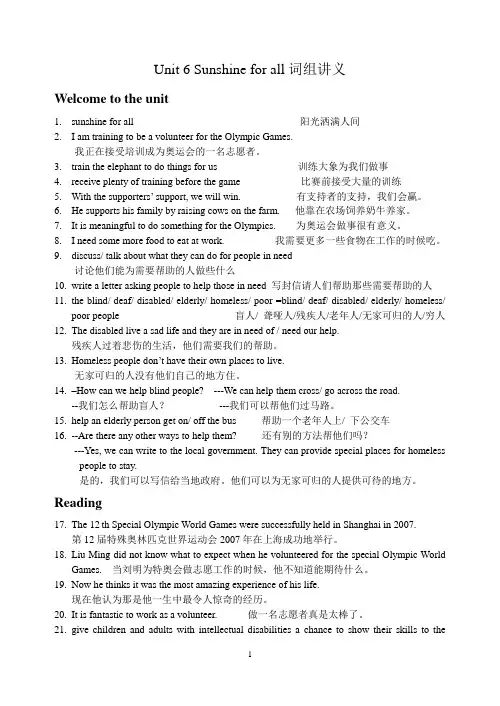
Unit 6 Sunshine for all词组讲义Welcome to the unit1.sunshine for all 阳光洒满人间2.I am training to be a volunteer for the Olympic Games.我正在接受培训成为奥运会的一名志愿者。
3.train the elephant to do things for us 训练大象为我们做事4.receive plenty of training before the game 比赛前接受大量的训练5.With the supporters’ support, we will win. 有支持者的支持,我们会赢。
6.He supports his family by raising cows on the farm. 他靠在农场饲养奶牛养家。
7.It is meaningful to do something for the Olympics. 为奥运会做事很有意义。
8.I need some more food to eat at work. 我需要更多一些食物在工作的时候吃。
9.discuss/ talk about what they can do for people in need讨论他们能为需要帮助的人做些什么10.write a letter asking people to help those in need 写封信请人们帮助那些需要帮助的人11.the blind/ deaf/ disabled/ elderly/ homeless/ poor =blind/ deaf/ disabled/ elderly/ homeless/poor people 盲人/ 聋哑人/残疾人/老年人/无家可归的人/穷人12.The disabled live a sad life and they are in need of / need our help.残疾人过着悲伤的生活,他们需要我们的帮助。
牛津译林版八年级英语下册Unit 6 Sunshine for allIntegrated skil
(6)E_n__g_li_sh__ and Maths teaches them (7) s_o_n_g_safter class gives them a lot of (8) _b_o_o_k_s_
What she thinks: meaningful to learn more about (9) t_h_e__p_o_o_r_a_r_e_a_s__ of China helpful to (10) _t_e_a_c_h__ the children there
Peter is writing about Judy and the village school in his diary. Help him complete his diary entry with the information in Parts A1 and A2.
My cousin Judy has taken part in a (1) __v_o_lu_n_t_e_e_r_p_r_o_j_e_c_t in her college. She works as a primary school (2) _te_a_c_h_e_r_ in North-west China for (3) o_n_e__y_e_a_r. The school is very (4) _sm__a_l_l . There are only (5) _si_x_c_l_a_s_sr_o_o_m__s_ in the school. Most of the students live (6) f_a_r_a_w__a_y__ and they have to walk for more than (7) _a_n__h_o_u_r_ to get to school.
牛津译林版8B英语Unit6 Sunshine for all Welcome课件
a poor person
a person who can’t see
a deaf person
a person who can’t hear
a disabled person an elderly person
a person who has no home a part of a person’s body
Amy and Daniel are talking about people who need help. Listen to the recording and answer the following question:
How can they help homeless people? Give them food and clothes. Write to the local government.
who need help. Write the correct words under them.
Never laugh at them! Help them cross the road. Help them go upstairs or downstairs. Raise money for them or donate things to them. Treat their eyes. Visit them often and make them happy. Do some housework for them. ......
B Work in pairs and talk about the people in Part A.
A: What are blind/deaf/disabled/elderly/ poor people?
牛津译林版英语八年级下册《Unit 6 Sunshine for all Welcome to th
牛津译林版英语八年级下册《Unit 6 Sunshine for all Welcome to the unit》教学设计7一. 教材分析本单元的主题是“阳光照耀所有人”,主要讲述了一个阳光男孩帮助一个盲人找到回家的路的故事。
通过本单元的学习,学生能够掌握一般过去时的被动语态,以及如何运用情态动词来表达可能性。
教材内容丰富,插图生动,有助于激发学生的学习兴趣。
二. 学情分析八年级的学生已经具备了一定的英语基础,对于一般过去时和情态动词有一定的了解。
但部分学生对被动语态的运用还不够熟练,需要通过大量的练习来提高。
此外,学生对于实际生活中的助人为乐的行为还有一定的了解,但对于如何在英语中表达这一概念可能还不够清晰。
三. 教学目标1.能够听懂、说出一般过去时的被动语态。
2.能够运用情态动词表达可能性。
3.能够理解并运用本单元所学词汇描述人物特征。
4.培养学生的同情心,鼓励他们在生活中助人为乐。
四. 教学重难点1.一般过去时的被动语态。
2.情态动词的运用。
3.如何用英语描述人物特征。
五. 教学方法1.任务型教学法:通过设定各种任务,让学生在实践中学习和运用语言。
2.情境教学法:通过设定生动的情境,让学生在真实的环境中学习英语。
3.交际法:鼓励学生积极参与课堂交际活动,提高他们的口语表达能力。
六. 教学准备1.PPT课件:制作与本单元主题相关的PPT课件,包括图片、视频等。
2.教材:牛津译林版英语八年级下册。
3.录音机:用于播放听力材料。
4.黑板:用于板书重点知识点。
七. 教学过程1.导入(5分钟)利用PPT展示一张阳光明媚的图片,引导学生谈论阳光。
然后引入本课主题“阳光照耀所有人”。
2.呈现(10分钟)播放课文动画视频,让学生初步感知故事内容。
之后,老师简要介绍课文情节,引导学生关注故事中的人物特征和情节发展。
3.操练(10分钟)让学生分组,根据课文内容进行角色扮演。
鼓励学生大胆开口,注意语音、语调的准确性。
牛津译林版八年级英语下册Unit6 Sunshine for all知识点
【知识建构】We use “ It’s + ____________________________”to express what we think about something. We use “ It’s + ____________________________”to specify who we are talking about.We use “ It’s + ____________________________”to express what we think of someone’s actions.1.Can you make sentences with “It is+形容词+to infinitive.” ?2.Can you make sentences with “It is+形容词+for …+ to infinitive.” ?3.Can you make sentences with “It is+形容词+of …+ to infinitive.”?【典例精讲】1. It’s kind __________you to give me a hand whenever I am in trouble.A. ofB. forC. toD. with本题考查两个句式的比较:It’s +adj. + for sb. to do sth 和It’s + adj. + of sb. to do sth。
重点关注for 和of的区别。
当句式中的adj修饰人的品格,个性时,常选用of;当句式中的adj. 修饰后面的不定式时,选用for。
句意:无论我何时有困难,你都给我帮助,你真好。
kind是修饰人,故选A。
2. It was really helpful___________him to take the cat to the animal centre_______ a rainy night.A. of; onB. of; atC. for; onD. for; at同上,helpful修饰人,排除C、D。