
仁爱版英语七年级上册知识点归纳总结(整理版)
仁爱版英语 上学期知识点汇总 ( 七年级上册 )
(包括重点句型、短语、知识点详解和重点语法 )
Unit 1 Making New Friends
【重点短语】
1.good morning/ afternoon / evening 早上 /下午 /晚上好
2.glad / nice to meet / see you 见到你很高兴
3.welcome to + 地点 欢迎来到 ……
4.let ’ s + v 让我们做 ……
5.stand up 起立
6.sit down 坐下
7.this is... 这是……
8.thanks = thank you 谢谢
9.see you = see you later = goodbye 再见
10.ID number 身份证号码
11.be from=come from 来自
12.in English 用英语
【重要句型】
1.---What’ s your name? ---My name is Sally.
2.---Where are you from? ---I ’ m from China.
---Where do you come from? ---I come from China.
3.---Where is he/ she from? ---He/She is from Japan.
4.---What’s this/ that in English? --- It ’ s a/ an …
5.---What’ re these/ those in English? ---They’re …
6.---How do you spell it? ---E-R-A-S-E-R, eraser.
7.---Can you spell it? ---Yes, M-A-P, map.
8.—How old are you/ is he/ are they?
— I ’ m/ He is/ They are eleven.9.—What’s your telephone number?
— It ’ s 4567967.10.— What class / grade are you in?— I ’m in Class Ten, Grade Seven.(注意大小写)
11.Good morning/ afternoon/ evening.
12.— Hello!/Hi! —Hello!/Hi!13.— Nice/Glad to see/meet you. — Nice/Glad to see/meet you, too.14.— Welcome to China/my home. —Thanks.15.— How do you do? —How do you do?16.— How are you? — Fine, thank you. And you? — I ’m OK.17.— See you then/ later. —See you.18.— Goodbye. —Bye.
19.— Thank you. —You’rewelcome. / That ’ s OK./Not at all.
【重点语法】
1.元音字母: Aa Ee Ii Oo Uu
包含有以下元音的字母:
[e] Aa Hh Jj Kk
[i:] Ee Bb Cc Dd Gg Pp Tt Vv
[aI] Ii Yy
[ju:] Uu Qq Ww
[e] Ff Ll Mm Nn Ss Xx Zz
2.大小写
句首字母,人名,地名,称呼语,专有名词,星期的首字母要大写,引人注意。
Look !Is that Jane?
He comes from Hubei, China.
Mr. Wang, this is my mom.
— What class are you in?
— I ’ m in Class Ten, Grade Seven.
On Sunday, we go to the West Hill for a picnic.
3.Be动词的用法
我用 am,你用 are,is 用于他、她、它,单数用 is,复数就用 are。
含 be动词的陈述句变否定句在 be 后加 not,变一般疑问句将 be 提前。
一般疑问句的肯定回答: Yes, 人称代词 + be;否定回答: No, 人称代词 +be + not。
如: ---They are teachers. ---They are not teachers.
---Are they teachers? ---Yes, they are./ No, they aren ’ t.
4.不定冠词、定冠词和 and 的用法
(1)不定冠词 a, an 的用法
a /an 都表示 “一,一个 ”,a 用在以辅音音素开头的单词前 ,如: a book; a desk; an 用
在以元音音素开头的单词前,如: an apple / an orange/ an English book;/ an English boy/ an
old man;/an actor/ an English teacher/ an office worker.
(2)the 是定冠词,表特指,单复数前面都可用
We are in the same class. The girl
in a pink skirt is Jane. Where is the
book?
This isn ’t my bike. The blue one is mine.
(3) and 的用法
数字相加看做单数: Two and three is five.
颜色相加也是单数 : Black and white is gray.
人和事物相加是复数: Lucy and Lily are sisters. The pen and the eraser are Jane ’s.
5.可数名词单数变复数
(1)规则变化
①一般在名词词尾加 -s,如: car---cars; photo---photos; toy---toys; boy---boys
②以 s, x, ch, sh结尾的词,在词尾加 --es,如: box---boxes; bus--buses
③以辅音字母 +y 结尾,变 y 为 i 再加 es,如: baby--babies; family--families
4)以 fe 结尾,变 fe 为 v 再加 es,如: knife--- knives
(2)不规则变化
如: foot---feet; man---men; woman---women; snowman---snowmen;
(3)集体名词: people, clothes, police, family
(4)成双出现的名词: shoes, pants(trousers), gloves, eyes, ears
九 . 一词多义: An orange(桔子) is orange(橙色的) .
Unit 2 Looking Different
【重点短语】
1.give sb. sth. = give sth. to sb.把某物给某人
Please give it to her.2.look the same 长相相同
look different 长相不同,看起来不一样
3.look like 看起来像
He looks like his father. = He and his father look the same.4.next to 在……旁边
The boy next to me is my good friend.5.in +颜色 穿着……颜色的衣服
in +a/an +颜色 +衣服 穿着……颜色的 ……The boy in a yellow T-shirt and gray pants is my good friend.6. (1) both 两者都( be动词之后,实义动词之前)
They both have brown hair and black eyes. They
are both office workers.
(2)all 三者或三者以上都
They are all kind to me.7.数字+(形状、大小 )+颜色+n.
two big red apples
She has short blond hair.
【重点句型】
1.Who is your favorite actor?2.We are in the same school, but we are in different grades.
3.What do/does +主语 +look like?……长得怎么样?
---What does he look like?
--- He is not very tall but very strong.4.We don't look the same, but we are good friends.
We look the same, but we are in different clothes.5.---What color is/are +主语?--- It’s/ They’re + 颜色 .
---What color is her hair? ---It’ s blond.
6.This is my cap. = This cap is mine.
Is this your cap? = Is this cap yours?
---Whose cap is this? = Whose is this cap? --- It ’ s Sally ’s.---Whose are these bananas? --- They’re their bananas/ theirs.
7.His pants are blue and mine are white.(mine=my pants)
My T-shirt is green and his is brown.(his=his T-shirt)8.I have small eyes, but he has big ones.(ones指代 eyes)
My jacket is blue and white. That one is blue. (one 指代 jacket)
【重点语法】
1.动词原形和动词第三人称单数形式
(1)主语是第三人称单数形式 (he、she、it ;单一的人;单一的名字; 单一的事物) ,
动词要用单三形式。实义动词变第三人称单数的规则:
①一般情况直接加 “s”,如: come---comes,meet---meets
②动词以 o,s,sh,ch, x 结尾,加 “es”,如: do--does; go--goes; teach--teaches
③以辅音字母 +y 结尾,变 y 为 i,再加 es, 如: study--studies, fly--flies, try--tries
④特殊情况: have--has
(2)句型转换
①当主语为第三人称单数:变否定句时,在动词前加doesn’t, 动词现原形;变一般疑问句时,在句首加 does,动词现原形。
一般疑问句的肯定回答:Yes, 人称代词 +does;否定回答:No, 人称代词 + doesn’t.
如: She has small eyes.
---She doesn’ t have small eyes.
---Does she have small eyes?
---Yes, she does. /No, she doesn’ t.②当主语为第一、第二人称变否定句,在动词前加don’t,变一般疑问句,在句首加 do,肯定回答: Yes, 人称代词 +do;否定回答: No,人称代词 +don’t.
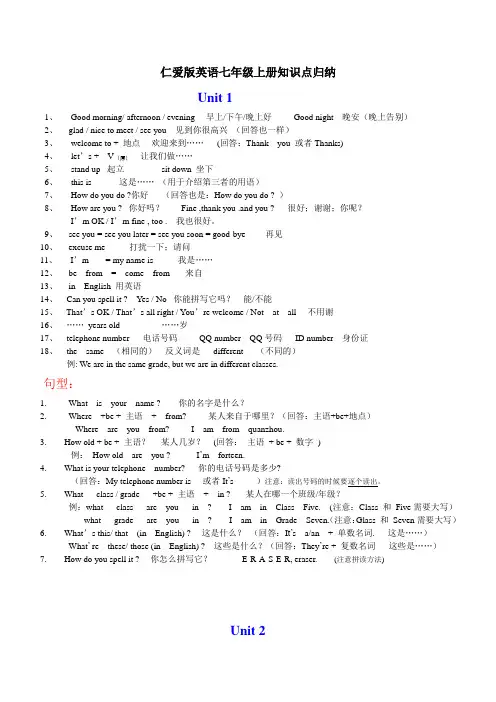
仁爱版七年级英语上册知识点归纳
仁爱版英语七年级上册知识点归纳
Unit 1
1、 Good morning/ afternoon / evening 早上/下午/晚上好 Good night 晚安(晚上告别)
2、 glad / nice to meet / see you 见到你很高兴 (回答也一样)
3、 welcome to + 地点 欢迎来到…… (回答:Thank you 或者Thanks)
4、 let’s + V(原) 让我们做……
5、 stand up 起立 sit down 坐下
6、 this is----- 这是…… (用于介绍第三者的用语)
7、 How do you do ?你好 (回答也是:How do you do ? )
8、 How are you ? 你好吗? Fine ,thank you .and you ? 很好;谢谢;你呢?
I’m OK / I’m fine , too . 我也很好。
9、 see you = see you later = see you soon = good-bye 再见
10、 excuse me 打扰一下;请问
11、 I’m -----= my name is ---- 我是……
12、 be from = come from 来自
13、 in English 用英语
14、 Can you spell it ? Yes / No 你能拼写它吗? 能/不能
15、 That’s OK / That’s all right / You’re welcome / Not at all 不用谢
仁爱版英语七年级上册知识点归纳

仁爱版英语七年级上册知识点归纳
Unit 1
1、 Good morning/ afternoon / evening 早上/下午/晚上好 Good night 晚安(晚上告别)
2、 glad / nice to meet / see you 见到你很高兴 (回答也一样)
3、 welcome to + 地点 欢迎来到…… (回答:Thank you 或者Thanks)
4、 let’s + V(原) 让我们做……
5、 stand up 起立 sit down 坐下
6、 this is----- 这是…… (用于介绍第三者的用语)
7、 How do you do ?你好 (回答也是:How do you do ? )
8、 How are you ? 你好吗? Fine ,thank you .and you ? 很好;谢谢;你呢?
I’m OK / I’m fine , too . 我也很好。
9、 see you = see you later = see you soon = good-bye 再见
10、 excuse me 打扰一下;请问
11、 I’m -----= my name is ---- 我是……
12、 be from = come from 来自
13、 in English 用英语
14、 Can you spell it ? Yes / No 你能拼写它吗? 能/不能
15、 That’s OK / That’s all right / You’re welcome / Not at all 不用谢
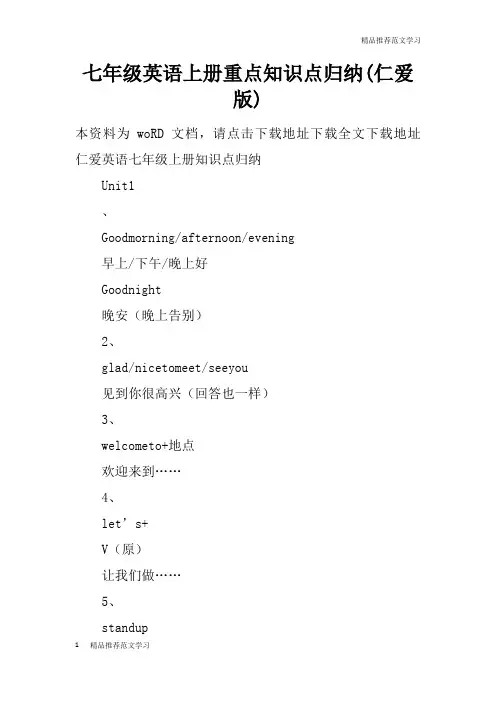
【学习实践】七年级英语上册重点知识点归纳(仁爱版)
精品推荐范文学习
精品推荐范文学习 1 七年级英语上册重点知识点归纳(仁爱版)
本资料为woRD文档,请点击下载地址下载全文下载地址
仁爱英语七年级上册知识点归纳
Unit1
、
Goodmorning/afternoon/evening
早上/下午/晚上好
Goodnight
晚安(晚上告别)
2、
glad/nicetomeet/seeyou
见到你很高兴(回答也一样)
3、
welcometo+地点
欢迎来到……
4、
let’s+
V(原)
让我们做……
5、
standup 精品推荐范文学习
精品推荐范文学习 2 起立
sitdown坐下
6、
thisis-----
这是……(用于介绍第三者的用语)
7、
Howdoyoudo?你好
(回答也是:Howdoyoudo?)
8、
Howareyou?
你好吗?
Fine,thankyou.andyou?
很好;谢谢;你呢?
I’mok/I’mfine,too.
我也很好。
9、
seeyou=seeyoulater=seeyousoon=good-bye
再见
0、
excuseme
打扰一下;请问
1、 精品推荐范文学习
精品推荐范文学习 3 I’m-----=mynameis----
我是……
2、
be
from
=
come
from
来自
3、
in
English用英语
4、
canyouspellit?
yes/No
你能拼写它吗?
能/不能
5、
That’sok/That’sallright/you’rewelcome/Not
at
all
不用谢 精品推荐范文学习
精品推荐范文学习 4 6、
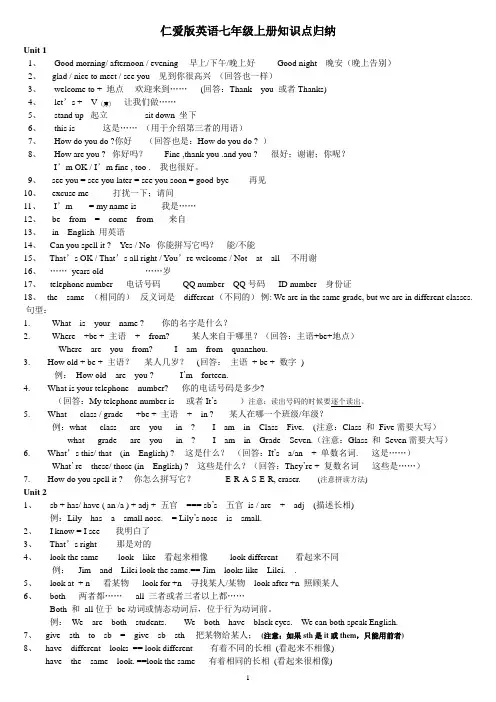
仁爱版英语七年级上册知识点归纳 2
仁爱版英语七年级上册知识点归纳
Unit 1
1、 Good morning/ afternoon / evening 早上/下午/晚上好 Good night 晚安(晚上告别)
2、 glad / nice to meet / see you 见到你很高兴 (回答也一样)
3、 welcome to + 地点 欢迎来到…… (回答:Thank you 或者Thanks)
4、 let’s + V(原) 让我们做……
5、 stand up 起立 sit down 坐下
6、 this is----- 这是…… (用于介绍第三者的用语)
7、 How do you do ?你好 (回答也是:How do you do ? )
8、 How are you ? 你好吗? Fine ,thank you .and you ? 很好;谢谢;你呢?
I’m OK / I’m fine , too . 我也很好。
9、 see you = see you later = see you soon = good-bye 再见
10、 excuse me 打扰一下;请问
11、 I’m -----= my name is ---- 我是……
12、 be from = come from 来自
13、 in English 用英语
14、 Can you spell it ? Yes / No 你能拼写它吗? 能/不能
15、 That’s OK / That’s all right / You’re welcome / Not at all 不用谢
仁爱版英语七年级上册知识点归纳 (1)

1 仁爱版英语七年级上册知识点归纳
Unit 1
1、Good morning/ afternoon / evening 早上/下午/晚上好
Good night 晚安(晚上告别)
2、glad / nice to meet / see you 见到你很高兴 (回答也一样)
3、welcome to + 地点 欢迎来到…… (回答:Thank you 或者Thanks)
4、let’s + V(原) 让我们做……
5、stand up 起立 sit down 坐下
6、this is----- 这是……
(用于介绍第三者的用语)
7、How do you do ? 你好 (回答也是:How do you do ? )
8、——How are you ? 你好吗?
——Fine ,thank you .and you ? 很好;谢谢;你呢?
=I’m OK / I’m fine , too . 我也很好。
9、see you = see you later = see you soon = good-bye 再见
10、excuse me 打扰一下;请问
11、I'm -----= my name is ---- 我是……
12、be from = come from 来自
13、in English 用英语
14、——Can you spell it ? ——Yes / No 你能拼写它吗? 能/不能
15、That’s OK / That’s all right / You’re welcome / Not at all 不用谢
16、…… years old ……岁
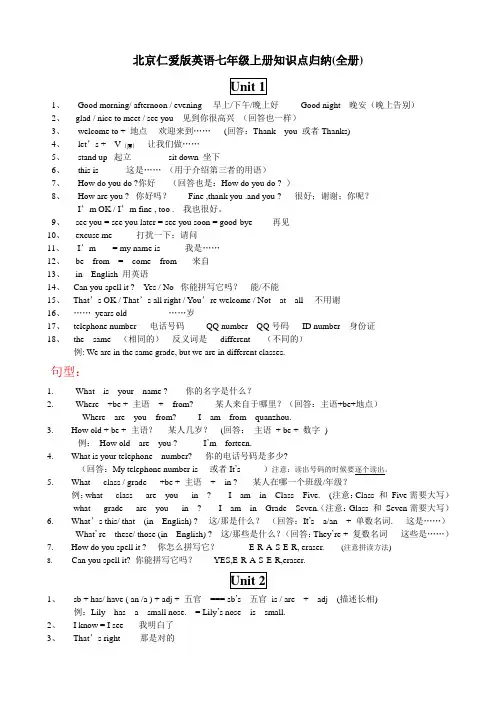
北京仁爱版英语七年级上册知识点归纳(全册)
北京仁爱版英语七年级上册知识点归纳(全册)
Unit 1
1、 Good morning/ afternoon / evening 早上/下午/晚上好 Good night 晚安(晚上告别)
2、 glad / nice to meet / see you 见到你很高兴 (回答也一样)
3、 welcome to + 地点 欢迎来到…… (回答:Thank you 或者Thanks)
4、 let’s + V(原) 让我们做……
5、 stand up 起立 sit down 坐下
6、 this is----- 这是…… (用于介绍第三者的用语)
7、 How do you do ?你好 (回答也是:How do you do ? )
8、 How are you ? 你好吗? Fine ,thank you .and you ? 很好;谢谢;你呢?
I’m OK / I’m fine , too . 我也很好。
9、 see you = see you later = see you soon = good-bye 再见
10、 excuse me 打扰一下;请问
11、 I’m -----= my name is ---- 我是……
12、 be from = come from 来自
13、 in English 用英语
14、 Can you spell it ? Yes / No 你能拼写它吗? 能/不能
15、 That’s OK / That’s all right / You’re welcome / Not at all 不用谢
(仁爱版)英语七年级下册知识点归纳与总结
第 页 1 (仁爱版)英语七年级下册知识点归纳
Unit 5 Topic1
重点语法 一般现在时(常与频度副词never, seldom, sometimes, often,usually,
always等连用)
重点句型 —How do you usually come to school?
—I usually come to school by subway.
—How often do you go to the library?
—Once/Twice/Three times a week/Very often/Every day/Sedom
重点详解
1.I always come to school by bus.
by+交通工具名称,表示使用某种交通方式,中间不加限定词,如果交通工具前有a, the, my 等限定词,就不能用by,而是用in或是on.
on the train=by train on his bike=by bike in my car=by car.
巧辩异同 on foot 与 walk on foot “走路”,是介词短语,不能作谓语,只作方式状语,位于句末。walk “走路”,是动词,可以作谓语。
go to…on foot= walk to I often go to school on foot. =I often walk to school.
同样,go to….by bike = ride a bike to go to…. by car = drive a car to
go to … by plane = fly to go to… by bus = take a bus to
2017年仁爱版英语七年级上册知识点归纳(已整理)
1 七年级上册
Unit 1
1.Good morning/ ________ / _________. 早上/下午/晚上好 2. Glad / nice to __________ you.
见到你很高兴3.welcome ___ + 地点 欢迎来到……--_____________ 4.let’s + _______ 让我们做……
5. How do you do ?你好 ---__________________ 6. excuse______ 打扰一下;请问
7. How ____you ? 你好吗? Fine ,thank you .and you ? I’m _______ , too . 我也很好。
8. I’m -----= __________ ---- 我是…… 9. be from = _____ _______ 来自10. ______English 用英语11.____ ____ ____ it ? 你能拼写它吗?--Yes / No. 12. … years old …岁
13. Not at all / _____________ / ______________ / _____________ 不用谢
18、 same / different 用法 例: We are in ____________grade, but we are in _______ classes.
句型:
1. What is ______name? 你的名字是什么?
2. ______be sb. ______?某人来自于哪里?回答:_____________________
仁爱版七年级英语上册知识点归纳 2
七年级仁爱版英语上册知识点归纳
*(Sb.=somebody, sth.=something,, sp.=someplace.)
Unit 1
1. good adj. 好的,良好的。Eg: Good night.晚安。
2. morning n. 早晨,上午。
Eg: Good morning\ afternoon (下午,午后)\ evening (傍晚,晚上)
This morning\ afternoon \ evening In the morning\ afternoon \
evening
3. thank v&n. 感谢。
谢谢你:thank you\ thanks\ thank you very much\ thanks very much\ thanks a lot\
many thanks. 不客气(答语):you are welcome\ not at all\ that’s OK\ that’s all
right\ it’s my pleasure (乐事;令人高兴的事情) \ with pleasure\ my pleasure.
4. you pron. 你,你们
人称代词与物主代词的区别与联系(参考课本P115)
人称 人称代词主格 人称代词宾格 形容词性物主代词 名词性物主代词
我 I me my mine
我们 we us our ours
你 you you your yours
你们 you you your yours
他们 they them their theirs
它 it it its \
她 she her her hers
他 he him his his
注意:(1)人称代词的主格一般用来做主语,位于句首。Eg: I am a studet.
(仁爱版)英语七年级下册知识点归纳
Unit6 Topic1
重点语法 There be 句型和方位介词短语。
重点句型 There are two bedrooms and a a small study.
There is a lamp, a computer, some books and so on.
—Is there a computer in your study? —Yes, there is.
Don't put them here. Put them away.
重点讲解
1 It’s on the second floor.
在哪一层楼,用介词on。on表示在……上面。second是序数词,前面要用定冠词the, 意为第二
巧辩异同 two与second
two是基数词,second是序数词,“第二”或“第二的”,指排列顺序。
2 in 在……里面,是方位介词。in the box in the classroom
Is there…? 表示某地存在……吗?其肯定回答是:Yes, there is. 否定回答No, there isn’t.它的复数形式为Are there…? 其肯定回答是:Yes, there are. 否定回答No, there aren’t.
3 巧辩异同 there be与 have
(1) there be“有”,指(某地)存在“有”。
(2) have“有”,指人或某物“拥有”。The is a dog in the picture. The dog has two big eyes.
注:..there be .......遵循就近原则。.......be ..用.is..还是..are...,取决于离该动词最近的那个名词。如果该名....................词是单数或.....不可数名词就用.......is..,如果是复数就用........are...。.