
外研版(新标准)英语七年级下册Module 7 My past life模块测试卷及答案
Module 7达标测试卷
时间:100分钟 满分:120分
第Ⅰ卷 听力部分(20分)
一、听句子,选择符合句意的图画(每小题1分,共5分)
1.________ 2.________ 3.________ 4.________ 5.________
二、听对话及对话后的问题,选择正确的答案(每小题1分,共5分)
6.A.In a restaurant. B.At home. C.In a bank.
7.A.Chicken and cabbage noodles. B.Mutton and potato noodles.
C.Tomato and egg noodles.
8.A.Rice. B.Fish. C.Dumplings.
9.A.$5. B.$6. C.$7.
10.A.To the library. B.To the supermarket. C.To the clothes store.
三、听对话,回答下面的问题(每小题1分,共5分)
听第一段对话,回答第11、12小题。
11.Where was Susan born?
A.In Jinan. B.In Hangzhou. C.In Beijing.
12.Was Jack's mother born in Beijing?
A.Yes,she was. B.No,she wasn't. C.Not mentioned.
听第二段对话,回答第13、14、15小题。
13.When was Helen born? A.In 1996. B.In 1997. C.In 1998.
14.Who was Helen's third friend?
A.Lucy. B.Jane. C.Mary.
15.What was Mary like?
A.Unfriendly. B.Difficult. C.Friendly.
四、听短文,选择正确答案(每小题1分,共5分)
16.Cindy has ________.
A.a sister B.a brother C.a sister and a brother
17.Cindy likes ________.
A.rice and vegetables
B.noodles and meat
C.noodles and vegetables
18.Cindy's parents don't like________.
A.noodles B.vegetables C.rice
19.Bob's favourite meat is ________.
A.mutton B.fish C.chicken
20.Bob also likes ________.
A.dumplings B.fruit C.soup
第Ⅱ卷 笔试部分(100分)
五、单项选择(每小题1.5分,共15分)
21.—________ is your grandfather like?
—He is very warm-hearted.
A.Where B.Whose C.Who D.What
22.When my parents ________young,there________ not so much food.
A.are;are B.were;was C.are;was D.were;is
23.There are________children in the garden,and I like playing there very much.
A.lots B.lots of C.a little D.a little of
24.—What can I do for you?
—I hope I have a nice house________a big garden. A.of B.with C.from D.about
25.Jane was very good ________ class but Adam was not.He was very ________.
A.in;difficult B.at;difficult
C.in;friendly D.at;friendly
26.The students from foreign countries like to stay in our school because everyone is
________ to them.
A.happily B.early C.friendly D.silly
27.Tony has nothing to do.He is ________.
A.tired B.interesting C.bored D.interested
28.The sofa is big and soft(柔软的) and it is very ________ to sit in.
A.new B.beautiful C.comfortable D.high
29.The teacher is strict ________ his students and________ his work.
A.in;with B.with;in C.to;in D.to;with
30.It is important ________ people ________ learn team spirit.
A.of;of B.of;to C.for;to D.to;to
六、完形填空(每小题1.5分,共15分)(词数:约130;建议用时:6分钟)
I don't like to stay at home on holidays. Last summer, my family took a ________(31) to
Hong Kong. It________(32)an interesting trip.
We went there by plane, because we wanted to get there quickly. We ________(33) there
at about eleven o'clock and we had lunch there. We ate the seafood. It was delicious. The
weather was sunny and ________(34), so we swam in the sea. There were ________(35) people
on the beach.
Disneyland is the place that I like best there, so we ________(36) visited the Disneyland.
It is a ________(37) place. We stayed in Hong Kong ________(38) a week. We took many
photos and bought lots of souvenirs. And then, we went home ________(39). We
just________(40) a good time.
I enjoyed the trip. It was really a fantastic trip.
31.A. travel B. trip C. trips
32. A. was B. is C. were
33. A. arrived B. arrived in C. arrived at 34. A. cool B. hot C. cloudy
35. A. many B. much C. large
36. A. also B. too C. either
37. A. wonderful B. beauty C. terrible
38. A. of B. for C. at
39. A. sad B. happy C. happily
40. A. had B. took C. stayed
七、阅读理解(每小题2分,共20分)
A(词数:约120;建议用时:5分钟)
Do you know He Jiong?Lots of young people in our country know him and the
programme Happy Camp.
He Jiong was born in 1974.When He Jiong was in high school,he was famous as a radio
host(主持人).In 1990,he worked for Hunan Economy(经济) Radio.He began to study in
Beijing Foreign Language University in 1992. After graduation in 1997, he worked in the
university as a teacher. In 1998, he began to host a programme on Hunan TV.It's called
Happy Camp.Stars from all over the country come to this programme.They tell their stories
or play games with the viewers(观众). The programme is so popular that it wins many prizes.
41.Where did He Jiong work in 1990?
A.In a high school.
B.In a TV station.
C.In Hunan Economy Radio.
D.In Beijing Foreign Language University.
42.He Jiong hosted the programme Happy Camp for the first time in________.
A.1974 B.1990
C.1992 D.1998
43.Happy Camp wins many prizes because ________.
A.He Jiong is the host of it
七年级英语外研版下册模块综合检测题(Module8 My past life)附答案
第8模块知识总结
[网络构建]
本模块以过去生活为话题,语法重点是含有动词be(was/were)的一般过去时句子的用法,并能谈论自己和他人的过去生活。在掌握语言结构的同时,能熟练介绍自己或他人过去的生活。本模块的learning to learn栏目介绍了英式英语和美式英语的一些不同,通过学习可以加深对语言知识的理解。在阅读过程中,学会应用寻找细节的阅读技艺,能将单词与释义相匹配。
语音 含有动词be(was/were)的一般过去时的陈述句、一般疑问句及肯定和否定回答形式。
词汇 past, was, born, founder, scientist, professor, were, strict, nice, friendly, naughty,
primary, hey, province, Mrs, president, with, store, movie, baseball, kitchen, bathroom,
wall, poster, garden, pond, fish, back, somewhere, unfriendly, partner, character
词组 be born, primary school, well-behaved, living room, go back
语法 动词be的一般过去式(was/were)。
功能 描述家乡与童年。
名师导学
典例分析
例1 —Excuse me, Where is the zoo?
—Sorry, I don’t know. Ask that policeman. He__________ know.
A. shall B. need C. may D. would
思维分析:本题考查情态动词的用法。根据上下可知,“他可能知道。”
答案:C
例2 —Would you like something to__________?
七年级英语下册Module7MypastlifeUnit3Languageinuse教案新版外研版
Unit 3 Language in use
课 题 Module 7 My past life 第三
课时 Unit 3 Language in use
课型 Revision
教学目标 知识
目标 1.复习并掌握以下词汇:
yesterday, born, strict, friendly, primary school, town, US,
village, nice, good, difficult, bathroom, bedroom, garden...
2.掌握以下句型:
①I was born in Quincy.
② My first teacher was Mrs Lane.
③I wasn’t born in Quincy.
④—Were you difficult in class too?
—No, I wasn’t.
⑤Where were you born?
能力
目标 能够用动词be的过去式描述自己和他人过去的生活或经历
情感
目标 通过对过去童年或家乡的描述,产生对家乡和美好生活的热爱
教学重点 1.Grasp the words and the expressions in this module
2.Grasp how to describe one’s own and others’ past life
教学难点 1.Grasp the past tense form of the irregular verbs
2.Describe one’s own and other’s past life
课前预习 Preview the new words
教学方法 Situational approach; Listening and speaking approach;
Communicative approach
教学过程
教学环节 教师活动 学生活动 备课札记
外研版英语七年级下册Module 7《My past life》模块测试
1 / 5 外研版英语七年级下册Module 7《My past
life》模块测试
Module 7 检测题
(时间:90分钟 满分:100分)
第一卷 (共45分)
Ⅰ.单项选择(15分)
( ) 1. Do you know why she __________ here last night?
A. isn’t B. wasn’t C. aren’t D. not in
( ) 2. ______ was the food in the restaurant?
A. How many B. How C. Why D. Where
( ) 3. — When and where _________ you born?
—I ________ born in Shanghai _______ September 1, 1990.
A. was, were, at B. were, was, in C. was, was, on D. were, was, on
( ) 4. My father likes _______ books in the evening. He doesn’t often ______ TV.
A. reading, watch B. watches, see
C. to read, watches D. looking at, see
( ) 5. There are _______ in the river.
A. many fish B. much fishes C. much fish D. a fish
( ) 6. Can you ________ him the story about Edison?
外研版七年级英语下册 Module 6-7模块知识点归纳
1
Module 6 Around town. Could you tell me how to get to the National Stadium?
必背单词
1. across prep. 越过→cross v. 穿越
2. tourist n. 游客→visitor(同义词)参观者→tour n. 游览;参观;旅行
3. turn v. 换方向→turning n. 转弯处
4. third num. 第三→three 三(基数词)
5. could v. aux. 可以;能→can(原形)能;会
6. take v. 搭乘;乘坐;固定使用;把(某人)带往;使(某人)到→took(过去式)
7. bank n. 银行
8. museum n. 博物馆
9. along prep. 沿着
10. opposite prep. 在……的对面
11. excuse v. 原谅;谅解
12. street n. 街道
13. guidebook n. 导游手册;旅游指南
14. bookshop n. 书店
15. right int.好了;是的;好
16.underground n. 地铁
必背短语
17. in front of 在……前面
18. turn left 向左拐
19. go across 穿过
20. go along 沿着……走
21. get to 到达
22. take the underground 乘地铁
23. get to 到达
24. over there 在那里
必背句子
25. Excuse me! Can you tell me the way to Wangfujing Dajie?
劳驾!你能告诉我去王府井大街的路吗?
26. You're welcome.不客气。
27. Could you tell me how to get to the National Stadium?
外研版七年级英语下册Module 8 学情评估含答案
1 外研版七年级英语下册Module 8 学情评估
七年级英语·下(WY版)
时间:90分钟 满分:100分
一、单项选择。(每小题1分, 共10分)
1. [易错题]She hurried out of the house ____ taking her basket.
A. in B. on C. without D. through
2. Goldilocks ____ the big bowl but she didn't like it—it was very hot.
A. put up B. picked up
C. stood up D. looked up
3. My mother lives ____, but she doesn't feel ____.
A. alone; lonely B. lonely; alone
C. lonely; lonely D. alone; alone
4. Lingling knocked ____ the door, ____ nobody answered.
A. on; and B. on; but
C. at; and D. to; but
5. —Does Tom know where the party is?
—Yes, he does. I ____ him last night.
A. tell B. told C. will tell D. tells
6. My two cousins decide ____ a school together and I want to join them.
A. to start B. starting
C. start D. started
7. —I don't like history. It's boring.
外研版七年级英语下Module 7学案
1 新标准七年级下英语Module7导学案
Unit1 Tony has the longest journey.
Language Knowledge Objects 语言知识目标
Function: 功能 三者或更多事物之间的比较。
Grammar: 语法 形容词的最高级;by+交通工具
Vocabulary: 词汇 bus, ferry, subway, taxi, crowded, modern
Pronunciation:语音 形容词最高级-est的发音
Language skills Objects 语言技能目标
Listening: 听 能听懂含有形容词最高级形式的对话以及对交通工具的描述。
Speaking: 说 能使用形容词最高级形式谈论乘坐的交通工具。
Reading: 读 能读懂有关旅游和交通方面的文章。
Writing: 写 能用形容词最高级形式描写旅行。
课前导学
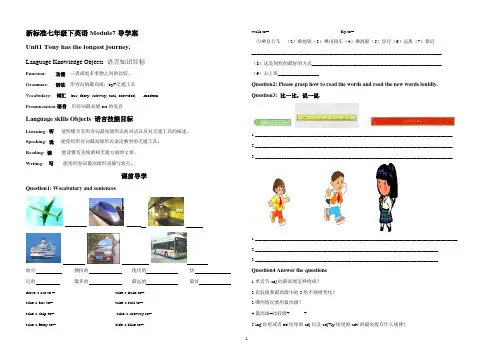
Question1: Wocabutary and sentences
_________ ______
旅行 拥挤的 现代的 快
近的 最多的 最远的 最好
drive a car to = take a train to=
take.a.bus.to= take a taxi to=
take.a.ship.to= take a subway to=
外研社七年级下册英语:Module 7 重点知识和训练(单词短语,语法,练习)(有答案)
Module 7
重点单词和短语
born [bɔːn] adj. (动词bear的过去分词)出生
strict [strɪkt] adj. 严格的; 严厉的
friendly['fren(d)lɪ] adj. 友好的
primary ['praɪm(ə)rɪ]adj. 初等的; 初级的
primary school 小学
town[taʊn] n. 城镇;市镇
US 美国
hey int. 嘿; 喂
village['vɪlɪdʒ] n. 村庄
nice [naɪs] adj. 友好的; 亲切的
good [gʊd] adj. 乖的; 守规矩的
difficult ['dɪfɪk(ə)lt]adj. 难对付的
bathroom['bɑːθruːm; -rʊm] n. 浴室
bedroom['bedruːm; -rʊm] n. 卧室
garden ['gɑːd(ə)n] n. 花园
living room 起居室; 客厅
east [iːst]adj.东面的; 东部的
n. 东方
coast [kəʊst]n. 海岸
ago [ə'gəʊ]adv. 以前
store [stɔː] n. 商店
movie theater (Br E theatre) 电影院
bored [bɔːd]adj. 厌烦的; 厌倦的
president ['prezɪd(ə)nt]n. 总统
comfortable ['kʌmf(ə)təb(ə)l]adj. 舒适的; 舒服的
lake[leɪk] n. 湖
last adj. (星期、月份等)最近过去的,紧接现在前面的
yesterday [leɪk]adv. (在)昨天
语法回顾
1. Where was/were sb. born?
某人出生在哪儿?
When was/were sb. born?
某人什么时候出生?
e.g. —Where were you born?
外研版七年级英语下册 知能提升作业二十一 Module 7 Unit 3精练精析
外研版七年级英语下册
知能提升作业(二十一)
Module 7 Unit 3
(20分钟 50分)
Ⅰ. 根据句意及首字母提示完成单词(10分)
1. Can you tell me about your p______life in America in the 1990s?
2. Tommy is very f______, so he has lots of friends.
3. There is a p______of Zhou Bichang on my bedroom wall.
4. I am b______at home. Let’s go out and do something fun.
5. There is a TV, three sofas and two tables in our l______room.
Ⅱ. 单项选择(10分)
1. The boy______in America last summer.
A. am B. were C. was
D. did
2. —Were they Lily’s brothers?
—No, ______.
A. they aren’t
B. they weren’t
C. he wasn’t
D. he isn’t
3. —______you good in your primary school?
—Yes,I was.
A. Was B. Were C. Are D. Is
4. One of the students______ill last week.
A. was B. is C. were D. are
5. —______was George Washington?
—He was the first president of the USA.
外研版七年级下册英语Module 7 教案
第1页 共22页 Module 7 My past life
Unit 1 I was born in a small village.
一、教学目标:
1. 语言知识目标:
1) 掌握下列单词: born, strict, primary, primacy school, town,
friendly, US,
village, nice, good, difficult...
2) 能听懂包含动词be的过去式 (was / were)的对话。
2. 情感态度价值观目标:
通过对过去童年或家乡的描述,产生对家乡和美好生活的热爱。
二、教学重难点
1. 教学重点:系动词be的一般过去时的运用
2. 教学难点:能用动词be的过去式(was / were)表述自己过去的经历,并能用它询问对方过去的生活。
三、教学过程
Step1 Study the following new words
born, strict, primary, primacy school, town, friendly, US, hey,
village, nice, good, difficult
Step2 Warming up
To give some pictures and videos about me and my past life to
students. Let them watch. And then, talk about my son. At last, let
第2页 共22页 students talk about themselves.
Step3 Listening
1. Work in pairs. Listen and number the questions as you hear
them.
a. Who was your first teacher?
外研版七年级下册英语期末测试卷 (7)
第1页 共20页 第二学期期末测试卷
时间:100分钟 满分:100分
第一卷 听力部分(20分)
一、听对话,选择合适的图片。(每小题1分,共5分)
( )1. What's the weather like today?
A. B. C.
( )2. What's Daming's favourite animal?
A. B. C.
( )3. Which of the following is Cindy's?
A. B. C.
( )4. How does Jim go to school?
A. B. C.
( )5. Where is Kate going?
A. B. C.
二、听长对话,选择正确答案。(每小题1分,共5分)
听下面一段对话,回答第6和7小题。
第2页 共20页 ( )6. What does the boy want to buy for his grandfather?
A. A book. B. A hat. C. A scarf.
( )7. When is the boy's grandfather's birthday?
A. Next Thursday. B. Next Friday. C. Next Saturday.
听下面一段对话,回答第8至10小题。
( )8. Where is Mary working?
A. At a store. B. At a school. C. At a hospital.
( )9. What did Mary use to do in the summer vacation?
A. She stayed at home. B. She went to
parties. C. She traveled a lot.
( )10. What did Mark do in the morning when camping?