
外研版英语七年级下册M1重点词组及句型
第 1 页 外研社英语七年级下册
MODULE 1 lost and found
Unit 1:
1. welcome back to…欢迎返回…;You are welcome.别客气。 You are welcomed. 你是被欢迎的。
2. everyone不定代词,“每个人”,指、只指人,不指物,不与of连用。谓语动词用单三形式。
every one即可指人,也可指物,可与介词of连用。 Every one of us has a chance to speak at the meeting.
3. first of all = firstly = above all首先; at first起初
4. lost and found box“失物招领箱”
5. there be句型的时态:
一般现在时There is/are There is (some) milk in the fridge.
一般过去时There was/ were There was nothing special about the meal
一般将来时There will be/ is/are going to be There will be rain next week.
过去将来时There would be/ was going to be Our teacher told us that there would be a test on Monday.
现在完成时There have/has been There has been an increase in the number of road incidents recently.
过去完成时There had been There had been a lot of earthquakes in this area.
6. a lot of/lots of许多;a lot相当于very much,意为“非常”。
I have lots of books in my room. Thanks a lot.
7. whose代词,意为“谁的”。一般whose + n. Whose pen is this?
8. look after照顾,照料;look ahead向前看;look as if看上去好像;look at看着;look around/about四下环顾;look back回头看;回顾;look down upon(on)看不起,轻视;look forward to盼望,期待;look into 朝...看去;调查;look like看上去象;look on旁观,观望;look on ... as ...把...看作...;look out当心,留神;look through浏览,翻阅,温习;look up查阅;抬头看;look up to尊敬
look为不及物动词,单独使用,用来引起对方的注意。Look! That’s an English car.
look at及物动词词组,后接宾语,侧重“看”的动作。Come and look at my new dress.
watch是及物动词,意思“观看,注视”,常用来指看电视、看球赛、看戏等。They are watching a match.
see vi.&vt. 及物动词意思“看见,参观”,不及物动意思“明白”。侧重“看”的结果。
Can you see the bird in the tree?
9. Here’s a purple wallet!本句为倒装句。由here, there, out, in, then, down等表示方位的副词开头的句子,如果主语是名词要用全部倒装语序,即谓语动词位于主语之前。但如果主语是代词时,则不倒装。 第 2 页 There goes the bell. Here you go.
10. care v.&n.—careful—carefully—carefulness—careless—carelessly—carelessness; be careful with小心…
11. from now on从现在起
Unit 2:
12. mobile phone移动电话;mobile adj.可移动的 The old lady sits on a mobile chair every morning.
13. talk, speak, tell, say区别
talk to强调谈话的对象是“单向的”。如:I am talking to Tom. (强调"I"单方面的对"Tom 在谈话)
talk with强调谈话的对象是“双向的”。如:I am talking with Tom. (强调"I"和"Tom"在相互谈话)
speak后常接语言。He can speak English and a little Chinese.
speak to“和…讲话、谈话”。Can I speak to Mr. Zhang?
tell意为“告诉”。词组:tell sb. sth./tell sth. to sb.; tell sb. (not) to do sth.; tell sb. + that从句;
He tells me something about his past. He tells his son not to make the same mistake.
He tells me that he wants to be a teacher.
say意为“说”,后常跟说话的内容。Can you say it in English? He said that he was a teacher before.
14. at the lost and found office在失物招领处,注意介词at。
15. get ready for sth.为某事作好准备;get on well/badly with sb./sth.和某人相处的好/不好;get ready to do sth.准备做某事;get on/off上车/下车;get in进去;get up起床;get down下来
16. be lost:迷路;丢失;迷失 I seem to be lost.
17. in a hurry“匆匆忙忙”,此处hurry为名词。hurry up赶紧;hurry to do sth匆忙作某事,此时hurry为动词。 He hurried home. = He went home in a hurry.
18.
19. a. leave此处作动词,意为“留下,落下”,后接表示地点的介词短语,表示把某物落在/忘在某地。
I often leave my homework at home. I leave my key in the reading room.
b.词组:leave school“毕业,退学”;leave the school单纯的离开学校;leave for sw.动身去某地。
c. leave作动词,意为“使保持…状态”。Who leaves the door open?
d. leave作名词,意为“假期,休假”。I want to ask for two days’ leave.
20. at the airport, at the station; on the plane/train/bus; in the taxi注意介词的不同。
the 第 3 页 21.
22. three hundred of these/those + npl(表示整体和部分关系) V.S hundreds +npl(数量关系)
them
23. at the moment此刻,目前
24. help sb. do sth./help sb. sth.帮助某人某事; with the help of在…帮助下; can’t help doing sth.禁不住做某事
25. try to do设法,try doing尝试;have a try尝试一下;try on试穿;try one’s best to do sth.尽力做某事
Unit 3:
26. the name of the dog名词所有格
27. such as例如
28. search v.&n.搜索;调查;research v.&n.研究,探讨
29. think of想起;think about考虑;think over仔细考虑
30. choose from从...选择;choose sb. sth. = choose sth. for sb.
31. detail细节;详述
32. sketch梗概
33. make a list of sth.列出…的清单
34. ask sb. (not) to do sth.要求某人做某事
重点句型:
1. First of all, come and look in the lost and found box!
2. People often lose things when they’re travelling or when they’re in a hurry.
3. They leave things on planes, on trains, on buses and in taxis.
4. Hundreds of people come here every day.
外研版七年级英语下册各模块语法知识汇总+专项练习
外研版七年级英语下册各模块语法知识汇总+专项练习
M1 形容词性和名词性物主代词专项练
物主代词分为两种:形容词性物主代词和名词性物主代词。形容词性物主代词不能单独使用,后面必须跟名词,例如:We are doing our XXX(我们正在做家庭作业。)名词性物主代词则具有名词的性质,可以单独使用,例如:My shirt is
black。but yours is white.(我的衬衫是黑色的,但你的是白色的。)名词性物主代词也可以具有“形容词性物主代词+名词”的作用,例如:Whose comb is it。It’s hers.(hers=her+comb)
下面是物主代词的对照表:
物主代词 | 形容词性 | 名词性 |
我的 | my | XXX |
你的 | your | yours |
他的 | his | his | 她的 | her | hers |
它的 | its | its |
我们的 | our | ours |
你们的 | your | yours |
他们的 | their | theirs |
需要注意的是,名词性物主代词可指一件东西,也可指很多件东西,需要根据上下文来决定。例如:
选择填空:
1.This is my teapot。It’s not __________。(your/ yours)
2.My hairdryer is on the desk。Where’s ____________?(her/
hers)
3.___________ hairdryer is not on the table。___________ is
there。(Her/ Mine)
4.Whose calculator is it?It’s __________。It’s __________
XXX)
5.Are they ___________ (your/ yours) combs。Yes。they’re
初中英语(新外研)初一下M7~~M12词组句型
姓名: Module 7~~Module 12 词词组句型测试 家长签字:
1
Module 7 一、单词
adj.(动词bear的过去分词)出生 born
adj.严格的;严厉的 strict
adj.友好的 friendly
adj.初等的;初级的 primary
小学 primary school
n.城镇;市镇 town
美国 US
int.嘿;喂 hey
n.村庄 village
adj.友好的;亲切的 nice
adj.乖的;守规矩的 good
adj.难对付的 difficult
n.浴室 bathroom
n.卧室 bedroom
n.花园 garden
起居室;客厅 living room
adj.东面的;东部的 n.东方 east
n.海岸 coast
adv.以前 ago
n.商店 store
电影院 movie theater
adj.厌烦的;厌倦的 bored
n.总统 president
adj.舒适的;舒服的 comfortable
n.湖 lake
adj.(星期、月份等)最近 过去的,
紧接现在前面的 last
adv.(在)昨天 yesterday
二、听写笔记
Unit 1 „„的名字 the name of
对某人要求严格 be strict with sb.
对某事要求严格 be strict in sth.
对某人友好 be friendly to sb.
今天天气怎么样? what’s the weather like?
How is the weather?
这部电影怎么样? What’s the film like?
Tom怎么样?(内在品质) What’s Tom like?
外研版初中英语七年级重点短语、词汇典型句型总结
一切为了学生的发展 红烛家教 第 1 页 共 67 页 红烛家教 一切为了家长的心愿
Wednesday, April 27, 2022 外研版初中英语重点短语、词汇典型句型总结
七年级
Starter module
1、早上六点半见面:
-Good morning!
下午二点见面:
-Good afternoon!
2、-Nice to meet you, 见到你很高兴
-Nice to meet you, too. 见到你也很高兴
3、A:How are you? 你好吗?
B:Fine,thank you. 很好,谢谢
A:And you。你呢
B:I’m fine, too. 我也很好
4、Sit down, please. = Please sit down. 请坐下
Stand up , please.= Please stand up. 请起立
5、当你问新同学的名字时用:What is / What’s your name? 你叫什么名字?
别人问你名字时用:My name is… 或I’m… 我叫…
6、What is /what’s this/that? 这/那是什么?
It is…/It’s… 它是…
7、 当朋友向你说Hello时: 你应该说Hello!
8、 朋友帮助了你时:Thank you!/ Thanks!
9、你想问别人的身体时用:How are you?
别人问候你身体状况时,你应该说:Fine,thank you/
10、你希望对方重复一遍刚才的话时用:Sorry!
11、你要和朋友分别时:Goodbye!See you tomorrow.
12、What’s this in English(用英语)? 用英语说这是什么?
外研版七下重点词组句型

Module1 Lost and found
Ⅰ.重点词组:
1. 欢迎来到welcome to…
2. 失物招领箱lost and found box
3. 小心对待be careful with
4. 打找call sb. at +
5. 在目前,此刻at the moment
6. 例如 such as
7. 欢迎回到学校welcome back to school
8. 许多,大量a lot of
9. 从现在开始from now on
10.几百,成百上千hundreds of
11.考虑think of
12.首先first of all
13.看着look at
14.寻找look for
15.移动mobile phone
16.上车,船get on
17.列出清单make a list of
18.匆匆忙忙in a hurry
19.在飞机上on planes
20.15公斤fifteen kilos of 21.成千上万的thousands of
22.许多其他东西many other things
Ⅱ.重点句型:
23.这是谁的书包?Whose bag is this?
24.这些是谁的磁带?Whose tapes are these?
25.这里有一个紫色的钱包。Here’s a purple wallet.
26.这有一些漂亮的手套。Here are some nice gloves.
27.这些蜡笔是你的吗?Are these crayons yours?
28.它也是你的吗?Is it yours, too?
29.请从现在开始小心对待你们的东西。Please be careful with
your things from now on.
30.那就是在飞机场及火车站有失物招领处的原因。That’s
why there are lost and found offices at airports and stations.
外研版七年级英语下册Module 1知识点汇总
外研版七年级英语下册Module 1知识点汇总
【重点短语】
1. lost and found 失物招领
2. welcome back to school 欢迎回校
3. first of all 首先
4. a lot of=lots of 许多
5. look at 看
6. from now on 从现在开始
7. be careful with sth 小心对待某物
8. talk to sb 与某人交谈
9. look for 寻找
10. get on the bus 上公交车
11. in a hurry 匆忙地
12. hundreds of 成百的
13. leave sth + 地点 把某物留在某地
14. every day 每天
15. at the moment 在此刻
16. such as 例如
17. help sb. to do sth 帮助某人做某事
18. many other things 许多其他东西
【重点句型】
1. Welcome back to school, everyone.欢迎大家回到学校。 2. Please be careful with your things from now on.从现在开始请仔细看管你的东西。
3.Whose gloves are they?它们是谁的手套?
4. People often lose things when they’re traveling or when they’re in a hurry. They leave things on planes, on trains, on buses and in
taxis. 人们旅行或匆忙时经常丢东西。他们把东西落在飞机上、火车上、公交车上或出租车里。
5. That’s why there are lost and found office at airports and
外研版 七年级英语下册 M1-M3复习
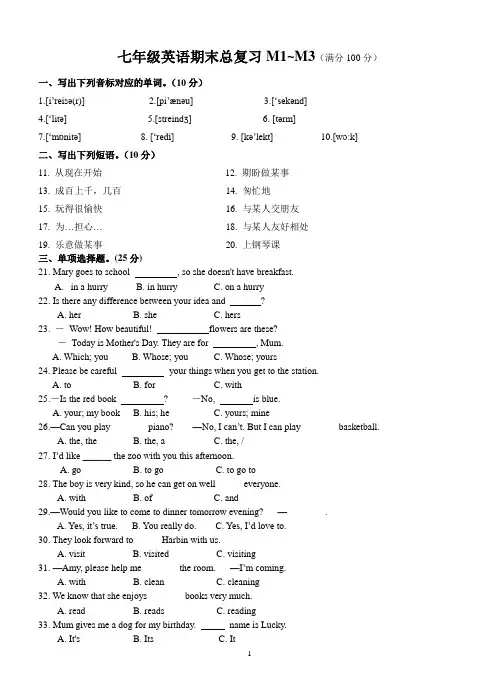
1 七年级英语期末总复习M1~M3(满分100分)
一、写出下列音标对应的单词。(10分)
1.[i’reisə(r)] __________ 2.[pi’ænəu]__________ 3.[‘sekənd]________
4.[‘litə]____________ 5.[streindʒ]___________ 6. [tərm]___________
7.[‘mɒnitə]____________ 8. [‘redi]__________ 9. [kə’lekt]________ 10.[wɔ:k]___________
二、写出下列短语。(10分)
11. 从现在开始________________ 12. 期盼做某事__________________
13. 成百上千,几百_______________ 14. 匆忙地______________________
15. 玩得很愉快_________________ 16. 与某人交朋友________________
17. 为…担心…____________________ 18. 与某人友好相处______________
19. 乐意做某事_________________ 20. 上钢琴课____________________
三、单项选择题。(25分)
21. Mary goes to school , so she doesn't have breakfast.
A. in a hurry B. in hurry C. on a hurry
22. Is there any difference between your idea and ?
A. her B. she C. hers
外研社七下英语M1至M6知识点总结
七年级下册知识点总结
Module 1
1、lost and found 失物招领 in the lost and found box at the lost and found office
2、welcome back to 欢迎回... welcome to +表示地点的名词 欢迎来某地 welcome home 欢迎回家 You are welcome. 不用谢。
3、first of all 首先 at first firstly 4、there be 句型中谓语动词采用就近原则
5、a lot of =lots of 许多 既可以修饰可数名词,也可以修饰不可数名词。
6、look at 看(不一定看见)look 不及物动词,后面不直接加名词 see 看见
watch 观看,仔细地看(比赛、电视等)read 看(书、报纸、杂志等)
7、everyone/everybody 做主语,谓语动词用单数 8、be careful with 注意.../小心... 9、from now on 从现在开始 from then
on 从那时开始
10、talk to sb 和某人说话(侧重主动说)talk with sb 和某人说话(侧重两人都说) talk about sth 谈论某事 say 说,强调说的内容
speak 说,后面可以直接接语言 speak English/Chinese speak to sb 和某人说话 tell sb sth=tell sth to sb告诉某人某事
11、look for 寻找(不一定找到) find (偶然地)找到 find out 查明,找到(经过努力) search 搜索,调查
look over检查 look after =take care of 照顾 look forward to 期盼,期待
外研版七年级英语下重难点句型汇总
外研版七年级英语下重难点句型汇总
外研版七年级英语下重难点句型汇总
七年级重难点句型汇总复习要求:1.识记并正确划分以下句型的使用处合。 2.可以模拟固定句型娴熟造句。请把以下句型翻译成汉语1. how old are you ?/what’s your
age ?________________________2. how are you ?/how is your
mother ?________________________3. what /which
class(grade/row/school…) are you in ?___________4. which class
are you in ,class 1 or class 2 ?___________________5. what’s one
and /plus one ? it’s two._________________________6. what’s one
minus one ? it’s zero.___________________________7. how many
story-books do you have ?_______________________8. how much water
is there in the glass?_______________________9. how much is this
pair of jeans?____________________________10. what’s the
population of china ?/how many people are there in
china ?_______________________________________________11. how
often do you take exercise ? twice a week._______________. how soon
新版外研社七下英语M1至M6知识点归纳讲解学习
七年级下册知识点总结
Module 1
1、lost and found 失物招领 in the lost and found box at the lost and found office
2、welcome back to 欢迎回... welcome to +表示地点的名词 欢迎来某地 welcome home 欢迎回家 You are welcome.
不用谢。
3、first of all 首先 at first firstly 4、there be 句型中谓语动词采用就近原则
5、a lot of =lots of 许多 既可以修饰可数名词,也可以修饰不可数名词。
6、look at 看(不一定看见)look 不及物动词,后面不直接加名词 see 看见
watch 观看,仔细地看(比赛、电视等)read 看(书、报纸、杂志等)
7、everyone/everybody 做主语,谓语动词用单数 8、be careful with 注意.../小心...
9、from now on 从现在开始 from then on 从那时开始
10、talk to sb 和某人说话(侧重主动说)talk with sb 和某人说话(侧重两人都说) talk about sth 谈论某事
say 说,强调说的内容 speak 说,后面可以直接接语言 speak English/Chinese speak to sb 和某人说话 tell
sb sth=tell sth to sb告诉某人某事
11、look for 寻找(不一定找到) find (偶然地)找到 find out 查明,找到(经过努力) search 搜索,调查
look over检查 look after =take care of 照顾 look forward to 期盼,期待
外研版七下英语重点词组、句型、作文汇总
七下M1重点词组、句型、作文
七下M1重点词组和句型
一、重点词组:
1. welcome back to 欢迎回到
give sb. a warm welcome 热烈欢迎某人
2. welcome to 欢迎来到….
3. look in 往里看
4. look at 看
5. look for 寻找
6. lost and found box 失物招领箱
7. lost and found office 失物招领处
8. be careful with 小心(对待)
9. from now on 从现在开始
10. from then on 从那时开始
11. let sb. do sth. 让某人做某事
12. ask sb. to do sth. 要求某人做某事
13. help sb. (to) do sth.= help sb. with sth. 帮助某人做某事
with the help of 在…. 的帮助下
can’t help doing 禁止不住做某事
14. mobile phone 移动电话;手机
15. talk to sb. 和某人谈话
16. a lot of 许多;大量的
17. lots of 许多;大量的
18. get on 上(车、船等)
19. get off 下(车、船等)
20. first of all 首先;第一
22. in a hurry 匆匆忙忙
hurry up 快点
hurry to do sth. 匆忙做某事
hurry to sp. 匆忙去某地
23. leave sth.…(sp)把某物落在…(某处)
24. on planes 在飞机上 25. on trains 在火车上
26. on buses 在公共汽车上