
六年级英语下册Lesson3《DidyougoboatinglastSunday》 优秀课件2科普版
Did you … walk to . . a bike.
Did you draw some pictures last Sunday?
Did you read a book last Sunday?
梦想的力量, 当我充满自信地,朝着梦想 的方向迈进,并且毫不畏惧 地,过着我理想中的生活, 成功,会在不期然间忽然降 临!
Lesson 3 Did you go boating last Sunday?
--- Let’s learn
1、一般情况下,动词词尾加 -ed ,如: work --worked play---played wanted----wanted act----acted 2、以不发音的 -e 结尾动词,动词词尾加 -d,如: live---lived move----moved taste---tasted hope--hoped 3、以辅音字母 + y结尾的动词,把-y变为-i 再加-ed, 如: study---studied copy---copied cry---cried carry--carried 4、以一个辅音字母结尾的重读闭音节动词,双写词 尾辅音字母,再加 -ed,如: stop ---stopped 5、不规则动词的过去式变化规律性不强,须多加记 忆。 go – went make – made get – got buy - bought come – came fly-flew
go ---- went draw ---- drew write ---- wrote read ---- read /red/ ride ---- rode take ---- took buy ---- bought
---- Did you stay at home last Sunday? ---- No, I … went to the zoo.
1有了坚定的意志,就等于给双 脚添了一对翅膀。 2一个人的价值在于他的才华, 而不在他的衣饰。 3生活就像海洋,只有意志坚强 的人,才能到达彼岸。 4、鸟欲高飞先振翅,人求上进 先读书。
最新六年级英语下册Lesson3《DidyougoboatinglastSunday》 1科普版优选教学课件
我想写下这段话的那个人也曾全力以赴的付出过、满心欢喜的期待过吧!当一次次怀抱满心欢喜的期待,一次次的让自己的底线撕开一道道缺口,当那一次次期待变为一次次的失望,也就学着去转身了。我们每个人何尝不是这样呢?都以为某时某刻的温暖可以长久、可以完美到无懈可击。我们都期待故事能以完的结局划上句号,可这样的概率又有多少呢? 曾经我也天真地认为只要我足够努力我们的故事就会有好的结局,可现实给了我当头一击。曾经真的能拍着胸脯说我们是一辈子互相牵挂的人,是一辈子有说不完话的人,是一辈子我累了或者你累了可以相互依靠的人,是一辈子我说我需要一个肩膀了你会出现让我靠的人,我们一辈子会在彼此看得见的地方守护着彼此。可走着走着好像丢了好多,我不知道是我弄丢了你还是你弄丢了我?可总归是丢了…… 曾几何时我们是那么的无话不谈,我们总是有说不完的话,讨论不完的问题。我也相信了以后,我曾把你的到来当做生命中的小确幸,你给的一点点好我都想炫耀,也记得你风尘仆仆的从另一个城市开车到我路过的城市只为在车站见一面,只为那几个小时的相见你说你一夜没睡冒着雨开车赶过来了,也记得你每次的秒回和主动,也记得和你一次次通话两个小时你的叮咛和嘱咐……在那一刻我尽看到了以后,也相信了你说的即使再怎么难也不会丢下我、也不会放开我的手。那一刻我也相信了我和别人的不一样,我也相信了你说承诺那一刻的真诚,可一颗真心终究敌不过距离和时间的挑唆,最后我们的关系也就这样了!你也没主动找过我,我也没有主动找过你……我还是在原地等你,可你却就那样连一句道别也没有。我知道从熬夜回复信息开始你就在我的生活中打开了一条缺口,你走了这个
六年级下册英语-Lesson 3 Did you go boating last Sunday?_学案1∣科普版(三起)
Lesson 3 Did you go boating last Sunday?【学习目标】1.学会听、说、读下列词汇:boat、last、zoo、life、protect、mine、middle、off、world。
2.学会使用:问句“Did you st Sunday?”与答句“No, I ... ”来进行交际。
【学习重难点】重点:1.单词的认读。
2.功能句的理解。
3.对课文的理解。
难点:1.运用“询问上个周末是否做了什么”的功能句型进行表述。
2.句型:(1)Did you st Sunday?(2)No, I ...【学习过程】一、新知学习。
1.课文预习。
阅读课文,将自己不认识的单词写下来。
_________________________________________________________________________________________________________________________________________________________________________________2.学习单词和句型。
(1)朗读词汇:boat、last、zoo、life、protect、mine、middle、off、world。
(2)朗读句型:(1)Did you st Sunday?(2)No, I ...(3)小组活动,练习上述句型。
S1: Did you st Sunday?S2: No, I ...二、达标检测。
1.根据给出的图片和信息,将对话补充完整。
(1)stay at home/go to the zoo—Did you stay at home last Sunday?—No, _________________________.(2)walk to school/ride a bike—Did you walk to school last Sunday?—No, _________________________.(3)read a book/write a letter—Did you read a book last Sunday?—No, _________________________.2.根据图片信息,回答问题。
六年级下册 Did you go boating last sunday 教学设计
Lesson 3 Did you go boating lastSunday?一Teaching Content教学内容Let's learn, Write and say, Ask and answer二Teaching Aims教学目标1. Knowledge aims:To understand and master the sentence structures: Did you stay at home last Sunday? No, I went to the 200.2. Ability aims:(1) To master the rules of the verbs forms of the simple past tense.(2) To use the scene to make conversations.(3) To do "write and say 'and "ask and answer".3. Emotion aims:Developing the students' integrated skills in using the language and promoting the students'learning interests.三Important and Difficult points教学重难点1. Difficult Points: To master the rules of the verbs forms of the simple past tense.2. Important points:using the sentence structures to make conversations.四Teaching Aids教具CAI, sound recording五Teaching Procedures教学过程Step1. Revision:1. Choose some students to recite or act the dialogue;1. 一般情况下,动词词尾加-ed.如:Work --worked; play--played; wanted--wanted;act---acted2. 以不发音的-e 结尾动词,动词词尾加-d,如:Live-lived; move--moved;hope--hoped3.以辅音字母+y结尾的动词,把-y变为-1再加-ed,如:Study-studied;copy-copied;cry--cried; carry-carried4. 以一个辅音字母结尾的重读闭音节动词,双写词尾辅音字母,再加-ed,如:Stop--stopped5.不规则动词的过去式变化规律性不强,须多加记忆.Go-went;make-made; get -got;buy-bought; come-came; fly-flewStep2. Presentation:1. Try to express the scenes in let's learn.Ⅱ. Using the sentence structures to make conversations.E.g-- Did you stay at home last Sunday?--- No, I went to the zoo.Step3. Practice:1. Ask and answer in pairs;IⅡ. Do the"write and say "and "ask and answer"; Homework-writing1. To finish the Exercise Book.2. To write a short conversation.六Blackboard-writing板书设计Lesson 3-- Did you stay at home last Sunday?--- No, I went to the zoo.。
科普版小学英语六年级下册【教学参考】Lesson3 Did you go boating last Sunday 单元内容分析
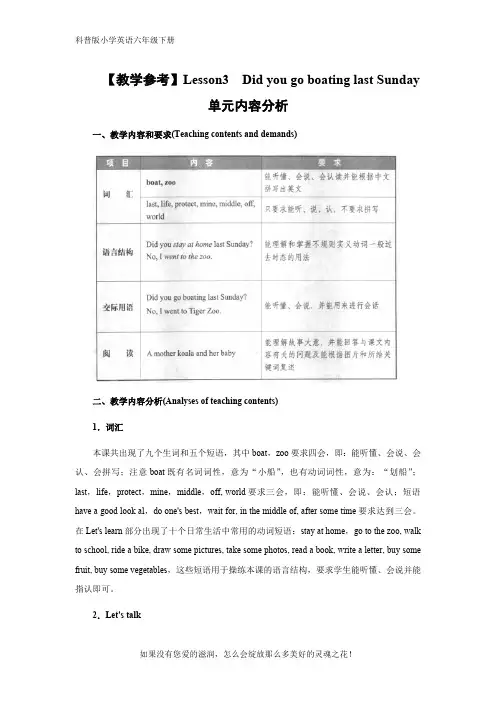
【教学参考】Lesson3 Did you go boating last Sunday单元内容分析一、教学内容和要求(Teaching contents and demands)二、教学内容分析(Analyses of teaching contents)1.词汇本课共出现了九个生词和五个短语,其中boat,zoo要求四会,即:能听懂、会说、会认、会拼写;注意boat既有名词词性,意为“小船”,也有动词词性,意为:“划船”;last,life,protect,mine,middle,off, world要求三会,即:能听懂、会说、会认;短语have a good look al,do one's best,wait for, in the middle of, after some time要求达到三会。
在Let's learn部分出现了十个日常生活中常用的动词短语:stay at home,go to the zoo, walk to school, ride a bike, draw some pictures, take some photos, read a book, write a letter, buy some fruit, buy some vegetables,这些短语用于操练本课的语言结构,要求学生能听懂、会说并能指认即可。
2.Let's talk本课的话题是“动物”。
通过询问“上周日做了什么?”引出话题,围绕该话题进一步学习一般过去时态,并且通过该话题,教育小学生们要爱护动物,保护环境。
本课的对话较长,教师要注意掌握操练的分寸,可以多操练几遍。
该对话中既有一般现在时态,又有一般过去时态,还有现在进行时态,句式也较复杂,所以多加操练,以便学生能更好地掌握。
3.语言结构本课和第二课一样,继续学习一般过去时态的一般疑问句形式及肯定否定回答,句型仍1日是Did you do sth …?但在本课当中,在作肯定回答时,更详细地说明了做了什么,练习使用更多的动词过去式,使学生进一步理解和掌握一般过去时态。
Lesson3DidyougoboatinglastSunday(教学设计)科普版英语六年级下册
Lesson 3 Did you go boating last Sunday? A mother koala and her baby Teaching design of a reading course Lesson 3 Read A mother koala and her babyPart 1 Analysis of the teaching materials1. This lesson is the reading part of Lesson3 A mother koala and her baby Book 8 of the Primary English.2. This lesson is about “A mother koala and her baby”. In this lesson, it requires the Ss to master the new words, such as middle, mine, etc......and guide Ss review the usage of past tense. The most important is not only to guide Ss how to read, but also to develop their reading methods, skills, their reading habits and enjoy the background culture of protecting the animals Part 2 Teaching aims1.Knowledge aims:1.1 Enable Ss to listen, speak, read, and understand the words such as: mine, off, world, and etc, and learn to use in the real situation.1.2 Enable Ss to read and understand the whole passage, and to finish the exercises and writing tasks.2.Ability aims:1. Develop Ss’ basic ability of listening, speaking, reading and writing, stimulate Ss language creation ability and then finish the task-based activities.2. Develop Ss’ the skills and the abilities of getting information anddealing with information in self-reading period.3. Develop Ss’ the skills and the abilities of studying in groups and cooperate with others.3.Emotion aims:1. Guide Ss think more and try their best to speak out their thoughts in class.2. Create a situation to cultivate the Ss to feel the scenery of protecting the animals, to stimulate them to love animals.Part 3 Teaching emphasis and difficulties.1. Difficulties:a: How to use the past tense to describe .b: Enable Ss to master the long sentence ,and try to say them fluently etc.2. Emphasis: Help Ss form the ability:a: Enable to read the materials according to the sentence group and then to understand the whole passage.b: Develop Ss abilities of getting information and dealing with information in self-reading period.Part 4 Analysis of the studentsThe students of Grade Six have already learned English for several years. They have acquired a base in English reading and learning experience. They can communicate with others with simple language. But they are not very clear in the way of English reading. Therefore I designthis lesson to try to have Ss learn some reading methods and skills, that is to make the reading lesson easy, and have the Ss understand the steps in reading practice.In the help of the multimedia, create more language environment to let Ss try to think and do in English.Part 5 Teaching procedures and my purposeIn this lesson I mainly used the task-based learning methods. I present the tasks with the help of listening, scanning, reading, intensive reading, discussing, and writing, etc. in order to help Ss finish the tasks effectively.I design the activities such as music leading, free talk, guessing game, telling stories, culture edification etc. and arrange individual work, pair work, group work for Ss to practice English.All the procedures are divided into three parts: Pre-reading, While-reading and Post-reading.Part 6 Teaching aidsmultimedia courseware, some pictures, and words cards, exercise paper, etc.Part 7 Teaching procedure Pre-readingStep1.Warm-up:1. Greeting2. Review:(1)Free talk(2) Look at the pictures, try to feel the lovely animals, and learn to say them.(3) Talk about the animals from Australia.While-readingStep1.Listen to the whole story and answer the main question.1. Look at the picture, guessing the meaning , and try to talk about it.(T sets a question before reading the story.) Who’s he? What was she doing?2. Read Part 1and Part 2 by Ss, after that try to answer the detail question.(1)Suddenly what happened?(2)How many cars in front of me?(3)What are they waiting for?[Methods and purpose: Before reading, Ss listen to the text, try to scan the story and know the basic information. Meanwhile, though listening, Ss can get a good pronunciation, intonation and sense of language. ]Step2. Learn Part 3-4 text intensively1.Read Part 3-4 by Ss.2. Ask and answer, try to understand the details of this part.a. What did I see?b. What did the mother Koala want to do?c. Are there any Koalas in the world?d. What do they do?3. Discuss:What should we do to protect them?(Try to think and say)[Methods and purpose: The aim of intensive reading is to cultivate Ss the ability of getting and dealing with the information. Intensive reading can help Ss get the main information and the details of the story. Discussing can check out the understanding level, and help them think deeply.]Post readingStep1 Watch some pictures with music, try to feel the good relations between human beings and animals.[Methods and purpose: After learning the whole passage, guide Ss review the main clue of the story, and try to say their own feeling, so as to practice their language ability.Step2. Homework1.Read A mother koala and her baby in groups..Read (会读): Speak (会说):2. Do you want to say something about your feelings, write down on the notebooks.[Methods and purpose: Homework is the output period in the post-reading. The homework design is to consolidate what they’ve learned, to practice language and develop their imagination and creation after class . ]。
六年级英语下册Lesson3《DidyougoboatinglastSunday》 精品优选PPT课件4科普版
Answer the questions
1.What do you usually do on Sundays? I usually go boating or swimming.
2.Did you go boating last Sunday? No,l went to Tiger Zoo.
3.How many tigers were there? There were about ninety.
near and have a good look at them. M:Oh! What fun!
Do the tigers live a good life in the zoo? D:Yes ,Tigers are rare in China. So people are doing their best to protect them.
4.Did you see many of them? Yes.
5.Do the tigers live a good life in the zoo? Yes.
Read and choose the right ones.
1.--How many tigers were there?
--__A___
• ( )5B.pr__t__ct A.e,y B.o,e C.o, i
• Ⅰ.Can you write them in the past?
• do-- did go-- went are-- were • can-- could say-- said look-- looked
• come--camepull— pulled sing-- sang
感知英语,激发起学生学习英语的兴趣,帮助学生树立
科普版三年级起点六年级下册英语《Lesson 3 Did you go boating last Sunda》(一等奖课件)
Part A
执教者:汪顺芳
动词的过去式变化分为:规则变化和 不规则一般在动词末尾加-ed. cleaned-cleaned wash-washed 2、以e结尾,直接加d. like-liked live-lived
表示过去时间的表达
last night last weekend last Monday
last year last summer holiday
last winter holiday yesterday
yesterday evening the day before yesterday
many years ago
3、以重读闭音节结尾,且词尾只有一个辅音字母, 应双写这个辅音字母再加-ed. stop-stopped plan-planned
4、以“辅音字母+y”结尾的,变y为i, 再加-ed; cry-cried study-studied
go — went ride— rode draw— drew take— took write— wrote buy— bought read— read
go ride
buy take
rea d
draw
write
—Did you stay at home last Sunday? —No, I went to the zoo.
—Did you + 动词原形(短语)? —No, I didn’t. I+过去式(短语).
—Did Tom stay at home last Sunday? —No, he didn’t. He went to the zoo.
科学普及出版社三年级起点小学六年级英语下册教案Lesson 3 Did you go boating last Sunday_教案4
Lesson 3 Did you go boating last Sunday?Lesson 4Teaching ContentRead (4.5.6), Look and sayTeaching Aims1.Knowledge aims:(1)To listen, speak and read the phrases: Walk off the road, in the world, do one's best to do sth(2)To listen and read the text.(3)To read and understand the " Look and say ".2.Ability aims:To comprehend the text, answer some questions about it, then retell it.3.Emotion aims:The text is a good way to educate the students to cherish life, love animals.Important and Difficult Points1.Difficult Points:To retell the text.2.Important points:To understand the text and the learning tips.Teaching AidsCAI, sound recordingTeaching ProceduresStep1.Revision:Review the words and phrases: read and translate;Read the text in last class.Step2.Presentation:Ⅰ.Learn the phrases:Walk off the road, in the world, do one's best to do sth(Read and find their meanings in the text)Ⅱ.Learn the text:1.Listen to the sound recording and perceive the text;2.Listen to the sound recording and understand the pictures;3.Listen, read and translate;4.To underline some difficult sentences and v-ed:get --- got, walk --- walked, start --- startedStep 3.Practice:Ⅰ.Read the text fluently and answer the questions:1.What did the koala do at last?2.Are there many koala in the world?3.How many kinds of animals are talked after the passage?4.What should we do to protect the animals?Ⅱ.(PPT/flip charts) To offer key words, pictures, and sound recording, let the students to read.Ⅲ.According to the information's, let the students to retell the text.Step 4.Look and sayⅠ.Listen to the recording;Ⅱ.Read after the recording and translate.Homework-writing1.Read the text five times or retell it;2.How do our best to protect the rare animals?Blackboard-writing:Lesson 3 (Read)A mother koala and her baby。
科普版小学英语六年级下册Lesson3 Did you go boating last Sunday优质教案
Lesson 3 Did you go boating last Sunday;听、说、读的单词和短语: last, life, protect,mine, middle, off, world, have a good look at, do one’s best, wait for, in the middle of, after some time …。
理解简单过去时态的用法。
理解和掌握句子结构: Did you stay at home last Sunday? No, I went to the zoo. 理解,说出和使用句子结构进行对话。
理解课文,回答一些问题,然后复述课文。
【知识目标】1.学生会听说读写下列单词: boat, zoo ;2.学生会听说读以下单词和短语: last, life, protect, mine, middle, off, world, have a good look at, do one’s best, wait for, in the middle of, after some time …;3.理解和掌握使用一般疑问句句型: Did you stay at home last Sunday? No, I went to the zoo.【能力目标】理解和掌握句子结构:理解、多说、多用句子结构进行谈话。
理解课文,回答一些问题,然后复述它。
了解简单过去时态的用法。
学生能结合自己的生活经验和英语知识,使用句型:Did you…..应用于生活中,能用此句型进行提问和回答。
【情感目标】通过对本课的学习,学生懂得使用本课重点句式与同学们进行交流,用过去时态来描述发生过的事情。
培养学生对时间变化的感受力,培养珍惜时间和生活以及爱护动物的情感态度。
掌握简单的过去时态的一般问题。
【教学难点】1.复述课文。
2.掌握简单过去时态动词形式的规则。
Tape recorder, MultimediaStep 1. Greetings and warm-up activities1. Free talk:--- What did you usually do on Sundays?--- I usually…--- Did you do your homework last Sunday?--- Yes, I did. No. I didn’t.--- Was it difficult?2. Learn the new words and phrases.boat (coat, road), last(fast,), last, life, protect, do one’s best, have a good look at(read, translate)3. Let’s talk.A. Answer the following questions:1. What does Dali us ually do on Sundays?2. Did Dali go boating last Sunday?3. Where did Dali go last Sunday?4. How did they see the tigers?5. Do the people protect the tigers?B. Listen to the sound recording and answer the questions.C. Read the dialogue after the recording.Step 2 Let’s learn.Did you stay at home last Sunday? No, I went to the zoo. 过去式:did went showed liked1. 选择一些学生背诵或表演对话。
小学英语科普版六年级下册Lesson 3 Did you go boating last Sunday教案模板范文
小学英语科普版六年级下册Lesson 3 Did you go boatinglast Sunday教案模板范文1重点难点教学重点:熟练掌握过去式不规则变化的动词并准确使用句型:Did you do …? I did …教学难点:将过去式不规则变化的动词替换到真实语境当中教学措施:为了达到教学目标,利用多媒体一些特有的功能和优势,采用灵活多样的教学方法,通过创设情境,设计任务,穿插游戏等活动,突出重点,突破难点,在课堂上落实六年级学生听、说、读、三项技能的训练。
真正做到“学中用,用中学”,体现英语教学的交际性。
2教学过程2.1第一学时教学活动1【导入】Lead in1.唱英语歌曲“Bingo”2.欣赏音乐“Yesterday once more”边听音乐边看一些老照片。
2【讲授】Presentation1.学习不规则动词的过去式1.T:There are some trains. Each train has a verb in it. Do you know their past tense?T:The first train ride, its past tense is rode. The second train is write, its past tense is wrote. These two words should change “I” to “o”.T:The third train is buy, its past tense is bought. We should erase uy and plus ought.T:The last train is draw, its past tense is drew. We should change aw to ew. T:go-went read-read/red take-took2.进一步强化动词的过去式T:There are some lucky eggs. You can pick an egg. Each egg has different scores. If you can answer it you can get the score.(小组竞赛:学生代表小组进行选择回答,将动词的原形与过去式进行匹配,回答正确可以获得鸡蛋上的分数)T:Can you find some secret?(出示动词不规则变化的顺口溜)。