
三年级英语上册Unit1lesson2教案北京版
Lesson 2
第一单元单元主题 SEPTEMBER 10TH IS TEACHER'DAY
课题Lesson 2 总课时 2
教学总目标【三维目标】
知识目标:
1. 能用序数词表达顺序,如“Is the first class Chinese”和“Yes, it is .”
2. 能听懂和认读序数词fifth, sixth, seventh, 以及 pupil, hi 和name, 并能在实际情境中运
用。
能力目标:
能听懂会说表达欢迎的功能用语并能在实际情景中初步学习使用.能在生活排序中和日期表达
中使用序数词。
情感目标:
能在迎接新同学的情景中,展示自己的热情和礼节。
教学重点、难点
教学重点:
1. 能问答“Is the first class Chinese”和“Yes, it is .”
2. 能认读词汇fifth, sixth, seventh.
教学难点:
1. “I’m American ”和“I’m from Canada”两句话的含义相似,但其中 American 和Canada 的词性和用法均不相同。
2. 关注sixth词汇中/s/和/Θ/ 连读时的发音
第一课时:
1. 能正确理解课文大意,并朗读课文,表演对话。
2. 初步感知句型Is the second class Chinese?
Yes, it is. 第二课时:
1. 能听懂、会说Is the second class Chinese? Yes, it is.
并能按照情景做出正确反应。
2. 巩固本课单词,理解并认读fifth, sixth,
seventh, pupil.能在相应的情景中进行
1。
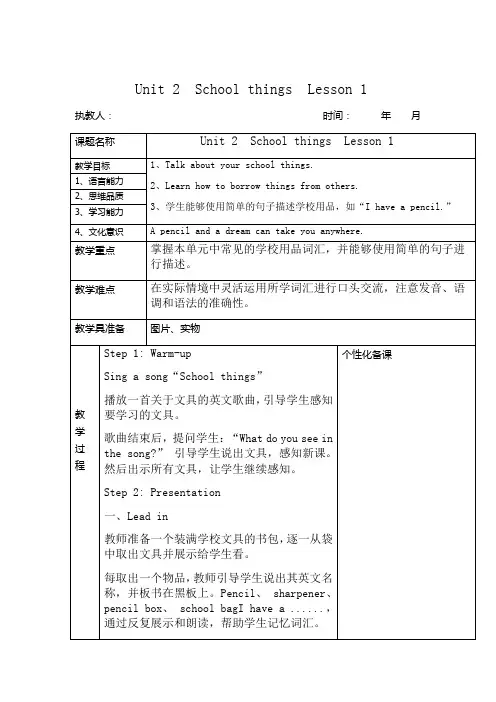
新版小学英语三年级教案,三上unit 2 Lesson 1 教案
2、思维品质
3、学习能力
4、文化意识
A pencil and a dream can take you anywhere.
教学重点
掌握本单元中常见的学校用品词汇,并能够使用简单的句子进行描述。
教学难点
在实际情境中灵活运用所学词汇进行口头交流,注意发音、语调和语法的准确性。
教学具准备
图片、实物
教师示范并强调每个词汇的正确发音和语调,引导学生跟读并模仿。
利用音频资源,让学生听录音并跟读,注意发音的准确性和语调的抑扬顿挫。
Step 3: Practice
一、Look and Say
T shows some pictures,let students say
the words.
二、Look,listen and tick.
小小收纳师:请说出句子,可将物品放好。
S: I have a _______ .
Step 4: Production
一、Let’s match. 词图配对。
二、Look,say and chant.
Pencil, pencil.
I have a pencil.I have a pencil.Me too. Metoo.Sharpener, sharpener.I have a sharpener.I have a sharpener.Me too.Metoo.
Unit 2 School things Lesson 1
执教人:时l things Lesson 1
教学目标
1、Talk about your school things.
2、Learn how to borrow things from others.
新北师大版英语三年级上册全册教案
新北师大版英语三年级上册全册教案课时一:Unit 1 Me and My FriendsLesson 1: Let's Make Friends教学目标:- 研究并认读单词:make, friends, friend, I, and, you- 在熟悉的语境下研究并复述句子:"I can make friends."- 能够用简单的句子描述自己和朋友教学准备:- 教学课件- 单词卡片- 学生练册教学步骤:1. 导入:让学生观看相关图片,引导他们讨论“朋友”和“交朋友”的话题。
2. 通过展示单词卡片的方式,教授新单词:make, friends, friend, I, and, you。
帮助学生正确发音并理解词义。
3. 在课件中展示简单的句子:“I can make friends.”,并纠正学生的发音。
利用肢体语言和示范,帮助学生理解句子的意思。
4. 师生互动练句子,并逐渐引导学生能够用正确的语音和语调表达句子。
5. 学生个别练和小组活动:让学生用自己的话描述自己和朋友。
鼓励学生尽量运用所学的单词和句子。
6. 小结:总结本课所学内容,鼓励学生用“朋友”和“交朋友”为话题展开讨论。
课堂作业:1. 完成练册上与本课相关的练。
2. 练和复述本节课所学内容。
课时二:Unit 1 Me and My FriendsLesson 2: Let's Sing教学目标:- 研究并唱歌谣:Make Friends教学准备:- 教学课件- 音乐播放器教学步骤:1. 导入:回顾上节课所学内容,引出本节课要研究的歌谣。
2. 播放演唱Make Friends歌谣的音乐,让学生先跟随音乐节奏拍手和跺脚。
鼓励学生积极参与。
3. 引导学生跟随音乐歌唱,帮助他们熟悉歌曲中的重要单词和短语。
4. 教师带领学生逐句学唱整首歌曲,并强调正确发音和语调。
5. 学生个别练和小组活动:学生分组进行唱歌比赛,评选最好的组合。
2024年秋新精通版(三年级起)英语三年级上册课件 Unit 1 Lesson 2

How do we greet at the special times?
When is it?
morning afternoon
How do we greet in the morning?
早上问好说 “G__o_o_d__m_o_r_n_i_n_g_!”
(6 a.m. — 12a.m.)
Good morning, Xinxin.
Look and predict (猜测)
students
Miss Wu
Who
Where
What
girls
boys
男孩
女孩
boys and girls 和
Look and predict (猜测)
In the classroom.
Who
Where
What
Look and predict (猜测)
Good evening!
Good afternoon, Miss Li!
Look and talk How will they greet each othe morning, Jenny!
Good afternoon! Good evening!
Good morning, Li Ming!
__S_t_a_n_d_u_p_!__
Listen and fill.
_S_i_t _d_o_w_n__, please!
stand up
起立;站起来
sit down
坐下
A Let’s talk.
听音频,大声跟读,并配音,注意语音语调。 Good morning, boys and girls!
Stand up!
Sit down, please! Good morning, Miss Wu!
2024新版三年级上册人教精通版 Unit1 Lesson 2教案
①通过图片学习stand up 和sit down,并且通过肢体语言来学习两个短语。
②以太阳的位置来学习morning、afternoon、evening,并巩固Good morning,引导学生依次说出Good afternoon、Good evening。
4)Play games. 打地鼠游戏,巩固所学短语。
5)听录音,回答问题。
6)播放课文录音,学生填空。
7)听录音,学习课文,让学生听录音,跟读,并要求学生用手指着句单词进行认读,力求做到“眼到、手到、口到、心到”,体会其英语句意,并且复习Misss read and act.做到老师点评、生生互评。
2)当学生们向老师问候 Good morning 时,教师不失时机地回答: Good morning, boys and girls. 为了便于学生理解 boy 和 girl 这两个单词的意思,教师可以先分别指着几个男同学说 boys ,指着几个女同学说 girls, 然后再说 Good morning, boys and girls.
3、学习能力
1.Learn to read and say the new dialogue.
2.Learn to read and write the words.
4、文化意识
学会用礼貌用语和别人打招呼。
教学重点
通过情景对话,让学生学习如何用英语相互问早上好。
教学难点
学习单词:boy,girl,and
小学英语学科教案
执教人:时间:年月
课题名称
Unit1 Greetings Lesson2
教学目标
1.通过情景对话,让学生学习如何用英语相互问早上好。
北师大版三年级英语上册全教案

Unit 1 Hello!Lesson 1Teaching aims:Hello! What’s your name? My name’s ….Listen and talk.Teaching emphasis:Asking names and giving one’s own.Teaching process:1. Warm-up (Greetings)Give each child an English name to use in class.Give each child an English name on a light card tag to pin on. As each name is assigned, say the name and have the class repeat it after you.2. Use English namesChoose one child. Ask, “What’s your name?” The child replies using the name of his or her card.If necessary, help with pronunciation. Repeat for the whole class.3. Introduce the charactersTell the children that they are going to read some stories about these characters:Uncle Booky, Mocky, Ken, Ann.Tell the children that they are going to meet some new friends.Hold up the mask for Peter and Wang Ling.4. Model the dialogUse any two of the masks. Use one mask and say, “Hello, what’s your name?”Use the other mask and reply, “My name’s … .”5. Talk about the storyHave the children open their books and talk about the characters.(What do you think they are saying?)6. StoryHave the class look at the pictures in their books as you play the tape.Play the tape again, and encourage the children to say the words.7. Sum up.HomeworkEncourage the childre n to practice greeting their family and friends in English, “Hello, my name’s … . What’s your name?”Lesson 2Teaching aims:Hello! What’s your name? My name’s ….Listen, say, talk and sing.Teaching emphasis:Asking names and giving one’s own.Teaching process:1. Review English namesSay, “Hello! What’s your name?” Encourage children to reply in turn,“My name’s … .”2. Review the characters with the masks.Ask, “What’s your name?” The children choose one character and then reply,“My name’s … .”Repeat with all the character masks.3. Learn to sayHave the class look at the picture at the top of the page.As you play the tape, have the class point to the character that is speaking.Replay the tape while displaying your copy of the page.As the tape is played, point to the words one at a time.Without the tape, read the words together. Have the children touch each word as they say it.4. Listen to thisPoint to each picture and ask, “Look at the picture, Who is saying?”Elicit children say out the right answer.Play the tape and have the children number each picture.Listen again and check the answer.5. Let’s singRead the words to the children, pointing to each word.Play the first six lines of the song, encourage the children touch the words in their books as their sing along.Play the last two lines of the song. Ask the children to sing these lines using their own English names.Try to sing along with the tape.Lesson 3Teaching aims:Hello! What’s your name? My name’s ….Listen, talk and read.Teaching emphasis:The correct writing of each letterTeaching process:1. Warm-upSing the song along with the tape.2. Talk togetherUsing the structures, review each child’s English name.Using the masks, review the structures in a speech chain.Ask and answer one by one.Have each child turn to the top of page 6 and display the page and model the dialog, pointing to the matching character as you speak.Organize a speech chain, where children substitute their English names for those that are underlined.3. Listen and numberI ntroduce the characters to children first.Explain that you want them to listen to the tape and touch the correct characters when they hear them say,“Hello!”Play the tape again, have them write the number of the sentence in the box beside each picture.Check the answer.4. Touch and sayDraw the children’s attention to the bottom part of page 9. Display your copy of the page, and explain that when you point to a character you will ask a child to tell the c lass what that character would say.If time allows, children could repeat the activity in pairs or small groups.5. Uncle Booky’s BlackboardHold up the What’s your name? Drill card and read it to the children point to the words as you read them.Have the children repeat the question after you.Now hold up the What is your name? Drill card and repeat the procedure. Explain that both structures mean the same thing.Point to the ’s of What’s and explain that the apostrophe mark shows that a letter has been left out.In the same way, review My name’s and My name is.Now have the children open their books at the top of page 9.Model the structures by reading.6. Read, match and colorReview the structure Hello! My name’s … . Using masks and name cards.Ask the children to practice reading sentences like My name’s … by using drill cards.Ask children to read the sentences in the 4 speech bubbles and match them with the characters who have said them. Ask children to draw a line between the speech bubbles and characters.7. Divide the class into two groups. Have one group repeat the questions, and the other groups repeat the answers. Use all possible combinations.8. Sum upHomeworkColor the pictures and letters for Aa, Bb, Cc, Dd at page 7.Lesson 4Teaching aims:Hello! What’s your name? My name’s ….(Phonics and writing)Aa Bb Cc DdListen, chant and write.Teaching emphasis:The correct writing of each letterTeaching process:1. Check the children’s work for last period.2. Sing the song.3. Introduce the letter Aa, Bb, Cc, Dd.Display your copy of the page. Draw the children’s attention t the pictu re of the thing beginning with Aa.Play the tape, pointing to the matching picture of the word.Replay the tape and have the children say the words aloud.Repeat the procedure for letters Bb, Cc, Dd.4. Uncle Booky’s ABCHave the children turn to the black and white copy of Uncle Booky’s ABC. They can trace over the letters Aa, Bb, Cc, Dd and color the picture.5. Listen for the letters.Draw the children’s attention to the pictures at the bottom half of page 8.Display your page. Point to each picture in turn and say the matching word.Now play the tape. As the children repeat each word they should point to its beginning letter.6. Write the letters.Say, “Watch me write the letter A.” Stand with your back to the class. Write capital letter A in the air, using large arm movements. Ask the children write the letter in the air with you.Repeat for the small letter a.Have the children trace and copy the letter Aa.Walk around the classroom and check the children’s work.Follow the same procedure for Bb, Cc, Dd.Tell the children that they will finish tracing over the letters for homework.7. Sum up for the structures and the letters.Lesson 5Teaching aims:Hello! What’s your name? My name’s ….Listen, read and write.Teaching emphasis:Use the structures in communicationTeaching process:1Let’s chantUse the flash cards and have children practice reading these words.Read the rhyme to the children, pointing to each word.Play the tape for the whole rhyme and have children listen and point to the words on the page.Play the tape again and have children join in, encouraging them to hum or clap with the rhythm.Put pictures of dog, cat, ball and apple on the blackboard. Ask children to point to these pictures when listening to the tape again or they can add some actions and act the rhyme out.2. Clap namesIn this activity the children practice sounding out the separate syllables in their English names.Model the children’s English names for them. As you say each name aloud, clap your hands together once for each syllable. For example: My name’s David. (Two claps.)Have the children repeat all their names after you, clapping as they do so.Start a speech chain, so that the children can each ask the question and sound out their names individually.If time allows, repeat the procedure, substituting the names of the characters in this book.Lesson 6Teaching aims:Wake up! One for you. One for me.Listen, read and write.Teaching emphasis:Consolidate the structures and vocabulary learned in this unitTeaching process:1. Uncle Booky’s Story timeTell the children that they are going to listen to a story.Play the tape, ask the children to listen to the story with their books closed.Have the children open their books, and look at the pictures.Ask them to look for familiar words in the story.Have children read the story silently, encourage them to try to guess the meaning of unfamiliar words.It doesn’t matter if they don’t know the words. The requ irement for this part is to understand the story.2. BingoThis is a vocabulary drill in the form of a game.Photocopy a Bingo Game board 1 for each child.The teacher calls out the different character names/words and the children find the correct picture in their game board. (make sure that you call out the names/words in a random order)The children circle the word or letter (in pencil)when they hear the teacher call it out.The children call out “Bingo!” each time they have circled a full column down th eir Bingo boards.At the end of the game, review all the vocabulary in a class drill.3. Self-assessmentHave the children do this part in pairs or in groups by themselves.Children should assess themselves according to their own situation.They should be encouraged to compare their results with and learn from each other.Students work in pairs in the first activity, practicing introducing themselves.For the second activity, have children group the words beginning with the same letter together and say them aloud.4. Conclude for this unit.UNIT 2 This is Danny DeerLesson 1Teaching Aims:1.he student can be understand the dialogue what’s mean.2.The students like to learn English.3.The students can be read the dialogue.Teaching Emphasis:1. Review: How can use “What’s your name?” in dialogue. And answer it.2. Emphasis sentence: This is…. This isn’t….Teaching Difficulty:How can use “This is….” ”This isn’t….” in dialogue.Teaching Medium:Step 1:1. Hold up mask for Lulu. Say, “This is Lulu.”2.Have the children say Lulu. Repeat this for Danny.3.Repeat several times, and have the children say the names.Step 2:T: Hold up mask for Mocky and say, “This is Mocky.” Have the children repeat the sentence after me.Repeat the procedure for all the other masks.Hold up each of the masks in turn, and say, “This is …”S: Make it.At last, hold up a mask but say nothing. Have the children make a sentence of their own.Step 3:T: Say, “stand up.” As you say this, s tand up. Then have the children stand up.Repeat the procedure for Sit down.S: Let the children stand up and sit down in response.T: Repeat the procedure for Open your books. And Show me a pencil.Step 4:Open the books.T: Ask these questions about the pictures:Picture 1: Who can you see in the picture?What are they doing?What do you think they are talking about?Picture 3: What are Ann, Ken and Mocky doing?Picture 4/5: Who do they meet?Picture 6/7: Do they like him?Picture 8: Who does Mocky see?Picture 9: How does Mocky feel?Picture 10: Has Mocky made a mistake?Picture 11: What is happening to Mocky?Step 5:Story: The students read after the tape.Explain that people often say” Oh, no.” ”Come on!” “Super”Homework:Explain that you want the class to tell their families about the new characters, Danny and Lulu.Lesson 2Teaching Aims:1.Understand the dialogue what’s mean.2.The students like to learn English.3.The students can be read the dialogue very expertly.Teaching Emphasis:1. Review: How can use “What’s your name?” very expertly in dialogue. And answer it.2. Emphasis sentence: This is…. This isn’t….Teaching Difficulty:How can use “This is….” ”This isn’t….”very expertly.Teaching Medium:Step 1:Review: “Hello! What’s your name?”“ My name is …”Step 2:T: “This is … “ “This isn’t …”S: Introduce your good friend’s name each other.Step 3:T: Touch a book in the classroom. Make sure all the children can see it. Say, “A book.”Repeat for a pen.Play the tape and touch each object as you hear the words.S: Have the children look at the pictures at the top of page 16.Step 4:T: Show me a pencil and so on.S: Show itStep 5:T: What is this?S: This is a book and so on.Step 6:Play games:Have the children open their books at page 17. Drew their attention to the box at the top of the page.Point to each of the object in turn, naming them in English as you do so.Look at the picture; ask each pair in turn to give the English word for a missing object.Lesson 3Teaching Aims:1.se the dialogues explain the mind.2.Keep the students like to learn English.3.The students can be introduced these good friends.Teaching Emphasis:1. Review: How can use “What’s your name?”in live. And answer it.2. Emphasis sentence: This is…. This isn’t….Teaching Difficulty:How can use “This is….” ”This isn’t….” in live.Teaching Medium:Step 1:Introduce your good friend’s name each other.Step 2:Student book page 18:Say to the children: “Open your books.”Display your copy of the page. Read the words slowly, pointing to each word as you say it. Substitute two of the children’s English names for the underlined names in the text.Step 3:Listen and number:T: Display your copy of the page.Point to the picture of Danny Deer..Say, “This is Danny Deer.”S: Have the children repeat the words as they point to the picture in their books.Repeat another people.T: play the tape. Touch the correct picture as you hear the words.S: Explain that you want them to write the number of the sentence in the box beside each picture as they listen to the tape.Step 4:Review the second letter: a, b, c, d.Learn the new letter: e, f, g, h, i.Replay the tape, and have the children point to the matching pictures in their book.S: replay the tape and have the children say the word aloud.Step 5:Repeat the procedure that was used to introduce the letter Ee and the word eggs.Homework:Have the children open their books at page 19. Explain that you want them to: Color all the Ee letters in one colorColor letters Ff, Gg, Hh, Ii in different colors.Lesson 4Teaching Aims:e the dialogues explain the mind.2.The students like to learn English.3.The students can be expertly introduced these good friends.Teaching Emphasis:1. Re view: How can use “What’s your name?” expertly in live. And answer it.2. Emphasis sentence: This is…. This isn’t….Teaching Difficulty:How can use “This is….” ”This isn’t….” expertly in live.Teaching Medium:Step 1:Write the letter Ee-Ii:Student book page 20T: Stand with my back to the class.Write capital letter E in the air, using large arm movements.Ask the children to write the letter in the air with you.S: Learn the teacher’s.T: Repeat for the small letter e.And another letters.S: Go on doing that.T: Tell the children that they will finish tracing over the letters.S: Write the letters.Step 2:Student book page 20Listen for E-I:T: Draw the children’s attention to the pictures on the bottom half of the page.Display you copy of the page.S: Open the book and do it.T: Show the pictures for teaching.Say the matching word, for Example: elephant.S: Read after the teacher.T: Now play the tape.S: Read after the tape and should point to beginning letter.Step 3:T: Show the pictures.Stop the tape.S: Have the children point to each picture in turn and say the beginning sound. Step 4:Student book page 21T: Hold up the This is drill card and read it to the childrenPointing to the words as you read them.S: Read.T: Repeat the procedure with the Danny drill card.S: Read and think it.T: Use another mask for drills such as: Monkey, Booky and so on.S: Make it.Step 5:T: Hold up the This is not drill card and read it to the childrenPointing to the words as you read them.S: Read.T: Repeat the procedure with the Danny drill card; say, “this is Monkey”.S: Read and think it.T: Use another mask for drills such as: Monkey, Booky and so on.S: Make it.Homework:Remind the class of the work they began earlier, tracing and writing the letters.color the pictures on page 20.Lesson 5Teaching Aims:1. Understand the sentence how can use.2. The students like to learn English.3. The students can be very expertly introduced these good friends.Teaching Emphasis:1. The letters.2. Emphasis sentence: This is…. This isn’t….Teaching Difficulty:How can use “This is….” ”This isn’t….” very expertly in live.Teaching Medium:Step 1:Match the names:Student book page 22T: Ask children to say the names of the characters in the picture.If I point at one character and ask children to say its name.S: Answer it.Then color the characters.Step 2:Sing a song:<<When you are happy>>T: Tape 1-2S: sing after the tape.I think the children will enjoy learning this song.T: Repeat the tape.S: sing it again.Step 3:Let’s chant:Student book page 23T: Show the picture for new words.S: Repeat the new words.T: Make sure the children can say these things when given a picture or a real object.Tell the children that they are going to learn a rhyme about a naughty elephant.Play the tape for that.S: The children like to learn that.T: Play the tape.S: read after the tape again and have themselves join in, encouraging them to hum or clap with the rhythm.T and S:Have children point to the pictures in their books as they listen to tape again or they can add some actions and act the rhyme out.Step 4:Homework:1. Color the picture on page 22.2. Sing the song or the rhyme to their families.Lesson 6Teaching Aims:1. Use the sentence is very expertly and read the dialogue.2. The students like to learn English.3. The students can be very expert introduced these friends.Teaching Emphasis:1. The letters.2. Emphasis sentence: This is…. This isn’t…. very expert in live.Teaching Difficulty:How can use “This is….” ”This isn’t….” very expert in live.Teaching Medium:Step 1:Review:1.Review the letters.2.Review the new words.3.Review the dialogues.4.Review the emphasis sentence.This prepares the children for the game later in the lesson.Step 2:Uncle Booky’s storytime:Student book page 24T: 1. Make a scene.2. Play the tape.S: read after the tape.T and S:Divide some roles for this story and do it.Step 3:Introductions:This game reviews the structures hello! My name’s (Ann ).and This is (Ann).T: Have the children either sit or stand in a circle.Explain to the children that they are going to play a game where they introduce themselves and their friends.S: Make a circle and introduce their friends by right.T: continue until all the children have had a turn.Step 4:Self-assessmentStudent book page 25Have the children do the part in pairs or in groups by themselves.They should assess themselves according to their own situation.They should be encouraged to compare their results with and learn from each other.T: Make some terms about two children.Try to introduce the characters by book.S: Try it.T: one child points to a picture, the other says the name and then checks the box that below.They switch their roles.S: Try to do it.T: The children work in pairs and circle the letters they have learned in this unit. Homework:Introduce your friends for your parents.UNIT 3 WHO’S THAT?Lesson 1Teaching Aims:1、Use the dialogues explain the mind.2、The students like to learn English.3、The students can be ask and answer.Teaching Emphasis:1. Read the dialogue.2. Emphasis sentence: Who’s that?Teaching Difficulty:Read and understand the dialogue.Teaching process:1.Review:Ready some maskT: Hold up the Ken mask and say, “This is Ken.”S: The children repeat, “This is Ken.”T: Do the same for the other masks.T: Hold up the Ken mask and say, “This isn’t Ann.”S: Repeat: “This isn’t Ann.”T: Encourage the children to finish my sentence with “This is Ken.”. Repeat the procedure, using the other masks.2.Practice greetings:T: Hold up our hand says: “Hello!”S: Say: “Hello!” each other.T: Call a student, another children say: “Hello!” with he/she.Model the dialogT: Put the character masks along the blackboard ledge.Stand at the side of the room.Choose one child to be your helper.The helper points to each mask in turn.For each mask you ask, “Who’s that?” model the answer, This is Ken.S: Repeat.T and S: repeat for the other five masks.3Talk about the storyStudent book pages 26-27T: say to the class, “open your books.”Have the children find pages 26 and 27.Ask these questions about the pictures:Picture 1: How many children are in the playground?What are they doing?Picture 2: Where is Mocky?Picture 3-5: What is Mocky doing?What happens nest?Picture 6-7: What do our two new friends look like?Where are they from?Picture 8: What is Mocky doing?Picture 9: What happened to Mocky?Picture 10: Was he hurt?What is happening now?S: Think it and answer it.4Story:T: Play the tape.S: Listening.T: At the end, explain that we say Oh! Poor Mocky!Poor her means “unlucky” or “unfortunate.”Give the word in Chinese for ouch!S: Listen and think.T: Play the tape.At the end, encourage the children to say.“Oh! Poor Mocky!”“Join us.”“Ouch!”S: Do it.Homework:Tell their families about Cathy and Tommy.Practice greeting their family and friends in English, saying “Hi,!”Lesson 2Teaching Aims:1.Understand the dialogues what’s mean.2.The students like to learn English.3.The students can be read the dialogues.Teaching Emphasis:1. How can use “Who’s that?” in dialogue. And answer it.2. Emphasis sentence: Who’s tha t?Teaching Difficulty:How can use “Who’s that?” in dialogue. And answer it.Teaching process:1.Review:1)The students can be difference between this and that.2)Take some mask for student, who can introduce that.3)Use some object on these table for drill the sentence like T.2.Conduct.Student book page 28T: 1) Drill the classroom activities “open your books.”.2) Look the picture at the top of the page.3) Pictures for countries.S: 1) Open the book.2) Look the picture at the top of the page and think it.3) Read after teacher and tape for countries.3.Play the tape:S: Whose name you hear, then to touch the character and readT: Check the children are touching the correct pictures before moving on.T: 1) Take several masks for students in front of the classroom.2) Play the tape, play one name stop a moment for students read.Example: This is Wang Ling. She from china.S: Read after the tape and think it next one.T: Play the tape and check the students’ write.S: Write the number for these hear.T: Replay the tape.S: Check it with these heard.4.Let’s song:T: play the tape.S: song after the tape.T and S repeat this activity.Homework:Teaching your parents for the dialogue and the new words.Lesson 3Teaching Aims:1、Understand the word s what’s mean.2、The students like to learn English.Teaching Emphasis:1.How can use “Who’s that?” in live. And answer it.2. Emphasis sentence: Who’s that?Teaching Difficulty:How can use “Who’s that?” in live. And answer it.Teaching process:1.Student book page 30T: Have the children open their books. Draw their attention to the exercise at the bottom of page 30.2.Play the tape.S: listen and number the pictures according to the tapes.Repeat this act, until the students all finish the answers.T: The whole class check answers.3.Introduce the letter J j.T: Open your book page 79Review the second-hand letters for Uncle Booky’s ABC.4.Learn the new words. For example: jeep1)Read the word2)Students read after the T3)Look at the picture for “jeep ”. E ncourage all the children to say the wordaloud as they touch it in their books.T: teach the new letters:Look the picture, read after the tape.Look other letters and read after the tape.Read after the tape aloud.Letters writing.T: teach the new words:1.Look the picture, read after the tape.2.Look other words and read after the tape.3.Read after the tape aloud.Homework:1.Color each letter Jj-Nn.2.Trace over the lettersJj-Nn of Uncle Booky’s ABC and color the pictures.Lesson 4Teaching Aims:e the dialogues explain the mind.2.The students like to learn English.3.The students can be expertly introduced these good friends.Teaching Emphasis:1. Review: How can use “What’s your name?” expertly in live. And answer it.2. Emphasis sentence: This is…. This isn’t….Teaching Difficulty:How can use “This is….” ”This isn’t….” expertly in live.Teaching Medium:Step 1:Write the letter Ee-Ii:Student book page 20T: Stand with my back to the class.Write capital letter E in the air, using large arm movements.Ask the children to write the letter in the air with you.S: Learn the teacher’s.T: Repeat for the small letter e.And another letters.S: Go on doing that.T: Tell the children that they will finish tracing over the letters.S: Write the letters.Step 2:Student book page 20Listen for E-I:T: Draw the children’s attention to the pictures on the bottom half of the page.Display you copy of the page.S: Open the book and do it.T: Show the pictures for teaching.Say the matching word, for Example: elephant.S: Read after the teacher.T: Now play the tape.S: Read after the tape and should point to beginning letter.Step 3:T: Show the pictures.Stop the tape.S: Have the children point to each picture in turn and say the beginning sound. Step 4:Student book page 21T: Hold up the This is drill card and read it to the childrenPointing to the words as you read them.S: Read.T: Repeat the procedure with the Danny drill card.S: Read and think it.T: Use another mask for drills such as: Monkey, Booky and so on.S: Make it.Step 5:T: Hold up the This is not drill card and read it to the childrenPointing to the words as you read them.S: Read.T: Repeat the procedure with the Danny drill card; say, “this is Monkey”.S: Read and think it.T: Use another mask for drills such as: Monkey, Booky and so on.S: Make it.Homework:Remind the class of the work they began earlier, tracing and writing the letters.Can color the pictures on page 20.Lesson 5Teaching Aims:1. Understand the sentence how can use.2. The students like to learn English.3. The students can be very expertly introduced these good friends. Teaching Emphasis:1. The letters.2. Emphasis sentence: This is…. This isn’t….Teaching Difficulty:How can use “This is….” ”This isn’t….” very expertly in live.Teaching Medium:Step 1:Match the names:T: Ask children to say the names of the characters in the picture.If I point at one character and ask children to say its name.S: Answer it.Then color the characters.Step 2:Sing a song:<<When you are happy>>T: Tape 1-2S: sing after the tape.I think the children will enjoy learning this song.T: Repeat the tape.S: sing it again.Step 3:Let’s chant:T: Show the picture for new words.。
三年级上册英语教案Unit1Lesson1北京版
三年级上册英语教案 Unit 1 Lesson 1 北京版教学内容本课为北京版三年级上册英语Unit 1 Lesson 1,教学内容主要包括:问候语、自我介绍、家庭成员介绍以及常用表达。
通过本课的学习,学生能够掌握基本的日常英语交流,并能够介绍自己及家庭成员。
教学目标1. 知识与技能:学生能够听懂、会说、会读本课单词和句子,能够运用所学知识进行简单的日常交流。
2. 过程与方法:通过听、说、读、写的训练,提高学生的英语听说能力和自主学习能力。
3. 情感态度与价值观:培养学生对英语学习的兴趣,提高学生的跨文化交际意识。
教学难点1. 单词和句子的发音及拼写。
2. 自我介绍和家庭成员介绍的语法结构。
3. 日常交流中的礼貌用语。
教具学具准备1. 多媒体设备:用于播放课件、视频和音频。
2. 教学卡片:用于展示单词和句子。
3. 学生练习册:用于课堂练习和课后作业。
4. 黑板和粉笔:用于板书设计。
教学过程1. 导入:利用歌曲或游戏等方式,激发学生的学习兴趣,营造轻松愉快的学习氛围。
2. 新课呈现:通过图片、实物等教学手段,引导学生学习本课单词和句子。
3. 操练:通过角色扮演、小组讨论等形式,让学生在实践中运用所学知识。
4. 巩固:通过听、说、读、写的训练,巩固学生对单词和句子的掌握。
板书设计1. Unit 1 Lesson 12. 主要内容:问候语、自我介绍、家庭成员介绍、常用表达3. 关键单词和句子:hello, my name is, this is my family, how are you, nice to meet you等。
4. 语法结构:自我介绍和家庭成员介绍的句型。
作业设计1. 听力练习:听懂本课所学单词和句子。
2. 口语练习:模仿课文录音,进行自我介绍和家庭成员介绍。
3. 写作练习:根据所学内容,编写一段自我介绍和家庭成员介绍的文字。
4. 课后阅读:阅读与本课内容相关的英语绘本或故事书。
课后反思本节课结束后,教师应认真反思教学效果,针对学生的掌握情况,及时调整教学方法和策略。
三年级上册英语教学设计-Unit1Lesson2-北京课改版
三年级上册英语教学设计Unit 1 Lesson 2北京课改版教学内容本节课主要围绕Unit 1 Lesson 2的内容进行教学,重点学习英语日常用语,包括问候、介绍、询问和回答等基本交流方式。
通过本课的学习,学生能够掌握基础的英语会话能力,并能在日常生活中进行简单交流。
教学目标1. 知识与技能:使学生掌握本课的日常用语,并能用英语进行基本的问候、介绍、询问和回答。
2. 过程与方法:通过听、说、读、写的训练,提高学生的英语口语表达能力。
3. 情感态度与价值观:培养学生对英语学习的兴趣,激发学生的求知欲,提高学生的自信心。
教学难点1. 词汇的发音和记忆。
2. 句型的正确运用。
3. 英语听力的理解和反应。
教具学具准备1. 多媒体教学设备。
2. 英语教材。
3. 词汇卡片。
4. 录音机。
教学过程1. 导入:利用图片或实物,引导学生复习上一节课的内容,为新课的学习做好铺垫。
2. 新课展示:通过多媒体展示新课的日常用语,引导学生跟读,并进行角色扮演。
3. 操练:分组进行对话练习,教师巡回指导,纠正发音和语法错误。
4. 应用:设计情景,让学生运用所学知识进行实际交流。
6. 作业布置:布置课后作业,巩固所学知识。
板书设计1. Unit 1 Lesson 22. 词汇:展示本节课的重点词汇,并标注音标。
3. 句型:列出本节课的重点句型,并标注中文翻译。
4. 注释:对难点进行注释,帮助学生理解和记忆。
作业设计1. 听力练习:听录音,完成相关练习。
2. 口语练习:模仿录音,进行口语练习。
3. 书面作业:完成课后练习题。
课后反思本节课结束后,教师应认真反思教学效果,针对学生的掌握情况,调整教学策略,以提高教学效果。
同时,教师还应关注学生的学习兴趣和自信心,鼓励学生积极参与课堂活动,提高学生的英语学习兴趣。
通过本节课的学习,学生应能掌握基础的英语日常用语,并能在日常生活中进行简单交流。
教师应关注学生的实际运用能力,提高学生的英语口语表达能力,为今后的英语学习打下坚实的基础。
三年级上册英语教学设计Unit 1 Lesson 2_北京课改版
UNIT ONE SEPTEMBER 10TH IS TEACHERS' DAYLesson 2教学设计一、教学目标1.能用序数词表达顺序,如“Is the second class Chinese?”和“Yes, it is.”2.能听懂和认读序数词fifth、sixth、seventh,以及pupil、hi和name,并能在实际情景中运用。
3.能在迎接新同学的情景中,展示自己的热情和礼节。
二、教学重难点1.教学重点:(1) 能问答“Is the second class Chinese?”和“Yes, it is.”(2) 能认读词汇fifth、sixth和seventh,以及pupil、hi和name。
2.教学难点:(1) “I'm American.”和“I'm from Canada.”两句话的含义相似,但其中American和Canada的词性和用法均不相同。
(2) 关注sixth词汇中/s/与/θ/连读时的发音。
三、教具准备教学挂图(组合图)、单词卡片(本课词卡及游戏用卡片)、头饰(教材人物)、图片、世界地图(突出美国和加拿大)、与教材内容一致的课程表、多套空课程表和课程贴纸、给学生的奖品(贴纸及贴有the first、the second等标牌的小奖品)、录音机、教学课件等。
四、教学步骤(一) Listen and say1.导入(1) 教师走进教室,向学生问候:“Hello, boys and girls!”(2) 如果本学期有新转进的学生,教师形容该学生,请其他学生猜测,如:“This is a girl. She is tall and thin.”学生猜中后,教师指着该学生继续介绍说:“×× is anew pupil. She is from ….”如果本学期没有新转进的学生,教师可以拿出其他班级新转进学生的照片,介绍说:“××is a new pupil. She / He is from ….”2.学习对话1(1) 观察对话背景,猜测图中人物。
三年级英语上册 Unit1 lesson2教案 北京版
1.“I’m American”和“I’m from Canada”两句话的含义相似,但其中American和Canada的词性和用法均不相同。
2.关注sixth词汇中/s/和/Θ/连读时的发音
第一课时:
1.能正确理解课文大意,并朗读课文,表演对话。
2.初步感知句型Is the second class Chinese?
I’m fromCanada.
学习新单词Ame rica和Canad a.,了解表示国家名称的词开头字母都要大写。
(3)听录音,并分句讲解
A.Is the second class Chinese?
Yes, it is.
引导学生了解词Chinese
跟读录音。
B.We have two new pupils
设计意图:通过贴词活动,巩固学生对单词和句型的理解能力。
V. Summary
1. Do you remember the sentence?
2. Can you read these words?
VI. Homework:
1. Recite the dialogue.
2. Copy the new word s .
课后补充备课
能力目标:
能听懂会说表达欢迎的功能用语并能在实际情景中初步学习使用.能在生活排序中和日期表达中使用序数词。
情感目标:
能在迎接新同学的情景中,展示自己的热情和礼节。
教学重点、难点
教学重点:
1.能问答“Is the first class Chinese”和“Yes, it is .”
2.能认读词汇fifth, sixth, seventh.
板书设计
Lesson 2
【精品】三年级上册英语课件-Unit 1 Lesson 2 I'm Ann 北师大版 (共17张PPT)
Hello, my name’s Ken.
Hi, my name’s Ann.
Hi/Hello, my name is… My English name is…
4
Task 3 Act out Lesson 1 表演第一课故事
Tips:和组员合作表演故事。
2. 能读懂故事,会表演故事。
3. 会唱歌曲:Hello!
2
Task 1 You ask and I answer 你问我答
Tips:小组成员模仿图中的对话,互相问答。
Hello! What’s your name? My name’s Mocky.
3
Task 2 Introduce yourself 自我介绍
Tips:自读课文,想一想Uncle Booky 和孩子们是怎样打招呼的,又 是怎样自我介绍的。
10
Task 6 Listen and follow听一听,并跟读
来看看
Come and meet Uncle Booky!
Good morning, children!
Hi! I’m Uncle Booky. What’s your name?
Hi. Hello!
What’s your name?
What’s your name?
My name’s Mocky. What’s your name?
My name’s Ann. My name’s Ken.
5
Task 4 Watch and answer看动画回答问题
Tips:仔细看动画,注意听清楚新朋友的名字
北师大版(三起)-三年级英语上册 Unit1 Hello!