
Module 4 Unit 1
3. Be especially careful with the door. 尤其要注意门。 Be careful with 小心;照顾 Be careful with that cat.小心对待那只猫。 Be careful with your health. 注意你们的身体健康。 especially adv. 特别;尤其;格外 I like to swim, especially in the sea. 我喜欢游泳,尤其喜欢在大海中游泳。
短信 /'kʌpl/
一对;两个
两个;少数几个
platform n. 平台;月台,站台;坛;讲台
The train was about to leave and I was not even on the platform. 火车就要开了,而我 甚至还没有赶到站台上。 Nick finished what he was saying and jumped down from the platform. 尼克讲完 话,从讲台上跳了来。
1. Work in pairs. Talk about the picture.
2. Listen and answer the questions. 1. Where are Betty and her parents? They are in the station. 2. Is Betty travelling with her parents? No.
3. Listen again and complete the sentences.
on your own 1. Will you be OK at home ________________? miss 2. I’ll _________________ you too, and I’ll call you every day. be proud of 3. I’ll keep it tidy so that you’ll ____________ me when you get home.
1. Betty’s parents are going to the meeting in Lhasa ___________________.
2. Betty’s mum tell her to______________ shut the door when ______________________________ she is in and lock it when she goes out. look after herself. 3. Betty can__________________________ wake her up 4. Betty’s parents usually______________ in the morning. __________________. given her their 5. Betty’s mum has not _______________ address in Lhasa! ______________.
text
n. [计] 文本;课文;主题 We have reviewed the whole text. 课文全复习完了。 I texted him yesterday. vt. 发短信 我昨天给他发短信了。 text message 短信 Send a text message to this number. 发送短信到这个号码。
1. It’s leaving from Platform 2. 该从二号站台离开了。
(1). Leave (vt)译“离开”。 leave+地点名词 离开某地 eg. We leave school at 5:00 in the afternoon. 我们下午5点放学。 Leave from 从……离开。 You can’t leave from here. 你不能从这儿离开。
Betty: Send me a text message. Have a good trip! Mum: Bye, my dear! Betty: Bye! See you in a couple of weeks!
Now complete the sentences. There may be more than one answer.
2. The meeting in Lhasa is very important for us. 在拉萨召开的这次会议对我们很重要。 (1). be important to sb. , 是说对某人很重要, Money is important to her. 钱对她很重要。 (2). be important to do sth. 做……(对某人) =be important for sb. to do sth. 很重要 It is important to keep fit. 保持健康很重要。 It is important for us to learn English. 学习英语对我们来说很重要。
/klɒk/ /rɪŋ/
/'pæsɪndʒə/ /ə'dres/ /tekst/
钟;时钟 n. 鸣响;发出声音 v. rang /ræŋ/ rung /rʌŋ/
乘客;旅客 n.
clock ring passenger
地址 n.
文本;正文 n.
address
text text message couple a couple of
lock v.锁,锁住
Lock up all the doors before you go out. 出门之前锁上所有的门。
wake sb. up v. 叫(某人)起床
Who wake you up every day? 每天谁叫你起床?
passenger n.乘客;旅客
There are many passengers on the train. 火车上有好多乘客。
(4). leave 译为“留(保留)”, leave(vt)+sb +sth=leave+sth+to sb 把某物留给某人 此时leave叫“双宾语动词”,且leave必须与to 搭 配。 I left my clothes to him.=I left him my clothes. 我把衣裳留给了他。
They walked a couple of miles. 他们步行了几英里 vt. 1. 连接;结合;把...拴在一起(+to/together/with) 2. 联想;与...联系起来(+with) His intelligence, coupled with her patience, overcame all difficulties. 他的智慧,配上她的耐心,克服了重重困难。 His name was coupled with hers. 他的名字与她的连在了一起 。
(2). leave 与for连用, Leave for+地点名词 译“动身去某地” He will leave for London next week. =He will go to London next week. 他下周要去伦敦。 (3). leave(vt)+sth+表地点的介词短语 译“把 某物忘在某地” 切记:不能用forget. I left my English book in the classroom yesterday. 昨天我把我的英语书忘在教室里了。
4
Unit 1
I can look after myself, although it won’t be easy for me.
If your parents are not at home, would you look after yourself? Would your life be OK?
couple
n. (1). 夫妇;未婚夫妻;一对舞伴 The young couple is w the bag. 这对年轻的夫妇在街上散步,袋子里提着小婴儿。
(2). (一)对,(一)双+of / 几个, 三两个(S)+of
meeting
会议;会见;集会; 汇合点
We all attended the meeting. 我们全体都参加了会议。 She gave us Saturday as our day of meeting. 她指定星期六为我们的 集会日。
shut v. 关上;合上
She shut the door. 她把门关上了。
If my parents are out, I would…
Lock the door well
Clean the room
Watch TV
Play games
Listen to music
Cook meals
Clock
Go to sleep on time
Ring
platform /'plætfɔ:m/ (供上下火车用的) 月台,站台 n. meeting /'mi:tɪŋ/ 会议;集会 n. miss /mɪs/ 未出席;未出现 v. shut /ʃʌt/ (shut shut)关上;合上 v. lock /lɒk/ 锁,锁住 v. /'sɪmpl/ simple 简单的;容易的 adj. anybody /'enɪbɒd/ 任何人
Shut it when you’re in and lock it when you go out. Betty: Yes, Mum. I can look after myself, although it won’t be easy for me. Mum: Well, make sure you eat plenty of fresh fruit and vegetables. And I’ve left lots of your favourite biscuits. Betty: Don’t worry. I can cook simple meals. Dad: There won’t be anybody to wake you up in the morning. Betty: I’ll be fine. My clock rings so loudly that
Module-4-unit-1-Mum-bought-a-new-T-shirt-for-me

Read .
Sam: I’m so sorry, Lingling.
Amy: I’m sorry too.
Lingling:That’s OK.
没关系。
Read .
Lingling: Look, this is my new kite. Amy: Oh, it’s beautiful. Sam: The cat is so cute!
5.let’s= let us 让我们
比一比,看谁填的最快,最准确
to 1.He ___ (想要)wear it. wants ___
for me. 2.Mum bought it ___ on the line. 3.Your red T-shirts are __ 4.Let’s ___ go .(去)
they their
主格
my
形代
mine yours his hers 名代 its ours yours theirs
重点短语
1.want to +动原 想要做某事 2. buy 某物 for 某人 给某人买某物
3.wash….for 为…..洗 …
4. on the line let’s 后加动原 在绳子上
注: 1.单三后边动词加“s” 2. 运用以上词组进行造句
连词成句。
the, matter, is, What?
What is the matter? a, for, Mum, me, T-shirt, bought, new.
Mum bought a new T-shirt for me.
连词成句。
Do, like, shorts, pair, this, you, of?
Do you like this pair of shorts?
外研版初中九年级上册英语 Module 4【早读手册】 Unit 1 早读手册
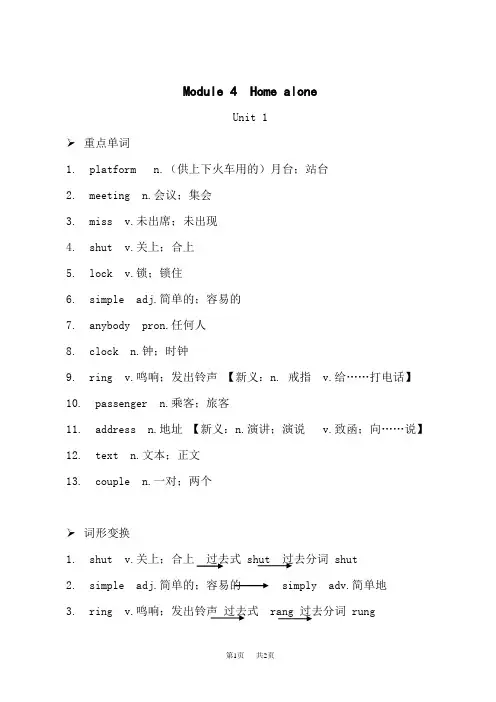
Module 4 Home aloneUnit 1➢重点单词1. platform n.(供上下火车用的)月台;站台2. meeting n.会议;集会3. miss v.未出席;未出现4. shut v.关上;合上5. lock v.锁;锁住6. simple adj.简单的;容易的7. anybody pron.任何人8. clock n.钟;时钟9. ring v.鸣响;发出铃声【新义:n. 戒指 v.给……打电话】10. passenger n.乘客;旅客11. address n.地址【新义:n.演讲;演说 v.致函;向……说】12. text n.文本;正文13. couple n.一对;两个➢词形变换1. shut v.关上;合上过去式 shut 过去分词 shut2. simple adj.简单的;容易的 simply adv.简单地3. ring v.鸣响;发出铃声过去式 rang 过去分词 rung4. advise v.劝告;建议 advice n.建议;劝告;忠告➢重点短语1. text message 短信2. a couple of 两个3. be careful with 小心……4. make sure 确保➢重点句型1. 我也是(很遗憾),但是我不能两周不上课。
So am I, but I can’t miss two weeks of school.2. 尽管那对我来说并不容易,但我能照顾自己。
I can look after myself, although it won’t be easy for me.3. 我的闹钟很响,它肯定能把我叫醒。
My clock rings so loudly that it will certainly wake me up.。
Module 4 Unit 1 八年级英语下册(外研版)
6.take your temperature 量一量你的体温 eg:Have you taken your temperature?你量体温了吗?
take常见的用法:
魔法
典记例忆完成句子。 (1)你最好先量一下他的体温。 You'd better __t_a_k_e___ _h_i_s_____ _te_m__p_e_r_a_tu_r_e__ first. (2)记得饭前吃药。
do more exercise
sleep well
eat more vegetables have more fruit
Language points
1. I feel ill. feel ill 感觉不舒服,感到身体不适。feel是系动词,后常跟形容词作表语,构成
系表结构。ill是形容词,意为“不健康的,生病的”,其比较级和最高级分别为 worse、worst。ill 的名词形式为illness(疾病)。 例:You should go to the doctor if you feel ill. 如果你觉得不舒服,就该去看医生。
【拓展】器官名词后缀-ache表示部位疼痛
tooth+ache = toothache (牙痛) head+ache = headache (头痛) back+ache= backache(背痛) stomach+ache = stomachache(胃痛) ear+ache= earache (耳朵痛) heart+ache= heartache(心痛)
例:That’s why he got angry with me. 那正是他对我生气的原因。
Tom overslept this morning. That is why he was late for work. 汤姆今天早晨睡过头了。 那就是他上班迟到的原因。
外研社英语七下册 Module 4 Unit 1
Complete the passage with the correct form of the words and expression from the box.
able any more free level maybe need question teltphone
句中的 “by”表示方式,意思是“用……,靠……通过……”。 例如: Send it by air mail. 用航空邮件寄吧。 They want to travel by train. 他们想坐火车旅行。
Computer won’t be able to do that. 计算机无法胜任。 句中的 “be able to”的意思是“能够,会,胜任”。
相当于 can,比起 can 来可以用于更多的时态中。例如:
(1)be able to do sth. “能够做某事”, be的形式随着时态的变化而变化。
(2)can 情态动词, 后用动词原形,表示能力,请求或允许等。
I’m able to swim. = I can swim. 我会游泳。
再如: They will be able to tell you the news soon. = They can tell you the news soon. 他们很快就能够告诉你这个消息了。 He was able to write when he’s three. = He could write when he’s three. 他两岁就会写字了。
School is good fun and you can make friends there.
Module 4 Unit 1小学一年级英语教案

Module 4 Unit 1小学一年级英语教案教学目标1.学生能正确说出以下单词:apple, banana, pear, orange。
2.学生能使用英语表达“我喜欢…”3.学生能理解并回答关于喜欢的英语问题,例如“Do you like apples?”教学准备1.单词卡片:apple, banana, pear, orange2.图片、卡通贴画等教具3.CD机和录音CD4.课本和练习册教学步骤Step 1:引入在引入时,可以使用图片、卡通贴画等教具,让学生对水果有一个直观的认识。
教师可以把水果从教师桌上拿出来,和学生共同观察。
先问(看):What fruit is this? 然后教师可以边出示卡片边读单词,慢慢教会学生apple、banana、pear、orange这四个单词。
教师可以通过比较这四种水果的颜色、形状、口感和味道等,让学生了解水果的不同特点。
例如:•Apple is red, yellow or green. It’s round and firm. It’s juicy and sweet.•Banana is yellow. It’s long and curved. It’s soft and sweet.•Pear is green or yellow. It’s pear-shaped. It’s juicy and juicy and sweet.•Orange is orange. It’s round. It’s juicy and sour.Step 2:教授问答教师可以使用手势和肢体语言帮助学生理解以下问答。
Q: What fruit do you like?A: I like apples/bananas/pears/oranges.教师可以把这个问答反复练习、模仿。
在这个活动中,可以训练学生音标的发音、认读字母和单词,也可训练学生的听力和口语表达能力。
Module 4 Unit1 Mum_bought_a_new_T shirt_for_me
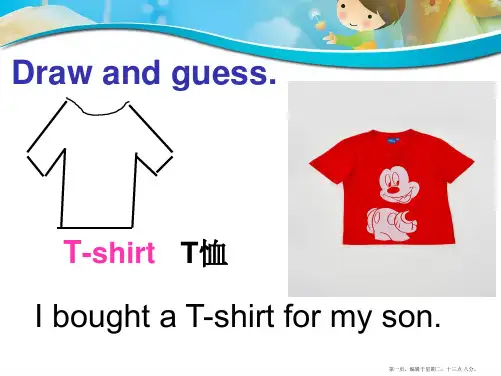
T- shirt for me.
第二十七页,编辑于星期二:十三点 八分。
Your red T-shirts are on the line. I washed them for you. Look!
第二十八页,编辑于星期二:十三点 八分。
Lingling’s
T-shirt
They are on the line. 4.Did Ms Smart wash Lingling’s T-shirt?
No, she didn’t. 5.Is Lingling’s T-shirt clean?
Yes, it is. Lingling didn’t wear it.
第二十五页,编辑于星期二:十三点 八分。
Don’t argue!
What’s the matter?
第二十六页,编辑于星期二:十三点 八分。
But it isn’t your T-shirt. Mum bought it for me.
Sam took my T-shirt.
He wants to wear it.
No, she didn’t.
第十六页,编辑于星期二:十三点 八分。
sweater
第十七页,编辑于星期二:十三点 八分。
coat
第十八页,编辑于星期二:十三点 八分。
Mum bought a
for me
第十九页,编辑于星期二:十三点 八分。
Let’s learn
buy bou#43;某人
clean
She didn’t w穿ea(r过it去. 式wore)
第二十九页,编辑于星期二:十三点 八分。
I’m so sorry!
Module4 Unit 1 Mum bought a new T-shirt for me教案_
Module4 Unit1教案一、教学目标(Teaching aims)(1)学生能听懂,会说,会用词汇it, it’s, a/an, my, look, red, yellow, blue, green, black, panda, chameleon.(2)学生能理解并正确运用句型: It’s red. It’s a/an…(3)学生能用简单的英语组织思维,能在语境中听懂、说对、会读、本课重点词句;会说明事物的颜色特征。
二、教学重难点(Teaching points and difficulties)(一)重点(Points)(1)会读,会用单词:i t, it’s, a/an, my, look, red, yellow, blue, green, black, panda, chameleon.(2)理解会读句型: It’s red. It’s a/an…(二)难点(Difficulties)会用本课句型任意说明事物的颜色特征。
三、教学准备(Teaching preparation)不同颜色的变色龙图片,3种颜色的鱼的卡片,多媒体PPT课件。
教学过程采用任务型教学法、情景教学法、交际法。
四、教学过程Step 1: Warm-up & Lead in1. Greetings.师生简单打招呼,然后学生之间互相打招呼。
2.出示幻灯片第2页,看一张动物的图片问学生What is this?这是什么?What do you know about it? 学生讨论回答,从而引出本课的新单词chameleon。
Step 2: Presentation1. Let’s learn.通过ppt第4-9页呈现变色龙图片,讲解变色龙的颜色的改变和一些实物展示学习新单词和句型look, it’s, It’s red/ yellow…2. 教材活动1:Listen, point and say.(1)出示幻灯片10页,看本课的插图,这些鱼都是什么颜色的,试着用刚学习的颜色词汇回答。
Module 4 unit 1 短语句型2021-2022学年外研版英语八年级下册
Module 4 Seeing the doctorUnit1短语1.胃痛,肚子疼have (got) a stomachache 头疼have(got) a headache 牙疼have (got) a toothache 发烧have(got) a fever / get a fever 感冒have a cold / catch a cold 咳嗽get a cough2. 从周五开始since Friday3. for about three days大约三天4.be ill / fall ill 生病5. 量体温take one’s temperature6.浑身;到处all over7.That's the problem 那就是问题所在8.do/get/take exercise =do sports 做运动,锻炼9.too much time 太多时间10.对...有害be harmful to... /do harm to ...11.Don't worry别担心12.three times a day 一天三次13.give you some medicine 给你开些药take the medicine服药,吃药14.give you a stomach ache让你胃疼15.than usual 比平常Unit 1 句型 1.How can I help you ?=What's the matter with you?你怎么了?2.---How long have you been like this ?你像这样多久了?---Since Friday.I have been ill for about three days.从周五开始。
我病了大约三天了。
3.---Have you caught a cold ?---I don't think so.---你感冒了吗?---我认为不是这样的。
英语Module 4 Unit 1 Mum bought a new T-shirt for me-
16
Listen and answer the questions!
2. Did Ms Smart wash Lingling’s T-shirt? Why?
Where are Sam and Amy’s T-shirts?
They are on the line.
No, she didn’t. Because Lingling’s T-shirt is clean.
14
on the line 在线(绳)上
Your red T-shirts are on the line.
你们的红色T恤衫晾在绳上。
15
No, I didn’t. Lingling’s T-shirt is clean. She didn’t wear it.
Did you wash Lingling’s T-shirt?
7
argue 争论, 争吵
Don’t argue ! 不要争吵!
8
What’s the matter?=What’s wrong?怎么了?
matter 问题,麻烦
What’s the matter?
9
What’s the matter with you?= What’s wrong with you?
萨姆拿走了我的T恤衫。
12
wear穿
worewear的过去式
He wants to wear it.
他想穿它。
want to+动原 想去做某事
13
No, she didn’t. Mum bought a new T-shirt for me.
But it isn’t your T-shirt. Mum bought it for me.
外研版英语八年级上册Module 4 unit 1 课文
Unit 1 He lives the farthest from school.
他住的离学校最远。
I was late for school today. 今天我上学迟到了。
Why? What happened? 为什么?发生什么事了?
那么骑自行车去怎么样? (what about+ving)
That’s a good choice, but it’s a bit dangerous.
那是个不错的选择,但有点危险。
There’s so much traffic. 交通那么拥挤。
But most of my classmates ride bikes, and it’s quite safe.
但我的大部分同学都骑自行车,而且相l be careful.
不用担心,我会小心的。 (I’ll= I will)
How does Tony go to school? 托尼怎么去上学?
He lives the farthest from school, so he takes the underground.
I took the bus.
我坐公共汽车。 (take 过去式:took)
There was a road accident, and the traffic was very heavy.
路上出了交通事故,且交通很拥挤。
But nobody was late, except me. 但除了我,没有别人迟到。
好的。你可以骑自行车去学校,但记着始终 要小心。
The end
How about Daming? 大明呢?