
高中英语 Unit 4《Body Language》教案(4) 新人教版必修4
Body language一、教学目标与要求通过本单元教学,使学生了解身势语在各国人民交往中的重要性。
了解在各国不同身势语所表示的不同的交际含义,并以此来学习一些国家的风俗习惯和文化背景,学会如何礼貌待人;学生能运用所学语言,对不同的身势语及其含义进行介绍;复习动词不定式作宾语、定语、表语和状语的用法;复习表述提供帮助积应答的用语;正确完成练习册安排的练习。
二、教学重点与难点1.重点词汇 manage;wave;nod;realize;agreement;disagreement;while;manners;communicate;make sb.…;body language;one another;not all…2.重要句型 1)Although we may not realize it,when we talk with others we make ourselves understood not just by words. 2)But not all body language means the same thing in different countries.3)In some Asian countries,you must not touch the head of another person.4)But English people do not like to be too close to one another unless there is a rea-son.3.语法复习动词不定式作宾语、定语、表语和状语。
(The Infinitive) 1) They don’t like to be too close to one another.2)They will move back to keep a certain distance away.3)Have you got anything to say?4) It’s a pleasure to meet you.5)Waving one’s hand is to say “Goodbye”.6)I don’t know how to communicate with foreigners.4.日常交际用语提供帮助和应答(Offers and responses)1) Can I take those boxes for you?2)Thanks.Thst’s very kind.3)What about your bag?Would you like me to carry it?4)No,thanks.I can manage it myself.5)Is there anything else I can do for you?6)No,thank you.Thanks for all your help.7)Shall I show you how to use this electrical typewrit-er?8)Thanks.I haven’t used this one before.三、课型(一)对话课Ⅰ.教具录音机、投影仪。
Ⅱ.课堂教学设计1.教师可通过以下句子导入正课:What do we do if we have something to tell others or if we want to learn something from the others?Yes,we use our language,that is,either spoken language or written language. But actually,there is another kind of language and it is also very important.Do you know what it is?Yes,that is it.That is the body language.Can you tell me something about body language? For example,if you agree with what I said just now,what do you do?And if you don’t agree with what I said,what do you do?2.准备放对话录音,用投影仪打出听前提问:1)Do the speakers know each other?How do you know?2)If you want to refuse somebody’s offer politely,what would you say?放录音一至两遍,请一位同学回答上述问题。
Key:1)No,they don’t. One is the organizer of a conference and the other is a speak-er and the dialogue takes place at the airport.2)No,thank you.Thanks for all your help.3.再放录音,学生跟读一至两遍。
学生两个人一组,练习对话三至五分钟。
教师请几组同学到前面表演。
4.教师指导学生归纳本课中所出现的有关提供帮助和应答(Offers and responses)的常用语(见日常交际用语部分)。
要求学生能熟练掌握这些语句,并在编练新的对话时加以运用。
5.组织学生两个人一组,练习Oral practice所提供的问答练习。
教师可请几组同学进行问答表演。
6.教师提供如下情景,组织学生编演新的对话:Situation 1:Someone has got a broken bicycle.He asks for your help.And you offer to repair this bicycle.Situation 2:You offer to fix one’s TV set.Situation 3:You offer to check one’s computer.学生可任选其中之一的情景编小对话。
数分钟后,请两组同学到前面表演。
7.布置作业 1)预习第10课;2)完成练习册中所安排的练习。
(二)阅读理解课(Ⅰ)Ⅰ.教具录音机、投影仪。
Ⅱ.课堂教学设计1.检查生词及短语。
2.教师给出读前提问:1)In which countries does nodding the head mean“No”? 2)In which country do people touch each other very often?教师给学生数分钟,要求学生快速阅读课文(默读),之后请同学回答上述问题。
Key:1)In some Asian countries nodding the head means“No”.2)In Puerto Rico people touch each other very often.放课文录音,学生跟读一至两遍。
教师就课文内容提问,检查学生的理解程度(可参阅练习册所列出的问题)。
3.教师用投影仪打出以下statements,要求学生判断其正误,并对错误的statements进行修改。
1)The only way to make others understand you is to use either spoken or written lan-guage.2)people who use their expressions and body movements cannot speak well.3)Ev-erywhere in the world nodding one’s head means“Yes”.4)Some gestures mean the same thing in both China and English-speaking countries.5)You must never touch the head of an-other person in some Asian countries.6)In Arab countries,you use either hand when eat-ing.7)According to this passage,foreigners don’t have to follow these customs when they are visiting other countries.8)The passage tells us that if you know a foreign language very well,it doesn’t matter whether you know the meaning of gestures and movements in that country.Key:1.F 2.F 3.F 4.T 5.T 6.F 7.F 8.F4.教师要求学生再次默读课文,并用简洁的语言归纳本课大意。
数分钟后,请几位同学交流。
Model:This passage mainly talks about the following:1)How do we make ourselves understood——we use words and body language,and ex-amples of this.(The first two paragraphs)2)Kissing and shaking hands.(The third paragraph)3)Touching.(The fourth paragraph)4)Other things one has to follow when in a foreign country.(The fifth paragraph)5.教师朗读以下结论,要求学生做出正确判断,并给予解释。
Which conclusion can you draw from this passage?A.Body language is very important.You can use body language to communicate with people from foreign countries without any difficulty even if you don’t know their language.B.When you’re in a foreign country,it’s very important for you to know what they speak.It doesn’t matter whether you know the meaning of gestures and movements of the people in their country.C.When you are in a foreign country,using body language in a correct way is important even though you know the language they speak very well,for it can make your stay in the country easy and comfortable.Key:C6.课堂活动组织学生进行以下活动: What other body language do you know? First,show it to your classmates and then explain the meaning of the body language in communica-tion.7.布置作业 1)复述课文,介绍不同身势语所表示的不同的交际含义;2)完成练习册中所安排的练习。
高中英语人教新课标必修四Unit-4Body-language教(学)案

Unit 4 Body language阅读课一、教学容Pre-reading (p.25); Reading (p.26); Comprehending (p.27)二、教学目标1. 能力目标●让学生通过阅读,能够理解并尊重不同区域的人的身体语言和其文化涵义。
●进一步训练学生推测、略读、找读、归纳容等阅读技巧;培养学生把握篇章中心容、归纳段落大意、获取关键信息、并且能针对阅读容表达自己的观点的能力。
2. 语言目标●重点词汇与短语greet prediction represent association dormitory canteen flight curiouscuriouly Colombia approach cheek defend defence majormisunderstanding Jordan dash adult spoken Spain Italy likely crossroadsdefend against be likely to in general●重点句子结构与用法Yesterday, another student and I, representing our university’s student association, wentto …After half an hour of waiting for their flight to arrive, I saw several young people enterthe waiting area looking around curiously.I stood for a minute watching them and then went to greet them.She stepped back appearing surprised and put up her hands, as if in defence.Then Akira Nagata from Japan came in smiling, together with Japanese student.When Darlene Coulon from France came dashing through the door, she recognizedTony Garcia’s smiling face.三、教学步骤步骤一读前1. 引导学生回顾Warming Up部分和听力材料的容,布置学生各组不同的任务归纳人和黑猩猩的相似之处。
高中英语必修四《Bodylanguage》教案设计
高中英语必修四《Body Language》教案设计一、教学目标1.知识目标:o学生能够掌握并识别至少10种常见的肢体语言信号及其含义。
o学生能够理解不同文化背景下肢体语言的差异和共性。
o学生能够运用所学词汇和句型描述和分析肢体语言在不同情境中的应用。
2.能力目标:o提高学生的跨文化交际能力,使其能在国际交流中准确解读他人肢体语言。
o培养学生的观察力和分析能力,通过观察视频或实际场景中的肢体语言,推断交流者的情绪和意图。
o增强学生的口语表达能力,使其能用英语流畅地讨论肢体语言的相关话题。
3.情感态度价值观目标:o培养学生尊重多元文化,理解并接纳不同文化中的肢体语言习惯。
o激发学生对非言语交流的兴趣,认识到肢体语言在日常沟通中的重要性。
o鼓励学生积极参与课堂互动,培养合作学习的精神。
二、教学内容-重点内容:肢体语言的基本概念、常见肢体语言信号及其含义、文化差异对肢体语言的影响。
-难点内容:如何在具体情境中准确识别并解读复杂的肢体语言信号,以及如何在跨文化交流中有效运用肢体语言。
三、教学方法-讲授法:介绍肢体语言的基本概念和理论知识。
-讨论法:分组讨论不同文化背景下肢体语言的差异,分享个人经验。
-案例分析法:通过观看视频片段,分析具体情境中的肢体语言。
-多媒体教学:利用、视频和音频资源,丰富教学内容,提高学生的学习兴趣。
四、教学资源-教材:《高中英语必修四》-教具:多媒体投影仪、电脑-多媒体资源:肢体语言相关视频、课件、音频材料-实验器材:无五、教学过程六、课堂管理1.小组讨论:每组分配明确的任务,确保每位学生都有参与机会。
设定时间限制,避免讨论偏离主题。
2.维持课堂纪律:通过设定课堂规则,如举手发言、尊重他人意见等,维持良好的课堂秩序。
3.激励学生:对积极参与课堂活动和表现突出的学生给予表扬,激发学生的积极性和参与热情。
七、评价与反馈1.课堂小测验:通过选择题或填空题的形式,测试学生对肢体语言基本知识的掌握情况。
Unit4BodyLanguage教案人教必修四.doc
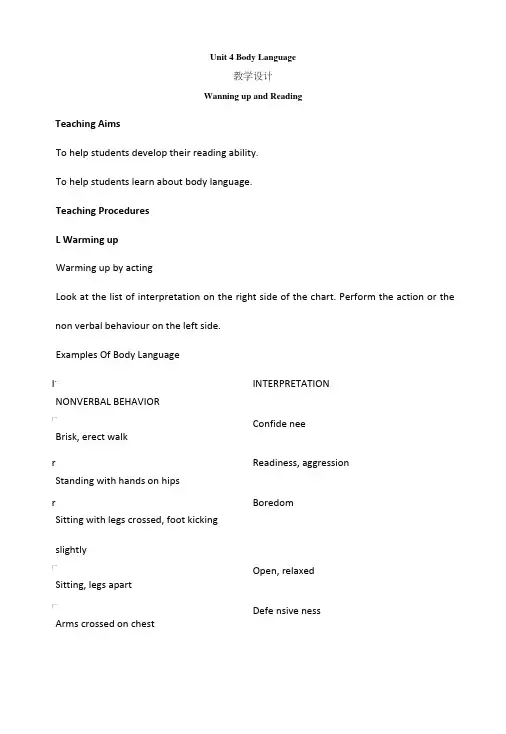
Unit 4 Body Language教学设计Wanning up and ReadingTeaching AimsTo help students develop their reading ability.To help students learn about body language.Teaching ProceduresL Warming upWarming up by actingLook at the list of interpretation on the right side of the chart. Perform the action or the non verbal behaviour on the left side.Examples Of Body LanguageI-INTERPRETATIONNONVERBAL BEHAVIOR厂Confide neeBrisk, erect walkrReadiness, aggressionStanding with hands on hipsrBoredomSitting with legs crossed, foot kickingslightly厂Open, relaxedSitting, legs apart厂Defe nsive nessArms crossed on chestDejectio n rWalki ng with hands in pockets,厂shoulders hunchedEvaluation, thinking1Hand to cheekrRejection, doubt, lying Touching, slightly rubbing nose厂Doubt, disbeliefRubbing the eye厂An ger, frustrati on, apprehensi on Hands clasped behind back厂Apprehe nsionLocked an kiesrBoredomHead resting in hand, eyes downcastrAn ticipatio nRubbing hands厂Confide nee, superioritySitting with hands clasped behind head,legs crossed厂Sincerity, openness, innocence Open palmNegative evaluationrPinching bridge of nose, eyes closedrImpatie neeTappi ng or drummi ng fin gers厂AuthoritativeSteepli ng fin gers厂Lack of self-c on fide nee; in security Patting/fondling hair厂InterestTilted head厂Trying to make a decision Stroking chinDisbeliefrLooking down, face turned awayInsecurity, nervousness i-Biting nails厂IndecisionPulling or tugging at earWarming up by defining—What is body language?describes all forms of human communication that are not Ianguage.。
高中英语人教版必修4Unit4教案
Unit 4 Body LanguageWarming up and reading白璐璐(一)there dimensional teaching aimsKnowledge and skill:1. Let the students know more about body language.2. Let the students can talk about body language freely.Ability aims:1. Encourage students to think about body language and talk about it.2. Learn to respect other cultures.3. Train students’ speaking ability through individual and group work.Emotional aims:1. To arise students’ interest in learning English.2. Let students have a better understanding of different customs.(二) Teaching important points1. Master language points and can use them to talk about body language.2. Learn to show respect to other cultures.(三) Teaching difficult points1. Talk about body language with partners by using new expressions.2. Have a better understanding of the whole passage.(四) Teaching methods1. Task-based teaching and learning.2. Pair work or group work to make every student learn in class.3. Asking-and- answering activity to help students understand the words andphrases.(五) Teaching aids:Blackboard and PPT(六) Teaching proceduresStep 1 GreetingToday we are going to use a different way to start our class, you guys need look at me and I will do some acting, you guys need do what I want you to do.Step 2 lead-in1. The definition of body language: a form of communication without using anywords.Body language: gesture, eye contact, facial expression, postureStep 3 warming up1. Different ways to meet or partShow some pictures about how to greet and how to say goodbye to each other.2. Do the gestureShow some picture about gesture and give the explanation of its different meanings. Step 4 ReadingTask 1 Fast readingRead the passage carefully and divide the passage into 4 parts. Match the main idea of each part.Para 1 A.Different people have different body language.Para 2&3 B. Summary of body language.Para 4 C. Meet the visitors at the airport.Para 5 D. People from different countries express greetings in differentways.Task 2 careful readingRead the first paragraph carefully and finish the T or F questions( T ) 1. Yesterday, another student and I, representing our university's student association, went to the Capital International Airport to meet this year'sinternational students.( F ) 2. After an hour of waiting for their flight to arrive, I saw several young people enter the waiting area looking around curiously.( T ) 3. I stood for a minute watching them and then went to greet them.Read the second and third paragraph carefully and match the left with the right column.Mr Garcia (Columbia) Julia Smith (Britain)Darlene Coulon (France) Akria Nagata (Japan)George Cook (Canada) 1.shakes hands and kisses others twiceon each cheek2.approaches others closely andtouches their shoulder and kissesthem on the cheek3.does not stand very close to others ortouch strangers4.bows5.shakes handFind out the two mistakes the writer found in the airport: Mr. Garcia from He approaches Ms Smith(Columbia)________ The firstmistakeJulia Smith from She ______ ________ appearing_________Garcia.a Japanese He ________ to Mr. Cook and his nose _________ Mr.Cook’s _______ ________.The secondmistakeJapanese.Task 3. careful readingListen the rest part carefully and choose the right answer.1.Besides spoken language, people also use “unspoken language” through___.A.physical distanceB. actionsC. postureD. all above2. ___ prefer to bow rather than kiss others on the cheek.A.The FrenchB. The JapaneseC. The AmericanD. The Chinese3. Which countries approach others closely expect___.A. AmericaB. SpainC. ItalyD. England4. Why do we need study international customs?A.avoid difficultiesB. for funC.go to study abroadD. international communicationTask 4 Post readingAnswer the following questions1. “When in Rome, do as the Romans do.” What do you think this famous saying means?This saying means that when we are in a certain place, we should follow the customs of the people who live in that place, not our own customs.2. Did any students have similar greeting customs? If so, which ones?Yes. Tony from Colombia and Darlene from France had a similar greeting custom—a kiss. George from Canada and Ahmed from Jordan also had a similar greeting custom—a handshake, but Ahmed shakes hands only with men.Step 5 DiscussionGive a speech about how different countries greet others. Your speech should include the following information.You may start like this:It is my great honor to give you a speech here.As we all know ,not all cultures greet each other the same way. In France, …It’s necessary to learn about some body language, because it can reduce some misunderstanding and avoid difficulties in communications.Step 6 Daily sentencesWhen in Rome, do as the Romans doStep 7 EntertainmentCan you guess what the following gesture from Japan means?Step 8 Homework➢Recite the new words of unit 4 and prepare for next period.➢Finish the exercise I on page 27➢内容总结➢➢。
高中英语人教版必修4Unit4BodylanguagePeriod2Languagepoints教案(系列四)
Unit 4 Body languageLanguage points教案Teaching goals教学目标1. To get Ss to know how to use new words and phrases.2. To help Ss to master some new words and expressions.3. To get Ss to have the knowledge of this grammar point: The v-ing form of the verb can be used as an adverbial describing a verb and as an attribute describing a noun.2. Ability goals 能力目标Enable the students to learn the new words and expressions3. Learning ability goals学能目标How to use the new words and expressionsTeaching important points教学重点Learn the new words and expressionsTeaching difficult points 教学难点The usage of important words and expressionsTeaching methods教学方法Individual work, pair work and group work.Teaching aids 教具准备A computer, a projectorTeaching Procedures:Step 1.ConsolidationPurpose: To consolidate the words and phrases in the text.1.Ask Ss to read the reading text again and finish Ex1 on P28Suggested answers:Defense, likely, Italy, canteen, represent, dash, approach, association, cheek, flight1.Ask Ss to finish Ex2, 3 and check the answers in pairs.Suggested answers:Ex2: approached, Jordan, cheek, curiously, dashed, misunderstood, contraryEx3: crossroads, adult, major, dormitory, greeted, representing, association, spoken, Colombia, curious, flightStep 2. GrammarPurpose: To get Ss to know the function of the v-ing form of the verb.1. Ask Ss to work in pairs and finish Ex1 on P29. After that, lead them to draw a conclusion.Conclusion: The rule of the grammar in this unit.We have learned that the v-ing form of the verb can be used as the subject and the object in Unit 2 and it is can be used as the predicative and the attributive in Unit 3. In this unit, we will go on to learn the v-ing form of the verb-used as the attributive and the adverbial.(1) As the attributive — A single v-ing form should be placed before the noun it serves; if a phrase after the noun it serves.For example: running water; floating ice block; leaking pipes; dripping taps;a boy standing there; the man smoking a cigarette; the driver driving a new cara sleeping bag; a fishing pole; a sewing machine…(2) As the adverbial —The v-ing form should be used as the adverbial of time, reason, way, result, condition, etc. For example:Passing the house, he saw a girl playing the piano. (time)I got to know him while working with him. (time)Being excited, none of us could fall asleep. (reason)He came running. (way)She stood waiting for a bus. (accompany)They opened the fire, killing one soldier. (result)(3)The v-ing form can be used in the following structures.①Present participle phrases such as adding /pointing out/reminding/warning can introduce statements in indirect speech. For example:He told me to start early, reminding me that the roads would be crowded.②After the verbs of sensation, such as see, hear, smell, listen (to), notice, and watch, the action can be either complete or incomplete. For example:I see him passing my house every day.Didn’t you hear the clock sticking?I felt the car skidding.She smelt something burning and saw smoke rising.I watched them rehearsing the play.③catch, find, leave+ object + present participle. For example:I caught him stealing the apples. (I found him doing this.)If she catches you reading her diary, she will be furious.I found him standing at the door.I left him talking to Bob. = He was talking to Bob when I left.④spend/waste + an expression of time /money +v-ing. For example:He spends two hours a day traveling.Tom spends much money modernizing his house.⑤ e busy +v.-in. For example:She is/ was busy packing.⑥The v-ing can replace as/since/because +subject +verb. For example:Knowing that he wouldn’t be able to buy food on his journey he took large supplies with him.Being a student he was naturally interested in museums.⑦When one action is immediately followed by another by the same subject, the first action can be expressed by a present participle. For example:He rode away. He whistled as he went. = He rode away whistling.⑧When the second action forms part of the first, or is the result of it, we can express the second action by a present participle. For example:She went out, slamming the door.He fell over, hitting his head against the table.⑨The negative form of the v-ing form is ‘not v-ing; the present perfect form is “having done”; the passive form is “being done”.Step 3. Practice1. Ask Ss to do the following exercises to grasp the grammar well.(1) He told us a very _______________ (有趣的) story.(2) The boy ____________(坐在我身边的) is my son.(3) There is nothing _______ (鼓舞人心的) in his words.(4) Did you see the boy_____________(正在被那个人审问的)?(5) The new is ___________ (鼓舞人心的).(6) He kept me ________________ (等了好长时间).(7) He can get the machine ______________ (发动).(8) He was found _____________ (躺在地上).(9) ______________________ (听到这个消息), he burst into laughter.(10) Be careful when __________________________(过马路时).(11) ___________________ (因为很穷), he couldn’t go to school.(12) ___________________________ (由于不知道他的地址), I can’t get in touch with him.(13) _____________________ (由于未收到会回音), he decided to write another letter to her.(14) He sat there ________________(读一本书).(15) The captain covered the boy with a national flag only ____________________(把脸露在外面).(16) ________________ (从他的口音判断), he must be a southerner.(17) ________________ (总的说来), his answer is right.(18) ________________ (综合考虑), they did a good job.(19) ________________ (每当看到这座山时), he always thinks of his hometown.(20) _________ (已经用了) for a long time, the watch needs to be mended.Suggested Answers:(1) interesting story (2) sitting by me (3) inspiring (4) being questioned by the man (5) encouraging (6) waiting for a long time (7) starting (8) lying on the ground (9) Hearing the news (10) crossing the street (11) being so poor (12) Not knowing his address (13) Not having received an answer (14) reading a book (15) leaving his face exposed (16) Judging from his accent (17) Generally speaking (18) Considering everything (19) Seeing the mountain (20) Having been used2. Ask Ss to work in pairs and finish Ex2, 3 on P29.3. Ask Ss to finish the exercises of Using Structures on P64 and check the answers in pairs.4. Ask Ss to complete the following sentences.(1) The young man, ______________(坐在隔壁房间里的), is writing a letter to his mother.(2) The soup _____________(闻起来很香的) on the table is cooked by Mother.(3) The ________(失踪的) boy was last seen _________(在河边玩).(4) The school bag _________(挂在墙上的) is Li Ming’s.(5) Anyone will be criticized by the teacher if he is found _________(在考试中作弊).(6) The man was caught ___________(偷一辆汽车).(7) I can’t leave the kitchen with_________(火着着).(8) You should take him to hospital at once instead of _________________(让他流血).(9) __________(正吃着饭时), we heard the doorbell ring.(10) The goat __________(痛苦地叫着的) is badly wounded by a knife.Suggested Answers:(1) sitting in the next room (2) smelling delicious (3) missing; playing in the river bank (4) hanging on the wall (5) cheating in the examination (6) stealing a car (7) the fire burning (8) leaving him bleeding (9) While having dinner (10) crying painfullyStep 4. Homework1. Review the new words and phrases and finish the exercises of Using Words. And Expressions on P63.2. Recite the sentences with the v–ing form in the reading passage.。
高中英语_人教新课标必修4 UNIT4 Body language教学设计学情分析教材分析课后反思

Book 4 unit 4 Body languageRevision教学设计一、Teaching aims:●知识目标1.master the words and phrases in Unit4.2.know about the cultural differences of using body language.3.master the language points●能力目标1.develop reading ability as well as speaking ability2.learn how to express in English.●情感目标know about the cultural differences of using body language.二、Important points:1.Important points:the difference and similarity of body language in the world.2.Difficult points: develop reading ability as well as speaking ability三、Teaching methods:1、教学方法:任务驱动法、小组讨论法。
2、学习方法:自主学习法、合作学习法、探究式学习法。
四、Teaching procedures:Step1. Vocabulary and phrasesAct. 1 Ask students to memorize the words, and then ask them todictate.Act.2. Exercise1. Believe it or not, children are usually more natural in their manner than_______ (成年人).2. The police knew all about his ____________ (联系)with organized crime.3. When you are playing, watch your tone of voice and _______ (面部的) expression.4. When I________________(接近) the dog, it ran away at once.5. She is the most _______(可能的) girl to win the price.Step2 sentence patterns1.她把自己描绘成世界上最好的母亲。
《Unit4Bodylanguage》教案教案高中必修4英语
《Unit4Bodylanguage》教案教案高中必修4英语教师在教学的过程中,大部分教学活动要建立在学生的自我构建理论上。
下面是小偏整理的《Unit4Bodylanguage》教案教案高中必修4英语,感谢您的每一次阅读。
《Unit4Bodylanguage》教案教案高中必修4英语教学准备教学目标1.教学目标(1)知识目标:学生能掌握下列重点单词和短语的意义和用法:greet,represent,approach,expression,defend,misunderstand,adul t,cheek,major,likely,ingeneral。
能够表达一些Bodylanguage.(2)能力目标:学生能掌握基本的阅读理解方法:速读,寻读,归纳中心和查找细节。
(3)情感目标:学生了解不同国家和文化的身势语,激发学生学习这种语言的兴趣。
教学重难点教学重点和难点(1)培养学生的阅读策略和技巧,让学生了解文章的细节知识和文章结构。
(2)让学生合适地使用不同的身势语。
(3)课文中现在分词作定语和状语的长难句。
教学过程Step1.Leadin(1)Theteachershowsaquestiononscreen:Howcanwecommunicatewithotherswhenwecan’tspeak?Thenaskastudenttoanswer.设计说明:引出本单元的话题。
(2)Theteachershowssomepicturesonscreenofsomebodylang uageandasksomestudentstoguessanddiscussthemeaningtheystandfor.设计说明:引出本节课的题目。
Step2.Fastreading1.Gothroughthepassagequicklyandfindoutthemainideaofeac hparagraph.oMatchthemainideaofeachpara.withlines.(Para.1)A.Otherexamplesofdifferentgreetingbodylanguage.(Para.2)B.Differentpeoplehavedifferentbodylanguage.(Para.3)C.Summaryofbodylanguage.(Para.4)D.Meetthevisitorsattheairport.(Para.5)E.Examplesofdifferentgreetingbodylanguage.2.Trytowritedownthemainideaofthetext.Thetextismainlyaboutdifferent_____________indifferentcountri es.Inordertoavoiddifficultiesintoday’sworldofculturalcrossroads,weshould___________________________.设计说明:通过这个题目的练习,让学生掌握速读,先对文章段落大意有一个了解。
高中英语 Body Language教案 新人教版必修4
Body Language一、Teaching aims and demands1.Topics1〕Talk about body language2〕Describe gestures and facial expressions3〕Practice making offers and requests4〕Write an imaginary story2.Function:1. Learn to use the expressions to make offers and requests and show thanks:4.Grammar:The -ing Form 〔2〕used as Subject, Object and Predicative二、Teaching Time:Six periods1st period ;Speaking →〔Warming up与Speaking以及Workbook 中的Talking〕2nd period;Listening →〔Listening和Workbook 中的Listening〕3rd period;Reading →〔Pre-reading ,Reading,Post-reading〕4th period;Language study→〔Language study 与Workbook 中Practicing〕5th period;Extensive Reading →〔Integrating skills中Part I 与Workbook 中Reading〕6th period;Writing →〔Integrating skills中Part 2 writing与Workbook 中writing〕三、Teaching procedures:Period 1〔一〕明确目标1. Learn body language.2. Study the language points connected with warming up. Listening and speaking.〔二〕整体感知Step 1 Greetings and Lead-in〔p175〕Step 2 Presentation.People communicate with each other in many ways:body language, writing, speaking, typing.Make a dialogue in pairs using body language.〔三〕过程Step 3 Warming-up〔p176〕Go through warming up and make sure the students understand it and can match each picture with the correct emotion and the correct sentence.〔1〕Action show:Try to use your body to act out the next actionsStop! Come here. You are very good. It's ok. Bye-bye.〔What is body language? Body language is the movements or positions of our body. We use them to show other people what we are thinking about and how we are feeling.〕〔2〕Match each picture with the correct emotion and the correct sentence.Possible answers:Picture 1:Confused;I don't know what to do.Picture 2:Angry;I can't believe she said that! That is so unfair!Picture 3:Sad;I've lost my wallet!Picture 4:Happy;I got an A in my exam!Picture 5:Tired;It's been a long day. I can't keep my eyes open.〔3〕Talk about the pictures1〕How does the man in Picture 1 feel?He feels very confused because he doesn't know what to do.2〕How does the man in Picture 2 feel?He feels very angry because he thinks it was unfair for Mary to say that to him.3〕How does the man in Picture 3 feel? 〔He feels very sad because he has lost his wallet.〕4〕How does the man in Picture 4 feel? 〔He feels very happy because he has got an A in maths.〕5〕How does the man in Picture 5 feel?He feels very tired and he nearly cannot keep his eyes open.〔4〕Answer the questionsStep 4 Speaking〔1〕Choose one of the situation to act out using the useful expressions in the blanks:Situation1:An old man is carrying a very heavy suitcaseSituation2 :Somebody is late for a flight and wants to go ahead of the queue. Situation3:An old and sick person is on a crowded bus and wants to sit down.〔2〕Phrases to accept offers/refuse offers:1〕That's very nice of you. Thanks./ Yes, please.Thank you for your help. That's very kind.2〕No, thanks. I can manage it myself. It's all right. Thank you. I can manage.〔3〕Sample:Situation 1Asking for helpO=old man P=PaulO:Excuse me, young man. Could you give me a hand with this, please? It's very heavy. P:Oh, of course, I'd be happy to. There we go.O:Thank you.P:You're welcome.O:Oh my, this is heavy. Excuse me, sir, could you help me with this bag?P:Certainly. Where should I put it?O:Thank you. Just put it over there, please.P:There you are.O:Thank you, that's very nice of you.Offering helpP:That bag looks very heavy. Do you need some help with that?O:Oh, thank you. Could you please put it over there?P:No problem. There you are. Is there anything else I can do for you?O:No, thank you. Thanks you for all your help.P:Would you like some help?O:Oh, yes, please. This bag is simply too heavy for me. Could you give me a hand with it?P:Sure. My, this bag is heavy! Ah, there we go. Where shall I put it?O:Over there, please. Thank you so much!P:You're welcome.Situation 2J = Jim A = Passenger A B = Passenger BJ:Excuse me, but I'm late for my flight. Could I please go ahead of youA:Why sure. My flight doesn't leave for another hour. Are these bags yours? Shall I help you with that?J:No, thanks. I can manage it myself. 〔To the passenger standing at the check-in counter.〕Hi.May I cut in front of you? I don't want to miss my plane.B:Go right ahead. I'm still looking for my ticket. Do you need some help with that bag?J:Yes. Could you please help me put it up here? Thank you.B:You're welcome.J:Oh no! I'm late for my flight.A:Excuse me, but did you say that you were late? Would you like to go ahead of me? My flight doesn't leave for another hour.J:Thank you, that's very nice of you! Could you help me with this bag, please?A:Sure. There you are. Would you like me to bring it up to the counter?J:Oh, no, thank you. I can manage it myself now.Situation 3〔O = Old person;P = Passenger〕O:Oh my, this bus is crowded. Excuse me, could you please help me with this bag?P:Certainly. There you are. Here, please take my seat, you look a bit tired.O:Thank you. Yes, I'm not feeling well today. I think I have a bit of cold. Could you please tell me when we reach Long Street? I'm afraid I can't see where we are when the bus is this crowded.P:Sure. I' ll let you know when we get there.P:Shall I help you with that?O:No thanks. I can manage it myself. But could please let me sit down for a while? I'm not feeling well.P:Oh, of course. Please take my seat.O:Thank you. That's very nice of you.P:Not at all.Step 5 Language points1.keep my eyes open使眼睛睁开着★keep跟带形容词的复合结构,例如:①Good food keeps you healthy.好的食品使你健康。
(完整版)人教版高一英语必修四unit4Bodylanguage教案
人教版高一英语必修四unit4 Body language教案Part 1.Teaching goals: 教学目标1. 语言能力目标●Talk about body language: cultural differences andimprove the students’ reading ability, such as skimming, scanning,get the detailed information and understand the main idea of the text.●让学生通过阅读,能够理解并尊重不同区域的人的身体语言和其文化涵义。
●进一步训练学生推测、略读、找读、归纳内容等阅读技巧;培养学生把握篇章中心内容、归纳段落大意、获取关键信息、并且能针对阅读内容表达自己的观点的能力。
3. 情感态度目标●要学生明白身势语是不同文化的载体,在跨文化交际中起到非常重要的作用,了解肢体语言在不同含义,可以帮助学生在日常的交际中正确的注意和使用自己的体态,姿势,面部表情等,正确的理解和运用肢体语言,达到良好的交际效果。
●Body language is actions that human beings canexpress themselves and communicate with otherswithout words, with which people can avoiddifficulties when they fully understand the bodylanguage when they communicate with others. Bodylanguage plays important roles in communicating.Part 2.Teaching Important and difficult Points●重点词汇与短语greet prediction represent association dormitory canteen flight curious curiouly Colombia approach cheek defend defence major misunderstanding Jordan dash adult spoken Spain Italy likely crossroadsdefend against be likely to in general●重点句子结构与用法Yesterday, another student and I, representing our university’s student association, went to …After half an hour of waiting for their flight to arrive, I saw several young people enter the waiting area looking around curiously.I stood for a minute watching them and then went to greet them.She stepped back appearing surprised and put up her hands, as if in defence.Then Akira Nagata from Japan came in smiling, together with Japanese student.When Darlene Coulon from France came dashing through the door, she recognized Tony Garcia’s smiling face.3.Improve the students’ reading ability, such as skimming, scanning,get the detailed information and understand the main idea of the text.4.let students learn about the words and expressions about body language.Part 2. Teaching Important Points:1.Teach the students how to understand body language used in different countries or cultures as well as in different occasions.2. How does body language differ among people fromdifferent cultures?Part 3. Teaching Difficult Points:1. Let the students know that there is both positive body language and negative body language.2.to grasp the main idea of the text.Part 4.Teaching Methods:。
人教新课标英语必修4全册教案(Unit 4 Body Language)
人教新课标英语必修4全册教案(Unit 4 Body Language) Unit 4 Bd LanguagePart ne: Teahing Design Teahing gals1 Target Languagea 重点词汇和短语isunderstand, siilar, faial, expressin, agreeent, an, hest, gesture, adult, punishb 重点句型或交际用语At ut the flling eanings, pleasePlease guess hat I eanPlease sh the atins, using bd languageN it is ur turn t sh the atin / gesturePlease use either spen rds r bd language t express ur ideasPlease use bth spen rds and bd language t express ur ideas2 Abilit galsa Enable the students t understand hat a ertain gesture f the bd language eans in a given situatinb Enable the students t at ut se eanings, requireents, requests r situatins given in the target languageEnable the students t express ith the target language the eanings given in bd language3 Learning abilit galsa Help the students learn h t express theselves in bd language hen neededb Help the students understand thers hen bd language is being usedTeahing iprtant pintsa Teah the students h t understand bd language used in different untries r ultures as ell as in different asinsb Teah the students h t use bd language in the st apprpriate asinsTeahing diffiult pintsa Enable the students t realize the iprtane f bd language in uniatin s that little r n isunderstanding a urb Let the students n that there is bth psitive bd language and negative bd languageTeahing ethdsa Individual r, pair r and grup rb Ating ut b iitatin, ie r ith gestures and bd veentTeahing aidsA puter, a pretr and se pituresTeahing predures ≈ asThe first perid reading(UNIATIN: N PRBLE?)AisT help students develp their reading abilit T help students learn abut bd language PreduresI aring uparing up b atingL at the list f interpretatin n the right side f the hart Perfr the atin r the nnverbal behaviur n the left sideExaples f Bd Languagearing up b defining—hat is bd language?II Pre-reading1 Ling and saingL at the an in the piture bel hat des he sa t u b his bd language?Basiall, h the d I n? r, I dn’t n nthin! The shulders are hunhed and the hands are pen signifing a big questin ar2 Taling and sharingBd language is the quiet, seret and st perful language f all!Arding t experts, ur nn-verbal language uniates abut 0% f hat e reall ean (vie tnalit ntributes 38%) hile rds theselves ntribute a ere 7%ur bdies send ut essages nstantl and ften e dn’t regnize that e’re uniating a lt re than e realizeur understanding and use f nn-verbal ues in faial expressin are failiar t us nearl fr birthIII Reading1 Reading alud t the rerdingN please listen and read alud t the rerding f the text UNIATIN: N PRBLE? Pa attentin t the prnuniatin f eah rd and the pauses ithin eah sentene I ill pla the tape tie and u shall read alud tie, t2 Reading and underliningNext u are t read and underline all the useful expressins r llatins in the passage p the t ur nteb after lass as her3 Reading t identif the tpi sentene f eah paragraphNext u are t si the text t identif the tpi sentene f eah paragraph4 Reading and transferring infratinRead the text again t plete the table here is he/ she fr? hat des he/ she d hen he/ she eet sene at the airprt fr the first tie?NaeuntrAtineaningr Garia ulia Sith Ahed Azizadae ulnReading and understanding diffiult sentenesAs u have read the text ties, u an surel tell hih sentenes are diffiult t understand N put ur questins nerning the diffiult pints t e the teaher6 Reading and translatingN it’s tie t translate the text int hinese, sentene b sentene h ill be the first t d it?IV lsing dnlsing dn b ding exerisesT end the lessn u are t d the prehending exerises N 1 and 2 n page 26 and 27lsing dn b heinghe se f the flling basi nn-verbal ues and u’ll regnize that u alread spea and translate uh f the language“I’surprised!” I’shed!”“I’sad!”The send perid Learning abut Language(The ~ing fr as the Attribute ≈ Adverbial)I aring uparing up b disvering useful rds and expressinsTurn t page 27 and d exerises N 1, 2 ,3 and 4 first he ur ansers against ur lassates’II Learning abut graar1 Reading and thiningTurn t page 2 and read ith e the text f UNIATIN: N PRBLE? As u read alng, pa attentin t the uses f The ~ing fr as the Attribute ≈ Adverbial(The are visitrs ing fr several untries 作定语;Fur peple enter ling arund in a urius a 作状语;This is an exiting experiene fr u 作定语; u stand athing and listening 作状语;……)2 Ding exerises N 1 and 2 n page 29Turn t page 29 D exerises N 1 and 2。