
新概念英语第一册课件47-50课
精品教学 件 | Excellent teaching plan
新概念第一册必备词汇 1 butcher ['but ??] n. 卖肉的
Lesson 47 2 meat [mi:t] n.( 食用)肉
1 like [laik] v. 喜欢,想要 3 beef [bi:f] n. 牛肉
2 want [w ?nt, w ɑ:nt] v. 想 4 lamb [l?m] n. 羔羊肉
5 husband ['h ?zb?nd] n. 丈夫
Lesson 48 6 steak [steik] n. 牛排
1 fresh [fre ?] a. 新鲜的 7 mince [mins] n. 肉馅,绞肉
2 egg [eg] n. 鸡蛋 8 chicken ['t ?ikin] n. 鸡
3 butter ['b ?t ?] n. 黄油 9 tell [tel] v. 告诉
4 pure [pju ?] a. 纯净的 10 truth [tru: θ] n. 实情
5 honey ['h ?ni] n. 蜂蜜 11 either ['aie ?] ad. 也 ( 用于否定句 )
6 ripe [raip] a. 成熟的
7 banana [b ?'n ɑ:n?] n. 香蕉 Lesson 50
8 jam [d ??m] n. 果酱 1 tomato [t ?'m ɑ:t?u] n. 西红柿
9 sweet [swi:t] a. 甜的 2 potato [p ?'teit ?u] n. 土豆
10 orange [' ?rind ?] n. 橙 3 cabbage ['k?bid ?] n. 卷心菜
11 Scotch whisky 苏格兰威士忌 4 lettuce ['letis] n. 莴苣
12 choice [t ??is] a. 上等的,精选的 5 pea [pi:] n. 豌豆
13 apple ['?p ?l] n. 苹果 6 bean [bi:n] n. 豆角
14 wine [wain] n. 酒,果酒 7 pear [pe ?] n. 梨
15 beer [bi ?] n. 啤酒 8 grape [greip] n. 葡萄
16 blackboard ['bl?kb ?:d] n. 黑板 9 peach [pi:t ?] n. 桃
Lesson 49 新概念第一册 讲义 第 47-48 课
新概念第一册 47-48 文 解及 答案
文 注 Further notes on the text
1. Yes, I do. 是的,我喜 。
是一句肯定的 略回答。 如果是否定的回答, No,
I don't. I like ⋯和 I don't like ⋯ 两个句型是分 表示 “我喜 /想要 ⋯⋯”和 “我不喜 /想要 ⋯⋯”的 常用法。
2. black coffee, 不加牛奶或咖啡伴 的清咖啡。
加牛奶的咖啡叫 white coffee. black 在有些搭配中不 黑色的,如: black tea 茶
3.序数 1st~12th
1st---- first 2nd ----second 3rd---- third
4th---- fourth 5th ----fifth 6th----sixth
7th---- seventh 8th---- eighth 9th---- ninth
10th---- tenth 11th----eleventh 12th----twelfth
英 中序数 必 与定冠 ( the) 用。 然有 不在
形式上表 出来,在 朗 的 候也必 加上 the。如: the 1st
month (第 1 个月), the twelfth century ( 12 世 )。
词汇学习及课文注释
1. like v.
( 1)喜 :
I like that sweet girl. 我喜 那个可 的姑娘。
John likes Chinese food. 翰喜 吃中国菜。
( 2)想要;希望有:
Would you like some coffee? 你要不要来点咖啡?
How does Ann like her coffee? 安想喝什么样的咖
啡?
Like father, like son.
2. want v.
( 1)想要;希望:
I want some sugar. 我想要些糖。
I want you to try. 我希望你试试。
( 2)需要:
Those drooping flowers want water. 那些正在枯萎的花朵需要水分。
3. Yes,please. No, thank you.
4. Do you want any sugar. (不可数名词,单独使用,表示类别,前面加 some / any 时,表示量)
5. I don ’t like milk in my coffee. (我喜欢清咖啡)
I like black coffee./ I like my coffee black.
6. Do you like biscuits. 可数名词,用复数形式表示类 别。
7. Do you want one (biscuit)
语法 Grammar in use
一般现在时( 1)——什么时候用一般现在时
1. 表示经常性、习惯性的动作或存在的状态。
e.g. I often get up early.
He is busy every day.
2. 表示主语的特征、性格、能力、爱好等。
e.g. Susan is tall.
精品教学课件设计 | Excellent teaching plan
I like swimming.
John works hard.
3. 表示普遍真理以及习惯性的动作。如:
e.g. There are seven days in a week.
The earth moves around the sun.
一般现在时的结构
1. 主语 + 系动词 be (am/is/are)
注意: be 之后不再有其它动词,常跟形容词、名词或
介词短语作表语。
e.g. She is beautiful.
This is my dog.
Mom is in the kitchen.
否定:在 be 后加 not
疑问:把 be 提至主语前
e.g. This isn't my dog.
Is this your dog?
2. 主语 + 其它动词( 1)主语 + 动词原形
适用于:主语不是 单三 。
e.g.I like coffee.
We get up at 7 in the morning.
John and Tom like tea.
You look well.
否定:主语 + don't + 动词原形
e.g. I don't like coffee.
疑问:在主语前加 do,句末加问号。
e.g. Do you like coffee?
What do you like?
Which one do you want?
Where do you live?
一般疑问句的回答常用 do 的简略形式。
e.g. Yes, I do. / No, I don't.
Joey: Phoebe, do you take this man to be your husband?
Phoebe: I do.
Joey: Mike, do you take this woman to be your wife?
Mike: I do.
切记:be 动词与行为动词原形通常不能同时 出现在一个句子里!
e.g. I am come from China. (F)
I am from China. (T) /I come from China. (T)
Make sentences:
1. 你喜欢巧克力吗?(作肯定、否定回答)
_________________________?
Yes, I do.
No, I don't.
2. 我爸妈不住在北京。
__________________________.
3. 你想要一杯茶吗? 精品教学课件设计 | Excellent teaching plan
__________________________?
练习:
e.g. Do you like milk?
Yes, I do.
I like milk, but I don't want any.
e.g. Do you like pears?
Yes, I do.
I like pears, but I don't want one.
P96 页,练习 B
新概念第一册 讲义 第 49-50 课
词汇学习及课文注释
1. butcher n. 屠夫 the butcher's 肉店,肉铺
应该: the butcher's shop
e.g. at the tailor's; at my mother's (house)
介词 at,表示在一个小地点。
2. Do you like any meat today? ( any,可不数名词前,在疑问句中,表数量)
3. Do you want beef or lamb? 选择疑问句,前升后降。
4. lamb n. 羔羊肉(可数),羔羊(不可数)
Silent Lamb 。类似: fish, chicken
5. I like lamb, but my husband doesn ’t.
6. What about some steak.
征求别人意见时: What about...?/How about...?
在口语当中,即便是疑问句中,如果我们非常希望得
到对方肯定的回答,表示“一些”用 "some" 。
e.g. Would you like some coffee/tea?
This is a nice piece ( of mince)
1 pound=0.454kg
7. Do you want a chicken. Mrs. Bird.
8. To tell you the truth. 实话跟您说吧。
true a. 真实的 truth n. 实情
a true story
true lies
9. too 常用于肯定句, 有时也用于疑问句, 但不能用
于否定句。常见于句末,而且 too 前常有逗号;如果不在
句末, too 前后都应当有逗号。
either 用于否定句,位于句末。
e.g. I like the movie______.
新概念英语一册单词表(1-50课)
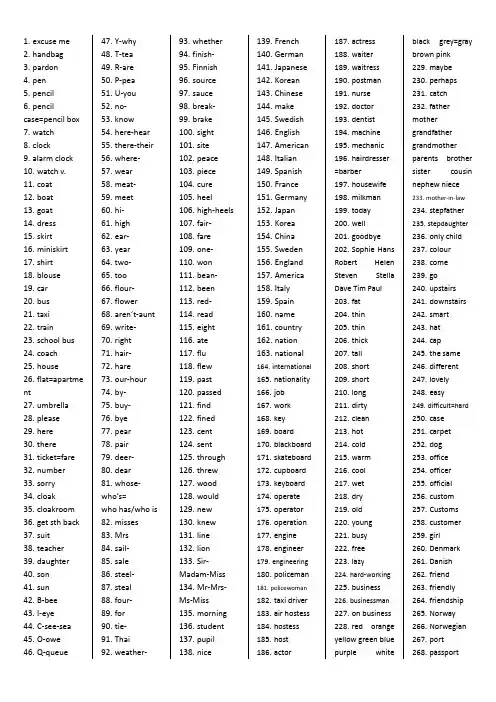
1. excuse me
2. handbag
3. pardon
4. pen
5. pencil
6. pencil
case=pencil box
7. watch
8. clock
9. alarm clock
10. watch v.
11. coat
12. boat
13. goat
14. dress
15. skirt
16. miniskirt
17. shirt
18. blouse
19. car
20. bus
21. taxi
22. train
23. school bus
24. coach
25. house
26. flat=apartment
27. umbrella
28. please
29. here
30. there
31. ticket=fare
32. number
33. sorry
34. cloak
35. cloakroom
36. get sth back
37. suit
38. teacher
39. daughter
40. son
41. sun
42. B-bee
43. I-eye
44. C-see-sea
45. O-owe
46. Q-queue 47. Y-why
48. T-tea
49. R-are
50. P-pea
51. U-you
52. no-
53. know
54. here-hear
55. there-their
56. where-
57. wear
58. meat-
59. meet
60. hi-
61. high
62. ear-
63. year
64. two-
65. too
66. flour-
67. flower
68. aren’t-aunt
69. write-
70. right
71. hair-
72. hare
73. our-hour
74. by-
75. buy-
新概念英语第一册1—50课测试题
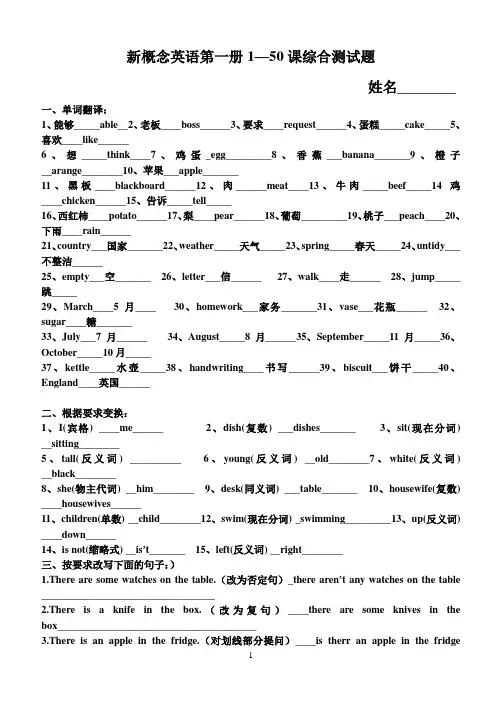
1 新概念英语第一册1—50课综合测试题
姓名________
一、单词翻译:
1、能够_____able__2、老板____boss______3、要求____request______4、蛋糕_____cake_____5、喜欢____like______
6、想_____think____7、鸡蛋_egg_________8、香蕉___banana_______9、橙子__arange________10、苹果___apple_______
11、黑板____blackboard______12、肉______meat____13、牛肉_____beef_____14鸡____chicken______15、告诉_____tell_____
16、西红柿____potato______17、梨____pear______18、葡萄_________19、桃子___peach____20、下雨____rain______
21、country___国家_______22、weather_____天气_____23、spring_____春天_____24、untidy___不整洁______
25、empty___空_______ 26、letter___信______ 27、walk____走______ 28、jump_____跳_____
29、March____5月____ 30、homework___家务_______31、vase___花瓶______ 32、sugar____糖_______
33、July___7月______ 34、August_____8月______35、September_____11月_____36、October_____10月_____
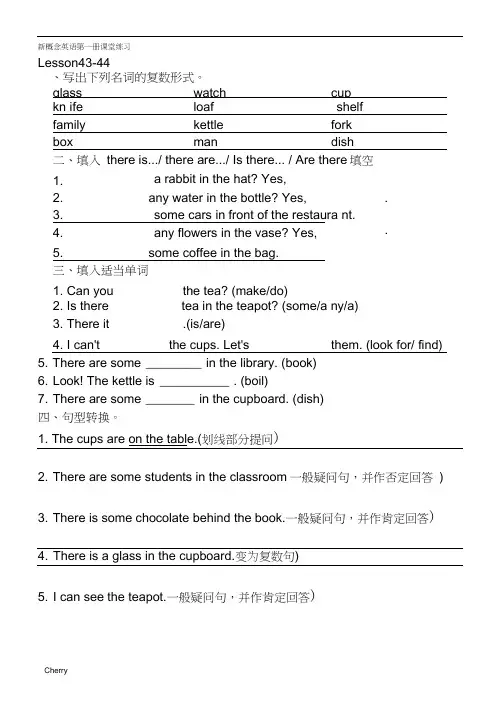
新概念英语第一册41-50课课堂练习
Cherry
新概念英语第一册课堂练习
Lesson43-44
、写出下列名词的复数形式。
glass watch cup
kn ife
loaf
shelf
family
kettle fork
box man dish
二、填入 there is.../ there are.../ Is there... / Are there填空
1. a rabbit in the hat? Yes,
2. any water in the bottle? Yes, .
3. some cars in front of the restaura nt.
4. any flowers in the vase? Yes, ■
5. some coffee in the bag.
三、填入适当单词
1. Can you the tea? (make/do)
2. Is there tea in the teapot? (some/a ny/a)
3. There it .(is/are)
4. I can't the cups. Let's them. (look for/ find)
5. There are some ________ in the library. (book)
6. Look! The kettle is __________ . (boil)
7. There are some _______ in the cupboard. (dish)
四、句型转换。
1. The cups are on the table.(划线部分提问)
2. There are some students in the classroom一般疑问句,并作否定回答 )
3. There is some chocolate behind the book.一般疑问句,并作肯定回答)
4. There is a glass in the cupboard.变为复数句)
新概念英语第一册 47课练习
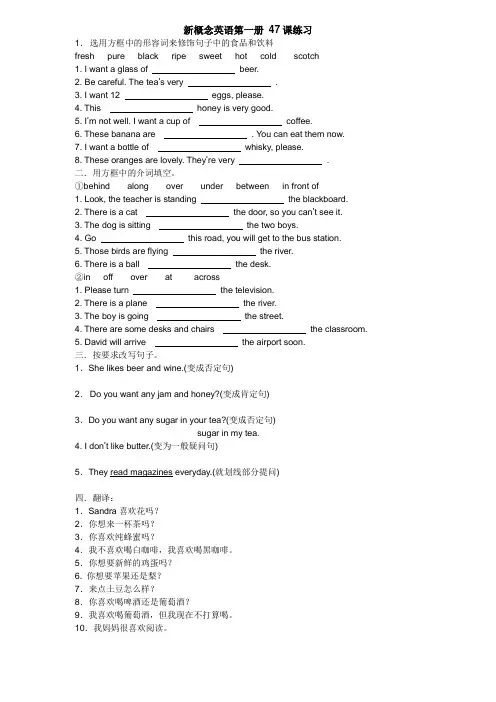
新概念英语第一册 47课练习
1. 选用方框中的形容词来修饰句子中的食品和饮料
fresh pure black ripe sweet hot cold scotch
1. I want a glass of beer.
2. Be careful. The tea’s very .
3. I want 12 eggs, please.
4. This honey is very good.
5. I’m not well. I want a cup of coffee.
6. These banana are . You can eat them now.
7. I want a bottle of whisky, please.
8. These oranges are lovely. They’re very .
二.用方框中的介词填空。
①behind along over under between in front of
1. Look, the teacher is standing the blackboard.
2. There is a cat the door, so you can’t see it.
3. The dog is sitting the two boys.
新概念英语第一册1—50课单词卡片制作
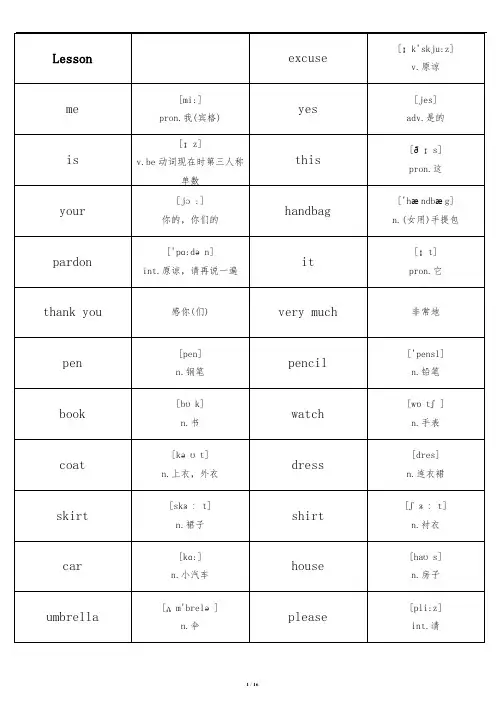
1 / 16
Lesson excuse [ɪk'skju:z]
v.原谅
me [mi:]
pron.我(宾格) yes [jes]
adv.是的
is [ɪz]
v.be动词现在时第三人称单数 this [ðɪs]
pron.这
your [jɔ:]
你的,你们的 handbag ['hændbæg]
n.(女用)手提包
pardon ['pɑ:dən]
int.原谅,请再说一遍 it [ɪt]
pron.它
thank you 感你(们) very much 非常地
pen [pen]
n.钢笔 pencil ['pensl]
n.铅笔
book [bʊk]
n.书 watch [wɒtʃ]
n.手表
coat [kəʊt]
n.上衣,外衣 dress [dres]
n.连衣裙
skirt [skɜːt]
n.裙子 shirt [ʃɜːt]
n.衬衣
car [kɑ:]
n.小汽车 house [haʊs]
n.房子
umbrella [ʌm'brelə]
n.伞 please [pli:z]
int.请
1 / 16
here [hɪə]
adv.这里 my [maɪ]
我的
ticket ['tɪkɪt]
n.票 number ['nʌmbə]
n.
five [faɪv]
num.五 sorry ['sɒri]
adj.对不起的
sir [sɜː]
n.先生 cloakroom ['kləʊkru:m]
n.衣帽存放处
suit [su:t, sju:t]
n.一套衣服 school [sku:l]
n.学校
teacher ['ti:tʃə]
n.老师 son [sʌn]
n.儿子
daughter ['dɔ:tə]
n.女儿 Mr. ['mɪstə]
先生
good [gʊd]
adj.好 morning ['mɔ:nɪŋ]
n.早晨
Miss [mɪs]
小姐 new [nju:] adj.新的
新概念英语第一册1-50课程的全面测试
新概念英语第一册1-50课程的全面测试
1. 第1课:概述
- 问题:新概念英语第一册是关于什么的?
- 答案:新概念英语第一册是一本英语研究教材,旨在帮助研究者掌握基础的英语语法和词汇。
2. 第2课:语法练
- 问题:请用适当的时态填空:I ____________ (go) to London
next week.
- 答案:will go
3. 第3课:词汇练
- 问题:请写出下列单词的复数形式:book, child, man, tooth
- 答案:books, children, men, teeth
4. 第4课:听力练
- 问题:请听录音,选择正确的答案:What color is the car? A)
Blue. B) Red. C) Green.
- 答案:A) Blue.
5. 第5课:阅读理解
- 问题:根据文章内容,回答问题:What did the girl buy at the
store?
- 答案:The girl bought a new dress at the store.
...(继续以此类推,测试第6课到第50课的内容)
总结
通过这份全面测试,我们可以对新概念英语第一册的内容进行全面的复和检验。每个测试题目都涵盖了课程中的不同方面,包括概述、语法、词汇、听力和阅读理解等。通过完成这份测试,研究者可以更好地巩固所学知识,提高英语能力。
第一册新概念英语课程1-50深度评估
第一册新概念英语课程1-50深度评估
简介
本文档对第一册新概念英语课程的1-50课进行深度评估,旨在总结和评价该课程的教学内容和效果。
教学内容
第一册新概念英语课程的1-50课程主要涵盖了以下内容:
1. 单词和词汇的学习。课程通过引入基础的英语单词和词汇,帮助学生建立起英语的基本词汇量,并通过反复练习巩固记忆。
2. 句型和语法的学习。课程重点讲解了常用的英语句型和基本语法规则,通过各种例句和练习,使学生能够正确运用这些句型和语法规则。
3. 听力和口语的训练。课程通过大量听力材料和口语练习,培养学生的听力理解能力和口语表达能力,提高学生的英语听说能力。
4. 阅读和写作的训练。课程提供了一些简单的阅读材料和写作练习,帮助学生提高英语阅读理解和写作能力。
教学效果
第一册新概念英语课程的1-50课程在教学效果方面取得了一定的成果:
1. 单词和词汇的学习效果良好。通过课程中的单词和词汇学习,学生能够掌握一定量的英语基础词汇,并能够正确运用于句子中。
2. 句型和语法的学习效果一般。课程中的句型和语法讲解相对简单,学生较容易理解和掌握,但对于更复杂的语法规则仍需要进一步的学习和练习。
3. 听力和口语的训练效果良好。通过课程中的听力材料和口语练习,学生的听力理解能力和口语表达能力有所提高,能够基本应对日常英语交流。
4. 阅读和写作的训练效果一般。课程提供的阅读材料相对简单,学生能够理解大意,但对于细节理解和写作表达仍需进一步培养和训练。
总结
第一册新概念英语课程的1-50课程提供了基础的英语学习内容,并在听力和口语方面取得了一定的成果。然而,在句型和语法的学习以及阅读和写作的训练方面仍有待加强和改进。建议在后续课程中增加更多的语法讲解和复杂的阅读材料,以提高学生的语言水平和应用能力。
新概念英语第一册1--50单词注解
excuse v. 原谅
me pron.我(宾格)I(主格)my(物主代词)
we(复数主格)us(复数宾格)mine(n性物主代词)
yes adv. 是的
is v. be动词现在时第三人称单数
this pron. 这(对应词that)(复数these)
your possessive adjective 你的,你们的
handbag n.(女用)手提包
pardon int. 原谅,请再说一遍
I beg your pardon
=Say it again.
it pron. 它
thank you 感谢你(们)=thanks
very much 非常地
修饰V词放在句末,或V后面。
2
pen n.钢笔
所有笔的总称
pencil n.铅笔
book n.书,本,预定
watch n.手表,V观看
coat n.上衣,外衣,遮阳伞的涂层
raincoat 雨衣
dress n.连衣裙 V给...穿衣服
skirt n.裙子,短裙
shirt n.衬衣的总称,男衬衣
(对应词:女衬衣blouse)
car n.小汽车,汽车的总称
house n.房子
3
umbrella n.伞(用an/a区别它与雨衣)
please int.请,V使...高兴
here adv.这里(对应:there)
my possessive adjective 我的
ticket n.票(+to 去某地的车票)
number n.号码,数字
five num.五 sorry adj.对不起的
+for+n :
+to+v :
sir n.先生
cloakroom n.衣帽存放处
4
suit n.一套衣服,V合适
(完整版)新概念英语一册49-50课练习
(完整版)新概念英语一册49-50课练习
一.根据所给中文意思补全单词。
1。b__tch__ __ (卖肉的)
2.m__ __ t (肉)
3.b__ __ f (牛肉)
4.l__m__ (羔羊肉)
5.h__sb__ __ d (丈夫)
6。st__ __k (牛排)
7。m__ __ce (肉馅) 8.ch__k__ __ (鸡)
9.t__ll (告诉)
10.tr__th (实情)
11。 __i__ __er (也)
12.t__m__t__ (西红柿)
13。p__t__t__ (土豆)
14.c__bb__g__ (卷心菜) 15。l__tt__ce (莴苣)
16。p__ __ (豌豆)
17.b__ __ n (豆角)
18. p__ __ r (梨)
19。 gr__p__ (葡萄)
20.p__ __ ch (桃子)二.你问我答
三.用too 或 either 填空
1. My sister likes hamburger. I like hamburger___________。
2。 Tom doesn’t like steak。 I don’t like steak___________。
3. She can’t swim. I can't swim ___________.
4。 Do you like tomatoes___________?
5. I don't know how to mend a bike。 My brother doesn't, ___________。
6。 - I'm hungry. -Me,_________。
四.单项选择
( )1。 —_________she like the strawberries?
- No, she ___________.
A. Does, does B。 Do, doesn’t C。 Does, doesn't D. Do, don’t
新概念英语第一册1—50课单词卡片制作之欧阳家百创编
欧阳家百创编
欧阳家百创编 Lesson
欧阳家百(2021.03.07)
excuse [ɪk'skju:z]
v.原谅
me [mi:]
pron.我(宾格) yes [jes]
adv.是的
is [ɪz]
v.be动词现在时第三人称单数 this [ðɪs]
pron.这
your [jɔ:]
你的,你们的 handbag ['hændbæg]
n.(女用)手提包
pardon ['pɑ:dən]
int.原谅,请再说一遍 it [ɪt]
pron.它
thank you 感谢你(们) very much 非常地
pen [pen]
n.钢笔 pencil ['pensl]
n.铅笔
book [bʊk]
n.书 watch [wɒtʃ]
n.手表
coat [kəʊt]
n.上衣,外衣 dress [dres]
n.连衣裙
skirt [skɜːt]
n.裙子 shirt [ʃɜːt]
n.衬衣
car [kɑ:]
n.小汽车 house [haʊs]
n.房子
umbrella [ʌm'brelə]
n.伞 please [pli:z]
int.请 欧阳家百创编
欧阳家百创编 here [hɪə]
adv.这里 my [maɪ]
我的
ticket ['tɪkɪt]
n.票 number ['nʌmbə]
n.号码
five [faɪv]
num.五 sorry ['sɒri]
adj.对不起的
sir [sɜː]
n.先生 cloakroom ['kləʊkru:m]
n.衣帽存放处
suit [su:t, sju:t]
n.一套衣服 school [sku:l]
n.学校
teacher ['ti:tʃə]
n.老师 son [sʌn]
n.儿子
daughter ['dɔ:tə]
n.女儿 Mr. ['mɪstə]
先生
good [gʊd]
adj.好 morning ['mɔ:nɪŋ]