
Unit 10 I'd like some noodles 人教版英语七年级下册易错题
七年级下册Unit 10 易错题一、单项选择1. Welcome to the ____restaurant! We have different _______.A. noodle; noodleB. noodle; noodlesC. noodles; noodlesD. noodles; noodle2. The number of our school teacher____80. A number of them____ women teachers.A. are; isB. is; areC. is ; isD. are ; are3. –Let’s go to the Pancake House! It has some_____ these days.-Good idea! The food there ______ always great.A. specials; isB. specials; areC. special; isD. special; are4. –If there is no rain tomorrow, we ___ the hill in the park.-Really? That’s wonderful.A. ClimbB. will climbC. to climbD. climbing5.-Would you like _____ with me ?-Sure , I like ____ very much.A. to go swim ; swimmingB. go swimming ; swimmingC. going swimming ; swimD. to go swimming ; swimming6. Linda like Chinese ______ English, but she doesn’t like science ______ math.A. and ; andB. or ; orC. and ; orD. or ; and7. It’s Christmas Day. We’ll have ___________.A. special somethingB. something specialC. special anythingD. anything special8.—Hello, Noodle House. .— Oh, hello. I want to ______some noodles, please.A. loseB. orderC. findD. pay 9—What do you think of your math teacher?—He’s very kind. But sometimes he can’t keep his classes in ______.A. surpriseB. orderC. sizeD. place10.—Would you like a large bowl?—____________.A. No, there isn’t any.B. Yes, please.C. I’d like a large bowl, please.11.—What does a rabbit like eating?—_____.I am sure.A. Mutton B, Beef C. Fish. D. carrots12.—May I take your ____,sir?—Sure, I’d like one bowl of beef soup.A. menuB. orderC. photoD. car13. --- Would you like something to eat?--- _______ I’m full.A. No, thanksB. Yes, I’d love to.C. Yes, pleaseD. No, I wouldn’t14. We are _______fish. Can you give us _______?A. short for; anyB. short of; someC. a little; someD. a little; any15. --- May I _______ your order?A. takeB. bringC. likeD. cook16. –I came first in the long jump.--_______. I’m so proud of you.A. Good luckB. Have funC. Well doneD. You’re joking17.—Daddy, can you come home for supper with us this weekend?--_______, but I might be a little late.A. I’m busyB. Hard to sayC. Of courseD. Never mind18. --________ I try on those shoes in the window?--_________. They’re just on show.A. Could; yes, you canB. Can; Sorry, you couldn’tC. Could; Sorry, you can’tD. Can; Yes, you could19. –Excuse me. Can you tell me the way to the post office?--Walk across the street. It is just _______ the cinema.A. in the front ofB. oppositeC. inD. next20.—What time do you usually go to bed ____ weekends?--I usually go to bed _______ about 9 o’clock.A. at; inB. in; ofC. on; atD. for; at21. –What do you think of Philip?--He is so careless that he often ______ his ______ at home.A. forgets; homeworkB. leaves; homeworksC. leaves; homeworkD. forgets; homeworks22. –Where is Lisa?--She with her friends ______ fun at the party right now.A. haveB. are havingC. hasD. is having23. –Is Steven good with the kids?--Yep! Look! The boy _______ a brown cap _______ chess with him.A. in; is playingB. in; playC. on; playingD. on; is playing24. –Do we need to go to the supermarket?--No, we still have ______ meat left.A. littleB. a littleC. fewD. a few25. –We have to finish our homework every day, __?--Yeah, that’s for sure.A. do weB. haven’t weC. have weD. don’t we26.--_______ is it from Tianjin to Beijing?--About two hours’ bus ride.A. How longB. How farC. How oftenD. How much27. --You know what? Jack’s computer often _______ on his desk, but he never plays games on it on school days.--Wow, that’s a good boy.A. sitsB. putsC. skatesD. takes28. –Could you please ____ the window open for a while? The room is very hot now.--Sure, I will do.A. keepB. putC. saveD. cut29. –Do you enjoy the show?--The story is _______ but the performances can’t make me _____.A. exciting; excitedB. excites; exciteC. excited; excitingD. excited; excited30. –There ______ a P.E Festival in NO.1 middle school affiliated to CNU.--Sounds great, I’d like to be _____ the soccer team.A. is; onB. have; inC. is, inD. have; on二、完形填空A poor little girl lives near a forest. She has no family and no one to love her. She often feels 1and lonely.One day ,when she is walking in the forest ,she 2 that a small butterfly is trapped(被困) in a bush(灌木丛).The butterfly tries to fly away but it 3 . The little girl 4 the butterfly . The butterfly 5 a beautiful fairy(仙女). The little girl is very surprised.“Thank you for saving(解救) me .I can make any of your dreams 6 . ”Says the fairy .The little girl thinks 7 a moment and then says, “I want to be 8 ! The fairy says, “I will help you.” Then she says something in the little girl’s 9 . And the fairy disappears.(消失)As the little girl grows up, she is always ready to 10 people in need and the villagers all like her. As a result, the girl is very happy. Everyone asks her the secret(秘密) of being happy. She always smiles and answers, “The secret of my happiness is that I 11 a fairy when I was a little girl.”When the girl becomes an old woman and 12 , the villagers all come to her. They are afraid that secret will die with her . They ask, “please tell us what the fairy 13 you”. The old woman smiles, “She says that everyone in the world 14 me .Helping others can make me 15 a happy life. ”1. A. cold B. cool C. sad D. proud2. A. hopes B. thinks C. finds D. plans3. A. does B. can C is D. can’t4. A. saves B. draws C. cleans D. cooks5. A. turns on B. turn into C. turn down D. turn up6. A. come out B. come on C. come up D. come true7. A. of B. from C. at D. for8. A. happy B. clever C. healthy D. beautiful9. A. eye B. nose C. ear D. hand10. A. teach B. help C. buy D. show11. A. wrote to B. play with C. listened to D. get to12. A. dead B. poor C. kind D. funny13. A. says B. talks C. gives D. tells14. A. dresses B. needs C. likes D. drives15. A. live B. take C. cross D. stop三、阅读理解My mom isn’t elegant(优雅的)like other moms. They wear elegant clothes and drive elegant cars. My mom wears her gardening clothes when she appears in our school when elegant moms laugh, their laughs sound soft and sweet. But my mom usually talks and laughs loudly.For our class hike(远足), parents are invited. At breakfast, I tell mom, “Please don’t whistle(吹口哨). Don’t laugh loudly…”We hike along, all in a line. Soon Mom starts to sing songs. I shake my head at her. She stops and whispers, “Oops Sorry, Jane.” We keep hiking. Everything is perfect until…Our teacher, Ms. Steele, stops and shouts, “A snake!” All the moms hole their kids hands and back up except my mom. “Watch out! It might be poisonous.” Ms. Steele says.Hearing this, my mom steps forward and says, “Hmm. Let’s see what kind it is. No, it’s not poisonous.”I know what’s coming next. Mom makes a sudden attack. “Got it!” she cries. The other moms scream, not elegant at all.“It’s OK to touch.” Mom laughs.Everyone is too scared, but I go first. Right away, others line up to touch the snake’s tail.Later, Ms. Steele tells us to draw our favorite part of the hike. Everyone’s picture is of Mom and me with the snake. I feel so great!As we hike back to the bus, I hold Mom’s hand. “I’m glad I didn’t tell you my don’t-catch-snake rule.” She smiles. But soon, she’s whistling her hiking songs again!This time, I don’t make her silent. Instead, I take a deep breath and sing out, too. Everyone joins in, even the elegant moms.1. Why does the author make rules for her mother probably?A. Because she doesn’t want to lose face because of her mother’s act.B. Because her teacher asks her to do so.C. Because she expects her mom not to catch snakes.D. Because the school makes rules for the parents.2. The word “poisonous” probably means _________ in Chinese.A. 脆弱的B. 善良的C. 丑陋的D. 有毒的3. The author begins to feel great when ________.A. she goes first to touch the snake and other kids follow her.B. she joins her mom in singing together with the other moms.C. she tries to stop her mom for whistling.D. she finds everyone’s picture is about her mom and her with the snake.4. What can we learn from the passage?A. The author has a poor family.B. The author hopes her mother can be as elegant as other mothers at first.C. The teacher asks Jane’s mother to catch the snake for her.D. Jane’s mother acts very elegantly when she catches the snake.5. Which can be the best title for the passage?A. My Mom isn’t ElegantB. My Don’t- Catch- Snake RuleC. An Exciting HikeD. Differences between moms2. The elephant is one of Thailand’s _________.3. I love to watch the monkeys ___________ around.4. Many of the students and ___________ never leave the village.5. People ___________ many trees so elephants are losing their homes.1. dishes2. symbols3. climbing4. villagers5. cut down五、阅读理解填词Do dogs understand what people s 1 ?Dogs can “learn” about 165 different w 2 .They can learn even more if you train them. You can t 3 dogs easy orders such as “sit”, “stay” and “go”.Dogs learn the meaning of a word by l 4 to the way it is said. How loudly a word is said and how a person moves while saying it h 5 a dog learn. A dog will not understand words b 6 they can learn the differences between hearing “bad dog” in an angry way and hearing it in a h 7 way. Dogs can learn that “ leash” is s 8 that controls them on walks because the leash is used the s 9 way every day.Dogs also “talk” to each other, mainly through their movements, their eyes, their smell and their六、根据句意及首字母提示完成单词1.I’m not sure y___________.2.I’d like the beef n___________.3.May I take your o___________?4.Are there any vegetables in beef s__________.5.We’d like one b___________ of beef soup.6.What s___________ would you like?7.The answer would be d ___________ in d ___________ countries.8.In many countries, people have birthday cakes with c .9.The n of the candles is the person’s age.10.The birthday person must make a w and b out the candles.11.The child with the candy is l .12.In China, it’s getting p to have cake on your birthday. But many people still eat very long nfor their birthday.13 In some places, people eat eggs on their birthday because they are a s____ of life and good luck.14 If he or she b_________ out all the candles in one go, the wish will come true.1. yet2. noodles3. order4. soup5. bowl6. size7. different8. candles 9. number 10. wish; blow 11. lucky 12. popular 13. symbol 14. blows七、完成句子。
人教版英语七年级下册 Unit 10 I'd like some noodles第1课时(A 1a-2d)
2. I’m not sure yet. 我还没确定。
意思
still already not yet yet
状元成才路
适用句型 肯定句 省略句
还,仍然
已经
状元成才路
还没有
状元成才路
还;仍然;已经
状元成才路
否定句或疑问句
still
already
yet
yet It’s time to go home, _________ I haven’t finish the
Unit 10 I’d like some noodles.
Section A 1a-2d
R· 七年级下册
Review
牛肉 beef
土豆;马铃薯
特色菜;特别的 (表示意愿)愿意
状元成才路 状元成才路 状元成才路 状元成才路
potato
special would noodle
面条(常用复数形式)
碗
状元成才路 状元成才路
(建议)
4. beef noodles 牛肉面 beef noodles = noodles with beef 名词 beef 作定语修饰名词 noodles,noodles为
中心词,常用复数形式。
类似的有:tomato and egg noodles 西红柿鸡蛋面 girl student 女学生 apple tree 苹果树
What would you like?
I’m not sure yet. Are there any vegetables in the beef noodles?
Yes, there are some tomatoes.
人教版七年级下英语 Unit 10 I'd like some noodles 学习笔记

(人教版7下)Unit 10 I’d like some noodles. (学习笔记)三、本单元重点语法知识1. What would you like?→would like意为“想要......”,与want意义相近,但语气要比want委婉。
后接名词、代词或者动词不定式作宾语。
①would like的基本用法②would like的一般疑问句及其回答1) ---Would you like some green tea? ---Yes, please. / No, thanks.2) ---Would you like to go shopping with me? ---Yes, I’d like to.---Well, I'd like to, but I feel very tired. Thank you.【提示】Would you like ...? 句型表示向对方提出客气的、有礼貌的请求、邀请、希望或询问等,意为“你(们)想要……吗?”,它比Do you want ...? 要委婉客气得多。
【巩固练习】1) —Would you like some more beef? —__________. I eat too much.A. No, thanksB. Yes, thank youC. I’d love toD. Yes, please2) —Nancy, would you like to come to have dinner with us tomorrow?—__________A. Yes, I must.B. Yes, I can.C. Yes, I may.D. Yes, I’d like to.3) She would like her parents _________ to the book fair with her on Sunday.A. goB. to goC. goingD. goes2. I’m not sure yet.(1) sure的用法①☞Are you sure about his telephone number? 你确信这是他的电话号码吗?②☞Be sure to send me a message as soon as you get there. 你一到那里一定要发信息给我哈。
2019-2020学年人教版英语七年级下册Unit 10 I’d like some noodle

2019-2020学年人教版英语七年级下册Unit 10 I’d like some noodles.全单元教案主编人:审稿人:学习目标1.知识目标:能够识记并运用本单元重点单词和短语(详见单词表),以及重点句型(详见课本第57页Grammar Focus)。
语法:(1.)表达意愿would like 的句型结构:肯定句、否定句、一般疑问句、特殊疑问句。
询问意愿句型:Would you like …?的应答Yes , please./No, thanks.(2.)可数名词与不可数名词:1.)可数名词变复数的规则变化:(a.)一般情况加s,例:book-books,map-maps(b.)以s/x/sh/ch结尾加es,例:box-boxes, bus-buses, watch-watches.(c.)以辅音字母加y结尾,变y为i加es,例:city-cities, family-families。
(d.)以f或fe结尾,变f/fe为v加es,例:knife-knives, leaf-leaves.注意:以o结尾的名词变复数时多数情况加s.如radio-radios, photo-photos等。
我们以初中阶段学过的以o结尾的名词复数,只有hero, tomato, potato三个词后加es。
我们可记为:“英雄吃西红柿拌土豆意有意思(-es)。
”2.)可数名词变复数的不规则变化:(a.)改a为e型:man-men, woman-women, Frenchman-Frenchmen.(b.)改oo为ee型:foot-feet, tooth-teeth.(c.)在词尾加en:child-chidren, ox-oxen.(d.)其他特殊变化:mouse-mice.(e.)有些名词的单复数相同,如:sheep, deer, Chinese, Japanese.3.)不可数名词的表达:数词+表示数量的名词(可数名词)+of+不可数名词。
人教版七年级下册unit10单词精讲
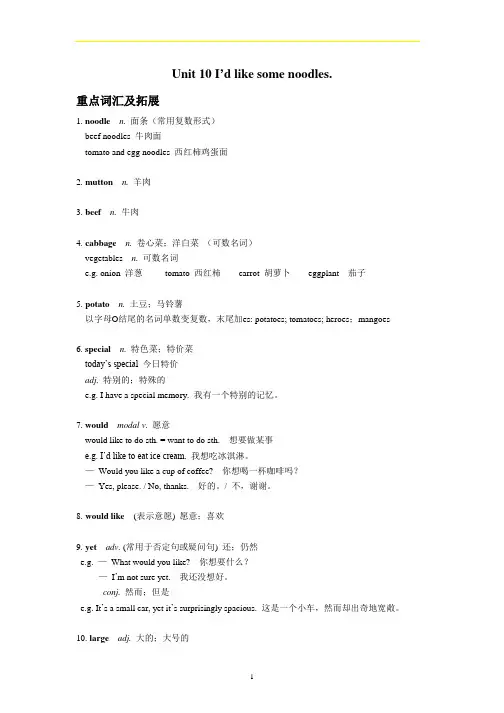
Unit 10 I’d like some noodles.重点词汇及拓展1. noodle n. 面条(常用复数形式)beef noodles 牛肉面tomato and egg noodles 西红柿鸡蛋面2.mutton n. 羊肉3.beef n. 牛肉4.cabbage n. 卷心菜;洋白菜(可数名词)vegetables n.可数名词e.g. onion 洋葱tomato 西红柿carrot 胡萝卜eggplant 茄子5.potato n. 土豆;马铃薯以字母O结尾的名词单数变复数,末尾加es: potatoes; tomatoes; heroes;mangoes6. special n.特色菜;特价菜today’s special 今日特价adj.特别的;特殊的e.g. I have a special memory. 我有一个特别的记忆。
7. would modal v. 愿意would like to do sth. = want to do sth. 想要做某事e.g. I’d like to eat ice cream. 我想吃冰淇淋。
—Would you like a cup of coffee? 你想喝一杯咖啡吗?—Yes, please. / No, thanks. 好的。
/ 不,谢谢。
8.would like (表示意愿) 愿意;喜欢9.yet adv. (常用于否定句或疑问句) 还;仍然e.g. —What would you like? 你想要什么?—I’m not sure yet. 我还没想好。
conj.然而;但是e.g. It’s a small car, yet it’s surprisingly spacious. 这是一个小车,然而却出奇地宽敞。
10. large adj.大的;大号的a large/medium/small bowl 一个大/中/小碗e.g. He had a large bowl of porridge. 他喝了一大碗粥。
人教版七年级Unit_10_I'd__like_some_noodles__Section__A

I’d= I would She’d= She would
I’d like beef noodles, please. I’d like a large bowl, please. Yes, please. No, there isn’t any./ No, there’s no meat.
Countable nouns
Noodle house
specials
What kind of noodles are they?
Special 1
Special 2
Special 3
Special 4
My sister works in a restaurant. They have many kinds of noodles for you to choose. They have some specials. Welcome to our restaurant!
dumplings
hamburger
bread
soup
noodles
noodles
I’d like noodles.
He’d like noodles. She’d like noodles.
What kind of noodles would you like?
I’d like beef and tomato noodles.
oranges
apples
bananas
strawberries
peach(es) [pi:t∫] grapes
mango
pears
What kind of vegetables would you like?
tomatoes
人教版七年级下册英语Unit 10 知识点语法归纳总结
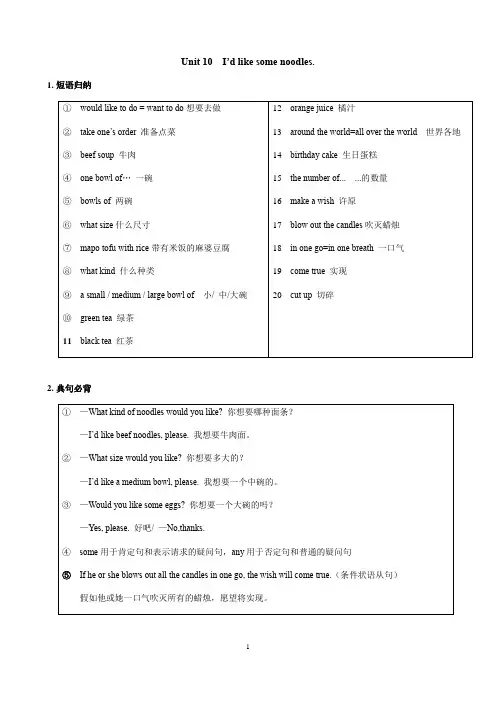
Unit 10 I’d like some noodles.1.短语归纳2.典句必背3.用法集萃(1)What would you like? 你想要什么?❖本句是含would like 的特殊疑问句,结构为“What would+主语+like?”,用于询问“某人想要什么”。
其中would like 意为“想要”,相当于want,但语气比want更加委婉,多用于口语中,并且would like 没有人称和数的变化。
例:—What would you like? 你想要什么?—I’d like some tomatoes. 我想要一些西红柿。
❖would like有如下两种常见的句式,它们的结构、用法和答语分别是:(2)May I take your order? 您现在点菜吗?❖take one’s order意为“点菜”,其中order作名词,意为“点菜”。
例:You can give your order to the waiter. 你可以把你点的菜告诉服务员❖拓展:order还有如下词性和用法牛刀小试If you are late again, the teacher will order you ______ outside the classroom.A. standB.to standC.standingD. stands(3)What size would you like? 你想要多大的?❖本句是what size引导的特殊疑问句,其中size是名词,意为“大小;尺码”,该句用于询问某人想要多大的。
答语通常含有large, medium或small等。
例:—What size is your jacket? 你的夹克是多大尺码的?—Large. 大号的。
❖拓展:what size属于“what+名词” 构成的特殊疑问词组。
此类词组归纳:牛刀小试—We have some different skirts. ______ does your daughter want?—She wants a medium one.A. What colorB.What kindC. What sizeD. What sport(4)The number of candles is the person’s age. 蜡烛的数量是人的年龄❖辨析:the number of, a number of牛刀小试In our city there _____ a number of cars and the number of them _____ growing larger and larger.A.are; isB.have; isC.is; are(5)The birthday person must make a wish and blow out the candles. 过生日的人必须许愿并把蜡烛吹灭。
(人教版)七年级下册英语导学案:Unit 10 I’d like some noodles
Unit 10 I’d like some noodles.Period 1Section A(1a~2c)自主学习课前诊断温故知新两人一组回顾所学过的食品名称,并且分别归类。
Food: _______________________Drink: _______________________Countable noun: _______________________Uncountable noun: _______________________Countable and uncountable noun: _______________________二.设问导读Ⅰ. Pairwork.Talk about your needs in pairs:I’d like some…Ⅱ. Ask and answer.If you go to a noodle house, what will you say? For example:A: Hello, I’d like some noodles.B: What kind of noodles would you like?A: Beef and tomato noodles, please.B: What size bowl of noodles would you like?A: I’d like a small / medium / large bowl of noodles.三.自学检测Practice the dialogue and listen to 1b, 2a and 2b.互动学习问题解决special n. ______________special adj._________________1.___________________ is steak.星期四的特色菜是牛排。
2. We have some great__________today.今天我们有很好的特色菜。
人教版英语七年级下册Unit I'd like some noodles词句精讲精练
Unit 10 I'd like some noodles词汇精讲1. potatopotato 可数名词,意为“土豆、马铃薯”,其复数形式为potatoes。
例如:I don’t like potatoes. 我不喜欢马铃薯。
注意:部分以字母o结尾的名词,变为复数时,在词尾加-es。
例如:tomato (西红柿) →tomatoes hero (英雄) →heroes Negro (黑人) →Negroes 我们可以用“黑人英雄爱吃西红柿和马铃薯”这个顺口溜来记住这几个词。
2. sizesize是名词,它的意思是“尺寸、大小”,既可以表示物体的大小,又可以表示服装、鞋帽的尺码、号码。
What size引导的特殊疑问句经常用来询问规格或者尺码。
例如:-What size shirt do you want? 你要多大号的衬衫?-I want size 36. 我要36号的。
3. small, medium&largesmall, medium, large都可以用来表示物体的型号,small是小号,medium是中号,large是大号。
这三个词可以放在表示量的词前做修饰,来说明具体的要求。
例如,a bowl of的意思是“一碗”,表示“大碗、中碗、小碗”时,分别在bowl前面加上“large, medium, small”即可。
例如:-What would you like? 您想要点什么?-I’d like a large bowl of beef noodles. 我要一大碗牛肉面。
4. special(1)special作名词时,意为“特色菜、特价品、特别的事物”等。
例如:The train is a special for the football game. 那班火车是为足球赛开的专车。
The menu changes regularly and there are daily specials to choose from.菜谱定期更换,而且每天都有特色菜供选择。
人教版英语七年级下册单元Unit 10 知识点+测试卷+思维导图
Unit 10 I’d like some noodles.1.重点词汇:beef, noodles, cabbage, potato, meat, fish, dumpling,soup ,pancake, cake, bowl, size, order, large, popular, special2. 短语归纳:1.would like 想要2.take one’s order 点菜3.one bowl of… 一碗……4.what size 什么尺寸5.cut up 切碎6.what kind 什么种类7.small / medium / large bowl 小/ 中/大碗8.orange juice 橘汁9.around the world 世界各地10.birthday cake 生日蛋糕11.the number of… 的数量12.make a wish 许个愿望13.blow out 吹灭14.in one go 一口气e true 实现3. 必背典句:1. What kind of noodles would you like? 你想要哪种面条?2. I’d like beef noodles, please. 我想要牛肉面。
3. What size would you like? 你想要多大的?4. I’d like a medium bowl, please. 我想要一个中碗的。
5. Would you like a large bowl? 你想要一个大碗的吗?6. Yes, please. 好的,请。
7. If he or she blows out all the candles in one go, the wish will come true.假如他或她一口气吹灭所有的蜡烛,愿望将实现。
4.语法知识:1. would like的用法短语would like用来表达意愿,意为“想要、愿意”,和want意思接近,但比want语气委婉、客气。
人教版七年级英语下册Unit10I’dlikesomenoodles单元复习
词
些土豆。
would like to do 想要做某事,后跟 I would like to have lunch with you.
sth.
to do
我想要和你一起吃午餐。
would like sb.to 想要某人做某事 I would like you to come to my home.
do sth.
目录 contents
重点短语
重点短语
Work seriously
二、重点短语 would like(表示意愿)愿意;喜欢; take one’s order点菜; one bowl of 一碗…; around the world 世界各地; make a wish许愿; blow out吹灭;
words ☆☆
__ __/10
min
基础复现天天练 Work seriously
Do you know McDonald’s? Yes, it is a famous fast food 1 and it is very popular around the world ①.You can find one near your house even in every city. 2 people like the hamburgers and potato chips there.People know fast food is 3 , but they eat a lot because it is very convenient(方便的).You can eat in the restaurant or 4 the food.
我想要你来我家。
目录 contents
5 基础复现 天天练