
七年级英语牛津 7A Unit4复习课件
从…到…
首先做早操 最喜欢的 擅长于 对某人友好 互相聊天 在操场上
18. Reading Club
阅读俱乐部
19. be in = be a member of
20. It’s time for … oneself
……的一员 做……的时间到了 玩得开心 放学/下课后
21. have a good time = enjoy 22. after school/class
15.练习,训练 16.希望,祝愿 17.生活,生命 18.运气 19.幸运的 adj. 20.博物馆 21.野餐 22.一次 23.两次 24. 不喜欢,厌恶 25.原因,理由 26. 准备好 27.学, 学习 28.世界
practise <英> practice <美> wish life luck lucky museum picnic once twice dislike reason ready learn world
Practise 1:选用介词at,in,on填空
Look and fill in the blank.
Kitty_____ likes dancing.She ____ dances after Daniel _____ plays football. Amy swims after school. Millie ____ goes roller skating. She’s not very Sandy _____ plays badminton. Simon football after school. school. good at it.
exercise (锻炼)
完成句子
• Sandy is good at dancing. • Sandy is agood dancer • It takes Lily two hours to practise playing volleyball every day. • Lily spends two hours practising playing volleyball every day. • My father goes to work every day except Saturday and Sunday. • My father goes to workfrom Monday to Friday. • Tom is in the school volleyball team. • Tom is a member of the school volleyball team
11. from…to… 12. do morning exercises first 13. favorite = like…best 14. be good at =do well in 15. be nice to sb. 16. chat with each other 17. in the playground
注意: every day/week/year… , this / that / last /next year/ week/ month… today/ tomorrow/ yesterday(昨天) 前面不能加任何介词。
1.生活,生命 2.在三月 3.在冬天 4.在暑假 5.在七月一号 6.在星期日的早上 7.在儿童节 8.在六岁时 9.今年 10.一切顺利
It is very cold in winter.
Children’s Day is on June 1st.
They do morning exercises at 9 :30.
It is very cold in winter. Children’s Day is on June 1st.
Phrases:
wake up 1.醒来 2.进行课外活动do after-school activities 3.迟到 be late (for…) 4.在八点一刻 at a quarter past eight 5.校园生活 school life 6.去野餐 go on a picnic / picnics 7.在操场上玩 play on/ in the playground 8.在校排球队 in the school volleyball team 9.在周三下午 on Wednesday afternoon 10.最美好的祝愿 best wishes
Fill in the blanks with ‘in’, ‘on’ or ‘at’. 1.They have a party____ on the evening of October 31 . on April 1st. 2. My birthday is _______ 3. We’re going to see the doctor _______ at four o’clock. at 4. They often chat with each _____ lunchtime. 5. They have a long holiday ______ November. in on 6.I play computer games_______ Sunday evening.
100%
80% 60% 40% 20% 0%
never seldom sometimes often usually always
频度副词 (频率由高到低):
always (总是)
usually(通常)
often (经常)
sometimes(有时)
seldom(很少) never(从不)
翻译下列句子 1. 太阳总是从东方升起,西方落下. The sun always ________ rises in the east and sets in the west. 2. 他通常10点钟睡觉. He _________ usually goes to bed at ten o’clock. 3. 他上学经常迟到. He is _________ often late for school. 4. 有时他晚饭后去图书馆. He sometimes ___________ goes to the library after supper. 5. 莉莉不常读报. Lily seldom _________ reads newspaper. 6. 我上学从来不迟到. never late for school. I time) at 1.I often get up ___six o’clock. at (mealtimes) 2.Tom often chats with me _ lunchtime. at (age) 3.I began to learn English___8. at 4.Children get many presents __Christmas. (festivals) in 5.I read English ___ the morning. (parts of the day) on 6.My sister was born ____the morning of (partscold of a specific day) 2nd October. (months) in 7. I was born _____ October, too. (seasons) in in 8.We skate ____ winter and swim ___ summer. (years) 9.Kate is my friend. She was born _____1999. in 10.We don’t have lessons ___ Sundays. on (days)
频率副词: never/seldom/sometimes/often/usually/always. (1)位置:行前be后(行为动词之前be动词之后) (2) 提问:how often 注意:对于 every day/week/year… 提问也用 how often
对划线部分提问。 1. I’m always hungry . How often are you hungry?
2. He walks to home once a week. How often does he walk to home? 3. They sometimes play football. How often do they play football?
比较下列句子 。 1. He goes swimming four times a day.
unit4 My day
Words:
1. 醒,醒来 2. 小山 3. 很少,不常 4. 需要 5. 休息, 歇息 6. 只是 7. 课外的,课后的 8. 活动 9. 从不,绝不 10.开始 11.一刻钟 12.晚于 13.首先 14.聊天 wake hill seldom need rest just after-school activity never start quarter past first chat
How often does he go swimming?
2. He goes swimming four times a day. How many times does he go
swimming a day?
根据汉语提示及句意写出单词
1.Get up,Lily.It's time to do 2.I usually (通常) go to school at 7:30 3.After breakfast,Eddie wants to go to sleep/bed (睡觉) 4.He wants to practise ____(练习) his English with Lucy. 5.Lucy likes reading. She often goes to school the library (图书馆)
牛津英语7aunit4复习课件

Examine how the article opens and closes, and the importance of each.
To enhance students' understanding of different cultures and ecosystems by exploring a variety of texts and media resources.
To promote critical thinking and analytical skills by encouraging students to compare, contrast, and evaluate different viewpoints on environmental issues.
Adjectives
03
Grammar Review
描述正在进行的动作或状态
The present continuous tense is used to describe an action or state that is ongoing at the moment of speaking. It is formed by using the present tense of the verb "to be" (am, is, are) followed by the -ing form of the verb. For example, "I am studying English" means that the action of studying is happening in the present moment.
七年级英语牛津 7A Unit4复习课件

Words:
1. 醒,醒来 2. 小山 3. 很少,不常 4. 需要 5. 休息, 歇息 6. 只是 7. 课外的,课后的 8. 活动 9. 从不,绝不 10.开始 11.一刻钟 12.晚于 13.首先 14.聊天 wake hill seldom need rest just after-school activity never start quarter past first chat
exercise (锻炼)
完成句子
• Sandy is good at dancing. • Sandy is agood dancer • It takes Lily two hours to practise playing volleyball every day. • Lily spends two hours practising playing volleyball every day. • My father goes to work every day except Saturday and Sunday. • My father goes to workfrom Monday to Friday. • Tom is in the school volleyball team. • Tom is a member of the school volleyball team
注意: every day/week/year… , this / that / last /next year/ week/ month… today/ tomorrow/ yesterday(昨天) 前面不能加任何介词。
1.生活,生命 2.在三月 3.在冬天 4.在暑假 5.在七月一号 6.在星期日的早上 7.在儿童节 8.在六岁时 9.今年 10.一切顺利
七年级英语7aunit4知识点牛津译林版
七年级英语7aunit4知识点牛津译林版Seven Grade English 7A Unit 4 Knowledge Points Oxford Abridged VersionUnit 4 of the 7th grade English textbook, Oxford Abridged Version, focuses on the topic of "Healthy Eating". This unit covers a variety of knowledge points related to healthy eating habits, such as healthy food choices, food labels, and understanding the importance of physical exercise. In this article, we will explore these knowledge points in detail.1. Functional vocabularyOne of the key components of Unit 4 is the introduction of functional vocabulary related to healthy eating. Students will learn new words and phrases such as "nutritious", "balanced diet", and "portion size." It is important for students to understand these new terms as they form the basis of healthy eating habits.2. Understanding food labelsAnother important knowledge point covered in this unit is how to read food labels. Students will learn how to identify the different types of nutrients, such as fat, salt, and sugar, and how to understand their measurements. By being able to read food labels, students can make informed decisions about their food choices.3. Healthy food choicesUnit 4 also covers the importance of making healthy food choices. Students will learn about the food groups, such as fruits and vegetables, carbohydrates, proteins, and fats, and the essential nutrients found in each group. By understanding the importance of a balanced diet and the nutrients required for healthy living, students can make better food choices.4. Exercise for a healthy lifestyleFinally, Unit 4 emphasizes the importance of physical exercise for a healthy lifestyle. Students will learn about the different types of exercise and their benefits, such as cardio, strength training, and flexibility exercises. By understanding the different types of exercise and their benefits, students can make informed decisions about their physical activity.ConclusionUnit 4 of the 7th-grade English textbook, Oxford Abridged Version, covers a variety of knowledge points related to healthy eating habits and physical exercise. By understanding functional vocabulary, reading food labels, making healthy food choices, and incorporating physical activity into their daily routine, students can develop a healthy lifestyle. By following these knowledge points, students can maintain their physical and mental health and achieve greater success in their academic and personal lives.。
七年级英语课件牛津版7AUnit4Vocabulary

M: Hi,… Do you like your new diet? R: It’s OK. I love … but I think they are not healthy. M: Do you feel better? R: Yes. Now I eat … for breakfast/lunch/supper. M: Do you exercise every day? R: Yes. I exercise for about …twice a week. And I feel healthier. M: Good luck with your new diet and lifestyle. R: Thank you!
Eat sweet snacks between meals every day. Eat vegetables every day. Go swimming twice a week. Do not eat fast food. Do not eat breakfast. Always eat Coke and hamburgers for lunch. Good for our health: Not good for our health:
Vegetables:
Meat:
Fruit:
Drink:
Grains (谷物): Dairy (牛奶制品):
Countable nouns ( 可数名词) :
Uncountable nouns (不可数名词):
Put the things into correct groups in the table below.
• What is healthy food and what is not?
牛津7A_Unit4复习课件
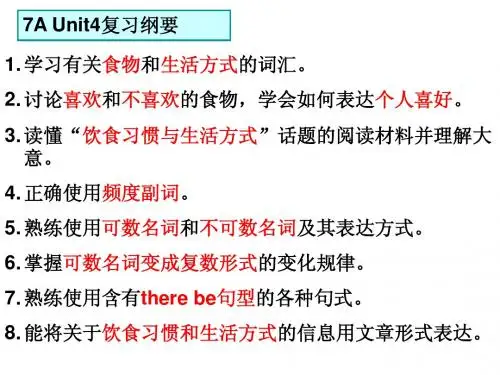
5. 与形容词连用的动词(系动词) ④. 变化系动词(become, grow, turn, get, go)
He became mad after that.
The leaves turn yellow in autumn.
My computer has gone wrong.
⑤. 表像系动词(seem, appear )
【特别提醒】
1. fish作为食物“鱼肉”时,不可数;作为活鱼时,可数,复数仍 为fish;作为鱼的种类时,可数,复数为fishes。 2. family作为“家庭”,是单数名词,复数是families;作为“家 人”,是复数含义。 3. maths,physics, news为不可数名词,不是复数。 4. people,police,audience 等为集体名词,是复数含义。 5. glasses(眼镜), trousers, clothes(衣服)等以复数形式出现,若 表达具体数目,要借助数量词pair(对,双);suit(套)。 6. 名词作定语一般用单数,如apple trees, shoe factories, boy students;但也有一些例外:sports meeting, men workers, women teachers 7. “数词+名词(+形容词)”构成的复合形容词,中间的名词用单 数,如:five- year- old, two- metre- long 8. 表示某国家的人变复数为:a Chinese →Chinese, a Japanese → Japanese, an Englishman → Englishmen, a Frenchman → Frenchmen, an American → Americans, an Indian → Indians
牛津英语7A-Unit4复习
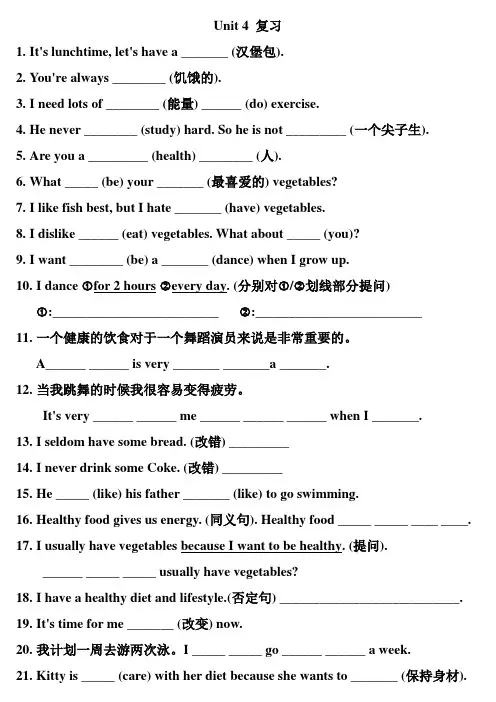
Unit 4 复习1.It's lunchtime, let's have a _______ (汉堡包).2.You're always ________ (饥饿的).3.I need lots of ________ (能量) ______ (do) exercise.4.He never ________ (study) hard. So he is not _________ (一个尖子生).5.Are you a _________ (health) ________ (人).6.What _____ (be) your _______ (最喜爱的) vegetables?7.I like fish best, but I hate _______ (have) vegetables.8.I dislike ______ (eat) vegetables. What about _____ (you)?9.I want ________ (be) a _______ (dance) when I grow up.10.I dance ①for 2 hours ②every day. (分别对①/②划线部分提问)①:_________________________ ②:_________________________11.一个健康的饮食对于一个舞蹈演员来说是非常重要的。
A______ ______ is very _______ _______a _______.12.当我跳舞的时候我很容易变得疲劳。
It's very ______ ______ me ______ ______ ______ when I _______.13.I seldom have some bread. (改错) _________14.I never drink some Coke. (改错) _________15.He _____ (like) his father _______ (like) to go swimming.16.Healthy food gives us energy. (同义句). Healthy food _____ _____ ____ ____.17.I usually have vegetables because I want to be healthy. (提问).______ _____ _____ usually have vegetables?18.I have a healthy diet and lifestyle.(否定句) ___________________________.19.It's time for me _______ (改变) now.20.我计划一周去游两次泳。
牛津译林英语 七年级上册Unit4 Integrated skills (共19张PPT)
notice
Welcome to the match
Dear classmates, There is a___fo_o_t_b_a_ll_m_a_t_c_h__be_t_w_e_e_n__Co_d_i_o_n_ _a_n_d__a_t_e_a_m__fr_o_m__J_a_p_a_n_______________ on _O_c_t_o_b_er__2_5_.The match starts _a_t__9_a_._m_._____, this S__un_d_a_y__m_o_rn_i_n_g__, at S_h_a_n_g_h_a_i _S_p_or_t_s_C_e_n_t_r_e_. We can go there__b_y_b_u_s__or__b_y_c_a_r_. I hopee_v_er_y_o_n_e_c_a_n__co_m__e_a_n_d_w__at_c_h__th_e__m_a_t.ch Thanks. Wish _o_ur__t_e_am__g_o_o_d__lu_c_k____! Daniel
Task two Report their weekends to your partner
Millie visits the museums twice a month. Tommy goes on picnics once a month.
Read and fill in the blanks
A:What do you like to do at weekends? B:I like to… A:How often do you…? B:About…. What about you? A:…
牛津7A Unit4 Reading 2英语课件PPT
Unit 4
Unit4 Food Reading (2)
广东 钟 聪
Warm - up
1. What is it? It is…
rice
chicken
fish
a hamburger
2. What are they? They are…
oranges cakes
vegetables apples
4. I’m 12 years old and a top student at school. a top student=a best student 一名优 秀学生
e.g. Do you want to be a top student in your school? She is one of the top singers in China.
61.任何一件事情,只要心甘情愿,总是能够变得简单。 79.你想要的未来,是一步步走出来的。 68.不是因为生活太现实,而对生活失望;而是知道生活太现实,所以更要用心的活下去。给自己一个拥抱。 26.压力、挑战,这一切消极的东西都是我取得成功的催化剂。 77.有钱的人更有钱,这往往是一种必然。 48.没有人会让你输,除非你不想赢。
New words
health /hel/ n.健康 person / p:sn/ n.人 power / pa(r)/ n.能 量
Phrases
want to be a dancer a healthy diet a top student between meals need lots of energy
喝点牛奶 drink some milk
1. I want to be a dancer. want to be 想成为……
【参考实用】七年级英语课件牛津版7A Unit4.ppt
How can we be healthy?
Their diets and their lifestyles
Kitty
Daniel
What they eat and how they live
Please read Kitty’s and Daniel’s articles:
c_h_a_t_ti_n_g_with his friends o_n_ the Internet. But he doesn’t have a healthy d_ie_t__. He always eats h_a_m_b_u__rg_e_r_s_. He wants to run f_a_s_t_ but he can’t.
milk and br_e_a_d_ for breakfast, she usually eats m_e_a_t_ and vegetables for dinner.
• Daniel likes st_u_d_y__in_g_and he is a t_o_p_ student at school. He likes playing c_o_m__p_u_t_e_r games and
3. What does Daniel do after school? (B)
A.dance B.plays computer games C.cooks healthy food
4.How often does Daniel plan to swim? (C)
A.twice a day B.every day C.twice a week
breakfast
Kitty
苏教牛津译林版初中英语七年级上册7A unit 4复习PPT课件
• 2W.__o_u_l_d_ you_li_k_e___to_____tell you about your life?
8.Thank you for youhre__lp_____(help). Thank you for _h__e_lp_i_n_g(help) me.
9.He goes to her dancing lessons every day(对划线部分提问)
__W_e__o_ft_en__c_ha_t_w_i_th__ea_c_h_o_t_h_e_r _in_t_h_e_p_la_y_g_ro_u_n_d__ 5.我们周三下午放学后练习。
_W__e_p_ra_c_ti_s_e_a_ft_e_r _sc_h_o_o_l_o_n_W_e_d_n_e_s_d_a_y_a_ft_er_n_o_on 6.我想告诉你关于我的生活情况
15.玩的很高兴(两种) _____h_a_v_e_a_g_o_o_d_t_im,_e_,_h_a_v_e_fu_n__
16.在星期天On__Su_n_d_a_y _____,在星期天的早上 ________O_n_S_u_nd_a_y_m, ornin在g 儿童节_o_n_C_h_ild_r_en_’s_D_ay
在12月15号的晚上___O_n__th_e_e_ve_n_in_g_o_f _15_D_e_c_em__be_r__, 在一个温暖的早上__O_n_a_w_a_rm__m_o_rn_i_ng_____
In the morning/afternoon/evening
17.在早上/下午/晚上_____________,在一月 _I_n_J_a_n_u_a_ry__在冬季__In_w__in_te_r____在2015年_____