
牛津译林版英语七年级下册7B Unit 7 Welcome to the unit课件
牛津译林版英语七上Unit7《Shopping》(Welcometotheunit)英文说课稿1

牛津译林版英语七上Unit 7《Shopping》(Welcome to the unit)英文说课稿1一. 教材分析《牛津译林版英语七上Unit 7 Shopping》是按照新的课程标准编写的一篇实用性强的教科书。
本单元的主题是购物,主要讨论在购物时可能会用到的一些日常用语和交际用语。
通过学习本单元,学生可以掌握购物场景下的基本词汇和句型,提高在实际生活中的英语口语表达能力。
二. 学情分析初中的学生已经掌握了一定的英语基础知识,对于日常的英语交流已经没有太大的问题。
但是,他们在口语表达方面还存在一定的困难,尤其是在一些特定的场景下,比如购物。
因此,我们需要通过一些特定的教学方法来帮助他们更好地掌握这些知识。
三. 说教学目标1.知识目标:通过学习,学生能掌握购物场景下的基本词汇和句型,理解对话内容。
2.能力目标:通过实践,学生能熟练运用所学知识,进行购物场景的模拟交流。
3.情感目标:通过学习,学生能提高对英语学习的兴趣,增强自信心。
四. 说教学重难点1.重点:购物场景下的基本词汇和句型的掌握。
2.难点:对购物场景下的一些特殊用语的理解和运用。
五. 说教学方法与手段1.教学方法:采用任务型教学法,让学生在实际操作中掌握知识。
2.教学手段:利用多媒体课件,为学生提供丰富的视觉和听觉材料。
六. 说教学过程1.热身(5分钟):通过播放一段购物场景的视频,引起学生的兴趣,并复习一些相关的词汇。
2.课堂导入(10分钟):介绍本节课的主题,展示本节课要学习的内容,让学生明白学习的目标。
3.课堂讲解(20分钟):通过讲解和示范,让学生掌握购物场景下的基本词汇和句型。
4.课堂实践(15分钟):学生分组进行角色扮演,模拟购物场景,运用所学知识进行交流。
5.课堂总结(5分钟):对所学内容进行总结,强调重点和难点。
七. 说板书设计板书设计要清晰、简洁,能够一目了然地展示本节课的主要内容和关键信息。
可以采用列表或者图示的形式,将购物场景下的基本词汇和句型展示出来。
Unit7Weletotheunit练习牛津译林版英语七年级下册(1)
Unit 7 Welcome to the unit一、词汇运用。
1. After the hens __________ (lay) some eggs, all the students cheered.2. Don’t leave your friend __________ (wait) for you all the time!3. What great fun it is __________ (watch) my dog running after the ball at this time yesterday!4.__________ (brush) you teeth twice a day will make your teeth healthy.5. __________your face__________(hurt) when you fell off the bed this morning?6. Be careful_____________(not burn) yourself when you start a fire.7. If Sandy___________ (try) her best to practise more, she will pass the exam next week.8 There____________(be)two basketball matches on TV tomorrow morning, aren't there?二、单项选择。
1. You’d better try different ways you can think of _____ maths problems. It’s good for you to learn maths well.A. work outB. to work outC. working out D .is working out2. ---How often do you _____ from your penfriend? ---Well, I _____ from him every month.A. get a letter; hearB. get; hearC. get; hear a letterD. get a letter; hear a letter3. ---You have seen the film the Monkey King, haven’t you?---_____. How I wish to see it again!A. No, what a pity!B. No, I haven’t.C. Yes, I like it.D. Yes, it’s boring.4. The old man had _______ money of all ,but he raised ______ money for Project Hope.A. the fewest, the mostB. the least, the mostC .the less, the more D. the least, the more5. ―Don’t play in the street. It’s dangerous. ― _________.A. No, I don’t.B. No, I won’t.C. Yes, I will.D. Yes, I won’t.6. ___________ it or not! I can see __________ your body with this pair of special glasses.A. Believe; overB. To believe; acrossC. Believing; throughD. Believe; through7. Emily didn’t feel __________. She stayed __________ for two weeks.A. good; in hospitalB. good; in the hospitalC. well; in hospitalD. well; in the hospital8. Nancy needs to ________________ Geography than other subjects.A.be good atB. do well inC. do better atD. do better in9. --- Look at the black clouds. Maybe it’s going to rain.--- Bad luck! I __________ my umbrella at home.A. leaveB. leftC. forgetD. forgot10. ---Tom, your bedroom is so dirty. Please _________________!--- Sorry, Mum. I have no time to _________________.A. clean it up; think it aboutB. clean it up; think about itC. clean up it; think about itD. clean up it; think it about三、完形填空Thousands of years ago,people did not know 1 to make a fire. When it was very 2 at night,they could not sleep well. Sometimes lightning hit(打,击)a 3 and started a fire. At first people were both surprised and 4 to see the fire. They were afraid to go up. Later a few 5 men took some of this fire and made a fire neartheir homes. They used the fire to keep them warm and to cook food.When they had a fire,they did not let it 6 burning. If it stopped,they could not start it again. Maybe they had to 7 for a long time,sometimes for 8 . Later they 9 how to make a fire with pieces of wood. Now we have matches. We can put them in our pockets and make a fire when we want to make it. But we have to be 10 with fire.( )1. ( )2. ( )3. ( )4. ( )5. ( )6. ( )7. ( )8. ( )9. ( )10. A. whatA. coldA. personA. gladA. veryA. stopA. workA. minutesA. forgotA. angryB. howB. hotB. mountainB. afraidB. braveB. makeB. playB. hoursB. decidedB. pleasedC. whenC. warmC. fieldC. readyC. sadC. beC. waitC. daysC. learnedC. carefulD. whereD. coolD. forestD. tiredD. happyD. startD. liveD. yearsD. toldD. busy四、阅读理解;You speak, write a letter, and make a telephone call. Your words carry a message. People communicate(交流) with words. Do you think you can communicate without words? A smile on your face shows you are happy or friendly. Tears in your eyes tell others that you are sad. When you raise your hand in class,the teacher knows you want to say something or ask questions. You shake your head, and people know you are saying “No”. You nod and people know you are saying “Yes”. Other things can also carry messages. For example, a sign at the bus stop helps you to know which bus to take. A sign on the wall of your school helps you to find the library. Signs on doors tell you where to go in or out. Have you ever noticed that there are a lot of signs around you and that you receive messages from them all the time?People can communicate in many other ways. An artist can use his drawings to tell about beautiful mountains, about the blue sea and many other things. Books are written to tell you about all the wonderful things in the world and also about people and their ideas. Books, magazines, TVs, radios and films all help us to communicate with each other. They all help us to know what is going on in the world and what other people are thinking about.1 Can we communicate with each other without words?A. Yes, sometimes we can.B. No, we can’t.C. No, it’s impossible.D. Yes, we always do so.2 When we see somebody smile,then,he must be feeling .A. angryB. joyfulC. surprisedD. sad3 We can learn news from .A. newspapersB. radiosC. TVsD. A, B and C4 A sign at the bus stop tells you .A. how many buses there areB. what kind of bus it isC. where the bus comes and goesD. how much money you’ll pay for the ticket5 What do you think is the quickest way to communicate with your friend in another city?A. Writing a letter.B. Making a telephone.C. Drawing a picture.D. Asking someone else to take a message.五、首字母填空。
译林版英语七年级下册-7B-Unit8-Pets-Welcome-to-the-unit

It lives in the water.
Its color is often orange.
It sleeps with eyes open.
two goldfish I like watching them swim around.
What is it?
a mouse
It is very small and soft.
dog
What is it?
She likes playing with balls.
She can sleep on my knees.
She likes fish best.
[niː] n . 膝, 膝盖
She can make a sound like “miaow”.
cat
More new words
Guess: Who is he?
He has a tail(尾巴) and four paws(爪子). His fur(皮毛) is yellow. He likes to eat and sleep. He is fat and lazy,but very lovely. We can see him every day.
It likes eating vegetables.
It has long ears. It has red eyes.
rabbit
We can feed them carrots. vt . 喂,喂养
What is it?
a goldfish
It has big eyes.
['gəʊldfɪʃ]
A:Why?
B: Because …
Daniel -parrot
译林牛津七年级英语下册 Unit 7-8单元词句梳理

译林牛津七年级英语下册Unit 7 AbilitiesPeriod 1 Comic strip & Welcome to the unit 必背单词1. ability n. 能力2. believe vt. 相信3. seat n.座位4. send vt.发送; 邮寄5. even adv. 甚至6. able adj. 能, 能够7. pay vi. & vt. 付费8. notebook n.笔记本9. raise vt. 募集必背短语10. believe it or not 信不信由你11. look out 留神, 当心12. pay for 为……付款13. be able to 能14. clean up the park 打扫公园15. plant trees 植树16. give a seat to someone 给某人让座17. an old people’s home 养老院18. in poor areas 在贫困地区19. send ... to 发送20. raise money for 为……筹钱必背句子21. Believe it or not! 信不信由你!22. We can send some books to them.我们可以给他们寄一些书。
23. Some families are not even able to pay for pens and notebooks.一些家庭甚至付不起钢笔和笔记本的费用。
24. We can raise some money for them to buy these things.我们可以为他们募集一些资金来买这些东西。
Period 2 Reading必背单词1. brave adj. 勇敢的2. save vt. 救, 救助3. smoke n. 烟, 烟雾4. badly adv. 严重地, 厉害地5. hurt adj. 受伤的6. could modal v. (can 的过去式) 可以, 能, 会7. protect vt. 保护8. rush vi. 冲, 奔9. wet adj. 湿的; 未干的; 有雨的10. burn vt. &vi. 烧伤; 烧11. nod vi. &vt. 点头12. careful adj. 仔细的, 认真的; 小心的→ carefully adv. 小心地, 谨慎地; 仔细地, 认真地13. hurt vt. &vi. 使受伤, 伤害; 疼14. news n. 新闻, 消息15. newspaper n. 报纸16. match n.火柴17. rubbish n.垃圾, 废弃物必背短语18. save... from 从……中救出19. next door 在隔壁20. put out the fire 扑灭火21. in hospital 住院22. be careful with 小心; 照顾23. find out 找出, 查明; 发现24. play with 同……一起玩25. at home alone 独自在家26. hear someone shouting 听见某人叫喊27. the 79-year-old Mrs Sun 79 岁的孙女士28. rush into 冲进必背句子29. What a brave young man! 多么勇敢的一个年轻男人!30. He was brave enough to save his neighbour from a fire.他足够勇敢从一场大火中救出了他的邻居。
牛津译林版英语 七年级下册 第七单元 导学案 (含答案)
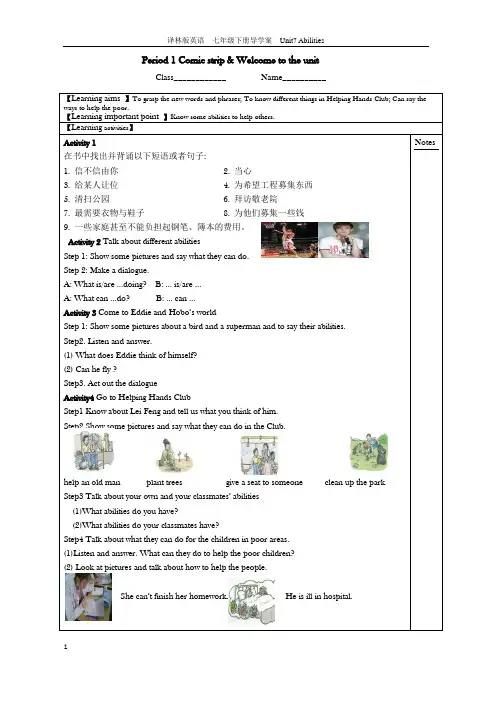
Period 1 Comic strip & Welcome to the unitClass____________ Name__________【Learning aims】To grasp the new words and phrases; To know different things in Helping Hands Club; Can say the ways to help the poor.【Learning important point】Know some abilities to help others.【Learning activities】Notes Activity 1在书中找出并背诵以下短语或者句子:1. 信不信由你2. 当心3. 给某人让位4. 为希望工程募集东西5. 清扫公园6. 拜访敬老院7. 最需要衣物与鞋子8. 为他们募集一些钱9. 一些家庭甚至不能负担起钢笔、簿本的费用。
Activity 2 Talk about different abilitiesStep 1: Show some pictures and say what they can do.Step 2: Make a dialogue.A: What is/are …doing? B: … is/are …A: What can …do? B: … can …Activity 3 Come to Eddie and Hobo’s worldStep 1: Show some pictures about a bird and a superman and to say their abilities.Step2. Listen and answer.(1) What does Eddie think of himself?(2) Can he fly ?Step3. Act out the dialogueActivity4 Go to Helping Hands ClubStep1 Know about Lei Feng and tell us what you think of him.Step2 Show some pictures and say what they can do in the Club.help an old man plant trees give a seat to someone clean up the parkStep3 Talk about your own and your classmates’ abilities(1)What abilities do you have?(2)What abilities do your classmates have?Step4 Talk about what they can do for the children in poor areas.(1)Listen and answer. What can they do to help the poor children?(2) Look at pictures and talk about how to help the people.She can’t finish her homework. He is ill in hospital.Period 2 Reading (I )Class____________ Name__________【Learning aims】To grasp the new words and phrases; To understand the passage ; Can say something about Li Tao in your own words.【Learning important point】Can understand the passage very well.【Learning activities】Activity 1在书中找出并背诵以下短语或者句子:1. 足够勇敢2. 从火中救了他的邻居3. 单独在家4. 听到某人正在大叫5. 她的左腿严重受伤6. 冲进厨房7. 把水泼在他的衣服上保护他自己8. 扑灭火9. 住院两周10. 没有时间考虑--- 11. 当心----Activity 2 Learn about fireStep 1 Look at the pictures and talk about fire.Fire is useful, but sometimes it is dangerous. If you are not careful with it, it can burn things oreven hurt you. A big fire can even burn forests and tall buildings. So keep yourself away fromfire.Step2 Talk about what we should do when there is a fire.call 119 for help run out of fire pour water around the house put a wet blanket over the bodyActivity 3 Know about a brave young manStep1. Listen and answerWhat did the young man do?Step2. Read and finish the following tableWhere What happenedIn abuildingHe was athomeLinTaohear heard someonesee saw a lot ofdo his neighbor a firefeel was notMrsSuncould not because she her legStep3 R ead and choose “T&F”(1) Lin Tao helped his neighbour out of a fire. ( )(2) Mrs Sun couldn’t get out because she hurt her left leg. ( )(3) Mrs Sun was in her kitchen when the fire took place. ( )NotesPeriod 3 Reading (II )Class____________ Name__________Period 4 GrammarClass____________ Name__________【Learning aims】To grasp the new words and phrases; To know and use “can\ could\ may”; Can Use “What & How” to express strong feelings.【Learning important point】To know and use “can\ could\ may”; Can use “What----!& How---!”【Learning activities】Notes Activity 1在书中找出并背诵以下短语或者句子:1. Millie能够说好英语。
译林版英语七年级下册Unit7学案
班级_________姓名_________ 【预习导学】一、翻译下列短语和句子。
1. 当心2. 植树3. 给某人让座4. 探望敬老院5. 为-----付款6. 最需要----- _______________________7. 清理公园_______________________ 8. 将----寄给________________________二、默写下列课文中的句子。
1.信还是不信!2.当心,Eddie!3.我们可以给他们寄送一些过去。
4..一些家庭甚至没有能力付得起钢笔和笔记本5.我们可以为他们筹集一些钱来买这些东西。
【新知预习】1. How cool! 多酷呀!这是一个感叹句。
它的结构是how + adj./adv. + 主语+ 谓语!e.g.她多么漂亮啊!How she !她跑的太快了!How she runs!2. I can fly. 我会飞。
can 是一个情态动词,表示“能,会”。
它的否定形式是can’t, 后面加动词的原型。
e.g. He can sing. But he dance.他会唱歌,但不会跳舞。
3. Believe it !I have got the first award. 信不信由你!我得了一等奖。
4. look out = be careful = take care 留神,当心e.g. 当心Look . Th e fire is dangerous.5. trees 植树6. clean the park 清理公园7. give a to on the bus 在公共汽车上给某人让座8. collect … for … 为…… 收集……9. visit an old people’s home参观老年公寓10. send sb. sth. = send sth. to sb.发送给某人某物e.g. I send him a card .= I send to him.11. raise money for … 为…… 募集资金e.g. we can raise some money the poor.班级_________姓名_________一、用所给首字母完成下列句子。
七年级牛津7B 牛津译林版七年级下Unit7 Period 1课文练习及答案
7B Unit 7 AbilityPeriod1(Comic strip & Welcome to the unit)一、词组翻译1. 信不信由你_____________________2. 给老人和小孩让座____________________3. 有温暖的衣服过冬_______________4. 参观敬老院__________________________5. 把公园清理干净_________________6. 为希望工程收集东西__________________二、单词拼写1. Different people have different_______(能力).2. I like_______(收集)animal stamps in my free time.3. Eddie thinks he can_______(飞),but Hobo doesn't think so.4. Some students can't_______(甚至)pay for school because they are poor.5. He is helpful. He often gives his_______(座位)to others on the bus.6. Remember to_______(发送)a message to me when you get to Tokyo.7.Every year people___________(植树)on Tree Planting Day.8.Li Hua is a good boy.He always help the _________(老人).三、句型转换1. He can swim. (改为同义句)He______ ______ ______ swim.2. Eric is running fast!(改为感叹句)______ ______ Eric is running!3. They planted many trees last week.(对划线部分提问)______ _______they_______ ________last week?4. They bought much food for the old.(对划线部分提问)______ ______ they_______ much food______?四、单项填空( ) 1. I_______ ride a bike when I was very young.A. canB. am able toC. could be able toD. was able to( ) 2. Look! The train is going_______ the tunnel (隧道).A. acrossB. throughC. thoughtD. over( ) 3. -Did you do anything for your safety (安全)?-_______. I had no time to think about it.A. Yes, I doB. No, I didn'tC. Yes, I didD. No, I don't( ) 4. Can you collect something interesting_______ me?A. toB. byC. towardsD. for( ) 5. We're going to plant 1,000 trees_______ Tree Planting Day.A. atB. in C on D. for( ) 6. Millie and Mary jumped out of the bus and_______ away_______.A. run; quickB. run; quicklyC. ran; quick aD. ran; quickly五、动词填空1. Last weekend, we_______ (raise) some money for them_______ (buy)some useful things.2. We_______ (send) some books to the poor students if we are free next weekend.3. Would you like_______ (sing) a song for all of us?4. -How much_______ you_______ (pay) for your new coat the day before yesterday?-One hundred and fifty yuan.5. It's polite_______ (give)a seat to others on the bus.6. The children_______ (help) us do some cleaning now.7. The bell rang and the students stopped_______ (talk).六、完形填空Li Yang’s brother is a 1 .He works in a bank.One day,he was driving two bags full of 2 important.But he and his truck were lost.The police looked for three hours,then they found Li Yang’s 3 and his truck.His 4 were tied(捆绑)behind his back.The bad man put something round into his 5 so that he could not shout.The police climbed into the back of the truck and freed Li Yang’s brother.They asked him what happened.“They asked me to stop soon 6 I left the bank,”his brother said.“Six men stopped me and made me 7 to the river.‘If you shout,’one of them said,‘we will cut you into pieces.’When I got to the river.they tied8 up.Then they threw me to the back of the truck.I sat on one of the 9 quietly.They didn’t see the bag,and took the other one.”“How much money was there in the bag?”a policeman asked.“There was not any 10 in it at all,”Li Yang’s brother laughed.“Only some letters,the money is in this one.I was sitting on it.”What a brave and clever man he is!( )1.A.worker B.driver C.teacher D.doctor( )2.A.something B.anything C.nothing D.everything( )3.A.sister B.brother C.father D.mother( )4.A.truck B.bags C.hands D.head( )5.A.ears B.eyes C.nose D.mouth( )6.A.after B.before C.as D.when( )7.A.run B.go C.swim D.drive( )8.A.him B.me C.you D.it( )9.A.bags B.letters C.truck D.seats( )10.A.1etters B.clothes C.money D.Paper七、阅读理解Do you hope to do a lot of homework every evening? Are you interested in your classes? Who do you want to teach you? Maybe you have lots of questions in your mind before school starts.Well,I want to give you some good advice on these problems.First,keep calm(冷静的).Don’t worry about all the questions you have.Put your heart into learning,and you can find something you are interested in.Do it actively.Second,try your best to finish your homework quickly.Don’t spend a lot of time on it.Do more reading or writing in English.Think about the problems you have and solve them at once.Don’t stay up late,or you can’t study well the next day.Third,think of something instead of copying(抄写)or repeating(重复).If you can remember the words in your way,you can tell your teachers you don’t like the way of copying them again and again.Be sure you can pass the test.I think your teachers will agree with you.And they can give you something.interesting to do.School is really a good place for you to learn.Believe in your teachers and yourself.You are the best one and you can do everything well.( )1.The writer writes the passage to .A.give students some good ways of learningB.ask students not to listen to their teachersC.ask students not to do their homeworkD.tell students what a good teacher is( )2.What does the writer tell students to do about their homework?A.They should spend a lot of time on it.B.They should stay up late doing it.C.They should do more reading or writing in English.D.They should have boring work to do.( )3.What’s the third piece of advice about?A.How to get on with friends.B.How to get high grades.C.What kind of schoolwork is better for students.D.How to finish the homework in a short time.( )4.According to the passage,students should believe in .A.themselves and their teachers B.themselves and their parentsC.their parents and teachers D.themselves and their classmates八、翻译句子1. 我觉得贫困地区的孩子最需要书和笔记本。
译林版英语七年级下册Unit7Welcom
Listen and answer.
1. What can they do for the children in poor areas? They can send some clothes and shoes to them.
2. Can they raise some money for them? Yes, they can.
She is planting trees.
Tree Planting Day (on 12th March)
Planting trees can make our city more beautiful.
五问五学,浅问深学—— 概问引标,课前先学
Did you give seats to others before?
He is giving a seat to someone on the bus. Giving a seat to others on the bus is polite. It is polite to give a seat to others on the bus.
五问五学,浅问深学—— 概问引标,课前先学
f. visiting an old people’s home
b
a
d
f
e
c
五问五学,浅问深学—— 概问引标,课前先学
Read and answer
The members at the Helping Hands Club are talking about what they can do to help others.
pay
vi. & vt.
pay for
believe
v.
牛津译林版七年级英语下册《Unit2Neighbours》Welcometotheunit教案
《Unit 2 Neighbours》Welcome to the unit教案授课时间:年月日总计:课时教学目标:1. .Master the names of all kinds of jobs and working places.2. .Can talk their own towns in English.Teaching contents:Words: neighbour will visitor like wow waiter neighbourhoodSentences: I’m going to visit our neighb ours.教学重点:Words and phrases教学难点:Write sentences about what will do课时安排: 1 课时教学过程:复备栏Ⅰ. Step 1. review①In the afternoon, my family wil l watch a film in a andhave a big meal in a famous .What a wonderful weekend! Now it is time to go to the tobuy something for tomorrow.2. T: Where do you live? What kind of home do you have? What’saround your home? Is your home near a park/a school/a re staurant/a supermarket?Is there a shop/a factory/a cinema/a museum/ahospital near your home? Encourage the students to answer bythemselves.Step2. Presentation1.T: Who lives next to your flat/house? Who lives above/blow you?Who’s your n eighbour? Wha t’s your neighbour? What’s yourneighbour’s name? What does he/she do?Write ‘neighbour’ on the blackboard.2.T: Mr. Lin is my neighbour. He’s a waiter in a big restaurant. Miss Huang lives above me. She’s a teacher.Write ‘waiter’ on the blackboard.Step 3. Practice1.Ask the students to finish exe rci se A.T: We have a lot of neighbours. They have different jobs. Look at the pictures. Where do they work? Please match them with the places. 2.Make a dialogue with a student.Step 4. Presentation1.Make sure the understand the idea of the dialogue B.T: Amy is asking Simon questions. What are these questions about? Please listen to the tape and tell me.2.Encourage the students to the tape and answer.T: The questions are a bout Simon’s home and different places a round his flat.Present ‘neighbourhood’ and write it.Step5.Practise1.Play the tape ,ask the students to answer more questions. eg:(1)Where’s Simon’s flat?(2)How many buildings are there in neighbourhood?(3)How many floors do the buildings have?(4)What does Simon have around his neighbourhood?(5)What does Simon think of his neighbourhood?2.Divide the students into two groups to read.3.Ask some students to make a dialogue using part B as a model.4.Ask some students to act.Step 6. Presentation1.T: Do you often talk with our neighbours? Do you often play withyour neighbours? Do you like visiting them? Do they often visit your home? Do you thin k they’re good visitors? What do you think your neighbours?Write ‘visitor’ on the blackboard.2.ask the students to listen to the t ape and find the answer:Where’sHobo going?3.ask the students to answer more questions according to the tape. Step7.PractiseAsk the students to read the dialogue and act.Step8. Presentation1.Encouage the students to say their ideas acco rding to the comicstrip.2.Arrange the students to talk about and discuss:Wh at can you dofor your neighbours?Step9.Homework1.Remerber all the new words and sentences.2.Ricite the dialogue and part B.3.Finish the exercise.教学反思:。
牛津译林版七下英语7Bunit2welcometotheunit
Whatdoeshe/shedo?=Whatishe/she?
=What’shis/herjob?
其余以-er结尾为主表示人的名词:
服务员______:工人______,作者_______,游
泳者__w__a_i_te_r__,读者_w__o_r_k_e_r_, writer
跑步者s__w_i_m__m_e_r__,运动r员ea_d_e_r_________,
女儿____r_u_n_n__e_r_. daughter
computergamesafterschool.
5.It’sluckyforus___t_o_h_a_v__e_(have)agood
teacherlikeMrhu.
完成句子:
1.别总那样看着我。
_D_o__n_’t_lo_o_k_a_t_l_ik_e_t_h_a_t me___________.
我们大部分人_m__o__s_t_o_f_u_s______________
如:我的大多数学生都有电脑。
_M_o_s__to__fm__y_s_t_u_d__e_n_t_s_h_a_v_e__________computers
我们大多数人喜欢躺在床上听音乐。
M__o_s_t_o_f_u_s_l_ik__e_li_s_t_e_n_i_n_g_i_n_btoemd usic_______.
……中的大多数_m__o_s__to__f_…_, mostof+_复__数__名__词__+___动__词__复__数_; mostof+__不__可___数__名__词_+___动__词__单___数___