
七年级下册英语Unit2-4单元词汇
Unit2◆短语归纳1. what time 几点2. go to school 去上学3. get up 起床4. take a shower 洗淋浴5. brush teeth 刷牙6. get to 到达7. do homework 做家庭作业8. go to work 去上班9. go home 回家10. eat breakfast 吃早饭11. get dressed 穿上衣服12. get home 到家13. either…or… 要么…要么…14. go to bed 上床睡觉15. in the morning/ afternoon/ evening 在上午/下午/晚上16. take a walk 散步17. lots of=a lot of 许多,大量18. radio station 广播电台19. at night 在晚上20. be late for=arrive late for 迟到◆用法集萃1. at + 具体时间点在几点(几分)2. eat breakfast/ lunch/dinner 吃早饭/午饭/晚饭3. thirty\half past +基数词……点半4. fifteen\a quarter to +基数词差一刻到……点5. take a/an +名词从事……活动6. from …to … 从……到……7. need to do sth 需要做某事◆典句必背1. What time do you usually get up? I usually get up at six thirty.2. That’s a funny time for brea kfast.3. When do students usually eat dinner? They usually eat dinner at a quarter to seven in the evening.4. In the evening, I either watch TV or play computer games.5. At twelve, she eats lots of fruit and vegetables for lunch..6. She knows it’s not good for her, but it tastes good.7. Here are your clothes.◆话题写作主题:谈论日常作息习惯My School DayI am a student. I usually get up at seven, and I eat breakfast at seven thirty. Then I go to school at eight. School starts at eight thirty. I eat lunch at twelve. I go home at17:00. I often eat dinner at 19:00 and then play the piano. I do my homework at 20:00. At 22:00, I go to bed.◆语法讲解1.what time和when引导的特殊疑问句。
(1)对时间提问用what time,也可以用when。
询问钟点时用what time,询问日期、月份、年份时用when。
(2)询问做某事的时间时,两者可以互换。
(3)其他询问时间的句子:What's the time? =What time is it?现在几点了?时刻表达法:顺读法和逆读法。
(1)顺读法:“钟点+分钟”直接读数字。
(2)逆读法:借助介词past或to表示,要先说分再说钟点。
A.当分钟不超过30分钟时(包括30分钟),即<或=30,用past表示。
其结构为:“分钟+past+整点” 意为“几点过几分”。
B.当超过30分钟时,即>30,用to表示。
其结构为:“所差分钟(即60—所过分钟数)+to+下一个整点”,to译成“差”,差几分钟到几点。
C.当分钟为30分钟用half表示,当分钟为15分钟用a quarter。
2. always 总是>usually 通常>often常常>sometime 有时3. Watch+TV、球赛“观看,观赏”,特指长时间注视。
See+电影、医生“看见”,强调看的结果。
Look “看”,强调看的动作,look后接宾语时要用介词at。
Read+书刊、杂志“阅读”4. listen to +宾语5. Go to +地点名词如:go to school go+地点副词如:go home6、Take a shower “淋浴”7、Eat breakfast 吃早餐Uint3◆短语归纳1. get to school 到达学校2. take the subway 乘地铁3. ride a bike 骑自行车4. how far 多远5. from home to school 从家到学校6. every day 每天7. take the bus 乘公共汽车8. by bike 骑自行车9. bus stop 公共汽车站10. think of 认为11. between … and … 在…和…之间12. one 11-year-old boy 一个11岁的男孩13. play with … 和…玩14. come true 实现15. have to 不得不◆用法集萃1. take… to …= go to … by… 乘…去…2. How do / does (sb)get to …? …是怎样到…的?3. How far is it from … to …? 从…到…有多远?4. It takes sb. some time to do sth. 做某事花费某人多长时间。
5. How long does it take to do s th.? …花费多长时间?6. It is + adj. + to do sth. 做某事是….7. Thanks for + n. / Ving 感谢你(做)某事。
◆典句必背1. How do you get to school? I ride my bike.2. How far is it from your home to school?3. How long does it take you to get to school?4. For many students, it is easy to get to school.5. There is a very big river between their school and the village.◆话题写作主题:上学的交通方式写作思路:开篇点题:点出自己的出行方式;具体内容:自己选择这种交通方式的原因;结束语: 表明自己的观点。
The Best Way for Me to Go to SchoolDifferent students go to school in different ways in our school, but I llike to go to school on foot.First, I live near the school, so my home is not far from my school. And it takes me a few minutes to get there. Second, there is a crossing on my way to school, and sometimes the traffic is very busy. I think it is safer to go to school on foot. Third, I think walking is good for my health. It‟s a kind of sport and it makes me study better.So in my opinion, the best way to go to school is on foot. What about you?◆语法讲解(一)how 引导的特殊疑问句1.how 引导的特殊疑问句提问交通方式,其答语分三种情况:a. take a/an/the+交通工具(单数)b. by+交通工具(单数)c. on/in+限定词+交通工具2. how far 用来提问距离,多远,其答语分为两种:(1)用长度单位表示:It is five kilometers.(2)用时间表示:It‟s twenty minutes‟ walk.3.how long 用来提问时间,意为多久回答常用“for+段时”。
----How long have you learnt English?----For 3 years.how soon 用来提问做完某事还需要多长时间,常用于将来时态时,常用“in+时间段”来回答。
――How soon will you arrive in Beijing?----In 3 hours.二、重点知识详解1.take +a/an/the+表示交通工具的名词,乘……去某地,是动词短语,在句中作谓语。
He takes the train.take the subway乘地铁take a walk散步take a shower洗个澡take a rest休息一会take a seat 坐下take some medicine 吃药2.by+表示交通工具的单数名词或on/in+ a/an/the/one‟s+表示交通工具的单数名词,是介词短语作方式状语。
I get to school by bike. = I get to school on my bike.3.walk/ride/drive/fly+to+地点名词,步行/骑自行车/开车/坐飞机去某地表示乘交通工具方式可以互换表达相同的意义:Take the bus to school=go to school by bus=go to school on a busDrive a car to work=go to work by car=go to work in a carFly to shanghai=go to shanghai by plane/air=take the/a plane to shanghai=go to shanghai on a/an/the plane.4.get表示“到达”,后接名词需加to,接地点副词不加to.reach 给示到达,是及物动词,其后直接接宾语。
七年级下册英语单词表(人教版)
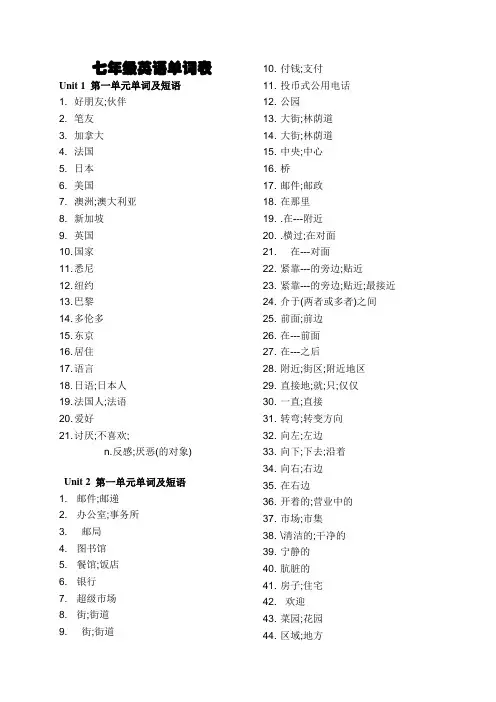
七年级英语单词表Unit 1 第一单元单词及短语1. 好朋友;伙伴2. 笔友3. 加拿大4. 法国5. 日本6. 美国7. 澳洲;澳大利亚8. 新加坡9. 英国10. 国家11. 悉尼12. 纽约13. 巴黎14. 多伦多15. 东京16. 居住17. 语言18. 日语;日本人19. 法国人;法语20. 爱好21. 讨厌;不喜欢;n.反感;厌恶(的对象)Unit 2 第一单元单词及短语1. 邮件;邮递2. 办公室;事务所3. 邮局4. 图书馆5. 餐馆;饭店6. 银行7. 超级市场8. 街;街道9. 街;街道10. 付钱;支付11. 投币式公用电话12. 公园13. 大街;林荫道14. 大街;林荫道15. 中央;中心16. 桥17. 邮件;邮政18. 在那里19. .在---附近20. .横过;在对面21. 在---对面22. 紧靠---的旁边;贴近23. 紧靠---的旁边;贴近;最接近24. 介于(两者或多者)之间25. 前面;前边26. 在---前面27. 在---之后28. 附近;街区;附近地区29. 直接地;就;只;仅仅30. 一直;直接31. 转弯;转变方向32. 向左;左边33. 向下;下去;沿着34. 向右;右边35. 在右边36. 开着的;营业中的37. 市场;市集38. \清洁的;干净的39. 宁静的40. 肮脏的41. 房子;住宅42. 欢迎43. 菜园;花园44. 区域;地方45. 享受---的乐趣;欣赏46. 散步;步行47. 散步48. 穿过;通49. 开始50. 旅行;游历51. 参观;游览52. 地方;地点53. 愉快;开心54. 玩得开心55. (表条件)如果56. 饥饿的57. 到达;抵达58. 路;路线;路途59. 乘;坐;搭(车、船)60. 出租车;的士;计程车61. 飞机场62. 通过63. 希望;盼望;期待64. 您的;你的(用在信末署名前,做客套语)Unit 3 第一单元单词及短语1. (澳洲)树袋熊;考拉2. 老虎;虎3. 大象4. 海豚5. 熊猫6. 狮子7. .企鹅8. 长颈鹿9. 动物园10. 可爱的;聪明的11. 地图;图12. 聪明的;漂亮的13. 动物14. 方框;盒;箱15. 有几分16. .南;南方; adj.在南方的;南部的;向南的17. 非洲18. 宾戈(一种游戏)19. 丑陋的;难看的20. 聪明的;机灵的21. 友好的22. 美丽的;美好的23. 害羞的;怕羞的24. 其他的;另外的25. 草26. 睡;睡觉27. 在---期间28. 在晚上;在夜里29. 叶;树叶30. 懒惰的;懒散的31. 食用的)肉;肉类32. 放松;休息Unit 4 第一单元单词及短语1. 商店;店铺2. 助手;助理3. 店员4. 医生5. 记者;通讯员6. 男警察7. 侍者;服务员8. 银行职员9. 医院10. 现在;此时11. 担任主角;主演12. 女警官;女警察13. 护士14. 钱;金钱;货币15. 给;授予16. 获得;得到;购买;拿来17. 穿;戴18. 制服19. 不时;有时20. 在---期间;在(一段时间)之内21. 危险的22. 小偷;贼23. .晚;晚于通常时间24. 在外;向外25. .谈话;谈论26. 车站;局;台27. 电视台28. 警方;警察29. 警察局30. 报纸31. 辛苦地;努力地32. 作为33. .按照;根据34. 夏季;夏天35. 故事;事迹;小说36. 杂志;期刊37. 年轻的,年纪小的38. 戏剧;剧本39. 新闻;消息40. 孩子(child的复数)41. i.国际的42. .教;讲授43. 技能;技巧44. 先生;阁下45. 女士;夫人Unit 5 第一单元单词及短语1. 打扫;清除2. 读;阅读3. 通过;以---的方式4. 公寓;住宅5. 电视节目6. 当然;的确7. 等待;等候8. 等候;等待9. .玩具10. .西;西方; adj.西方的;向西方的;在西方的11. 活动12. 买东西;购物13. 购物商场;商业街14. 水池;水塘15. .照像机16. 鸟Unit 6 第一单元单词及短语1. 下雨2. 有风的;多风的3. 多云的;阴天的4. 阳光充足的5. 下雪6. 天气;气候7. 莫斯科8. 波士顿9. .烹调;煮10. 学习11. how’s=how is12. 坏的;劣质的13. 很糟的;极坏的;可怕的14. 相当;很;颇15. .热的16. 寒冷的17. 凉爽的18. 温暖的;暧和的19. 潮湿的;湿润的20. 假期;休假21. 在度假中22. 拍照23. (现在分词lying)平卧;躺24. 海滩25. 看;朝---看26. 团体;组27. 令人满意的;绝妙的28. 感到惊讶的29. 热;热度30. 放松的;得到休息的31. 冬季32. 围巾33. .每个人34. have a good time 玩得高兴;过得快乐35. man n.男人;人;人类Review of units 1-61. 描述;形容2. 寻找;寻求3. 谈论;讨论;议论4. 方向5. 元6. (many和much的最高级)最7. 下列的;下述的8. 为了9. 改进;改善Unit 7 第一单元单词及短语1. 头发;毛发2. 卷曲的;卷毛的3. .直的;笔直的4. .高的5. 中等的6. 高度7. 瘦的8. 重的9. 体格;体形10. 像;如同11. 总是;始终12. 队长;首领13. 队;组14. 受欢迎的;通俗的;流行的15. .金黄色的16. 漂亮的17. 一点儿;少许18. 一点儿;少许19. 笑话;玩笑20. 决不;从不21. 停止;终止22. 棕色的;褐色的23. 人;人物24. 胡须25. 眼镜26. .外表;外貌27. 牢记;记住28. 流行音乐29. 歌唱家;歌手30. 不再……31. .讲32. 没有人;没人Unit 8 第一单元单词及短语1. (will的过去式)表示意愿2. I’d = I would3. .面条4. 牛肉5. 羊肉6. 洋白菜;卷心菜7. 土豆;马铃薯8. 特色菜9. 饮料10. 大的;宽广的11. 大小;尺寸12. 碗;一碗的容量13. he’d= he would14. .果汁;果汁饮料15. 饺子16. 粥;糊17. 茶;茶叶18. 绿茶19. 米;稻;米饭20. 汤;羹21. 洋葱22. 鱼;鱼肉23. 电话24. 人民币25. 星期一26. 星期二27. 星期三28. 星期四29. 星期五30. 原因;理由31. 菜单Unit 9 第一单元单词及短语1. (is的过去式)2. (do的过去式)3. (go的过去式)4. .拜访;访问5. 考试;测验6. ---怎么样?7. 停留;留下8. 在家9. 做;进行;从事10. 读;阅读11. 练习;实践12. 正常的;规则的;有规律的13. 不规则的;无规律的14. 现在时态的;现在的;目前的15. 过去时态的;以前的;过去的16. 山;山脉17. 地理学18. 度过;花费19. y昨天20. 编号;号码21. 等的;中间的22. 中学23. 大多数的;大部分的;几乎全部的24. 购物25. have的过去式26. .(see的过去式)27. 访谈节目;谈话;交谈;演讲28. 访谈节目29. .(write的过去式)30. 歌;歌曲31. 去散步32. 坐;使坐下33. sit的过去式)34. 向下;在下面;下去;降下35. .猫36. 该是---的时候了37. wasn’t= was not38. 没有的;极少的39. 任何事;无论何事40. .建议;意见Unit 10第一单元单词及短语1. 纽约市2. 野营;营地3. 夏令营4. 博物馆5. 向导6. 中心的;位于中心的7. didn’t= did not8. 考试;检查9. 真的;是吗;真是的10. 下雨的;多雨的11. (are的过去式)12. 极好的13. 不友善的;不友好的14. 极坏的;极讨厌的15. 美味的16. 昂贵的;价高的17. 拥挤的18. 廉价的;便宜的19. 思考;考虑20. 水21. 流泪;哭泣22. 角落;街角;墙角23. 使;促使;迫使24. (make的过去式)25. 感到;觉得26. 走;步行;散步27. .回原处;往回去28. 决定;下决心29. 墙壁;围墙;城墙30. 万里长城31. 宫殿32. 故宫33. 广场34. 天安门广场35. 汉)胡同36. 做;制定;写37. 同班同学38. 讨论;议论39. 报告;汇报40. 性别Unit 11 第一单元单词及短语1. 肥皂2. 肥皂剧3. 情景喜剧4. 情景;形势5. 没什么;一个都没有6. 哈(表惊讶.欢乐.胜利. 怒)7. 忍受8. 介意9. 君主;国王10. ...怎么样?11. 事实;真实事情12. 实际上;其实;确切地说13. 文化14. 主持人15. 同意;赞成16. 赞同;持相同意见’17. 太阳镜18. 皮带19. 钱包20. 钥匙链21. 由;被22. 时尚;潮流23. 的过去式24. 文章25. 放;摆;装26. 主意;想法27. 色彩鲜艳的Review of units 7-12(总复习)1. 配件;饰品2. 雪3. 预订;点(菜)4. 意见;看法5. 订单;订货6. 表格Unit 12 第一单元单词及短语1. 规则2. 走廊;过道3. 教室4. 打架;争吵5. 女士6. 外面的;在外部的7. .进餐;吃饭8. .大厅;礼堂9. 不得不;必须10. 其他的;别的;另外的11. 运动鞋12. 体育馆13. 医生14. 到---之前;不迟于15. .洗;洗涤16. 后来;以后17. 少年宫18. 不许讲话19. 大声地。
人教版英语七年级下册Unit2 单元核心知识点精讲练
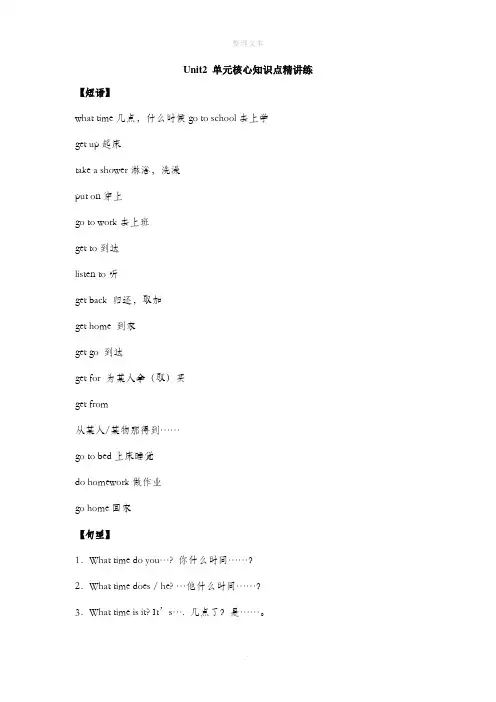
Unit2 单元核心知识点精讲练【短语】what time几点,什么时候go to school去上学get up起床take a shower淋浴,洗澡put on穿上go to work去上班get to到达listen to听get back 归还,取加get home 到家get go 到达get for 为某人拿(取)买get from从某人/某物那得到……go to bed上床睡觉do homework做作业go home回家【句型】1.What time do you…? 你什么时间……?2.What time does / he? …他什么时间……?3.What time is it? It’s…. 几点了?是……。
4.She takes shower at …她经常在…淋浴。
【口语】1.What time is it? 几点了?2.-What time do you usually get up?你通常几点起床?3.-I usually get up at five o’clock.通常5点钟起床。
4.-What time does he eat breakfast?他什么时候吃早饭?5.-He eats breakfast at seven o’clock.他七点钟吃早饭。
【语法】1.一般现在时:主语为第三人称单数,动词为第三人称单数形式2.学习时间的表达法二.难点讲评1.What time do you get up?释:这是一个由疑问词what time(几点)引导的特殊问句。
其结构:What time +助动词do/does +主语+动词原形,询问某人做某事的具体时间。
例如:what time do you begin class in the morning?你们早晨几点开课?注:What’s the time=What time is it?也是用来询问时间,意为“几点了”。
Unit2 词汇课件2022-2023学年人教版英语七年级下册
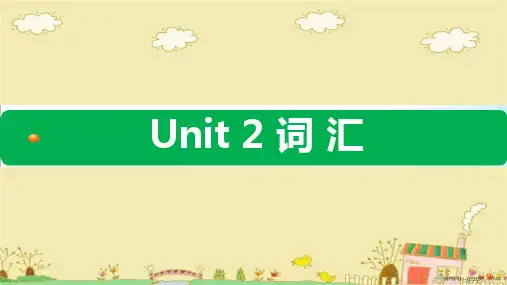
广播电台 电视台 警察局 公交站 地铁站 火车站
radio station TV station police station bus station subway station train station
词汇讲解
6. funny
(1)funny 形容词, 意为“有趣的,可笑的,滑稽的,奇 怪的”;意为“有趣”时,相当于“isn’t all fun. It has its bad time.
人生不仅有乐趣, 也有令人不快的时刻。
每周末我们都在公园里玩得很开心。
We have fun playing in the park on weekends.
【典型例题】
1.I think this story is so_____. A.funny B.funs C.fan D.fans 2.They have fun______ outside. A.having a picnic B.had picnic C.have picnic
and bread for breakfast. After breakfast, I 2._ta_k_e_a__s_h_o_w_e_r____ (洗澡)and then I 3._g_o__to__s_ch_o_o_l(上学)by bus. I get to
school at a quarter to eight. I have five classes in the morning.
_________at the desk.
A.exercise, exercise B.exercises, exercises
C.exercises, exercise D.exercise, exercises
七年级英语下册第二单元知识点归纳Unit2单元归纳
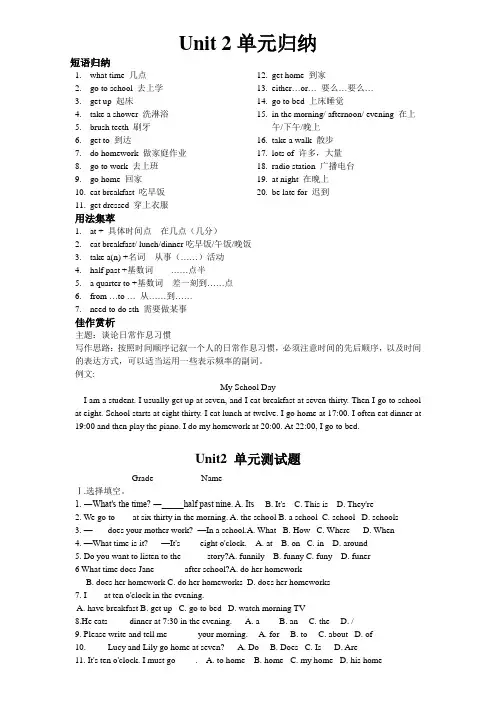
Unit 2单元归纳短语归纳1.what time 几点2.go to school 去上学3.get up 起床4.take a shower 洗淋浴5.brush teeth 刷牙6.get to 到达7.do homework 做家庭作业8.go to work 去上班9.go home 回家10.eat breakfast 吃早饭11.get dressed 穿上衣服12.get home 到家13.either…or…要么…要么…14.go to bed 上床睡觉15.in the morning/ afternoon/ evening 在上午/下午/晚上16.take a walk 散步17.lots of 许多,大量18.radio station 广播电台19.at night 在晚上20.be late for 迟到用法集萃1.at + 具体时间点在几点(几分)2.eat breakfast/ lunch/dinner吃早饭/午饭/晚饭3.take a(n) +名词从事(……)活动4.half past +基数词……点半5. a quarter to +基数词差一刻到……点6.from …to …从……到……7.need to do sth 需要做某事佳作赏析主题:谈论日常作息习惯写作思路:按照时间顺序记叙一个人的日常作息习惯,必须注意时间的先后顺序,以及时间的表达方式,可以适当运用一些表示频率的副词。
例文:My School DayI am a student. I usually get up at seven, and I eat breakfast at seven thirty. Then I go to school at eight. School starts at eight thirty. I eat lunch at twelve. I go home at 17:00. I often eat dinner at 19:00 and then play the piano. I do my homework at 20:00. At 22:00, I go to bed.Unit2 单元测试题Grade________ Name ________Ⅰ.选择填空。
初一下册英语第四单元单词
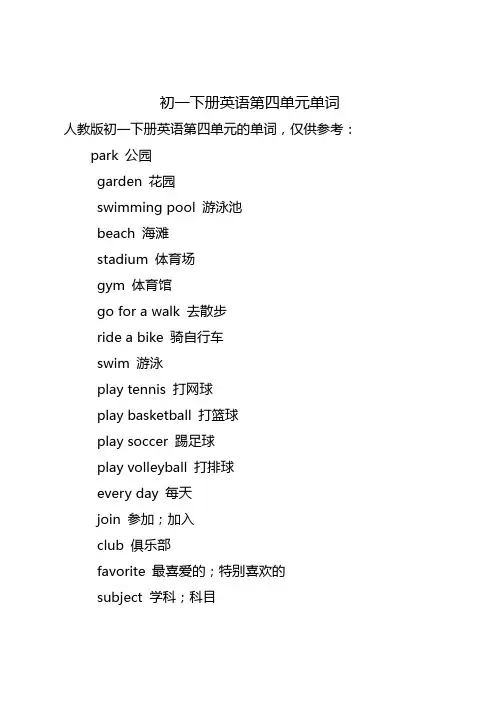
初一下册英语第四单元单词人教版初一下册英语第四单元的单词,仅供参考:park 公园garden 花园swimming pool 游泳池beach 海滩stadium 体育场gym 体育馆go for a walk 去散步ride a bike 骑自行车swim 游泳play tennis 打网球play basketball 打篮球play soccer 踢足球play volleyball 打排球every day 每天join 参加;加入club 俱乐部favorite 最喜爱的;特别喜欢的subject 学科;科目science 科学P.E. 体育because 因为description 描述interesting 有趣的;好玩的boring 无聊的;令人厌烦的difficult 困难的fun 有趣的;愉快的easy 容易的watch 观看;注视TV 电视sound 听起来great 很好的;令人愉快的collection 收藏品;收藏but 但是interesting 有趣的;引起兴趣的play 戏剧;剧本news 新闻game 游戏today 在今天at school 在学校e-mail 电子邮件at home 在家how about 怎么样?=what about why 为什么why not 为什么不sports 体育运动only 只;仅仅after school 放学后too 也let's=let us 让我们(一起)play sports 做运动every 每一个;每个day 一天;一日Sunday 星期天Monday 星期一Tuesday 星期二Wednesday 星期三Thursday 星期四Friday 星期五Saturday 星期六every other day 每隔一天be good for 对……有益health 健康;人的身体或精神状态all 所有;全部night 夜;夜间work 工作以上单词列表可能并不完整,建议参考实际教材获取更详细和准确的单词列表。
人教版七年级下册英语Unit-2单元知识点复习

人教版七年级下册英语Unit-2单元知识点复习Unit 2 What time do you go to school?1. What time / when...? (U8 已讲)几点/什么时候。
2. get up : 起床1) get up early /late 早起/ 起得晚2)---你通常几点起床?-What time do you usually getup ?---我通常在6:30起床- I usually get up at sixthirty.3. dress 1)dress sb给...穿衣eg:我小时候我妈妈给我穿衣服。
My mother dressed me when I was young.2) dress oneself 给自己穿衣服eg: 这个女孩会自己穿衣服。
The girl can dress herself.3)be dressed in 穿着;戴着=weareg:她穿着一件漂亮的裙子。
She is dressed in a beautiful skirt.4)get dressed 穿上衣服4. brush 1) v 刷brush teeth 刷牙eg: 我一天刷两次牙。
I brush my teeth twice a day.2)n 刷子two brushes 两个刷子5. shower ①n/v 淋浴②淋浴器、间1)take/have a shower洗淋浴2)take a cold shower洗个冷水澡6. never 从不;绝不1)我从没起床这么早。
I never get up so early.2)我上班/上学从迟到。
I'm never late for work/ school.7. early adj/adv 早的1) catch the early bus赶早班车2) The early bird catch而是the worm.早起的鸟儿有虫吃。
七年级英语下册Unit-2-What-time-do-you-go-to-school知识点总结
Unit 2 What time do you go to school?一、重点词汇〔1〕重点单词和短语get up起床get dressed穿衣服brush teeth/ brush one’s teeth刷牙eat/have breakfast吃早餐run跑步take a shower洗澡;沐浴go to work去工作at a radio station在广播电台radio show广播节目go to school去上学get to school到达学校have English class上英语课have Music class上音乐课play the guitar弹吉他play basketball打篮球play sports做运动eat/have lunch吃午餐after school放学后after class下课后go home回家eat/have dinner吃晚餐take a walk去散步do one’s homework做某人的家庭作业clean one’s room打扫某人的房间go to bed上床睡觉got to bed early/late睡的早/晚on weekends在周末on weekdays在工作日on school days在学校上课日best friend好朋友/最好的朋友eat ice-cream吃冰淇淋eat vegetables吃蔬菜play computer games玩电脑游戏eat a nice/good breakfast吃一份不错的早餐fruits and vegetables水果和蔬菜(2)about 表示“大约〞E.g. She always exercises about seven ten.It’s about 5 kilometers from my home to the school.(3)from...to... “从....到...〞E.g. She works from nine a.m. to five p.m. everyday.〔4〕介词for表示“为了...;对于...〞for breakfast/ lunch/ dinnerE.g. I sometimes eat chicken and rice for lunch.Mike eats fruits and vegetables for dinner.〔5〕after 表动作时间的先后,表示“在...之后〞after school/class/lunch/dinner before 表示“在...之前〞before breakfast/ lunch/ dinnerE.g. I often play sports before breakfast.Mr. Li usually takes a walk after dinner.〔6〕much;many;lots of/ a lot of都表示“许多〞;区分:much+不可数名词;many+可数名词复数;lots of/ a lot of+可数名词复数/不可数名词E.g. I don’t have much time for breakfast. = I don’t have lots of/ a lot of time for breakfast. (time时间为不可数名词)Linda bought many new pens. = Linda bought lots of/ a lot of new pens. (pen为可数名词)〔7〕either A or B 表示“要么A要么B〞,做主语时,根据就近原那么来选择动词形式。
北师大版七年级下册英语unit2知识点总结 语法点(含答案)
知识图谱Unit 2 On the Weekend知识精讲一、必背词汇violin n. 小提琴chore n. 家务活;琐事clean v. 打扫adj. 干净的,洁净的dust v. 擦去……的灰尘 n. 灰尘feed v. 给(人或动物)食物;喂养;饲养sweep v. 扫;清扫floor n. 地板;地面;楼层rubbish n. 垃圾;废弃物water v. 给……浇水n. 水busy adj. 忙的,杂乱的vt. 使忙于vi. 忙cup n. 杯子;一杯anything prop. 任何事物;任何东西worry v. 担心;担忧ring v. 响起铃声;给……打电话n. 戒指knock v. 撞;敲n. 敲击;敲门声candle n. 蜡烛wonderful adj. 精彩的;使人愉快的dish n. 碟;盘;餐具;一道菜nose n. 鼻子, 突出部分, 嗅觉v. 嗅communication n. 交流;交际tool n. 工具vt. 驾驶,用工具加工,印压图案于vi. 驾驶, 用工具加工instant adj. 立即的message n. 信息,消息text n. 文本;文章v. 发短信send v. 发送receive v. 接到;收到while n. 一会儿conj. 在……期间slow adj. 慢的adv. 慢慢地vt.& vi. 放慢,减速just adv. 只是;正好;刚才website n. 网站bank n. 银行;河岸museum n. 博物馆police n. 警察部门;警方station n. 站,所,局;火车站;电视台post n. 邮政;职位v. 邮寄;张贴;发布office n. 办公室,职务,事务train n. 火车underground n. 地铁way n. 路线;路;方法excuse v. 原谅n. 借口;理由cross v. 穿越,越过,横过street n. 大街;街道road n. 路,道路,公路corner n. 角;街角miss v. 错过;想念opposite prep. 与……相对adj. 对面的;across prep. 从一边到另一边;横过square n. 广场gym n. 体育馆;健身房二、重点词汇1. busy adjective /ˈbɪzi/If you are busy, you are working hard, or giving your attention to a particular thing.忙碌的;忙于……的;专注的1). Mum was busy in the kitchen.妈妈在厨房里忙活呢。
七年级下 1--4 词汇短语汇总
Unit1词汇guitar-guitarist 吉他手dance-dancer -dancing swim-swimming 游泳story-stories(复) 故事write-writer-writing(动名词) piano-pianist 钢琴家violin-violinist小提琴家Center - central(中心的) teach-teacher -teaches(三单)music - musician 音乐家magic(魔术)-magician魔术师. science--scientist科学家二、短语:1..be good at swimming擅长游泳2.play chess下棋3. play the drums.敲鼓4. play the violin拉小提琴5. be good with children善于与孩子相处、6. make friends交朋友.7.help sb do sth /help sb with sth.8. on weekends=on the weekend 在周末9. be good for health对健康有好处.10.Show sb sth=show sth to sh 11.teach sb. Sth.教某人某事(teach me English)12.teach sb.to do sth.教某人做某事teach us to speak English 教某人说英语12.tell stories/tell jokes(讲故事)/讲笑话13.join the story telling club 加入讲故事俱乐部14.as we all know 众所周知15.be interested in speaking English 对讲英语感兴趣Unit2 What time do you get to school?一、词汇1.brush--brushes(复数) 2,tooth--teeth(复数)3.通常的usual (形)--usually (副通常地4. good(well)-better(更好)-best(最好)5.half-halves(复数) 一半life -lives(复数) 生命6.quick(形)-quickly(副)快速地7.taste n. 味道-tasty (有味道的) adj.二,短语:1、在4:30.at half past four2,在11:45 at a quarter to twelve.3.散步take a walk =take walks4.要么..要么.either...or...5.做早操d o morning exercises.6.做运动do exercise / play sports7.给某人穿衣dress sb.穿上衣服g et dressed8、洗淋浴take a shower9.早睡早起go to bed early and get up early10刷牙brush teeth. 11.做作业do homework12.快速的吃早餐eat breakfast quickly 13.去跑步go runningAs we all know, doing sports is healthy for us.(It is healthy for us to do sports?众所周知,做运动对我们来说是健康的.Unit 3 How do you get to school?一、train--trainer(教练员) bus--buses(复数) drive--driver(司机)many-more(更多)-most(最多) village(村子)-villager(村民)true(adj)-truly(adv.)truth (n.)真相二、短语.1.乘地铁take the subway /by subway(介短)2.迫使某人做某事drive sb to do sth.3.过着幸福的生活,live a happy life4.停止做.stop to do sth/stop doing sth5.阻止某人做某事stop sb from doing sth6.害怕做某事be afraid to do7.害怕某物/做某事be afraid of sth/ doing sth. 8.公共汽车之行the bus ride.9.看起来象look like(外貌)10.象..be like(品质,性质)11..实现梦想.realize my dream. 12. on a ropeway 乘索道13.get to +某地(get to Beijing)get home /get here /get there 到家、到这里、到那儿三、句子1.My dream will come true.我会实现我的梦想2.It is adj for sb to do sth.对于某人来说做某事是Eg: It's interesting for me to drive a car.3.It's my dream to go to college.上大学是我的梦想.4.I'm afraid of driving a car我害怕开车5.It takes sb. Some time to do sth.Eg: It takes me 5 minutes to get to school on foot.6.How long does it take sb. to do sth.做某事花了某人...时间eg:How long does it take you to get to school by bus? 坐公共汽车去上学花了你多少时间?7.How far is it from... to...? 从...到.. 多远?How far is it from your home to school?--It’s 10 kilometers./ It’s 20 minutes’ walk/ride/drive / It’s 20 minutes by bike.(三类表达)Unit 4 Don’t eat in class.一、词汇:rule-ruler (尺子n ) v统治.管理. arrive at/in+地点,到达某地be on time (准时) in time 及时be late for 迟到listen-listener (听众listen to sb carefully认真听.important (adj)-importance(n.)重要性. quiet(adj.)--quietly(adv.)安静地dish - dishes(复数)noise(n吵闹)---noisy (adj吵闹的)--noisily (adv.)吵闹地relax --relaxing(令人轻松的)--relaxed(感到放松的read---reader(读者)terrible (adj)---terribly (adv)非常糟地.Luck 幸运n.--lucky(adj幸运的)---luckily(adv)幸运地learn(学习)-learner(学习者)二、短语:1. make the rules制定规则follow the rules 遵守规则break the rules破坏规则2. fight for...为.而战. fight with 与...打架3. get into a fight with 与...打架4. say sorry to sb对Sb说对不起be sorry to do sth做...感到难受5.More importantly更为重要的是,(用于句首)6. bring sb sth=bring sth to sb给某人带来某物bring good luck to people给人带来好运8.keep/ be quiet!保持安静9.play an important role in在...方面扮演重要角色10.Practice makes perfect.熟能生巧. practice doing练习做...11.do the dishes清洗餐具12.make one's bed铺床13.Reading is good for our mind/读书有益于我们的文脑14.Reading can open our eyes.读书可以开阔眼界15.be strict with sb in sth.对某人在某事上要求严格Eg: Our teachers are strict with us in our schoolwork.16.keep moving!坚持不懈17.learn a lot from...向...学到了很多。
人教版七年级英语下册unit2知识点
Unit2Whattimedoyougotoschool?短语·集萃1.getup起床2.either…or…或者…或者…;要么…要么…3.getdressed穿上衣服4.lotsof大量5.takeashower洗澡6.gotobed上床睡觉7.radiostation广播台8.dohomework做家庭作业9.gotoschool去上学10.eatdinner吃晚饭11.burshteeth刷牙齿12.takeawalk散步13.belatefor因……迟到14.cleanmyroom打扫我的房间15.needtodosth需要做某事16.havetimetodosth有时间做某事17.from…to…从…到…18.onweekends在周末=ontheweekend句式·记忆4.1.getinterested3.o’clock4.fun与①funny②funIt’5.4:30p.m.8:14读作6.halfa(7.quarter①gotobed强调“上床睡觉”的动作及过程,无“睡着”的意思。
②gotosleep强调“入睡;睡着”这一动作,强调人已经“睡着”。
9.quickly,fast和soon的区别:①quickly迅速的强调动作发生或完成得快,也可指人的思维敏捷。
②fast迅速的强调运动速度之快,既可做形容词,也可作副词。
可与quickly互换。
③soon不久以后侧重两件事情的先后发生,中间的间隔的时间很短。
Eg:1)Thenextmorning,theteacheraskedtheboy,“Howdidyoufindtheanswersoquickly?”第二天早上,老师问这个男孩:“你怎么能够这样快找到了答案的呢?”2)YouarealwayssayingIamgrowingsofast.你老是说,我长得很快。
3)Soontheywereinthemiddleoftheriver.很快他们就到了河中间。