
人教版九年级英语第6单元
‣ understand-understood-understood
‣ Carl
15. make v. 制作;使
‣ make sb. + adj. 使某人...
They made their customers happy. 他们能取悦他们的顾 客
‣ make sb. do sth. 使某人做某事
‣ inventor n. 发明家
‣ carl
2. with
‣ 和 ... 在一起
He likes to live with his parents. 他喜欢跟父母一起生活
‣ 长着、戴着、带着、有…的,表示特征
My teacher is an English with golden hair. 我的老师时一个金发英国人
Unit 6
Section A&B
‣ Carl
1. invent v. 发明
‣ Adison invented the bulbs.
爱迪生发明了灯泡。
‣ invention n. 发明
the invention of … …的发明 The invention of printing make writing a easier thing. 印刷的发明使书写变得更加简单
‣ Carl
11. produce v. 生产,制造,产 生‣ It produces a pleasant smell.
‣ smell v. 闻起来 n. 味道,气味
The smell is awful. 味道太难闻了
‣ taste v. 尝起来
The food tastes good.
‣ Carl
‣ Carl
5. daily adj. 日常的 = everyday
‣ daily life = everyday life 日常生活
In my daily life, ….
‣ think about 思考,想想
think about doing sth.
‣ how often 多经常,表示频率
‣ Carl
把某物添加到某物
‣ Carl
14. mistake n. 错误[C] v. 误认 为‣ make a mistake 犯错误
She made a lot of mistakes in her exam paper. 她在她的考卷上范了很多错误
‣ mistake … for … 把…误认为...
I mistook you for your twin brother. 我总是错认你为你哥
‣ 随身携带
Have you some money with you? 你带钱了吗?
‣ 具有,带有,加上,包括...在内
‣ Carl
3. style n. 样式,款样,风格
‣ the style of… …的样式,款式
The style of cloth is in fashion nowadays. 现在这种布料正在流行
‣ drink 作饮料时,为可数名词,复数形式为drinks ‣ by accident 偶然地;意外地
She found out the truth by accident. 她意外地发现了真相
‣ by accident = by chance = accidentally
‣ Carl
9. It is said that … 据说
‣ It is known that … 众所周知
‣ It is reported that … 据报道
‣ Carl
10. fall v. 掉落,衰落
‣ fall into 落入,陷入
They fell into the river yesterday. 昨天他们掉进了河里
‣ fall down 摔倒 ‣ remain v. 留下,保持
She made me do her homework again. 她又让我做她的作业
‣ 类似make的使役动词有 let, have, get
‣ keep doing sth.
‣ Carl
16. in the end 最后
‣ It is said that it is the most dangerous shark on the
earth.
据说
,这是地球上最危险的鲨鱼
‣ It was said that they were haunted by ghosts.
据说,他们被鬼魂所困扰
‣ It is believed that … 据认为
‣ Carl
7. mention v. 提到
‣ mention + that 从句
She mentioned that she is not tolerant of this. 她提到他受不了这件事
‣ Don’t mentioCarl
8. drink n. 饮料 v. 喝
‣ out of style 过时的 ‣ in style 流行的
‣ Carl
4. pleasure n. 乐事;快事
‣ It’s a pleasure to do sth. 做某事是乐意的
It’s a pleasure to do a favor for you. 我乐意帮你忙
‣ With pleasure. 我很乐意。 ‣ pleasure/pleased/pleasant ‣ Can/Could you help sb. do sth.? 你能帮某人做某事吗?
6. You do have a point. 你确实 很有道理 ‣ 肯定句中,”助动词do+动词原形“ 表示强调。
He did know me. 他确实认识我。
‣ have a point 有道理
You have a point there but I think the students know what they want.
12. delicious adj. 美味的
‣ Carl
13. salty adj. 咸的
‣ This soup is too salty; add some water (to the soup).
这汤太咸了,加点水进去吧
‣ salt n. 盐巴
‣ add v. 添加
add sth. to sth.
人教版九年级英语第六单元
Unit6单元语法小专题(Grammar Focus)语法精讲一般过去时的被动语态一般过去时的被动语态的结构为“was/were+及物动词的过去分词(+by)+其他”。
其否定形式是在was/were后加not;疑问形式是把was/were放到句首。
如:A wonderful film was seen by us yesterday evening.昨天晚上我们看了一场精彩的电影。
Mary didn't go to David's birthday party because she wasn't invited.玛丽没有参加大卫的生日聚会,因为她没有受到邀请。
Were flowers and grass planted by them along the road last year?去年他们沿路种植了一些花草吗?特殊的被动语态:1.含有双宾语的被动语态含有双宾语的主动句变被动句时,可以将其中任何一个宾语变为被动结构的主语。
一般是把主动结构中指人的间接宾语变为被动语态的主语,这样句子显得自然;若指物的间接宾语变为被动语态的主语,间接宾语前要加介词to,for等。
如:He lent me a bike.→I was lent a bike(by him).→A bike was lent to me(by him).他借给了我一辆自行车。
2.复合宾语的被动语态若主动句为“主语+谓语+宾语+宾补”这种复合宾语结构时,则只能将宾语变为被动结构的主语,宾补变成被动结构的主语补足语。
如:We call him Xiao Wang.我们叫他小王。
→He is called Xiao Wang.他叫小王。
注意:若主动语态中的宾补是省略to的不定式,变为被动语态时需把to补上。
如:They heard her sing a song at the party.→She was heard to sing a song at the party.在晚会上他们听她唱了一首歌。
人教版英语九年级全册单元unit 6 知识点+测试卷+思维导图
Unit 6 When was it invented?1.重点词汇:style, project, pleasure, website, pioneer, ruler, smell,doubt, fridge, earthquake, biscuit, cookie, instrument, customer, basket, hero...2. 短语归纳:1.It's my pleasure.= My pleasure. 我的荣幸2.seem+to+动词原形好像做某事3.such a great invention 如此伟大的一项发明4.think of = think about 想到,考虑5.in our daily lives 在我们的日常生活中6.in my daily life在我的日常生活中7.have a point 有道理8.by accident 偶然地,意外地9.over an open fire 在篝火上10.it mentioned that 它提到11.It is said that 据说12.It is believed that人们相信13.fall into(过去式fell into)=drop into掉进…14.in the 19th century 在19世纪15.spread to other countries 传播到其他国家16.at a low price 以很低的价格17.bring(brought) sth. to sp. 把某物带到某处18.all of a sudden 突然地3. 必背典句:1.-When was the zipper invented? 拉链是什么时候被发明的?-It was invented in 1893. 它是1893年被发明的。
2. -Who was it invented by? 它是被谁发明的?-It was invented by Whitcomb Judson. 它是由惠特科姆·朱德森发明的。
人教版9年级英语第六单元知识点归纳
精心整理九年级上册第6单元考情分析:本单元还是在讲被动语态,主要在单选中与动词时态混合考查,在写作与阅读中也常会用到。
A.不知道或没有必要说明动作的执行者是谁时.We haven’t been told about it.没人通知我们这件事B.强调动作的承受者(这时可带由by引起的短语)The book was written by Mo Yan.C.不愿说出动作的执行者是谁He was asked to give a speech about how to study English well.3.被动语态的注意事项:A. there be 结构没有被动语态B.主句中宾语是反身代词的没有被动语态7.fall into落入,陷入。
比较容易搞混淆的还有:fall down摔倒,fall off掉下,fall asleep入睡8.辨析:remain是动词,保持不变/仍然是;remind动词,提醒,remind to do sth,remind···of。
9.辨析:【了解】家;translation名词,翻译15.all of a sudden突然,猛地=suddenly16.by mistake无意中,错误地17.much-loved 深受喜爱的,复合形容词18.divide···into···把····分成·····19.stop···from···阻止····做····20.dream of/about 梦想···向往···· (of/about是介词,后面的动词用-ing 形式)21.look up to 倾佩/仰慕/抬起头看练习:(15年上海中考)以“I want to invent ______"为题,写一篇不少于60个词的短文,标点符号不占格参考词汇:1.It can be used to ...with the help of our robot doctors,?you can talk to your personal doctor one to one whenever you want.In short, family doctor robots can?make great contribution to?our society.精彩亮点分析:亮点一:全文巧用“first, furthermore, in short”等连接词,把家庭机器人医生的好处写的非常清晰,让阅卷老师一目了然。
人教版英语九年级全册Unit6 单元重难点归纳
Unit6 单元重难点归纳【重点单词】1. project n. 项目,工程;2. pleasure n. 高兴,愉快;3. daily adj. 日常的,每日的;4. mention v. 提到,说到;5. nearly adv.几乎,差不多;6. boil v. 煮沸,烧开;7. remain v. 保持不变;剩余;8. national adj.国家的,民族的;9. low adj.低的,矮的;10. translate v. 翻译;11. lock v.锁上;n. 锁;12. sudden adj. 突然的13. crispy adj. 脆的;酥脆的;14. salty adj. 咸的;15. sour adj. 酸的,有酸味的;16. customer n. 顾客。
17. Canadian 加拿大的,18. divide v. 分开,分散;19. hero n 英雄,男主角;20. professional adj. 职业的,专业的;【重点词组】1. shoes with special heels 特殊后跟的鞋子2. hot ice cream scoop 热的冰其淋勺子3. run on electricity 电动的4. be used for 被用作5. the subject for my school project 学校项目的课题6. our daily lives 我们的日常生活7. have a point 有点道理8. by accident 偶然,意外地9. over the open fire 在火堆上10. fall into the water 落入水中11. take place 发生12. without doubt 毫无疑问13. at a low price 以一个很低的价格14. translate the book into different language 把书翻译成不同种的语言15. all of sudden 突然16. by mistake 错误地17. a much-loved and active sport 一个深受喜爱并且积极的运动18. divide…into 把…分开19. stop sb from doing sth 阻止某人做某事20. look up to 钦佩,仰慕21. the professional basketball groups 职业篮球机构22. use someone else’s idea 借用其他人的想法【重点句式】1. I think the TV was invented before the car. 我认为电视是在轿车之前发明的。
人教版9年级英语第六单元知识点归纳
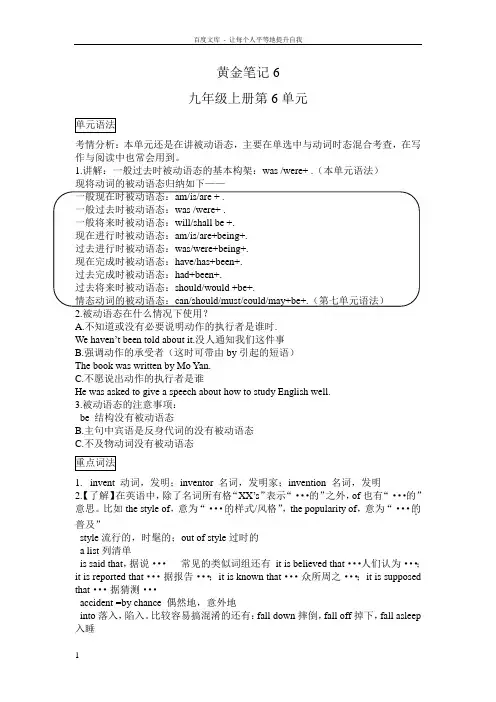
黄金笔记6九年级上册第6单元单元语法考情分析:本单元还是在讲被动语态,主要在单选中与动词时态混合考查,在写作与阅读中也常会用到。
1.讲解:一般过去时被动语态的基本构架:was /were+ .(本单元语法)现将动词的被动语态归纳如下——一般现在时被动语态:am/is/are + .一般过去时被动语态:was /were+ .一般将来时被动语态:will/shall be +.现在进行时被动语态:am/is/are+being+.过去进行时被动语态:was/were+being+.现在完成时被动语态:have/has+been+.过去完成时被动语态:had+been+.过去将来时被动语态:should/would +be+.情态动词的被动语态:can/should/must/could/may+be+.(第七单元语法)2.被动语态在什么情况下使用?A.不知道或没有必要说明动作的执行者是谁时.We haven’t been told about it.没人通知我们这件事B.强调动作的承受者(这时可带由by引起的短语)The book was written by Mo Yan.C.不愿说出动作的执行者是谁He was asked to give a speech about how to study English well.3.被动语态的注意事项:be 结构没有被动语态B.主句中宾语是反身代词的没有被动语态C.不及物动词没有被动语态重点词法1.invent 动词,发明;inventor 名词,发明家;invention 名词,发明2.【了解】在英语中,除了名词所有格“XX’s”表示“···的”之外,of也有“···的”意思。
比如the style of,意为“···的.样式/风格”,the popularity of,意为“···的.普及”style流行的,时髦的;out of style过时的a list列清单is said that,据说···常见的类似词组还有it is believed that···人们认为···;it is reported that···据报告···;it is known that···众所周之···;it is supposed that···据猜测···accident =by chance 偶然地,意外地into落入,陷入。
人教版九年级英语第6单元

CARL
19
18. divide v. 分离,分开
▸ divide … into … 把…分成...
The coach divided them into 3 groups. 教练把他们分成了3组
▸ be divided into 被分成...
▸ division n. 分离
▸ be + 过去分词 + (by sb.)
▸ out of style 过时的
▸ in style 流行的
CARL
5
4. pleasure n. 乐事;快事
▸ It’s a pleasure to do sth. 做某事是乐意的
It’s a pleasure to do a favor for you. 我乐意帮你忙
▸ With pleasure. 我很乐意。
▸ add v. 添加
add sth. to sth.
把某物添加到某物
CARL
15
14. mistake n. 错误[C] v. 误认为
▸ make a mistake 犯错误
She made a lot of mistakes in her exam paper. 她在她的考卷上范了很多错误
▸ mistake … for … 把…误认为...
She achieved her dream in the end. 她最后还是实现了她的梦想
▸ encourage sb. to do sth. 鼓励某人做某事
My father encouraged me to give a speech in the public. 我爸鼓励我在公共场合下做个演讲
▸ Don’t mention it. 不客气!
人教版九年级英语第六单元重点短语及句型知识点小结
人教版九年级英语第六单元重点短语及句型知识点小结Unit 6 When was it invented?一.重点短语1.by accident偶然;意外地2.divide into把…分成…3.take place发生happen发生(没有被动形式)4.all of a sudden=suddenly 突然;猛地5.look up to 仰慕6.dream of 梦想;梦见7.translate…into…把…翻译成…二.重点语法1. 辨析invent; find; find out; discoverinvent“发明”,指通过劳动运用聪明才智“发明/创造”出以前从未存在过的新事物例:Who invented the telephone?He invented a new teaching method.find“找到、发现”,指找到或发现自己所需要的东西或丢失的东西,着重指找到的结果。
例:We've found oil under the South Sea.I finally found my English book.find out指经过研究或询问查明某事或真相。
例:I've found you out at last.Please find out when the ship sails for New York.Please find out what time the delegation will come.discover“发现”,表示“偶然”或“经过努力”发现客观存在的事物、真理或错误,即指发现原来客观存在但不为人所知的事物,也可表示发现已为人所知的事物的新的性质或用途。
Columbus discovered America in1492.We soon discovered the truth.我们很快就弄清了真相。
【练习】a.Edison ____the electric lamp.b.I lost my necklace last night.I haven’t ____it.c.Who ____America first?d.Can you ____what time the train leaves?2.一般过去时的被动语态(见P188页)结构:was/were+过去分词【练习】( ) 1. People's Republic of China __ on October 1, 1949.A. foundB. was foundedC. is foundedD. was found( ) 2. English ____ in Canada.A. speaksB. are spokenC. is speakingD. is spoken( ) 3 This English song __ by the girls after class.A. often singsB. often sangC.is often sangD.is often sung( ) 4 This kind of car___ in Japan.A. makesB. madeC. is makingD. is made( ) 5 Computers ___ all over the world.A. is usedB. are usingC. are usedD. have used。
人教版九年级英语第六单元单词解析
第六单元1、prefer更喜爱;更喜欢(preferred---preferring)prefer sth. 更喜欢某事I prefer English. 我更喜欢英语。
prefer doing/ to do 宁愿做某事I prefer sitting/ to sit.我宁愿坐着。
prefer sth to sth. 同…相比更喜欢…(like---better than----) I prefer dogs to cats. 与猫相比我更喜欢狗。
prefer doing to doing 宁愿做某事而不愿做某事I prefer walking to sitting. 我宁愿走路也不愿坐着。
Prefer to do rather than do sth.I prefer to do my homework rather than see such a boring film.2. along with 伴随…同…一道I sing along with m usic. 我伴随着音乐唱歌。
I will go along with you. 我同你一道去。
3、lyric n. (常pl. )歌词;抒情词句The lyrics of that song touched m e.4、gentle adj. 轻柔的;柔和的Please be gentle to the kids.5、dislike [dIs5laIk]v. 不喜欢(like喜欢=enjoy)I dislike eating durian because of the s m ell.6、rem ind sb. of sb./sth. 提醒使…记起….This song rem inds him of his m other. 这首歌使他记起了他的妈妈。
The old lady rem inds m e of my grandmother.7、heart n. 心;内心learn---by heart 背诵She is sufferring from heart disease.– How do you learn English words? -First of all I learn them by heart.8、string n. 细绳;线I don’even know how m any strings a guitar has.9、sink v.(sank\sunk)下沉;沉没The coin sinks in the water.10、Yellow River 黄河Yellow River is one of the famous rivers in China.11、fisherm an 渔夫渔民复数形式fisherm enWhen I was young,I wanted to be a fisherm an.12、latest adj. 最近的late 晚的later比较晚lately近来I have read the lastest news about the aeroplane accident.13、entertain v.娱乐、entertainm ent n.娱乐;乐趣;快乐This bar is a good place for relaxation and entertainm ent.14、feature n. 特点;特征Team work is the m ain feaature of this programme.15、gallery n. 美术馆;画廊16、photograph n. 照片相片photography n. 摄影照相photographer n. 摄影者;摄影师Can I take a look at the photographs taken last week?I am deeply interested inphotography.Gu Changwei is one of the top photographers in China.17、display v.& n, 展览;陈列on display 展览;陈列Please stay away from the art display.His latest art piece will be on display next week.18、interest v. & n. 引起......关注;使......感兴趣interested interestingMy interest is going fishing.19、class n. 等级;类别I want to stay in a higher class hotel during travelling.20、whatever (=no m atter what)pron. 不管什么;无论什么;任何(事物)Whatever you decide to do,I will support you.Wherever you go, whatever you do, I’ll be right here waiting for you.21、m iss v. 错过;遗漏I dont want to miss a single m oment with you.22、suggest v. 显示;间接明白暗示;建议suggest doing sth建议做某事suggestion n.It's getting colder and colder. I suggest buying some warm clothes.W e will consider your suggestion later.23、energy n. 活力力量energetic adj. 有活力的She puts all her energies in her work.24、okay adj.(=OK) 好的She replied okay for m y invitation of going for a date.25、pro n. (常pl.)赞成的观点26、con n. (常pl.)反对的观点There are pros and cons of holding this m eeting.27、honesty n. honest adj.诚实的to be honest(作插入语)老实说;说实在的To be honest,I dont agree with your opinion.如:To be honest I really like flowers. 老实说我真的很喜欢花。
人教版9年级英语第六单元知识点归纳
黄金笔记6九年级上册第6单元考情分析:本单元还是在讲被动语态,主要在单选中与动词时态混合考查,在写作与阅读中也常会用到。
1.讲解:一般过去时被动语态的基本构架:was /were+ P.P.(本单元语法)现将动词的被动语态归纳如下——2.被动语态在什么情况下使用?A.不知道或没有必要说明动作的执行者是谁时.We haven’t been told about it.没人通知我们这件事B.强调动作的承受者(这时可带由by引起的短语)The book was written by Mo Yan.C.不愿说出动作的执行者是谁He was asked to give a speech about how to study English well.3.被动语态的注意事项:A.there be 结构没有被动语态B.主句中宾语是反身代词的没有被动语态C.不及物动词没有被动语态1.invent 动词,发明;inventor 名词,发明家;invention 名词,发明2.【了解】在英语中,除了名词所有格“XX’s”表示“···的”之外,of也有“···的”意思。
比如the style of,意为“···的.样式/风格”,the popularity of,意为“···的.普及”3.in style流行的,时髦的;out of style过时的4.make a list列清单5.it is said that,据说···常见的类似词组还有it is believed that···人们认为···;it is reported that···据报告···;it is known that···众所周之···;it is supposed that···据猜测···6.by accident =by chance 偶然地,意外地7.fall into落入,陷入。
人教版九年级英语第六单元 知识点总结
人教版九年级英语第六单元知识点总结U nit6 When was it invented?一.单词heel scoop electricity style project pleasure zipper daily have a point website pioneer list mention accidental by accident nearly ruler boil remain smell saint national trade take place doubt without doubt fridge low somebody translate lock earthquake sudden all of a sudden bell biscuit cookie musical instrument crispy salty sour by mistake customer the Olympics Canadian divide divide ... into basket popularity not only…but also look up to hero professionalSomeone stole my camera from my hotel room.My camera was stolen from my hotel room.My camera wasn’t stolen from my hotel room.Was your camera stolen from your hotel room?When was your camera stolen from your hotel room?二1.in style/out of style2. please v 取悦;请;→ pleasure n 愉快 →pleased adj.(人)高兴的→pleasant adj.(物)令人愉快的(1)With pleasure.我的荣幸(对方提出要求,答应对方的用语。