
牛津译林版七下英语7bunit1dreamhomesgrammar
1 2 3 4 5 6 7 8 9 10
eleven twelve thirteen fourteen fifteen sixteen seventeen eighteen nineteen twenty
11 12 13 14 15 16 17 18 19 20
twenty-one thirty forty fifty sixty seventy eighty ninety one hundred
翻译句子
1. 我有一个带有美丽花园的大房子。
I have a big house with a beautiful garden. 2. Sandy经常和她的家人在客厅里玩得很 开心。 Sandy often has fun with her family in the living room.
3. 我可以和你合用这张书桌吗?
100
onehundred
200
1,000 3,000
twohundred
onethousand threethousand one million fourmillion
1,000,000
4,000,000
1,000,000,000
onebillion
The CN Tower is over
1,500 feet tall.
Can I share the desk with you?
4. Millie有时在阳台上听音乐看外面的 海滩和大海。 Sometimes Millie listens to music and looks out at the beach and the sea on the balcony.
Recite the passages on
zero hundred thousand million foot square metre area over
num.零 num.百 num.千 num.百万 n. (pl. feet ) 足;英尺 n.广场 adj.平方的 n.米,公尺 n.面积 prep.超过
one two three four five six seven eight nine ten
P8.
Talking about numbers freely.
How old are you? How many family members are there in your family? How many students are there in your class?
What’s your favourite number?
4,056
four thousand and fifty-six
23,813
twenty-three thousand eight hundred and thirteen
567,110 five hundred and sixty-seven thousand one hundred and ten 6,425,200 six million four hundred and twenty-five thousand two hundred
21 30 40 50 60 70 80 90 100
1,000 one thousand 10,000 ten thousand 100,000 one hundred thousand 1,000,000 one million
How do we say the following numbers?
9,3 0 5 ,4 0 0 ,6 0 7
nine billion three hundred and five
hundred
million four hundred thousand six million
hundred and seven
billion
thousand
1. People from about 180 countries and areas live in New York. 大约有来自180个国家和地区的人们生活 在纽约。 2. The CN Tower is 1,815 feet tall. 加拿大国家电视塔有1,815 英尺高。 3. Red Square in Moscow is about 91,000 squaremetres in size. 莫斯科的红场面积大约91,000平方米。
4. France has an area ofover 260,000 square miles. 法国有260,000多平方英里的面积。 5. There are about 8,000,000 people living in London. 大约有8,000,000人生活在伦敦。 6. Tokyo, the capital of Japan, has over 13,000,000 people. 日本的首都东京有13,000,000多人口。
How do we say the following numbers?
4,056
four thousand and Hale Waihona Puke ifty-six23,813
twenty-three thousand eight hundred and thirteen
567,110 five hundred and sixty-seven thousand one hundred and ten 6,425,200 six million four hundred and twenty-five thousand two hundred
over prep.超过
foot 足;英尺 (pl. feet) 1 foot = 0.3048 metre
metre (=meter) 米, 公尺
Tian’anmen Square has an area of about 440,000 square metres. square n. 广场;正方形 adj. 平方的 area 面积
What is your telephone number?
We use cardinal numbers (基数词)almost every day.
No.11 Bus No.21 player Page 28
10 yuan
What number is it like? It looks like a ‘zero’.
2018译林牛津七年级下册英语7B单元教案 Unit 1 Dream Homes
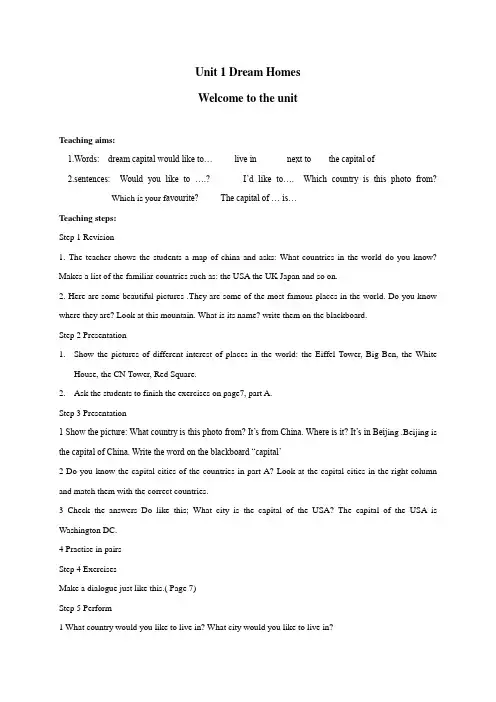
Unit 1 Dream HomesWelcome to the unitTeaching aims:1.Words: dream capital would like to… live in next to the capital of2.sentences: Would you like to ….? I‟d like to…. Which country is this photo from?Which is your f avourite? The capital of … is…Teaching steps:Step 1 Revision1. The teacher shows the students a map of china and asks: What countries in the world do you know? Makes a list of the familiar countries such as: the USA the UK Japan and so on.2. Here are some beautiful pictures .They are some of the most famous places in the world. Do you know where they are? Look at this mountain. What is its name? write them on the blackboard.Step 2 Presentation1.Show the pictures of different interest of places in the world: the Eiffel Tower, Big Ben, the WhiteHouse, the CN Tower, Red Square.2.Ask the students to finish the exercises on page7, part A.Step 3 Presentation1 Show the picture: What country is this photo from? It‟s from China. Where is it? It‟s in Beij ing .Beijing is the capital of China. Write the word on the blackboard “capital‟2 Do you know the capital cities of the countries in part A? Look at the capital cities in the right column and match them with the correct countries.3 Check the answers Do like this; What city is the capital of the USA? The capital of the USA is Washington DC.4 Practise in pairsStep 4 ExercisesMake a dialogue just like this.( Page 7)Step 5 Perform1 What country would you like to live in? What city would you like to live in?2 Show them two pictures: a palace and a restaurant Tell them :There are two places her .One is a restaurant and the other is a palaceStep 6 Understanding1 Look at these two places .Where would you like to live? Where do you think Eddie would like to live?2 Look at the picture and read the dialogue ,then answer the teacher‟s questionsWhy would Eddie like to live next to a restaurant?Which is Eddie‟s favourite restaurant?Why does he like the biggest one? Can you guess?Step 7Action Practice the dialogue in pairs Ask the students to make similar dialogues.Step 8 HomeworkRecite the dialogueFinish the additional exercisesUnit 1 Dream HomesReadingTeaching aims and demands:New words: mile, garden, flat, centre, living room, share, bedroom, own, bathroom, balcony, beach, sea, dining roomTeaching methods: task-based approachTeaching task:1. To read and learn about different types of homes and lifestyles..2. To obtain details about homes in different countries.3. To respond to the text by mak ing statements about the foreign students‟ activities.4.Write an article to introduce their own homes, using the four home pages as a model.Teaching aids: tape recorder, tapes, slide projector, slidesTeaching steps:Step1 Free talk1. Free talk about a picture of a house.(1)Which floor do you live?(2)How many rooms do you have in your family?(3)Which room do you like best? Why?Step2 Presentation1.What rooms do I have in my dream home?Present some rooms and the activities(1)living room, chat with(2)kitchen, cook meals, make dinner, enjoy a cup of tea(3)dining room, have dinner, in the centre(4)study, do the/my homework(5)bathroom, wash my face, brush my teeth(6)bedroom, share…with…(7)garden, grow flowers, have fun with my dog(8)balcony, look out at the beach and the seaStep3 Practice1.I sleep in the_______________.2.I cook dinner in the_______________.3.I have a bath in the_______________.4.I read books and do my homework in the_______________.5.I chat with my friends in the_______________.6.I have meals in the_______________.7.I grow flowers in the_______________.Step4 Read and answer1.Read the information about Neil‟s home and answer the question.1).Where do you live?2).What is your favourite place?3).What do you often do in the kitchen?4).Where do you have fun with your dog?2. Read the information about Anna‟s home and judge T and F1).Anna lives in a big flat in the centre of Moscow._____2).Her flat is on the seventh floor. ______3).Anna shares a bedroom with her brother. _____4).They often listen to music in the garden.______3. Read the information about Stephen‟s home and answer the question.1).How many rooms are there in Stephen‟s home?2).What is his favourite place?3).What can he do on the balcony?4).Does he share a bathroom with his family?Step5 Finish the exercises on P9.1. Finish the exercises on P9.2. check the answer.Step6 Make a survey1.What kind of home do you live in?2.A house or a flat?3.How many people are there in your home?4.Who are they?5.How many rooms are there in your home?6.What is your favourite place in your home?7.What do you often do there?Step7 WritingHello! My name is ________. I‟m_____years old.I live in________with________.There are _____people in my family.They are my______________and________. There are _______rooms in my home and my favourite is __________.I often___________there.Step8 Homework1. Review the contents of this lesson.2. Write an article to introduce their own homes, using the four home pages as a model.Unit 1 Dream HomesGrammarTeaching Aims:1. Can use cardinal numbers correctly.2. Can use cardinal numbers to express the larger numbers.New words: zero, hundred, thousand, million, foot, square, metre, area, overTeaching methods: task-based approachTeaching aids: tape recorder, tapes, slide projector, slidesTeaching Emphasis /Difficulties: The spelling and writing of the larger cardinal numbers. Teaching steps:Step1: Free talk Free talk about students‟ homes.Step2: Talk about cardinal numbersAsk Ss to remember where they can find numbers in their lives.Give pictures about numbers in our lives. (见课件)Ask Ss to read page numbers, room numbers, student numbers…1章节,页数的读法第三课the Third Lesson, Lesson Three第507页Page five o seven第2564页Page two five six four /Page twenty-five sixty-four2房间,门牌,电话号码的读法第305房间Room three o five长安街76号seventy-six Chang‟an Street电话号码204486 telephone number, two o four four(double four) eight six.十一路公共汽车Bus (No.) elevenReview numbers from 1 to 100, and give Ss some simple maths problems to plus and minus; Step3: Talk about the spelling归纳:1)以teen结尾的数词: 13-192)以ty结尾的数词: 20以上的整十3)20---100之间各数词都要在十位和个位之间加连字符“-”。
7b unit 1 Dream homes(译林牛津版七年级英语下册教案教学设计)2060
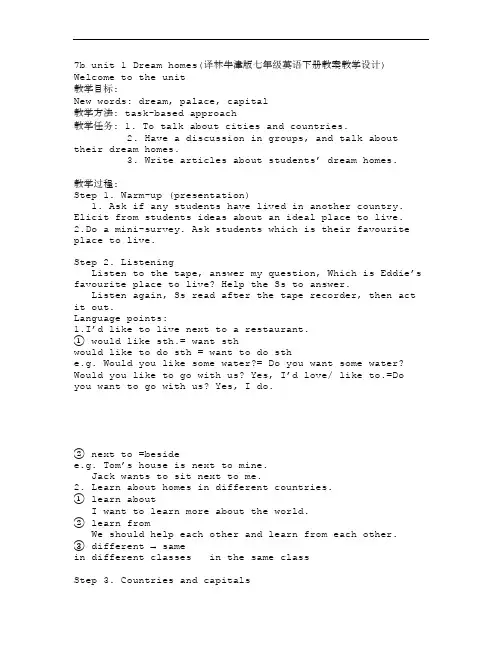
7b unit 1 Dream homes(译林牛津版七年级英语下册教案教学设计) Welcome to the unit教学目标:New words: dream, palace, capital教学方法: task-based approach教学任务: 1. To talk about cities and countries.2. Have a discussion in groups, and talk abouttheir dream homes.3. Write articles about students’ dream homes.教学过程:Step 1. Warm-up (presentation)1. Ask if any students have lived in another country. Elicit from students ideas about an ideal place to live.2.Do a mini-survey. Ask students which is their favourite place to live.Step 2. ListeningListen to the tape, answer my question, Which is Eddie’s favourite place to live? Help the Ss to answer.Listen again, Ss read after the tape recorder, then act it out.Language points:1.I’d like to live next t o a restaurant.① would like sth.= want sthwould like to do sth = want to do sthe.g. Would you like some water?= Do you want some water? Would you like to go with us? Yes, I’d love/ like to.=Do you want to go with us? Yes, I do.② next to =besidee.g. Tom’s house is next to mine.Jack wants to sit next to me.2. Learn about homes in different countries.① learn aboutI want to learn more about the world.② learn fromWe should help each other and learn from each other.③different → samein different classes in the same classStep 3. Countries and capitals1.Ask students to study the pictures on page 3.2.Say: The capital of China is Beijing . The Capital is the mostimportant city in a country. Ask students to do Part B. Ask them to check with others.Step 4. Discussion (task)Have a discussion in groups of four to talk about their dream homes.Each group will choose a student to tell us about his / her dream home.Why?Language points:The capital of the USA is Washington D.C.the capital of ……e.g. Nanjing is the capital of Jiangsu Province.The capital of China is Beijing.Step 5.Sum-upGo through the new words and the language points learnt during this lesson.Step 6. Homework1.Review the contents of this lesson.2. Write articles about students’ dream homes.Reading教学目标:New words: balcony, cushion, beach, sea, bunk beds, town, wooden, over,climb, ladder , quiet, rain, while, sitting room, street, share, friendly,above, dining room, grow, most, lie教学方法: task-based approach教学任务: 1. To read and learn about different types of homes and lifestyles..2. To obtain details about homes in different countries.3. To respond to the text by making statements about the foreign students’ activities.4.Write an article to introduce their own homes, using thefour home pages as a model.教学步骤:Step 1. Warm-upAsk some students to report their homework about dream homes.Step 2. Presentatione the pictures to teach the new words.balcony cushions ladder kitchen bunk beds sitting room2. Complete the following sentences using the new words.⑴ Two beds , one above the other, are .⑵ In most homes, people cook meals in the .⑶ We usually put the sofa in the .⑷ is a good place to chat with friends.⑸ Sitting on the big is very comfortable.⑹ We can climb the tall tree with a .Step 3.ListeningNow, let’s listen to the home pages of four foreignstudents, after youlisten to them, please do some “T” or “F” exercises. Checkthe answerswith the whole class.1.Stephen lives near the sea.2.There are more than ten rooms in Stephen’s house.3.Maddee lives in a wooden house in the hills.4.Maddee has a small family.5.Neil has a TV in the kitchen.6.Neil’s dog sleeps in the sitting room.7.Anna’s flat is on a busy street.8.Anna shares a bedroom with her brother.9.Stephen’s favourite place is the balcony.10.Anna lives in a large flat. Step 4. ReadingSs read the articles by yourselves. Then check theirreading.Language points:1.We sit on the big floor cushions and look out at thebeach and the sea.look out (of) …e.g. Don’t look out of the window in class.look at / look around / look for / look like / look forwardto / look after / look up2. I live with my family in a wooden house.= I live with my family in a house made of wood.wooden(adj.) → wood (n.)e.g. We need some wooden chairs.This house is made of wood.3. I climb a ladder to get into my house. =I get into my house with a ladder.①e.g. I often go to her house to see Uncle Li.Daniel often goes to the shopping mall to play computer games.②get into → get out ofget into the car get out of the car4. I do not have my own bedroom.own(adj./v.) → owner (n.)e.g. I see with my own eyes.Who’s the owner of this pen?= Who owns this pen?5. My family and I often sit in the kitchen while my mother makes dinner.e.g. I am reading books while my brother is watching TV.She called while you were out.6. I share a bedroom with my sister.share sth with sbe.g. The boy shared his toy with other childrenshare in sthe.g. We should share in our sorrows as well as joys.7. Our neighbours are friendly and we are happy here.e.g. I’m friendly with her.be friendly to sbe.g. People are usually friendly to foreign friends.8.Simon wrote down the meaning of some of the words.①write + n. +down=write down +n. write it /them downe.g. Can you write down the words on your book ?= Can you write the words on your book?OK, I’ll write them down.②meaning (n.) → mean(v.)e.g. What’s the meaning of “quick?= What does “quick” mean?9.A garden is the best place to grow flowers.e.g. It’s really a good place to go.I’m hungry. Do you have anything to eat?10.Stephen is lying on his bunk beds.lie → lying tie → tying die → dying tell a liee.g. Don’t tell a lie any more . It’s not good for you.Step 5.Discussion (task)Divide the class into groups of six. Ask students to draw picture of their homes.Students look at their pictures and talk about their homes.Step 6.Sum-upGo through the new words and the language pointslearnt during this lesson.Step 7. Homework1. Review the contents of this lesson.2. Write an article to introduce their own homes, using the four home pages as a model.Vocabulary ﹠ Grammar教学目标:New words: cupboard, bookshelf, shower, lamp, wardrobe, sink, bath, basin,in front of , opposite, chalk, air conditioner, below, printer, shelf,top, tidy, sixteen, nineteen, seventy, ninety, thousand, million, arrive,seventh, sixth, come, exam, second, third, fourth, fifth, ninth, eleventh,twelfth, twentieth, sound教学难点: prepositions of placecardinal numbers & ordinal numbers教学方法: task-based approach教学任务:1.To use prepositions of place to identify specificlocations of things.2.To revise and use cardinal numbers in everydaysituations , including phone numbers and amounts of money.3.To understand the purpose of ordinal numbers in terms of ordering things and events.4.To use ordinal and cardinal numbers to talk about schedules, dates, scores and results.教学过程:Step 1. Warm-upAsk the student on duty to give a free talk.Step 2. VocabularyAsk the students how many words they already know about furniture.Then teach furniture. Use pictures to teach other words.e.g. chair,cupboard, lamp, sofa, table, wardrobe…Ask the students to write the names under the pictures(Page 75).Step 3.Grammar1.Prepostitions of placeWe use prepositions of place to say where things are. Prepositions of place: above, at, behind, below, beside, between, in, in front of , inside, next to, on , opposite, over, under.e.g. Millie sits in front of me.Amy sits between Millie and Simon.Kitty sits next to Sandy.Sandy sits between Kitty and me.Simon sits in front of Kitty.The window is opposite the door.The chalk is on the teacher’s desk.Language points:⑴above, over, onabove →(反) below表示位置高于某物在其上方,并不表示正上方。
牛津译林版7BUnit1 Dream homes Grammar精讲(有答案)
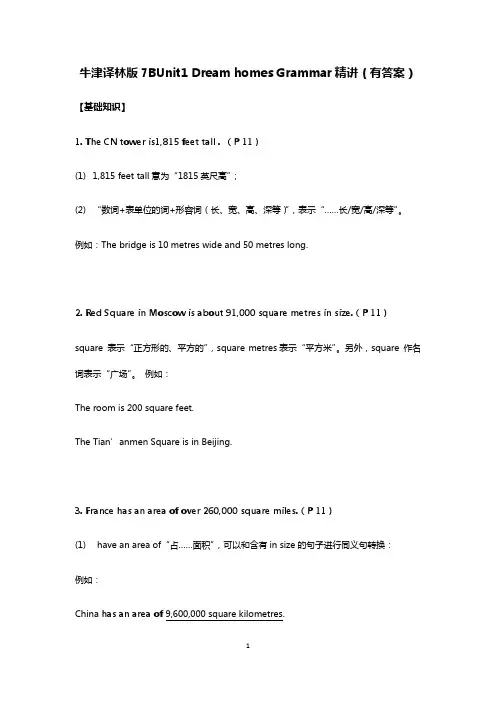
牛津译林版7BUnit1 Dream homes Grammar精讲(有答案)【基础知识】1.The CN tower is1,815 feet tall . (P 11)(1)1,815 feet tall意为“1815英尺高”;(2)“数词+表单位的词+形容词(长、宽、高、深等)”,表示“……长/宽/高/深等”。
例如:The bridge is 10 metres wide and 50 metres long.2.Red Square in Moscow is about 91,000 square metres in size.(P 11)square 表示“正方形的、平方的”,square metres表示“平方米”。
另外,square 作名词表示“广场”。
例如:The room is 200 square feet.The Tian’anmen Square is in Beijing.3.France has an area of over 260,000 square miles.(P 11)(1)have an area of“占……面积”,可以和含有in size的句子进行同义句转换:例如:China has an area of 9,600,000 square kilometres.=China is 9,600,000 square kilometres in size.(2)over“超过”,相当于more than:例如:My father is over forty.Tokyo, the capital of Japan, has over 13,000,000 people.数词1、数词的定义:表示数目多少或顺序先后的词为数词。
2、数词的分类:数词可分为基数词和序数词,基数词表示数量的多少,序数词表示顺序的先后。
3、数词的用法:基数词的用法(1)基数词的构成:①非整十基数词21-99是在十位数后面加上个位数构成,中间加上连字符“-”: twenty-one, seventy-six, eighty-eight②三位数以上的基数词,百位数和十位数之间用and 连接:two hundred and one, three thousand five hundred and fourteen③英语中没有“万”和“亿”这两个单位,在表示“万”和“亿”时,把“万”念成10个千,“十万”念成100个千,“亿”念成100个百万……以此类推:10,000:ten thousand100,000: a hundred thousand100,000,000: a hundred million35, 845: thirty-five thousand, eight hundred and forty-five(2)英语中的百千万:①hundred, thousand, million和billion 等表示确切数字时,只用其单数形式;但是在表示不确切数字时,要用其复数形式,并且与of 连用,表示约数。
牛津译林版七年级下册Unit 1 Dream homes Grammar 教案

Unit 1 Dream homesGrammar教学目标1.Get to know the spellings and usages of the cardinal and ordinal numbers.e cardinal numbers correctly to talk about numbers, size ,quantity and areas.e ordinal numbers correctly to talk about dates, floors and orders.教学内容1.Words: zero, hundred, thousand, million, foot, square, metre, area, over.2.Phrases: square meter, in size, have an area of3.Sentences:The CN Tower is 1,815 feet tall.Women’s day is on the eight of Match.He is always the first to come to school in our class.重点难点To use cardinal numbers and ordinal numbers correctly to talk about things.教学准备a dictionary; a calendar; teaching pictures.教学过程Step 1 . Lead-in1.Enjoy a number song.2.Talking about numbers freely.3.Remind Ss to ask such questionsHow old are you?How many family members are there in your family?How many students are there in your class?What’s your favorite number?What’s your telephone number?......Step 2 . Present new wordszero, hundred, thousand, million, foot ,feet, square, meter, area, overStep 3 . Cardinal numbers1.Teach Ss the spellings and usages of cardinal numbers: zero, one milliom.2.Teach Ss how to read the cardinal numbers.4,056 four thousand and fifty-six23,813 twenty-three thousand eight hundred and thirteen.567,110 five hundred and sixty-seven thousand one hundred and ten6,425,200 six million four hundred and twenty-five thousand two hundred3.Help them to find out the rules of reading a big number.4.Read and learn.(1)People from about 180 countries and areas live in New York.(2)The CN Tower is 1,815 feet tall.(3)Red Square in Moscow is about 91,000 square meters in size.(4)France has an area o over 260,000 square miles.(5)There are about 8,000,000 people living in London.(6)Tokyo , the capital of Japan ,has over 13,000,000 people .Step 4 . Ordinal numbers1.Explain the usage of ordinal numbers.We use ordinal numbers to order things and events. We use them to talk about dates ,floors, positions,etc.Eg. Women’s Day is on the eighth of Match.Our flat is on the seventh floor.He is always the first to come to school in our class.2.Learn the spellings of the ordinal numbers with the help of the cardinal numbers . remind the Ss the rules of the word-building.基变序,有规律;1,2,3,特殊记;8去t, 9去e;Ve要用f 替;最后再加“th”ty变成tie.plete B2 on page 12.Step 5 . Summary一、基数词用法1.基数词在表示数量时与表示编号、号码时的读法不一样。
牛津译林版七下英语7bunit1dreamhomesgrammar
1.大约180个国家和地区 about 180 countries and areas 2. 1,815英尺高 1,815 feet tall in size/area
3. 在面积方面
4. 占地260,000多平方英里 have an area of over 260,000 square miles 5. 大约8,000,000人生活在伦敦 about 8,000,000 people living in London 6. 13,000,000多的人 over/more than 13,000,000 people
21 30 40 50 60 70 80 90 100
1,000 one thousand 10,000 ten thousand 100,000 one hundred thousand 1,000,000 one million
How do we say the following numbers?
How do we say them 2, 007= two thousand and seven twenty-eight thousand, three 28, 324= hundred and twenty-four five hundred and sixty-seven 567, 215= thousand, two hundred and fifteen five million, seven hundred and 5, 778, 125= seventy-eight thousand, one hundred and twenty-five sixty-eight million,six hundred and 68, 689, 253= eighty-nine thousand,two hundred and fifty-three
牛津译林版七年级英语下册Unit1 Dream homes Grammar课件
❖1、使教育过程成为一种艺术的事业。 ❖2、教师之为教,不在全盘授予,而在相机诱导。2021/10/252021/10/252021/10/2510/25/2021 7:56:32 PM ❖3、一年之计,莫如树谷;十年之计,莫如树木;终身之计,莫如树人4、智力教育就是要扩大人的求知范围 ❖5、教育是一个逐步发现自己无知的过程。 ❖6、要经常培养开阔的胸襟,要经常培养知识上诚实的习惯,而且要经常学习向自己的思想负责任。2021年10月 2021/10/252021/10/252021/10/2510/25/2021 ❖7、风声雨声读书声,声声入耳;家事国事天下事,事事关心。2021/10/252021/10/25October 25, 2021 ❖8、先生不应该专教书,他的责任是教人做人;学生不应该专读书,他的责任是学习人生之道。2021/10/252021/10/252021/10/252021/10/25
A Cardinal numbers B Ordinal numbers学科网 zxxk
What numbers can you see?
To learn the cardinal numbers and use them to talk about the numbers of people or things
4. Our flat is on the seventh floor. (P8)
5. It has eight rooms. (P8)
to test your sense of observation to test your ability of short-term memory to test your ability to highlight the language points
牛津译林版七年级英语下册7B unit1 重点单词+词组+句子(分课时整理)
7BUnit 1 Dream homes Welcome to the unit一、重点单词梦想dream-宫殿palace-饭店restaurant-照片photo-花园garden起居室living room-中心centre-合用,分享share-伦敦London-卧室bedroom公寓,套房-自己的own-浴室bathroom-阳台balcony-海滩beach二十twenty-城镇town-最喜欢的favourite-国家country-首都capital加拿大Canada-法国France-日本Japan-俄国Russia-英国the UK二、重点短语梦想的家园dream homes-住在皇宫里live in a palace住在餐馆隔壁live next to a restaurant-在镇上in town二十家饭店twenty restaurants-第五大街最大的那个the biggest one in Fifth Street国家和首都countries and capitals-富士山Mount Fuji白宫the white House-埃菲尔铁塔the Eiffel Tower加拿大国家电视塔the CN Tower-大本钟Big Ben红场Red Square-天安门广场Tian’anmen Square三、重点句子你想要住在宫殿里吗?Would you like to live in a palace?我想要住在餐馆隔壁。
I would like to live next to a restaurant.镇上有二十家饭店,哪一家是你的最爱?There are twenty restaurants in town. Which is your favourite? 第五大街最大的那个。
The biggest one in Fifth Street.这张照片来自哪个国家?Which country is this photo from?它来自日本。
牛津译林初中英语七下Unit 1 Dream homes Grammar》教案 .doc
教
学
目
标
1.To use prepositions of place to identify specific locations of things.
2.To revise and use cardinal numbers in everyday situations , including phone numbers and amounts of money.
eight million, five hundred and forty-three thousand, six hundred and one
2 .基数词的运用:
hundred, thousand, million, billion等一般用单数,但以下情况用复数:
⑴表示不定数目:e.g. hun dreds of millions of
教学反思
Finish the exercises in the books.
Homework
1. Review the cont ents of this lesson.
2. Do the Exx of workbook.
作业设计
1.Revise this period.
2.Pre-learn the ne xt period
重点
1.To use prepositions of place to identify specific locations of things.
2.To revise and use cardinal numbers in everyday situations , including phone numbers and amounts of money.
牛津译林版七年级英语下册Unit1DreamhomesGrammar教案
2 .I’ll arrive inBeijingon Sunday.
arrive (vi.) arrive in(大地点)/at (小地点)= get to = reach
Have a discussion and find out the diffe rences between cardinal numbers and ordinal number
教学反思
eight million, five hundred and forty-three thousand, six hundred and one
2 .基数词的运用:
hundred, thousand, million, billion等一般用单数,但以下情况用复数:
⑴表示不定数目:e.g. hun dreds of millions of
Unit 1 Dream homes Grammar
教
学
目
标
1.To use prepositions of place to identify specific locations of things.
2.To revise and use cardinal numbers in everyday situations , including phone numbers and amounts of money.
⑵表示“几十”的数词,其复数形式可以表示年龄或年代。
3. Ordinal numbers
We can use ordinal numbers to to order things and events. We use them to talk about dates, f loors, results, etc.
牛津译林版七年级下册英语Unit 1 Grammar讲解和练习-
Unit 1 Dream homes重点单词1. zero num. 零The figure 100 has two zeros in it. 数字100有两个零。
拓展:zero n. 零度;最低点;完全没有;无足轻重的人或物2. hundred num. 百There are nine hundred students in our school. 我们学校有900名学生。
短语hundreds of 数以百计的注意:hundred前有数词修饰时不+s;后跟of时要+s。
谚语:It takes ten years to grow trees, but a hundred to rear people.十年树木,百年树人。
3. thousand num. 千The hall can seat one thousand people. 这个大厅能坐1000人。
短语thousands of 成千上万的谚语:Separated as we are thousands of miles apart, we come together as if by predestination. 有缘千里来相会。
4. million num. 百万It must be worth a million. 它一定值一百万。
短语millions of 大量的5. foot n. (pl. feet) 英尺The boy is six feet tall. 这个男孩身高六英尺。
拓展:foot n. 脚;底部6. square adj. 平方的The city covered ten square miles. 这个城市的面积有10平方英里。
短语square kilometre 平方公里拓展:square n. 正方形;广场7. metre n. 米,公尺=meterThe blue whale can grow to over 30 metres long. 蓝鲸能长到30多米长。