
人教版 八年级英语 下册 Unit2_I_'ll_help_to_clean_up
You could help the old people clean up their houses.
You could help the passengers with their luggage.
You could help the passengers with their luggage.
• How did you get such an idea?
• 你怎么会产生这样一个想法? • 第二个get是系动词,后接形容词,表示体质、情
绪、天气等方面的改变,通常译作
• “变得;变为”。例如:
• satisfaction n.满足;满意。 • I have a feeling of satisfaction. 我有一种满
2c Lei Feng Day is two weeks from now. We need to come up with a plan. What would you like to do? Talk with your partner and come up with a plan.
A: We need to come up with a plan for the City Park Clean-Up Day.
• 在这里当志愿者对我来说是梦想成真。
• 此句中a dream come true表示“梦想成为现 实;梦想成真” ,是一种固定结构。再如:
• I got the latest CD player as a birthday present yesterday. It was just a dream come true !
sign n.
标牌,招牌
2b
A group of students are planning a City Parks Clean-Up Day. They are talking about ways to tell people about the Clean-Up Day. Listen and fill in the blanks.
clean up v.“打扫”。 Please clean up your bed and clothes. 请整理一下你的床铺和衣服。 clean –up n.“扫除”。 Clean –Up Day Clean –Up Day is only three ways from now on.
Section A
food at the food bank
volunteer in an after-school study program
• I’d like to • work outside.
You could help clean up the city parks
Do you often help others?
Tell us something about the last time you helped others.
I helped my classmate with math. I helped my parents with the housework. I _________________________. I _________________________. I _________________________.
B: Let’s have lunch first.
A: No, we need to start now.Clean-Up Day is only two weeks from now.
B: ….
1 help sb. out “帮助某人解决难题”。
I can’t work out this math problem. Please help me out. 2.help sb. with sth. =help sb. do/to do sth 在某事上帮助某人。
You could help the old people cross the street.
You could help plant trees and grass to beautify your hometown.
You could help the police catch the thieves.
I help him with his English every day. 3.help oneself to sth.随便吃食物等。
Help yourselves to apples, boys. 4.with the help of =with one’s help在……的帮助下。
With the help of the teachers, I get good grades in all subjects.
Did you use to sing when you do housework? be used to do sth 被用来做某事 get / be used to doing sth 习惯于做某事
• She could read by herself at the age of four. 此句中“by+反身代词” 表示“独自地;独立
1. We need to come up with a plan. 2. We can’t ____p_u_t_ __o_ff____ making a plan.
Clean-Up Day is only two weeks from now.
3. I’ll ___w__ri_t_e __d_o_w_n__ all our ideas. 4. We could ____p_u_t_ _u_p_____ signs.
• You could give the money to the charity and help the poor people.
Other ways we could help people
_______________________________________________
__Y_o_u__c_o_u__ld__h__e_lp__t_h_e__p_a__s_s_e_n_g_e_r_s__w__it_h___th__e_ir__l_u_g_gage. __Y__o_u__c_o_u_l_d__h_e_l_p__p_l_a_n_t__t_r_e_e_s_a_n__d__g_r_a_s_s__to_______ __b_e_a__u_t_if_y__y_o_u__r_h__o_m__e_t_o_w__n_.____________________ ___Y_o_u__c_o_u__ld__h__e_lp__t_h__e_o_l_d__p_e_o__p_l_e_c_r_o__ss__t_h_e__s_t_r_e_et. __Y__o_u__c_o_u_l_d__h_e_l_p__t_h_e__o_ld__p__e_o_p_l_e__c_le_a__n__u_p__t_h_e_i_r_houses. ___Y_o_u__c_o_u__ld__h__e_lp__t_h__e_p__o_li_c_e__c_a_t_c_h__t_h_e__th__ie_v__e_s_. _
What other ways we could help people?
There are many other ways you could help people.
You could help clean up the city parks.
You could cheer up(使 某人高兴)the sick people in the hospital .
5. I’ll ___h_a_n_d_ _o_u_t____ advertisements after school.
6. We could each _____ca_l_l __u_p____ ten students and ask them to come.
• We can’t put off making a plan. • put off 推迟 v.+adv. 结构 • put away 将.....收起来 put on 穿上;上演 • put out 熄灭;伸出 • put up 张贴,搭建
期他的表现令人 满意。
• care for照料;服侍;关心。
• We must care for each other and help each other.
• 延伸 care for 喜欢;宠爱。 I don’t care for sweets.
• 3. Volunteering here is a dream come true for me.
• 句意: 当我看到动物们(病情)渐好,看到它
们主人脸上的喜悦表情时,我产生出那么一种极 强的满足感来。
feeling 感觉;感触。它 为可数名词,表示人 的喜怒哀乐 或冷热痛累等感受或感觉。 have a feeling that we are being followed. 我有种正被人跟踪的 感觉。
You could give the money to the charity and help the poor people.
1a PAIRWORKPractice the conversation below. Then have similar conversation using the information in activity 1b.
足感。延伸 a) • satisfy v.(使)满足/ 满意。
• It seems that no one can satisfy him. • satisfied adj.感到满意 的。
• I’m satisfied at this result. • satisfying adj.令人满意的。 • His performance is satisfying this term.这学
人教版新目标八年级下册英语Unit2_I_will_help_clean_up_the_city_parks全单元
cheer up the old people
give out(分发,派发) food
If I had lots of money, I would…
set up a Hope School
建立、建造
=establish
help poor kids
2 They told me stories about the past and how things used to be. 他们给我讲过去的生活经历,讲过去是什么 样子的。 used to be/do 曾经。。。 She used to live in that city before. She didn't use to live in that city before. used to be /do过去常做某事,现在不那样了 Did you use to sing when you do housework?
Unit 2
I’ll help to clean up the city parks.
Section A
Warming up
Do you often help others?
What other ways we could help people?
I helped to clean the classroom. I helped my parents with the chores.
You could help the old people cross the street. _______________________________________________
_______________________________________________ You could help the police catch the thieves. _______________________________________________ You could help the old people clean up their houses. You could give the money to the charity and help the _______________________________________________
人教新版八年级下册Unit2I’llhelptocleanupthecityparks.知识点精讲--SectionB
人教新版八年级下册Unit 2 I ’ll help to clean up the city parks.知识点精讲--Section B Section B1. I repaired it . 我把它修好了【解析】repair v “修理;修复”1) repair的对象范围很广,从房屋、道路、机器到日常生活必需品,是使受到一定损失或失灵的东西恢复其形状或功能。
Who has repaired the broken leg of the table? 谁把桌子的断腿修好了?2) mend的意思是恢复某物原来的样子(包括用针、线来缝补),一般指较小之物。
This shirt is too old to mend. 这件衣服太旧不能补了。
3) fix用于需要重新“调”物体的结构,把松散的部件固定结实,将分离的物体各部分装配起来。
用于美国口语中,与repair无多大区别。
Can you fix the broken chair? 你能修理那把坏了的椅子吗?2. I take after my mother. 我长的像我妈妈。
【解析】(1)take after =be similar to在(外貌、性格等方面)与(父母)相像(v. +adv)【短语】take back 收回,接回take down 写下take off 脱下;起飞take up 占去(时间或空间)take care 小心take care of 照顾 take place 发生take out 拿出take away 拿走(2)look like 只指在外貌上与…..相像【短语】:look after 照顾look up 向上看,查找look for 寻找look out 小心( ①)—Do you ___after your mother or your father?—My father .We both have big eyes and black hair.A. look B. take C. run( )②The girl _____ the woman. Maybe she is her daughter. A. take care B. takes after C. takes off D. look after【2011山东青岛2】Tom ___ his father, because they both are cheerful and easygoing.A. looks likeB. takes afterC. doesnt’take afterD. isn’t like3. I fixed it up. 我把它修理好了。
人教版英语初二下册 Unit 2 I`ll help to clean up the city park 知识讲解
Unit 2 I’ll help to clean up the city parks.词句精讲精练词汇精讲1. clean upclean up意为“打扫”,up为副词,此短语是动副型短语,如果宾语为代词,应放在短语中间;如果宾语是名词,可放于短语之间或两词之后。
例如:Please clean up this street at once. 请马上把这条街打扫干净。
This street is dirty. Please clean it up. 这条街道太脏了,请把它打扫干净。
2. cheer upcheer up意为“变得高兴,振奋起来”,是“动词+副词”结构的短语。
cheer up既可作及物动词短语,也可作不及物动词短语。
例如:He cheered up at once when I agreed to help him. 我同意帮助他时,他马上高兴起来。
Cheer up! The news isn’t too bad. 振作起来!这消息不是太坏。
He took her to the cinema to cheer her up. 为了让她高兴,他带她去了电影院。
【拓展】(1) cheer作不及物动词,意为“欢呼;喝彩”。
例如:The girls cheered as the famous singer arrived. 当这位著名的歌手到达时,女孩子们大声欢呼。
(2) cheer作及物动词,意为“为……欢呼,高呼”。
例如:The whole village turned out to cheer the hero. 全村人都出来向那位英雄欢呼。
(3) cheer作可数名词,意为“欢呼声;喝彩声”。
例如:We can hear the cheers of students outside the gym. 我们在体育场外就能听到学生的欢呼声。
(4) cheer on意为“为……加油”。
例如:We will have a basketball game this afternoon. Would you like to come and cheer us on?我们今天下午有一场篮球比赛,你愿意来为我们加油吗?3. give outgive out意为“散发;分发”,相当于hand out,是“动词+ 副词”结构的短语动词。
2014年人教版新八年级英语下unit2《_i'll_help_to_clean_up_the_city_parks_》Section_A1a-4c

I hope to
work outside.
You could help to
clean up the city
parks.
2b Listen again. Fill in the blanks. up ____ come ___ with a plan to tell 1. We need to _____ people about the city park clean-up. 2. Clean-Up Day is only two weeks from now. We can’t ____ put ____ off making a plan. 3. We could _____ put ___ up signs. 4. Let’s make some notices, too. Then I’ll ____ them ___ hand out after school. up 10 students and 5. We could each ____ call ____ ask them to come.
1. Where’s Helen going to work this summer? _________________________________ She’s going to work in an old people’s _________________________________ home. 2. What did Tom do to help the old people?
___ 4 The girl could volunteer in an after-school study program to teach kids. ___ 1 The boy could help to clean up the city parks.
新人教版八年级英语下册unit2__I'll___help__to__clean_the_city_Section_A-1课件
3. We could put up signs. sign 是名词,具体用法如下: (1) “标牌,招牌”。例如: the sign of barber’s shop (2) “记号,符号”。 (3) “示意动作”。例如: The teacher made a sign to us to be quiet. (4) “迹象,征兆”。 例如: A red sky at sunset is a sign of good weather.
(2) need用作情态动词, 意为“必须”、“必 要”,没有人称、数的变化,后接不带to 的
动 词不定式。 通常用于疑问句和否定句中,构 成疑问句和否定句时,不需要使用助动词。
e.g. Need you go to the park with your
classmate?
(3) 由need引出的疑问句,答语表肯定时用 must或have to;表示否定时用needn’t或 don’t have to。例如: A: Need I come to work tomorrow? B: Yes, you must/have to.
Unit 2 I’ll help to clean up the
city park.
Warming up
• Do you want to be a volunteer?
• How could we help people?
Look at the pictures. What are they doing?
You could help sick people in the hospital.
I’d like to cheer up sick kids.
Language goals: How to offer help.
人教版八年级英语下册Unit 2 I'll help to clean up the cit
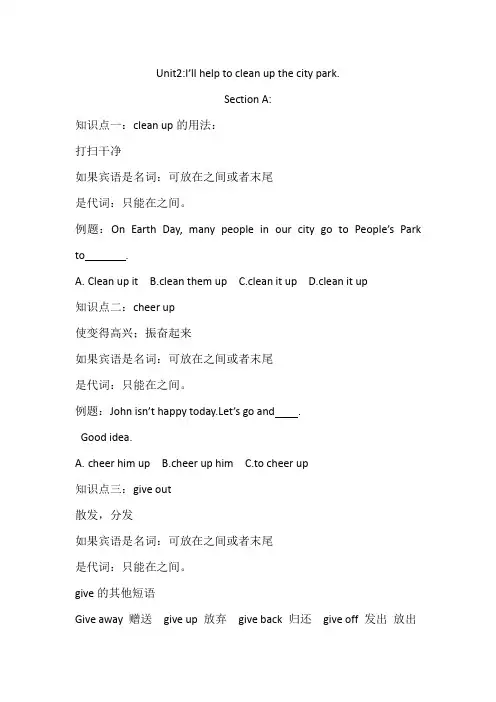
Unit2:I’ll help to clean up the city park.Section A:知识点一:clean up的用法:打扫干净如果宾语是名词:可放在之间或者末尾是代词:只能在之间。
例题:On Earth Day, many people in our city go to People’s Park to .A.Clean up itB.clean them upC.clean it upD.clean it up知识点二:cheer up使变得高兴;振奋起来如果宾语是名词:可放在之间或者末尾是代词:只能在之间。
例题:John isn’t happy today.Let’s go and .Good idea.A.cheer him upB.cheer up himC.to cheer up知识点三:give out散发,分发如果宾语是名词:可放在之间或者末尾是代词:只能在之间。
give的其他短语Give away 赠送give up 放弃give back 归还give off 发出放出Give sb sth给某人某物give in屈服例题:Could you please teach me how to red envelopes on WeChat? Sure. Let me show you.A.give outB.give backC.give way知识点四:put offput off意为“推迟”。
The concert was put off because of the heavy rain.演唱会因为大雨而被推迟了。
拓展:常见的put短语有:put off推迟;延迟穿上;put on展出;上演戴上put away收起来put out熄灭;扑灭put up with容忍put up搭建;建造张贴提升例4They the date of the meeting because of the bad weather.A.put offB.gave awayC.put onD.turn down知识点五used to的用法used to表示“过去常常;以前经常”,后跟动词原形,用来描述过去经常发生的动作或存在的状态。
人教版英语八年级下册Unit2《I’llhelptocleanupthecitypark》说课稿
人教版英语八年级下册Unit 2《I’ll help to clean up the city park》说课稿一. 教材分析人教版英语八年级下册Unit 2的主题是“I’ll help to clean up the city park”,通过本节课的学习,学生将掌握一般将来时的用法,学会如何表达将来的计划和承诺。
教材内容丰富,包括听力、口语、阅读和写作等方面,旨在培养学生的综合语言运用能力。
此外,本节课还涉及了环保意识的教育,引导学生关注环境保护,培养他们的社会责任感和公民意识。
二. 学情分析八年级的学生已经具备了一定的英语基础,能够听懂并运用一般现在时、一般过去时和一般将来时。
但在实际运用中,部分学生对时态的掌握还不够熟练,容易混淆。
此外,学生的词汇量和语法知识有限,对于一些复杂句型的理解和运用还需加强。
因此,在教学过程中,教师需要关注学生的个体差异,针对不同层次的学生进行有针对性的指导。
三. 说教学目标1.知识目标:学生能够掌握一般将来时的用法,学会如何表达将来的计划和承诺。
2.能力目标:学生能够听懂、会说、会读、会写关于将来的计划和承诺的句子。
3.情感目标:学生能够关注环境保护,培养他们的社会责任感和公民意识。
四. 说教学重难点1.教学重点:一般将来时的用法,如何表达将来的计划和承诺。
2.教学难点:一般将来时的句子结构,以及如何正确运用相关词汇和语法知识。
五. 说教学方法与手段1.教学方法:采用任务型教学法、情境教学法和交际法,引导学生参与课堂活动,提高他们的语言运用能力。
2.教学手段:利用多媒体课件、图片、卡片等辅助教学,创设真实情境,激发学生的学习兴趣。
六. 说教学过程1.导入:通过展示城市公园的图片,引导学生谈论自己对公园的印象和感受,引出本节课的主题。
2.新课呈现:讲解一般将来时的用法,展示相关句子和例句,让学生感知和理解一般将来时的结构。
3.操练环节:通过听力练习、角色扮演、小组讨论等形式,让学生在实际语境中运用一般将来时。
初中英语人教版八年级下册Unit 2 I’ll help to clean up
Unit 2 I’ll help to clean up the city parks(Section B 1a-1e)当堂测评分层达标一、短语翻译:1.用完,用尽 ____________2.相像 _________=3.修理它 ________________4.赠送 ____________5.破损的自行车部件 ____________________6.卖自行车 ___________________ 7帮助有需要的人 ______________________二、翻译下面句子。
1.我已经把我的钱用完了。
I my money. My money 。
2.他和他的爸爸很相像。
(take)(Similar)3他正在修他最喜欢的那辆自行车。
He (repair)4我们把书捐赠给了那些住在大山里的可怜的孩子们。
We (give)5.许多孩子没有足够的钱卖他们自己的自行车。
Many children 。
6.有时候像轮子这样的部件可能会损坏。
Sometimes 。
7.他总是志愿去帮助有需要的人。
He 。
三、书面表达每个人都有成长的烦恼。
假如你是某报社的编辑TOM,下面是三个学生的烦恼倾诉,请你结合本节课我们学习的句型给其中一位写一封不少于80词的e-mail,告诉他(她)你的想法、_______________________________________________________________________________ _______________________________________________________________________________ _______________________________________________________________________________ _______________________________________________________________________________ _______________________________________________________________________________ _______________________________________________________________________________。
新人教版八年级英语下册Unit2-I'll-help-to-clean-up-the-city-parks教案
教案讲义学生:任课教师:例:Several boys were injured. 有几个小伙子伤了。
My friend speaks several languages. 我的朋友能讲几种语言11. Last year, she decided to try out for a volunteer after-school reading program.去年,她决定尝试在一个课后阅读项目中做一名志愿者。
【解析】try out 尝试;实验【拓展】try on 试穿①We should __________________(尽最大努力)to be happy in the future.②We should try ___ much fruit.A. eatB. to eatC. eatingD. eats12. care for sb./sth.照顾;照料care【名词】小心,关心;take care of = look after →【动词】care about sb./sth.关心,在意某人/事例:Many students in our school _______ the old and they usually offer their seats to them on buses. A.worry about B. care for C. agree with D. take care【拓展】care的短语总结take care =be careful v.当心,小心;take care of =look after v.照顾,照料,照看take care of 处理,做完练习:Thanks for your invitation, but I’m so sorry I can’t go. I need to ______ my baby at home. A. take away B. take off C. take care of D. take out of13. But I want to learn more about how to care for animals...但是我想学习更多的关于如何照顾动物的知识【解析】―疑问词+不定式‖作及物动词的宾语,【记】:I don’t know what to do.I don’t know how to do it. I don’t know what to do with it.【拓展】v+up with构成的短语:catch up with赶上;追上;put u with容忍;忍得住;keep up with 跟上;跟、保持联系end up with 结束;以.......而结束17.They told me stories about the past and how things used to be.他们给我讲过去的故事,并告诉我过去事情是什么样子的。
八年级英语下册:Unit_2_I’ll_help_to_clean_up_the_city_parks_Section_A_Period_1[1]
Girl 1: You could ask hospitals to let
you visit the kids.
Conversation 4
Girl 1: I’d like to help kids with schoolwork.
Girl 2: You could volunteer in an after-school study
cheer up
clean up
Zx.xk
volunteer
1b
Tape script
Conversation 1
Boy 1: I hope to work outside. Girl 1: You could help to clean up the city parks.
Conversation 2
I will … I’ d like to … I could …
help old people
Zx.xk
cheer up sick kids
raise money
clean up the city parks
plant trees
clean up the advertisements
give out the cards
Boy 2: I’d like to help homeless people.
Girl 1: You could give out food at the food bank to help feed them.
Conversation 3
Girl 2: I want to cheer up sick kids.
Zx.xk
Tape script
Boy1: Now we need to come up with a plan to tell people about the city park clean-up. Girl1: Yeah, but I’m hungry, Bob. Let’s have lunch first. Girl2: No, we need to start now. Clean-up Day is only two weeks from now. Boy2: You’re right, Sally. We can’t put off making a plan. As we talk, I’ll write down all our ideas. Then we can decide which ideas are best. Girl1:Um…well…we could put up signs. Boy2:That’s a good idea! Girl2:Let’s make some notices, too. Then I’ll hand them out after school. Boy1:OK. Great! And we could each call up 10 students and ask them to come. Boy2: Hey, we’re coming up with a lot good ideas, aren’t we?