
外研版英语七年级上册语法总结1
M1语法1】Where are you from? 你来自哪里?回答:I am from Beijing. / I come from Beijing.2】What about going swimming? 去游泳怎么样?回答:Good idea! / Sounds great!/ Great!用法:what about= How about, about 是介词,后接动词ing.例:What about __listening__ (listen)to music?3】Everyone is here. 每个人都在这里。
Everyone :每个人,是单数,谓语动词用第三人称单数形式。
例如:Everyone __likes__(like) music.4】and/but 的用法and: 和,表示并列或顺承关系。
but: 但是,表示转折关系。
例如:He is from China, __but_ he isn’t Chinese.5】It’s nice to meet you all. 很高兴见到你们。
句型:It’s + 形容词+ to do sth.例如:It’s difficult _to learn__ (learn)English.6】My name is Tony Smith.My first name is ___Tony______.my last name is___Smith______.7】Be 的用法1. Be 包括is,am, are.2. Be 搭配口诀:I 用am, you 用are, is 用于he, she, it. 单数和不可数名词用is,复数全用are.3. Be 的肯定变否定,be + not4. Be 的缩写:I am = I’m ; you are = you’rehe is = he’s ; she is =she’s ; it is =it’s; what is =what’s5. Be 的疑问句:Be + 主语+ 其他?回答:Yes, 主语+be. / No, 主语+be not.M2语法1】What/How 引导的感叹句What + a/an + 形容词+ 名词+ (主语+谓语)!= How + 形容词/ 副词+ 主语+谓语!What a big family ( it is ) ! =How big the family is!What fine weather ( it is )! = How fine the weather is!2】in front of 在前面/ in the front of 在前部3】名词所有格两人共有:A and B’s + is两人分别有:A’s and B’s +are例如:Mrs Green is __A__ mother.A. Lingling and Lucy’sB. Lingling’s and Lucy’sC. Lingling’s and Lucy4】合成词合成词变复数,一般情况,后面的单词变复数。
boy student ___boy students____bus driver __bus drivers______2. 含woman 和man的合成词变复数,两个都要变复数。
man teacher ___men teachers_______woman doctor __women doctors_____5】What’s your father’s job?你的爸爸是做什么工作的?= What does your father do?= what is your father ?回答:He is a teacher.6】Beijing is the capital of China. 北京是中国的首都。
China —Chinese England –EnglishJapan –Japanese America –AmericanAfrica –African7】This is a photo of my family. 这是我的一张全家照。
a photo of …的一张照片8】名词所有格有生命的:Lingling’s books无生命的:a door of classroom表示时间和距离的:two hours’time我爸爸的一个朋友:a friend of my father’s9】方位介词on the left 在左边;on the right 在右边in front of 在前面;next to = near 紧靠in the middle of 在中间10】She and Daming’s mother are at the same hospital. 她和大明的妈妈在同一家医院工作。
11】My father is a bus driver, and he works in a bus station.(职业的单词:policeman; doctor; nurse; teacher; actor; manager.)M3语法1】数字one, two, three, four, five, six, seven, eight, nine, ten.eleven, twelve, thirteen, fourteen, fifteen , sixteen, seventeen, eighteen, nineteen, twenty.thirty, forty, fifty, sixty, seventy, eighty, ninety, hundred.2】What’s your classroom in England like? 你在英国的教室是什么样子的?be like = look like 看起来像3】a lot of = lots of 许多a lot of / lots of 后接可数名词复数时,等于many; 后接不可数名词时,等于much.4】furniture 家具(总称);food ; drink; information 信息,这些词都是不可数名词,用is5】some / any 一些1. Some : 用于肯定句(表示请求和建议,希望对方肯定回答的句子)Would you like some milk?What about some milk?Can I have some milk?2. any: 用于否定句和疑问句中例如:I haven’t got __any__ (some/any) apples.Would you like _some___ (some/any) apples?6】on the wall / in the wall 在墙上/在墙里例如: a door is _in the wall______________a map is __on the wall__________7】with / and 的区别with 和and 都有“和”的意思with 强调前者。
例如:Jack with his father __goes____(go) to park.and 强调两者都。
例如:Jack and his father ___go_____(go) to park.8】There be 句型There be 表示“有”( there is / there are )含义:表示某地存在某人/某物(have:强调某人/某物拥有)句型:(1)肯定句:There is / are + 某人/某物(2)否定句:There isn’t / aren’t + 某人/某物(3)疑问句:Is / Are + there + 某人/某物?Yes, there is . / No, there isn’t. Yes, there are . / No, there aren’t 4. 就近原则:is 和are 的选择由最靠近它的名词的单复数决定。
例如:There __is____ a pen and two books.There ___are____ two books and a pen.M4语法1】food/drink 不可数名词(1)drink “饮料”,是不可数名词,用is(2)drink : have a drink(3)drink: “喝”,drink tea.2】too much /too many 太多(1)too much + 不可数名词(2)too many + 可数名词复数(3)much too + 形容词(much too big)3】kind 种类(1)a kind of 一种(2)different kinds of 不同种类的(3)be kind to sb. 对某人和蔼4】health / healthy 健康/健康的(1)I t is good for your health,please keep healthy.(2)stay healthy; keep healthy; healthy food.5】a bit of一点She has __a bit of _____ money. = a little6】remember 记得remember to do sth. 记得去做某事remember doing sth. 记得做过某事7】or 或者; 还是在肯定句中:表示”或者”在否定句和疑问句中,常用or 来代替and:I haven’t got a pen or a book.在并列句中:表示“否则”: Hurry up, or you will be late.8】have got/has got 句型1. 定义:拥有。
have got = have ;has got =has2. 句型:肯定句:主语+ have got /has got +其他否定句:主语+ haven’t got /hasn’t got +其他疑问句:Have /Has+ 主语+ got + 其他?回答:Yes, 主语+have/has.No, 主语+haven’t / hasn’t.3.There be 和have got 的区别There be(某地存在某人/某物;强调存在);have got (某人/某物拥有...;强调拥有)9】特问词what (什么)where (哪里)when (何时)who(谁)which (哪一个)How (方式或状态)What time (什么时刻)How old (多大)What colour (什么颜色)How often (多少次)once / twice / three times10】is good for 对…有益反义词is bad for对…有害11】名词1. 可数名词--单数变复数规律:(1)一般情况:加s(2)以s, x, ch, sh 结尾:加es(buses , boxes, watches)(3)以“辅音+y”结尾的,变y为i, 加es. (family -families, city- cities )(4)以f/fe 结尾:把它变成ves. (leaf-leaves, wife-wives, knife-knives)(5)以o结尾,记口诀:(photo-photos)Negroes and heroes like potatoes and tomatoes.黑人和英雄喜欢马铃薯和西红柿。
七年级上英语外研知识点归纳总结
七年级上英语外研知识点归纳总结一、单词和短语1. Greetings and Introductions (问候和介绍)- Hello! (你好!)- Hi! (嗨!)- Good morning/afternoon/evening! (早上/下午/晚上好!)- How are you? (你好吗?)- Nice to meet you! (很高兴见到你!)- What's your name? (你叫什么名字?)- My name is... (我叫…)2. Classroom Objects (教室用品)- Pen (钢笔)- Pencil (铅笔)- Book (书)- Desk (课桌)- Chair (椅子)- Eraser (橡皮擦)- Ruler (尺子)- Bag (书包)3. Numbers (数字)- Zero (零)- One (一)- Two (二)- Three (三)- Four (四)- Five (五)- Six (六)- Seven (七)- Eight (八)- Nine (九)- Ten (十)4. Days of the Week (星期) - Monday (星期一)- Tuesday (星期二)- Wednesday (星期三)- Thursday (星期四)- Friday (星期五)- Saturday (星期六)- Sunday (星期日)5. Family Members (家庭成员) - Mother (妈妈)- Father (爸爸)- Brother (哥哥/弟弟)- Sister (姐姐/妹妹)6. Colors (颜色)- Red (红色)- Blue (蓝色)- Yellow (黄色)- Green (绿色)- Orange (橙色)- Purple (紫色)- Black (黑色)- White (白色)二、语法知识点1. 一般现在时- 表示经常性或习惯性的动作或状态。
外研版英语七年级上册 Module 1 重点难点易错点梳理
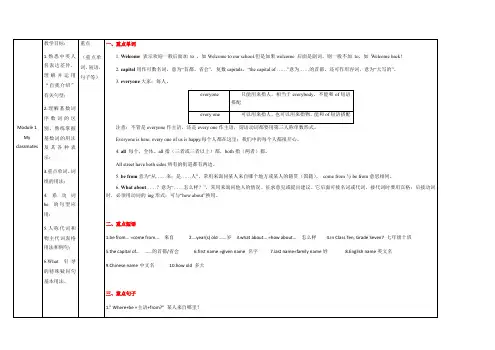
3.(辽宁大连中考改编) They are from China. They
from England.
A. isn't
B. aren’t
C. are
4.(2014 北京中考) I have a big brother.
D. is Name is Paul.
A. His
B. Her
C. Its
D. Your
to our class! 解析:答案为 Welcome
1. 代词 What's _________ (she) family name?
易错点+ 解析:形容词性物主代词后加名词,her 例题分析 2. be 动词
例:My brother and I ___________ (be) students. 解析:主语是两个人,所以用 are 3. Nice __________________(meet) you. 解析: It’s +adj.+to do 答案为 to meet 4. 年龄 Lingling is twelve _____________ (year) old. 解析:答案为 years,注意单复数变化 5.国家及词性变化 Betty is from ____________ and she is _______________.(America) 解析:America 是美国,American 是美国人
教学目标: 重点
一、重点单词
1. 熟 悉 中 英 人 (重点单 名表达差异, 词,短语, 理 解 并 运 用 句子等) “自我介绍”
有关句型;
Module 1
2. 理 解 基 数 词 序数词的区 别,熟练掌握
1. Welcome 表示欢迎一般后面加 to ,如 Welcome to our school.但是如果 welcome 后面是副词,则一般不加 to,如 Welcome back!
初中英语新外研版七年级上册Starter—Unit 1重点单词用法总结(2024秋)

七年级英语上册重点单词用法Starter Welcome to junior high1.ready准备好(做某事)的,形容词。
(1)be / get ready to do sth.准备做某事。
如,I'm ready to play football with my friends.(2)be /get ready for sth. 为某事准备好;为......做好准备。
如,She's ready for the Spring Festival.(3)be ready to do sth.乐意做某事。
如,He’s ready to help others.(4)be ready准备好了。
如,Dinner is ready, Sam.2.join参与,加入(某项活动),动词。
如,join后接人或组织。
如,Do you want to join the Music Club? / I want to join them now.3.introduce介绍,动词。
(1)introduce myself 自我介绍。
如,I introduce myself first.(2)introduce...to ...把......介绍给......。
如,Now I introduce Lucy to you.4.yourself你自己;你们自己,代词(反身代词)。
反身代词构成规律:第一、二人称的反身代词由形容词性物主代词+self(单数)或selves(复数)。
如,myself, yourself, ourselves, yourselves。
第三人称的反身代词是宾格+self(单数)或selves(复数)。
如,himself,herself,itself,themselves。
5.enjoy喜欢;享受......的乐趣,动词。
enjoy sth./enjoy doing sth. 喜欢某物或喜欢做某事。
外研版英语语法概览:七年级
外研版英语语法概览:七年级第一章:名词1.1 名词的分类名词可以分为可数名词和不可数名词。
可数名词有单数和复数形式,而不可数名词没有复数形式。
1.2 名词所有格名词所有格表示某物属于某人或某物。
对于可数名词,我们在名词后面加上 's 或 ' 表示所有格。
对于不可数名词,我们在名词后面加上 'of',然后跟上拥有者的名字。
第二章:代词2.1 代词的分类代词可以分为人称代词、物主代词、反身代词、指示代词、不定代词和疑问代词。
2.2 人称代词人称代词包括 I、you、he、she、it、we 和 they。
它们用来代替人或者事物。
2.3 物主代词物主代词包括 my、your、his、her、its、our 和 their。
它们用来表示所有关系。
第三章:形容词和副词3.1 形容词形容词用来修饰名词,表示事物的特征或性质。
形容词有比较级和最高级形式。
3.2 副词副词用来修饰动词、形容词或其他副词,表示程度或方式。
副词有比较级和最高级形式。
第四章:动词4.1 动词的分类动词可以分为实义动词、助动词和连系动词。
4.2 动词的时态动词的时态表示动作发生的时间。
常见的时态有现在时、过去时和将来时。
4.3 动词的语态动词的语态表示动作的执行者。
主动语态表示动作由主语执行,被动语态表示动作由他人执行。
第五章:冠词5.1 不定冠词不定冠词包括 a 和 an。
它们用来修饰可数名词,表示泛指。
5.2 定冠词定冠词包括 the。
它们用来修饰特定的名词,表示特指。
第六章:介词6.1 介词的分类介词可以分为地点介词、时间介词、方向介词、方式介词和关系介词。
6.2 介词短语介词短语由介词和它所引导的词组成,用来表示位置、时间、方向等关系。
第七章:句子的结构7.1 简单句简单句由主语、谓语和宾语组成。
7.2 复合句复合句由两个或更多的简单句组成,通过连词连接。
7.3 复杂句复杂句由一个主句和一个或多个从句组成,从句在句子中充当一定的成分。
外研版七年级英语上册Module 1 语法 现在进行时
•
The students are listening to the teacher. He is watching TV now.
• ②现在进行时态还可以表示当前一段时间内的 活动或现阶段正在进行的动作。 活动或现阶段正在进行的动作。如: • We are working on a farm these days . I am writing a book this year.
③以重读闭音节结尾的,双写结尾 以重读闭音节结尾的, 的辅音字母加-ing. 的辅音字母加 Eg: stopping, shopping, sitting, swimming, putting, running. 特殊变化的: ④ 特殊变化的: Eg: lie lying
I’m writing something.
• 2. 选择题: 选择题: • ① Our teacher is B/D a red sweater.
• • • • • A. put on B. wearing C. wear D. putting on ②That boy isn’t D the teacher. A. listen B. listens C. listening D. listening to
动词的现在分词的构成: 3. 动词的现在分词的构成:
①一般情况下,直接加 –ing; 一般情况下, ; • Eg: working, buying, visiting, reading, thinking, eating, drinking. 以不发音的e结尾的 结尾的, 加 ②以不发音的 结尾的,去e加-ing; ; Eg: taking, having, making, writing.
do his homework
外研版初一(上)英语第2讲:unit 1 语法篇
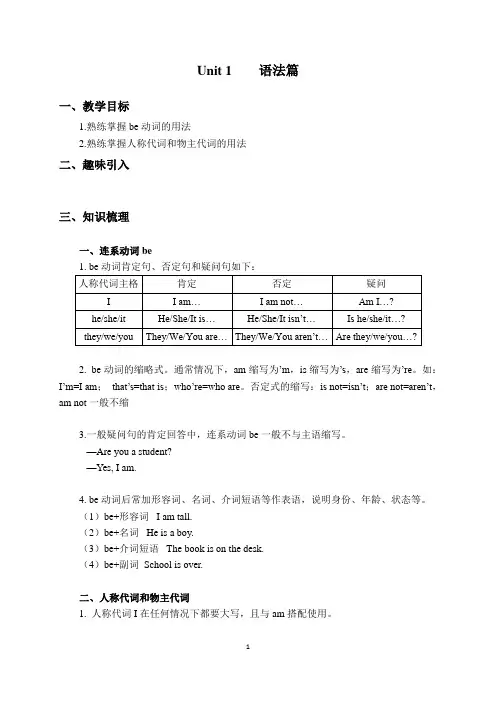
Unit 1 语法篇一、教学目标1.熟练掌握be动词的用法2.熟练掌握人称代词和物主代词的用法二、趣味引入三、知识梳理一、连系动词be1. be动词肯定句、否定句和疑问句如下:2. be动词的缩略式。
通常情况下,am缩写为’m,is缩写为’s,are缩写为’re。
如:I’m=I am;that’s=that is;who’re=who are。
否定式的缩写:is not=isn’t;are not=aren’t,am not一般不缩3.一般疑问句的肯定回答中,连系动词be一般不与主语缩写。
—Are you a student?—Yes, I am.4. be动词后常加形容词、名词、介词短语等作表语,说明身份、年龄、状态等。
(1)be+形容词 I am tall.(2)be+名词 He is a boy.(3)be+介词短语 The book is on the desk.(4)be+副词School is over.二、人称代词和物主代词1. 人称代词I在任何情况下都要大写,且与am搭配使用。
2. 单独使用时,he, she与is搭配使用;you与are搭配使用;I与am搭配使用;而任何两个人称代词并列作主语时,均表达复数意义,与are连用。
3. 单数人称代词并列作主语时,英语中的顺序通常是:第二人称→第三人称→第一人称,即:you and he; you and I; he and I。
4. 在口语中,如果人称代词孤立地用于不带谓语动词的句子中作主语,习惯上用宾格;如果用主格,就要带谓语动词。
—I like playing baseball.—Me, too.5. 人称代词的主格和与之相对应的形容词性物主代词,如下表:6. 形容词性物主代词的用法与形容词用法相似,具有形容词的性质。
作定语修饰名词一般放在被修饰的名词之前,不能单独使用。
如果名词前面还有其他的定语,物主代词要放在其他定语的前面。
例如:my pen我的钢笔;my red pen我的红色钢笔。
最新外研版七年级英语上册词组归纳(1)
外研版七年级上册英语短语归纳Starter Module1 和Module2的重点词汇1.good morning 早上好2.good afternoon 下午好3。
work in pairs 两人一组练习 4.thank you 谢谢5。
see you 再见,回头见 6.stand up 起立,站起来7。
sit down 坐下,请坐Starter Module1 和Module2的重点句子1.What’s your name,please? 请问你叫什么名字?2.Can you spell it, please? 你能把它拼写出来吗?3.How are you? 你好吗?4.This is my friend,Tony。
这位是我的朋友,托尼。
5.Nice to meet you. 很高兴认识你。
6.It’s time to go now。
该走了;现在是时候走了。
7.See you tomorrow。
明天见。
8.Open your book. 打开你的书。
9.Close your book。
合上你的书。
10.Put up your hand。
举起你的手。
11.Are you a new student here? 你是一个新学生吗?12.What class are you in? 你在哪个班?13.I let it go again。
我把它放生了。
14.What’s your telephone number?你的电话号码是多少?15.How old are you? 你多大(几岁)了?Starter Module3和Module4的重点词汇1.in English 用英语,用英语说2.write on 在。
..上写3.write it on 把它写在。
.。
上4.of course 当然,当然可以5.in spring 在春天6。
after school 放学后7.good idea 好主意,好想法8。
七年级英语外研版上册Starter_Module1_Unit1_知识点归纳
Unit1 知识点归纳【单词】1. good adj. 好的I have a good friend. 我有一个好朋友。
【拓展】good的反义词为bad,good的副词形式为well,意为“好地”。
2. morning 早晨,上午Good morning! 早上好!【拓展】in the morning是固定短语,意为“在早上,在上午”。
morning一般指12点以前的这段时间。
3. afternoon 下午Good afternoon! 下午好!【拓展】in the afternoon是固定短语,意为“在下午”。
4. name n.名字,名称例:My English name is Ann. 我的英文名字是安。
拓展:在英语中,姓和名的排列顺序为先名字(first name/given name)后姓氏(last name/family name),这和中国人先姓氏后名字的排列顺序刚好相反。
例:—What’s Bob White’s first name?鲍勃·怀特的名字是什么?—Bob. 鲍勃。
【句型】1. Good morning, Miss Zhou! 早上好,周老师!Good morning常用于较正式的问候语。
在非正式场合,如熟人和家人之间,可以省略good,只用“Morning”。
回答时也常用“Good morning”;在非正式场合,也可用Morning或Hi来回答。
【拓展】:一天的问候Good morning! 上午好!(凌晨至上午12:00)Good afternoon! 下午好!(下午12:0~18:00)Good evening! 晚上好!(黄昏到入睡之前)Good night! 晚安!(晚间告别)2. Hello, class. 同学们好。
hello和“hi”一样,是朋友、熟人之间非正式的问候语。
还可以用来与他人打招呼或引起对方的注意,这时既可用于熟人、朋友之间,也可用于陌生人之间。
外研版七年级上英语重点语法总结与练习组合一 (2)
Starter Module 1 My teacher and my friends主系表结构主系表结构由“主语+系动词+表语”构成,系动词主要是指be动词,其变形am, is, are的基本意思为“是”,用来说明某人的年龄、身份、身体状况等,在英语中起着非常重要的作用。
1.肯定句式为:主语+am/is/are+其他。
am我是一名学生。
(说明主语I的身份)They are my friends.他们是我的朋友。
2.动词be的否定式就是在其后加not,且可以缩写为“isn’t,aren’t”,但是am与not不能缩写。
He is not a teacher. He isn’t a teacher. 他不是一名教师。
You are not Chinese. You aren’t Chinese. 你/你们不是中国人。
3. be动词的一般疑问句式是把be动词提至句首,第一个字母要大写,句末用问号。
This is a map. 这是一张地图。
Is this a map? 这是一张地图吗?They are from Xinjiang. 他们来自新疆。
Are they from Xinjiang? 他们来自新疆吗?语法专练一、用be动词的适当形式填空。
1. I _______ a boy in Class Two.2. Daming ______ my good friend.3. _______ she a student?4. Where ______ you from?We _______ from England.5. How _______ Tony and Betty?They _______ fine.二、句型转换。
1. He is in Class Four. (改为否定句)He ________ in Class Four.2. We are from England. (改为否定句)We ________ from England.3. I am from Beijing. (改为一般疑问句,并作否定回答)_______ ________ from Beijing?_______, I _______ _________.4. Daming is twelve years old. (改为一般疑问句,并作肯定回答)_______ Daming twelve years old?_______, he ______.Starter Module 2 My English lesson祈使句系动词1. 祈使句可用来表示命令、请求和建议等意义的句子。
外研版初中英语七年级上册Module1~10知识点汇总
外研版初中英语七年级上册Module1知识点汇总【重点短语】1. come from 来自be from 来自2. Nice to meet you./It's nice to meet you./Good to see you.很高兴见到你3. welcome sb to somewhere 欢迎某人来到某地4. Class One Grade Seven 七年级一班5. the capital of …...的首都/省会6. family name 姓given name 名last name 姓first name 名【重点句型】1. I’m Chinese, and I’m from China. = I’m Chinese, and I come from China.) 我是中国人, 我来自中国.2. ---Where are they from? =Where do they come from? 他们来自什么哪里? ---They are from America.=They come from America.) 他们来自美国.3. ---How old is that man? 那位男子多少岁了?---He is forty-four. 他44岁.4. The students are in Class Five, Grade Seven. 这些学生在七年级五班.5. Tom is in Class One with Lingling.=Tom with Lingling is in Class One.=Tom and Lingling are in Class One. 汤姆和玲玲在一班.6. What about you?=How about you?=And you? 你呢?/你怎么样?7. Welcome to Class 6 Grade 7! 欢迎来到七年级六班。