
新人教版八年级英语下册知识点归纳
新人教版八年级英语下册知识点归纳Unit 1 What’s the matter?重点短语:have a stomachache have a cold lie downtake one’s temperature have a fever go to a doctorto one’s surprise agree to (do sth.) get into troublebe used to take risks run out (of)cut off get out of be in control ofkeep on ( doing sth.)give up语言知识归纳:1. Wh at’s the matter (with you)?此句用来询问别人的病情。
类似的句子还有:What’s wrong with you?/ What’s the trouble?matter作动词用,意为“要紧”“有关系”,主要用于疑问句和否定句。
What does it matter? It doesn’t matter.【例题】Does it ________ if we can’t finish it today?A. mindB. mindsC. matterD. matters2. I have a sore throat.have “患病”,常用“have a /an+ 名词”.have a cold have a fever have a sore backhave a stomachache have a cough【例题】( )---Does he often have ______ cold? ---Yes. He also _____a cough and a sore throat.A. a; hasB. /; hasC. a; haveD. /; have3.Lie down and rest! 躺下休息lie down 躺下4.That’s probably why. 那可能就是原因。
probably意为“很可能,大概”,表示的可能性很大,是一种近乎肯定的意思。
5.hurt v.使受伤;伤害;疼痛He hurt his leg when he fell. 他摔伤的时候伤了腿。
My feelings were hurt when he didn’t ask me to the party.他没有请我参加聚会使我很伤心。
6.The bus driver, 24-year-old Wang Ping...公交车司机,24岁的王平……24-year-old 是用连字符连接数字和名词所构成的一个形容词结构,意思是“24岁的”。
(名词必须用单数,常用在名词前做定语)【例题】A____girl named DongXinyi looked after her disabled father.A. three-year-oldB. three-years-oldC. Three years old7.expect vt. 期待;预期;期盼【辨析】expect与look forward to两者都有期待的意思look forward to doing sth.I’m looking forward to seeing Tom.8.But to his surprise...但是令他吃惊的是……to one’s surprise 表示“令人惊奇的是……”,相当于“主语+be+surprised”To his surprise, he found the girl was bind.= He was surprised to find the girl was blind. 令他惊奇的是,他发现这个女孩是个盲人。
【拓展】in surprise表示“惊奇的”,相当于副词性短语,用来修饰动词。
The two girls looked at each other in surprise. 那两个女孩惊奇地互相看着。
be surprised at表示“对……感到惊讶”。
We are very surprised at the news. 听到这个消息,我们很诧异。
surprising 表示“使人惊奇的”,作表语时,主语是事物。
9.They don’t want any trouble. 他们不想惹麻烦。
① trouble用作名词,意为“烦恼,困难,麻烦,疾病等”。
His life is full of trouble. 他的生活充满了烦恼。
What’s the trouble? 怎么了?② trouble用作动词,意为“麻烦,打扰”。
I’m sor ry to trouble you. 抱歉打扰你。
【拓展】与trouble相关的短语in trouble处于困境中get into trouble陷入困境Have trouble (in) doing sth. 做某事有困难【例题】-How is your English study? -Not bad. But I_____learning English grammar.A. am interestedB. am good atC. have a little troubleD. have no trouble10.辨析used to do sth. 与be used to sth. / doing sth.↓ ↓过去常常…… 习惯于某事/做某事We used to draw pictures badly.You will get used to the weather here.In the end, I got used to doing hard work.11.辨析run out 与run out of人+ run out of They have run out of the water.物+ run out (不可用于被动语态)The money is running out.【例题】选出能代替句中画线部分的一项( ) Yesterday I used up all the salt to cook dumplings. I need to buy some now.A. ate upB. run out ofC. ran ofD. ran out of12.make decisions = make a decision 作出决定decision为decide的名词形式make a decision to do sth. = decide to do sth.13.be in control of 管理;控制A teacher should be in control of his class.重点语法:情态动词should的用法(1)should后接动词原形,变否定句在should后加not, 变一般疑问句时将should提前。
(2)should常用于以下两种情况:①提出建议You looked tired. You should lie down and rest.②表推测,意为“该,按理应当”。
Wait a minute. I think he should come in a minute.Unit 2 I’ll help to clean up the city parks.重点短语:clean up by oneself cheer upput off give out put onused to give away take afterset up make a difference care for come up with语言知识归纳:1. give out 分发,发放【拓展】give构成的短语还有:give away 赠给,赠送give in 屈服,投降give up 放弃give off 发出(气味、光、热等)e up with 提出,想出(1)表示“想出或提出”,相当于think ofI think she can come up with a good idea(2)come up with还可表示“赶上”,相当于catch up with.We should study hard to come up with them【例题】( ) We must _____a plan to improve your math.A. pick upB. catch up withC. come up withD. make up3. I’v run out of it. 我已经把它用完了。
run out of 表示“用完,用光”,其主语一般是人。
【拓展】run out of 还可表示“从……跑出来”。
Bill ran out of the room. Bill从房间里跑出来。
run构成的短语还有run away 逃走run after追赶run into difficulties遇到困难【例题】( ) When your money____, please come to me for some.A. runs out ofB. runs outC. is running out ofD. is run out4.I take after my mother.我长得像我妈妈。
【辨析】take after 与look liketake after意为“长得像,行为、性格等像”,尤其是像自己的长辈。
The boy takes after his father. 这个男孩长得像他爸爸。
look like 可以用于所有场合,既可指人也可指物,仅指外表看上去像。
The man looks like our teacher. 这个男的看起来像我们的老师。
The rainbow looks like a bridge. 彩虹看上去像一座桥。
【拓展】take 构成的短语take up take off take placetake one’s time take care【例题】( ) -You’ve really beautiful blond hair. -Thank you. I ____my mother.A. look afterB. take afterC. take fromD. look for5.set up 创办,建立set up 为副词短语,与start, establish同义They’ve set up a company. 他们创办了一家公司。
与set 相关的短语还有:set out 动身,开始(做某事)set off 出发,引起,激发6.You helped to make it possible for me to have lucky. 对我来说,有了你的帮助,我才有可能拥有Lucky.it是形式宾语You made it possible for me to catch up with others. 你让我有可能赶上其他人。
初二英语下册知识点归纳人教版
初二英语下册知识点归纳人教版一、Unit 1 What's the matter?1. 重点短语。
- have a cold 感冒。
- have a stomachache 胃痛;腹痛。
- have a sore back 背痛。
- lie down 躺下。
- take one's temperature 量体温。
- have a fever 发烧。
- take breaks (take a break) 休息。
- get off 下车。
- to one's surprise 使……惊讶的是;出乎……意料。
- right away 立即;马上。
- get into 陷入;参与。
- be used to 习惯于……;适应于……- take risks (take a risk) 冒险。
- run out (of) 用尽;耗尽。
- cut off 切除。
- get out of 离开;从……出来。
- be in control of 掌管;管理。
2. 重点句型。
- What's the matter? = What's wrong? = What's the trouble? 怎么了?- Should I put some medicine on it? 我应该在它(伤口)上敷些药吗?- You should lie down and rest. 你应该躺下休息。
- He hurt himself in P.E. class. 他在体育课上伤到了自己。
- Aron Ralston is an American man who is interested in mountain climbing. 阿伦·罗尔斯顿是一个对登山感兴趣的美国人。
3. 语法。
- 情态动词should的用法:should表示“应该”,用来提出建议或劝告,后接动词原形。
例如:You should see a dentist. 否定形式为shouldn't,例如:You shouldn't go to school late.二、Unit 2 I'll help to clean up the city parks.1. 重点短语。
新人教版|八年级下册英语所有知识点大汇总
新人教版|八年级下册英语所有知识点大汇总!Unit1 what' s the matter?1. It’s +形容词+ for sb. + to do sth. 做某事对某人来说是…的。
It’s important to do sth. 做某事很重要。
It’s important for me to eat a balanced diet. 平衡饮食对我来说是很重要的.It’s easy to do sth. 做某事是容易的。
It’s easy for us to find out the answer. 找出答案对我们来说是容易的。
2. 情态动词should的用法should是情态动词,它的基本用法是必须和其他动词一起构成谓语。
意为"应该......"。
should(应当,应该)用于所有人称,表示劝告或建议。
eg. ---I have a very bad cold. 我感冒很厉害。
---You should lie down and have a rest. 你应该躺下,多喝水。
3. maybe与may be(1)maybe是副词,译为“也许、可能”,相当于“perhaps”。
如:Maybe he can answer the question. 也许他能回答那个问题。
He maybe is from the USA, too. 他可能也来自美国。
(2)may be中的may为情态动词,译为“可能是......”。
如:He may be from the USA, too. 他可能也来自美国。
She may be our English teacher. 她可能是我们的英语老师。
4. few、a few、little、a little的区别和联系:(1)few / a few用来修饰可数名词,few表示否定意义,没有,几乎没有;a few表示肯定意义,有几个。
例如:He has few friends here, he feels lonely. 他这里没朋友,他感觉寂寞。
人教版英语八年级下册所有短语 归纳
八年级下册英语基础知识归纳(一)Unit 1 What’s the matter?【短语归纳】1. 太多too much2. 躺下lie down3.量体温take one’s temperature4. 看牙医see a dentist5.做个X光检查get an X-ray6. 在……上敷药put some medicine on…7. 发烧have a fever 8.整个周末all weekend9.玩电脑游戏play computer games10. 下车get off11. 看医生go to a doctor 12. 送某人去医院take sb. to the hospital13.到达get to 14.立刻; 马上right away 15.休息take breaks/take a break16. 等待wait for 17.多亏;由于thanks to18.没多想without thinking twice19. 及时in time 20. 考虑think about21. 使…….惊讶的to one’s surprise…22. 摔倒fall down 23. 踢足球play soccer 24. 患有心脏病have a heart problem25. 几个;少数a few 26. 造成麻烦get into trouble 27. 做正确的事do the right things28. 进来come in 29. 对…感兴趣be interested in 30. 被打击/晒伤get hit/sunburned31. 习惯于be used to 32. 冒险take risks/ take a risk 33. 把……放在某物上put… on sth.34. 因为because of 35. 失去生命lose one’s life 36. 用完; 耗尽run out (of)37. 切除cut off 38. 离开;从……出来get out of 39. 做决定make a decision/decisions40. 放弃give up 41. 掌管; 管理be in control of 42. 去爬山go mountain climbing【用法集萃】1. 需要去做某事need to do sth.2. 看见某人正在做某事see sb. doing sth.3. 询问某人某事ask sb. sth.4. 期望某人做某事expect sb. to do sth.5. 同意做某事agree to do. sth.6. 帮助某人做某事help sb. (to) do sth.7. 想要做某事want to do sth.8. 告诉某人去做某事tell sb. to do sth.9. 做某事有困难have problems (in) doing sth.10.习惯于做某事be/get used to doing sth.11. 用某物去做某事use sth. to do sth.12. 好像做某事seem to do sth.13. 继续做某事keep on doing sth.14. 介意做某事mind doing sth.Unit 2 I’ll help to clean up the city parks.【短语归纳】1. 分发give out2. 打扫(或清除)干净clean up3. (使)变得更高兴;振奋起来cheer up4.建起;设立set up5. 赠送;捐赠give away6. 曾经……; 过去…… used to7. 推迟put off 8. 想出come up with 9. 影响; 有作用make a difference10. 张贴put up 11. 打电话给call up 12. 帮助…….摆脱困难help out13. 实现come true 14. 照顾; 照看care for 15. 参加选拔try out for16. 修理fix up 17. 用光run out of 18. 与……相像take after19. 与……相似be similar to【用法集萃】1. 制订计划做某事make plans to do sth.2. 要求某人(不要)做某事ask sb. (not) to do sth.3. 过去常常做某事used to do sth.4. 决定做某事decide to do sth.5. 有……感觉get a feeling of…6. 对……产生影响make a difference to7. 自愿花时间某事volunteer one’s time to do sth. 8. 放弃时间去做某事give up +时间+ to do sth. 9使得做某事对某人来说是可能的make it possible for sb. to do sth.Unit 3 Could you please clean your room?【短语归纳】1. 洗餐具do the dishes2. 扫地sweep the floor3. 倒垃圾take out the rubbish4. 整理床铺make the bed5. 叠衣服fold the clothes6. 打扫起居室clean the living room5. 搭车get a ride6. 去看电影go to the movies7. 出去吃晚饭go out for dinner8. 至少at least 9. 在外待得晚stay out late 10.帮助做完某事help out (with sth.)11. 扔下throw down 12. 随时any minute now 13.一直;频繁;反复all the time14. 过来come over 15. 一……就…… as soon as 16. 带狗去遛遛take the dog for a walk17.惊讶地in surprise 18. 和……一样as… as 19. 在….上花费(时间或金钱)spend… on20. 为了in order to 21. 依赖; 信赖depend on 22. 向某人提供某物provide sth. for sb.23. 照顾;照看look after 24. 照顾take care of 25. 结果as a result26. 进入get into 27. 保持它干净、整洁keep it clean and tidy【用法集萃】1. 做完某事finishing doing sth.2. 想要某人做某事want sb. to do sth.3. 尽力(不)做某事try (not) to do sth.4. 让某人做某事let sb. do sth.5. 介意做某事mind doing sth.6. 花费……做某事spend… in doing sth.7. 学会做某事learn to do sth. 8. 学会怎样做某事learn how to do sth.9. 越……., 就越……. the + 比较级, the + 比较级Unit 4 Why don’t you talk to your parents?【短语归纳】1. 太多(不可数n.) too much2. 太多(可数名词n.) too many3. 得到充足睡眠get enough sleep4. 闲逛hang out with sb.5. 争吵get into a fight6. 早点儿去睡go to sleep earlier7. 谈论talk about sth. 8. 擅长be good at (doing) sth. 9. 给某人打电话call sb. up10. 归还give back 11. 在电话中on the phone 12. 浏览; 翻阅; 仔细检查look through13. 没问题no problem 14. 重要的事情a big deal 15. 生某人的气be angry with sb.16. 解决; 算出work out 17. 感到孤独feel lonely 18. 与某人和睦相处get on with sb.19. 下次next time 20. 今后;从今以后in future 21. 与某人交流communicate with sb.22. 交朋友make friends 23. 害怕……. be afraid of 24. 在……的前面in front of25. 做运动do sports 26. 不再…….not… any more 27. 与某人竞争compete with sb.28. 那么多so much/many 29. 上课have lessons 30. 去购物go shopping31. 删除; 删去cut out 32. 各种各样的all kinds of 33. 比较; 对比compare… with…34. 几个; 少数a few 35. 同意某人agree with sb. 36. 依………看in one’s opinion37. 调小turn down 38. 一些安静的事something quiet【用法集萃】1. 允许某人做某事allow sb. to do sth.2. 你什么不做某事呢? Why don’t you do sth.?3. 发现某人在做某事find sb. doing sth.4. 拒绝做某事refuse to do sth.5. 让某人做某事let sb. do sth.6. 主动提出做某事offer to do sth.7. 介意某人做某事mind sb. doing sth. 8. 直到…….才…….. not… until….9. 该做某事了。
最新人教版八年级英语下册第一单元知识点汇总
最新人教版八年级英语下册第一单元知识点汇总Unit 1 What’s the matter?一、基础知识1.我感冒了。
可以表达为I had a cold、catch a cold或have the flu。
have a fever表示发烧,have a cough表示咳嗽,have a stomachache或肚子疼表示胃疼,have a toothache表示牙疼,have a headache表示头疼。
2.将身体部位和ache(疼痛)结合起来构成新的复合词,如stomach+ache=stomachache,head+ache=headache,tooth+ache=toothache,back+ache=backache,表示相应的疼痛。
3.“怎么啦?出什么事情了?”可以表达为What’ s the matter。
也可以用What’ s the trouble with you?或What’ s wrong with you。
matter和trouble为名词,其前可加the或形容词性物主代词,而wrong是形容词不能加the。
用于询问某人有什么病或遇到什么麻烦、问题,其后跟询问对象时,与介词with连用,如What’s the matter with sb。
= What’s your trouble?= What’s up?= What happens to sb。
举例来说,当问到“What’s the matter with you?”时,回答可以是“I have a bad cold.”4.maybe表示“或许”,常用于句首,表示可能性,后加句子。
例如Maybe you are right。
may be是情态动词+be的结构,意为“可能,也许”,后加名词、代词或形容词。
例如He maybe angry。
sound like可以和名词、代词以及从句结合使用,如It sounds like you don’t know the truth.It sounds like a good idea。
(完整版)最新人教版八年级下册英语全册知识点大全

最新人教版八年级下册英语全册知识点大全Unit 1重点短语:have a stomachache have a cold lie downtake one’s temperature have a fever go to a doctorto one’s surprise agree to (do sth.)get into troublebe used to take risks run out (of)cut off get out of be in control ofkeep on ( doing sth.)give up语言知识归纳:1. What’s the matter (w ith you)?此句用来询问别人的病情。
类似的句子还有:What’s wrong with you?/ What’s the trouble?matter作动词用,意为“要紧”“有关系”,主要用于疑问句和否定句。
What does it matter? It doesn’t matter.【例题】Does it ________ if we can’t finish it today?A. mindB. mindsC. matterD. matters2. I have a sore throat.have “患病”,常用“have a /an+ 名词”.have a cold have a fever have a sore backhave a stomachache have a cough【例题】( )---Does he often have ______ cold? ---Yes. He also _____a cough and a sore throat.A. a; hasB. /; hasC. a; haveD. /; have3.Lie down and rest! 躺下休息lie down 躺下4.That’s probably why. 那可能就是原因。
人教版八年级英语下册各单元知识点总结完整版
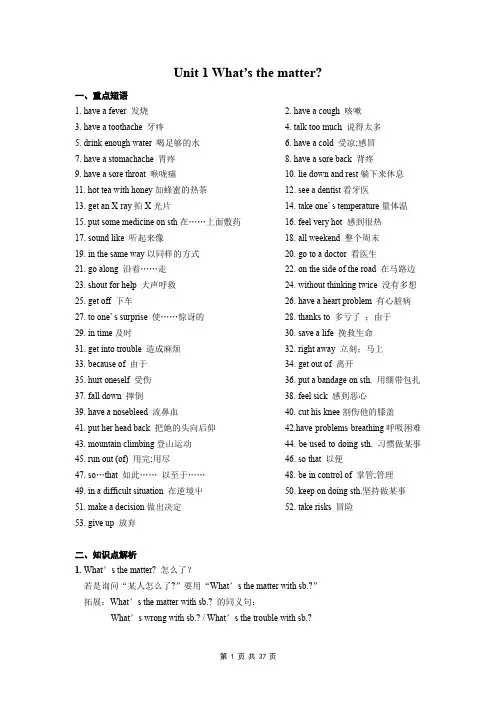
Unit 1 What’s the matter?一、重点短语1. have a fever 发烧2. have a cough 咳嗽3. have a toothache 牙疼4. talk too much 说得太多5. drink enough water 喝足够的水6. have a cold 受凉;感冒7. have a stomachache 胃疼8. have a sore back 背疼9. have a sore throat 喉咙痛10. lie down and rest躺下来休息11. hot tea with honey加蜂蜜的热茶12. see a dentist看牙医13. get an X-ray拍X光片14. take one’ s temperature量体温15. put some medicine on sth在……上面敷药16. feel very hot 感到很热17. sound like 听起来像18. all weekend 整个周末19. in the same way以同样的方式20. go to a doctor 看医生21. go along 沿着……走22. on the side of the road 在马路边23. shout for help 大声呼救24. without thinking twice 没有多想25. get off 下车26. have a heart problem 有心脏病27. to one’ s surprise 使……惊讶的28. thanks to 多亏了;由于29. in time及时30. save a life 挽救生命31. get into trouble 造成麻烦32. right away 立刻;马上33. because of 由于34. get out of 离开35. hurt oneself 受伤36. put a bandage on sth. 用绷带包扎37. fall down 摔倒38. feel sick 感到恶心39. have a nosebleed 流鼻血40. cut his knee割伤他的膝盖41. put her head back 把她的头向后仰42.have problems breathing呼吸困难43. mountain climbing登山运动44. be used to doing sth. 习惯做某事45. run out (of) 用完;用尽46. so that 以便47. so…that 如此……以至于……48. be in control of 掌管;管理49. in a difficult situation 在逆境屮50. keep on doing sth.坚持做某事51. make a decision做出决定52. take risks 冒险53. give up 放弃二、知识点解析1. What’s the matter? 怎么了?若是询问“某人怎么了?”要用“What’s the matter with sb.?”拓展:What’s the matter with sb.? 的同义句:What’s wrong with sb.? / What’s the trouble with sb.?2.疾病类短语:have a +疾病. e.g. :have a fever 发烧have a cold 感冒have a cough 咳嗽.have a +身体部位-ache. e.g.: have a headache 头痛have a toothache 牙痛.have a sore+身体部位. e.g.: have a sore throat咽喉痛have a sore back背痛例题:Mom, I____________.I’m sorry to hear that, dear. We must go to see the dentist right away.A. have a headacheB. have a stomachacheC. have a toothacheD. have a fever3. lie down 躺下V. 躺,平躺。
人教版八年级下册英语——知识点语法归纳总结
人教版八年级下册英语——知识点语法归纳总结Unit 1 What’s the matter?1. 短语归纳①have a cold/ fever/ stomachache…感冒、发烧、胃疼……②lie down 躺下③too much 太多④get an X-ray 拍片⑤take one’s temperature量体温⑥sound like 听起来像……⑦take breaks (take a break) 休息⑧go to a doctor 看医生⑨get off 下车⑩on the side of…在……边上have a heart problem 患心脏病wait for 等待to one’s surprise 使……惊讶的;出乎意料? thanks to 多亏;由于in time 及时think about 考虑,认为right away 立刻,马上get into trouble 陷入麻烦fall down 摔倒a few 几个,一些21 have problems breathing 呼吸困难22 get sunburned 晒伤23 look up 查阅24 be interested in…对……感兴趣25 be used to doing…习惯于做某事26 take risks (take a risk) 冒险27 lose one’s life 丧生28 became of 因为29 run out (of) 用尽,耗尽30 be ready to do sth. 准备做某事31 cut off 切除32 climb down 爬下33 get out of 离开;从……出来34 tell of 讲述35 the importance of (doing sth.) (做某事的)重要性36 be in control of 掌管,管理37 make a decision 做决定38 keep on doing sth. 坚持做某事39 give up 放弃40 cut/ hurt oneself 使自己受伤2. 典句必背①What’s the matter?②I have a stomachache.③What should I do?④Should I take my temperature?⑤I think you should lie down and rest.⑥If your head and neck still hurt tomorrow, then go to a doctor.⑦His love for mountain climbing is so great that he kept on climbing mountains even after this experience.3. 用法集萃(1) 当别人心情不好,身体不适或遇到麻烦时,我们可以用如下表达表示关心:What’s the matter?What’s the matter with you?What’s wrong with …?What’s the trouble\problem with …?(2) 英语中常用have描述身体的不适,此时have意为“患有”,常用结构:①have a + 疾病例:have a cold 感冒;have a fever 发烧;have a cough 咳嗽②have a + 身体部位-ache例:have a headache 头痛;have a toothache 牙痛③have a sore + 身体部位例:have a sore throat 咽喉痛;have a sore back 背痛(3) lie down躺下;tell lies/a lie 说谎含义过去式过去分词躺;平躺lay lain位于撒谎;说谎lied lied(4) maybe & may be①maybe,“或许”,常用于句首,表示可能性,后加句子。
新人教版|八年级下册英语所有语法全汇总
新人教版|八年级下册所有语法全汇总一. 询问某人的健康问题及遭到麻烦的表达方法1. 询问某人患了何种疾病或遇到了何种麻烦时,常用以下几种结构来表达:What’s the matter with sb.某人怎么了What’s wrong with sb.某人怎么了What’s the trouble with sb 某人出什么事了What happened to sb 某人发生了什么事Are you OK 你没事吧Is there anything wrong with sb.某人有不舒服/麻烦吗2. 要表达身体疼痛或不舒服,可用以下结构:①某人+have/has+病症The twins have colds.双胞胎感冒了;②某人+have/has+a+headache/toothache/stomachache/backache/earache. She had a stomachache last night. 她昨晚肚子痛;③某人+have/has+a+sore+发病部位He has a sore throat. 他喉咙痛;④某人+hurts+身体部位或反身代词He hurt his leg. 他的腿受伤了;⑤某部位+hurts.My head hurts badly. 我头痛得厉害;⑥某人+have/has+a pain+in one’s+身体部位I have a pain in my chest. 我胸口痛;⑦There is something wrong with one’s+身体部位There is something wrong with my right eye. 我的右眼有毛病;⑧其他表达方式She has a heart trouble. 她有心脏病;He got hit on the head. 他头部受到了撞击;She cut her finger. 她割破手指了;二. 情态动词should的用法1. should为情态动词,意为“应该;应当”,否定式为shouldn’t,其后接动词原形,无人称和数的变化;常用来表示征询意见、建议、劝告、要求或义务等;You should drink more water. 你应该多喝水;He should put his head back. 他应该把头后仰;We should try our best to help him. 我们应当尽力去帮助他; You shouldn‘t watch TV. 你不应该看电视;2. should用于主语为第一人称的疑问句,表示征询意见;Should I put some medicine on it 我应当给它敷上药吗Should we tell her about it 我们应该告诉她这件事吗3. 在英语中,表示建议的说法有很多,而且都是中考考查的重点;主要结构有:①Would you like to do sth你想要/愿意做某事吗Would you like to play basketball with me 你想要和我一起打篮球吗②Shall I/we do sth 我/我们做某事好吗Shall we go to the zoo tomorrow 明天我们去动物园,好吗③Why not do sth 为什么不......呢Why not join us为什么不加入到我们当中来呢④How/What about doing sth 做某事怎么样How about going swimming 去游泳怎么样⑤Let’s do sth. 让我们做......吧;Let’s go home. 咱们回家吧;⑥You’d better not do sth 你最好不要做某事;You’d better not go there alone. 你最好不要一个人去那儿;三. 反身代词英语中共有八个反身代词,在使用时应注意和它所指的相应的对象在人称、性别和数上保持一致;第一人称第二人称第三人称单数 myself yourself himself/herself/itself复数 ourselves yourselves themselves反身代词的用法1. 可用作宾语,指的是宾语和主语表示同一个或同一些人或事物;如:Maria bought herself a scarf.We must look after ourselves very well.2. 可用作表语,指的是表语和主语表示同一个或同一些人或事物;如: She isn’t quite herself today.3. 可用作主语或宾语的同位语,常用来加强语气;如:She herself will fly to London tomorrow.I met the writer himself last week.4. 用在某些固定短语当中;如:look after oneself / take care of oneself 照顾自己teach oneself sth./learn sth. by oneself 自学enjoy oneself 玩得高兴,过得愉快help oneself to sth 请自用……随便吃/喝些……hurt oneself 弄伤自己say to oneself 自言自语leave sb. by oneself 把某人单独留下注意反身代词不能单独做主语,但可以做主语的同位语,起强调作用;如:我自己能完成作业;误Myself can finish my homework.正I myself can finish my homework. / I can finish my homework myself.四. 一般将来时一般将来时表示将来某个时间要发生的动作或状态,或将来经常发生的动作或状态;一般将来时的基本结构1. will+动词原形否定式:will not=won't一般疑问式:will/shall+主语+动词原形+其他特殊疑问式:特殊疑问词+一般疑问式—Will he help you with your English tonight今天晚上他会帮助你学习英语吗—Yes, he will./No, he won't.是的,他会;/不,他不会;—When will you arrive for America你什么时候去美国—Tomorrow.明天;2. am/is/are going to +动词原形否定式:am/is/are not going to +动词原形一般疑问式:am/is/are +主语+ going to + 动词原形+其他特殊疑问式:特殊疑问词+一般疑问式Look at the dark clouds. There is going to be a storm.看那乌云,快要下雨了;Is he going to collect any data for us他会帮我们收集数据吗What are you going to do tomorrow明天你打算作什么3. will+动词原形与am/is/are going to +动词原形的用法区别will+动词原形与am/is/are going to +动词原形的用法虽然都表示将来发生动作或情况,一般情况下能互换;但它们的用法是有区别的;will主要用于在以下三个方面:1表示主观意愿的将来;They will go to visit the factory tomorrow.明天他们将去厂参观工厂;2表示不以人的意志为转移的客观的将来;He will be thirty years old this time next year.明年这个时候他就将三十岁;3表示临时决定,通常用于对话中;—Mary has been ill for a week.玛丽病了一周了;—Oh, I didn't know. I will go and see her.噢,我不知道;我去看看她;be going to主要用于以下两个方面:1表示事先经过考虑、安排好打算、计划要做某事;Dad and I are going to watch an opera this afternoon.今天下午我和爸爸打算去看歌剧;2表示根据目前某种迹象判断,某事非常有可能发生,表示推测;Look There come the dark clouds. It is going to rain.瞧乌云密集;天要下雨了;五. 动词不定式to do的用法1. 作主语为避免句子的头重脚轻,常用it作为形式主语,而真正的主语动词不定式后置; 常用句型:It +be+adj./n.+for/of sb. to do sth./It takes sb. some time to do sth.2. 作宾语动词want, decide, hope, ask, agree, choose, learn, plan, need, teach, prepare常接动词不定式作宾语;3. 作后置定语常用于“have/has+sth.+to do”或“Its time to do sth.”等结构中;4. 作宾语补足语tell, ask, want, invite, teach, like, call等可接带to的动词不定式作宾语补足语,构成tell/ask/want /call/invite sb. to do sth.结构;注意动词不定式作使役动词和感官动词的宾语补足语时应省去to:“一感feel,二听listen to, hear,三让let, make, have,四看look at, see, watch, notice,半帮助help”;5. 动词不定式作状语主要用来修饰动词,表示目的,结果或原因;为了强调目的,有时可以把动词不定式放在句首,或在不定式前加in order to 或so as to “为了,目的是”;六. Could you please...句型1. 请求别人时通常用此句型,也可以说Can you...please情态动词could或can 在这里均表示请求,在意思上无区别,但是用could在于其显得更委婉、客气、诚恳;在日常生活中常使用could you/I...若在句末加上please,则显得更礼貌; Could you help me find my book, please你能帮我找到我的书吗2. 对could you/I...的问句作出肯定回答,常用“sure/certainly/of course”等;如果作否定回答,常用“sorry或oh, please don’t”; 一般不用no开头,用no显得语气生硬、不礼貌;3. 表示请求的其他句式Would you like to do...Would you mind doing...Let’s do....Please do...祈使句前加please七. 过去进行时1. 基本概念:过去进行时表示在过去某一时刻或一段时间内正在进行的动作;这一特定的过去时间除有上下文暗示以外, 一般用时间状语来表示;常用的时间状语this morning, the whole morning, all day yesterday, from nine to ten last evening, when, while等;We were watching TV from seven to nine last night.昨天晚上七点到九点的时候我们在看电视;It was raining when they left the station.他们离开车站的时候天正在下雨;2. 基本结构 was / were not + 动词-ing3. 一般过去时与过去进行时用法的比较一般过去时表示在过去某个时间发生过的动作或存在的状态, 而过去进行时则表示在过去某一时刻或某一段时间正在进行的动作;David wrote a letter to his friend last night. 大卫昨晚给他的朋友写了封信;信写完了;David was writing a letter to his friend last night. 大卫昨晚一直在给他的朋友写信;信不一定写完;八. 状语从句1. unless引导条件状语从句unless = if...not... 除非,若不They will go tomorrow unless it rains.= They will go tomorrow if it doesn’t rains.2. as soon as引导时间状语从句,意为“一...就...”;He will come and see you as soon as he can.3. so...that...引导结果状语从句句型1:主语+谓语+so+形容词/副词+that从句The wind was so strong that we could hardly move forward. 句型2: so +形容词 + a/an + 单数名词 + that从句It was so hot a day that they all went swimming.句型3. so + many/ few + 复数名词 + that从句He has so few friends that he often feels lonely.句型4: so +much/ little + 不可数名词 + that 从句I had so little money that I couldn’t buy a pen.九. 形容词/副词的比较等级形容词和副词有三个比较等级,即原级也就是原形、比较级表示“较……”或“更……”的意思,用于两者之间比较和最高级表示“最……”的意思,用于三者或三者以上的比较;1. 形容词/副词的比较级和最高级的规则变化1单音节词和少数以-er,-ow结尾的双音节单词,比较级在后面加-er,最高级在后面加-est;①单音节单词small→smaller→smallestshort→shorter→shortesttall→taller→tallestgreat→greater→greatest②少数以-er,-ow结尾的双音节单词clever→cleverer→cleverestnarrow→narrower→narrowest2以不发音e结尾的单音节单词,比较级在原形后加-r,最高级在原级后加-st; large→larger→largestnice→nicer→nicestable→abler→ablest3以一个辅音字母结尾的闭音节即:辅音+元音+辅音单词中,先双写末尾的辅音字母,比较级加-er,最高级加-est;big→bigger→biggesthot→hotter→hottestfat→fatter→fattest4以“辅音字母+y”结尾的双音节词, 把y改为i,比较级加-er,最高级加-est; easy→easier→easiestheavy→heavier→heaviestbusy→busier→busiesthappy→happier→happiest5其他双音节词和多音节词,比较级在前面加more,最高级在前面加most; beautiful→more beautiful→most beautifuldifferent→more different→most differenteasily→more easily→most easily2. 形容词/副词的比较级和最高级的不规则变化good→better→bestwell→better→bestbad→worse→worstill→worse→worstold→older/elder→oldest/eldestmany/much→more→mostlittle→less→leastfar →further/farther→ furthest/farthest3. 原级常用句型1A is as+原级+ as+ B 表示A与B一样...eg. He is as tall as me.2A is not as/so +原级+ as B 表示A不如B...eg. He is not as tall as me.3只能修饰原级的词,very,quite,so,too,so,enough,pretty等 ; eg. He is too tired to walk on.他太累了以至于不能再继续走了;4. 比较级常用句型1当句中有than时则用比较级;eg. He is fatter than me.2“特殊疑问词+be+形容词比较级,A or B ”eg. Which is bigger,the earth or the moon哪一个更大,地球还是月球3“比较级+and+比较级”表示“越来越...”;eg. The flowers are more and more beautiful.花儿越来越漂亮;English is more and more important. 英语越来越重要了;4“the+比较级,the+比较级”表示“越...,越...”;eg. The more careful you are,the fewer mistakes you’ll make.5可以修饰比较级的词:much,a lot,far,a little,a bit,even,still等;eg. Lesson One is much easier than Lesson Two. 第一课比第二课容易得多;5. 最高级常用句型1.“主语+be+the+形容词最高级+单数名词+in/of...”表示“……是……中最……的”;Tom is the tallest in his class/of all the students.汤姆是他们班上/所有学生当中最高的;2.“主语+实意动词+the+副词最高级+in/of...”表示“……是……中最……的”;I jump the farthest in my class.我是我们班跳得最远的;3.“主语+be+one of the+形容词最高级+复数名词+in/of...”表示“……是……中最……之一”;Beijing is one of the largest cities in China.北京是中国最大城市之一;4.“特殊疑问词+be+the+最高级,甲,乙,or丙”用于三者或三者以上的比较; Which country is the largest,China,Brazil or Canada哪个国家最大,中国,巴西还是加拿大5.“特殊疑问词+助动词+主语+the+副词最高级+甲,乙,or丙”用于三者或三者以上的比较;Which season do you like the best,spring,summer or autumn你最喜欢哪一个季节,春天,夏天还是秋天注意:副词最高级用在句中时,其前可以加the,也可以不加;但形容词最高级用在句中时,其前一般都要加the;十. 现在完成时一. 现在完成时基本结构①肯定句:主语+have/has+动词的过去分词②否定句:主语+have/has+not+动词的过去分词③一般疑问句:Have/Has+主语+动词的过去分词④特殊疑问句:特殊疑问词+一般疑问句have/has+主语+过去分词二. 现在完成时用法1. 现在完成时用来表示过去已经完成的动作对现在造成影响或后果;也就是说,动作或状态发生在过去但它的影响现在还存在,强调的是现在;I have already posted the photo.我已经邮寄出了照片;与此种用法连用的时间状语时一些模糊的过去时间状语,如already肯定句, yet 否定句/疑问句, just, before, recently,still, lately,never等;2. 现在完成时也可用来表示动作或状态发生在过去某一时刻,持续到现在并且有可能会继续持续下去;He has lived here since 1978.自从1978年以来,他一直住在这儿;动作起始于1978年,一直住到现在,可能还要继续住下去;此种用法常与for+时间段,since+时间点或过去时的句子连用;谓语动词必须是延续性动词;有些瞬间动词可变为延续动词:go out----be outfinish----be overopen----be opendie----be deadbuy---havefall ill---be illcome back----be backcatch a cold----have a cold。
人教版八年级英语下册各知识点归纳总结
千里之行,始于足下。
人教版八年级英语下册各知识点归纳总结
人教版八年级英语下册的各知识点归纳总结如下:
1. 职业和家庭:学习如何描述职业、谈论家庭成员和家庭活动,如询问职业、描述人物、说明工作地点等。
2. 爱好和兴趣:学习如何描述爱好和兴趣,如谈论体育运动、音乐、电影、读书等。
3. 交通和旅行:学习如何描述交通工具、问路和旅行方面的话题,如描述公共交通工具、询问路线、购买车票等。
4. 环保与保护:学习如何描述环保和保护环境的行为,如讨论环境问题、讨论减少污染的方法、倡导保护野生动植物等。
5. 书信和便条:学习如何写书信和便条,如写自我介绍信、道歉信、邀请信等。
6. 教育和学习:学习如何描述学校和学习,如谈论学校设施、描述学习方法、讨论学业压力等。
7. 健康和饮食:学习如何描述健康和饮食,如谈论健康习惯、讨论饮食结构、询问健康问题等。
8. 动物和自然:学习如何描述动物和自然景观,如描述动物的特征、描述自然场景、讨论保护动物和自然的重要性等。
第1页/共2页
锲而不舍,金石可镂。
9. 文化和传统:学习如何描述文化和传统活动,如讨论节日、描述传统习俗、谈论文化差异等。
10. 社会问题和解决方案:学习如何描述社会问题和提出解决方案,如谈论青少年问题、讨论解决社会问题的方法等。
以上是人教版八年级英语下册的各知识点的归纳总结,供您参考。
人教版八年级下册英语必考知识点梳理(期末复习必备)
人教版八年级下册英语必考知识点梳理(期末复习必备)八年级下册英语知识点Unit 1 What’s the matter?【重点短语】1.have a fever 发烧2.have a cough 咳嗽3.have a toothache 牙疼4.talk too much 说得太多5.drink enough water 喝足够的水6.have a cold 受凉;感冒7.have a stomachache 胃疼8.have a sore back 背疼9.have a sore throat 喉咙痛10. take risks 冒险11.hot tea with honey 加蜂蜜的热茶12.see a dentist 看牙医13.get an X-ray 拍X 光片14.take one’s temperature 量体温15.put some medicine on sth. 在……上面敷药16. give up 放弃17. sound like 听起来像18. all weekend 整个周末19. in the same way 以同样的方式20. go to a doctor 看医生21. go along 沿着……走22. on the side of the road 在马路边23. shout for help 大声呼救24. without thinking twice 没有多想25. get off 下车26. have a heart problem 有心脏病27. to one’s surprise 另某人惊讶的是28. thanks to 多亏了;由于29. in time 及时30. make a decision 做出决定31. get into trouble 造成麻烦32. right away 立刻;马上33. because of 由于34. get out of 离开;从……出来35. keep on doing sth. 继续或坚持做某事36. put a bandage on sth. 用绷带包扎37. fall down 摔倒38. feel sick 感到恶心39. have a nosebleed 流鼻血40. cut his knee 割伤他的膝盖41. put her head back 把她的头向后仰42. have problems breathing 呼吸困难43. mountain climbing 登山运动44. be used to doing sth. 习惯做某事45. run out (of) 用完;用尽46. so that 以便47. so...that... 如此……以至于...…48. be in control of 掌管;管理49. in a difficult situation 在闲境中【重点句型】1. What's the matter with you?= What'the trouble with you? = What's wrong with you? 你怎么了?2. What should she do? 她该怎么办呢?3.Should I take my temperature? 我应该量一下体温吗?4.You should lie down and rest. 你应该躺下休息一会儿。