
人教版小学五年级英语上册 Unit 5 B read and write 课件
Let’s wrap it up
I say, you draw
I like my living room. There are some sofas on the floor. There is a TV behind the sofa. I can watch TV on the sofa. There is a table in front of the sofa. There are some pictures on the wall. There is a plant beside the TV. What's your favourite room?
I am Yifan’s art teacher. I just moved into an old house. The
rooms are dirty. There are pencils and crayons on the floor.
There are pictures and photos everywhere. Oh, no! I see a
mouse behind my computer!
Please help me. I live near the nature park. Please hurry!
Mr. Jones
1.Mr. Jones is a music teacher.(×) 2.Mr. Jones moved into a new house.(×) 3.There are photos and pictures everywhere.(√ ) 4.There is a mouse on the computer.(×) 5.Mr. Jones lives near the nature park.(√ )
My room is dirty(脏)!
So he writes an email to ask for help.
An e-mail(电子邮件)
An Email to Robin To: robin @ From: jones@
Dec.20th
Dear Robin,
Unit 5 There is a big bed B read and ater bottle
behind
bike
above
plant
in front of
Mr. Jones’s room
Wu Yifan’s art teacher has some trouble.
Read and write
What is in your room? Write three sentences.
1. There is _a_c_o_m__p_u_te_r_o_n__m_y__d_e_s_k_. ________. 2. There are _s_o_m_e__b_o_o_ks__o_n_t_h_e_s_h_e_l_f._______. 3. T_h_e_r_e_a_r_e_s_o_m__e_f_lo_w__e_rs__b_e_si_d_e_t_h_e_b_e_d_.____. 可选用的词汇: bed desk chair computer photo clock book picture bag plant flower … big small clean dirty beautiful …
Let’s look and say. What’s the room like? a mouse behind the computer
The room is……
There is……
old
There are……
dirty
pencils and crayons on the floor Pictures and photos everywhere
I just moved into an old house.
There are pictures and photos everywhere.
I see a mouse behind my computer.
Help!
Please help me.
Let’s listen and answer Which is Mr. Jones’s room?
人教版pep英语五年级上册Unit 5 There is a big bedRead and write课件
到处
Practice : Read and answer
自然公园 请尽快!
5. Where does Mr Jones live?
He lives n_e_a_r_t_h_e__n_a_t_ur_e__p_a_r_k_.
Test:Let's read and choose
1.There are pencils and crayons on the table.×( )
2.I see a mouse in front of the computer.×( )
3.I live near the nature park√.( )
Practice : Complete the sentences
B:There is a ball behind the dog.
C:There is a ball above the dog.
D:There is a ball in front of the dog.
E: There is a ball between two dogs.
( E)
(D )
Practice : Find the difference
plant beside the computer. The green plant is good for your
eyes. ______C_____They’re Christmas cards for you!
__R_o_b_in____
A: There is no mouse now. B: pencils and crayons C: There are cards on the bed. D: pictures and photos
(PEP)五年级英语上册教案 Unit 5 Part B Read and write
Part B Read and write & Let’s check & Let’s wrap it up教学目标学生能够在图片的帮助下读懂电子邮件并选出正确的房间图。
学生能够正确写出三个描述自己房间的句子。
学生能够从图片信息中推测考查点,做到有意识地听录音并完成听后任务。
学生能够在教师的帮助下完成连线步骤,重点关注is、are与名词单复数的搭配。
学生能够根据连线结果完成三个句子。
教学重点学生能够读懂电子邮件,完成阅读任务。
学生能够听懂录音并完成相应的练习。
学生能够了解is、are与名词单复数的搭配。
教学难点学生能够在语境中正确运用is、are与名词单复数的搭配。
学生能够完成写句子的活动。
教学准备PPT课件、课文录音、视频等。
教学过程Step 1: Warm-up & Revision & Lead-in1. Greetings.2. Quick response.The teacher shows the key words in this unit one by one. Students read them out quickly. (出示课件)3. Magic show.Show some pictures of a mouse in different positions on the PPT. The pictures appear in turns to help students review the key words and the phrase about positions. (出示课件)T: Look!This is a mouse.Lead students to read “mouse” in a high and low voice.T: Now look carefully. Where is the mouse?Ss:It’s in front of the box. Ss: It’s behind the box.…4. Lead-in.Show the picture of “Let’s talk” on page 48 on the PPT. (出示课件)T: Zhang Peng’s room is really nice. It’s clean and tidy. Today we are going to see another room. Let’s go and see.Step 2: Presentation“Read and write”1. Pre-reading.(1)Learn the new words “dirty, move, live”.Show two pictures of two rooms on the PPT. (出示课件) One room is clean. The other one is dirty. Let students know t he meaning of “dirty”by comparing the two pictures. Teach it in a high and low voice.T:I don’t like the dirty room. So I’m going to move into the clean room.Write down the word “move”. Draw an arrow from the dirty room to the clean room. (出示课件) Help st udents understand the word “move”. Students read it after the teacher.T: And now I live in the clean room.Write down the word “live”on the blackboard and teach it in different voices. Show the picture of “Find and say” on page 52 on the PPT. (出示课件)T: Lo ok! Zhang Peng’s grandparents live in the house.(2)Look and predict.Show the picture of an old house on the PPT. Mr Jones is standing in front of it. (出示课件)Ask some questions to lead students to predict. The questions can be like the following:①Who is he? (He’s Mr Jones.)②Where is he? (He’s in front of an old house.)③Is he happy? Why? (Yes, he is./No, he isn’t. Maybe…)…2. While-reading.(1)Fast reading.Students read the email for the first time quickly and get the main idea of the email. Try to an swer the teacher’s questions. And check the answers with the teacher.(2)Careful reading.Show some sentences on the PPT. Ask students to judge and correct.Students read the email for the second time carefully. Try to find the answers and underline the sentences.Check the answers with students.Explain the meaning of “everywhere” (“here and there” or “every place”)in the process of checking answers. Help students remember the word like this: every+where=everywhere. Students read it after the teacher.Show a picture of a nature park to help students know the meaning of the word “nature”. (出示课件)Students read it in different voices. At last, students read the correct sentences together. The teacher writes down the sentences “There are pencils and crayons on the floor. There are pictures and photos everywhere.” on the blackboard.(3)Read the email.Play the recording of “Read and write”. (出示课件) Let students listen and read after the recording. Pay attention to the intonation, the stress, the pause and the meaning group. After reading together, students read freely. Let students know the format of an email briefly.3. Post-reading.(1)Read and tick.Students observe the two pictures of “Read and write” on page 53 and compare the differences according to the text. Tick the right picture and give the reason with the sentence patterns “There is/are…”These are different:There are pencils and crayons on the floor in the left picture.There are some pencils on the floor in the right picture.There is a mouse behind the computer in the left picture.There is a mouse in front of the computer in the right picture.…Answer: the left picture.(2)Think and write.T:Mr Jones’ room is dirty. How about your room? What’s in your room? Please write three sentences.Students think and write the sentences on the lines. Pay attention to the correct writing and check the answers with their partners.Step 3: Practice“Let’s check”1. Talk about the pictures.Show the five pictures of “Let’s check” on page 54 to students. (出示课件)Ask students to talk about the pictures in pairs with the sentence patterns “—What’s in the picture? —There is/are… in the picture.”A: What’s in the picture? B: There is a bed/a desk/a dog/a plant in the picture.A: What’s in the picture?B: There are two photos in the picture.2. Listen and tick or cross.T: Now let’s listen and tick or cross.Play the recording. (出示课件) Students listen and tick or cross. Then check the answers. (出示课件)3. Read the sentences.Lead students to read the two sentences. Lead students to predict the missing words according to the pictures above. Help students listen on purpose.4. Listen again and write.Play the recording again. (出示课件)Students write down the missing words on the lines.5. Listen and check.Play the recording again. (出示课件)Let students check the answers. Then choose two students to show their answers. Lead students to judge the answers. At last, ask students to read the two sentences together. Step 4: Consolidation & Extension1. Let’s wrap it up.(1)Read and observe.Students look at the pictures and read these words and the phrase: in front of, above, behind, beside. Know their meanings. Then observe the example sentence and read the sentence.(2)Match and say.Students match and make sentences and say them in groups. Have a competition among groups. Make as many sentences as they can within the limited time.(3)Sum up.Show some sentences that students made up. Lead students to observe the collocation rules of “is, are” with nouns. Let students discuss in groups. Choose one from the groups to report their result. Then the teacher helps students sum up.(4)Write the sentences.Students complete the sentences independently according to the collocation rules of “is/are” with nouns. Then the partners exchange and check the answers. The teacher asks students to pay attention to the writing.2. Emotional education.Lead students to compare some pictures. Some rooms are clean and some rooms are dirty in the pictures. (出示课件)Ask students to choose the pictures that they like and give the reasons. Help students form the habit of sorting things out in time.板书作业1. Read the text adroitly.2. Search for more sentences about “There is/are…”教学反思整节课不仅检测了学生对单元核心词汇及句型的掌握,而且让学生自主探究,总结出了is、are与名词单复数的搭配规则。
人教PEP版英语五年级上册Unit 5 Part B read and write课件
Let's read the email.
An email to Robin To: robin@ From: jones@
收件人邮箱 发件人邮箱
收件人称呼
Dear Robin,
Fast reading:用时两分钟 点击这里,开始计时
读中小任务2 Careful reading:判断对错
F 1.The rooms are cdleiratny. ( )
2.There are pencils and crayons on the dfelosko.r
( F)
3.There are pictures and photos everywhere.
邮件内容
Dec.20th
写邮件时间
I am Yifan’s art teacher. I just moved into
an old house. The rooms are dirty. There
are pencils and crayons on the floor.
There are pictures and photos everywhere. Oh, no! I see a mouse behind my computer! Please help me. I live near the nature park. Please hurry! Mr Jones 发件人姓名
There is a mouse behind the computer in the left picture.
There is a mouse in front of the computer in the right picture.
小学人教PEP版英语五年级上册Unit5 B Read and write名师教案
播放录音,学生跟读,提醒模仿录音中的语音、语调。
播放动画,学生回答问题。
师生一起体会故事蕴含的意义。
4.使用课堂互动训练习题,进行课堂学习效果检测。
四、小结(Summary)
师生一起总结本单元学习的主要内容。
五、作业设计
1. Read the email and the story correctly and fluently.
②呈现到处都是垃圾的场景,说:Here is the rubbish and there is the rubbish. The rubbish is everywhere. It’s dirty.
(2)播放录音,学生选择正确的图片。
播放录音,判断下面句子正误。
①Mr Jones is an art teacher.
The rooms in the old house are clean.
③There are pencils and crayons on the table.
④There is a mouse in front of the computer.
⑤Mr Jones lives near the nature park.
登录“优教同步学习网”,听读故事。
2. Write an e-mail about your school or room to your friend.
模仿范例,给朋友写一封电子邮件,介绍自己的学校或者房间。
六、板书设计:
Unit 5 There is a big bed
Read and write &Let’s check&Let’s wrap it up&Story time
人教PEP版小学五年级上册英语Unit5 There is a big bed 教案 第5课时
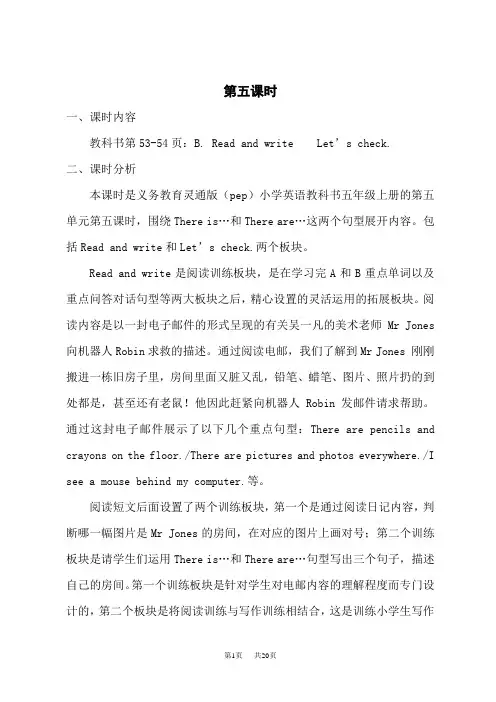
第五课时一、课时内容教科书第53-54页:B. Read and write Let’s check.二、课时分析本课时是义务教育灵通版(pep)小学英语教科书五年级上册的第五单元第五课时,围绕There is…和There are…这两个句型展开内容。
包括Read and write和Let’s check.两个板块。
Read and write是阅读训练板块,是在学习完A和B重点单词以及重点问答对话句型等两大板块之后,精心设置的灵活运用的拓展板块。
阅读内容是以一封电子邮件的形式呈现的有关吴一凡的美术老师Mr Jones 向机器人Robin求救的描述。
通过阅读电邮,我们了解到Mr Jones 刚刚搬进一栋旧房子里,房间里面又脏又乱,铅笔、蜡笔、图片、照片扔的到处都是,甚至还有老鼠!他因此赶紧向机器人Robin 发邮件请求帮助。
通过这封电子邮件展示了以下几个重点句型:There are pencils and crayons on the floor./There are pictures and photos everywhere./I see a mouse behind my computer.等。
阅读短文后面设置了两个训练板块,第一个是通过阅读日记内容,判断哪一幅图片是Mr Jones的房间,在对应的图片上画对号;第二个训练板块是请学生们运用There is…和There are…句型写出三个句子,描述自己的房间。
第一个训练板块是针对学生对电邮内容的理解程度而专门设计的,第二个板块是将阅读训练与写作训练相结合,这是训练小学生写作功底的重要方式之一。
Let’s check.是一个听力训练,共有两个听力板块,第一个是要求学生根据听到的内容选择所听到的内容并将对应的图片圈出来,第二个是要求学生重新听取录音内容,并且根据所听到的内容补全句子。
这个板块的精心设置,证明在小学阶段学习英语,并不是简单的了解,而是要求学生们不仅要懂得其语句意思,还要听懂英语内容,因此,教师和学生对这种听力板块的题型设计都要引起足够的重视,学生们在日常学习中要注意多参与听力训练活动。
人教PEP版五年级英语上册《Unit5_B_Read_and_write名师教案》
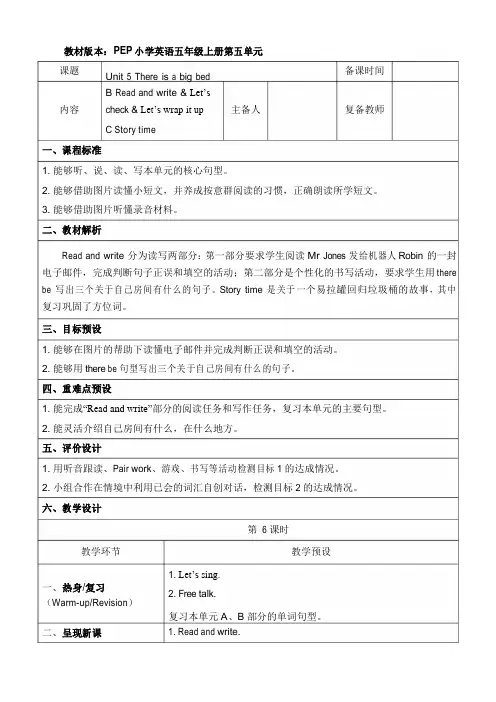
教材版本:P EP小学英语五年级上册第五单元课题内容Unit5There is a big bedB Read and write&Let’scheck&Let’s wrap it up主备人备课时间复备教师C Story time一、课程标准1. 能够听、说、读、写本单元的核心句型。
2. 能够借助图片读懂小短文,并养成按意群阅读的习惯,正确朗读所学短文。
3. 能够借助图片听懂录音材料。
二、教材解析Read and write分为读写两部分:第一部分要求学生阅读Mr Jones发给机器人Robin的一封电子邮件,完成判断句子正误和填空的活动;第二部分是个性化的书写活动,要求学生用there be写出三个关于自己房间有什么的句子。
Story time是关于一个易拉罐回归垃圾桶的故事,其中复习巩固了方位词。
三、目标预设1. 能够在图片的帮助下读懂电子邮件并完成判断正误和填空的活动。
2. 能够用there be句型写出三个关于自己房间有什么的句子。
四、重难点预设1. 能完成“Read and write”部分的阅读任务和写作任务,复习本单元的主要句型。
2. 能灵活介绍自己房间有什么,在什么地方。
五、评价设计1. 用听音跟读、Pair work、游戏、书写等活动检测目标1 的达成情况。
2. 小组合作在情境中利用已会的词汇自创对话,检测目标2的达成情况。
六、教学设计第6课时教学环节一、热身/复习(Warm-up/Revision)二、呈现新课教学预设1. Let’s sing.2. Free talk.复习本单元A、B部分的单词句型。
1.Read and write.(Presentation)三、趣味操练(Practice)四、小结(Summary)五、作业设计(1)简单介绍阅读材料。
T: We know that the robot,Robin, is very helpful.Wu Yifan’s art teacher has some trouble.So he writes an email to ask for help.① 呈现搬家的场景和老鼠的图片,引出单词“move”和“mouse”。
英语五年级上册unit5教案
英语五年级上册unit5教案英语五年级上册unit5教案1一、TeachingMaterial:Unit 3 B Read and write ,Let's Play ,Let's check二、Teaching objectives1、To master the four skills sentences:What's the date ?June 9th.Is her birthday in June ?Yes.2、To understand the dialogue,make sure the students can answer the questions of the dialogue and can write out the keys.3、Make sure the students can play the game : Bingo.4、To finish “Let's check” .三、Teaching points:1、Main points : To master the four skills sentences.What's the date? June 9th. Is her birthday in June? Yes.2、Difficult points : To understand the dialogue.四、Vision aids:1、The picture of “Read and write”.2、Video tape, slides and some birthday cards.五、Teaching procedures:(一)、Warm-up1、全班吟唱P26 Let's chant ,说做结合,营造活跃的课堂气氛。
2、听歌猜节日:教师放节日歌曲:“Jingle Bell”、“Happy Teachers' Day”、“Happy New Year”每放一段歌曲,提问:What festival? What's the date?学生用英语回答。
人教版PEP版英语五年级上册 read and write 课件 名师教学PPT课件
Tick or cross.(√/×)
√ 1.Wu Yifan often watches TV on the weekend.
sometimes
× 2.Wu Yifan often reads books on the weekend. × 3.Wu Yifan likes sports.
doesn’t like
Robin: What do you often do on the weekend?
Wu Yifan: I often watch TV. Sometimes I read books.
Read and write P19 Read Part 2 and answer.
What does Wu Yifan do on the weekend?
Time is money! 时间就是金钱!
Arrange your time reasonably! 合理安排自己的时间!
Homework 1. Listen to the tape and read
the book on P19 five times. 2. Copy the words and phrases
He often _w_a_tc_h_e_s__T_V_. Sometimes he r_e_a_d_s_b_o_o_k_s_.
Let's say
You should play sports every day. Here is a new schedule for you.
You should...
watch TV
read books
小学英语《Unit5 Dinner's ready B Read and write》教案、教学设计
学生感知中西方用餐文化的差异,激发他们的民族自豪感。
4.情感态度目标
培养学生节约光荣、浪费可耻的意识。
5.学习策略目标:
通过小组合作、两人合作,相互帮助,共同进步。
重点
1.单词:rice,noodles, fish,beef, soup, vegetable。
2.句 型What would you like?I’d likesome…Wouldyoulike…?Yes,thankyou./No,thanks.
一.Warm-up:
1.欣赏歌曲What would you like?,找出歌曲中出现的食物。
①学生边唱边做动作;
②学生说出听到的食物,利用希沃白板5思维导图的遮罩功能马上呈现单词,并用单词进行freetalk,练习句型What would you like?I’d like some...Would youlike…?Yes,thankyou./No,thanks.的应用。
【设计意图】:通过让学生用白板点出答案,其他同学相互检查的方式完成本环节,让学生主动学习,成为课堂的主人。
2)用beef和noodles两幅图片引导学生找出并划出关键
句型,通过听和跟读,培养学生的正确的语音语调。再进行小组合作朗读,巩固重点句型。利用希沃授课助手的直播功能,让全体学生在大屏幕上观看实时表演。
学的有限知识,真正做到学以致用,知行合一。
四.总结
(Summary)
引导学生从知识、能力、情感等方面总结所学,利用思维导图帮助他们系统掌握本课内容。
五. 作业
(Homework)
1.Make a shopping list.(制 作 一 张 购 物 清 单) 2.Help parents prepare dinner.(帮助父母准备晚餐)
人教版小学五年级英语上册Unit 5 Read and write
一、教材分析:本课取材于《义务教育课程标准实验教科书》PEP版第五册。
教材的编排思路是以话题为纲,以交际功能为主线,兼顾语言结构,逐步引导学生运用英语完成有实际目的的语言任务,即:话题—功能—结构—任务。
Part A包括词汇教学(Let’s learn),会话教学(Let’s talk)和阅读教学(read and write)。
如果三部分孤立地教学,教学就走上了歧途——重语言知识,轻运用能力地培养。
因此我选择了三者的结合:教学房间摆设的词汇与句型There be句型结合,并作听说读写四会要求。
对新句子:There are green curtains and two end tables. There is a new air-conditioner.的三会要求。
重点是四会词汇及句型的掌握以及交际运用,难点是四会句型的书写以及区分使用There is和There are的表达法。
二、学习目标1、教学目标与要求:语词学习目标:100%的学生能做到会听、说、认读四会单词。
语句学习目标:通过完成学习活动,100%的学生学会运用There be 句型。
语言运用的能力得到强化,其中60%的学生能熟练运用。
技能学习目标:100%的学生能听懂本课句型,其中60%的学生能灵活运用所学结构设计并简单描述自己的新房间。
情感培养目标:100%的学生能在活动中培养注意观察,学会比较,增强团结协作的意识。
2、教学重、难点分析教学房间摆设的词汇与句型There be句型结合,并作听说读写四会要求。
对新句子:There are green curtains and two end tables. There is a new air-conditioner.做三会要求。
重点是四会词汇及句型的掌握以及交际运用,难点是四会句型的书写以及区分使用There is和There are的表达法。
三、教学过程:Step 1: Warm-up ---- preview1. Enjoy a song: "My small bedroom" (播放C部分歌曲欣赏)2.做“低声传句子”活动。