
高中英语必修第三册教案Unit 9 Learning Lesson 1 Active Learning-北师大版(2019)
北师大版(2019)英语必修 第三册 Unit 9 Learning—Writing Workshop 教案
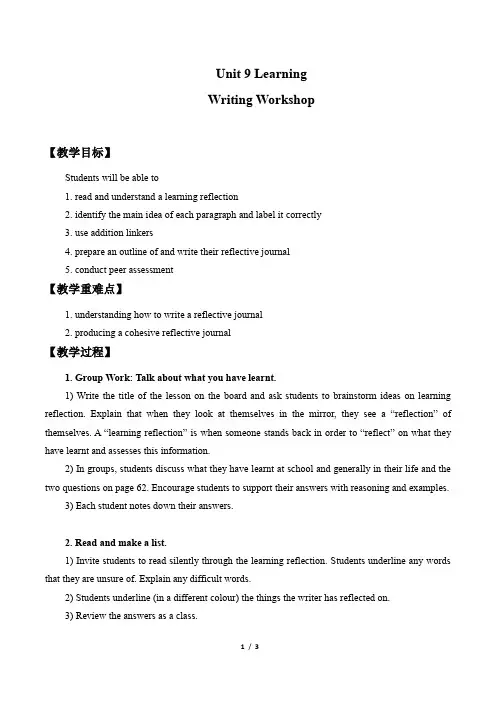
Unit 9 LearningWriting Workshop【教学目标】Students will be able to1. read and understand a learning reflection2. identify the main idea of each paragraph and label it correctly3. use addition linkers4. prepare an outline of and write their reflective journal5. conduct peer assessment【教学重难点】1. understanding how to write a reflective journal2. producing a cohesive reflective journal【教学过程】1. Group Work: Talk about what you have learnt.1) Write the title of the lesson on the board and ask students to brainstorm ideas on learning reflection. Explain that when they look at themselves in the mirror, they see a “reflection” of themselves. A “learning reflection” is when someone stands back in order to “reflect” on what they have learnt and assesses this information.2) In groups, students discuss what they have learnt at school and generally in their life and the two questions on page 62. Encourage students to support their answers with reasoning and examples.3) Each student notes down their answers.2. Read and make a list.1) Invite students to read silently through the learning reflection. Students underline any words that they are unsure of. Explain any difficult words.2) Students underline (in a different colour) the things the writer has reflected on.3) Review the answers as a class.3. What does each paragraph talk about?1) Read the list of headings on page 63.2) Independently, students complete the task, by marking the paragraphs.3) Call out the headings for students to point at the corresponding paragraph.4. Write three things you have learnt.1) Tell students: I learnt that some people have amazing memories. It’s amazing to know how a person’s memory changes with age. I was surprised to learn that 25 is the age the human memory works best. Discuss with students on how these three sentences could be better linked.2) Read the Sentence Builder. Point out that using addition linkers makes both speech and writing easier and more interesting to follow.3) Students work through the learning reflection text on page 62 and underline any examples of addition linkers they can find.4) Students write down the three things they have learnt in this unit. Check students are using addition linkers correctly.5. Compose your writing: Outlining.1) Ask students to use their notes in Activity 4 and the structure of the learning reflection on page 62 in order to complete the outline of their own reflection.2) Remind them to only fill it in with notes at this point. Ask stronger students to help any struggling students with the preparation of their reflection.6. Compose your writing: Drafting.1) Read through the Writing Help. Point out that students need to organise the information they have into clearly structured paragraphs.2) Students should also pay attention to how they link sentences and paragraphs so that their work is cohesive.3) Students complete their learning reflection.7. Compose your writing: Editing.1) Tell students that the final stage of writing, before publishing, is editing. When we edit, we check that our ideas are clear and that our sentences are complete.2) Have students exchange their writing with a partner and offer each other suggestions to improve their drafts.3) After editing, writers will make changes to their drafts and either rewrite or print a clean copy of the work.4) Ask students to prepare a final draft of their work to submit for your review and then place ina writer’s portfolio.。
高中英语 Unit 9 Learning lesson 1课件 北师大版必修第三册
( 反思 ) ( 与……争吵 ) ( 最终 ) ( 弄懂 )
5. In short, there is no simple answer to what makes a team successful.
( 总而言之 )
6. He attempted to climb the mountain, but in vain.
反思我们所学到的
2. the _in_n_e_r_ voice and the _o_u_te_r_ voice 内在的声音和外在的声音
3. be _f_le_x_i_b_le_ in your opinions
灵活表达你的观点
4. the easiest way to _p_r_o_m__o_te_ active learning
(4)What can we learn from the text? A. The outer voice expresses your personal opinions. B. Active learners focus on what their brain is saying in the background. C. Active learners accept everything they learn. D. Active learners don’t judge people based on first impressions or personal feelings. 答案: (1)~(4)BACD
may be right. Be (3) _______ in your the speaker/writer after all. If not, at
olepaisntioynosuahnadveyo“ulimsteignheatdegtnord”eauenpion(t4hg)er
高中英语 Unit 9 Learning Period 1 Topic Talk 北师大版必修第三册
课堂新知讲练
◇词汇拓讲 1.approach n.方法 Paraphrase:a way of dealing with sth. (P50)What is your learning approach to it? 【翻译】关于它,你的学习方法是什么?
【用法详解】
n.方法; at the approach of…在……快到的时候 途径; an approach to 接近,近似,约等于;(做某 接近; 事)的方法 approach 接洽 make an approach to…向……提出建议(要求) v.靠近; be approaching/with…approaching……快到了 接近; approach sb. on/about sth. 接洽 就某事与某人洽谈(商量、交涉)
4.take part in 参加;参与 (P50)I like to take part in problemsolving activities after class. 【翻译】我喜欢课后参加解决问题的活动。
完成句子 (4)The tennis players need _______ _______ during the play. Unless ________ ________ the game, they are easily beaten. But sometimes they are too concentrated to hit the ball. 网球运动员在比赛时需要完全投入,如果在比赛中,不集 中注意力,他们很容易被打败。但是有时候,他们打球时太投 入了以至于不能击中球。 【答案】(4)total concentration; concentrating on
②focus/fix one’s attention on/put one’s mind to/put one’s heart into/be absorbed in/be lost in/apply oneself/one’s mind to… 专心 于……
高一英语(师大版)-必修三 Unit 9 Learning (2)-1教案
教学环节
主要教学活动
设置意图
1、导入课文话题
List some actions of learning, including both active learning and passive learning. Compare them.
引入主题
Show some pictures of learning behaviours and ask students to think whether the learning behaviours present the principle of active learning.
6、作业
Write a passage about active learning.
巩固所学内容,运用、内化语言。
Read the three questions and invite students to give their opinions.
引导学生获取“主动学习”的基本信息,并对下文做出预测。
Students read the first paragraph of the text and answer the three questions.
5、内化——谈论五个建议中最有用的建议,并说明原因
Students decide on which suggestion would be most useful for their own learning.
Students provide reasons for their answers and introduce the most useful suggestion.
Encourage students to think of additional information that would make their presentation more interesting and personalized.
高中英语Unit9gLesson3TheSecretsofYourMemory教案北师大版必修第三册
Unit 9 LearningLesson 3 The Secrets of Your Memory【教学目标】Students will be able to1. read a text about memory2. read for detail and correct false statements3. understand the main theme of each paragraph in an extended text4. correct mistakes in a summary of the reading text5. study and understand the subject–verb agreement rules in sentences6. discuss tips on memory improvement【教学重难点】1.reading for detail and understanding the main themes2. Talking about ways to improve memory【教学过程】1. Talk about memory by identifying things that are easy to remember.1)In small groups, volunteer students discuss their first memory.2) Volunteers can share their answers with the class.3) Explain to students that the human brain remembers information roughly categorised into broader groups.4) Read the bulleted list.5) Conduct a survey to find out which things are the easiest and the hardest to remember. Each student shares the category they remember best and the one they struggle to remember.2. What do you want to know about memory?1)Give an example of one or two questions you would like to ask a memory expert,e.g., Does age play a role in the human’s brain ability to store and recall information? Is there any special food that helps memory?2) In pairs, students note down 4–5questions that they would like to ask a memory expert.3) If possible, students can find the answers online.4) Each student shares at least one question they would like to ask.3. Read the text and find out.1) Ask students to quickly skim through the text and find out if any of the questions they noted down in Activity 2 are answered by the memory expert.2) Students share the questions and answers that were addressed.4. Read again, write T or F, and correct false statements.1)Read the statements. Ask volunteer students to read the text. Explain any difficult words.2) Read each statement again. Students answer if they are true or false from memory. Do not confirm their answers at this point.3) Independently, students read through the text to check their answers and correct the false statements.4) To help struggling students, give them the paragraph number where the information for each statement is included.5) Read out loud each statement and pause after each one for students to call out “true” or “false” in chorus. If the answer is “false”, invite a volunteer to come to the board and write the corrected statement.5. Pair Work: Offer suggestions.1) In pairs, students read each paragraph in the text and discuss further advice that they would suggest. Revise empathy with the students. What do you do when you can’t remember something? What memory tricks do you suggest?2) If possible, students can research online some advice for each question.3) Review the answers as a class. Write the useful advice on the board.6. Match suggestions and questions.1) Read through each suggestion. Explain any difficult words.2) Students need to connect each comment to one of the four paragraphs in the readingtext on pages 58 and 59. Then, students write the suggestions on the lines provided in the text.3) Review the answers as a class.4) Compare the suggestions students gave in Activity 5 with the suggestions in Activity 6.Which suggestions are more helpful? Which suggestion works best for you? Why?Which suggestion was surprising?7. Find out truths and advice.1) Point out to students that each of Jemima Gryaznov’s answers can be divided into two sections: the truth and the advice section. Go through the first answer with the class and have volunteers identify the two parts to illustrate what students need to do.2) Students note the four truths and advice that Jemima Gryaznov gives in the text.3) Review the answers as a class. Which truth is the most significant to you? Why?8. Group Work: Think and share.1) Students underline the most and least convincing words in the text that Jemima Gryaznov puts forward using two different colours.2) Students discuss what methods she uses to convince others and share their answers in small groups.3) Challenge students in each group to convince one another of each answer that is being questioned.Conduct a class survey to find the most and least convincing answer shared by the majority of students.4) Assign groups of students to search online for additional information that could beer support or deny this answer.9. Find words and phrases to replace underlined words.1) Revise synonyms with students. In pairs, students replace the underlined words and phrase with the words from the text.Remind students that the meaning must be similar.2) Help students who are struggling by giving the first letter of the word or theparagraph number where the word can be found.3) Read aloud the sentences and pause before each item for students to call out the answer in chorus.4) Encourage students to provide their own words or expressions for the underlined part in the sentences.10. Find subjects and use the correct verbs to complete sentences.1) Write this example on the board: “We remembers things that have strong connections in our mind.” Ask students to think whether there’s anything wrong with the sentence (the verb “remembers” should be plural to match the subject “we”.) Ask students to correct the mistake, i.e., change the verb to “remember”.2) Explain to students that in English the verb always needs to match the subject in terms of singular/plural form and that this is called “subject–verb agreement”. Find out whether this is the case in the students’ first language.3) Point out that the -ing form of verbs, when used as a subject, is considered as singular.4) Revise subjects of the sentence with students; the subject of a sentence is the person, place, thing, or idea that is doing or being something.5) Read the sentence frames in the Sentence Builder. Independently, students complete the task. Remind students to first circle the subject in each sentence.6) In pairs, students read their answers and listen if they sound correct.7) Review the answers as a class.11. Group Work: Read the tips and discuss the most/least useful ones.1) In small groups, students read and discuss the tips.2) Each student explains, with reasoning, which is the most and least useful tips for learning English.3) Conduct a class survey to find out the most and least popular tips of all.。
Unit 9 Learning 大单元说课课件高中英语北师大版(2019)必修第三册

Step 1
Step 2 Reading Post-reading Step 3
Step 4
Step 5
Activity 8
Which of these suggestions do you think is the most useful for you?
Intention
To practice critical thinking
What attitude should be adopted to deal with learning and life under different cultural backgrounds so as to improve students' logical and critical thinking
Theme: Human & Self
What
Topic: Learning
Aim: To form correct outlook on
Why
learning & strive to be an active lifelong learner
Value Orientation: Willing to learn, good at learning, lifelong learning
Method
Activity-based Teaching
Method
Individual Study
Communicative Teaching Method
Cooperative Study
Audio-visual Teaching Method
P art
大观念 小观念 单元目标 语篇 学生活动 学生评价
Unit 9 Learning Lesson 1 教案-高中英语北师大版(2019)必修第三册
Unit 9 LearningLesson 1 Active Learning 教学设计科目:英语课题:Lesson 1 Active Learning 课时:1课时教学目标与核心素养:知识目标:Students can learn some new words and verb-ing or infinitive.能力目标:Students can have a further understanding of the passage.情感目标:Students can think individually and learn cooperatively.教学重难点教学重点:How to learn the new words and verb-ing or infinitive.教学难点:How to make students have a better understanding of the passage.课前准备:多媒体,黑板,粉笔教学过程:一、Pre-reading1. Greeting2. Leading-inACTIVA TE AND SHARE教师活动:教师提问What do active learners do? Think about who may be an active learner in your class.Use the phrases below to help you.to take notes to focus on to ask questionsto reflect on to pay attention to to be curiousto be open-minded to listen to a different point of viewAsk students to think and share their answers.二、While- readingREAD AND EXPLORE1. 学生活动:阅读文章,回答问题。
Unit 9 Lesson 3第1课时示范教案【高中英语北师大版必修第三册】
Unit 9 LearningLesson 3 The Secrets of Your MemoryPeriod 1教材分析本课为第九单元的阅读课,介绍的是关于人类记忆的秘密。
文章由问题展开,共分四部分,每部分均采用“问题—分析—建议”这一模式。
首先探讨了人们为何拥有儿时记忆,强调了“触发情绪变化”和“复述事件”的重要性;紧接着指出所谓“过目不忘”并无科学依据,但确实存在记忆力超群的人;作者随后介绍了记忆曲线,强调了及时复习的重要性;最后指出人的记忆力会随着年龄增长而逐渐衰退,25岁为记忆鼎盛期。
本文属于“人与自我”主题,旨在帮助学生正确认识关于记忆的那些“奥秘”,破除原有的误解,准确锁定加深记忆的关键因素,鼓励学生运用科学方法,强化记忆,提升学习效率。
教学目标在本课学习结束时,学生能够:1. 提取关于记忆的细节信息;2. 识别并准确订正所给阅读信息中的错误;3. 识别连续文本中每段的主旨大意。
教学重难点【教学重点】1. 准确提取细节信息,能从所提供的摘要里,及时发现问题并准确订正;2. 通过锁定关键词,厘清段落内部逻辑,总结常见的逻辑论证模型。
【教学难点】辩证思考问题,有理有据地评判他人的观点。
教学过程Step 1 Warming-up1. Which of the following things do you find easy to remember? Can you explain why?2. If you were going to meet a memory expert, what questions would you ask him/her?设计意图:创设情景,用问题激活学生背景知识,预测内容。
Step 2 Reading1. True or False? Correct the false statements.设计意图:通过判断正误,培养学生获取细节信息的语言能力。
借助订正错项这一任务,引导学生发现问题、解决问题,提升细节理解能力。
高中英语必修第三册课件Unit 9 Learning Lesson 1 Active Learning-北师大版(2019)
2. What is active learning? Active learning is training ourselves to be better learners, to actively take part in the learning process.
and learning effects for teach
s u g g e s t i o nL.earning actions:
_______________________________ _
1. Listen to the outer voice
Reasons: ___________________________ Nhomakorabea___ _
● keep
● risk
● end up ● stop
doing
● try
● cannot help
Verbs followed by infinitive
need attempt try refuse
to do
—Have you spoken to Rachel?
—No. I tried to call her but the line was
Learning effects: _______________________________ _
2. Argue with your inner voice
北师大版高中英语选择性必修第三册Unit9 Lesson 1 课文中英文对照
北师大版高中英语新教材(选择性必修第三册)课文Lesson 1 To Clone or not to Clone?第一课克隆还是不克隆Cloning is the process of making an exact copy of a plant or animal and developing it either naturally or artificially. Natural cloning has been going on for generations. For example, gardeners have been using a form of cloning when they take a cutting from a plant and place it in a suitable medium, such as soil. Another example of natural cloning is identical twins, who are produced from the same egg.克隆是通过自然或人为的方式,对植物或动物进行精确复制、培育的过程。
自然克隆由来已久。
例如,园丁们从植物上截取一段,放在合适的培养基中(例如土壤),就是一种克隆。
自然克隆的另一个例子是同卵双胞胎,它们是由同一个卵子受精产生的。
For years, there had been attempts to clone animals artificially. The first successfully cloned animal was a sheep named Dolly in 1996. At first, Dolly grew normally, but later she developed an illness that is more normally found in much older animals. She lived for six and a half years, only half the life of the sheep from which she was cloned. After Dolly, scientists have cloned more than 20 mammal species, including camels, cattle, deer, dogs, goats and mice. However, they have found a similar pattern of health problems with these other species as well. This has led to questions such as, “Will this be a major issue for all cloned animals?” “Will it continue to happen forever?”.多年来,人们一直在尝试人工克隆动物。