
虚拟语气口诀与总结
虚拟语气总结
(1)一种定语从句:It’s time that+did
(2)两种目的状语从句:
so that/in order that+ can/may/could/might +do
in case\lest\for fear(以防) that+should do
(3)三种随时变化句:
①wish 现在→did/were
if only +过去→had done
as if/though 将来→could/would do
②would rather+/将来→did/were
过去→had done
③现在:if+did/were, would+ do
过去:if+had done, would+ have done
将来:did
if+ were to do, would+ do
should do
注意:除了由if引导的虚拟条件句外,还有倒装条件句,即把were、had或should提前;混合时间句,虚实错综句,以及含蓄条件句,即由or, otherwise, with, without, but for来引导的。
(4)四种名词性从句:
①当表语是important, natural, necessary, possible, strange, arranged, decided, demanded, ordered, requested, suggested, surprising, a pity, no woder时,主语从句要用虚拟语气。
例:
It’s important that we (should) help each other.
②动词一坚持(insist),两命令(command, order),三建议(advise, propose, suggest),四要求(ask, demand, request, require)后的宾语从句要用虚拟语气。
例:
He insisted that he (should) be sent to the West.
注:insist(坚持说), suggest(暗示,表明)时,从句应用陈述语气。
如:
Her pale face suggested that she was ill.
1). Mother insisted that John (should) go to bed before 9 o’olock.
对比:He insisted that I had taken away his dictionary.(不是建议、要求、命令或主张)
2). His suggestion that Tony (should) be invited to the party was refused.(同位语从句)
对比:His words suggested that he was very angry with me.(不是建议、要求、命令
③idea, plan以及表示“坚持,命令,建议,要求”等动词的同源名词作主语时,表语从句用虚拟语气。
例:
My suggestion is that we (should) hold a class meeting.
④idea, plan以及表示“坚持,命令,建议,要求”等动词的同源名词后的同位语从句要用虚拟语气。
例:
The office gave an order that his soldiers fight back bravely.
If +were/ did (动词过去式),主语+情态动词(would, could, might, should)+do(用来表示对现在情况的假设)1). I don’t have a cellphone. If I had one , it would be convenient for me to contract others.
If +had done (过去完成式),主语+情态动词(would, could, might, should)+have
done(用来表示对过去情况的假设)
1). If I had gone to the concert, I would have seen the famous singer.
If +were/ did (动词过去式),主语+情态动词(would, could, might, should)+ do
were to do
should do (用来表示对将来情况的假设)
1). If I were not to take/ should take/ took the exam tomorrow, I would go shopping with you.
虚拟语气条件句的倒装:在虚拟语气条件句中,如果出现助动词were, should, had,
可省略if, 把这些词提到主语前面,变成倒装句。
1). Should he act like that again, he would be fined. If he should act like that again, he would be fined。
Were he to act like that again, he would be fined. If he were to act like that again, he would be fined.
If he acted like that again, he would be fined.(不可以倒装)
2). Had the doctor come in time last night, the boy would have been saved.
If the doctor had come in time last night, the boy would have been saved.
3). If I had time now, I would go to the film with you. (不可以倒装,因为句中的had不是助动词)
But for….--> If it were not for…../ If it hadn’t been for
1). But for the determined captain, all the passengers on board wouldn’t have been saved.
If it hadn’t been for the determined captain, all the passengers on board……
2). But for your rich parents, you wouldn’t live such a easy life.
If it were not for your rich parents, you wouldn’t live such a easy life.。
虚拟语气的规则总结
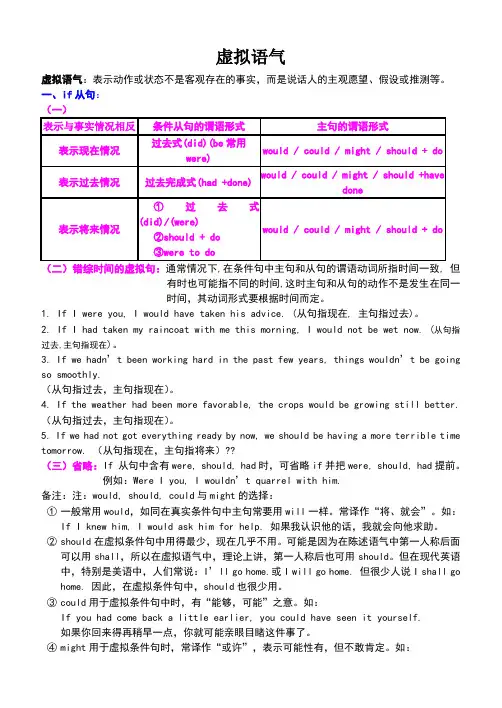
虚拟语气虚拟语气:表示动作或状态不是客观存在的事实,而是说话人的主观愿望、假设或推测等。
一、if从句:(二)错综时间的虚拟句:通常情况下,在条件句中主句和从句的谓语动词所指时间一致, 但有时也可能指不同的时间,这时主句和从句的动作不是发生在同一时间,其动词形式要根据时间而定。
1. If I were you, I would have taken his advice. (从句指现在, 主句指过去)。
2. If I had taken my raincoat with me this morning, I would not be wet now. (从句指过去,主句指现在)。
3. If we hadn’t been working hard in the past few years, things wouldn’t be going so smoothly.(从句指过去,主句指现在)。
4. If the weather had been more favorable, the crops would be growing still better.(从句指过去,主句指现在)。
5. If we had not got everything ready by now, we should be having a more terrible time tomorrow. (从句指现在,主句指将来)??(三)省略:If 从句中含有were, should, had时,可省略if并把were, should, had提前。
例如:Were I you, I wouldn’t quarrel with him.备注:注:would, should, could与might的选择:①一般常用would,如同在真实条件句中主句常要用will一样。
常译作“将、就会”。
如:If I knew him, I would ask him for help. 如果我认识他的话,我就会向他求助。
虚拟语气句型

虚拟语气一、if 引导的虚拟条件句(表示与事实相反的假设):现在:If+主语+过去式/were ,主语+should/would/could/might+动词原形过去:If+主语+had+过去分词,主语+should/would/could/might+have+过去分词过去式/were将来:If+主语+ should + 动词原形, 主语+should/would/could/might +动词原形were to + 动词原形另外:有些词,如:or /otherwise (否则);without (没有);but for (要不是……)等,表示一个隐含的条件,所用的虚拟语气与if 引导的虚拟条件句结构相同注意:if 引导的虚拟条件句中,谓语部分含有were /had /should ,可将引导词if 省略,并将were /had /should 提到句首。
二、wish 之后接的宾语从句(表示不可能实现的愿望):过去式/were (现在)Wish +(that ) had + 过去分词 (过去)would/could/might +动词原形 (将来)三、as if/as though 常与seem/look/appear 等动词连用,表示“看起来似乎……好象……”;以及if only 表示“要是……该多好啊”所用的虚拟语气结构与wish 结构相同;四、虚拟语气在名词从句中的运用:1、表示“命令”、“建议”、“要求”、“坚持”等词后所带的名词从句用虚拟语气,结构都是:(should ) + 动词原形,其中should 可以省略。
记忆口诀:insist2、动词 order +(that )+ 主语+ (should )+ 动词原形advise/suggest/recommend (宾语从句)require一坚持:insist 二命令:order /command 三建议:advise /suggest /recommend 四要求:demand /require /request /ask3、名词:advice/suggestion/order /request之后接表语从句或同位语从句,谓语部分也是用(should)+ 动词原形;4、在主语从句中:It is suggested/required/ordered/…that + 主语+ (should)+ 动词原形;It is important/strange/necessary/…that + 主语+ (should)+ 动词原形;过去式(现在/将来)五、would rather + sb. +had + 过去分词(过去)六、It is (high) time that + 主语+ 过去式鱼儿,在水中串上串下,吐着顽皮的泡泡;鸟儿从荷叶上空飞过,想亲吻荷花姑娘的芳泽。
虚拟语气的用法总结
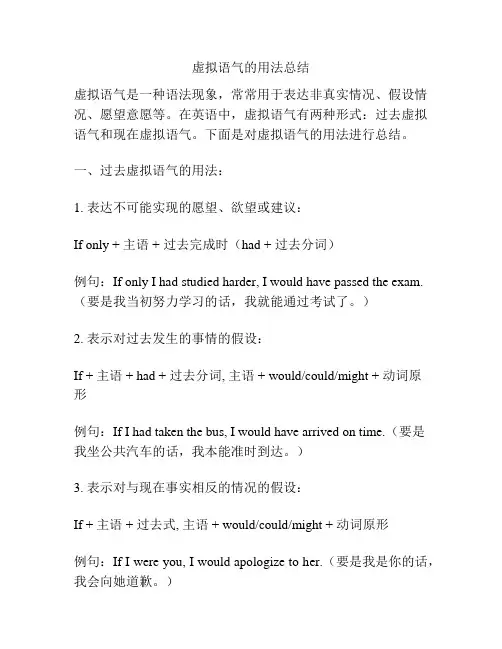
虚拟语气的用法总结虚拟语气是一种语法现象,常常用于表达非真实情况、假设情况、愿望意愿等。
在英语中,虚拟语气有两种形式:过去虚拟语气和现在虚拟语气。
下面是对虚拟语气的用法进行总结。
一、过去虚拟语气的用法:1. 表达不可能实现的愿望、欲望或建议:If only + 主语 + 过去完成时(had + 过去分词)例句:If only I had studied harder, I would have passed the exam.(要是我当初努力学习的话,我就能通过考试了。
)2. 表示对过去发生的事情的假设:If + 主语 + had + 过去分词, 主语 + would/could/might + 动词原形例句:If I had taken the bus, I would have arrived on time.(要是我坐公共汽车的话,我本能准时到达。
)3. 表示对与现在事实相反的情况的假设:If + 主语 + 过去式, 主语 + would/could/might + 动词原形例句:If I were you, I would apologize to her.(要是我是你的话,我会向她道歉。
)4. 表达对不可能实现的条件:If only + 过去式例句:If only I had a million dollars.(要是我有一百万美元该多好。
)二、现在虚拟语气的用法:1. 表达建议、命令等正式用法:表达建议:(should +动词原形/动词原形)例句:It's important (that) you should take some rest.(你应该休息一下,这很重要。
)表达命令:(应用“命令式”的虚拟形式)例句:It's vital (that) he be here on time.(他必须准时到达,这很重要。
)2. 表达愿望、要求、建议等陈述式的用法:It's time/It's high time + 过去式例句:It's time you went to bed.(你该去睡觉了,时间到了。
虚拟语气英语知识点总结

虚拟语气英语知识点总结一、虚拟语气的概念。
虚拟语气是一种特殊的动词形式,用来表示说话人所说的话不是一个事实,而是一种假设、愿望、怀疑、猜测或建议等。
二、虚拟语气在条件句中的用法。
1. 与现在事实相反的虚拟条件句。
- 结构:从句(If + 主语+ 动词的过去式(be动词一般用were)),主句(主语+ would/should/could/might+动词原形)。
- 例如:If I were you, I would study harder.(如果我是你,我会更努力学习。
实际上我不是你)2. 与过去事实相反的虚拟条件句。
- 结构:从句(If+主语+had+过去分词),主句(主语+would/should/could/might + have+过去分词)。
- 例如:If he had taken my advice, he would have passed the exam.(如果他听了我的建议,他就会通过考试了。
实际上他没听建议,也没通过考试)3. 与将来事实相反的虚拟条件句。
- 结构:从句(If+主语+动词的过去式/should+动词原形/were to+动词原形),主句(主语+would/should/could/might+动词原形)。
- 例如:If it rained tomorrow, we would stay at home.(如果明天下雨,我们就会待在家里。
明天是否下雨还不确定,但这是一种假设情况)- 或者If he should come tomorrow, I would tell him the news.(如果他明天来,我就会告诉他这个消息)- 以及If I were to see her tomorrow, I would give her the book.(如果我明天见到她,我就会把书给她)三、虚拟语气在宾语从句中的用法。
1. wish后的宾语从句。
- 表示与现在事实相反的愿望,从句谓语动词用过去式(be动词用were)。
4句话搞定英语最难语法:虚拟语气10大必背句式(10=1234)
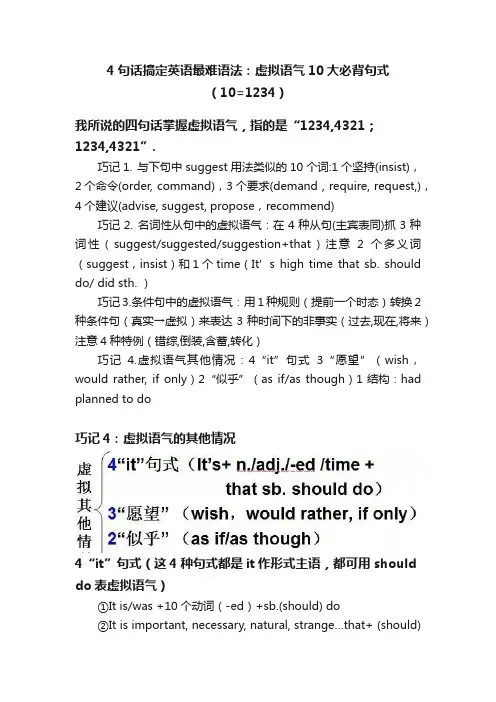
4句话搞定英语最难语法:虚拟语气10大必背句式(10=1234)我所说的四句话掌握虚拟语气,指的是“1234,4321;1234,4321”.巧记1. 与下句中suggest用法类似的10个词:1个坚持(insist),2个命令(order, command),3个要求(demand , require, request,),4个建议(advise, suggest, propose,recommend)巧记2. 名词性从句中的虚拟语气:在4种从句(主宾表同)抓3种词性(suggest/suggested/suggestion+that)注意2个多义词(suggest,insist)和1个time(It’s high time that sb. should do/ did sth. )巧记3.条件句中的虚拟语气:用1种规则(提前一个时态)转换2种条件句(真实→虚拟)来表达3种时间下的非事实(过去,现在,将来)注意4种特例(错综,倒装,含蓄,转化)巧记4.虚拟语气其他情况:4“it”句式3“愿望”(wish,would rather, if only)2“似乎”(as if/as though)1结构:had planned to do巧记4:虚拟语气的其他情况4“it”句式(这4种句式都是it作形式主语,都可用should do表虚拟语气)①It is/was +10个动词(-ed)+sb.(should) do②It is important, necessary, natural, strange…that+ (should)do③It is a pity, a shame, no wonder… that+ (should) do④It is (high/about) time that sb. should do/did sth.(should不可省略)例句和更详细解析可点击扩展资料参照前文《虚拟语气——名词性从句中的虚拟语气:4句话搞定最难语法(1)》3“愿望”(wish希望 would rather宁愿 if only要是…就好了)表示愿望与现在或过去事实相反,或对于将来的愿望,这就是虚拟语气,也是提前一个时态。
演讲稿虚拟语气用法总结(超好,原创)完整版

优选
7
If you ______ with George earlier, you _____ so angry now.
A.talked; would not be B.had talked; would not be C.would talk; would not be D.had talked; would not have been
5.Without / But for your help, we couldn’t have finished the work ahead of time.
=If it had not been for your help, …
优选
12
Without electricity, human being life ______ quite different today.
优选
8
If we had taken such effective measures much earlier, the river _____ so seriously now.
A.is not polluted
B.would not be polluted
C.had not been polluted
优选
14
He hesitated for a moment before kicking the ball, otherwise he _____ a goal.
A.had scored B.scored C.would score D.would have scored
优选
15
— Why didn’t you buy it? — I ______ but I didn’t have the money. A. would B. would have C. had had D. had bought
巧学活记虚拟语气
巧学活记虚拟语气第一、条件虚拟语气条件虚拟语气是最常用的虚拟语气,在历年高考中也经常出现。
学生需要掌握基本的三种条件虚拟语气条件句:对现在表示虚拟;对过去表示虚拟;对将来表示虚拟。
例如:If I were you, I would refuse the money.I would have dropped by if we had time.If you came/were to come/should come tomorrow, I would give the book to you.当然,除了基本用法外,学生还需注意以下2点:1、if 省略句在条件句中可省略if, 把were, had, should提到句首,变为倒装句式。
例如:If I were you, I would take his advice.→Were I you, I would take his advice.If he had been in your position, he’d probably have done the same.→Had he been in your position, you’d probably have done the same..2、错综虚拟语气(混合虚拟语气)当条件句是表示对过去的虚拟,而主句表示对现在的虚拟,则用错综虚拟语气(混合虚拟语气)。
例如:If you had followed your advice, you would be better now.If you had studied hard before, you would be a college student.第二、含有should的虚拟语气含有should的虚拟语气,可分为2类:用于表示建议、愿望、命令等词后的宾语从句中;用于其它名词性从句中(包括主语从句、表语从句和同位语从句)。
1、表示建议、愿望、命令等词后的宾语从句中,可以归纳为“一坚持(insist),二命令(order, command),三建议(advise, suggest, propose),四要求(demand, desire, require, request)”。
虚拟语气知识点总结
虚拟语气知识点总结
虚拟语气知识点总结
虚拟语气
一、虚拟语气的规则用法:
1主、从句都表示与过去事实相反:
从句的.谓语动词用:had + 动词过去分词;
主句的谓语动词用:情态动词 + have + 动词过去分词。
注意:能用于虚拟语气的情态动词只有四个:should, could, would, might.
使用哪一个情态动词要由句子含义决定,考试中出现最多的是could, would.
2 主、从句都表示与现在事实相反:
从句的谓语动词用:动词过去式(如果是be则只能用were)
主句的谓语动词用:情态动词 + 动词原形。
3 主、从句都表示与将来事实相反:
从句的谓语动词用:were to + 动词原形(重点)、should + 动词原形、动词过去式;
主句的谓语动词用:情态动词 + 动词原形。
二、虚拟语气的特殊应用:
1 would rather + 句子,这时句子谓语动词用一般过去时来体现虚拟语气。
2 if only 如果,要是...就好了,if only + 句子,这时句子一定要用虚拟语气。
虚拟语气口诀
虚拟语气口诀2012-06-30 00:00《虚拟语气口诀1》虚拟语气,愿望难成,违背事实,时态后退.《教你18字口诀,学会if条件从句虚拟语气2》口诀:【过去了,就原了;过完了,就完了;过去了,也原了】与现在相反:从句用过去时态,主句用would,should,could,might+动原。
口诀:过去了,就原了。
与过去相反:从句用过去完成时态,主句用would,should,could,might+have+PP。
口诀:过完了,就完了。
与将来相反:从句用过去时态,主句用would,should,could,might+动原。
口诀:过去了,也原了。
说明:原指用动词原形;完指用动词完成时态。
口诀巧学巧记3---虚拟一、虚拟主从,宾从表语从,should之后加原形。
省去should用原形,换成would行不通。
1.主从:It is necessary(important, natural strange better)that….It is suggested(requested, proposed desired)that……It is a pity(a shame)that……1) It is necessary that he _____ in time to attend the meeting.A. comeB. cameC. would comeD. need come译文:他及时来参加会议很重要。
2) I is a pity that he here.(他不在这儿,真令人遗憾。
)A. not beB. beC. would beD. should not3)It’s strange that they_____nothing about this matter.A. knowB. would knowC. knowsD. knew2.宾从: 一坚二令三要求,切望三建议用虚拟。
should原形或原形,换成would行不通。
4句话搞定英语最难语法:虚拟语气10大必背句式
4句话搞定英语最难语法:虚拟语气10大必背句式巧记1. 与下句中suggest用法类似的10个词:1个坚持(insist),2个命令(order, command),3个要求(demand , require, request,),4个建议(advise, suggest, propose,recommend)巧记2. 名词性从句中的虚拟语气:在4种从句(主宾表同)抓3种词性(suggest/suggested/suggestion+that)注意2个多义词(suggest,insist)和1个time(It’s high time that sb. should do/ did sth. )巧记3.条件句中的虚拟语气:用1种规则(提前一个时态)转换2种条件句(真实→虚拟)来表达3种时间下的非事实(过去,现在,将来)注意4种特例(错综,倒装,含蓄,转化)巧记4.虚拟语气其他情况:4“it”句式3“愿望”(wish,would rather, if only)2“似乎”(as if/as though)1结构:had planned to do巧记4:虚拟语气的其他情况4“it”句式(这4种句式都是it作形式主语,都可用should do表虚拟语气)①It is/was +10个动词(-ed)+sb.(should) do②It is important, necessary, natural, strange…that+ (should) do③It is a pity, a shame, no wonder… that+ (should) do④It is (high/about) time that sb. should do/did sth.(should不可省略)例句和更详细解析可点击扩展资料参照前文《虚拟语气——名词性从句中的虚拟语气:4句话搞定最难语法(1)》3“愿望”(wish希望 would rather宁愿 if only要是…就好了)表示愿望与现在或过去事实相反,或对于将来的愿望,这就是虚拟语气,也是提前一个时态。