
七年级英语下册第十单元课件 人教版
went to the mountains
went to summer camp
Where did … go on vacation?
went to New York City
went to the beach
1b. Listen and answer: Where did they go on vacation?
Vacation Travel
the Great Wall
the Palace Museum
Beijing
Tian’an Men Square
a Beijing Hutong
Hangzhou
Shanghai
Hale Waihona Puke SuzhouThe End
Vacation Survey
Name Place Activity visited friends Miss Shen Shanghai
Sentences you need:
Where did you go on vocation? What did you do?
Homework:
1. Review and recite the key phrases and the dialogue.
2. Preview the new lesson.
Lyrics(歌词) 歌词)
Yesterday Once More
when I was young I'd listen to the radio waiting for my favorite songs when they played I'd sing along, it made me smile. Those were such happy times and not so long ago how I wondered where they'd gone. but they're back again just like a long lost friend all the songs I love so well.
g
b
7. visited museums
d
Where did you/he/she/they go on vacation?
stayed at home I We You He She They visited museums went to summer camp visited my uncle went to the mountains went to the beach on vacation. went to New York City
went to the beach
f
c 1. stayed at home 2.went to New York City 3. visited my uncle
e
a
4. went to summer camp 5. went to the mountains 6. went to the beach
Unit 10 Where did you go on vacation?
I visited my aunt
She
stayed stayed at home
She went to New York City
They went to summer camp
visited
museums
went to the mountains
Exercises
Match the sentences. Draw a line.
1. He went to summer 2. I visited 3. She went to the 4. We stayed 5. They went to a. at home . b. camp. c. my uncle. d. mountains. e. New York City
Name
1. Tina 2. Xiang Hua 3. Sally 4. Brad 5. Tom
Activities went to the mountains visited his uncle stayed at home went to New York City went to summer camp
人教版七年级下教学课件:Unit 10

2. If he or she blows out all the candles in one go, the wish will come true. 如果他(她)一口气把 蜡烛全部吹灭的话,许的愿望便会成真。
1)in one go 相当于汉语中的“同一次;一次性 地”,其中的介词还可用at,即at one go。例如: You can’t do the work all at one go. 你不可能一 次把工作都干完。
I’d like a cup of black tea with milk, please. 请给我来杯加奶的红茶。 I want some hot tea, Mom. 妈妈,我想喝些 热茶。 What do you want to eat today, children?孩 子们,今天你们想吃些什么? What would you like to order, sir? 先生,您 想点些什么?
adj. 特别的;特殊的 5. would modal v. (表示意愿)愿意 6. yet adv. (常用于否定句或疑问句)
还;仍然
Hale Waihona Puke 7. large adj. 大号的;大的 8. order n. & v. 点菜;命令 9. size n. 大小;尺码 10. bowl n. 碗 11. meat n. (可食用的)肉 12. dumpling n. 饺子
13. fish n. 鱼;鱼肉 14. pancake n. 烙饼;薄饼 15. world n. 世界 16. answer n. 答案 v. 回答 17. different adj. 不同的 18. cake n. 蛋糕
19. candle n. 蜡烛 20. age n. 年龄 21. blow v. 吹 22. if conj. 如果 23. will v. 将要;会 24. the UK n. 英国
人教新版英语七年级下册Unit10SectionB2a-3c课件(共35张PPT)
人教新版英语七年级下册Unit10SectionB2a-3c课件(共35张PPT)英语七年级下册Unit10I’d like some noodles.Period 1Content Section A 教学目标要求1.能够使用What would you like? 和I’d like ... 句型来询问和回答对食物的喜好,完成在饭店中的点餐活动,如:I’d like beef noodles.2.能够使用情态动词would,如:What would you like? I’d like ...3.能够使用there be 句型的一般疑问形式来询问食物中的材料,并作简单回答,如:Is there any cabbage in the no No, there’s no cabbage. Are there any vegetables in the noodles? Yes, there are some tomatoes.4.能够听懂和学会使用一些常用的食物名称,如:noodle, cabbage, potato, carrot, meat, beef 等。
5.能在教师指导下理解可数名词和不可数名词的区别和用法,如:countable nouns: tomatoes, potatoes, noodles, car beef等。
6.能认读并能工整书写所学单词和短语,如:noodle, cabbage, potato, carrot, meat, would like, come with等。
7.能模仿录音正确朗读和表演教材上的对话并能模仿目标语的结构和语调进行初步表达(会话),如:What would any cabbage in the noodles? No, there isn’t any. / No, there’s no cabbage.教学过程活动步骤教与学活动目的及其操作教学复习时间3 m 1复习已学目标语和导入谈论食物的话题教师指着一些有关食物的图片,与学生进行对话。
人教版七年级英语下册第十单元课件sectionA精美课件(共49张PPT)

Ⅱ. 英译汉
1. There are all kinds of animals in the zoo. 动物园里有各种各样的动物。 2. What kind of bag would you like? 你要哪一种包? 3. Look! The baby koala is kind of cute.
cabbage
['kæbidʒ]
卷心菜
broccoli ['brɔkəli:] 花椰菜
What kind of meat would you like? beef [bi:f] 牛肉 mutton
['mʌtn]
羊肉 chicken 鸡肉
What kind of food would you like?
写出下列可数名词的复数形式
1. dumpling __________ dumplings apple_______ apples boxes watch _______ watches 2. box ______ leaves thief _______ thieves 3. leaf _____ 4. country _________ countries strawberry ____________ strawberries 5. policeman __________ policemen woman _______ women 6. potato ________ tomato _________ potatoes tomatoes
What kind of fruits would you like?
oranges
apples
bananas
strawberries
What kind of vegetables would you like?
七年级下册英语人教版unit10课件
七年级下册英语人教版unit10课件一、教学内容本节课为人教版七年级下册英语Unit 10 "Why don't you talkto your parents?"。
本单元主要围绕家庭成员的日常生活和情感交流展开,让学生学会描述家人的日常生活、情感和喜好,并能运用情态动词提出建议。
具体内容包括:1. 单词和短语的学习:如 washing clothes, cooking dinner, cleaning rooms, watch TV, listen to music等。
2. 情态动词的运用:can, could, may, might, must等。
3. 日常对话交流:学会用英语询问和描述家人的日常生活、喜好和情感。
二、教学目标1. 学生能够掌握本课的生词和短语,并能正确运用。
2. 学生能够听懂、说出一家人日常活动的对话,并在真实情境中进行运用。
3. 学生能够学会使用情态动词提出建议,并能正确回答相关问题。
三、教学难点与重点重点:情态动词的运用,日常对话的交流。
难点:情态动词在不同语境中的正确运用,日常对话的交流。
四、教具与学具准备1. 教具:PPT课件、录音机、磁带或音频文件。
2. 学具:笔记本、课本、练习册。
五、教学过程1. 情景引入(5分钟)教师通过展示一张全家福照片,引导学生谈论自己的家人,激发学生对家庭成员日常生活的兴趣。
2. 单词和短语学习(10分钟)教师引导学生跟读PPT课件上的单词和短语,并让学生用这些单词和短语造句。
3. 对话学习(10分钟)教师播放录音机或音频文件,让学生听懂并跟读对话。
之后,教师邀请学生进行角色扮演,模拟对话中的情景。
4. 情态动词练习(10分钟)教师设计一些练习题,让学生运用所学的情态动词完成句子。
教师可适时给予提示和指导。
5. 小组活动(10分钟)学生分小组,用英语谈论家人的日常生活、喜好和情感,鼓励学生大胆开口。
6. 课堂小结(5分钟)教师对本节课的主要内容进行回顾,强调情态动词的运用和日常对话的交流。
人教版英语七年级下册Unit 10 Section B 1a-1d 课件
soup green tea
potato chips pizza
hamburgers cakes
a glass of water a bag of milk a cup of tea a bottle of juice a tin of coke a cup of coffee
1a Match the words with the pictures.
I like dumplings and soup. But I don’t like meat.
Really? I like fish, porridge and pancakes. But I don’t like onions.
I like orange juice, and soup. But I don’t like green tea.
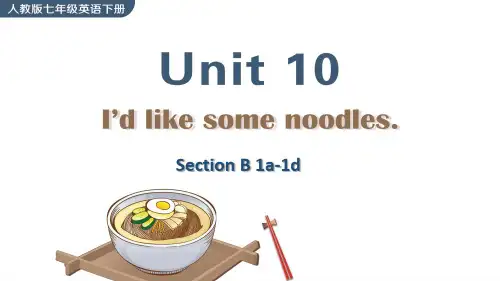
Section B 1a-1d
➢ Objectives
To learn to listen for the details. To learn to discuss the food about
likes and dislikes.
➢ Warming up
dumplings fish
porridge pancake
Байду номын сангаас
A: Uh-huh. B: And twelve dumplings. A: What kind of dumplings would
you like? B: Beef and carrot dumplings, please. A: OK. What else? B: Umm … I’d like some soup, too.
Write down some sentences about:
人教版七年级英语下册教学课件《Unit 10 Section A 1a-1c》

√ 1b Listen and check ( ) the noodles that the person orders.
√___ Special 1
___ Special 2 ___ Special 3
What size bowl of noodles would you like? a small bowl of noodles
He has a big nose and he wears a white uniform. What is he doing? He is cooking. But what is he cooking?
He is cooking some
noodles.
Would you like some noodles?
Section A 1a-1c
➢ Objectives
To learn to order food. To learn to listen for the details.
➢ Warming up What does he do?
He is a cook, I think. What does he look like?
A. would like B. like C. would D. can
5. — Would you like something to drink?
— _______.
A. No, thanks.
B. Yes, thanks.
C. No, just a little.
D. It is not good.
8. 那只小老虎有几分可爱。
That baby tiger is kind of cute.
人教版七年级英语下册unit10SectionA课件
Where did Brad go on vacation?
He visited his uncle.
Where did Tom go on vacation?
He went to summer camp.
Where did Sally go on vacation?
She stayeddo?
Played foolball
What did she do?
flew a kite
Mount Tai
Hushan Park have a picnic
Choose one picture as the thing you did on May Day. Write a short passage about it.
Pair work
They went to summer camp. 夏令营
She visited his friend.
He went to the mountains.
b
d c
a
f g
1b. Listen and answer:
Where did they go on vacation?
Did he watch TV? Yes,he did.
He stayed at home.
Where did he go on vacation?
Where did she go on vacation?
She went to New York City.
Did she go to Central Park? No,she didn’t.
about people’s vacations.Listen and find out where Nancy, Kevin and Julie went, and what they did.
人教版七年级下册英语第10单元unit10 sectionB课件
Do you know?
Why Chinese people eat noodles on their birthday? How do noodles become the symbol of longevity(长寿)?
It is said that the shape of noodles is both long and slim. In Putonghua, long (chang) and slim (shou) is similar to the pronunciation of longevity (changshou). Noodles are the most popular food on birthdays for the Chinese.
There’re hundreds of fish in the pool. 在这水池里有几百条鱼。 There’re all kinds of fishes in the lake. 这个湖里有各种各样的鱼。 Help yourself to some fish. 请随便吃些鱼。 7. 英语中表示食物的一些词的特殊用法 1)beef, fish, chicken, pork, meat, mutton等表示肉类的食物,是不可数 名词。
cake? They put a candy in a birthday cake.
3. Why do people never cut up birthday noodles in China?
Because long noodles are a symbol of long life.
4. Why do people eat special foods on their birthday?
人教新版英语七年级下册Unit10SectionB2a3c课件共35张PPT
In _C__h_in__a__, it isg_e_t_t_in__g_p__o_p_u_l_a_r to have cake on your birthday. But many people still eat very _lo_n_g__n_o__o_d_l_e_s_f_o_r__th__e_ir__b_ir_t_h_d_a_y. They never cut up the noodles because the long noodles are a symbol of long life. In some places, Chinese people also eat eggs on their birthday. They are a symbol of life and __g_o__o_d__lu_c_k_. All of these birthday foods may be different, but the ideas are _t_h_e__s_a_m__e_. They bring good luck to the birthday person.
蜡烛在生日蛋糕上,我们刚刚把它们吹灭。
4. If he or she blows out all the candles in one go, the wish will come true.如果他(她)一口气吹灭所有的蜡烛,愿望就会实现。
1) if conj. 如果 引导条件状语从句,在 从句中,if 和条件句位置 灵活,可直接放在主句后面,假设 if 条件句放句首, 从句后面要 加逗号,和主句隔开。 还要注意前后时态一致原那么
2.What do people in the UK sometimes put in a birthday cake? ___T_h_e_y_p_u__t _a_c_a_n_d_y__in__a__b_ir_t_h_d_a_y_c_a_k_e_.
人教版七年级下册英语Unit10课件ppt
经营者提供商品或者服务有欺诈行为 的,应 当按照 消费者 的要求 增加赔 偿其受 到的损 失,增 加赔偿 的金额 为消费 者购买 商品的 价款或 接受服 务的费 用
eg:根据提示写单词。 We have different kinds of noodle.s 我们有不同种类的面条。
思路解析: 根据句意,结合本单元所学单词,做
will come true.
要求互改互签
经营者提供商品或者服务有欺诈行为 的,应 当按照 消费者 的要求 增加赔 偿其受 到的损 失,增 加赔偿 的金额 为消费 者购买 商品的 价款或 接受服 务的费 用
知识点三 would like
would like 意为“_想__要___",相当于__w__a_n_t_,但语 气比want委婉。
经营者提供商品或者服务有欺诈行为 的,应 当按照 消费者 的要求 增加赔 偿其受 到的损 失,增 加赔偿 的金额 为消费 者购买 商品的 价款或 接受服 务的费 用
eg:If we Chinese work hard
together,China Dream will__B__
. e out e ture C.achieve
7.麻婆豆腐盖浇饭 :m__a__p_o__tofu with rice
8.小/中/大碗:sm___a_l_l/medium/large bowl 9.绿茶:_g_r_e__en tea
经营者提供商品或者服务有欺诈行为 的,应 当按照 消费者 的要求 增加赔 偿其受 到的损 失,增 加赔偿 的金额 为消费 者购买 商品的 价款或 接受服 务的费 用
知识点四精练
根据汉语意思完成句子。
你想要喝哪种饮料? What kind of drinks would you