
人教版英语七年级下册unit 11Section A 1a-2d课件
It was great and the air was so clean.
5. What did he do at night? He watched the stars.
6. How did Eric feel about the trip? It was excellent.
Watch the video.
Bob: Hi, Carol. How was your school trip yesterday?
Carol: It was great! Bob: Did you go to the zoo? Carol: No, I didn’t. I went to a farm. Look,
here are my photos. Bob: Did you see any cow? Carol: Yes, I did. I saw quite a lot.
1. I visited my grandparents in the countryside.
名词country和countryside都有“乡村; 农村”的意思, 往往与限定词“the”搭配 连用, 尤其是country。 e.g. We spent a pleasant day in the
Sounds good. How was the weather there?
Lucky you.
Ask your partners what they did last week. A: Hi, Lucy. What did you do last weekend? B: I …, and then I …. A: How was your last weekend? B: It was ….
--She talked with a farmer.
Listen and circle the three things
1b Carol did on her school trip in 1a.
went for a walk rode a horse talked with a farmer
milked a cow fed chickens took some photos
around the farm and talked with a farmer.
1c Ask and answer questions about
Carol’s school trip.
A: Did Carol take any photos? B: Yes, she did. -- Did Carol …?
It was excellent. I visited…
Hi, Eric. How was your trip
last week?
I went fishing every day. And I fed…
Oh, nice. What did you do?
It was great, and the air was so clean. I watched …
4. Did she milk a cow? Yes, she did.
5. What else did she do? She and her friends went for a walk around the farm and talked with a farmer.
Role-play the conversation.
2b Listen again. Circle T for true
or F for false.
1 The farmer showed Carol around the
farm.
TF
2 Carol learned a lot about farming. T F
3 The farmers grow strawberries from
cow. --What did you do? -- I went for a walk around the farm.
milk cow milk a cow horse ride a horse feed (fed, fed) feed chickens farmer quite quite a lot (of…)
went for a walk took photos
Yesterday Carol and his classmates went to the farm. What did they do on the farm?
ride/rode a horse milk(ed) a cow
feed/fed chickens
1a Match the phrases with the pictures.
1. went for a walk e 2. milked a cow b 3. rode a horse a 4. fed chickens c 5. talked with a farmerf 6. took some photos d
talk(ed) with a farmer
Past 过去
Present 现在
rode a horse fed chickens did homework milke feed chickens do homework milk a cow
过去时表示过去某个时间里发生的动作 或状态。 1. 一般过去时的动词通常用动词的过去
A: What did Carol do? B: She picked some strawberries. A: Was the farmer friendly? B: … A: What did Carol see? B: …
A: Do they grow apples? B: … A: When do they pick apples? B: … A: What did Carol pick on the farm?
Listen again and answer the questions.
1. How was Carol’s school trip? It was great.
2. Did she go to the zoo? No, she didn’t.
3. Where did she go? She went to a farm.
Apples or strawberries? Were they delicious? B: …
听力原文
带某人参观
从12月到6月
摘草莓 带一些回家
种草莓
Read the conversation and
2d answer the questions.
1. Where did Eric go last weekend?
-- Yes, she did. /No, she didn’t. She …
Listen and check the questions
2a you hear.
___What did the farmer say? ___What did you see? ___ Did you learn anything? ___ Did you ask him any questions? ___ Did you grow any apples? ___ Do they grow apples? ___ Did you eat them? ___ Were they good?
A: What does your grandfather usually do on weekends?
B: He usually …
goes for a walk takes photos
A: What did your grandfather do last weekend?
B: He usually …
v. 挤奶 n. 奶牛 给奶牛挤奶
n. 马 骑马
v. 喂养; 饲养 喂鸡
n. 农民; 农场主 adv. 相当; 完全 许多
anything
pron. (常用于否定句
或疑问句)任何东西;
任何事物
grow
v. 种植; 生长; 发育
farm
n. 农场 v. 务农; 种田
pick
v. 采; 摘
excellent
1. To talk about the activities in the farm. 2. To learn simple past tense. 3. To learn to talk about the past events:
Carol milked a cow. --Did you ride a horse? --Yes, I did./No, I didn’t. But I milked a
He went to the countryside.
n. 乡村; 农村
2. Why did he go there?
He visited his grandparents.
3. What did he do?
He went fishing and fed the chickens.
4. How was the weather there?
--She fed chickens.
--What did she do on her school trip?
--She took some photos.
--What did she do on her school trip?
--She went for a walk.
--What did she do on her school trip?
adj. 极好的; 优秀的
countryside
n. 乡村; 农村
七年级-人教版-英语-下册-[基础诊断]Section-A-(1a-2d)
![七年级-人教版-英语-下册-[基础诊断]Section-A-(1a-2d)](https://360docs-1393072327.cos.ap-beijing.myqcloud.com/088f747415791711cc7931b765ce0508763275ae.webp)
Unit 12 What did you do last weekend? (Period 1)Section A (1a-2d)Ⅰ.单项选择。
1.There are lots of ________ on my uncle’s farm.A.sheep B.horse C.chicken D.cow2.All the students felt a little ________ after they took three exams.A.surprised B.tired C.tiring D.surprising 3.________ a Beijinger, Mr. Zhang likes Beijing Opera very much.A.Of B.With C.For D.As 4.Sometimes Li Lei ________ all night to watch a football match.A.wakes up B.puts up C.stays up D.gets up 5.—Who went to the park with you yesterday?—Li Wei ________.A.does B.did C.was D.doⅡ.阅读理解。
Dear Grandma,How are you?Last Saturday I went to Long Bay with my parents. We got up at 6:00 a.m. We ate breakfast at 6:30 a.m. and after half an hour we left for Long Bay. My father is a good driver and he drove very fast. But I have to say the trip was a bit long. When we got out of our car and got to Long Bay, it was already ten o’clock!First, we swam in the water for an hour. Then we played cricket (板球) for an hour. It was time to have lunch. We ate a big lunch in a restaurant. In the afternoon, my mother and I enjoyed the sunshine on the beach. My father went fishing. He didn’t get any fish, but it was very relaxing. Soon it was time to go home. My parents and I left Long Bay. We had a great day last Saturday.My parents and I will go to see you this weekend. I miss you very much.Yours,Kate6.When did Kate leave home?A.At 6:00 a.m.B.At 6:30 a.m.C.At 7:00 a.m.D.At 7:30 a.m.7.How did Kate go to Long Bay?A.By car.B.By bus.C.By train.D.By plane. 8.How long did it take Kate to get to Long Bay?A.Half an hour.B.An hour. C.Two hours.D.Three hours. 9.What did Kate’s father do in the afternoon?A.He went swimming.B.He went fishing.C.He played cricket.D.He enjoyed the sunshine. 10.Which of the following is TRUE?A.Kate didn’t swim in the water.B.Kate’s father didn’t have lunch.C.Kate’s mother was good at driving.D.Kate will see her grandma this weekend.Ⅲ.用括号中所给词的适当形式填空。
人教版七年级下册英语Unit1第1课时(SectionA 1a-2d)-最新
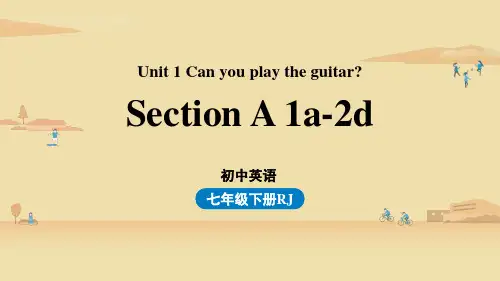
B: Oh, can you ˈsing?
A: ˈYes, I ˈcan. 2 A: Can you ˈswim?
want等词要重 读哦
B: ˈNo, I ˈcan’t.
3 A: I ˈwant to ˈjoin the ˈart ˈclub.
B: Can you ˈdraw? A: ˈYes, I ˈcan.
3. Sentences: ①Can you swim? —Yes, I can. /No, I can’t. ②What can you do? —I can dance./I can’t sing. ③What club do you want to join?—I want to join a/the
Unit 1 Can you play the guitar?
Section A 1a-2d
初中英语 七年级下册RJ
Learning goals
1. New words: guitar, chess, club, story, sing, swim, dance, draw, speak, join, tell 2. Expressions: play chess, speak English, be good at, play the guitar, join a club
play+球类运动/ 棋牌类名词
play soccer/football 踢足球 play volleyball 打排球
play Chinese chess下中国象棋
(2) play与乐器类名词连用,表示“演奏,弹奏, 吹奏”,此时名词前加定冠词the。
play the + 乐器 类名词
play the guitar 弹吉他 play the piano 弹钢琴 play the violin 拉小提琴 play the drums 敲鼓
2023【人教版】七年级英语下册教学课件-第1课时(A 1a-2d) (7)

accurate (准确).
4
5
6
six thirty
twelve o’clock
seven fifteen
Let’s enjoy a song
Round the clock the hours go
Round the Clock
Sometimes fast and sometimes slow
Tell me what the two hands say
Look at the clocks in the picture & say the time.
seven forty-five six six ten
seven thirty seven twenty
seven fifteen
seven six fifty
six fifteen six twenty six thirty six forty
get up
get dressed
brush teeth
take a shower eat breakfast go to school
Fill the time based on your actual time schedule in the form.
Daily Activities get up
6:30
get up
6:40
brush his teeth & take a shower
7:00
eat breakfast
7:20
get dressed
7:30
go to school
假如你是 Rick,根据 1a 的图片和时间说出 你一天的基本活动。可以适当增加内容。
初中英语人教版七年级下册SectionA(1a-2d)
Unit 3 How do you get to school?Period 1(1a-1c)教学依据:《新目标英语》的语言教育理念是:知识用于行动,强调“语言应用”,培养“创新、实践、能力”,发展“学习策略”。
教材分析:那么本节课作为unit4的Section A,教材以How do you get to school?为中心话题,围绕“traffic way”展开,运用一般现在时。
Section A与学生的实际密切相关,易于引发学生用英语进行交际交流,完成听说读写的任务活动,我将灵活运用这些活动,将其中的一些活动进个教学环节上,即Presentation ,practice and production上,将“激发兴趣,激活思维,轻松导入,读后仿说,逐层训练,强化能力,创设情景,迁移知识,实现目标”作为本课的设计导向。
学情分析:1、初一下学生经过小学和初中的学习,已经有了一定的英语基础知识和听说能力,正逐渐向读写过渡,同时,学生们对英语学习还保持着较浓厚的兴趣。
在加上受新课程理念的熏陶及实践,能巩固所学知识,又能提高解决问题的能力以及综合运用语言的能力。
2、从年龄特征看,学生们也很在乎他人的评价。
在学习过程中通过“兵教兵”小组训练,鼓励性评价等措施,提高学生综合语言技能。
Teaching Aims1. Knowledge Objects:a) key vocabulary:train, subway, bus ,bike…(几种交通工具的名称)b) how do you get to school? how does she\he get to school?(重点句型)c) oral practice.(练习说的能力,在说中体会句型,练习关键词汇)2. Ability Objects:a) let all the students to master some main transportations,be able to use“How do you get to…”and “How does she\he ge t to school?”to makea conversation.b) to teach the students some listening skills.3. Moral Objects:a) use the languages to talk bravely and communicative competenceb) communicational and cooperation attitude.Teaching Key Points1. Key vocabulary: subway, train, bus, ride...2. Key phrases: How do you get to ...?I take the bus/train/car...How does she/he get to...?She/He takes the bus/train/car...Teaching Difficult PointsTo use target language to describe different forms of transportations Teaching AidsMulti-media, blackboardTeaching procedure。
人教版七年级英语下册Unit10_Section_A(1a-2d)名师教案

Unit10 Section A(1a-2d)名师教案【教材版本与册数】新目标人教版七年级下册【单元名称】Unit 10 I’d like some noodles.【课时】Section A1a-2d(第1课时)【课型】Listening and speaking(听说课)附:教学活动设计步骤过程措施(教师活动与学生活动)目的持续性评价1预备与激活先期知识Step 1Greeting andLeading in(2mins)Show a picture and let the students answer the questionsbelow:1)Can you see three bowls?2)What are in them?3) Do you like noodles?4)Can you find the differences among the three bowls ofnoodles?通过图片引入话题,并通过提问引入课时单词学习。
部分学生能说出“noodles”,少部分学生能说出“beef noodles”。
2获取新知识Step 2Pre-listening(3mins)1. Teach the new words of food used in noodles.2. Look at the numbered list of ingredients. Read andrepeat.3. Ask students to match each word with the foods in 1a.4. Present the countable and uncountable nouns.5.List many words, and let the students discuss in groupsand tell us what kinds of nouns these words are.Ss practice in pairs like this:A: What kind of noodles would you like?B: I’d like beef and tomato noodles, please.A: What size bowl of noodles would you like?为1b的听力作铺垫准备和搭支架,这样通过直观图片和单词匹配的方式,能让学生更容易记住这些食物名称,也为后面的听说活动扫清了一部分词汇障碍。
七年级下册英语unit 11 Section A第1课时(1a~2d)
第11单元How was your school trip?
【课时建议】 本单元建议5课时
Section A (1a~2d ) (1)
Section A (3a ~3b ) (1)
Section B (1a ~1d ) (1)
Section B (2a~2c ) (1)
Section B (3a ~3c )……………………………………………………………………………………1课时
词汇短语:主要采用图片及多媒体展示助记法。
基本句子:采用多媒体展示及交际法。
语法:般过去时态——采用歌诀助记法。
规则动词的过去式构成方法
过去式构成有规律,一般词尾加-ed 。
词尾有个e ,去e 再加上-ed 。
辅音字母加y,变y 为i 加-ed 。
一辅重闭作尾巴,双写之后加-ed 。
Section A 第1课时(1a~2d
)
布置作业:教师引导学生课后完成本课时对应练习,并预习下一课时内容。
教学说明:
以上周的郊游为话题,引出一般过去时态,简洁明了,直奔主题。
教学说明:
通过听、说、读、写学习训练让学生掌握语言目标——一般过去时态,同时学生的口语表达能力在这一环节得到提升。
人教PEP版英语七年级下册--Unit-11-Part-B 优质教学课件
John went to _m__u_s_e_u_m__. The trip is _b_o_r_i_n_g__.
John
Alice went to _t_h_e_f_a_r_m__. She saw many _a_n_i_m__a_ls_. The trip is _g_r_e_a_t .
Alice
go on a trip 去旅行
June 15th
Language points
1. visit a fire station 参观消防站 fire 作不可数名词时,意为“火”;作可数名词 时,意为“火灾;炉火;灶火”。
常见短语:be on fire着火 put out a fire灭火 fire station消防站 make a fire生火
快地(的) adv. & adj. 机器人 n. 导游;向导 n. 礼物;赠品 n. 总的说来 所有事物;一切 pron.
fast robot guide gift all in all everything
感兴趣的 adj. 对……感兴趣 黑暗的;昏暗的 adj. 听到;听见 v.
interested be interested in dark hear (heard)
2a
Do the following words describe good things or bad things? Put a√ for good and an×for
bad. Leave a blank if they can mean both.
_√__ interesting _×__ difficult _√__ lovely _×__ slow
I went to ...
七年级-人教版-英语-下册-[学习任务单]Section-A-(1a-2d)
Unit 12 What did you do last weekend? (Period 1)Section A (1a-2d)班级_________ 姓名_________学习目标学完这一课,你能够掌握:1.词汇:camp、lake、beach、badminton、sheep、as、natural、butterfly、visitor、tired、stay、stay up late;2.能力:运用一般过去时谈论周末活动;从对话中抓住主要信息;3.交际功能:使用句型“What did you do last weekend?”“On Saturday morning, I played badminton.”“I worked as a guide at the Natural History Museum.”“I stayed up late to watch the soccer game.”谈论周末活动。
课前学习任务【学习任务一】写出下列动词的过去式want live study stopclean dance play planturn taste stay shoppick arrive worrywash save carrydo go have issee sit read buyeat lose pay rideput come get know【学习任务二】词汇检测1.v.扎营;搭帐篷__________2.n.湖;湖泊__________3.n.海滩;沙滩__________4.n.羽毛球运动__________5.n.羊;绵羊__________6.prep.作为;当作__________7.adj.自然的__________8.n.蝴蝶__________9.n.游客;访问者__________10.adj.疲倦的;疲劳的__________ 11.v.停留;待__________12.深夜不睡;熬夜__________课堂学习任务【学习任务一】1.看图,回答问题。
七年级-人教版-英语-下册-[综合训练]Section-A-(1a-2d)
Unit 12 What did you do last weekend? (Period 1)Section A (1a-2d)Ⅰ.补全对话。
根据对话情景,在每个空白处填上一个适当的句子,使对话的意思连贯、完整。
A: Hi, Linda. ____1____?B: My last weekend was quite good.A: ____2____?B: I did my homework first and then I cleaned my room on Saturday morning.A: ____3____?B: Yes, I did. I like reading books, so on Saturday afternoon I went to the library.A: Did you play sports on Sunday?B: Yes, I did.A: ____4____?B: My favorite sport is volleyball. I usually play it with my friends.A: ____5____?B: I played volleyball in the park last Sunday.1._____________________________________________________2._____________________________________________________3._____________________________________________________4._____________________________________________________5._____________________________________________________Ⅱ.短文填空。
人教版七年级英语下册教学课件(RJ) Unit 10 Section A (1a-2d)
I want some hot tea, Mom. 妈妈,我想喝些热茶。
would like的固定句型
1). Would you like some …? 你想要一些……吗? 该句型常用于征求对方的意见。肯定回答常用Yes, please. ,而否定回答常用No, thanks.。需要注意的是,在该句型 中要用some,而不用any,以表示说话人希望得到肯定回 答。如: — Would you like some apples?
beef
mutton
potatoes
cabbage
What’s this?
bread
noodles
rice
dumplings
beef chicken
tomatoes
carrots
1a Match the words with the foods.
1. mutton __g___
2. beef ___b__ 3. noodles __c___ 4. chicken __d__ 5. cabbage __e__ 6. potatoes __f__ 7. tomatoes __a__ 8. carrots ___h__
B: I’d like beef and tomato noodles.
Special 2
A: What kind of noodles would you like?
B: I’d like chicken and cabbage noodles.
Special 3
A: What kind of noodles would you like? B: I’d like mutton and potato noodles.