
初中英语人教版八年级下册Grammar Focus
7. —Amy, can we give away these soft toys? We ________ them for many years. —Mom, but I want to keep the bear. A. bought B. had C. have bought D. have had (2015 湖北黄冈)
Tony basketball
How long
since he was 10 years old
favorite book for two years
Student 1
Student 2
1. Review Grammar. 2. Finish the exerciseshe sentences using for or since.
1. Jim is in Japan. He arrived there three days ago. Jim has been in Japan for three years. 2. They are very hungry. Their last meal was ten hours ago. They have not eaten for ten hours/ since ten hours ago.
2. 在现在完成时中,含有for和since的 句子可以相互转换。如: They have lived here for five years. =They have lived here since five years ago.
3. 在现在完成时中,表示短暂意义的 动词(如come和see)在肯定句和一般 疑问句中不能和表示一段时间的时 间状语连用,但在否定句中是可以 的。如: Mike has come to London for three weeks. (×) They haven’t seen each other for many years. (√)
2. 有些短暂性(短语)动词可转化为表示状态的 短语。常见的有: leave → be away fall asleep →be asleep die → be dead fall ill → be ill begin / start → be on finish → be over join → be in / be a member of(参加,加入) open → be open come back → be back close→ be closed return → be back arrive/get/reach → be in/at marry → be married lose→be lost
【中考链接】 1. —When ________ you ________ the new bike? —I ________ it for 2 days. A. did, have; bought B. did, buy; have had C. did, buy; have bought (2015 湖北恩施)
5. This museum _________ has been (be) here for is (be) one of the over 20 years. It _____ oldest buildings in this small town.
4c
Fill in the questions and ask two
2. for作介词,后接一段时间,表示 一个动作或一种状态已经持续了多 长时间。如: I have studied here for three years. She has been away for five days.
注意: 1. 对since和 for引导的时间状语提问时, 常用how long。如: Jane has learned to play the piano since two years ago. (对划线部分提 问) How long has Jane learned to play the piano?
students. Then complete the chart.
1. Do you have a(n) _______? How long have you had it? 2. Do you own a(n) _______? How long have you owned it?
Things
短暂性(短语)动词与延续性(短语)动词 和与表示状态的短语之间的转化 1. 有些短暂性(短语)动词可转化为相应 的延续性(短语)动词。常见的有: become → be borrow → keep buy → have / own catch a cold → have a cold come → stay put on → wear/be on go to sleep → sleep move to → live in
1. How long have you had that bike over there? I’ve had it for three years. 2. How long has his son owned the train and railway set? He’s owned it since his fourth birthday. 3. Have you ever played football? Yes, I did when I was little, but I haven’t played for a while now.
• 8.Hurry up! The play ___for ten minutes. A.has begun B.had begun C.has been on D.began 9.I have ____the book for a mouth. A.borrowed B.lent C.kept D.bought 10.His father ___the Party since 1978. A.joined B.has joined C.was in D.has been in
现在完成时的持续型用法 现在完成时还可表示过去某一时间开始 并一直持续到现在(包括“现在”在内)的 动作或状态,该用法中的动词多是延续
性动词,常见的时态标志词有since, for等。
1. since意为“自从……以来”, 它既可作 介词,也可作连词。作介词时, 后接表 示过去的时间点, 表示某事开始的时间; 作连词时, 引导时间状语从句, 从句常用 一般过去时。如: We have been here since last Sunday / two years ago/2011. Mr. Jones has worked here since he was twenty-five.
Fill in the blanks with the correct 4b forms of the verbs in brackets. 1. I _______________ have never been (never be) to the water park before. I want to _____ go (go) next month before the weather gets too cold. 2. They _________________ have never owned (never own) any pets, but they have _________________ always wanted (always want) to have a dog.
4. We have been friends ________. A. last year B. one year ago C. since we met last year D. when we met last year (2015 广西南宁)
5. —How happy the grandparents are! —Yes, they _____ for fifty years. A. have been married B. have married C. have got married D. married (2015 四川眉山)
6. —What age did you leave home? —I left home at 18, Neil. I ________ your city for five years. A. have gone to B. have been to C. have been in D. have come to (2015 江苏扬州)
3. I have a camera. I bought it in 2009. I have had a camera since 2009. 4. I know Anna. I first met her three years ago. I have known Ann for three years/ since three years ago. 5. Linda is ill. She became ill on Monday. Linda has been ill since Monday.
3. We _________ have had (have) a piano since last bought (buy) it from November. We _______ the Li family when they moved to the US last year. haven’t been (not be) 4. Cathy and Amy ____________ back to their hometown for two years. They ______ miss (miss) their hometown a lot and hope to visit the place next year.
英语人教版八年级下册Unit9Grammar -focus(语法课)
Unit9 Have you ever been to a museum设计者:江口三中韦玉霞教材版本:八年级下册( 人教版 Go for it !)教学内容:Unit9(Grammar Focus—4b)教学重难点;教学重点:掌握与话题有关的重点词汇,have been to ,have gone to以及现在完成时结构和动词过去分词分类。
教学难点:在不同的语境中准确应用不同的标志词。
学情分析:教学对象为八年级学生,此阶段的学生模仿能力已相当的强,并有一定的词汇量积累。
可以通过已学过的词汇去理解新的词汇。
教学方法:听说法,练习法教学手段:多媒体教学目标:1.Have been to 和have gone to 的用法及区别2.学习现在完成时的构成及用法。
3.现在完成时和一般过去时的区别。
4.动词的变化分类。
(1)知识目标:掌握have been to ,have gone to(2)能力目标:能正确运用短语(3)情感目标:培养学生勤于总结归纳的习惯教学准备:学生提前预习本课内容,标志生词教学流程:Step1:Leading inT:Do you know this picture? S:Yes,I do.T:Have you seen the cartoon of Journey to the West ??S:Yes ,I have/No , I haven’t.T:Have you read Alice in Wonderland yet?S:Yes, I have ./No, I haven’t.T:Have you ever been to Guilin?S:I have been there twice.1.教师引导学生对already 和yet 做复习回顾,并即刻造句使用。
2.讲述have been to 和have gone to 的含义,以及遇到地点副词时省略to,并引导学生造句。
初中英语人教版八年级下册Unit 1 Grammar Focus
• 6. There’s something wrong with one’s +身 体部位/sth. • = Something is wrong with one’s +身体部位 /sth. ...有问题。 • 如:他的电脑有点问题。(2) There is something wrong with his computer. _____________________________________ _____________________________________ Something is wrong with his computer.
4. He should go to a doctor.
4c. One student mimes a problem. the other students in your group guesss the problem and give advice.
A: What's the matter? Did you hurt yourself playing soccer? B: No, I didn't. C: Did you fall down? B: Yes, I did. D: You should go home and get some rest.
A:What’s the matter? toothache B:I have a _____________. go to the dentist A:You should_______________________. You shouldn't _______________________. drink cold water
A:What’s the matter?
初中英语人教版八年级下册Grammar Focus
Unit 8 Have you read Treasure Island yet?Section A Grammar focus-4c ( 第4课时)(练习课)授课教师:Ms Hu 时间:2017.5.25学习目标:1. 能正确使用现在完成时表达已经发生的事情。
2. 能够通过动词时态填空的练习,体验并辨别现在完成时和一般将来时、一般过去时的区别。
3. 词汇:fiction,science fiction,technology, French教学重点:学习用“Have you …yet? I’ve already…”等谈论过去的经历。
教学难点:掌握already, yet在现在完成时中的用法。
教学过程:Step1.Greetings and lead-in.( Play the English song we will rock you )Step 2.Warming up1.Show the two books to the students and ask if they have read the two books.2.Target language show and practice.(Grammar Focus)Step 3.Pair work ---- Conclude: Present perfect tense※我来总结:1.Already & yet 的用法区别:_________________________________________________2.现在完成时的用法:现在完成时表示____________________________________________________________________________3.现在完成时的构成:______________________________________4.动词过去分词变化规则(1) 规则动词过去分词的变化规则和过去式的变化规则一样。
初中英语人教版八年级下册Unit10 Grammar focus

Title The Revision of ThePresent Perfect Tense Teacher Hada Middle SchoolHan YunTeaching goals 1.Cognitive Dimension:1)Grammatical items: Review The present perfecttense.2)Topic: Talking about what we have done2.Skills and Competence: Students can use the present perfect tense.to talk about things and write a composition about what we have done.3.Affective Dimension: Love our mothers and love our life.Teachingmethods andStrategiesApplying Task-Based Language Teaching Approach.ImportantpointsThe form of the present perfect tense and the using of the tenseDifficultpointsThe differences between the past tense and the present perfect tenseSteps Contents Teacher’sActivities Students’ActivitiesTeaching IdeasStep 1 Leading in 1)Greet the Ss2)Review thetenses .3)Introduce thetopic.1)Greet the Ss.2)Ask thequestion.3)Write downthe topic.1)Greet theteacher.2)Look andtalk withthe teacher.1)Greet eachother.2)Lead in thenew lesson.Step 2 Presentation The form of thepresent perfecttense.Tell the Ss toreview the form ofthe present perfecttense .Review theform of thepresent perfecttense ,and answer thequestionHelp Ss masterthe tense points.Step 3 Practice Do some exercises Guide Ss toexercises aboutpast participle.Watch andanswerReview the pastparticiple.Step 4The using of the present perfect tense 1)Compare thesentences.2)Inchoative Verb1)Ask Ss tocompare thesentences and findout the1)Compare thesentences andfind out thedifferences .Consolidate thetarget language.and Continuative Verb3)Have/has gone to Have/has been to Have/has gone in differences .2)Do exercisesabout InchoativeVerb andContinuative Verb3)Ask Ss totranslate sentencesto review the usingof these phrases.4)And check theanswers.2)Do someexercises.3)Translatesentences andreview theusing ofthese phrases.Step5 Consolidation The differencesbetween the pasttense and thepresent perfecttenseAsk Ss tocompare thesentencesFind out thedifferencesConsolidate thelanguagepoints.Step6 Production 1)Translate somesentences.2)Fill in the blanks3)Multiple choice4) Writing1)Ask Ss totranslate.2)Ask Ss to discussinto groups .3) Ask Ss to usewords to fill in theblanks.4)Ask Ss to discussinto groups thengive a report.1)Translatesomesentences .2)Discuss intogroups.3)Fill in theblanks.4)Discuss andmake a report.1)To improveSs’creativeability.2) To improveSs’comprehensive.3)Train Ss’ability ofwriting.Step6 Homework Writing Ask Ss to write acomposition .BlackboardDesignThe Revision of The Present Perfect TenseHave/has + doneHave/has gone toHave/has been toHave/has been inHe went to Beijing last week.。
初中英语人教版八年级下册grammar focus
3.Let’s help our friends.Let studentslisten to the MP3from their classmatescarefully, and then give advice.
•You should/could +dosth
•Why don’t youdosth?
•Why notdosth?
•You’d better (not)+dosth.
•What about/How about +doingsth.
Step3. Practice
1.Ask some students to give advice according to the ppt.
第4章第节(课)第课时连续号__
课题
Unit4 Why don’t you talk to your parents?
Section AGrammar focus
备课时间
月日第周
主备人
覃洁
教学目标
知识与技能
掌握给建议的句型。
过程与方法
Pair work, talking
情感态度与价值观
了解别人的生活现状以及苦恼,帮助他人。
t4.Exercise.
教学反思
S:You should…
Step2.Summary
By asking students to give advice, we summary all the sentence structures about how to give advice. And let students read them together in order to deep their memory.
初中英语人教版八年级下册Grammar Focus
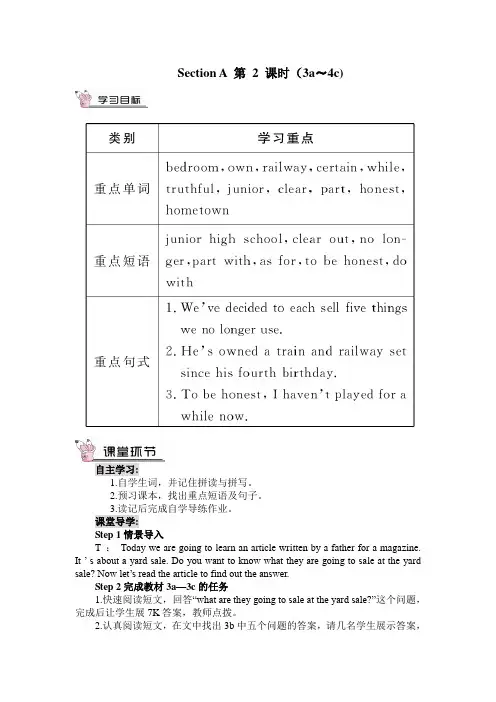
Section A 第2 课时(3a〜4c)自主学习:1.自学生词,并记住拼读与拼写。
2.预习课本,找出重点短语及句子。
3.读记后完成自学导练作业。
课堂导学:Step 1情景导入T :Today we are going to learn an article written by a father for a magazine. It ’ s about a yard sale. Do you want to know what they are going to sa le at the yard sale? Now let’s read the article to find out the answer.Step 2完成教材3a—3c的任务1.快速阅读短文,回答“what are they going to sale at the yard sale?”这个问题,完成后让学生展7K答案,教师点拨。
2.认真阅读短文,在文中找出3b中五个问题的答案,请几名学生展示答案,教师点拨。
3.细心阅读短文,理解每一句话的意思,小组合作解决遇到的疑难问题,教师点拨短文中出现的重点和难点。
4.熟读短文,识记并背诵知识要点。
5.小结训练.(B)(1) things in this cupboard,please.A.Clear upB.Clear outC . Clean upD . Put up(D )(2)She feit sorry to partA .to B. for C.at D. with( C )(3) ,I was surprised he know where Iwas because we moved so often.A.Excuse meB. SorryC . To be honest D. As forStep 3 完成Grammar Focus —4c 的任务1.让学生朗读Grammar Focus中的句子。
人教版新目标英语八年级下册Grammar-Focus翻译
人教版新目标英语八年级下册人教版新目标英语八年级下册Grammar-Focus 翻译Grammar-Focus 翻译Unit 1怎么了?我胃痛。
下次你不该当吃那么多。
Ben 怎么了?他伤者自己了。
他背痛。
他应当躺下歇息。
你发热吗?是的 ,我发热。
不 ,我不发热。
我不知道。
他牙痛吗?是的 ,他牙痛。
他应当去看牙医,并做一个X 光检查。
她该怎么办?她应当量体温。
我应当在上边敷些药吗?是的 ,你应当。
不 ,你不该当。
Unit 2我想帮助无家可归的人。
她决定参加一个堪称阅读项目的志愿者选拔。
你能够要求医院同意你探望这些孩子并使他们高盛行来。
Mario 相信这能帮助他找到未来朝思暮想的工作。
她志愿每周在那边工作一次,帮助孩子们学习阅读。
我将制作一些口号并把它们张贴在学校四周。
Unit 3我能够和我的朋友们一同出去吃晚餐吗?自然 ,那应当能够。
看完电影后 ,我们能喝点东西吗?不 ,你们不可以。
明日你有一场篮球赛。
请你带狗去遛遛好吗?好的 ,但我想先看一个节目。
请你把垃圾取出去扔掉好吗?好的 ,自然能够。
Unit 4你看上去很疲倦,怎么了?昨晚我学习到子夜,所以我睡眠不足。
我应当怎么做?你为何不忘掉它呢?只管她不对,但这也不是什么大不了的事。
他应当怎么做?他应当和他的朋友说说,以便他能说声对不起。
也许你能够去他家。
我想我能够 ,但我不想让他惊讶。
Unit 5昨晚 8 点你在做什么?狂风雨时她在做什么?她在做家庭作业。
当狂风雨到暂时他在做什么?当狂风雨到暂时,他在图书室里阅读。
当开始下大雨的时候Ben 在做什么?当开始下雨时,Ben 在帮他妈妈做晚餐。
当 Linda 在睡觉时 Jenny 在做什么?当 Linda 在睡觉时 Jenny 在帮助 Mary 造作业。
Unit 6故事是如何开始的?以前 ,有一位老人接下来发生了什么?这个人一说完,愚公就说 ,他死后他的家人将持续移山. 为何愚公试图移山?由于它们这样之大,以致于走到另一边要花很长时间. 美猴王是谁 ?他是《西游记》里的主人公.美猴王不可以做什么?他不可以把自己变为人,除非他能隐蔽他的尾巴.Unit 7世界上最高的山是什么?珠穆朗玛峰。
人教版八年级英语下册Unit 7 Grammar Focus-4c 课件
much, a little, even, a lot, a bit, far等。
Grammar Focus
一、同级比较句型
(1)as + adj./adv. + as: 和...一样 (2)not + so/as + adj/adv. + as:和… 不一样
➢The book is less interesting than that one. 这本书不如那本书有趣。
(3)The+比较级…, the+比较级…: “越…,就越…”
➢The more games you play, the worse your grades get.你游戏玩得越多,成绩就越差。
人人教教版版英语英语
Unit 7 What’s the highest mountain in the world?
Section A Grammar Focus - 4c
1. To learn to use numbers to describe facts.
2. To learn to use comparatives and superlatives with adjectives and adverbs.
Who
One of the most popular places for this is the Himalayas. They run along the southwestern part of China. Qomolangma, which rises the highest, is very dangerous to climb.
人教版八年级下英语Unit 1 Grammar Focus
Unit 1What's the matter?Grammar Focus课前预习1.乘客;旅客2.向;朝3.问题;苦恼4.击;打5.她自己6.下车7.使……惊讶;出乎……意料8.立即;马上9.陷入;参与10.呼叫求助11.有心脏病12.同意做某事13.由于;多亏14.及时15.陷入麻烦16.摔倒典例精讲典例1At 9:00 a.m.yesterday,bus No.26 was going along Zhonghua Road when the driver saw an old man lying on the side of the road.昨天上午9点,26路公交车正行驶在中华路上,这时司机看到一位老人躺在路边。
此处was going为过去进行时。
过去进行时由“was/were+doing”构成,表示过去某个时间正在发生或进行的动作。
see sb.doing sth.意为“看见某人正在做某事”。
典例2He got off and asked the woman what happened.他下车问那位妇女发生了什么事。
(1)get off意为“下车”,其反义短语为get on(上车)。
(2)happen动词,意为“(某事)发生”。
表示“某地/某时发生了某事”,用“sth.happened+地点/时间”。
【拓展】①表示“某人出了某事”,用句型sth.happened to sb.。
e.g.What happened to Julie?朱莉发生了什么?②happen还有“碰巧”之意,常用于“sb.happened to do sth.”和“It happened+that从句”。
e.g.I happened to be there.我碰巧在那儿。
典例3He expected most or all of the passengers to get off and wait for the next bus.他预料大部分或全部乘客会下车等下一辆公交车。
Unit3GrammarFocus课件人教版英语八年级下册
it
last
night.
finish doing sth.完成做 某事
4. _R_ Could you help me do the dishes? No, I can’t. I cut my finger and I’m trying not to get it wet.
5. _R_ Could you lend me some money? Hmm. How much do you need?
eg:You can borrow a book from the library.
★ lend表示“借出”,把属于自己的东西借给
别人暂时使用,常与介词to连用,也可以跟
双宾语。
lend...to...
把...借给...
lend sb. sth.
借给某人某物
He’s going to lend his bike to Tom. 他打算把他的单车借给Tom。 You mustn’t lend others my pen. 你不能把我的笔借给其他人。
2. —Could you please clean your room?(2017・云南昆明)
—___D___!
A. Me too
B. What a pity C. See you
D. No problem
3. — Could I borrow your dictionary, please?(2016・广西贺州)
—___D___. Here you are.
A. No, thank you B. Sorry, you can’t C. Yes, I’d love to D. Of course
情态动词could的用法