
高中英语 Unit16 Stories Section Ⅲ Lesson 3 Life Stories课件 北师大版选修6
基础导练
文本感知
知识精要
篇章信息 Read the text and choose the best answer. 1.From the passage we can know that B . A.Helen knew well on how to learn abstract(抽象的) words B.Helen had some difficulty learning words that she couldn’t touch C.Helen gave up trying when she couldn’t understand the meaning of “love” D.Helen could learn language as easily as children who could see and hear
基础导练
文本感知
知识精要
Ⅰ
Ⅱ
Ⅲ
5.Uncertain about ,she stopped to think carefully. 由于不确定怎样改正,她停下来仔细思考。 答案:how to fix them 6. Helen such a complex word... 这是海伦第一次理解了一个如此复杂的单词…… 答案:It was the first time;had understood
基础导练
文本感知
知识精要
1
2
3
4
5
6
7
8
9
restriction(s) on...对……的限制 restrict vt.限制 restrict...to...把……限制在……
基础导练
文本感知
知识精要
1
2
3
4
5
6
7
8
9
基础导练
文本感知
知识精要
1
2
3
4
5
6
7
8
9
2.Now that Helen understood the key to language,she was very eager to learn more and use it as much as she could.(Page 11) 既然海伦理解了语言之谜,她非常渴望学习更多的词语并且尽可能 多使用它们。 1)now that 既然,由于 Now that everybody is here,we can begin the meeting. 既然大家到齐了,我们开会吧。 Now that you are a big boy,you must behave better. 既然你已是个大男孩了,就必须表现得好些。
基础导练
文本感知
知识精要
3.According to the passage,which of the following words may be C difficult for Helen to understand? A.Chair. B.Clothes. C.Hate. D.Rope. 4.In which order does the author organize the passage? D A.Time. B.Place. C.People. D.The process of learning words.
基础导练
文本感知
知识精要
1
2
3
4
5
6
7
8
9
As she thought about its meaning again,the sun came out.(Page 11,Lines 81-82) 当她再次考虑它的意思时,太阳出来了。 I saw Peter as I was walking in the street. 我在街上走的时候看见了彼得。 As time went by,things seemed to get worse. 随着时间的推移,情况似乎变得更加糟糕了。
key后的介词常常用to,类似的单词还有 entrance,solution,answer,reply,invitation,reaction,attitude等。
基础导练
文本感知
知识精要
1
2
3
4
5
6
7
8
9
基础导练
文本感知
知识精要
1
2
3
4
5
6
7
8
9
3)eager adj.渴望的,热衷的 He is eager for the teacher’s praise. 他渴望得到老师的赞许。 The saleswoman in the shop is eager to please everybody. 商店里的那个女售货员总是十分殷勤,希望使每个人都满意。 She is eager for her parents to buy a doll for her. 她盼望父母给她买一个洋娃娃。
Ⅰ
Ⅱ
Ⅲ
Ⅱ.短语互译 1. 对……的限制 答案:restriction(s) on 2. ……的关键 答案:the key to 3. 渴望 答案:be eager for/ to do sth. 4.be doing...when... 答案:正在……这时…… 5.it is/was the first time (that) 答案:这是……第一次……
基础导练
文本感知
知识精要
1
2
3
4
5
6
7
8
9
expand,extend,spread与stretch ①expand“展开,扩大”,不仅可指尺寸的增加,还可指范围和体积的 扩大。 ②extend“伸出,延伸”,可指空间范围的扩大,以及长度、宽度的向外 延伸,也可指时间的延长。 ③spread“伸开,传播”,一般指向四面八方扩大传播范围,如“传播(疾 病),散布(信息等)”。 ④stretch“伸展,拉长”,一般指由曲变直、由短变长的伸展,不是加长。
基础导练
文本感知
知识精要
1
2
3
4
5
6
7
Байду номын сангаас
8
9
基础导练
文本感知
知识精要
1
2
3
4
5
6
7
8
9
2)the key to……的关键,……的答案 The key to success is preparation. 成功的关键在于准备。 The driver of the car probably holds the key to solving the crime. 这位司机很可能掌握着破获这一罪案的线索。
vt.限定,限制→
adj.能容忍的,忍得住
adv.渴望地,热切地→
基础导练
文本感知
知识精要
Ⅰ
Ⅱ
Ⅲ
4. v.扩大,扩充→ n.扩张,扩大;展开 答案:expand,expansion 5. adj.明显的,显而易见的→ adv.明显地 答案:apparent,apparently
基础导练
文本感知
知识精要
基础导练
文本感知
知识精要
1
2
3
4
5
6
7
8
9
基础导练
文本感知
知识精要
1
2
3
4
5
6
7
8
9
2)expand v.扩大,扩充;使膨胀;展开 Metals expand when they are heated. 金属受热膨胀。 We’ve expanded the business by opening two more stores. 我们增开了两个商店以扩展业务。 expand one’s view 充分阐述自己的观点 expand on/upon 充分阐述;详谈 expand...in/into...把……扩展 The scientist expanded on/upon his new theory. 那位科学家详述了他的理论。
基础导练
文本感知
知识精要
2.Which of the following statements is NOT right? A A.Before seven years old,Helen could communicate with her parents in simple language. B.Anne Sullivan had some teaching experience before she came to teach Helen. C.Anne Sullivan was very patient and loved Helen very much. D.When Helen learned language,she followed a “simple-to-complex” way.
基础导练
文本感知
知识精要
1
2
3
4
5
6
7
8
9
基础导练
文本感知
知识精要
1
2
3
4
5
6
7
8
9
3.As Helen’s knowledge and vocabulary expanded,she asked more and more questions.(Page 11) 随着海伦的知识和词汇量的扩大,她问的问题越来越多了。 1)这是一个复合句,其中as引导时间状语从句,as意为“随着,当…… 的时候”。 As she did this,Miss Sullivan touched Helen’s head and spelled the word “think” into her hand.(Page 11,Lines 74-75) 当海伦这样做时,沙利文小姐就摸摸她的头,在她的手里拼写“思考” 这个词。
北师大版英语高二上册Module 6《Unit 16 Stories》(lesson3)ppt课件
Read these comprehensive questions and try to think of possible answers. Then find answers to questions in the text.
Answer the questions
1. How was Helen Keller different from other children? 2. Why was her teacher so important to her? 3. How did she learn new words? 4. Why did she feel happy when she understood the meaning of the word “water”? 5. Why was the word “love” so difficult for Helen to understand? 6. Why did she think that love might be the sun? 7. How did she learn the word “think”?
8. What do the words “love” and “think” have in common?
1. How was Helen Keller different from other children? Heller Keller couldn’t see or hear. 2. Why was her teacher so important to her? Because she was a very special girl who needed a superb teacher.
getting to know Sullivan …getting to know some words which can be touched…the mystery of language was revealed to her …getting to understand some abstract words.
高中英语 课时3 Unit 16 Stories Period Three Lesson 3 Li

areas.
7.There is no sense (in) trying to argue with a stubborn (固执
的) woman.
8.He would want you to remember him as he was in former
Ⅴ.完成句子 1. While in London
,he studied music and painting.
在伦敦时,他学习音乐和绘画。
2. Eager to see her friends
,she took a taxi home
rather than ride a bike. 因为渴望见到她的朋友,她乘出租车回家而不是骑自行车回
复习课件
高中英语 课时3 Unit 16 Stories Period Three Lesson 3 Life Stories作业课件 北 师大版选修6
课时作业3 Lesson 3 Life Stories
Ⅰ.单词拼写
1.China has made a great breakthrough (突破) in space
1.A.wedding C.funeral
B.party D.lecture
答案:C
解析:考查名词辨析。根据下文 It was a cloudy day when the funeral was held.可知 Caro 在犹豫去不去参加大学老师的葬礼。 A.wedding 婚礼;B.party 聚会;C.funeral 葬礼;D.lecture 演讲。故 选 C。
这是一篇记叙文。文章讲述了 Caro 在大学毕业典礼的演讲中, 出现了很严重的失误。这使他十年来都不能释怀,断绝了与同学 的来往。后来在大学老师的葬礼上,他意外得知自己纠结了十年 的事情,原来别人并没有放在心上。有些事情被证明并不是我们 想的那样。
高中英语 Unit 16 Stories—Lesson 3《Life Stories》学案 北师大版选修6
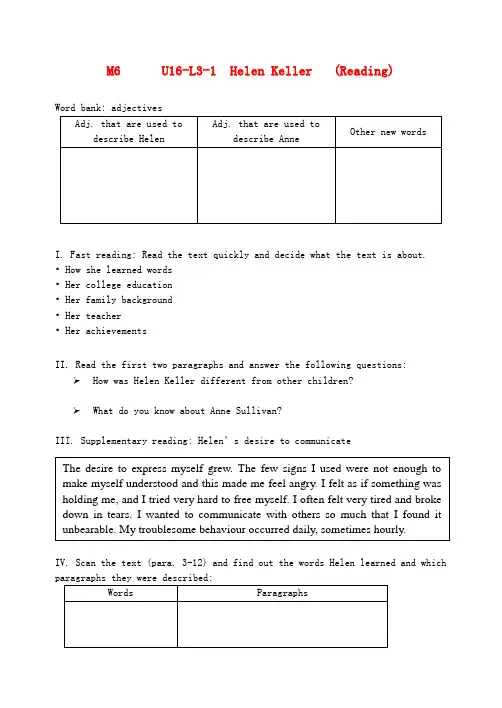
M6 U16-L3-1 Helen Keller (Reading)Word bank: adjectivesAdj. that are used todescribe Helen Adj. that are used todescribe AnneOther new wordsI. Fast reading: Read the text quickly and decide what the text is about. • How she learned words • Her college education • Her family background • Her teacher• Her achievementsII. Read the first two paragraphs and answer the following questions:How was Helen Keller different from other children?What do you know about Anne Sullivan?III. Supplementary reading: Helen ’s desire to communicateIV. Scan the text (para. 3-12) and find out the words Helen learned and whichV. Read the text and work in pairs to find out how Anne Sullivan taught the words to Helen. Fill in the blanks with words or phrases.VI. Read Para.3&4 again and fill in the chart in pairs.Word bank: adjectivesAdj. that can express positivefeelingAdj. that can express negative feelingAnne Sullivan let Helen ______________ the doll and ________ the letters __________________.Anne let water ________ one of Helen ’s hands and ________ the letters into the other hand. Helen had a _________________.Anne _____ her arm ______ round Helen. She ____ Helen _____ to her and pointed to ______________.“Think” was also difficult but Helen had ______________. When Helen ___________ her mistakes when making necklaces, Anne _______ Helen ’s head and _______ “think ” into her hand.______________________________After Helen asked again if love was __________, Anne told her that love could not be ___________ but she could _______________________ of love.I. Use the following words to describe what happened in the video clips. “doll”“water”II. Read paragraph 7-9 and answer the following questions: What did Helen think ‘love’ was at first?Why was the word “love” so difficult for Helen to understand?How did Helen feel when she couldn’t understand “love”?III. Read paragraph 10-12 and answer the following questions: How did she learn the word “think”?How did Anne explain “love”?IV. Read Para.7-12 and fill in the chart in pairs.V. Find out adjectives or phrases that are used to describe the following: Helen’s learning process and results (Para. 5-adj.)Helen’s feeling when she didn’t understand the meaning of “love” (Para. 9-adj.)Helen understood the meaning of “think” suddenly (Para. 10-phrases)The moment when Helen finally under stood the truth of “love” (Para. 12-adj.)VI. Decide which of them are used to describe the process of learning the words “think”and “love”and write down the numbers into the correct box. Use them to describe how Helen learned “think” and “love”:1) had a breakthrough 2) drew me closer3) pointed to my heart 4) in a flash5) put her arm gently round…6) pointed up to7) vivid moment 8) uncertain about9) touched… head 10) feel the sweetness11) confused and disappointed。
2020学年高中英语Unit16StoriesSectionⅢLesson3LifeStories

2019-2020学年高中英语Unit 16 Stories Section ⅢLesson 3 Life Stories课后限时训练北师大版选修6编辑整理:尊敬的读者朋友们:这里是精品文档编辑中心,本文档内容是由我和我的同事精心编辑整理后发布的,发布之前我们对文中内容进行仔细校对,但是难免会有疏漏的地方,但是任然希望(2019-2020学年高中英语Unit 16 Stories Section ⅢLesson 3 Life Stories课后限时训练北师大版选修6)的内容能够给您的工作和学习带来便利。
同时也真诚的希望收到您的建议和反馈,这将是我们进步的源泉,前进的动力。
本文可编辑可修改,如果觉得对您有帮助请收藏以便随时查阅,最后祝您生活愉快业绩进步,以下为2019-2020学年高中英语Unit 16 Stories Section ⅢLesson 3 Life Stories课后限时训练北师大版选修6的全部内容。
Section Ⅲ Lesson 3 Life StoriesⅠ.单词拼写1.The government placed many restrictions (限制)on foreign trade。
2.The company has expanded (扩大)its operations in Scotland by building a new factory there。
3.You should make the best of every precious (宝贵的)minute to study。
4.It is apparent (明显的)to us that he hasn't done his work properly。
5.It is uncertain (不确定的)what side effects the medicine will bring about.6.Loneliness in a gloomy raining day may be unbearable to him。
2019_2020学年高中英语Unit16StoriesSectionⅢLesson3LifeStories练习(含解析)北师大版选修6

Section Ⅲ Lesson 3 Life Stories一、根据句意及首字母或汉语提示,填写单词1.It is foolish to waste one’s p time.2.We all know that most metals e when heated.3.In f times we crossed the river by boat,but now we drive over the new bridge.4.Life is u ;he has lost heart finally.5.He is as s as a donkey.6.It is(显然)to all that the driver is to blame for the accident.cation is a (逐渐的) process.8.The naughty boy is really (烦人的).9.It was found at the (准确的)spot where he had left it.10.He is a (直率的)man;just trust him.二、单句语法填空1.—Hurry up!Don’t have the car (wait)at the gate.—I’ll be ready after I have my son (dress).2.—Do you know London at all?—No,this is the first time that I (be)here.3.The sale of alcohol is restricted people over the age of 18.4.I was wondering what to do with my car which couldn’t start a kind man offered to help.5.—It is no use having ideas only.—Don’t worry.Peter can show you to turn an idea into an act.6.The rocks (gradual)wears away due to the action of the water.7.She was stubborn and angry,and often broke things when she(not understand).’t understood8.Helen would have to learn to understand words (spell)on her hand.9.This soon led her (discover)more complex words and changed her (think)processes.10.(try) to learn the word “love” was an experience that she remembered well.11.Is love the (sweet)of flowers?12.Helen then felt the (warm)of the sun (shine)on them.三、完成句子1.由于她在交流方面有诸多严重的限制,海伦的行为常常令人难以忍受。
英语:Unit 16《Stories》课件-Lesson3 Life Stories(北师大版选修6)
Life Stories
Helen Keller
Helen Keller’s Autobiography
Helen Keller (June 27, 1880 - June 1, 1968), was an author, lecturer, and humanitarian (献身的 献身的) whose unusual life and dedicated (献身的) work had an international influence on (残疾人 残疾人). the lives of the disabled (残疾人). She became blind and deaf at the age of 19 months through a damaging brain fever and could communicate only through (歇斯底里 歇斯底里) hysterical (歇斯底里) laughter or violent tantrums (发怒). But, with the help of her (发怒). 发怒 teacher Anne Mansfield Sullivan, Keller braille(盲文 盲文) learned to read braille(盲文) and to write by using a special typewriter.
Ex 3 Find words in the text that have the same meaning as the words in brackets.
1—severe 3—eager 5—restrictions 7—apparent 2—precious 2— 4— 4—straightforward 6— 6—former
北师大版高中英语选修六Unit 16《Lesson 3 Life Stories》教案 3
Unit 16 Stories Lesson 3 Life Stories教学设计3教学目标知识和技能:1. Target language语言目标(重点词汇和短语)a. 重点词汇和短语severe, restriction, unbearable, stubborn, troublesome, straightforward, precise, precious, eager, gradual, complex, warmth, apparent, uncertain, breakthroughb. 重点句子1).Now that Helen understood the key to language, she was very eager to learn more and use it as much as she could.2). She was making necklaces with the help of Miss Sullivan when she noticed that she had made some mistakes.3).It was the first time Helen had understood such a complex word ---a word for something she couldn’t touch.2. Ability goals能力目标The students can catch the main idea by using reading strategies.教学过程Lead-inStep 1 T asks the students to look at the picture and asks whether and what they know about Helen Keller.• If Ss’ response is limited, T can provide the background of Helen Keller and list her famous saying.[PPT 2–3]Pre-readingStep 2 T asks Ss about Helen’s problems. T may use the following questions:What were her problems?• T uses pictures, examples to ask Ss to guess the meaning of the new words.Step 3 T presents reading strategies.• T asks Ss to predict what will be talked about in the article based on the title and the picture. Step 4 Ss predict what will be talked about in the text.While-readingStep 5 Ss read the text quickly and check their predictions.Step 6 Ss Read and find out the examples of words Helen learned.Step 7 Ss read the text to fill in the table or complete the passage.Step 8 Ss talk about Helen’s learning process.Post-readingStep 9 Ss answer the questions.Step 10 Ss work in groups of 4 and do a role-play:Xiao Ming, 15 years old, recently had an accident and lost his left arm. He was in low spirit. Talk with him and try to encourage him to cheer up using Helen as an example.• Encourage Ss to use the information on the handouts.• Provide the language that Ss may use while presenting.I’m optimistic about…As far as I know…It seems to me that…From my point of view, ...• T chooses some groups to present their interview in front of the class.Homework1. Underline some useful expressions in the text.2. Read the article “Three Days to see” and write about your feelings using at least 200 words.。
高中英语 Unit 16 Stories Period Three Lesson 3 Life St
Unit 16 Stories Period Three Lesson 3 Life Stories 课件(北师大版选修 6)
Language Focus
1.Anne was a teacher and former student at a school for the blind in Boston. 安妮是波士顿一所盲人学校的老师,她也曾在那里就读。 [归纳拓展] former 作形容词用时,意为“以前的,在前的”;作名 词用时,常与 the 连用,表示“(两者中的)前者”。 the former...the latter...前者……后者……
[题组训练] (1)This is the fourth time that she has rung you today .
这是她今天第四次给你打电话了。
(2)It was the second time that I had visited the Great Wall . 这是我第二次参观长城。
他太好学了,以致于每晚都熬夜。 (2)The girls were bored and seemed eager for new
experience. 女孩子们感到腻烦了,似乎对新的体验很渴望。
第五页,共13页。
Period Three
3.As Helen’s knowledge and vocabulary expanded,she asked more and more questions. 随着知识面的扩大和词汇量的增加,海伦问的问题越来越多。 [归纳拓展] expand v.扩大,扩充;膨胀,扩张;详述 expand into...扩展成为…… expand on/upon 详述 [助学图解]
北师大版英语高二选修六 Unit 16 Stories Lesson 3课件(共35张PPT)
Reading Strategy II— draw a mind map
Task 6: Retell the learning process based on the mind map.
Reading Strategy II— draw a mind map
Task 6: Retell the learning process based on the mind map.
Task 1: Read the text to get the main idea. The text is mainly about: A. how Helen learned to play games. B. how Helen communicated with her teacher. C. how Helen learned words.
Summary of Helen’s learning process
Watch a video about Helen’s burst of understanding.
Further thinking and speaking
Task 7: Think about the following questions and voice your opinions. 1. What did Helen learn from Anne Sullivan? 2. What made Helen a success? Find evidence from
选修六 Unit 16 Stories (5) 高二年级 英语
Lesson 3 Life Stories Reading
Helen Keller (1880-1968)
Background information
Unit 16 Stories—Lesson 3《Life Stories》教案(北师大选修6)
教学设计Unit 16 Lesson 3 Life Stories教材分析本课是16单元的第3课,以“人生故事”为主题,主课文讲述的是美国著名盲人女作家Helen Keller 童年学习语言的真实故事。
本课的难点在于文章较长、生词较多且抽象、情节脉络较复杂。
本课的教学设计分为三课时。
第一课时侧重对课文的整体理解及情感体验,引导学生清晰地整理出文章结构和事件发展脉络,提取文章细节信息并进行初步的输出活动。
第二课时在对已学课文进行复习的基础上,学生继续完成对细节信息的提取,并能够重组信息和尝试运用重点词汇进行表达,最后总结和提升所学内容。
第三课时的主要任务是(1)词汇的巩固、扩展及在新语境中的使用;(2)对情态动词过去时形式和意义的体验和理解。
教学内容话题:著名美国女作家Helen Keller童年学习语言的故事(阅读)词汇:重点词汇:severe, restriction, unbearable, stubborn, troublesome, straightforward, precise, precious, eager, gradual, complex, warmth, apparent, uncertain, breakthrough相关词汇:sweetness, now that, expand策略:通过图片、标题、开头等预测文章内容,略读等语法(体验):情态动词过去时的功能和形式第一课时First Period教学目标:在本课学习结束时,学生能够:1.理清课文故事的大体情节和发展脉络;2.说出Helen Keller学习语言过程中的1-2个事例;3.感悟并描述课文中人物的情感、态度。
*表示可灵活处理的活动。
第二课时Second Period 教学目标在本课学习结束时,学生能够:1.运用所学单词和短语描述Helen的学习语言的过程;2.讨论Helen和/或Anne成功的原因;*表示可灵活处理的活动。