
人教版七年级上册英语讲义 Unit 4 Where is my bag
第1页 /共 10页 Unit4 Where is my bag? 讲义
一、【重点单词】
where [wɛə] adv.在哪里;到哪里
table ['teibl] n.桌子
bed [bed] n.床
sofa ['səufə] n.沙发
chair [tʃɛə] n.椅子
on [ɔn] prep.在…上
under ['ʌndə] prep.在…下
come [kʌm] v.来;来到
desk [desk] n.书桌
think [θiŋk] v.认为;想;思考
room [ru:m, rum] n.房间
their [ðɛə] pron.他(她,它)们的
hat [hæt] n.帽子
head [hed] n.头
know [nəu] n.知道,了解
radio ['reidiəu] n.收音机;无线电广播
clock [klɔk] n.时钟
tape [teip] n.磁带;录音带;录像带
player ['pleiə] n.播放机
model ['mɔdl] n.模型
plane [plein] n.飞机
tidy ['taidi] adj.整洁的;井井有条的
but [bʌt] conj.但是
our ['auə] pron.我们的
everywhere ['evriwɛə] adv.处处;到处;各个地方
always ['ɔ:lweiz, 'ɔ:lwəz] adv.总是
二、【重点短语】
1. my pencil box 我的铅笔盒
2. on the sofa 在沙发上
3. in your schoolbag 在你的书包里
4. under your bed 在你的床底下
5. in your grandparents’ room 在你祖父母的房间里
6. a tape player 一台录音机
7. a model plane 一个飞机模型 第2页 /共 10页 8. English books 英语书
9. in the bookcase 在书柜里
10. under the radio 在收音机下面
11. on the teacher’s desk 在讲台上
12. on your head 在你头上
e on 快点儿
14.under the table在桌子底下
15.be tidy 整洁的
16. have a clock 有一个时钟
三、【重点句型】
1.—Where’s the schoolbag? 书包在哪里?
— I t ’s under the table. 在桌子底下。
2.— Where are my books?我的书在哪里?
—They’re on the sofa. 在沙发上。
3.Where is your ruler?
你的尺子在哪里?
4.—Where’s my bag? 我的包在哪里?
—Is it on your desk? 在你的书桌上吗?
5.It’s not under the chair.
它不在椅子下面。
6.I think it ’s in your grandparents’ room.
我想它在你祖父母的房间里。
7.I‘m tidy,but Gina is not.
我(东西放得)整齐,但吉娜(东西放得)不整齐。
8.I have a clock.
我有一个时钟。
9.Gina’s books are everywhere.
吉娜的书到处乱放。 第3页 /共 10页 10. Where is my pencil box? 我的铅笔盒在哪?
11. Where are my books? 我的书在哪?
12.. It’s under your bed. 它在你的床底下。
13.. Come on, Jack. 快点儿,杰克。
14. I don’t know. 我不知道
15.I’m tidy. 我是爱整洁的人。
四、【词汇精讲】
1. on
on作介词可以表示
(1)在……之上
Your book is on the desk. 你的书在桌子上。
(2)附近,靠近
He is on my right. 他在我的右边。
(3)在……的时候
I get up late on Sundays. 周日我起得较晚。
(4)关于
He gave us a lecture on how to learn English.
他给我们做了一个关于怎么学习英语的报告。
(5)通过(某种方式)
I study English on radio.
我通过收音机学英语。
2. table
table可数名词,“桌子”,其复数形式为tables。常用于以下短语:
at table 在吃饭/ 就餐;
at the table 在桌子旁。
例如:She is at table now. 她现在在吃饭。
3. room
room可数名词,“房间”,对应的复数是“rooms”。例如: 第4页 /共 10页 There are 180 rooms in this hotel. 这个酒店有180个房间。
room还可以做不可数名词,意为“空间,位置”。例如:
There is no room in the room.
房间里已经没有空间了。
4. bed
bed 可数名词,“床”;其复数形式为beds。常用于以下短语中:on the bed 在床上, in bed卧床(睡觉)。例如:
My book is on the bed. 我的书在床上。
She is ill in bed. 她卧病在床。
拓展:与bed相关的常见短语
go to bed 去睡觉
lie in bed 躺在床上
make the / one’s bed 整理床铺
5. know
know动词,“知道、了解、认识”;其后常接名词、代词或者句子作宾语,也可以承接上文,省略宾语,其同音词为no。例如:
I know his name. 我知道他的名字。
Do you know her? 你认识她吗?
I know him. 我了解他
I don’t know. 我不知道。
—Where is my English book? 我的英语书在哪?
—Sorry, I don’t know. Is it on the table? 对不起,我不知道。它在桌子上吗?
辨析:watch 和clock
watch作名词时,指戴在手腕上的手表,挂在胸前的怀表或者用来计时的秒表。
clock 指生活中用的钟表、挂钟、闹钟等,多用来指报时或闹响的钟。闹钟是“alarm clock”。例如: 第5页 /共 10页 There is a clock on the wall. 墙上有个钟。
I have a beautiful watch. 我有一个漂亮的手表。
6. but
but是连词,意为“但是”,和and, or等一样,可以用来连接两个并列句。but连接两个并列句时,表示前后意义的转折;此时,but的前面要有逗号。例如:
I like English, but he doesn’t.
我喜欢英语,但是他不喜欢。
7. come on
come on 意为“快点”,是come组成的常用词组之一,在口语中使用很广泛,有很多不同的意思。以下是常见的用法:
(1)表示请求、鼓励、劝说等。例如:
Come on,Lucy,don’t be so shy. 来吧,露茜,别不好意思。
(2)表示催促。例如:
Come on, it’s getting dark. 快点,天要黑了。
(3)体育竞赛时鼓励队员,意为“加油”。例如:
“Come on!Come on!” shouted the audience again and again.
“加油!加油!”观众一再地喊。
五、【句式精讲】
1.-Where is the schoolbag?书包在哪里?
- It’s under the table.在桌子底下。
询问某人或某物在哪个地方,可用句型“Where + be + 主语(人或物)?”。where是疑问副词,意为“在哪里”,be要随着后面主语人称单复数进行变化,单数用is,复数用are。where’s
是where is的缩写形式,回答时不能用yes或no,而是问什么就答什么。如果主语是人,回答时用人称代词主格做主语;如果主语是物,回答时单数为“It’s + 表示地点的词”,复数用第6页 /共 10页 “They are + 表示地点的词”。例如:
—Where’s my radio? 我的收音机在哪儿?
—It’s on the desk. 在桌子上。
-Where are your books? 你的书在哪里?
-They are in the bookcase. 在书柜里。
—Where’s your father? 你的父亲在哪儿?
—He’s at home. 他在家。
-Where are your father and mother? 你的父母在哪里?
-They are at home.他们在家。
2. Are the keys on the sofa?
这是用一般疑问句句型“Is/Are+主语+介词短语+?”来询问“某物是在某处吗?”的意思。比特殊疑问句少一个特殊疑问词,它可以用Yes/No来回答。例如:
-Is your schoolbag on the bed? 你的书包在床上吗?
-Yes, it is./No, it isn’t. 是的,它在那里。/不,它不在那里。
3. I don’t know.
I don’t know. 可单独成句,表示“我不知道”;因此当别人向你询问的事情你不知道时,可用“I don’t know.”作答,也可以在后面跟宾语,说明我不知道的内容。也可以在前面加上“Sorry.
/ I’m sorry.”,这样语气上显得更客气些。例如:
—Where is my pencil? 我的铅笔在哪儿?
—Sorry, I don’t know. 对不起,我不知道。
六、【核心语法】
1.常用方位介词的用法
介词常置于名词或代词之前,表示词与句子其他成分之间的关系。一般在句子中不单独作任何成分。
(1)on 在……上面 与物体有接触面
on the wall 在墙上
on the floor 在地板上
最新人教新目标七年级上册英语Unit 4 Where’s my schoolbag全单元教案

Where’s my schoolbag?
Section A 单词 where adv. 在哪里; 到哪里 table n. 桌子 bed n. 床
sofa n. 沙发 chair n. 椅子 on prep. 在……上
under prep. 在……下 come v. 来; 来到 desk n. 书桌
think v. 认为; 想;思考 room n. 房间
their pron. 他(她、它)们的
hat n. 帽子 head n. 头 know v. 知道; 了解
短语 come on 快点儿 on the table 在桌上
in the schoolbag 在书包里 under the chair 在椅子下
句型 1. —Where’s his pencil box? 他的文具盒在哪儿?
—It’s in his schoolbag. 它在他的书包里。
2. —Where are my books? 我的书在哪里?
—They are on the sofa. 它们在沙发上。
3. —Are the keys on the sofa? 钥匙在沙发上吗?
—No, they aren’t. They’re on the table. 不,它们不在。它们在桌上。
Section B 单词 radio n. 收音机; 无线电广播 clock n. 时钟
model n. 模型 tape n. 磁带; 录音带; 录像带
player n. 播放机 plane n. 飞机
tidy adj. 整洁的; 井井有条的 but conj. 但是
人教版七年级上册英语Unit 4 Where is my schoolbag 测试题
Common Progress Please Criticize
金戈铁骑制作人教版七年级上Unit 4 Where is my schoolbag测试题
(满分100分)
一、 单项选择。 (10分)
( )1. This is ________ radio. It’s my grand-father’s.
A. the B. a C. an D. /
( )2. — What’s that ________ the desk?
— It’s a cat.
A. in B. on C. under D. for
( )3. — ________ is your hat?
— It’s on the table.
A. Where B. Who C. What D. How
( )4. The two boys are my cousins. ________ names are Tony and Jack.
A. My B. Our C. His D. Their
( )5. The clock is Kate’s. The tape player is ________, too.
A. her B. his C. she D. hers
( )6. I see a bed, a table and a bookcase in his ________.
A. bag B. hat C. room D. sofa
( )7. I put (放) my keys on the table, ________ I can’t find them now.
A. and B. but C. too D. well
( )8. — Do you ________ Ms. Wu’s phone number, Jane?
初一上英语Unit4 Where is my schoolbag讲义
好教育 始于爱
Unit4 Where is my schoolbag?
词句精讲精练
责编:郭素清
词汇精讲
1. on
on作介词可以表示
(1)在……之上
Your book is on the desk. 你的书在桌子上。
(2)附近,靠近
He is on my right. 他在我的右边。
(3)在……的时候
I get up late on Sundays. 周日我起得较晚。
(4)关于
He gives us a lecture on how to learn English.
他给我们做了一个关于怎么学习英语的报告。
(5)通过(某种方式)
I study English on radio.
我通过收音机学英语。
注意:in the tree 与 on the tree的区别
in the tree 表示外来的事物,不是树上长出来的。on the tree是树上长出来的。
例如:The bird is in the tree. 鸟在树上。
There is an apple on the tree. 树上有个苹果。
2. table
table可数名词,“桌子”,其复数形式为tables。常用于以下短语:at table 在吃饭/ 就餐;at
the table 在桌子旁。
例如:She is at table now. 她现在在吃饭。
辨析:table 和 desk
两者都有“桌子”之意,其区别如下:
desk指“书桌、课桌、办公桌”,常指读书、写字、办公等用的桌子;通常带有抽屉(drawer)。
例如:There is a desk in his office. 他的办公室里有一张桌子。
七年级英语上册 Unit 4《Where is my backpack》教案和练习 人教新目标版
word 1 / 13 英语:Unit 4《Where is my backpack》教案和练习
(人教版七年级上)
一、学习目标:
1. 知识目标
Where is / are …?
—Is the baseball on the sofa? —Yes, it is. /No, it isn’t.
—Are his keys on the dresser? —Yes, they are. /No, they aren’t.
2. 能力目标
Talk about where things are 谈论物品的位置
二、重点、难点:
重点
1. 单词、短语:
table,math book,behind,under,next to,between
2. 句型:
—Where is my backpack? —It’s under the table.
—Where are her books? —They are on the chair.
难点
介词的使用
三、知能提升:
(一)【单词学习】
1. table
desk [desk]
【用法】
table n. 桌子;餐桌
desk n. 书桌;办公桌;写字台
辨析:
table n. 指用餐、会谈或消遣时所用的桌子。
desk n. 指读书、办公时所用的桌子,一般带有抽屉。 word 2 / 13
【例句】
There is only a table for four at the restaurant. 这个餐馆只有一X四人桌。
【考点】
at a/the table 在桌子旁
at table 在进餐,在吃饭
【例句】
My bag is at the table. 我的书包在桌子旁边。
They talk loudly at table. 他们吃饭的时候大声交谈。
【考题】
—Would you give me the chair _______, please? —OK. Here you are.
七年级英语上册 Unit 4 Where’s my schoolbag讲义+习题 (新版)人教新目标版
1 Where is my schoolbag
课程新授
授课题目
UNIT4. Where is my schoolbag?
教
学
设
计 学习目标 1.引导的特殊疑问句,物品位置的表达方式及相关问答。
2.方位介词的用法。如in,on,under,behind等。
教学重难点 1.引导的特殊疑问句,物品位置的表达方式及相关问答。
2.方位介词的用法。如in,on,under,behind等。
教
学
流
程
一、温习(复习提问)
上单元测试题讲解。本单元重点单词检查默写。
二、学习目标:
1.引导的特殊疑问句,物品位置的表达方式及相关问答。
2.方位介词的用法。如in,on,under,behind等。
三、学习新课(自主探究学习)
一、重点词组。
on the sofa 在沙发上 in your schoolbag在你的书包里
under the table 在桌子下面 come on快点 on your head在你的头上
tape player录音机 model plane飞机模型 English books英语书
on the teacher`s desk 在讲课桌上 on my bed在床上
二、重点句型。
1. bed: go to bed 上床睡觉 under the bed在床下
on the bed(物品放在床上)in bed (躺)在床上
eg: There is a new bed in my bedroom.
She is ill in bed.
2. bookcase 书橱,书柜 on the bookcase, in the bookcase
Eg: The bookcase is for me. 这个书橱是给我的。
My dictionary is on the bookcase.
新人教版七年级英语下册unit6导学案
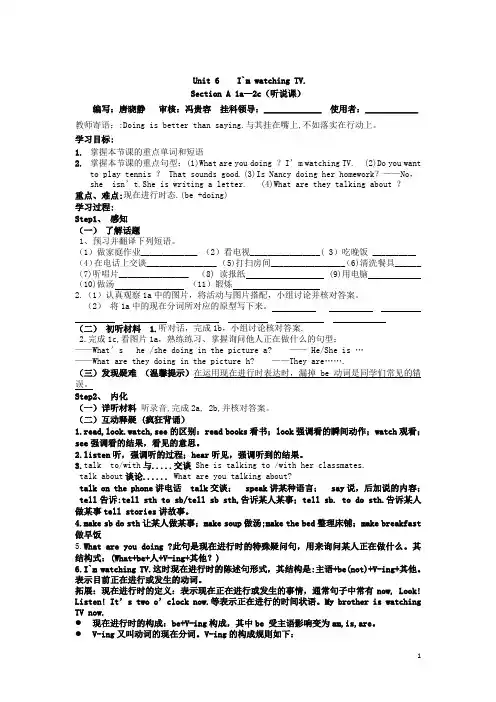
1
Unit 6 I`m watching TV.
Section A 1a—2c(听说课)
编写:唐晓静 审核:冯贵容 挂科领导:_____________ 使用者:____________
教师寄语::Doing is better than saying.与其挂在嘴上,不如落实在行动上。
学习目标:
1. 掌握本节课的重点单词和短语
2. 掌握本节课的重点句型:(1)What are you doing ?I’m watching TV. (2)Do you want
to play tennis ? That sounds good.(3)Is Nancy doing her homework?——No,she isn’t.She is writing a letter. (4)What are they talking about ?
重点、难点:现在进行时态.(be +doing)
学习过程:
Step1、 感知
(一) 了解话题
1、预习并翻译下列短语。
(1)做家庭作业_____________ (2)看电视________________( 3)吃晚饭 __________(4)在电话上交谈________________ (5)打扫房间_________________(6)清洗餐具______(7)听唱片________________ (8) 读报纸 (9)用电脑
(10)做汤 (11)锻炼
2.(1)认真观察1a中的图片,将活动与图片搭配,小组讨论并核对答案。
(2) 将1a中的现在分词所对应的原型写下来。
(二) 初听材料 1.听对话,完成1b,小组讨论核对答案.
英语人教版七年级上册unit 4 Where is my schoolbag
课题: Unit 4 Where 's my schoolbag?
设计者:尹玲 审核者:于林安 执教者: 授课时间:
学生学案 教师导案
Section A 1a~1c(一课时)
一.学习目标:
1、掌握下列句型
(1)— the schoolbag?
—It’s under the table.
(2)—Where my book?
—They are the sofa.
(3)— it on your desk?
—No, It’s on the sofa.
(4)— the keys on the sofa?
—No, they .
2、学会一些表示家具的名词以及学习用品的单词。
3、学会方位介词, in, on, under, behind,的用法。
4、能用方位介词和where句型表述物品的正确位置。
5、掌握由“be动词+物体+介词短语”构成的询问物体位置的一般疑问。
二、学习重点
1、学会使用where引导的特殊疑问句询问物品的位置,并正确运用方位介词谈论物品的位置。
2. 句型:—Where 's my schoolbag?
—It’s under the table.
—Where are my schoolbag?
—They’re in your schoolbag.
三、学习难点
能够理解功能句型中形容词性物主代词my, your, his, her, 的用法,以及句子的单复数一致性原则。
四、学法指导:预习中自主学习的方法,课堂上积极参与小组讨论、合作、探究的方法。
五、学具准备:多媒体、课本、学案。
六、学习过程:
(一)、明确目标,学案导学 谈话导入新课:
1.回顾复习旧知识
精选】人教版七年级上册英语Unit4第四单元优秀教案
精选】人教版七年级上册英语Unit4第四单元优秀教案
Unit 4 Where's My School Bag?
n A (1a-1c)
XXX:
1.Key words: where。table。bed。bookcase。sofa。chair。on。under
2.Key phrases: on the sofa。in your bag。under your bed
3.Key XXX:
Where are my books?
They are on the sofa.
Where's my pencil box?
It'XXX.
Where's my computer game?
It's under your bed.
Focus of Learning: 1.Correct use of special XXX "where"
2.Describing the n of items using nal phrases
Difficulties in Learning:
1.Correct use of special XXX "where"
2.Describing the n of items using nal phrases
Self-Study:
1.Preview the new words on page 19 and memorize them。Complete the following n from Chinese to English:
Where: ________ 2.Table: ________ 3.Bed: ________ 4.Sofa:
________ 5.Chair: ________ 6.On: ________ 7.Under: ________
2.Carefully preview 1a。1b。and 1c。and XXX:
On the sofa
Unit 4 Where's my schoolbag 讲义及答案
Unit 4 Where's my schoolbag
讲义及答案
第 2 页
第 3 页
第 4 页 Part 2 Texts
课文(一)
Mom: Come on, Jack!
Jack: Oh, no! Where’s my bag?
Mom: Hmm…is it on your desk?
Jack: No. And it’s not under the chair.
Mom: Oh! It’s on the sofa.
Jack: Thank you, Mom. Err…where’s the
map? Mom: I think it’s in your grandparents’
room. Jack: Yes, it’s on their bed! And my
hat?
Mom: It’s on your head!
Jack: Oh, yeah! Haha!
Structure
1.Where’s the map? It’s in your grandparents’ room.
2.Where are my books? They’re on the sofa.
3.Where’s his pencil box? It’s in his schoolbag.
4.Where’s your ruler? It’s under the chair.
5. Where are their keys? They’re on the table.
句型:—Where+be+名词?
—It’s / They’re +介词短语.
A: Where the keys?
B: They’re the .
A: Where’s the ? it on your
desk? B: No, it’s the chair.
A: Where the pencils?
七年级英语上册 Unit 4 Where’s my schoolbag?(第3课时)教案人教新目标版
Unit 4 Where’s my schoolbag?(第3课时)
一、教材分析
本单元围绕着Where is my schoolbag?的话题,共设计了三个部分的内容。通过教授本单元,使学生学会谈论房间里物品的位置,能读懂有关物品位置的便条,并学会写便条让朋友帮自己从房间里取东西。
Section B学会通过观察和听音,来谈论和记录房间里物品的名称和位置。
1a, 1b, 1c, 2a, 2b进一步熟悉表示物品的单词,并能谈论和记录物品的位置。
二、三维目标
语言知识目标 1. 正确谈论物品的位置。 2. 掌握表示日常物品的新单词。 3. 熟练运用in, on, under, beside, in front of, near。 4. 熟练运用 where is/ are „?的疑问句形式并做出正确回答。 5. 注意名词单复数和代词they 的用法。
语言技能目标 1. 能流利地谈论物品的所在位置,如:Where is my backpack? It’s under
the bed. Where are my books? I don’t know. 2. 能询问所找物品的物质,并能用yes/no
进行简单回答, 如:Is the plant near the chair? Yes, it is. / No, it isn’t. Are
my keys in the drawer? Yes, they are. /No, they aren’t.
情感态度目标 1. 培养语用能力,让学生真正做到在用中感悟,把所学到 的语言知识与生活实际结合起来,使学习过程生活化; 2. 帮助学生养成干净整洁的好习惯。
三、教学重点
1.重点词汇:table, bed, sofa, dresser, bookcase, chair, drawer, plant, bag, alarm
clock, video, hat, tape, take, bring, thing, under, on, to, can, need.