
【推荐】六年级英语下册 Unit 8 I’m watching TV课件 鲁教版五四制
(二)现在进行时的构成 现在进行时的构成:be+动词的-ing形式。 肯定句:主语+be+动词的-ing形式+其他。 否定句:主语+be+not+动词的-ing形式+其他。 一般疑问句:Be+主语+动词的-ing形式+其他。 特殊疑问句: 特殊疑问词+be+主语+动词的-ing形式+其他。
二、现在进行时的时间状语及标志性词语 ①now 现在 ②at this time 在这时 ③at the moment 现在 ④look 看(常用于句首) ⑤listen 听(常用于句首)
全的人,主要是担心漏掉重要内容,影响以后的复习与思考.,这样不仅失去了做笔记的意义,也将课堂“听”与“记”的关系本末倒置了﹙太忙于记录, 便无暇紧跟老师的思路﹚。 如果只是零星记下一些突出的短语或使你感兴趣的内容,那你的笔记就可能显得有些凌乱。 做提纲式笔记因不是自始至终全都埋头做笔记,故可在听课时把时间更多地用于理解所听到的内容.事实上,理解正是做好提纲式笔记的关键。 课堂笔记要注意这五种方法:一是简明扼要,纲目清楚,首先要记下所讲章节的标题、副标题,按要点进行分段;二是要选择笔记语句,利用短语、数 字、图表、缩写或符号进行速记;三是英语、语文课的重点词汇、句型可直接记在书页边,这样便于复习时查找﹙当然也可以记在笔记本上,前提是你 能听懂﹚;四是数理化生等,主要记老师解题的新思路、补充的定义、定理、公式及例题;五是政治、历史等,着重记下老师对问题的综合阐述。
4. Is she ___(listen) to the teacher? 5. Look at the picture. The children ____(fly) kites. 答案:4.listening 5.are flying
Ⅱ. 句型转换 1. Jenny is running. (改为否定句) ________________________________________________. 2. Tom is looking at a picture. (改为一般疑问句,并作肯定回答) —_____________________________________________? —____________________. 答案:1. Jenny isn’t running 2. Is Tom looking at a picture;Yes, he is
sit on a chair read a book on the sofa play computer games
Байду номын сангаас 【佳作鉴赏】
It’s 8: 00 p. m. now. Tom’s family are at home. Tom’s father is sitting on a chair and reading a book. His mother is watching TV on the sofa in the living room. His grandmother is cleaning the room. What is Tom doing now? He’s doing his homework. But his sister Mary is playing computer games in her bedroom.
3. Jim stands under the tree. (改用现在进行时表达) ________________________________________________ 4. They are cleaning their classroom. (对画线部分提问) _______________________________________________? 5. We are reading English at the moment. (对画线部分提问) ______________________________________________? 答案:3.Jim is standing under the tree 4. What are they doing 5. What are you reading at the moment
2019/8/4
最新中小学教学课件
14
谢谢欣赏!
2019/8/4
最新中小学教学课件
15
编后语
做笔记不是要将所有东西都写下,我们需要的只是“详略得当“的笔记。做笔记究竟应该完整到什么程度,才能算详略得当呢?对此很难作出简单回答。 课堂笔记,最祥可逐字逐句,有言必录;最略则廖廖数笔,提纲挈领。做笔记的详略要依下面这些条件而定。
讲课内容——对实际材料的讲解课可能需要做大量的笔记。 最讲授的主题是否熟悉——越不熟悉的学科,笔记就越需要完整。 所讲授的知识材料在教科书或别的书刊上是否能够很容易看到——如果很难从别的来源得到这些知识,那么就必须做完整的笔记。 有的同学一味追求课堂笔记做得“漂亮”,把主要精力放在做笔记上,常常为看不清黑板上一个字或一句话,不断向四周同学询问。特意把笔记做得很
动情况, 要求词数60个左右。
It’s 8: 00 p. m. now. _________________________________ ______________________________________________________
【思路点拨】 (1)该题目以介绍一家人的活动为话题,主要内容涉及每个人的 活动情况,描述某人的活动要使用现在进行时。 (2)单元实用短语、句型储备
【探究总结】 一、现在进行时的用法
表示现在(说话瞬间)正在进行或发生的动作。 (一)现在分词的构成 ①一般在动词词尾加-ing。例如: go—going look—looking ②以不发音字母e结尾的动词,去e加-ing。 例如: write—writing close—closing ③以重读闭音节结尾的动词,如果末尾只有一个辅音字母,应先 双写这个字母,再加-ing。例如: get—getting run—running
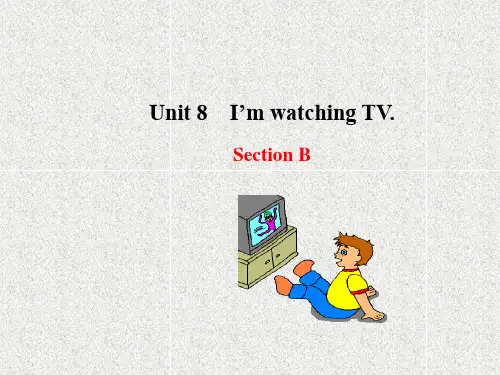
Unit 8 I’m watching TV.
现在进行时 Ⅰ. 用所给词的适当形式填空 1. —What are you doing now? —I ____ (clean) the windows. 2. —Are you ___ (make) a cake? —Yes, we are. 3. OK. I am ___(come) now. 答案:1.am cleaning 2.making ing
本单元以谈论活动为话题,具体谈论某人正在做某事,因 此句子谓语要用现在进行时。现在进行时的构成是“be动词+ 现在分词”,而学生容易漏掉be动词。现在分词的构成分三种 情况(①直接加;②去e加;③双写加),学生容易在双写上出差 错,这些容易出错的地方,就是在表达方面的难点。
【习作练习】 现在是晚上8点, 请根据以下信息, 描述一下Tom一家的活
鲁教版英语六年级(下)第8单元 Unit 8 I'm watching TV课件1

4、What is he doing ? He is doing homework . 5、What is she doing ? She is eating dinner .
3aConversation NhomakorabeaAA:Do you want to go to the movies ? B:Sure ,this video is boring . A:When do you want to go ? B:Let’s go at six o’clock .
Conversation B
Yes,she is . No,they aren’t .
3、现在分词的构成: (1)、一般在动词原形末尾加——ing go--going eat--eating watch—watching (2)、以不发音e结尾的动词,先去掉e再加--ing have –having write—writing come—coming (3)、以重读闭音节结尾的动词,如末尾只有一 个辅音字母,应先双写这一字母,再加—ing swim—swimming get—getting put—putting
A:What are you doing ? B:I’m reading a book . A:Do you want to go to the movies ? B:Sure ,when do you want to go ? A:Let’s go at seven o’clock .
Unit 8 I’m watching TV
鲁教版英语六下Unit 8《I’m watching TV》(Section B)ppt课件
A bird is walking.
Three birds
are flying.
Practice
is drawing (draw) a picture now. 1. The boy _________ are singing 2. Listen! Some girls __________(sing) in the classroom.
PAIRWORK
—What is/are …doing? —… —Where is/are…? —…
PAIRWORK
Names Places Activities Tina mall eating lunch Mike school playing basketball Lisa library reading books
Let’s talk about this photo !
Mike
Task 2
Dear Bob,
Here is a photo of my family. In this
I’m doing my homework. My watching TV father is ________________. My reading a book My grandfather is ________________.
—Is Alice playing basketball?
—No, she isn’t. She’s…
Task 1
2b Read the TV report and answer the questions below. 1. Why are Zhu Hui’s family watching boat races and making zongzi? 2. Does Zhu Hui like his host family? What does he think
鲁教版英语六年级下Unit8 I;m watching TV SectionA (8)

课堂教学设计U8 I’m watching TV.GrammarSection AⅠ.Teaching ObjectivesKnowledge Objectives1. To master the Present Progressive tense (be doing) .--What are you doing? -- I’m watching TV.--Are you doing your homework? --Yes, I am.\ No, I’m reading a book.2. To master the between the simple present tense and thepresent progressive tense.--She’s exercising now.--She exercises on Monday.Ability objectives: Students are able to1. Talk about what people are doing.2. Use the target language in natural speech.Moral ObjectivesLearn more about each other through communicating more. II. Teaching Key and Difficult PointsPresent progressive tenseIII. Teaching MethodsCommunicative Language Teaching Methods;Task-based Language Teaching MethodsIV. Teaching ToolsPPT, blackboardV. Teaching ProceduresScene 1—Cartoon World(Grammar learning)1.Lead-inEnjoy a video about the lively cartoon characters to learn what they are doing.PPT shows some cartoon characters which students are interested.T: What is he\she doing?Ss: He\She is …T: What are they doing?Ss: They are…2.Summarize the Decla rative sentence of the present progressivetense. (主语+ Be + doing.)I am hav ing an English class.The dog is play ing.The girl is sing ing.The swans are danc ing.To help S s reco gnize the target language in natural speech. It can decompose knowledge and reducing difficulties.Scene2——Our Class(Grammar learning)1.PPT shows three pictures of students from our class who aredoing different things.Summarize the What questions of the present progressive tense.What is he do ing?What is she do ing?What are they do ing?To help Ss recognize the target language in natural speech. 2. PPT shows some lively pictures to give students some examples to comprehend present progressive tense and at the same time review the new words and phrases.—What is/are … doing?—I/ He/ She/ They am/ is/ are …Ask students to practice the conversations in pairs and otherdifferent forms.2.PPT shows two pictures of students who are doing differentthings.Summarize the Yes \No Questions of the present progressive tense.Is he play ing the guitar? Yes, he is.Are they play ing the basketball? No, they aren’t.To help Ss recognize the target language in natural speech.3. A guessing gameUse a guessing game to ask students to guess what he/she/they is/are doing to practice present progressive tense.Use a game to increase students’ interest.4. PPT shows two pictures of me and another girl who are doing different things to compare the simple present tense and present progressive tense.Look, I’m playing the guitar. But I don’t play the guitar every day.She’s exercising now.And she exercises every morning.现在进行时一般现在时用法构成时间状语6. 3a Make sentences with the words and phrases about two tenses. (Grammar practicing)Jenny\ clean the house\ nowBob \make dinner \ every SaturdayTo give Ss the o pportu nity to use the target language in a controlled manner.Scene3——A Phone Call(Grammar practicing)1. 3b Read the conversation about the phone call and answer two questions.(These two qu estion s are about the simple present tense and present progressive tense.)3.Make a call ——Call a friend in your group.Practice in pairs and use the present progressive tense.—Hi, Bob! What are doing?—Hello, Mary! I’m watching TV. …To give Ss the oppor tunity to use the target language in natural speech.Scene4——John’s Family (Grammar Using)1.Help John record the lift of his family.First enjoy a video about John’s life at home.Then use the simple present tense and present progressive tense to finish the article about John’s life at homeTo give Ss writing practice with the target language.2.Analyze the key sentences in the article above.The sentences of the simple present tense.Eg. My mother is watching TV in the living room.The sentences of the present progressive tense.Eg. My father plays the mobile phone every day.To ask Ss to maste r the key structures of the article to record the lift.Scene5—Your Life at School (Grammar Using)1.GroupworkWork in groups to talk about the partime life.S1: What are you doing?S2: I’m…I often…S3: I’m…S4: I’m … I like…2.WritingWrite an article to record the activities of the students in the group according the conversation talked above.In my group, I’m reading a book. I like reading very much. Look, Bob is …S ome groups to present their activities to class.T o let Ss use the target language to communicate about themselves and people they know. To practice the target language through wrting,3.Don’t forget to record your daily life.(Moral Objective)Homework: 运用今天所学的句型,询问一下家人他们正在做什么事,并试着写下来。
(完整版)鲁教版六年级下册Unit8I’mwatchingTV.
Unit 8 I’m watching TV.短语use a computer 用电脑make soup 做汤wash the dishes 淸洗餐具kind of 有点儿go to the movies 希电影sound good 听起来不错not much 没什么大亊watch TV 看电视read a newspaper 看报纸talk on the phone 通电话listen to 听wash one’s clothes 洗衣服join sb. for sth 加人某人之列做某事at home 在家eat out 下馆子吃饭let sb. do sth. 让某人做事at one’s home 在某人家里at half past six 在六点半do one's homework 做家庭作业clean one's room 打扫房间play basketball 打篮球on Mondays 在每周一every night 每天晚t /夜里in the mornings 在(每天)早上make dinner 做晚饭every Saturday 每周六drink/have tea 喝茶after dinner 吃过晚饭后a picture of 一张......的画/照片a living room 起居室talk show 脱口秀tomorrow evening 明天晚上what time 几点钟on weekends 在周末read a book 看书watch boat races 看划船比赛make zongzi 包綜子the United States 美国the Dragon Boat Festival 端午节on TV 在电视里the night before the festival 节目前的夜里read sth. to sb. 把......读给某人听watch a soccer game 看足球赛miss sb. 想念狀人wish to do 盼望做a lot 非常句型1.一 What are they doing? ——他们在干什么?—They’re listening to a CD. ——他们在听光碟。
六年级下册课件:Unit 8 I’m watching TV Section B
Section B
Lead in
What is he/she doing?
zxxkw
He/She is…
A: What are they doing?
B: They are shopping. A: Where are they
shopping? B: (They are shopping) At the mall. mall
A: What is Tina doing ? B: She is eating lunch. A: Where is she eating lunch? B: She is eating lunch at the mall.
zxxkw
zxxkw
1e Use the information in the chart to make a conversation. —Is Alice playing basketball?
are having 3. Look, they ___________(have) an English lesson. aren’t watering 4. They _______________(not ,water) the flowers now. is your father _________(do) doing 5. —What _____ ? — He is reading newspapers. are doing (do) now? 6. — What ________ you _______ are listening —We ____________(listen) to the tape recorder.
living room. My grandfather is reading a newspaper. My
六年级英语下册Unit8I'mwatchingTV单元整合与拔高课件鲁教版五四制
A. have
B. had
C. are having
【点拨】句意为“现在是上午九点钟,九年级 的学生正在参加一场重要的考试”。由时间状 语now判断时态是现在进行时。故选C。
2. —May I speak to Mrs. Smith?
—Sorry, she ____A____ the clothes. 【中考·怀化】
【中考·抚顺】
A. is exercising
B. was exercising
C. exercises
D. exercised
【点拨】语境分析法。由“汤姆不在这里。” 可知他现在正在锻炼。本句应用现在进行时, 其构成:be+v. ing。故选A。
5. —Kitty, I'm busy cooking. Can you give me a hand?
3. The underlined word “It” in Paragraph 4 refers to “ __C__ ”.
A. the Puy du Fou theme park B. a crow cleaner
C. six crows work as cleaners
D. what Simon said
A. is washing
B. washes
C. wash
3. Listen! The birds ___B_____ in the trees outside
our hotel.
【中考·重庆B卷】
A. sing
B. are singing
C. sang
D. were singing
4. Tom is not here. He ____A____ in the health club.
Unit8 I’mwatchingTV单元复习课件英语(五四学制)六年级下册
Zhu Hui misses his family and wishes...朱辉思念 家人,希望......(P47)
1.miss一词意为“怀念,想念”。 ◎I really miss you.我真的想你。
玛丽比她班上的任何一个女生都高。 ◎Mary runs faster than any girl in her brother’s class.
玛丽比她哥哥班上任何一个女生跑得都快。
辨析:other,the other,others,the others与another
考点
意义及用法
图解
other 意为“别的(泛指)”,可修饰名词
miss一词有其他一些常见含义: ①用于姓名或姓之前,对未婚女子的称呼。意为“小姐;女士”。 ◎Miss Li teaches us English.李小姐教我们英语。 ②作动词,还可有“漏掉;错过(机会)”的意思。 ◎If we miss this bus,we won’t be able to go today.
1.—Jerry,could you tell me how to take a taxi through the
app?
—
.
A.Take it easy B.You are welcome
C.Thank you
D.Sure,I’d love to
2.—Can you go to the concert with me,Dad?
③see “看见,看到”,强调看的结果。 ◎Please look at the picture.What can you see?请看图片。你能
鲁教版英语六年级下Unit8 I;m watching TV SectionA (2)
Unit8 I'm watching TV教学设计一.教学理念1.建构主义理论:知识是由个人自己建构的,而不是由他人传授的,这种建构发生在交往的环境中,是社会互动的结果。
这就要求教师在实际操作过程中:1)注重学生的主体作用,提供语料和语境;2)帮助学生理解任务的意义和目标;3)形成控制自己的行为的意识、信心和目标;4)创造适宜的心理环境。
2.任务型课堂教学模式:将英语的教学目标整合到一个或多个具体的活动任务当中,使学生在使用英语完成任务的同时,不知不觉中学会英语,更主要的是培养学生运用英语的能力。
这里,英语只是一种完成任务的工具、一种技能,而不是仅仅作为一门知识来学习。
3. 生活英语理论1)语言要求生动,活泼,以激发学生的兴趣;2)设计的task要贴近我们的现实生活,根据教材和课堂教学实际,适当调整教学内容;3)积极加以引导,降低任务难度。
二.教学目标:1)语言知识目标1. 学生能听、说、读、写课标内单词:house,drink,tea,drink tea, tomorrow。
2. 学生学会运用这些句型:---What are you doing? ---I’m …A: What is she doing?B: Is she…?B: Is she…?3. 学生能正确区分使用be(am,is,are)+Ving这一句式结构。
2)语言能力目标1. 通过对话训练,能用现在进行时对图片动作进行提问和回答;2. 能识别不同句式的语调(陈述句,疑问句);3. 运用学习策略,能对所所学知识进行初步的语法总结。
3)情感态度目标1. 通过开展任务型活动,激发学生主动参与,与他人合作,激发学生学习英语的兴趣;2. 通过看动作说表达的游戏,培养学生团结协作的良好品质;3. 通过开展小组活动,互相帮助,培养协作意识,培养交际能力。
三.教学重点1. 掌握现在进行时的用法;掌握一般疑问句及肯、否定回答;2. 正确区分使用be动词和现在分词的构成形式。
鲁教版英语六年级下Unit8 I;m watching TV (6)
Unit8 I’m watching TV一.教学目标1知识目标(1)学习短语和单词doing homework, watching TV, cleaning, eating dinner, reading a book, talking on the phone, newspaper,use, soup , wash ,exercise …(2)学习句型结构---What are you doing? ---I'm watching TV. ---What's he/she doing? ---He/She's reading. ---What are they doing ? ---They're watching TV. ---Is he reading? ---Yes, he is./ No, he isn’t.(3)语法了解现在进行时的结构:主语+be(am/is/are)+动词-ing 形式2.能力目标(1)能用现在进行时进行准确的描述和表达正在发生的动作。
(2)能掌握现在进行时态及一些表示具体动作的词组搭配,如:doing homework, watching TV, eating dinner…等。
3、情感目标通过对本节内容的任务性活动,能培养学生学习英语的强烈兴趣,乐于参加各种活动的积极情感,培养学生团结合作的精神。
(二).教学重点、难点教学重点:What are you doing? I’m doing sth.. What is he/she doing? He/she is doing sth.. Is he/she doing sth.?Yes,he/she is.或No,he/she isn’t.教学难点:用be doing来表示说话的瞬间正在做某事。
采用让学生动手操作、合作探究、媒体演示的教学方法来突出重点、突破难点。
(三).教具、学具准备(准备好以下相关的教具、学具)1.教具:多媒体课件。
六年级英语下册 Unit 8 I'm watching TV(第2课时)教案 鲁教版五四制
Uint8 I am watching TV Section A(2a-4)一、教材分析:本单元是Unit 8,主要围绕“What are you doing?”这一主题展开各种教学活动,并以这一主题引出现在进行时的一般疑问句,否定句以及特殊疑问句等语言功能。
让学生能在“做中学”(learning by doing),通过有限的课堂实践活动,注意观察别人的行动。
二,教学目标:即总体目标:在本单元学生学会谈论人们正在做什么。
教学生如何合作,善于观察和爱我们的生活。
特定的目标::a,语言的焦点。
1。
谈论人们正在做什么。
2。
培养学生使用新的语言技能。
,b,语言目标:谈论人们正在做什么。
c语言结构:1。
现在进行时时态。
2。
是的/没有问题和短的答案。
d .有用的单词和短语:词: See, do, cleaning, playing, swimming, shopping, shopping mall, library, reading, pool.短语: television, waiting for dinner, talk on the phonee .语法语言:现在进行时时态和是的/没有问题。
f .教学难点:1。
词汇和句子结构。
2。
语法:现在进行时。
3。
口头练习使用目标语言。
g .情感目标:教学生如何合作。
善于观察的东西和爱我们的生活。
三。
教学方法听和练习方法、任务型学习方法。
四。
教学用具一个录音机,一些照片。
五,教学步骤1。
修订老师让学生做一些动作,询问和回答一个接一个(链工作)老师:你在做什么?S1:我正在读一本英语书。
你在做什么?S2:我写作。
展示一些图片,指向他们,问。
师:看图片1 !他/她在做什么?S1:他/她是在电话上交谈。
2。
演示老师问一个学生到黑板上,做一个行动。
师:你踢足球吗?不,我不是。
师:你打篮球吗?学生:是的,我是。
师:你呢?你…。
吗?让更多的学生。
3。
实践这样让学生做一个类似的对话吗S1:你在读一本书吗?S2:不,我不是。