
人教PEP英语六年级上册Unit 2 单元复习课件【新版】
五、连词成句。 1. how to you come do school (?)
_H__o_w__d_o_y_o_u__c_o_m_e__to__s_c_h_o_o_l _?________________ 2. sometimes come by I bike(.)
_S_o_m__e_ti_m__es__I_/_I_s_o_m__e_ti_m__es__c_o_m__e_b_y__b_ik__e.______ 3.we slow stop at down and a yellow must light(.)
何冠词。例如:I go to school by bike.=I go to school
on a bike.
back
1. Don’t go at the red light. 红灯处不要行走。
2. You must pay attention to the traffic lights. 你必须注意交通灯。
B. ship
C. subway C. stop C. foot
( B ) 4. left A. under
( A ) 5. light A. fan
B. right
C. in
B. straight
C. ferry
三、单项选择。
( A ) 1. —______ do you go to school?
fly _l_ig_h_t__ __b_y___
but s_u_b_w__a_y __r_u_n__
二、找出与所给单词同类的一项。Leabharlann ( C ) 1. plane
A. crossing
B. cinema
( B ) 2. by
A. wait
B. on
( A ) 3. bookstore
A. museum
train , subway, plane, air, ship…
3. go …on foot = walk…某地。例如: go there on foot =
walk there ; go to the cinema=walk to the cinema.
4. by bike=on a bike, by当‘乘坐’讲时,后面不加任
3. How do you go to school? 你/你们怎么去上学?
4. I often go by subway. 我经常乘地铁去。
5. That’s good exercise. 那是很好的锻炼。
6. How do you get to the USA from China? 你怎么从中国到达美国?
Stop and wait at a red light.
Traffic rules
Go at a green light.
Slow down and stop at a yellow light. back
1. usually, often, sometimes 的区别: usually 意为“通常”,即很少例外,频度仅次于always “总是、一直”。 如: What do you usually have for breakfast? often 意为“经常”,在频度上不如usually那么频繁。 如: Li Ping often does his homework in the afternoon.
back
一、根据字母发音规律,选择划线部分发音与所给 单词相同的单词。
foot taxi light
slow have
yellow by bookstore subway run
apple _t_a_x_i__ _h_a_v_e__
book _f_o_o_t__ b_o_o_k_s_to_re
snow _s_l_o_w__ _y_e_ll_o_w_
四、翻译下列句子。 1. In Alaska, USA, it snows a lot.
_在__美__国__阿__拉__斯__加__,__天__经__常__下__雪__。_____ 2. The ferry didn’t work.
__摆__渡__不__工__作__啦__。__________________
Unit 2 Ways to go to school
PEP 六 年级上册
词汇
对话、 课文
当堂 检测
语法
句型
on foot
by bus
by plane
by subway
by train
Mrs Smith: Let’s go to the nature park. John: Hooray! Sarah: How do we get there? Mrs Smith : By bus.
Hospital. ( F ) 2.Mr Jones’ cousin is in the UK. ( T ) 3.In the USA people by bike must wear a helmet. ( T ) 4.Wu Yifan doesn’t pay attention to the traffic
在美国,骑自行车的人们必须戴头盔。
11. Slow down and stop at a yellow light. 在黄灯处减速停车。
12. Stop and wait at a red light. 红灯处停车等待。
13. Go at a green light. 绿灯时行驶。 back
一、听录音,将人物与时间,交通方式连线,然后
复述他们如何到校 。
Mrs Smith
usually
on foot
Amy
sometimes
by bike by bus
Mike
often
by car
Mrs Smith usually walks to school/ goes to
school on foot.
二、听录音,判断正误。(正确T错误F) ( F ) 1. Wu Yifan can take the No.56 bus to the Fuxing
W__e__m_u_s_t_s_l_o_w__d_o_w_n__a_n_d_s_t_o_p__a_t _a_y_e_l_lo_w__l_ig_h_t_.__ 4. you can bus over take the No.21 there (.)
_Y_o_u_c_a_n__ta_k__e_t_h_e_N__o_.2_1__b_u_s_o_v_e_r_t_h_e_r_e_. _______
sometimes 意为“有时候”,频度比often小,表示动作偶 尔发生,间断较大。
如: 1. I sometimes go to the library. 2. Sometimes I read a book in the evening.
2. 如果表达如何去某地,可用 go … on foot /by bike,
( B ) 3. Don’t _______at the red light.
A. wait
B. go
C. going
( B ) 4. In England, drivers drive on the ______.
A. both sides B. left side C. right side
四、根据图片及所给首字母,补全单词,完成句子。 1. S_to_p____ and wa_i_t___ at a red light. 2. Turn l_ef_t__ at the bookstore. 3. Many students go to school by bu__s ___. 4. Go st_r_a_i_g_h_t_ and you can find the shop.
lights at first .
三、听录音,在你听到的交通方式前打对号。
( ) 1.by bus ( ) 2.by subway ( √ ) 3.by plane ( ) 4.by train ( √ ) 5.by ferry ( ) 6.on foot ( √ ) 7.by sled ( ) 8.by car ( ) 9. by ship
— I go to school ______ bike.
A. How ; by B. What ; by C. How ,on
( C ) 2. My uncle goes to Australia ______. He flies
there.
A. by bus
B. by train
C.by plane
7. How can I get to the Fuxing Hospital? 我怎么能福兴医院 ?
8. Take the No.57 bus over there. 去那边乘坐57路公交车。 9. So many pictures of bikes. 那么多自行车的照片。 10. In the USA people on bikes must wear one.
A. By train. B. Yes, you can. C. Yes, there is. D. You can walk there. E. It’s next to the bank.
1 复习课本,背诵重点单词和句型。 2 前后桌四人为一小组,每位组员调查组内
其他成员到学校的交通方式,所用句型: How do you go to school?并整理成文: My deskmate goes to school…
六、读一读,为问句选答语。 ( E ) 1. Where is the bus stop? ( C ) 2. Is there a pet hospital here? ( D ) 3. How can I get to the cinema? ( B ) 4. Can I take a bus? ( A ) 5. How do you go to Beijing?
人教版六年级英语上册Unit2 完整版课件PPT

ship
subway
taxi
bus
by
plane bike
15
train
.
.
I go to school by bus.
16
.
I go to school on foot.
17
. 18
.
nature park 自然公园
19
.
get there get to there
How can we get there?
5. DonoDn'otnr'ut nthoenrutnhefefrerryr(y..)
.
68
homework
1. 完成练习册PartB; 2. 抄写短语2遍Let's learn; 3. 读书并家长签名; 4. 熟记本课单词,下周听写。
.
69
70
.
对应词:same
fast→slow
单数:child
go的过去式
don't的过去式
61
.
How many+可数名词复数 多少(问数量)
everyone 后面的动词要用单数形式( 每个人)
62
.
for 为/给
at home 在家
63
.
必须
must+动词原形
同音词:buy/bye
救生衣
同音词:to/two
at a yellow light.
at a green light.
at a red light.
.
58
1. If the light is red, you must___________.
go 2. 2. If the light is green, you must___________. stop 3. 3. If the light is yellow, you must___________.
人教PEP版英语六年级上册Unit 1 - Unit 3 复习课件

3.特殊: go to+地点+ on foot walk to +地点
I go to school on foot. = I walk to school.
提出建议的句型: Let's +动词原形+其他
Let's go to the nature park. 我们去自然公园吧。 我们去学校吧。 Let's go to school.
Let's=Let us 的缩写 Let 让 us 我们 we的宾格形式
情态 1. 情态动词+动词原形 动词
2.情态动词没有人称和数的变化
11
on foot 步行
by bus 乘公交汽车
by ship 乘轮船
by taxi 乘出租车
by plane 乘飞机
by train 乘火车
by subway 乘地铁
1、
1.问句: How do you come to/go to+地点名词? 询问对方来某地的交通方式
答语: I come to/go to +地点+表达出行方式的介词短语
a e i o u 元音字母开头且发元音的单词 冠词要用an
have a good time!玩的开心!
have to do(动词原形) 不得不去做
他不得不去学校。
he has to go to school.
六年级的英语上册版第二单元复习新PEP人教版完美版ppt课件
A. to C. a
B. / D. at
11. We go to Beijing ______ train.
A. in
B. at
C. by
12. How do you get to the USA ____China?
A. for
B. to
C. from
13. In the USA, people on bikes must ____ a helmet.
(.) _T_h_e_y_a_r_e__fr_o_m__m__y_c_o_u_s_i_n_i_n_t_h_e__U_S_A_._ 8. get, the, can, I, to, hospital, how
_H_o__w_c_a_n__I_g_e_t_t_o_t_h_e_h_o__s_p_it_a_l?_______
2. That’s good_________ A. exercise. B.a exercise C.the exercise D.excercises
3. What’s this? ________a helmet.
A. This is B. That is C. It’s D Its 4. The bus is__________.
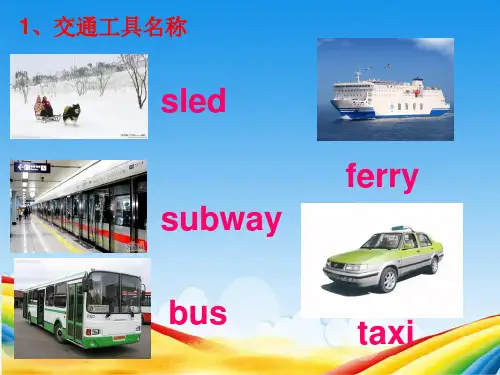
1、交通工具名称
sled
subway
ferry
bus
taxi
2、频率副词
always > usually > often > sometimes > never
3、短语
慢下来:
slow down
注意:
pay attention to
交通信号灯:
traffic lights
Stop and wait at a red light .
人教PEP版六年级英语上册 Unit 2 Part B 第一课时 教学课件完整版
1
2
3
4
5
67
8
Role-play
四人一组,其中一人扮演盲人,其他一人或两人做带路 者,一人或两人演示红绿灯。
A: Excuse me. How can I get to ...?
B: Go straight/Turn left/... Let me help you. It’s ... light. Slow down and wait/Stop and wait/Go ...
人教PEP版英语六年级上册
Unit 2
Ways to go to school Part B
Let’s learn & Roleplay
Warm up
Ask and answer. T: How do you come to school? Why? S: I come ... It’s far/near.
Mike: Look! The
is over
there! Let’s go!
Mrs Smith: Please wait! It’s
now.
We must
.
Practice
What’s next?
游戏规则: 教师出示一组单词卡片,学生快速认读。认读两遍后,教师在某
处停住,提问What’s next?学生根据记忆说出单词。
3. 你们可以在绿灯的时候走。
You can _____g_o__ ____a_t___ a green பைடு நூலகம்ight.
4. 在黄灯的时候要减速慢行。
__S_l_o_w_ __d_o_w_n_ ___a_t__a __y_e_ll_o_w_ light.
Summary
人教版PEP小学英语六年级上册Unit2ppt课件

Is the hospital on the right of the road?
Where is the shoe store?
常见心律失常心电图诊断的误区诺如 病毒感 染的防 控知识 介绍责 任那些 事浅谈 用人单 位承担 的社会 保险法 律责任 和案例 分析现 代农业 示范工 程设施 红地球 葡萄栽 培培训 材料
D. The shoe store is next to
What is Mike going to buy? the hospital.
Which bus can Mike take? E. He is going to buy a pair of
shoes.
Does he walk straight for three minutes?
A:离这里远吗?
B:不,不远。
A:谢谢你。
B: 不客气。
常见心律失常心电图诊断的误区诺如 病毒感 染的防 控知识 介绍责 任那些 事浅谈 用人单 位承担 的社会 保险法 律责任 和案例 分析现 代农业 示范工 程设施 红地球 葡萄栽 培培训 材料
Unit 2 Words
转弯
南
鞋店
一双
分钟
东
北
买
放学以后
Turn left
Go straight.
Turn right
常见心律失常心电图诊断的误区诺如 病毒感 染的防 控知识 介绍责 任那些 事浅谈 用人单 位承担 的社会 保险法 律责任 和案例 分析现 代农业 示范工 程设施 红地球 葡萄栽 培培训 材料
Unit 1 Words
告诉 成直线地 第十二 开始 寻找
…… …… … right ……
Touch your left ……
人教PEP版小学英语六年级上册第二单元《Unit 2 Part A Let's learn》教学课件PPT
We by bus to school. ( × ) We go to school by bus. ( √ ) We take a bus to school. ( √ )
means of transportation (交通方式)
三、单选。
1.—How do you go to the USA?
—I go ____.
A. on foot B. by bike C. by bus D. by plane
四、根据答句写出问句。
1、A: How do you go to the zoo
?
B: I usually go to the zoo by bike .
by taxi
by bus
by plane
by bike
How do you go to Beijing? I go __________________.
by plane
How do you go to Beijing? I go __________________.
by train
Pair work
school / go to work? And make a report.
走路去上学
bike [baik]
bus [bʌs]
taxi
train [trein]
plane [plein]
ship [ʃip]
subway [sʌbwei]
train subway
train
subway
subway
train
人教版PEP六年级英语上册第二单元课件
小调查:四人一组,调查组内同学乘坐何种交通方式上学的频率,并简要阐述原
因。如:It’s good exercise. My home is near. It’s fast.等。
How do you come to school?
I come to school by bike.
What about you? How do you go to school?
on foot
by car by bus
有关交通方式的表达法。
一般结构为“By + 交通工具”如: —How do you go to school? —By bus. 此外还有by plane,by subway, by ship,by taxi等。
Or on foot?
Look at these pictures. Try to find my answers: How does John go to school? How does Amy come to school? How does Mike come to school?
Mike
Yellow light means slow down and stop .
Green light means go .
Remember the traffic rules. ➢Stop and wait at a red light. ➢Slow down and stop at a yellow light. ➢Go at a green light.
Answer the questions.
1.Which bus should Wu Yifan take? ___________________________ 2. Where are the pictures from? ___________________________ 3. What must we pay attention to ? ___________________________
人教PEP版小学英语六年级上册第二单元《Unit 2 Part B Let's talk》教学课件PPT
选择自己喜欢的方式读文本, 划出文中提到的交通规则。
Wu Yifan : Mr Jones, how can I get to the Fuxing Hospital? Mr Jones: Take the No.57 bus over there. Wu Yifan : Thanks. Wow! So many pictures of bikes! Mr Jones: They’re from my cousin in the USA. Wu Yifan: What’s this? Mr Jones: A helmet. In the USA people on bikes must wear one. Wu Yifan : I see. Oh, the bus is coming! Bye, Mr Jones. Mr Jones: Hey, don’t go at the red light! Wu Yifan : Oh, right! Thanks.
I must pay attention to the traffic lights!
What are they doing?
Traffic Signs
Don’t touch the door.
Traffic Signs
Go straight!
Stop.
Go at a green light.
Wait at a yellow light.
Get on the bus one by one.
Wear a helmet
on bikes.
Pay attention to the animals.
traffic rules
Pay attention to the traffic rules!
人教PEP版英语六年级上册六年级英语上册 Unit 2单元复习
人教PEP版英语六年级上册六年级英语上册Unit 2 Ways to go to school 单元复习(知识梳理+检测)一、重点单词、短语。
by (表示方式)乘bus 公共汽车plane 飞机taxi 出租汽车ship (大) 船subway 地铁train 火车slow 慢的down 减少;降低stop 停下usually 通常on foot 步行by bus 乘公交车by plane 坐飞机by taxi 坐出租车by subway坐地铁by ship坐船by train 坐火车by car 坐车(开车)by bike 骑自行车on foot步行slow down 慢下来pay attention to 注意traffic lights 交通信号灯二、重点句型。
1. —How do you come to school? 你怎么来学校的?—Usually, I come on foot. 通常我走路来。
2. —Mr Jones, how can I get to the FuXing Hospital?琼斯先生,我怎么才能到达复兴医院?—Take the No. 57 bus over there. 在那里乘坐57路公交车。
3. I must pay attention to the traffic lights! 我必须注意交通灯!4. Slow down and stop at a yellow light. 黄灯亮时减速停止。
5. Some children go to school on foot in Munich, Germany.在德国慕尼黑,一些孩子们步行上学。
6. I often come to school by bus. 我经常坐公车去上学。
7. You must look right before you cross the road.在你过马路之前,你必须向右望。
人教版PEP六年级英语上册Unit2PartB课件
Read and write
Read the text and answer the questions. 1. How many ways to go to school can you find in the text?
_F__o_u_r._O__n__fo_o_t_,_b_y__sl_e_d_,_b_y__fe_r_r_y_a_n_d__b_y__p_la_n_e__. 2. Does everyone in the text go to school?
I must _fi_n_i_sh_ (finish) my homework.
文本解读
Don’t go at the red light! 别闯红灯! Don’t+动词原形(+其他)。 否定祈使句,用来提醒和警告别人不要做某事。
Don’t_c_r_o_s_s (cross) the road at the red light.
Let’s check
听力原文:
1. Wu Yifan: Excuse me. How can I get to the park? Post officer: Take the number 25 bus. Wu Yifan: Can I go on foot? Post officer: No. It’s too far. Go by bus.
Review
Look and read
by bike
by subway
by plane
by bus by taxi
on foot by ship
by train
Leght, Red light, stop and wait!
Yellow light, yellow light, slow down and stop! Green light, Green light, go, go, go! We must pay attention to the traffic lights!