
八年级英语上册 Unit 6 Go With Transportation阅读理解 (新版)冀教版
Go With Transportation
阅读理解。
(30分)
A
Mr. Perkin stood at the bus stop and watched the cars go by. Many of the cars were new Beta 400s, and most of them were yellow. Mr. Perkin always wore the same clothes as other men, ate the same food as other people, and did the same thing after work, and at the end of the week, Mr. Perkin did not like to be different.
The following week, Mr. Perkin bought a new, bright yellow Beta 400s. He was satisfied with (对……感到满意) it, and drove it to work the next day. He was even more satisfied with his new car, when he saw all the other Beta 400s, in front, behind, and on both sides of his.
Mr. Perkin parked his car in a big parking lot near his office. But when he came back at five o’clock, there were so many bright yellow Beta 400s in the parking lot that he did not know which car was his. He tried his key in some of the cars, but people passing by gave him a look he didn’t like. So he stopped.
The poor Mr. Perkin had to wait nearly two hours until there was only one yellow Beta 400s in the parking lot.
根据短文内容,选择最佳答案。
(10分)
1. Mr. Perkin wanted a new yellow Beta 400s because ______.
A. the bus did not come
B. he liked new clothes, food and cars
C. he liked to do the same thing as other people
D. he liked to be different from others
2. He drove to work in his new car ______.
A. the next day
B. the day he bought it
C. the next week he bought it
D. on the day he first watched the cars passing
3. He was satisfied with his new car because ______.
A. no one else had a yellow one
B. it was the same as other cars all around him
C. he was in front of all the other cars
D. other cars were not as bright as his
4. People gave him a look because ______.
A. he had a nice new car
B. he could not open the door of his car
C. he was in the wrong parking lot
D. he was thought a thief
5. Mr. Perkin had to wait until ______.
A. there was only one yellow Beta 400s in the parking lot
B. there was only one red car in the parking lot
C. there were two green yellow cars in the parking lot
D. there was no one looking at him
B
In the past, many people liked travelling by bus. All passengers had to buy tickets. There was a bus-conductor in each bus. He collected money from the passengers and sold the tickets. But now passengers put their money in a box instead.
In the past, there were only single-decker (一层) buses. None of them was double-decker bus.
In the past, travelling by bus was not very comfortable, because there were no air-conditioners in the buses. Nowadays, most buses have air-conditioners. Most of the bus-drivers were men before, but now some of them are women.
根据短文内容,判断下列句子正(T)、误(F)。
(10分)
6. In the past, all passengers had to buy tickets.
7. Now passengers needn’t pay to take a bus.
8. Now there are double-decker buses.
9. In the past, taking a bus wasn’t very comfortable, because there were so many people in it.
10. Few women were drivers before.
C
阅读下面短文,把A—D四个句子分别填入文中空缺处(51—54),使短文完整、正确,然后完成第55题。
In a lot of cities, hundreds of people ride bikes to work every day. __11__ They believe that if more people rode bikes to work, there would be fewer cars in the city and there would be less dirty air from cars.
__12__ For example, they want the city to paint special lanes—for bikes only —on some of the main streets. Because when bike riders use the same lanes as cars, there may be accidents. “Bikes for a Better City” feels that if there are special lanes, more people will use bikes.
But no bike lanes have been set aside yet. __13__ Taxi drivers don’t like the idea—they think it will slow the traffic. Some store owners on the main roads don’t like the idea—they say that if there is less traffic, they will have less business. __14__
11. ________ 12. ________ 13. ________ 14. ________
15. Which is the best title for the passage?
A. Americans like bikes
B. Different ideas about bikes for a better city
C. Bikes are better than cars
D. Bike riders in cities
【答案】:
A. 1—5 CABDA
B. 6—10 TFTFT
C. 11—15 CADBB。
八年级英语上册 Unit 6 Go with Transportation复习讲义 冀教版-精品

03 语法集训
考点二:要特别注意下列含有不定式的句式或结构。
It+be+adj.+of+sb.+to do sth.意为“某人做某事 是……的。”这些形容词通常是表示主观感情或人物性 格的形容词。如:good,kind,nice,wise,clever, foolish,right 等。
03 语法集训
13.All the Chinese people must work hard __A______ China Dream.
A.to realize B.realize
C.realizing
14.Tony,remember ____B____ with your mouth full of food.
Unit 6 Go with Transportation!
Review
C目录 ONTENTS 01 单元复习目标 02 单元词汇听写 03 单元语法集训 04 单元要点训练 05 单元实战演练
01 复习目标
1
熟记本单元的重点词汇,短语和句型
2
熟练掌握动词不定式的用法
02 词汇听写
同学们,本单元的单词你们都掌握了吗? 现在大家来检验一下,点击下面的音频开始听写吧!
03 语法集训
It+be+adj.+for+sb.+to do sth.意为“对某人来说干某事真 是太……了。”这里的形容词通常是表示客观情况的形容词。 如:easy,hard,difficult,important,impossible 等。 eg:It was difficult for him to finish the work on time.
八年级英语上册Unit6GoWithTransportation拓展阅读新版冀教版(含答案)

八年级英语上册拓展阅读:阅读文章Man always wanted to fly in the sky. They watched birds flying and wished they could fly, too. Man made wings and tied (绑) them on their bodies to help them fly. But they failed again and again. Man knew how to make kites. They made different kinds of kites and tried to fly with the help of them. But unluckily, many of them were badly hurt.So they had to stop trying to fly with wings.In 1783, two Frenchmen found hot air was lighter than cold air. They then builta balloon. They filled it with hot air and it went up into the air. The next year abig hotair balloon carried 7 persons to a height of 900 metres.Later, airships (飞艇) were made in the world. It could fly up into the sky with the help of hydrogen gas. The hydrogen gas caught fire very easily. At last people stopped making airships.Now, people can travel to different places by plane. It's very convenient and fast.Rockets are also known all over the world. Rockets can help people travel in space.The dream of flying to space has become true.试着做一做1.Man made wings because ________.A.they wanted to be birdsB.they wanted to make kitesC.they wanted to fly in the skyD.they wanted to fly with kites2.Many people tried to fly with the help of kites ________.A.but failed again and againB.but were badly hurtC.and could fly to a height of 900 metresD.and could fly up into the sky3.The underlined word “filled” means ________.A.混合 B.搭配 C.充满 D.连接4.Hydrogen gas was ________ so people stopped making airships.A.not safe B.too expensiveC.not easy D.too heavy5.People can travel to space with the help of ________.A.planes B.airshipsC.hotair balloons D.rockets答案1.C 点拨:细节理解题。
冀教版初中英语八年级上册Unit 6 Go With Transportation !word教案
免费下载网址/Unit 6 Go with Transportation!Lesson 31 How Do You Travel?Learning aims:1. Learn the information about the transportation.2. Know the transportation history and what the future transportation will be like.Learning important and difficult points:1. How many types of transportation are there in the world?2. Talk about all kinds of transportation.Learning tools:audiotape, flashcards, picturesLearning steps:Step 1. Leading inAsk the students to discuss the questions:How do you come to school every day? Why?S1: I come to school on foot because my home is near the school.S2: I come to school by bike because I ride my bike well.S3: I come to school by bus because my home is far away from school.Step 2. Talking aboutLet the students talk about the questions:1. What do you take if you go on a trip to Beijing? Why?2. Can you describe your favourite trip to the class?Step 3. ReadingRead the text quickly and check the answers. Then read the text again and repeat after it.After a while, ask some students to read the text loudly in roles.Step 4. PracticeDiscuss the following question:1. What are the advantages and disadvantages of the transportations?2. If you go on a trip, where would you like to go?3. How will you go there?Let the students work in groups of three of four. After a while, present their answers to the class.Step 5. Come to “LET’S DO IT.”Ask the students to talk in the class. Then they can give their presentation in dialogues or in composition. Encourage them to report one by one.Step 6. Homework1. Finish off the activity book.解压密码联系qq 1119139686 加微信公众号jiaoxuewuyou 九折优惠!淘宝网址:2. Review Lesson 32.Lesson 32 Trains Go Faster!Learning aims:1. Know about the train history.2. What will the future train be like?Learning important and difficult points:1. The invention of the steam engine, the first steam locomotive, railways and the first passenger.2. Who invented the inventions and when did they invent them.Learning tools:audiotape, flashcards, picturesLearning steps:Step 1. Leading inLet the students talk in groups about the question:“How do you usually travel to other cities?”After discussing for a while, the students make a report to the class.Step 2. Let the students read the text then answer how is the text arranged.Step 3. Listen to the tapeAfter repeating the text for several times, ask them to retell the story in their own words. Step 4. Let the students talk more about the trainsThey may talk about their experience on trains. They also may talk about the structure of the trains, the use of the trains and the future of them.Step 5. Homework1. Finish off the activity book.2. Preview Lesson 33.Lesson 33 Life on WheelsLearning aims:1. Learn the history of the cars.2. Describe one type of transportation in the future.Learning important and difficult points:1. Learn about the Danny wheels.2. Imagine what types of transportation will be like from one hundred years now.Learning tools:audiotape, flashcards, picturesLearning steps:Step 1. TalkingLet the students talk about something about the planes and the cars. What do they know aboutthe planes and the cars? If they know, let them say their details.Step 2. AskingAsk the students to talk about the picture in the text. What do they think about this? Step 3. Let’s listen to the tape and answe r the following questions:Step 4. ReadingRead the text and check the answers. Then let the students read it loudly in class. Aftera while, ask the students read the text in roles.Step 5. ActionLet students act out the dialogue. They can take a circle for Danny’s wheel.Step 6. Ask some students to make sentences with the following phrases:At that time, need to, present, you’d better not.At that time, I was a little girl.You need to wear warm clothes in cold winter.Present your invention to the class.You’d better say it again.Step 7. HomeworkWrite a letter to your friend in English.Lesson 34 Flying DonutsLearning aims:1. Stimulate students’ learning interests.2. Cultivate students’ listening by catching the useful information in the listenin g process. Learning important and difficult points:1. Encourage students’ to increase creative ability.2. Why is the invention called “flying donuts”?Learning tools:audiotape, flashcards, picturesLearning steps:Step 1. Play a gameLet some students explain it in English, while the others guess what it is. You must say the transportation. Such as:A transporter is very long. It can hold many people in it. It can also take goods. Whatis it?Step 2. Listen to the tape and answer the following questions:1. What is Danny’s invention made of?2. Why is it called “Flying Donuts”?3. Will Danny’s invention really work?Step 3. ReadingRead the text and check the answers. Then listen to the tape again and read after it for several times.Step 4. AskingAsk the students to read the text in roles. Then act the dialogue in front of the class. Step 5. PracticeMake sentences with the following language points: on the way to school, turn on, at the front ofStep 6.Homework1. Finish off the activity book.2. Preview Lesson 35.Lesson 35 Future TransportationLearning aims:1. Review words and phrases for transportation that the students learned before.2. Encourage the students to find and restate information in personal and imaginative ways. Learning important and difficult points:1. How do you demonstrate your invention?2. Learn about the use of Modal Verbs.Learning tools:audiotape, flashcards, picturesLearning steps:Step 1. Leading inLet the students answer the questions and discuss them in pairs.Step 2. Listen to the tape and answer the following questions:1. What type of transportation would Sam like to see in the future?2. What would a hoverboard be like?3. What types of transportation are in this text?Step 3. ReadingRead the text and check the answers. Then play the tape for several times. Let the students repeat after it for several times.Step 4. AskingAsk the students to have a reading content. Divide the class into several groups. Each group chooses one person every time. The one reads bes t can get a star. Let’s have a compete to see which group will have the most stars.Step 5. TalkingDivide the class into several groups. Ask them to talk the future transportation that theywould like to see. Use the words and the expressions that we learn in this unit.Step 6. Homework1. Finish off the activity book.2. Preview Lesson 36Lesson 36 Clean Cars?Learning aims:1. Learn about the words and expressions about the transportation.2. Know about the development of the transportation.Learning important and difficult points:1. Grasp the modal verbs2. Talk about the possibility and impossibility.3. Modal VerbsLearning tools:audiotape, flashcards, drawingsLearning steps:Step 1. Leading inTalk about the questions: “What we want to see in t he future? Yesterday we leave this as our project. Can you show it to the class now?”Then let the students show their drawings to the class. Ask the students to explain their invention in English to the class.Step 2. Listen to the tape and answer the following questions:1. What did the teacher ask us to think about?2. What is Jenny’s invention?Step 3. ReadingRead the text silently and check the answers. Let the students discuss the main idea of the passage in details.Step 4. ListeningListen to the tape again. Then let the students tell the main idea in their own words. Step 5. TalkingTalk about Jenny’s invention. What do you think of her idea? Can you give her any good ideas?Step 6. Homework1. Finish off the Ss workbook.2. Finish off the exercises in Unit Review.Unit ReviewLearning aims:1. Know about the history of some transporters.2. Learn about the development of the future transportation.Learning important points:1. Giving Advice/Order.2. Possibility and Impossibility.Learning difficult points:Modal VerbsLearning aids:audiotape, flashcards, picturesLearning steps:Step 1. TalkingTalk about the way of coming to school. Ask the students the questions:1. How do you come to school? Why?2. How many students in the class come to school by bike, by bus or on foot?Make a chart to show the information.Step 2. Talk about the main idea of this unitWhat advantages and disadvantages do the following transporters have? What do you do with the disadvantages? What’s your good opinion?Step 3. Think about the main ideas of this unitLet the students say it in details. Talk about what would they like to see in the future about the transportation?Step 4. Come to the exercisesEncourage the students to ask questions and discuss them on the blackboard.Step 5. PracticeLead the students to talk about the Modal Verbs. Make sentences with can, could, would, may and might.Step 6. Come to the “Speaking the Language”Step 7. Come to the activity bookStep 8. Do some review activities。
八年级英语上册 Unit 6 Go With Transportation Lesson 31 Ho
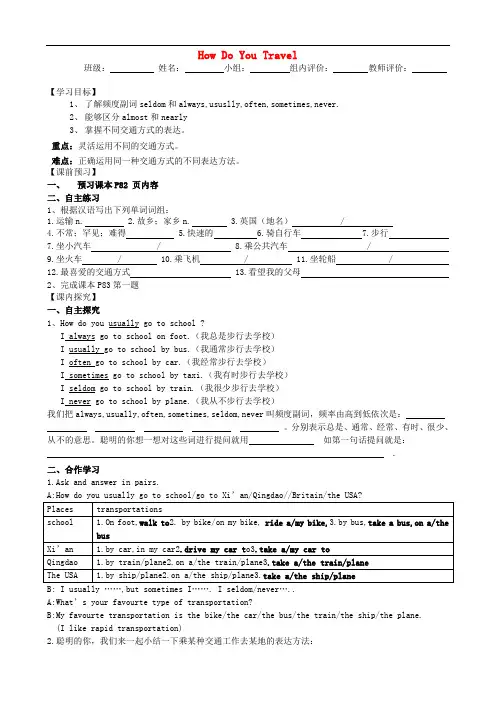
How Do You Travel班级:姓名:小组:组内评价:教师评价:【学习目标】1、了解频度副词seldom和always,ususlly,often,sometimes,never.2、能够区分almost和nearly3、掌握不同交通方式的表达。
重点:灵活运用不同的交通方式。
难点:正确运用同一种交通方式的不同表达方法。
【课前预习】一、预习课本P82 页内容二、自主练习1、根据汉语写出下列单词词组:1.运输n.2.故乡;家乡n.3.英国(地名) /4.不常;罕见;难得5.快速的6.骑自行车7.步行7.坐小汽车 / 8.乘公共汽车 / 9.坐火车 / 10.乘飞机 / 11.坐轮船 / 12.最喜爱的交通方式 13.看望我的父母2、完成课本P83第一题【课内探究】一、自主探究1、How do you usually go to school ?I always go to school on foot.(我总是步行去学校)I usually go to school by bus.(我通常步行去学校)I often go to school by car.(我经常步行去学校)I sometimes go to school by taxi.(我有时步行去学校)I seldom go to school by train.(我很少步行去学校)I never go to school by plane.(我从不步行去学校)我们把always,usually,often,sometimes,seldom,never叫频度副词,频率由高到低依次是:。
分别表示总是、通常、经常、有时、很少、从不的意思。
聪明的你想一想对这些词进行提问就用如第一句话提问就是:.二、合作学习1.Ask and answer in pairs.A:What’s your favourte type of transportation?B:My favourte transportation is the bike/the car/the bus/the train/the ship/the plane.(I like rapid transportation)2.聪明的你,我们来一起小结一下乘某种交通工作去某地的表达方法:(1)步行去某地: =(2)骑自行车去某地: = =(3)乘其它交通工作去某地: = =同学们请注意:1、by直接加交通工具的单数;2、on/in加冠词(a/an/the)/形容词性的物主代词再加交通工具单数。